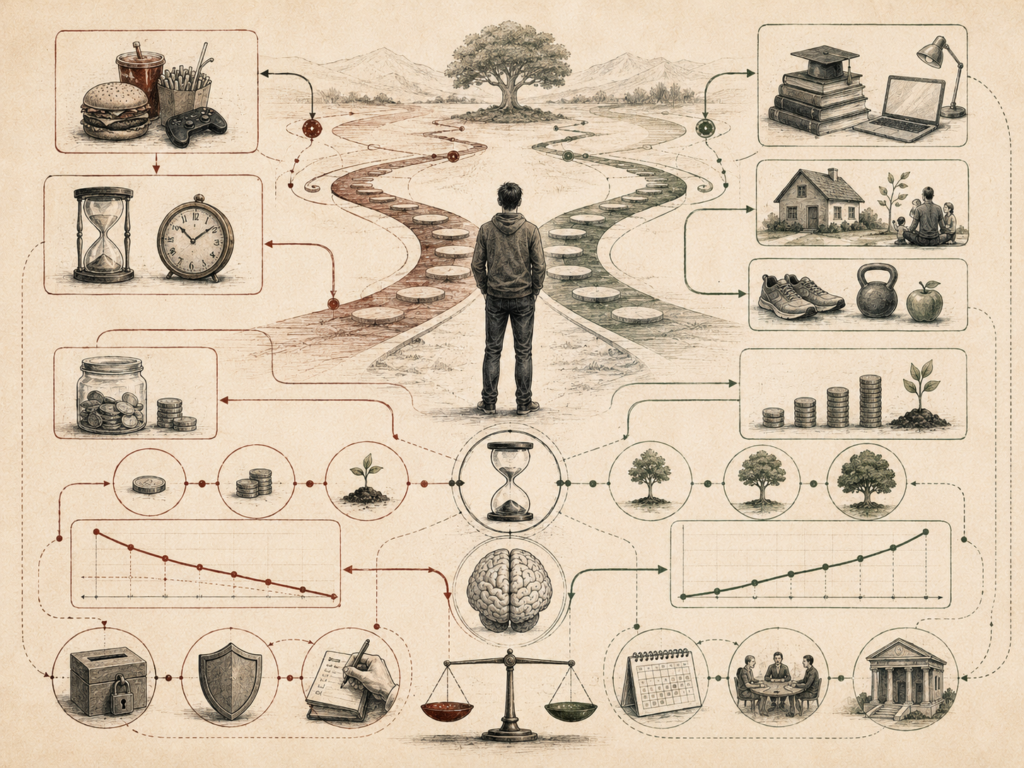
Time Discounting and Long-Term Decision-Making
Time discounting refers to the tendency to value present rewards more highly than equivalent rewards in the future, shaping how individuals make choices across savings, consumption, education, health, and long-term planning. This article explains how behavioral economics expands the standard concept of discounting by showing that real people often discount the future more steeply and less consistently than classical models assume, especially when immediate rewards become available. It explores the distinction between standard discounting, hyperbolic discounting, and present bias, while also examining the implications for economic behavior, sustainability, and policy design. The broader argument is that time discounting is not just a technical matter of present value calculation, but a central behavioral mechanism through which short-term incentives repeatedly undermine long-run welfare.