
Last Updated May 25, 2026
Herd behavior in financial markets refers to the tendency of investors, traders, institutions, analysts, and market participants to follow the actions, expectations, or visible positioning of others rather than relying solely on independent valuation, private information, or fundamental analysis. Behavioral finance treats herding as a core mechanism through which collective psychology can shape asset prices, amplify volatility, intensify bubbles, accelerate crashes, and transform uncertain information environments into self-reinforcing market movements.
Herd behavior is not simply irrational crowd-following by unsophisticated investors. In many financial settings, imitation can appear individually reasonable. When private information is noisy, fundamentals are difficult to interpret, prices move quickly, and other participants may possess superior information, observing what others do becomes a meaningful signal. Fund managers also face reputational pressure, benchmarking incentives, client scrutiny, and career risk when they diverge from consensus. Retail investors face social media narratives, platform cues, fear of missing out, and rapidly visible price momentum. Under these conditions, following the crowd can be individually defensible while collectively destabilizing.
Main Library
Publications
Article Map
Behavioral Economics
Related Topic
Economic Systems
Related Topic
Risk & Resilience
Related Topic
Data Systems & Analytics
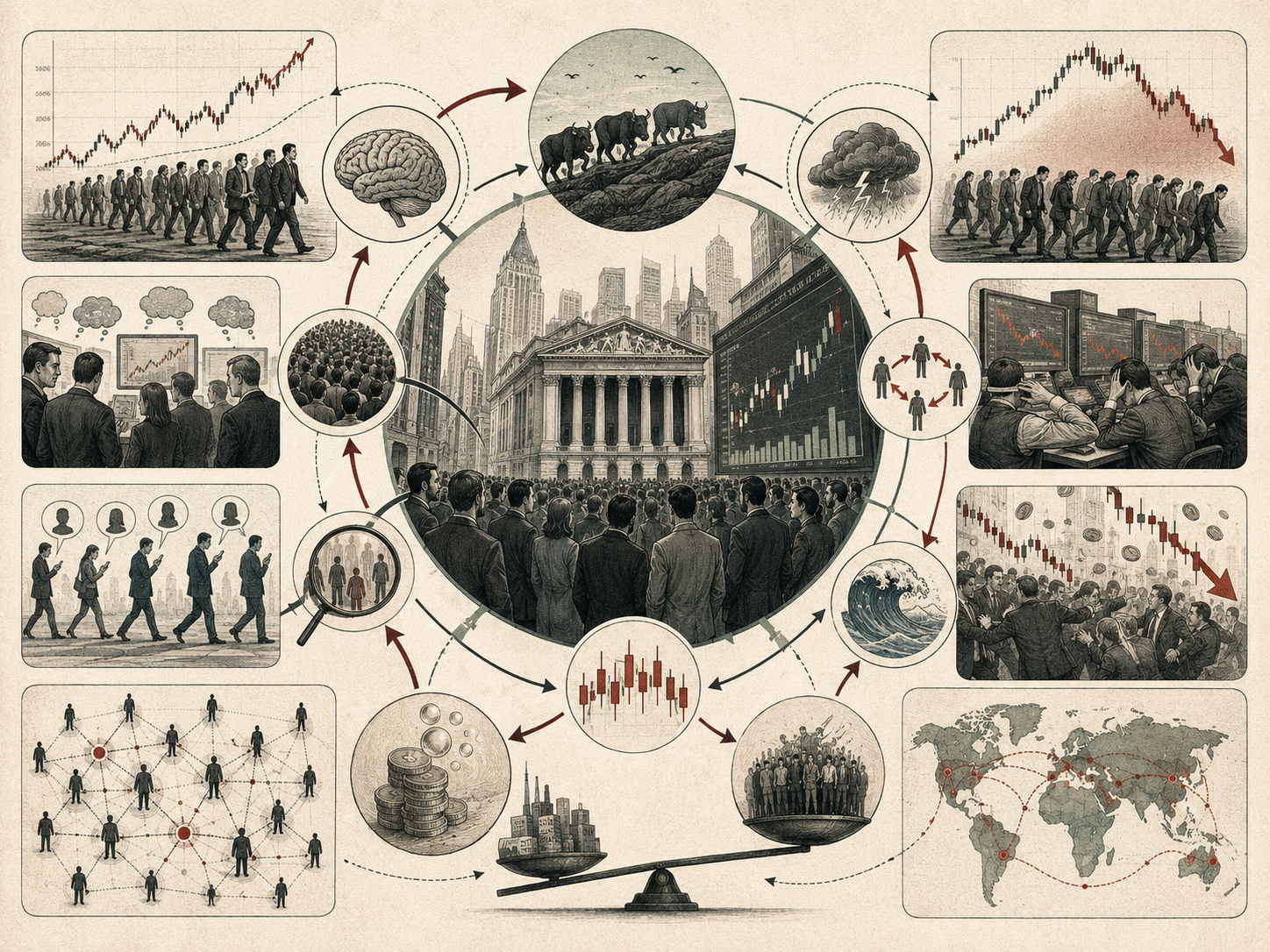
Herding matters because financial markets are not only mechanisms for aggregating dispersed information. They are also social, institutional, technological, and psychological environments in which information is interpreted through the behavior of others. Prices are not merely outputs of valuation; they can become inputs into belief. A rising price may be treated as evidence that others know something. A widely held position may be treated as validation. A consensus narrative may become safer to repeat than to challenge. These dynamics can detach asset prices from fundamentals and produce collective vulnerability.
The problem becomes especially important in markets where liquidity, leverage, benchmarking, algorithmic trading, passive flows, social platforms, and real-time sentiment interact. Herding can appear as synchronized buying, momentum chasing, crowded trades, correlated liquidation, benchmark hugging, index concentration, meme-stock surges, crypto cycles, bank-run dynamics, or institutional retreat from an asset class. A serious behavioral-finance account must therefore connect individual cognition with market structure, institutional incentives, technological mediation, and financial stability.
What Herd Behavior Means in Financial Markets
Herd behavior occurs when investors condition their choices on the observed or inferred behavior of other investors to such a degree that independent analysis becomes weakened, displaced, or strategically subordinated. This can happen through direct observation of trades, price movement, analyst consensus, fund flows, media narratives, institutional positioning, social media attention, or visible peer behavior. The central issue is not simply that many investors make the same decision. The issue is whether their decisions become mutually reinforcing because each actor treats others’ behavior as evidence.
Not every clustered trade is herding. Investors may independently reach similar conclusions because they observe the same fundamentals, react to the same policy announcement, or use similar valuation models. True herding implies social dependence or informational dependence across decisions. An investor buys not only because the asset appears undervalued, but because others are buying. A fund manager avoids a contrarian position not only because it seems risky, but because being wrong alone is reputationally more dangerous than being wrong with the crowd. A retail trader joins a surge not only because of valuation, but because momentum, visibility, and community enthusiasm make participation feel validated.
Herding can be intentional or unintentional. Intentional herding occurs when investors consciously follow others because they believe the crowd has information, because they want to avoid reputational risk, or because they expect price momentum to continue. Unintentional herding occurs when many participants respond to similar signals, rules, models, constraints, or platform cues in ways that create synchronized action. Passive indexing, risk-parity rebalancing, stop-loss rules, margin requirements, and common factor models can produce herding-like outcomes even when no actor explicitly imitates another.
Behavioral finance treats herding as important because it demonstrates how market-level instability can emerge from individually understandable behavior. A single investor who follows the crowd may reduce personal uncertainty or career risk. But when many investors do the same, prices can become less anchored to fundamentals, liquidity can become fragile, and reversals can become synchronized. This is one of the clearest examples of how micro-level behavior can scale into macro-level financial risk.
Herd behavior is closely related to Behavioral Finance and Investor Psychology, Overconfidence Bias in Financial Markets, Loss Aversion and Risk Perception, Availability Bias and Economic Perception, and Behavioral Economics and Digital Platforms. Its distinctive contribution is to explain how individual judgment becomes socially coordinated through imitation, perceived consensus, reputation, and feedback from prices themselves.
The Psychology of Herd Behavior
Several psychological mechanisms help explain why herding appears so frequently in financial markets. The first is uncertainty. When investors face ambiguous information, noisy signals, complex instruments, rapid news cycles, or unfamiliar technologies, they may look to the behavior of others as a substitute for confidence. The crowd becomes a source of reassurance. If many people are buying, perhaps they know something. If many analysts are bullish, perhaps dissent is reckless. If a price keeps rising, perhaps the market has discovered value that private analysis missed.
The second mechanism is social proof. People often infer correctness from popularity, especially when the decision environment is difficult to evaluate independently. In finance, this can be especially dangerous because the popularity of a trade can itself move prices, making the trade appear more correct in the short run. A rising price becomes evidence that the crowd was right, which attracts additional buyers, which pushes the price higher. The signal and the outcome become entangled.
The third mechanism is fear of missing out. Investors may enter positions not because they believe valuation is compelling, but because the psychological cost of watching others profit becomes too difficult to tolerate. This is especially powerful in bull markets, crypto cycles, speculative technology surges, housing booms, and highly visible retail trading episodes. The more public the gains appear, the more painful nonparticipation becomes.
The fourth mechanism is regret avoidance. Investors may prefer a conventional error to an unconventional one. Losing money in a widely held asset can feel less personally blameworthy than missing a widely celebrated rally or losing money in a contrarian position. This is one reason herding persists among sophisticated actors. The psychological and reputational cost of being wrong alone may exceed the cost of being wrong with peers.
Herding also interacts with other behavioral biases. Overconfidence can lead investors to interpret confirming crowd behavior as proof that their position is correct. Confirmation bias can make investors selectively attend to social signals that support the dominant narrative. Availability bias can make recent price increases or widely shared stories feel more representative than they are. Loss aversion can intensify synchronized selling once the crowd reverses. Herding is therefore not a single isolated bias. It is a behavioral pattern produced by uncertainty, social influence, reputational concern, salience, and asymmetric emotional response to gains and losses.
Private Information, Public Signals, and Social Learning
Financial markets are often described as information-processing systems. Investors receive private signals, observe public information, and make trades that contribute to price discovery. Herd behavior complicates this view because public action can become mistaken for independent information. If many investors buy a stock, later investors may infer that the earlier buyers possessed strong signals. But if those earlier buyers were themselves imitating others, the apparent information content of the crowd may be much weaker than it appears.
This distinction is crucial. Markets can aggregate information effectively when participants act on independent signals and prices reflect the synthesis of dispersed knowledge. Markets become more fragile when visible behavior is repeatedly reinterpreted as information even though the behavior itself is socially dependent. In that case, prices may reflect chains of inference rather than independent valuation.
Social learning can be useful. Observing others can help investors learn when others genuinely possess better information or expertise. Analysts, short sellers, institutional investors, insiders, market makers, and specialized researchers may reveal information through their actions. The difficulty is that outside observers often cannot distinguish informed action from imitation, noise trading, liquidity-driven trading, mechanical rebalancing, or speculative momentum. The same observable behavior can have multiple causes.
This is why herd behavior is not simply a failure of intelligence. It is a response to information asymmetry. If an investor believes others may know more, imitation can be rational from the individual point of view. The problem arises when many actors reason this way simultaneously. Once public action is overinterpreted, the market can move on the appearance of information rather than information itself.
Public signals also carry social and institutional meaning. Analyst upgrades, media coverage, price targets, fund-flow data, social media attention, volatility spikes, and trading volume can all become signals about what others believe. Some signals are informative; others are performative. Behavioral finance is concerned with how investors interpret these signals under pressure and how those interpretations feed back into price movement.
Informational Cascades
One of the most influential theoretical explanations of herd behavior is the informational cascade. In a cascade, later decision-makers rationally ignore part or all of their private information because the observed actions of earlier actors appear more informative than their own signals. Once enough actors move in one direction, imitation becomes self-reinforcing. The original cascade may begin with weak evidence, but the sequence of observed actions gives it growing social force.
The classic insight of cascade theory is that large collective movements can arise from small initial signals. A few early actors may buy based on limited or noisy information. Later actors observe their buying and infer that the early buyers may know something. As more investors join, the apparent strength of the signal grows. Eventually, even investors with contrary private information may choose to follow the crowd because the accumulated public action appears stronger than their private signal.
This mechanism is especially relevant in financial markets because actions are visible and sequential. Investors observe prices, volume, flows, filings, analyst revisions, social media discussion, and peer behavior. They rarely observe the true quality of the underlying information that produced those actions. This creates fertile ground for cascades: the action is public, but the reason for the action is often ambiguous.
Cascades are fragile because they can reverse quickly. If the crowd’s behavior is based on inference rather than strong fundamentals, new information can destabilize the entire sequence. A disappointing earnings report, regulatory action, liquidity shock, margin call, analyst downgrade, or narrative shift can cause investors to reinterpret the crowd. The same social mechanism that supported buying can support selling.
Informational cascades also explain why markets may sometimes appear confident and fragile at the same time. A dominant consensus can look strong because many actors are aligned. But if that alignment is based on imitation rather than independent conviction, the market may be vulnerable to abrupt reversal. Apparent consensus is not always evidence of deep information. It may be evidence of social dependence.
Reputation, Career Risk, and Institutional Herding
Herding is not limited to retail investors or emotionally driven traders. Institutional investors may herd because of reputation, benchmarking, career incentives, and principal-agent problems. Fund managers are often evaluated relative to peers, benchmarks, and short-term performance windows. Under those conditions, deviating from consensus can be costly even when a manager privately doubts the consensus.
The logic is straightforward. If a manager follows the crowd and loses money, the loss may be interpreted as a market-wide event. If the manager deviates from the crowd and loses money, the loss may be interpreted as individual incompetence. Failing conventionally can be safer than failing unconventionally. This creates career incentives to hold crowded positions, avoid contrarian trades, and remain close to benchmarks.
Analysts face similar pressures. Publishing a view far outside consensus can damage reputation if it proves wrong, while a consensus forecast may be easier to defend. Investment committees, pension funds, endowments, consultants, and risk officers may also reinforce conformity by requiring justification for deviation but not for consensus. Over time, institutional processes can make herd behavior appear prudent.
Benchmarking intensifies the problem. If institutional performance is judged relative to an index, managers may avoid underweighting large benchmark constituents even when valuations appear stretched. This can contribute to crowded positioning in dominant sectors or mega-cap firms. Passive flows can further amplify concentration when market-cap weighting directs more capital toward assets whose prices have already risen.
Institutional herding therefore demonstrates that market psychology is embedded in organizational structure. Herding is not merely a cognitive bias inside individual minds. It is often produced by compensation systems, performance evaluation, client expectations, risk models, committee governance, consultant advice, and reputational accountability. Financial markets are social institutions as well as information systems.
Herd Behavior and Market Bubbles
Herd behavior is often associated with speculative bubbles because collective optimism can create feedback loops between price appreciation and investor demand. As asset prices rise, those increases may be interpreted as confirmation that other investors see real value or that further gains are likely. More buyers enter, pushing prices still higher. In that process, price becomes both an outcome and a signal.
This price-as-signal dynamic is central to bubble formation. In a stable valuation environment, investors evaluate price relative to expected cash flows, earnings, dividends, productive value, or future utility. In a bubble environment, the price increase itself becomes part of the investment case. Investors buy because prices are rising, and prices rise because investors buy. Narrative, visibility, and social validation can then substitute for fundamental discipline.
Bubbles often involve more than simple optimism. They are usually supported by stories. New technology, financial innovation, policy support, scarcity narratives, demographic shifts, platform communities, or claims of a “new era” can make rising prices feel justified. Herding spreads and stabilizes these stories. The more widely the narrative is repeated, the more difficult it becomes to challenge. Skepticism may appear out of touch until the reversal has already begun.
Herd behavior also changes risk perception during bubbles. As more actors participate and prices continue rising, perceived risk may decline even though objective risk increases. Investors may conclude that widespread participation itself reduces risk, or that liquidity will remain available because so many others are involved. But crowded trades can become least liquid precisely when many actors attempt to exit together.
Not every bubble is caused by herd behavior, and not every herd produces a bubble. Credit conditions, leverage, monetary policy, regulatory gaps, financial innovation, and real economic expectations also matter. Herding is best understood as an amplification mechanism. It can take a story, signal, or valuation shift and turn it into a market-wide movement whose scale exceeds the underlying evidence.
Herding, Loss Aversion, and Synchronized Market Reversals
The same mechanisms that support herd-driven booms can accelerate herd-driven crashes. When prices begin to fall, investors observe not only their own losses but the actions of others. Selling by others can be interpreted as evidence that risks are worse than previously understood. If investors believe others may be exiting with superior information, the incentive to sell increases. The crowd becomes a warning signal.
Loss aversion intensifies this process. Prospect theory shows that losses often loom larger than gains. Once investors shift from paper gains to losses, their emotional and behavioral response may become sharper. Some investors sell to avoid further pain. Others hold too long and then capitulate. Institutions may sell because risk limits, margin requirements, redemptions, or volatility triggers force action. In each case, individual responses can become synchronized.
Liquidity is crucial. During rising markets, liquidity often appears abundant because buyers are plentiful. During reversals, liquidity can vanish because many actors want to sell at the same time. If a position is crowded, the exit is crowded too. Price declines can then become nonlinear: small shocks produce large moves because the market structure cannot absorb synchronized selling.
Herding can also create feedback between volatility and risk management. Many institutional systems reduce exposure when volatility rises. If volatility rises because some investors sell, risk models may instruct others to reduce exposure, which increases selling pressure and volatility further. This dynamic is not purely psychological; it is also mechanical. But its effect resembles herding because common rules produce common behavior.
Market crashes therefore reveal the systemic dimension of herding. The problem is not only that investors panic. It is that shared narratives, crowded positions, leverage, liquidity constraints, and risk-management rules can align investor behavior at precisely the moment when diversity of action would stabilize the system.
Digital Platforms, Social Media, and Retail Herding
Digital platforms have transformed the speed, visibility, and emotional intensity of herd behavior. Online brokerages, financial news feeds, trading apps, social media communities, influencer commentary, recommendation algorithms, push notifications, trending tickers, leaderboards, livestreams, and short-form video can all make market participation more immediate and socially visible. The result is a financial environment in which crowd signals are constantly displayed.
This does not mean digital platforms cause all herding. But they can amplify herding by increasing salience. Investors can see what is trending, what others claim to be buying, which assets are moving, which narratives are spreading, and which communities are celebrating gains. Market participation becomes performative as well as financial. Buying an asset can become a social identity signal, a community act, or a visible stance against perceived institutions.
Platform design can also alter decision environments. Frictionless trading, gamified interfaces, instant account opening, real-time alerts, confetti-like reward cues, simplified charts, social feeds, and default watchlists can increase trading frequency and make short-term price movement more salient. The user may experience the market less as a valuation problem and more as a stream of opportunities, signals, and social proof.
Retail herding became especially visible in meme-stock and crypto episodes, where online communities, viral narratives, and platform access interacted with market mechanics. These episodes should not be dismissed as irrational noise. They reveal how financial markets now incorporate networked communication, identity, distrust of institutions, algorithmic visibility, and collective action. Herd behavior in digital markets is often part investment, part narrative, part social coordination, and part platform-mediated behavior.
This topic connects naturally to Behavioral Economics and Digital Platforms and Behavioral Design in Technology Systems. Modern herding is not only a problem of investor psychology. It is also a problem of information architecture.
Market Microstructure, Liquidity, and Crowded Trades
Herd behavior must also be understood through market microstructure. Prices move through order books, liquidity provision, bid-ask spreads, market depth, leverage, execution algorithms, margin requirements, and institutional flows. When many participants move in the same direction, the structure of liquidity determines whether herding produces gradual price adjustment or abrupt dislocation.
Crowded trades are especially vulnerable. A crowded trade exists when many investors hold similar positions or depend on similar assumptions. The danger is not merely that many investors agree. The danger is that they may need to exit under similar conditions. If investors are leveraged, benchmark-sensitive, volatility-constrained, or subject to redemptions, a negative shock can trigger forced selling. When everyone tries to leave through the same door, prices can gap.
Liquidity can be endogenous. It appears plentiful when participants are comfortable, volatility is low, and prices are rising. It can disappear when uncertainty rises and market makers widen spreads or reduce exposure. Herding can therefore create a false sense of liquidity during accumulation and a liquidity shortage during liquidation. This is one reason financial stability analysis must consider positioning, leverage, and liquidity together.
Algorithmic and quantitative strategies can contribute to herding-like dynamics when they respond to similar signals or risk triggers. Momentum strategies may buy assets that have already risen. Volatility-targeting strategies may reduce exposure when volatility rises. Trend-following systems may reinforce existing movement. Passive flows may allocate more capital to assets whose market capitalization has grown. These processes are not psychological in the ordinary sense, but they can produce synchronized behavior that interacts with human herding.
The microstructure lens shows why herding is not only about beliefs. It is about the translation of beliefs into trades under constraints. Herding becomes systemically important when imitation, crowded positioning, leverage, and fragile liquidity combine.
Implications for Financial Stability
Understanding herd behavior has major implications for financial stability, macroprudential supervision, risk management, and market governance. Herding can increase systemic vulnerability by concentrating exposure, weakening informational diversity, amplifying asset-price misalignment, and producing synchronized liquidation. It can make markets appear stable during the buildup and unstable during the unwind.
For regulators and central banks, herding matters because it can turn local shocks into system-wide stress. If many institutions are exposed to the same asset class, funding structure, model assumption, or liquidity condition, a price decline can propagate through margin calls, redemptions, collateral constraints, and risk limits. The result can be market contagion even when the initial shock is modest.
Sentiment monitoring is therefore not superficial. Market narratives, positioning data, leverage, fund flows, volatility, retail participation, options activity, short interest, liquidity depth, and social media intensity can all help identify environments where herding risk is rising. No single indicator is sufficient, but together they provide evidence about whether market behavior is becoming excessively synchronized.
Financial stability also depends on diversity of strategy. Markets are more resilient when participants have different time horizons, risk constraints, information sources, and valuation frameworks. Herding reduces that diversity. If everyone relies on the same benchmark, model, narrative, or momentum signal, the system becomes more fragile. Diversity of belief and horizon is not merely intellectual variety; it is a stabilizing market feature.
Behavioral finance therefore matters for governance because it connects investor psychology with systemic risk. Herd behavior shows how market instability can arise not only from bad assets, poor regulation, or leverage, but from the social dynamics of belief formation and imitation under uncertainty.
Regulatory, Institutional, and Risk-Management Implications
Regulation cannot and should not attempt to eliminate all herding. Some correlated behavior is unavoidable and sometimes informative. Investors should be allowed to learn from others, respond to public information, and coordinate expectations. The governance challenge is to identify when herding becomes destabilizing, deceptive, excessively leveraged, or driven by fragile information environments.
Risk managers can address herding by monitoring crowded trades, stress-testing liquidity, examining correlations under stress, and asking whether portfolio diversification remains meaningful when market regimes shift. A portfolio may appear diversified across names or sectors while remaining exposed to the same factor, narrative, funding condition, or liquidity shock. Herding risk is often hidden in common dependence.
Institutional governance can reduce career-driven herding by encouraging independent analysis, longer evaluation horizons, transparent investment theses, and accountability for both consensus and contrarian decisions. If investment committees punish unconventional losses more harshly than conventional losses, they incentivize conformity. Better governance evaluates decision quality rather than only short-term relative performance.
Platform governance is also relevant. Trading platforms, financial media, and social networks influence salience and participation. Design choices that emphasize trending assets, instant trading, social validation, or gamified reward can amplify herd behavior. Responsible design should avoid turning crowd movement into an addictive signal. Investor protection should include attention to interface design, disclosure quality, friction, leverage, options access, and the social dynamics of promotion.
Regulators should also distinguish between ordinary enthusiasm and manipulative coordination. Herd behavior can arise organically, but markets can also be manipulated through false rumors, pump-and-dump schemes, paid promotion, coordinated misinformation, or misleading displays of social consensus. The challenge is to protect speech and market participation while addressing deception, fraud, and systemic risk.
The goal is not to make markets emotionless. It is to make them more robust against self-reinforcing fragility. That requires transparency, liquidity awareness, investor education, institutional accountability, platform design scrutiny, and macroprudential attention to crowded behavior.
Empirical and Policy-Evaluation Lens
A professional economist-facing treatment of herd behavior should ask what can be measured, identified, estimated, and evaluated. Herding can be studied through trade-level data, fund-flow data, analyst forecasts, institutional holdings, order-book data, social media data, volatility measures, price momentum, cross-sectional correlation, return comovement, volume spikes, and event-study designs. It can also be studied through laboratory markets and agent-based simulations.
The empirical challenge is that correlated behavior does not automatically prove herding. Investors may buy the same asset because they independently observe the same fundamentals. Analysts may change forecasts because the underlying information changed. Funds may rebalance because of benchmark rules rather than social imitation. Researchers must therefore distinguish true herding from common information, common constraints, mechanical flows, and correlated rational response.
Several empirical strategies can help. Researchers can compare trading behavior after controlling for public information. They can examine whether investors follow others despite contrary private signals. They can test whether institutional managers cluster near benchmarks more than fundamentals justify. They can study whether social media intensity predicts abnormal volume or price movement after controlling for news. They can evaluate whether crowded positions experience sharper reversals during liquidity stress.
Policy evaluation should distinguish between participation, welfare, and stability. Increased trading activity is not automatically beneficial if it reflects momentum chasing, excessive leverage, or misinterpreted social signals. Greater access to markets can be valuable, but democratized access without adequate design, education, disclosure, and protection can expose investors to herd-driven losses. Similarly, institutional alignment may appear disciplined until it creates systemic fragility.
Heterogeneity matters. Retail investors, hedge funds, mutual funds, pension funds, market makers, algorithmic traders, and passive vehicles herd through different mechanisms. Retail herding may be narrative-driven and platform-mediated. Institutional herding may be career-driven and benchmark-mediated. Algorithmic herding may be rule-driven. A rigorous empirical approach should separate these channels.
A serious workflow should ask: What is the herd signal? What is the private-information proxy? What is the timing sequence? Is the movement explained by fundamentals? Are investors imitating, responding to common information, or following common rules? Does herding increase price deviation, volatility, liquidity risk, or crash probability? These questions turn herding from a loose metaphor into a disciplined object of behavioral finance analysis.
An Analytical Framework for Herd Behavior
A simple way to formalize herd behavior is to let an investor’s action depend on both private information and the observed behavior of others. Let the latent desirability of buying asset \(i\) for investor \(k\) be:
U_{k,i} = \theta_i + \alpha s_{k,i} + \beta H_i – \gamma R_{k,i}
\]
Interpretation: The utility of buying depends on fundamentals, private signals, observed herd behavior, and perceived risk.
Here, \(\theta_i\) is the asset’s underlying fundamental component, \(s_{k,i}\) is investor \(k\)’s private signal, \(H_i\) is the observed herd signal or aggregate buying intensity, and \(R_{k,i}\) is perceived risk. Parameters \(\alpha, \beta, \gamma > 0\) represent sensitivity to private information, herd behavior, and risk.
When \(\beta\) is small, investors rely primarily on private information and fundamentals. When \(\beta\) becomes large relative to \(\alpha\), the actions of others begin to dominate independent judgment. This creates the possibility that market participation becomes self-reinforcing even when the original signal was weak or noisy.
A logistic decision rule can convert latent utility into a buying probability:
P(\text{buy}_{k,i}) = \frac{1}{1 + e^{-U_{k,i}}}
\]
Interpretation: The probability of buying rises as fundamentals, private signals, or herd signals increase, and falls as perceived risk increases.
A simplified cascade condition emerges when the social component outweighs the private signal:
\beta H_i > \alpha s_{k,i}
\]
Interpretation: Herd behavior dominates when the perceived value of following the crowd exceeds the perceived value of one’s own private signal.
This condition does not imply that every investor has become irrational. It means the informational environment has shifted so that social evidence appears stronger than private evidence. If many actors reach that threshold, \(H_i\) rises further, making the process increasingly self-reinforcing.
Price dynamics can be represented by allowing price to respond to aggregate buying pressure:
P_{t+1} = P_t + \lambda \left(B_t – \bar{B}\right) + \varepsilon_t
\]
Interpretation: Price rises when aggregate buying exceeds a normal baseline and falls when buying weakens or selling dominates.
Here, \(B_t\) is the aggregate buy rate, \(\bar{B}\) is a normal or neutral buy-rate baseline, \(\lambda\) captures price impact, and \(\varepsilon_t\) captures noise or external shocks. If higher prices increase \(H_i\), then a feedback loop emerges between buying and price movement.
Prospect-theoretic loss response can intensify reversals. A simplified value function may be written as:
v(x) =
\begin{cases}
x^\eta, & x \geq 0 \\
-\lambda_L(-x)^\eta, & x < 0
\end{cases}
\]
Interpretation: Losses receive greater psychological weight than comparable gains when \(\lambda_L > 1\), contributing to stronger reactions during downturns.
When herd-driven price increases reverse, loss aversion can produce synchronized exits. Investors who tolerated valuation risk during gains may become highly sensitive to losses once the reference point shifts. This helps explain why herd-driven bull phases can unwind abruptly.
A systemic-risk version of the model should account for crowded exposure:
S_t = C_t \times L_t \times Q_t^{-1}
\]
Interpretation: Systemic herding risk rises with crowded exposure and leverage, and increases as liquidity depth declines.
Here, \(C_t\) represents crowded positioning, \(L_t\) represents leverage or forced-selling pressure, and \(Q_t\) represents market liquidity. Herding becomes most dangerous when many investors hold the same trade, leverage is high, and liquidity is thin.
R Workflow: Simulating Herding, Cascades, and Price Deviations
The following R workflow simulates a stylized market in which agents receive private signals but also observe prior aggregate buying behavior. It is designed as a professional starting point for behavioral finance, market microstructure teaching, and financial-stability simulation. The workflow produces period-level price paths, buy rates, herd signals, price deviations, and regime summaries.
# Herd Behavior in Financial Markets
# R workflow: herding, cascades, and price deviations
# Synthetic data only. Economist-facing research scaffold.

set.seed(1111)

n_investors <- 1200
n_periods <- 100

investors <- data.frame(
  investor_id = 1:n_investors,
  private_signal_weight = pmin(pmax(rnorm(n_investors, 1.0, 0.25), 0.2), 2.0),
  herd_weight = pmin(pmax(rnorm(n_investors, 0.9, 0.30), 0.1), 2.5),
  risk_weight = pmin(pmax(rnorm(n_investors, 0.8, 0.25), 0.1), 2.5),
  loss_aversion = pmin(pmax(rnorm(n_investors, 1.8, 0.35), 1.0), 3.0),
  reputation_pressure = pmin(pmax(rnorm(n_investors, 0.50, 0.20), 0), 1)
)

simulate_herd_market <- function(
  herd_multiplier = 1.0,
  fundamental_value = 0.15,
  shock_period = 65,
  shock_size = -0.35
) {
  price <- 1.0
  prior_buy_rate <- 0.5
  reference_price <- price

  history <- list()

  for (t in 1:n_periods) {
    private_signals <- rnorm(n_investors, mean = fundamental_value, sd = 0.25)

    price_deviation <- abs(price - 1.0)

    market_shock <- ifelse(t == shock_period, shock_size, 0)

    loss_domain <- as.integer(price < reference_price)

    buy_utility <- with(investors,
      private_signal_weight * private_signals +
        herd_multiplier * herd_weight * prior_buy_rate -
        risk_weight * price_deviation -
        loss_aversion * loss_domain * abs(price - reference_price) +
        reputation_pressure * prior_buy_rate +
        market_shock
    )

    buy_prob <- plogis(buy_utility)

    buys <- rbinom(n_investors, 1, buy_prob)

    current_buy_rate <- mean(buys)

    price_impact <- 0.18 * (current_buy_rate - 0.5)
    noise <- rnorm(1, mean = 0, sd = 0.015)

    price <- max(0.10, price + price_impact + noise + market_shock * 0.10)

    history[[t]] <- data.frame(
      period = t,
      mean_private_signal = mean(private_signals),
      herd_signal = prior_buy_rate,
      buy_rate = current_buy_rate,
      price = price,
      price_deviation = price - 1.0,
      volatility_proxy = abs(price_impact + noise),
      shock = market_shock
    )

    prior_buy_rate <- current_buy_rate
  }

  do.call(rbind, history)
}

low_herding <- simulate_herd_market(herd_multiplier = 0.40)
medium_herding <- simulate_herd_market(herd_multiplier = 1.00)
high_herding <- simulate_herd_market(herd_multiplier = 1.60)

low_herding$regime <- "low_herding"
medium_herding$regime <- "medium_herding"
high_herding$regime <- "high_herding"

market_history <- rbind(low_herding, medium_herding, high_herding)

regime_summary <- aggregate(
  cbind(buy_rate, price, price_deviation, volatility_proxy) ~ regime,
  data = market_history,
  FUN = mean
)

max_price <- aggregate(price ~ regime, data = market_history, FUN = max)
min_price <- aggregate(price ~ regime, data = market_history, FUN = min)
final_price <- aggregate(price ~ regime, data = market_history[market_history$period == n_periods, ], FUN = mean)

names(max_price)[2] <- "max_price"
names(min_price)[2] <- "min_price"
names(final_price)[2] <- "final_price"

regime_summary <- merge(regime_summary, max_price, by = "regime")
regime_summary <- merge(regime_summary, min_price, by = "regime")
regime_summary <- merge(regime_summary, final_price, by = "regime")

print(regime_summary)

dir.create("outputs/tables", recursive = TRUE, showWarnings = FALSE)
write.csv(market_history, "outputs/tables/r_herd_market_history.csv", row.names = FALSE)
write.csv(regime_summary, "outputs/tables/r_herd_market_regime_summary.csv", row.names = FALSE)
This simulation illustrates how identical fundamentals can produce different price paths when investors place different weights on crowd behavior. It also demonstrates why herding is a financial-stability issue: the high-herding regime may generate stronger price movement, larger deviations, and more fragile reversals even when the underlying value process is unchanged.
Python Workflow: Comparing Market Regimes Under Herding Assumptions
The following Python workflow compares stylized low-, medium-, and high-herding market regimes. It produces synthetic investor-level and period-level data, estimates regime-level outcomes, and creates an experiment-style dataset suitable for treatment-effect estimation. The workflow is intentionally extensible: analysts can add leverage, short-selling constraints, algorithmic trading, institutional benchmarking, social-media sentiment, or liquidity shocks.
# Herd Behavior in Financial Markets
# Python workflow: market regimes, herding, treatment effects, and stability risk
# Synthetic data only. Economist-facing research scaffold.

from __future__ import annotations

from pathlib import Path

import numpy as np
import pandas as pd

rng = np.random.default_rng(1111)

n_investors = 1500
n_periods = 120

investors = pd.DataFrame({
    "investor_id": np.arange(1, n_investors + 1),
    "private_signal_weight": np.clip(rng.normal(1.0, 0.25, n_investors), 0.2, 2.0),
    "risk_weight": np.clip(rng.normal(0.8, 0.25, n_investors), 0.1, 2.5),
    "loss_aversion": np.clip(rng.normal(1.8, 0.35, n_investors), 1.0, 3.0),
    "reputation_pressure": np.clip(rng.normal(0.50, 0.20, n_investors), 0, 1),
    "information_quality": np.clip(rng.normal(0.55, 0.20, n_investors), 0, 1)
})

def simulate_market(
    herd_weight: float,
    liquidity_depth: float,
    leverage_pressure: float,
    social_media_intensity: float,
    fundamental_value: float = 0.15,
    shock_period: int = 80,
    shock_size: float = -0.35
) -> pd.DataFrame:
    """Simulate a stylized asset market with herding and a negative shock."""
    price = 1.0
    prior_buy_rate = 0.5
    reference_price = price

    rows = []

    for period in range(1, n_periods + 1):
        private_signals = rng.normal(
            loc=fundamental_value,
            scale=0.25 * (1.0 - 0.30 * investors["information_quality"].to_numpy()),
            size=n_investors
        )

        shock = shock_size if period == shock_period else 0.0
        loss_domain = float(price < reference_price)

        herd_signal = prior_buy_rate + 0.15 * social_media_intensity * max(prior_buy_rate - 0.5, 0)

        buy_utility = (
            investors["private_signal_weight"].to_numpy() * private_signals
            + herd_weight * herd_signal
            + investors["reputation_pressure"].to_numpy() * prior_buy_rate
            - investors["risk_weight"].to_numpy() * abs(price - 1.0)
            - investors["loss_aversion"].to_numpy() * loss_domain * abs(price - reference_price)
            + shock
        )

        buy_prob = 1 / (1 + np.exp(-buy_utility))
        buys = rng.binomial(1, buy_prob)
        buy_rate = buys.mean()

        liquidity_adjusted_impact = (0.16 / liquidity_depth) * (buy_rate - 0.5)
        leverage_feedback = -leverage_pressure * max(0, 0.5 - buy_rate) * abs(price - reference_price)
        noise = rng.normal(0, 0.012)

        price = max(0.10, price + liquidity_adjusted_impact + leverage_feedback + noise + shock * 0.08)

        rows.append({
            "period": period,
            "mean_private_signal": private_signals.mean(),
            "herd_signal": herd_signal,
            "buy_rate": buy_rate,
            "price": price,
            "price_deviation": price - 1.0,
            "liquidity_depth": liquidity_depth,
            "leverage_pressure": leverage_pressure,
            "social_media_intensity": social_media_intensity,
            "volatility_proxy": abs(liquidity_adjusted_impact + leverage_feedback + noise),
            "shock": shock,
        })

        prior_buy_rate = buy_rate

    return pd.DataFrame(rows)

regimes = {
    "low_herding_deep_liquidity": {
        "herd_weight": 0.25,
        "liquidity_depth": 1.40,
        "leverage_pressure": 0.10,
        "social_media_intensity": 0.10,
    },
    "moderate_herding": {
        "herd_weight": 0.85,
        "liquidity_depth": 1.00,
        "leverage_pressure": 0.25,
        "social_media_intensity": 0.35,
    },
    "high_herding_crowded_trade": {
        "herd_weight": 1.45,
        "liquidity_depth": 0.65,
        "leverage_pressure": 0.55,
        "social_media_intensity": 0.75,
    }
}

history_frames = []

for regime_name, params in regimes.items():
    hist = simulate_market(**params)
    hist["regime"] = regime_name
    history_frames.append(hist)

market_history = pd.concat(history_frames, ignore_index=True)

summary = market_history.groupby("regime").agg(
    mean_buy_rate=("buy_rate", "mean"),
    mean_price=("price", "mean"),
    max_price=("price", "max"),
    min_price=("price", "min"),
    final_price=("price", "last"),
    mean_price_deviation=("price_deviation", "mean"),
    mean_volatility_proxy=("volatility_proxy", "mean"),
).reset_index()

summary["boom_bust_range"] = summary["max_price"] - summary["min_price"]

print(summary.sort_values("boom_bust_range", ascending=False))

# Experiment-style panel for treatment-effect estimation.
experiment = market_history.copy()
experiment["moderate_herding_treat"] = (experiment["regime"] == "moderate_herding").astype(int)
experiment["high_herding_treat"] = (experiment["regime"] == "high_herding_crowded_trade").astype(int)

try:
    import statsmodels.api as sm

    outcomes = ["price", "price_deviation", "buy_rate", "volatility_proxy"]

    for outcome in outcomes:
        X = experiment[[
            "moderate_herding_treat",
            "high_herding_treat",
            "liquidity_depth",
            "leverage_pressure",
            "social_media_intensity"
        ]]
        X = sm.add_constant(X)

        model = sm.OLS(experiment[outcome], X).fit(cov_type="HC1")

        print(f"\nOutcome: {outcome}")
        print(model.summary().tables[1])

except ImportError:
    print("statsmodels is not installed; skipping regression table.")

output_dir = Path("outputs/tables")
output_dir.mkdir(parents=True, exist_ok=True)

market_history.to_csv(output_dir / "synthetic_herd_market_history.csv", index=False)
summary.to_csv(output_dir / "herd_market_regime_summary.csv", index=False)
experiment.to_csv(output_dir / "synthetic_herd_market_experiment.csv", index=False)
For researchers and regulators, the value of this workflow is that it separates herding intensity from liquidity depth, leverage pressure, and social-media amplification. This helps analysts ask whether instability arises primarily from psychology, market structure, platform-mediated attention, or the interaction among all three.
Stata Replication Note: Herding and Market-Regime Evaluation
For an economist-facing repository, the companion code should support Stata as well as R and Python. The article-level GitHub folder should include a Stata workflow that imports the synthetic market-regime dataset, estimates treatment effects, reports robust standard errors, and exports regression tables. A compact Stata pattern for this article would look like this:
clear all
set more off

* Herd Behavior in Financial Markets
* Stata market-regime evaluation workflow using synthetic data.

global ROOT "`c(pwd)'"
global TABLES "$ROOT/outputs/tables"
global REG "$ROOT/outputs/regression_tables"

capture mkdir "$REG"

import delimited "$TABLES/synthetic_herd_market_experiment.csv", clear varnames(1)

label variable moderate_herding_treat "Moderate herding treatment"
label variable high_herding_treat "High herding crowded-trade treatment"
label variable price "Simulated market price"
label variable price_deviation "Price deviation from baseline"
label variable buy_rate "Aggregate buy rate"
label variable volatility_proxy "Absolute price-impact volatility proxy"

local controls liquidity_depth leverage_pressure social_media_intensity
local outcomes price price_deviation buy_rate volatility_proxy

tempname handle
postfile `handle' str45 outcome str45 term double estimate double std_error double p_value double n using "$REG/stata_herd_market_estimates.dta", replace

foreach y of local outcomes {
    regress `y' moderate_herding_treat high_herding_treat `controls', vce(robust)

    foreach x in moderate_herding_treat high_herding_treat {
        local b = _b[`x']
        local se = _se[`x']
        local p = 2 * ttail(e(df_r), abs(_b[`x'] / _se[`x']))
        local n = e(N)
        post `handle' ("`y'") ("`x'") (`b') (`se') (`p') (`n')
    }
}

postclose `handle'

use "$REG/stata_herd_market_estimates.dta", clear
export delimited using "$REG/stata_herd_market_estimates.csv", replace

display "Stata herd behavior market-regime evaluation workflow complete."
The purpose of including Stata is to make the repository useful to economists, policy analysts, financial-stability researchers, and graduate-level applied researchers who commonly work across Stata, R, and Python. The full repository scaffold should also include identification notes, robustness plans, replication instructions, synthetic market-history data, treatment-effect estimation, liquidity and leverage diagnostics, social-signal sensitivity checks, and stress-test outputs.
GitHub Repository
The companion repository provides reproducible scaffolding for the computational side of this article, including synthetic herding datasets, market-regime simulations, informational-cascade workflows, price-deviation diagnostics, treatment-effect estimation, liquidity and leverage stress tests, robustness checks, Stata/R/Python workflows, SQL metadata structures, and scientific-computing examples for behavioral finance research.
Complete Code Repository
This article is supported by an article-level folder in the Behavioral Economics computational repository, with synthetic panel and market-history datasets, causal-inference workflows, financial-stability diagnostics, econometric identification notes, policy-evaluation scripts, robustness and sensitivity checks, Stata/R/Python workflows, SQL metadata structures, and scientific-computing examples for studying herd behavior, informational cascades, crowded trades, price momentum, investor imitation, liquidity stress, leverage feedback, market bubbles, crash dynamics, social-media amplification, and behavioral finance.
Interpretive Limits and Cautions
Herd behavior is a powerful concept, but it can be overused. Not every market movement is a herd. Investors may move together because fundamentals changed, interest rates shifted, earnings expectations updated, regulation changed, or macroeconomic risk became clearer. Correlation in behavior is not sufficient evidence of imitation. Analysts must distinguish true herding from common response to common information.
There is also a risk of treating herding as simply irrational. In many contexts, observing others is informative. Investors may rationally learn from prices, volume, institutional filings, analyst behavior, or market flows. The problem is not social learning itself. The problem is when social learning becomes self-referential, when crowd behavior is mistaken for independent evidence, or when institutional incentives make conformity safer than judgment.
Herding should also not be used to dismiss retail investors as uniquely irrational. Institutional herding can be equally powerful and often more systemically important. Fund managers, banks, pension funds, insurers, hedge funds, consultants, analysts, and rating agencies can all participate in herding through benchmarks, models, mandates, career concerns, and risk-management rules. Sophistication does not eliminate social dependence.
Digital-platform herding also requires careful interpretation. Online communities can spread misinformation, exaggerate confidence, and amplify speculative behavior. They can also reveal distrust of institutions, challenge gatekeeping, and coordinate participation among investors historically excluded from elite financial spaces. A serious analysis should distinguish manipulative crowd dynamics from legitimate collective attention and critique.
Finally, herding is not only a behavioral-finance problem. It is a structural problem when leverage, liquidity fragility, concentrated ownership, algorithmic synchronization, platform incentives, and institutional benchmarking reinforce imitation. The strongest analysis combines psychology with market design, regulation, financial stability, and governance.
Conclusion
Herd behavior in financial markets shows that investors do not always behave as isolated processors of information. They observe one another, infer information from the crowd, respond to reputational and institutional pressure, and participate in feedback loops that can amplify both booms and reversals. Under conditions of uncertainty, imitation may appear individually reasonable. But when many investors imitate simultaneously, prices can become less anchored to fundamentals and more vulnerable to sudden shifts in sentiment, liquidity, and narrative.
Behavioral finance matters here because it explains how collective psychology can become market structure. Herding connects private judgment to public signals, investor psychology to price dynamics, retail participation to platform design, institutional incentives to crowded trades, and market narratives to systemic risk. It is one of the clearest examples of how micro-level behavior can produce macro-level instability.
The mature lesson is not that investors should ignore others. Markets are social information systems, and learning from others can be valuable. The lesson is that market participants, institutions, platforms, and regulators must distinguish information from imitation, consensus from independent conviction, liquidity from crowded exit risk, and price movement from value. Herd behavior becomes dangerous when the crowd is treated as evidence without asking what the crowd itself is responding to.
In that sense, herd behavior offers one of the strongest bridges between behavioral economics, financial stability, risk management, digital platforms, and institutional governance. It reminds us that markets are not only mathematical systems of valuation. They are human and institutional systems of belief, imitation, fear, confidence, and collective movement under uncertainty.
Related Articles
- Behavioral Economics
- Behavioral Finance and Investor Psychology
- Overconfidence Bias in Financial Markets
- Loss Aversion and Risk Perception
- Availability Bias and Economic Perception
- Anchoring Bias in Economic Judgment
- Framing Effects and Consumer Choice
- Behavioral Economics and Digital Platforms
- Behavioral Design in Technology Systems
- Choice Architecture and Decision Environments
Further Reading
- Avery, C. and Zemsky, P. (1998) ‘Multidimensional uncertainty and herd behavior in financial markets’, American Economic Review, 88(4), pp. 724–748. Available at: https://www.jstor.org/stable/117004.
- Banerjee, A.V. (1992) ‘A simple model of herd behavior’, Quarterly Journal of Economics, 107(3), pp. 797–817. Available at: https://academic.oup.com/qje/article-abstract/107/3/797/1873520.
- Bikhchandani, S., Hirshleifer, D. and Welch, I. (1992) ‘A theory of fads, fashion, custom, and cultural change as informational cascades’, Journal of Political Economy, 100(5), pp. 992–1026. Available at: https://www.journals.uchicago.edu/doi/10.1086/261849.
- Brunnermeier, M.K. (2001) Asset Pricing under Asymmetric Information: Bubbles, Crashes, Technical Analysis, and Herding. Oxford: Oxford University Press. Available at: https://global.oup.com/academic/product/asset-pricing-under-asymmetric-information-9780198296980.
- Cipriani, M. and Guarino, A. (2005) ‘Herd behavior in a laboratory financial market’, American Economic Review, 95(5), pp. 1427–1443. Available at: https://www.aeaweb.org/articles?id=10.1257/000282805775014443.
- Devenow, A. and Welch, I. (1996) ‘Rational herding in financial economics’, European Economic Review, 40(3–5), pp. 603–615. Available at: https://www.sciencedirect.com/science/article/pii/0014292195000739.
- Kahneman, D. and Tversky, A. (1979) ‘Prospect theory: An analysis of decision under risk’, Econometrica, 47(2), pp. 263–291. Available at: https://www.jstor.org/stable/1914185.
- Scharfstein, D.S. and Stein, J.C. (1990) ‘Herd behavior and investment’, American Economic Review, 80(3), pp. 465–479. Available at: https://www.jstor.org/stable/2006678.
- Shiller, R.J. (2015) Irrational Exuberance. 3rd edn. Princeton, NJ: Princeton University Press. Available at: https://press.princeton.edu/books/paperback/9780691173122/irrational-exuberance.
References
- Avery, C. and Zemsky, P. (1998) ‘Multidimensional uncertainty and herd behavior in financial markets’, American Economic Review, 88(4), pp. 724–748. Available at: https://www.jstor.org/stable/117004.
- Banerjee, A.V. (1992) ‘A simple model of herd behavior’, Quarterly Journal of Economics, 107(3), pp. 797–817. Available at: https://academic.oup.com/qje/article-abstract/107/3/797/1873520.
- Bikhchandani, S., Hirshleifer, D. and Welch, I. (1992) ‘A theory of fads, fashion, custom, and cultural change as informational cascades’, Journal of Political Economy, 100(5), pp. 992–1026. Available at: https://www.journals.uchicago.edu/doi/10.1086/261849.
- Brunnermeier, M.K. (2001) Asset Pricing under Asymmetric Information: Bubbles, Crashes, Technical Analysis, and Herding. Oxford: Oxford University Press. Available at: https://global.oup.com/academic/product/asset-pricing-under-asymmetric-information-9780198296980.
- Cipriani, M. and Guarino, A. (2005) ‘Herd behavior in a laboratory financial market’, American Economic Review, 95(5), pp. 1427–1443. Available at: https://www.aeaweb.org/articles?id=10.1257/000282805775014443.
- Devenow, A. and Welch, I. (1996) ‘Rational herding in financial economics’, European Economic Review, 40(3–5), pp. 603–615. Available at: https://www.sciencedirect.com/science/article/pii/0014292195000739.
- Kahneman, D. and Tversky, A. (1979) ‘Prospect theory: An analysis of decision under risk’, Econometrica, 47(2), pp. 263–291. Available at: https://www.jstor.org/stable/1914185.
- Scharfstein, D.S. and Stein, J.C. (1990) ‘Herd behavior and investment’, American Economic Review, 80(3), pp. 465–479. Available at: https://www.jstor.org/stable/2006678.
- Shiller, R.J. (2015) Irrational Exuberance. 3rd edn. Princeton, NJ: Princeton University Press. Available at: https://press.princeton.edu/books/paperback/9780691173122/irrational-exuberance.