
Last Updated May 25, 2026
Inequality aversion refers to the tendency for individuals to care about the distribution of resources across persons rather than evaluating outcomes solely by their own material payoff. Behavioral economics shows that people often resist unequal allocations even when inequality would increase their own income, status, or bargaining advantage. This matters because distributive judgments shape labor markets, wage bargaining, taxation, redistribution, social insurance, institutional legitimacy, bargaining behavior, public-goods provision, and patterns of cooperation and conflict across economic systems.
Traditional models of rational choice often assume that individuals maximize their own utility in isolation from the relative positions of others. Under that view, any allocation that raises one’s own payoff should be preferred, regardless of whether the resulting distribution is highly unequal. Behavioral and experimental evidence has repeatedly challenged that assumption. People frequently reject advantageous but unequal offers, punish perceived unfairness, redistribute resources at personal cost, and support institutions that reduce unequal outcomes even when doing so constrains narrow self-interest.
Main Library
Publications
Article Map
Behavioral Economics
Related Topic
Economic Systems
Related Topic
Institutions & Governance
Related Topic
Stewardship & Ethics
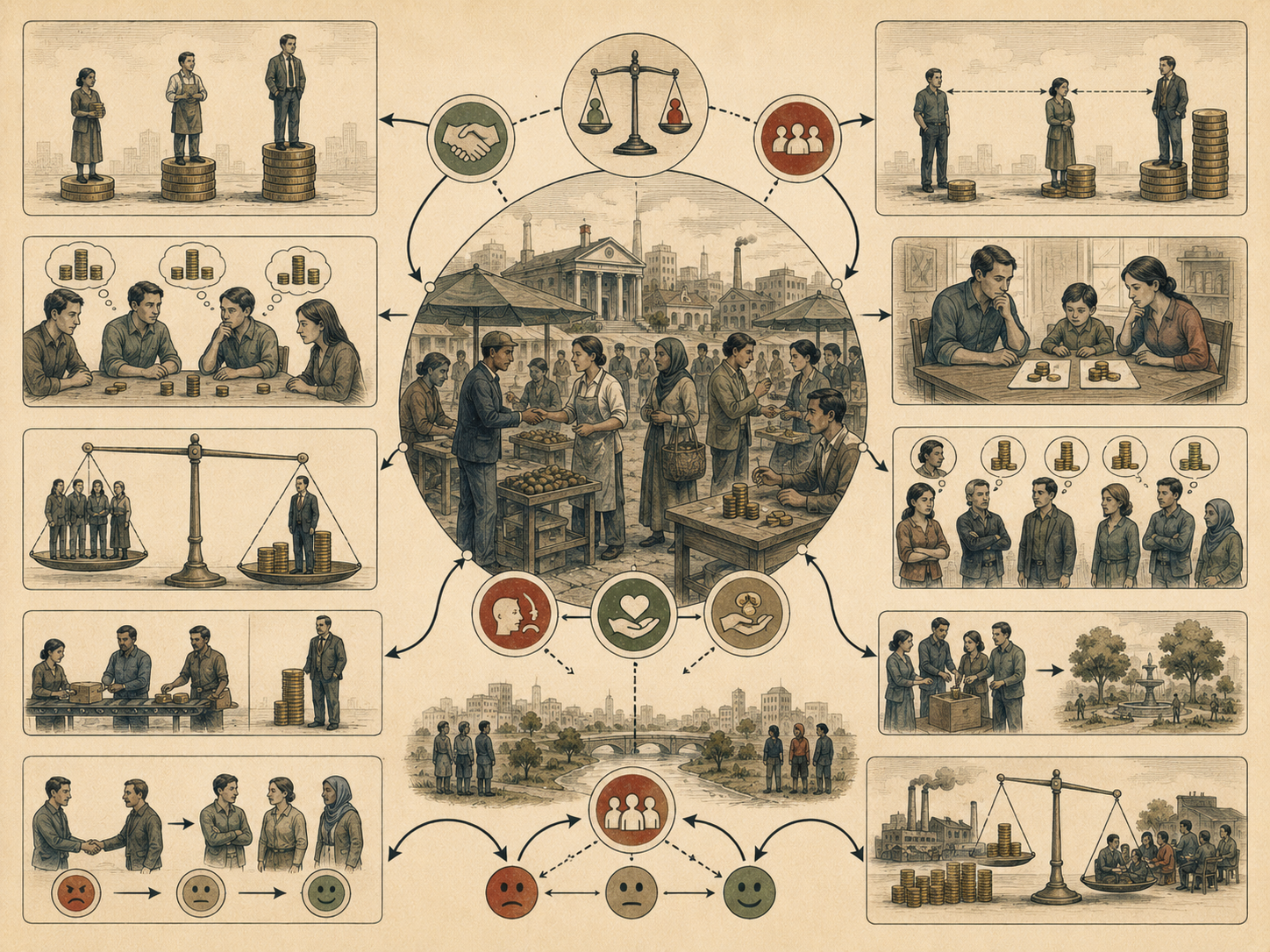
Inequality aversion therefore belongs at the intersection of behavioral economics, social preference theory, distributive justice, labor economics, organizational economics, public economics, and political economy. It helps explain why people do not respond to incentives as isolated payoff calculators, why markets and institutions are judged partly through fairness norms, and why distributive conflict remains central to economic life even when aggregate efficiency arguments appear strong on paper.
The concept is especially important because inequality is not only a statistical condition. It is also an experienced relation. People encounter inequality through wages, prices, bargaining outcomes, taxation, access to public goods, workplace hierarchies, inheritance, housing markets, credit conditions, healthcare access, education, social status, and institutional treatment. Behavioral economics clarifies that distributive structure affects not only welfare in a material sense, but also trust, cooperation, legitimacy, motivation, resentment, social comparison, and willingness to participate in shared systems.
A serious account of inequality aversion must therefore distinguish several questions. Do people dislike inequality because they are harmed by disadvantage? Do they object to inequality because it violates fairness norms? Do they resist extreme advantage because it feels morally uncomfortable? Do they support redistribution because they identify with those who lose? Do they oppose redistribution when they believe unequal outcomes were earned legitimately? These questions show why inequality aversion is not reducible to envy, altruism, or ideology alone. It is a structured social preference shaped by comparison, fairness, reciprocity, legitimacy, and institutional context.
The Concept of Inequality Aversion
Inequality aversion describes preferences in which individuals evaluate outcomes partly in relation to how resources are distributed across others. Rather than caring only about their own absolute payoff, individuals may experience disutility when outcomes appear excessively unequal. This broad idea includes at least two distinguishable tendencies: resistance to disadvantageous inequality, where others receive more, and resistance to advantageous inequality, where one receives substantially more than others.
Disadvantageous inequality aversion is the more intuitive form. People often dislike receiving less than peers, coworkers, bargaining partners, or comparable groups. This can occur even when their own absolute payoff is positive. A worker may resent a wage increase if comparable coworkers receive much larger increases. A bargaining party may reject a low offer even though acceptance would yield a material gain. A citizen may oppose a tax or benefit structure that appears to impose disproportionate burdens on one group while protecting another.
Advantageous inequality aversion is more subtle but equally important. People may also experience discomfort from receiving much more than others, especially when the advantage appears undeserved, exploitative, arbitrary, or inconsistent with shared norms. This tendency can help explain voluntary giving in dictator games, support for redistribution among some relatively advantaged groups, discomfort with excessive executive compensation, and willingness to reduce one’s own payoff to preserve group cohesion or moral legitimacy.
These tendencies matter because they imply that utility is socially embedded. Economic choices are not always evaluated on the basis of private consumption alone. Relative standing, fairness, proportionality, and distributive legitimacy can enter directly into how outcomes are experienced and judged. This makes inequality aversion closely related to Fairness and Reciprocity in Economic Behavior and Trust and Cooperation in Economic Systems.
The concept also clarifies why distributive questions persist even in settings where aggregate wealth could be increased through more unequal allocations. People do not simply ask whether more is being produced. They ask who gets what, whether burdens and gains are proportionate, whether inequality reflects merit or power, and whether an institution’s distributive logic can be regarded as fair. In that sense, inequality aversion is not only a behavioral anomaly. It is a central way people judge the moral and institutional order of economic life.
Inequality aversion is also distinct from simple envy or altruism. Envy would imply a dislike of others doing well. Altruism would imply concern for others’ welfare. Inequality aversion is more relational. It concerns the gap itself, the perceived fairness of the allocation, and the legitimacy of the process that produced it. A person may accept inequality when it appears earned, temporary, transparent, or socially beneficial, while resisting inequality that appears arbitrary, inherited, exploitative, corrupt, or imposed through unequal power.
Inequality Aversion as a Social Preference
Inequality aversion is part of the broader category of social preferences. Social preference theory examines cases in which utility depends not only on one’s own payoff, but also on the payoffs, intentions, treatment, and welfare of others. Fairness, reciprocity, altruism, spite, status concerns, guilt, shame, norm compliance, and inequality aversion all belong to this broader family of behavioral explanations.
Social preferences matter because many economic settings are not anonymous one-shot exchanges. They are socially interpreted interactions. A wage is interpreted relative to peer wages and managerial compensation. A price increase is interpreted relative to cost, scarcity, and perceived exploitation. A tax obligation is interpreted relative to public benefit and whether others are contributing. A bargaining offer is interpreted as a signal of respect or disrespect. A public policy is interpreted through ideas of deservingness, burden sharing, and legitimacy.
Inequality aversion gives these social interpretations formal economic significance. It shows why the same absolute payoff can generate different behavioral responses depending on the distribution around it. Receiving $100 may feel acceptable in an equal split, insulting in a 90–10 split, or morally uncomfortable in a situation where others receive nothing and the allocation appears arbitrary. The payoff is the same in private terms, but the social meaning changes.
Social preference theory also helps explain why institutions cannot rely on incentives alone. A compensation system may be technically efficient but morale-damaging if employees perceive it as unfair. A redistribution policy may be economically beneficial but politically unstable if recipients and contributors are framed in morally divisive ways. A market rule may generate growth but lose legitimacy if the gains are perceived as captured by insiders. Economic systems depend not only on material output, but on whether participants regard the distribution of that output as intelligible and justified.
Inequality aversion can also support cooperation. People are more likely to cooperate when they believe others are not gaining unfair advantage from their contribution. Conversely, perceived distributive unfairness can trigger withdrawal, punishment, noncompliance, turnover, protest, or refusal to bargain. This links inequality aversion to public-goods provision, organizational behavior, tax compliance, and institutional stability.
At the same time, social preferences are heterogeneous. People differ in how strongly they respond to inequality, whether they distinguish earned from unearned inequality, how much they value equality relative to efficiency, and whether they respond more strongly to disadvantageous or advantageous inequality. This heterogeneity is one reason inequality aversion must be studied empirically rather than assumed uniformly.
Theoretical Models of Inequality Aversion
One of the most influential formalizations of inequality aversion is the Fehr-Schmidt model. In that framework, an individual’s utility depends not only on their own payoff, but also on payoff differences relative to others, with separate parameters for disadvantageous and advantageous inequality. The model captures the idea that people may suffer more from receiving less than others than from receiving more, while still exhibiting some aversion to inequity in both directions.
The Fehr-Schmidt framework is powerful because it turns fairness concerns into a tractable utility function. Instead of treating fairness as an external moral comment on economic behavior, it places distributive comparison inside the utility function itself. This makes it possible to analyze bargaining, cooperation, punishment, public-goods provision, and labor relations using formal tools while relaxing the assumption that individuals care only about their own material payoff.
A second major framework is Bolton and Ockenfels’ ERC model, which emphasizes equity, reciprocity, and competition through an actor’s relative share of total payoff. Whereas the Fehr-Schmidt model focuses on payoff differences, the ERC model focuses more directly on relative standing within the total distribution. This allows analysts to examine how people respond to their proportion of group resources, not only to pairwise gaps.
These models are not identical, and neither should be treated as a complete account of justice. They are simplified representations of social preference. Their value lies in making distributive comparison analytically usable. They help explain why people reject low offers, punish free-riders, prefer wage compression, support redistribution, or object to extreme inequality even when pure self-interest would predict different behavior.
Later social preference models extend this literature by incorporating intention, reciprocity, type uncertainty, guilt, shame, status, identity, and norm compliance. For example, people may respond differently to the same unequal allocation depending on whether they believe it resulted from luck, effort, exploitation, discrimination, or legitimate reward. Inequality aversion is therefore often inseparable from process fairness. Distributions are judged not only by their shape, but by how they were produced.
For policy and institutional analysis, these models matter because they show that distributive perception can affect behavior in predictable ways. If people experience an institution as unfair, they may cooperate less, comply less, work less, trust less, or resist more. That behavioral response can then alter the effectiveness and stability of the institution itself.
Experimental Evidence
Experimental economics provides extensive support for the claim that inequality aversion is a recurring feature of human decision-making. In ultimatum games, low offers are frequently rejected even though rejection leaves both parties worse off in material terms. In dictator games, some allocators voluntarily transfer resources despite facing no strategic necessity to do so. In public-goods and punishment games, individuals often incur costs to sanction outcomes they regard as unfair, exploitative, or norm-violating.
These findings matter because they reveal that distributive fairness is not merely rhetoric layered onto underlying self-interest. It often affects actual behavior under controlled conditions. People may sacrifice income to avoid being treated unfairly, and they may also sacrifice income to avoid benefiting from what they regard as morally excessive advantage. The evidence does not imply that everyone is equally fairness-oriented, but it does show that fairness preferences are behaviorally real.
The ultimatum game is especially important because it shows that people may reject materially beneficial offers if the distribution appears insulting. A responder who rejects a low offer receives nothing, but the proposer also receives nothing. Such rejection can be interpreted as punishment, self-respect, norm enforcement, or resistance to exploitation. Standard self-interest models predict acceptance of any positive offer. Rejection patterns therefore reveal that people often evaluate offers through fairness thresholds.
Dictator games show a different pattern. Since the recipient has no ability to reject the allocation, any positive transfer by the dictator cannot be explained by strategic fear of punishment. Some giving may reflect altruism, experimenter demand, reputation concerns, or fairness norms, but the finding remains important: many allocators do not keep everything even when they can. This suggests that advantageous inequality can sometimes produce disutility or moral pressure.
Public-goods and punishment experiments extend the logic into collective-action settings. People often contribute to shared pools and punish free-riders at personal cost. Such behavior suggests that inequality aversion is connected to cooperation. When some actors benefit from others’ contributions without contributing themselves, the unequal burden can trigger punishment and reduce willingness to cooperate in future rounds.
Experimental results vary by culture, context, stakes, framing, anonymity, and institutional environment. That variation is important. It shows that inequality aversion is not a fixed universal constant. It is a social preference whose expression depends on norms, expectations, history, and perceived legitimacy. The core behavioral insight remains: distributive structure influences economic action.
Ultimatum Games, Dictator Games, and Fairness Rejection
Ultimatum and dictator games are often discussed together because they isolate different dimensions of distributive judgment. The ultimatum game includes both allocation and rejection power. The dictator game removes rejection power and focuses on voluntary allocation. Together, they help distinguish fairness enforcement from voluntary concern for distribution.
In an ultimatum game, one player proposes a division of a sum of money. The second player accepts or rejects. If the offer is accepted, both receive the proposed amounts. If it is rejected, both receive nothing. The standard self-interest prediction is that proposers should offer the smallest positive amount and responders should accept it. In practice, proposers often offer much more than the minimum, and responders frequently reject very low offers.
This pattern can be interpreted in several ways. Proposers may anticipate rejection and offer more strategically. Responders may reject low offers because they experience disadvantageous inequality as insulting or unacceptable. Both sides may share norms about fair division. The game therefore reveals not only inequality aversion, but expectations about inequality aversion in others.
In dictator games, one player unilaterally determines the allocation. The recipient cannot reject. Standard self-interest predicts that dictators keep everything. Many do not. Some give positive amounts, suggesting that advantageous inequality aversion, altruism, moral identity, or fairness norms influence behavior even without strategic pressure.
The distinction matters for policy. Some distributive behavior is driven by fear of punishment, protest, or exit. Other distributive behavior is driven by internalized norms of fairness. Institutions that rely only on coercive enforcement may miss the broader role of legitimacy. Institutions that rely only on voluntary fairness may underestimate the need for accountability when unequal power creates opportunities for exploitation.
Fairness rejection also appears outside the laboratory. Workers may quit rather than accept perceived unfair treatment. Consumers may boycott firms they regard as exploitative. Citizens may resist policies that appear to reward the already advantaged. Bargaining parties may reject offers that fail symbolic or distributive fairness tests. These reactions are economically consequential because they convert distributive judgment into real behavior.
Inequality Aversion and Market Outcomes
Inequality aversion influences real-world market behavior in many ways. In labor markets, perceptions of unfair compensation can weaken morale, lower effort, increase turnover, and damage organizational trust. Workers often compare wages not only to their own needs or market alternatives, but to what peers, managers, executives, or comparable groups receive. Compensation is therefore evaluated as a distributive relation, not merely as a price.
In negotiations, parties may reject offers that appear unfair even when acceptance would generate positive material gain. This has implications for wage bargaining, union negotiations, settlement offers, procurement contracts, and platform work. A technically profitable agreement may fail if one side perceives the split as exploitative. The behavioral boundary of acceptable distribution can therefore shape feasible bargains.
Consumer markets also show inequality-aversion dynamics. People often respond negatively to pricing practices that appear to exploit scarcity, emergencies, captive demand, or informational asymmetry. A price increase may be accepted when costs rise, but rejected as unfair when it appears to reflect opportunism. Consumers do not evaluate prices only as signals of supply and demand. They often evaluate whether pricing behavior violates fairness norms.
Financial markets and credit relationships are also shaped by perceived distributive fairness. Lending practices, fees, interest rates, foreclosure policies, overdraft charges, and insurance pricing can be judged not only by contract terms, but by whether they impose disproportionate burden on vulnerable groups. Behavioral responses include distrust, avoidance, political backlash, and demand for regulation.
Markets therefore operate through social expectations as well as through prices. Institutions that ignore distributive perception may produce arrangements that appear efficient in narrow accounting terms but remain behaviorally unstable, politically contested, or legitimacy-eroding. Inequality aversion helps explain why economic systems require fairness narratives as well as incentive structures.
Labor Markets, Organizations, and Wage Fairness
Labor markets are among the most important settings for inequality aversion because wages are both income and status signals. Workers often compare compensation across coworkers, managers, departments, occupations, firms, and demographic groups. These comparisons influence morale, effort, loyalty, trust, turnover, and willingness to cooperate inside organizations.
A worker may be satisfied with a wage in absolute terms until discovering that a comparable worker is paid substantially more. Similarly, employees may tolerate hierarchical pay differences when they believe those differences reflect responsibility, skill, risk, scarcity, or contribution. They are more likely to resent pay gaps perceived as arbitrary, discriminatory, opaque, or disconnected from value creation. This is inequality aversion operating through institutional interpretation.
Organizational behavior also depends on perceived fairness in workload, promotion, recognition, scheduling, discipline, and access to opportunity. Compensation is only one distributive domain. If some employees repeatedly carry more burden while others receive more reward, cooperation may erode. Teams depend on a sense that effort and reward are not radically misaligned.
Executive compensation is a particularly visible site of inequality aversion. Large pay gaps between executives and workers can become politically and organizationally contentious when workers perceive that executives are rewarded regardless of performance, while ordinary employees bear layoffs, wage stagnation, or increased workload. The issue is not merely the absolute size of compensation. It is the perceived relation between contribution, risk, reward, and burden.
Inequality aversion also helps explain why pay transparency can have complex effects. Transparency may reveal inequities and support accountability, but it may also increase dissatisfaction if organizations cannot justify observed differences. The behavioral lesson is not that all wage gaps must disappear. It is that distributive differences require credible justification if they are to remain legitimate.
For organizational design, this means compensation systems should be evaluated not only by incentive alignment but by perceived fairness, distributive clarity, procedural justice, and the effects of pay structure on trust and cooperation. A formally efficient incentive plan can become behaviorally damaging when it violates fairness expectations.
Redistribution, Taxation, and Social Insurance
Inequality aversion has major implications for taxation, redistribution, wage policy, social insurance, and public legitimacy. Public support for redistributive programs is shaped not only by material self-interest, but by judgments about deservingness, fairness, proportionality, reciprocity, and the moral acceptability of extreme inequality. Policies seen as excessively unequal often face resistance, even when defenders claim they improve efficiency or growth.
Progressive taxation can be understood partly as an institutional response to inequality aversion. If citizens regard extreme income or wealth concentration as socially destabilizing, morally excessive, or inconsistent with shared public goods, they may support tax systems that reduce after-tax inequality. But support depends strongly on perceived legitimacy: whether taxes are administered fairly, whether public benefits are visible, whether evasion is punished, and whether burdens are distributed across groups in ways people recognize as justified.
Redistribution preferences are not reducible to current income position. Some lower-income individuals oppose redistribution if they believe inequality reflects effort or if they expect future upward mobility. Some higher-income individuals support redistribution if they regard unequal outcomes as partly shaped by luck, inheritance, structural barriers, or institutional privilege. This shows that inequality aversion interacts with beliefs about causation. People evaluate not only inequality itself, but how inequality came about.
Social insurance also depends on distributive judgment. Programs such as unemployment insurance, public pensions, healthcare subsidies, disability support, and poverty relief involve transfers across risk groups, income groups, and life stages. Public support often depends on whether recipients are perceived as deserving, whether the system is reciprocal over time, and whether benefits are administered with dignity and accountability.
Behavioral economics therefore contributes to a more realistic understanding of economic governance. Policy does not operate on a population indifferent to distribution. It operates on people whose support for institutions depends partly on whether the outcomes those institutions generate are seen as fair, reciprocal, and publicly defensible.
At the same time, inequality aversion can be politically unstable. People may oppose inequality in the abstract but resist specific redistributive policies. They may support fairness for in-groups more readily than out-groups. They may interpret the same distribution differently depending on partisan framing, racialization, national identity, media narratives, or institutional trust. A serious policy account must therefore connect inequality aversion with political economy, not treat it as a simple preference for equal outcomes.
Distributive Justice, Legitimacy, and Political Economy
Inequality aversion connects behavioral economics to broader debates about distributive justice and political economy. The issue is not only whether unequal outcomes lower utility in experiments. It is whether inequality affects institutional legitimacy, public consent, political stability, and the perceived fairness of the economic order. High inequality can generate resentment, distrust, perceived exclusion, status anxiety, social fragmentation, and conflict over whether the rules of the system are themselves fair.
This is why inequality aversion belongs in conversation with normative economics and theories of economic justice. Behavioral economics does not settle philosophical debates about justice, but it does supply evidence that distributive fairness concerns are behaviorally real. That evidence matters because institutions that ignore those concerns may face resistance, noncompliance, withdrawal, protest, populist backlash, or erosion of legitimacy even if they satisfy narrow efficiency criteria.
The distinction between inequality and injustice is important. Not all unequal outcomes are perceived as unjust. Many people accept some inequality when it reflects effort, skill, risk, scarcity, contribution, or legitimate democratic choice. Inequality becomes more destabilizing when it appears rooted in inheritance, corruption, discrimination, monopoly power, insider advantage, political capture, exploitation, or unequal access to opportunity.
Political economy adds another layer: distributive rules are not neutral. Tax structures, labor laws, property rights, financial systems, zoning rules, education funding, healthcare access, monopoly regulation, inheritance law, and public investment all shape the distribution of resources before individuals make choices. Inequality aversion therefore cannot be confined to interpersonal experiments. It must also be applied to institutions that produce distributive outcomes at scale.
Legitimacy depends partly on whether people believe the economic system distributes burdens and rewards through acceptable rules. When inequality becomes too extreme or too weakly justified, people may cease to regard the system as fair. This can weaken cooperation, trust, tax compliance, institutional confidence, and willingness to accept short-term sacrifice for long-term public goals.
Behavioral economics contributes to political economy by showing that distribution is not merely a final outcome to be evaluated after efficiency is achieved. Distribution shapes behavior throughout the system. People respond to inequality as they work, bargain, vote, comply, cooperate, invest, protest, and trust.
Power, Structure, and Unequal Exposure to Inequality
A serious account of inequality aversion must include power. Inequality is not experienced evenly. The same distribution can mean different things depending on who has bargaining power, who has exit options, who controls information, who sets rules, and who bears risk. Behavioral economics becomes more credible when it connects social preferences with structural conditions rather than treating unequal allocations as isolated laboratory events.
Disadvantageous inequality is especially consequential when people cannot exit the relationship that produces it. Workers may dislike wage inequality but lack labor-market power to bargain. Tenants may resent rent extraction but lack housing alternatives. Borrowers may dislike predatory terms but lack access to fair credit. Platform workers may experience unequal algorithmic treatment but lack transparency or appeal rights. In these cases, inequality aversion may not produce immediate rejection because rejection is too costly. The absence of rejection should not be misread as acceptance.
This is a crucial point for revealed preference. If a person accepts an unequal offer under constraint, that behavior may reflect necessity rather than consent. A low-wage worker may accept unfair compensation because the alternative is unemployment. A debtor may accept unfair credit terms because no better credit is available. A tenant may accept a rent increase because moving is impossible. Observed acceptance does not erase inequality aversion; it may reveal unequal power.
Advantageous inequality also depends on social context. Some advantaged actors may feel discomfort with excess inequality, but others may rationalize it through merit narratives, market ideology, group identity, or distance from those harmed. Institutions can either intensify or soften these perceptions through transparency, accountability, and distributive justification.
Power also shapes which inequalities become visible. Executive compensation is often public, while subcontracted labor conditions may be hidden. Consumer prices are visible, while supply-chain exploitation may not be. Public benefits are scrutinized, while tax avoidance by elites may be opaque. Inequality aversion depends partly on perception, and perception depends on information architecture.
For policy, this means inequality aversion should not be used to blame individuals for resentment or noncompliance without examining structural unfairness. Distributive conflict is often a signal that institutions need repair. The goal should not be to suppress inequality aversion, but to understand when it reflects legitimate objection to unjust distribution.
Empirical and Policy-Evaluation Lens
A professional economist-facing treatment of inequality aversion should ask what can be measured, estimated, and evaluated. Inequality aversion can be studied through laboratory experiments, survey experiments, administrative data, wage data, tax data, bargaining outcomes, organizational surveys, redistribution-preference surveys, field experiments, natural experiments, and structural estimation of social preference parameters.
The empirical challenge is that inequality aversion is rarely observed directly. Researchers infer it from behavior: rejected offers, voluntary transfers, costly punishment, wage dissatisfaction, turnover, support for redistribution, protest participation, tax compliance, or institutional trust. But these outcomes can have multiple causes. A rejected offer may reflect fairness concerns, strategic bargaining, anger, identity, or distrust. Support for redistribution may reflect self-interest, altruism, ideology, risk aversion, or beliefs about mobility. Careful design is needed.
Experimental methods allow researchers to vary allocations, information, process fairness, earned versus unearned income, group identity, and institutional framing. Field data allow researchers to examine how actual wage gaps, tax changes, benefit structures, or public-policy reforms affect behavior. Survey experiments can test whether people respond differently to inequality when it is described as resulting from effort, luck, inheritance, discrimination, market power, or corruption.
Policy evaluation should distinguish inequality-reduction effects from legitimacy effects and welfare effects. A policy may reduce measured inequality but be viewed as unfair if it violates reciprocity norms. A policy may preserve inequality but increase legitimacy if it expands opportunity and procedural fairness. A policy may raise aggregate welfare while intensifying distributive resentment. These possibilities show why inequality aversion must be connected to institutional interpretation.
Heterogeneity is central. Inequality aversion differs by income, class position, ideology, institutional trust, labor-market experience, group identity, cultural context, beliefs about merit, and exposure to unfair treatment. Analysts should therefore estimate subgroup effects and avoid assuming a single representative fairness preference.
A serious empirical workflow should ask: What inequality is being measured? Is it income, wealth, wage, status, opportunity, risk, burden, or access? Is the inequality advantageous or disadvantageous from the actor’s perspective? Is the inequality perceived as earned or unearned? What is the relevant comparison group? Does the outcome measure behavior, welfare, legitimacy, or political support? These questions turn inequality aversion from a general concept into a disciplined object of economic analysis.
An Analytical Framework for Inequality Aversion
A standard formalization of inequality aversion follows the Fehr-Schmidt structure. Let individual \(i\) receive payoff \(x_i\) in a group of \(n\) players. Utility is written as:
U_i(x) = x_i – \alpha_i \frac{1}{n-1}\sum_{j \neq i}\max(x_j – x_i, 0) – \beta_i \frac{1}{n-1}\sum_{j \neq i}\max(x_i – x_j, 0)
\]
Interpretation: Utility depends on one’s own payoff, disutility from disadvantageous inequality, and disutility from advantageous inequality.
Here, \(\alpha_i\) captures aversion to disadvantageous inequality and \(\beta_i\) captures aversion to advantageous inequality, with \(\alpha_i \geq \beta_i \geq 0\) in the usual formulation. The model captures the idea that receiving less than others is often more painful than receiving more is pleasurable, while still allowing some discomfort from advantageous inequality.
This structure helps explain behaviors such as rejecting low ultimatum offers, resisting steep wage disparities, or supporting redistribution when inequality is perceived as excessive. It also makes visible that two people with the same material payoff may evaluate that outcome differently depending on the surrounding distribution.
For a two-person allocation, the same logic can be written more simply as:
U_i = x_i – \alpha_i\max(x_j – x_i, 0) – \beta_i\max(x_i – x_j, 0)
\]
Interpretation: In a two-person setting, utility falls when the other person receives more, and may also fall when the individual receives much more than the other person.
The Bolton-Ockenfels ERC model takes a different approach by focusing on one’s share of total payoff. A simplified representation is:
U_i = U_i(x_i, \sigma_i)
\qquad \text{where} \qquad
\sigma_i = \frac{x_i}{\sum_{j=1}^{n}x_j}
\]
Interpretation: Utility depends on both absolute payoff and relative share of total group payoff.
This approach captures how individuals may care about proportional standing within a distribution, not only pairwise payoff gaps. It is especially useful when group-level distribution matters more than comparison with a single other actor.
Redistribution preferences can be modeled by allowing individuals to evaluate post-tax income and inequality reduction together. Suppose pre-tax income is \(y_i\), tax rate is \(\tau\), and transfer \(T\) is distributed across the group. Post-tax income is:
z_i = (1-\tau)y_i + T
\]
Interpretation: Redistribution changes the individual’s own payoff while also changing the distribution against which that payoff is evaluated.
An inequality-averse individual may support redistribution even when it reduces their own material payoff if the reduction in perceived inequality produces enough social-preference utility. Conversely, an individual may oppose redistribution if they believe the resulting distribution violates effort, reciprocity, or deservingness norms.
For policy evaluation, the effect of a distributional intervention can be expressed as:
\tau = E[Y_i(1) – Y_i(0)]
\]
Interpretation: The treatment effect compares behavior, welfare, legitimacy, or policy support under a distributional intervention with the counterfactual condition.
But a welfare evaluation should account for both material output and distributional utility:
W = \sum_{i=1}^{n}x_i – \lambda I(x) + L(x, P)
\]
Interpretation: Social welfare depends on total material payoff, an inequality penalty, and legitimacy effects tied to the process that produced the distribution.
Here, \(I(x)\) is an inequality measure and \(L(x, P)\) represents legitimacy associated with process \(P\). This broader formulation helps avoid a narrow interpretation of inequality aversion as dislike of all inequality. People often evaluate both the distribution and the process that generated it.
R Workflow: Bargaining, Redistribution, and Inequality-Aversion Parameters
The following R workflow simulates agents with heterogeneous aversion to advantageous and disadvantageous inequality in a bargaining and redistribution environment. It is designed as a practical scaffold for applied behavioral economics, public economics, labor-market analysis, and teaching. The workflow produces bargaining outcomes, rejection rates, parameter-group summaries, and redistribution support under social preferences.
# Inequality Aversion in Economic Decision-Making
# R workflow: bargaining, redistribution, and inequality-aversion parameters
# Synthetic data only. Economist-facing research scaffold.

set.seed(909)

n_agents <- 2500
n_rounds <- 6000

agents <- data.frame(
  id = 1:n_agents,
  alpha = pmin(pmax(rnorm(n_agents, mean = 1.5, sd = 0.5), 0), 3),
  beta = pmin(pmax(rnorm(n_agents, mean = 0.6, sd = 0.3), 0), 2),
  income = exp(rnorm(n_agents, mean = 10.2, sd = 0.55)),
  redistribution_norm = pmin(pmax(rnorm(n_agents, mean = 0.55, sd = 0.20), 0), 1),
  merit_belief = pmin(pmax(rnorm(n_agents, mean = 0.50, sd = 0.22), 0), 1)
)

fehr_schmidt_utility <- function(self_payoff, other_payoff, alpha, beta) {
  self_payoff -
    alpha * pmax(other_payoff - self_payoff, 0) -
    beta * pmax(self_payoff - other_payoff, 0)
}

history <- vector("list", n_rounds)

for (t in seq_len(n_rounds)) {
  pair_ids <- sample(agents$id, 2, replace = FALSE)
  proposer <- agents[agents$id == pair_ids[1], ]
  responder <- agents[agents$id == pair_ids[2], ]

  possible_offers <- seq(0.05, 0.95, by = 0.05)

  proposer_utilities <- sapply(possible_offers, function(offer_to_responder) {
    proposer_share <- 1 - offer_to_responder

    fehr_schmidt_utility(
      self_payoff = proposer_share,
      other_payoff = offer_to_responder,
      alpha = proposer$alpha,
      beta = proposer$beta
    )
  })

  chosen_offer <- possible_offers[which.max(proposer_utilities)]

  responder_accept_utility <- fehr_schmidt_utility(
    self_payoff = chosen_offer,
    other_payoff = 1 - chosen_offer,
    alpha = responder$alpha,
    beta = responder$beta
  )

  accepted <- as.integer(responder_accept_utility >= 0)

  history[[t]] <- data.frame(
    round = t,
    proposer_id = proposer$id,
    responder_id = responder$id,
    offer_to_responder = chosen_offer,
    proposer_share = 1 - chosen_offer,
    accepted = accepted,
    responder_alpha = responder$alpha,
    responder_beta = responder$beta,
    proposer_alpha = proposer$alpha,
    proposer_beta = proposer$beta
  )
}

bargaining <- do.call(rbind, history)

summary_stats <- data.frame(
  mean_offer = mean(bargaining$offer_to_responder),
  median_offer = median(bargaining$offer_to_responder),
  acceptance_rate = mean(bargaining$accepted),
  rejection_rate = 1 - mean(bargaining$accepted)
)

print(summary_stats)

bargaining$responder_alpha_quartile <- cut(
  bargaining$responder_alpha,
  breaks = quantile(bargaining$responder_alpha, probs = seq(0, 1, 0.25)),
  include.lowest = TRUE,
  labels = paste0("Q", 1:4)
)

rejection_summary <- aggregate(
  accepted ~ responder_alpha_quartile,
  data = bargaining,
  FUN = mean
)

rejection_summary$rejection_rate <- 1 - rejection_summary$accepted
print(rejection_summary)

evaluate_redistribution <- function(df, tax_rate) {
  pre_tax_income <- df$income
  revenue <- tax_rate * pre_tax_income
  transfer <- mean(revenue)
  post_tax_income <- (1 - tax_rate) * pre_tax_income + transfer

  mean_income <- mean(post_tax_income)

  inequality_gap <- abs(post_tax_income - mean_income) / mean_income

  social_preference_utility <- post_tax_income - df$alpha * pmax(mean_income - post_tax_income, 0) / mean_income - df$beta * pmax(post_tax_income - mean_income, 0) / mean_income + df$redistribution_norm * (1 - mean(inequality_gap)) - df$merit_belief * tax_rate data.frame( tax_rate = tax_rate, mean_post_tax_income = mean(post_tax_income), inequality_index = mean(inequality_gap), mean_social_preference_utility = mean(social_preference_utility), support_share = mean(social_preference_utility > pre_tax_income)
  )
}

tax_grid <- seq(0, 0.45, by = 0.05)

redistribution_results <- do.call(
  rbind,
  lapply(tax_grid, function(tau) evaluate_redistribution(agents, tau))
)

print(redistribution_results[order(-redistribution_results$mean_social_preference_utility), ])

dir.create("outputs/tables", recursive = TRUE, showWarnings = FALSE)
write.csv(bargaining, "outputs/tables/r_inequality_aversion_bargaining_history.csv", row.names = FALSE)
write.csv(summary_stats, "outputs/tables/r_inequality_aversion_bargaining_summary.csv", row.names = FALSE)
write.csv(rejection_summary, "outputs/tables/r_inequality_aversion_rejection_summary.csv", row.names = FALSE)
write.csv(redistribution_results, "outputs/tables/r_inequality_aversion_redistribution_results.csv", row.names = FALSE)
This workflow highlights how inequality-aversion parameters alter offer behavior, acceptance thresholds, and redistribution support. It also separates disadvantageous inequality aversion from advantageous inequality aversion, which is essential for economists who want to distinguish resentment of being treated unfairly from discomfort with benefiting from unfair advantage.
Python Workflow: Comparing Distributional Regimes Under Social Preferences
The following Python workflow compares stylized economic environments under heterogeneous inequality aversion. It includes regime-level welfare analysis, subgroup summaries, redistribution simulation, and an experiment-style dataset suitable for treatment-effect estimation. The code is intended as a professional scaffold that can be extended to bargaining games, wage-setting, tax-preference analysis, redistribution experiments, or political support models.
# Inequality Aversion in Economic Decision-Making
# Python workflow: distributional regimes, social preferences, and welfare
# Synthetic data only. Economist-facing research scaffold.

from __future__ import annotations

from pathlib import Path

import numpy as np
import pandas as pd

rng = np.random.default_rng(909)

n = 8000

agents = pd.DataFrame({
    "agent_id": np.arange(1, n + 1),
    "alpha": np.clip(rng.normal(1.5, 0.5, n), 0, 3),
    "beta": np.clip(rng.normal(0.6, 0.3, n), 0, 2),
    "income": np.exp(rng.normal(10.2, 0.55, n)),
    "redistribution_norm": np.clip(rng.normal(0.55, 0.20, n), 0, 1),
    "merit_belief": np.clip(rng.normal(0.50, 0.22, n), 0, 1),
    "institutional_trust": np.clip(rng.normal(0.55, 0.20, n), 0, 1)
})

def fehr_schmidt_utility(
    self_payoff: np.ndarray,
    other_payoff: np.ndarray,
    alpha: np.ndarray,
    beta: np.ndarray
) -> np.ndarray:
    """Compute Fehr-Schmidt utility for a two-person allocation."""
    return (
        self_payoff
        - alpha * np.maximum(other_payoff - self_payoff, 0)
        - beta * np.maximum(self_payoff - other_payoff, 0)
    )

def evaluate_regime(
    df: pd.DataFrame,
    regime_name: str,
    self_payoff: float,
    other_payoff: float
) -> dict[str, float]:
    """Evaluate average utility and dissatisfaction under a payoff regime."""
    utility = fehr_schmidt_utility(
        self_payoff=np.repeat(self_payoff, len(df)),
        other_payoff=np.repeat(other_payoff, len(df)),
        alpha=df["alpha"].to_numpy(),
        beta=df["beta"].to_numpy()
    )

    disadvantageous_gap = np.maximum(other_payoff - self_payoff, 0)
    advantageous_gap = np.maximum(self_payoff - other_payoff, 0)

    return {
        "regime": regime_name,
        "mean_utility": float(utility.mean()),
        "share_negative_utility": float((utility < 0).mean()), "mean_disadvantageous_gap": float(disadvantageous_gap), "mean_advantageous_gap": float(advantageous_gap), "material_payoff": self_payoff } regimes = { "equal_distribution": {"self_payoff": 0.50, "other_payoff": 0.50}, "advantageous_inequality": {"self_payoff": 0.70, "other_payoff": 0.30}, "disadvantageous_inequality": {"self_payoff": 0.30, "other_payoff": 0.70}, "moderate_advantage": {"self_payoff": 0.60, "other_payoff": 0.40}, "moderate_disadvantage": {"self_payoff": 0.40, "other_payoff": 0.60}, } rows = [] for name, params in regimes.items(): rows.append(evaluate_regime(agents, name, **params)) results = pd.DataFrame(rows).sort_values("mean_utility", ascending=False) print(results) agents["alpha_group"] = pd.qcut( agents["alpha"], 4, labels=["low", "medium", "high", "very_high"] ) distribution_rows = [] for name, params in regimes.items(): for group in agents["alpha_group"].unique(): subset = agents.loc[agents["alpha_group"] == group].copy() out = evaluate_regime(subset, name, **params) out["alpha_group"] = str(group) distribution_rows.append(out) distribution = pd.DataFrame(distribution_rows) print(distribution.sort_values(["regime", "alpha_group"])) def evaluate_redistribution(df: pd.DataFrame, tax_rate: float) -> dict[str, float]:
    """Evaluate a stylized redistribution regime."""
    pre_tax_income = df["income"].to_numpy()
    revenue = tax_rate * pre_tax_income
    transfer = revenue.mean()
    post_tax_income = (1 - tax_rate) * pre_tax_income + transfer

    mean_income = post_tax_income.mean()
    relative_gap = np.abs(post_tax_income - mean_income) / mean_income

    social_preference_utility = (
        post_tax_income
        - df["alpha"].to_numpy() * np.maximum(mean_income - post_tax_income, 0) / mean_income
        - df["beta"].to_numpy() * np.maximum(post_tax_income - mean_income, 0) / mean_income
        + df["redistribution_norm"].to_numpy() * (1 - relative_gap.mean())
        - df["merit_belief"].to_numpy() * tax_rate
        + 0.05 * df["institutional_trust"].to_numpy()
    )

    return {
        "tax_rate": tax_rate,
        "mean_post_tax_income": float(post_tax_income.mean()),
        "inequality_index": float(relative_gap.mean()),
        "mean_social_preference_utility": float(social_preference_utility.mean()),
        "support_share": float((social_preference_utility > pre_tax_income).mean()),
    }

tax_grid = np.arange(0, 0.50, 0.05)
redistribution = pd.DataFrame(
    [evaluate_redistribution(agents, tax_rate=float(tau)) for tau in tax_grid]
)

print(redistribution.sort_values("mean_social_preference_utility", ascending=False))

experimental = agents.copy()
experimental["assigned_regime"] = rng.choice(
    ["equal_distribution", "advantageous_inequality", "disadvantageous_inequality"],
    size=len(experimental),
    p=[0.34, 0.33, 0.33]
)

payoff_lookup = {
    "equal_distribution": (0.50, 0.50),
    "advantageous_inequality": (0.70, 0.30),
    "disadvantageous_inequality": (0.30, 0.70)
}

self_payoff = []
other_payoff = []

for regime in experimental["assigned_regime"]:
    s, o = payoff_lookup[regime]
    self_payoff.append(s)
    other_payoff.append(o)

experimental["self_payoff"] = self_payoff
experimental["other_payoff"] = other_payoff
experimental["social_preference_utility"] = fehr_schmidt_utility(
    experimental["self_payoff"].to_numpy(),
    experimental["other_payoff"].to_numpy(),
    experimental["alpha"].to_numpy(),
    experimental["beta"].to_numpy()
)

experimental["advantageous_treat"] = (
    experimental["assigned_regime"] == "advantageous_inequality"
).astype(int)

experimental["disadvantageous_treat"] = (
    experimental["assigned_regime"] == "disadvantageous_inequality"
).astype(int)

try:
    import statsmodels.api as sm

    X = experimental[[
        "advantageous_treat",
        "disadvantageous_treat",
        "alpha",
        "beta",
        "redistribution_norm",
        "merit_belief",
        "institutional_trust"
    ]]
    X = sm.add_constant(X)

    model = sm.OLS(experimental["social_preference_utility"], X).fit(cov_type="HC1")
    print(model.summary().tables[1])

except ImportError:
    print("statsmodels is not installed; skipping regression table.")

output_dir = Path("outputs/tables")
output_dir.mkdir(parents=True, exist_ok=True)

results.to_csv(output_dir / "inequality_aversion_regime_summary.csv", index=False)
distribution.to_csv(output_dir / "inequality_aversion_distributional_summary.csv", index=False)
redistribution.to_csv(output_dir / "inequality_aversion_redistribution_results.csv", index=False)
experimental.to_csv(output_dir / "synthetic_inequality_aversion_experiment.csv", index=False)
For analysts, the value of this comparison is that it shows how distributional preferences can alter welfare rankings across regimes, even when material output alone would suggest a different ordering. It also makes clear why the same inequality may produce different responses depending on whether a person is advantaged, disadvantaged, trusting, merit-oriented, or redistribution-oriented.
Stata Replication Note: Inequality Aversion Policy Evaluation
For an economist-facing repository, the companion code should support Stata as well as R and Python. The article-level GitHub folder should include a Stata workflow that imports the synthetic experiment dataset, estimates treatment effects, reports robust standard errors, and exports regression tables. A compact Stata pattern for this article would look like this:
clear all
set more off

* Inequality Aversion in Economic Decision-Making
* Stata policy-evaluation scaffold using synthetic data.

global ROOT "`c(pwd)'"
global TABLES "$ROOT/outputs/tables"
global REG "$ROOT/outputs/regression_tables"

capture mkdir "$REG"

import delimited "$TABLES/synthetic_inequality_aversion_experiment.csv", clear varnames(1)

label variable advantageous_treat "Advantageous inequality treatment"
label variable disadvantageous_treat "Disadvantageous inequality treatment"
label variable social_preference_utility "Fehr-Schmidt social preference utility"
label variable alpha "Disadvantageous inequality aversion"
label variable beta "Advantageous inequality aversion"

local controls alpha beta redistribution_norm merit_belief institutional_trust
local outcomes social_preference_utility self_payoff other_payoff

tempname handle
postfile `handle' str45 outcome str45 term double estimate double std_error double p_value double n using "$REG/stata_inequality_aversion_estimates.dta", replace

foreach y of local outcomes {
    regress `y' advantageous_treat disadvantageous_treat `controls', vce(robust)

    foreach x in advantageous_treat disadvantageous_treat {
        local b = _b[`x']
        local se = _se[`x']
        local p = 2 * ttail(e(df_r), abs(_b[`x'] / _se[`x']))
        local n = e(N)
        post `handle' ("`y'") ("`x'") (`b') (`se') (`p') (`n')
    }
}

postclose `handle'

use "$REG/stata_inequality_aversion_estimates.dta", clear
export delimited using "$REG/stata_inequality_aversion_estimates.csv", replace

display "Stata inequality aversion policy-evaluation workflow complete."
The purpose of including Stata is to make the repository useful to economists, policy analysts, and graduate-level applied researchers who commonly work across Stata, R, and Python. The full repository scaffold should also include identification notes, robustness plans, replication instructions, synthetic bargaining and redistribution data, treatment-effect estimation, distributional summaries, and sensitivity tests for assumptions about disadvantageous inequality aversion, advantageous inequality aversion, merit beliefs, redistribution norms, institutional trust, and welfare.
GitHub Repository
The companion repository provides reproducible scaffolding for the computational side of this article, including synthetic inequality-aversion datasets, bargaining simulations, redistribution models, social-preference utility functions, treatment-effect estimation, welfare analysis, distributional summaries, robustness checks, Stata/R/Python workflows, SQL metadata structures, and scientific-computing examples for behavioral economics research.
Complete Code Repository
This article is supported by an article-level folder in the Behavioral Economics computational repository, with synthetic panel and experiment-style datasets, causal-inference workflows, welfare analysis, econometric identification notes, policy-evaluation scripts, robustness and sensitivity checks, Stata/R/Python workflows, SQL metadata structures, and scientific-computing examples for studying inequality aversion, social preferences, bargaining, redistribution, wage fairness, distributive legitimacy, taxation, public policy, and behavioral political economy.
Interpretive Limits and Cautions
Inequality aversion is a powerful concept, but it can be misused if treated as a universal preference for equality in all circumstances. People often distinguish between inequalities they regard as earned and inequalities they regard as arbitrary, exploitative, discriminatory, inherited, corrupt, or structurally imposed. A serious account must therefore examine both distribution and process.
There is also a risk of psychologizing distributive conflict. If people object to inequality, the objection should not automatically be interpreted as bias, envy, or irrationality. Distributive resistance may be a rational response to unfair rules, unequal power, institutional capture, weak mobility, or exclusion from opportunity. Behavioral economics should not be used to reduce structural injustice to individual preference parameters.
Experimental models also have limits. Ultimatum games, dictator games, and public-goods games clarify behavioral mechanisms, but real economic systems involve labor law, property rights, taxation, inheritance, discrimination, political power, organizational hierarchy, and historical inequality. Laboratory evidence should therefore be connected to institutional analysis rather than treated as sufficient by itself.
Inequality aversion is also politically ambivalent. It can support redistribution, solidarity, and institutional accountability. It can also be redirected toward resentment, scapegoating, or opposition to perceived out-groups. People may object strongly to some forms of inequality while tolerating or rationalizing others. The politics of inequality aversion depends on framing, identity, institutions, and beliefs about deservingness.
Finally, reducing inequality is not automatically equivalent to improving welfare. Equality achieved through broad deprivation is not desirable. The relevant question is how institutions can combine material sufficiency, fair opportunity, accountable power, legitimate reward, social insurance, and distributive justice. Inequality aversion is one part of that broader analysis.
The strongest use of behavioral economics is not to declare all inequality irrational or all fairness concerns morally correct. It is to show that distributive relations shape behavior, legitimacy, cooperation, and institutional stability in ways that economic analysis must take seriously.
Conclusion
Inequality aversion reveals that economic behavior is shaped not only by absolute gains, but also by distributive relations. Individuals often judge outcomes through comparison, fairness benchmarks, proportionality, and the acceptability of unequal allocations. This helps explain why people reject unfair offers, support redistribution, resist extreme disparities, punish exploitative behavior, and evaluate institutions partly through the distributions those institutions produce.
Behavioral economics matters here because it gives formal and empirical shape to these social preferences. It shows that distributive justice is not merely a philosophical concern external to economic life, but a recurring feature of actual decision-making in markets, organizations, and public policy. Inequality aversion affects bargaining, labor relations, taxation, social insurance, public legitimacy, and political conflict because people experience economic outcomes as socially situated, not privately isolated.
The mature lesson is not that people always prefer equality or that all inequality is behaviorally unacceptable. Rather, people evaluate inequality through beliefs about fairness, merit, reciprocity, process, power, and legitimacy. Institutions that ignore those judgments may appear efficient on paper while becoming unstable in practice. Institutions that take distributive legitimacy seriously can strengthen cooperation, trust, and public support.
In that sense, inequality aversion is one of the clearest ways behavioral economics expands economic analysis beyond narrow models of isolated payoff maximization toward a fuller account of social preferences, institutional legitimacy, distributive conflict, and the conditions under which economic systems remain morally and politically sustainable.
Related Articles
- Behavioral Economics
- Fairness and Reciprocity in Economic Behavior
- Trust and Cooperation in Economic Systems
- Loss Aversion and Risk Perception
- Behavioral Regulation and Institutional Design
- Choice Architecture and Decision Environments
- Nudge Theory and Behavioral Public Policy
- Behavioral Economics and Organizational Decision-Making
- Behavioral Economics and Digital Platforms
- The Future of Behavioral Economics in Governance and Policy
Further Reading
- Alesina, A. and Giuliano, P. (2011) ‘Preferences for redistribution’, in Benhabib, J., Bisin, A. and Jackson, M.O. (eds.) Handbook of Social Economics, Vol. 1A. Amsterdam: North-Holland, pp. 93–131. Available at: https://www.sciencedirect.com/science/article/pii/B9780444531872000048.
- Bolton, G.E. and Ockenfels, A. (2000) ‘ERC: A theory of equity, reciprocity, and competition’, American Economic Review, 90(1), pp. 166–193. Available at: https://www.aeaweb.org/articles?id=10.1257/aer.90.1.166.
- Fehr, E. and Schmidt, K.M. (1999) ‘A theory of fairness, competition, and cooperation’, Quarterly Journal of Economics, 114(3), pp. 817–868. Available at: https://academic.oup.com/qje/article-abstract/114/3/817/1848113.
- Fleurbaey, M. (2004) ‘Normative economics and economic justice’, in Zalta, E.N. (ed.) The Stanford Encyclopedia of Philosophy. Available at: https://plato.stanford.edu/entries/economic-justice/.
- Kahneman, D. (2011) Thinking, Fast and Slow. New York: Farrar, Straus and Giroux. Available at: https://us.macmillan.com/books/9780374533557/thinkingfastandslow.
- Rawls, J. (1999) A Theory of Justice. Rev. edn. Cambridge, MA: Harvard University Press. Available at: https://www.hup.harvard.edu/books/9780674000780.
- Sen, A. (2009) The Idea of Justice. Cambridge, MA: Harvard University Press. Available at: https://www.hup.harvard.edu/books/9780674060470.
- Stiglitz, J.E. (2012) The Price of Inequality. New York: W.W. Norton. Available at: https://wwnorton.com/books/The-Price-of-Inequality/.
References
- Alesina, A. and Giuliano, P. (2011) ‘Preferences for redistribution’, in Benhabib, J., Bisin, A. and Jackson, M.O. (eds.) Handbook of Social Economics, Vol. 1A. Amsterdam: North-Holland, pp. 93–131. Available at: https://www.sciencedirect.com/science/article/pii/B9780444531872000048.
- Bolton, G.E. and Ockenfels, A. (2000) ‘ERC: A theory of equity, reciprocity, and competition’, American Economic Review, 90(1), pp. 166–193. Available at: https://www.aeaweb.org/articles?id=10.1257/aer.90.1.166.
- Fehr, E. and Schmidt, K.M. (1999) ‘A theory of fairness, competition, and cooperation’, Quarterly Journal of Economics, 114(3), pp. 817–868. Available at: https://academic.oup.com/qje/article-abstract/114/3/817/1848113.
- Fleurbaey, M. (2004) ‘Normative economics and economic justice’, in Zalta, E.N. (ed.) The Stanford Encyclopedia of Philosophy. Available at: https://plato.stanford.edu/entries/economic-justice/.
- Kahneman, D. (2011) Thinking, Fast and Slow. New York: Farrar, Straus and Giroux. Available at: https://us.macmillan.com/books/9780374533557/thinkingfastandslow.
- Rawls, J. (1999) A Theory of Justice. Rev. edn. Cambridge, MA: Harvard University Press. Available at: https://www.hup.harvard.edu/books/9780674000780.
- Sen, A. (2009) The Idea of Justice. Cambridge, MA: Harvard University Press. Available at: https://www.hup.harvard.edu/books/9780674060470.
- Stiglitz, J.E. (2012) The Price of Inequality. New York: W.W. Norton. Available at: https://wwnorton.com/books/The-Price-of-Inequality/.