
Last Updated May 25, 2026
Trust and cooperation are foundational conditions of economic life because exchange, coordination, institutional stability, and long-term investment depend not only on incentives and enforceable rules, but also on expectations of reliability, reciprocity, fair dealing, and legitimate governance under uncertainty. Behavioral economics helps explain why markets do not function through prices and contracts alone. Incomplete information, imperfect enforcement, hidden effort, temporal delay, unequal bargaining power, and social interdependence make economic systems reliant on forms of trust that reduce friction, stabilize expectations, and sustain cooperation where narrow self-interest alone would often be insufficient.
Traditional economic models often explain cooperation through formal incentives, reputational discipline, repeated interaction, contractual enforcement, or the threat of punishment. Those mechanisms matter. But many real economic interactions take place under incomplete contracts, asymmetrical information, uncertain future conditions, and institutional environments where monitoring is costly and enforcement is imperfect. Under those conditions, trust becomes an economic resource and cooperation becomes a central problem of governance.
Main Library
Publications
Article Map
Behavioral Economics
Related Topic
Economic Systems
Related Topic
Institutions & Governance
Related Topic
Organizational Psychology
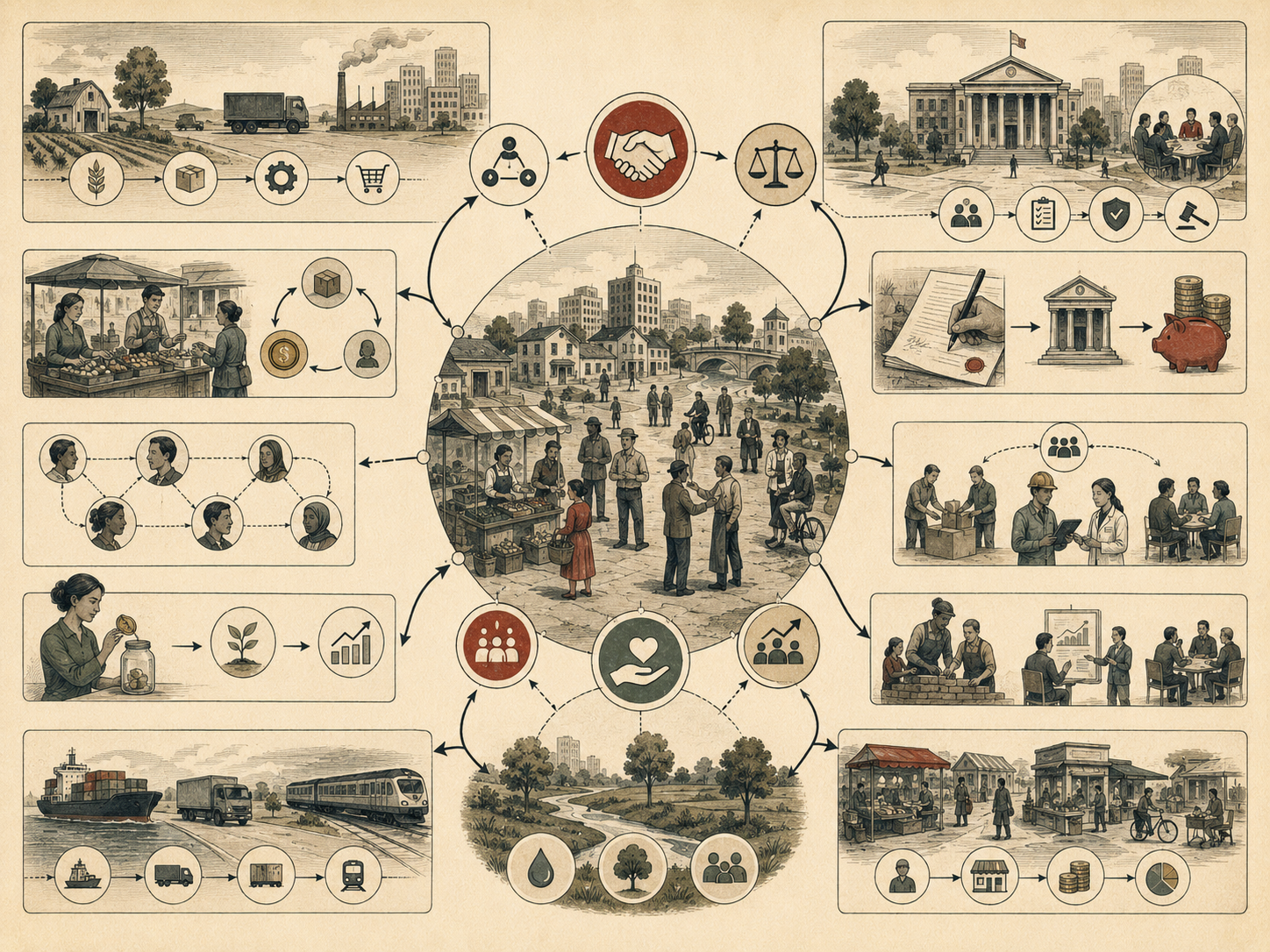
Behavioral economics provides a richer account of these processes by showing that people often care about fairness, reciprocity, legitimacy, reputation, and the behavior of others in ways that cannot be reduced to immediate material payoff. Trust and cooperation therefore link psychology to institutional order. They shape transaction costs, public compliance, organizational performance, market participation, digital exchange, credit relationships, supply-chain resilience, public-goods provision, and the ability of societies to solve collective-action problems over time.
The subject is especially important because trust is both fragile and productive. It can lower the cost of exchange, increase willingness to cooperate, strengthen compliance, and support long-horizon investment. But it can also be abused by opportunistic actors, captured by insiders, or weaponized by institutions that demand trust without earning legitimacy. A serious behavioral account must therefore distinguish trust from naivety, cooperation from submission, and legitimacy from mere compliance.
The Role of Trust in Economic Interaction
Trust refers to the expectation that others will behave in a sufficiently reliable, reciprocal, competent, or norm-abiding manner in situations where one is vulnerable to opportunism. In economic life, this matters because many transactions involve promises, delayed performance, hidden quality, uncertain effort, asymmetric information, or incomplete knowledge about the intentions of others. Buyers trust sellers to deliver what they advertise. Firms trust suppliers to honor obligations. Lenders trust borrowers to repay. Workers trust employers to pay wages and honor commitments. Citizens trust institutions to administer rules impartially and predictably.
Without trust, exchange becomes heavier, slower, and more expensive. Actors must rely more intensively on monitoring, verification, collateral, legal advice, exhaustive contracting, background checks, litigation, reputation systems, and repeated enforcement. In this sense, trust reduces transaction costs by lowering the expected burden of guarding against opportunism. It does not remove the need for law, contract, or oversight, but it changes how much weight ordinary exchange must place on them.
Behavioral economics adds an important insight: trust is not merely an instrumental forecast built from incentives. It is also shaped by fairness expectations, reciprocity norms, prior experience, institutional legitimacy, group identity, emotional memory, and morally charged interpretations of betrayal. This is why trust connects closely to Fairness and Reciprocity in Economic Behavior and Inequality Aversion in Economic Decision-Making. It is simultaneously a cognitive expectation, a social relation, and an institutional resource.
Trust can also be layered. A person may trust an individual seller but distrust the marketplace. A worker may trust a manager but distrust the corporation. A citizen may trust a local office but distrust national institutions. A platform user may trust the rating system but distrust the algorithmic ranking behind it. Economic systems therefore depend on interpersonal trust, organizational trust, institutional trust, and systemic trust operating together.
The economic significance of trust becomes clearest when it is absent. Low-trust environments force actors into defensive behavior. Contracts become more rigid. Credit becomes more expensive. Informal exchange shrinks. Long-term investment becomes riskier. People may avoid mutually beneficial cooperation because they expect betrayal, corruption, arbitrary enforcement, or unequal burden. Trust, therefore, is not merely a pleasant social condition. It is part of the infrastructure of economic coordination.
Cooperation and Collective Action
Cooperation occurs when individuals align behavior in ways that generate mutual or collective benefit despite the temptation to defect, free-ride, or withhold contribution. Many of the most important economic problems take this form: public-goods provision, tax compliance, environmental protection, organizational teamwork, common-pool resource management, infrastructure maintenance, workplace safety, institutional rule-following, and collective adherence to fair market practices.
In narrow self-interest models, these settings often produce under-cooperation because each actor has an incentive to capture the benefits of collective action while avoiding its costs. The Prisoner’s Dilemma remains the classic formalization of this problem. Each individual may do better by defecting if others cooperate, yet all are worse off when everyone defects. This structure appears repeatedly in economic life: firms may prefer others to obey standards while cutting corners themselves; taxpayers may prefer public services while avoiding payment; households may prefer environmental protection while hoping others bear the cost.
Yet experimental and observational evidence repeatedly shows that people cooperate more often than narrow self-interest would predict, especially when reciprocity, fairness, reputation, punishment, communication, and institutional legitimacy are present. People often condition their willingness to contribute on whether others are contributing. They may punish defectors even when punishment is personally costly. They may accept lower material payoffs to preserve fairness or avoid participating in exploitative arrangements.
Behavioral economics helps explain this pattern by showing that cooperation is not only a payoff calculation. It is also a response to perceived fairness, social norms, expectations of reciprocity, and trust in governance. A person may pay taxes not only because penalties exist, but because they believe public institutions are legitimate and others are also contributing. A worker may cooperate with colleagues because shared norms make free-riding morally costly. A firm may comply with standards because reputational and normative incentives supplement formal sanctions.
Cooperation is therefore a behavioral and moral phenomenon as well as a strategic one. It cannot be fully understood without examining expectations, fairness, trust, identity, legitimacy, and institutional design. Economic systems depend on cooperation because many of their most valuable outcomes cannot be produced through isolated optimization alone.
Experimental Evidence on Trust and Reciprocity
Experimental economics has produced some of the clearest evidence that trust and reciprocity are robust features of economic behavior. The Trust Game is especially important. In its classic form, one participant receives an endowment and may send part of it to another participant. The transferred amount is multiplied. The receiver then decides how much to return. Under a strictly self-interested model, the receiver should return nothing, and the sender should anticipate this by sending little or nothing. Yet substantial trusting transfers and reciprocal returns are commonly observed.
The classic paper by Berg, Dickhaut, and McCabe remains foundational because it showed that both trust and reciprocity appear even in experimental settings where opportunism would be the obvious prediction under narrow rationality. The experiment made visible a central behavioral point: people often act as if trust and fairness matter even when immediate material incentives alone would suggest otherwise.
Public-goods experiments extend the point further. In these games, individuals decide how much to contribute to a shared pool that benefits the group. The standard free-rider prediction is low contribution, especially when individual contributions are costly and benefits are shared. Yet many participants contribute at positive levels, especially early in the interaction or when communication, identity, punishment, or reciprocity is present.
Punishment experiments show that cooperation can be stabilized when people are willing to sanction defectors. Fehr and Gächter’s work on cooperation and punishment in public goods experiments demonstrated that individuals often incur personal costs to punish free-riders. This behavior is difficult to explain through narrow immediate self-interest, but it makes sense when people care about fairness, reciprocity, norm enforcement, and the preservation of cooperative order.
These findings matter because they show that cooperation is not a behavioral anomaly. It is a recurring, measurable feature of human economic behavior. The relevant question is not whether humans are always selfish or always cooperative. The question is which institutional and social conditions elicit trust, sustain reciprocity, discourage opportunism, and protect cooperative norms from exploitation.
Trust Games, Public Goods, and Punishment
Trust games, public-goods games, ultimatum games, dictator games, and punishment games each illuminate a different dimension of social preferences. Trust games examine vulnerability and reciprocity. Public-goods games examine collective contribution and free-riding. Ultimatum games examine fairness and rejection of unequal offers. Punishment games examine the willingness to enforce norms even when enforcement is personally costly.
Taken together, these experiments show that economic behavior is often conditional. People are more willing to cooperate when others cooperate. They are more willing to contribute when free-riders can be sanctioned. They are more likely to trust when institutions are perceived as fair or when past behavior supports reliable expectations. They are more likely to withdraw cooperation when they perceive exploitation, hypocrisy, or unequal burden.
This conditionality is crucial for policy and institutional design. Cooperation is rarely a fixed personality trait that institutions merely observe. It is often an emergent property of the environment. A well-designed institution can make cooperation easier, more visible, more reciprocated, and more fairly enforced. A poorly designed institution can turn cooperative actors into defensive actors by exposing them to repeated exploitation or by signaling that defection is widespread and unpunished.
Public-goods experiments also help explain why communication and transparency matter. When people know that others are contributing, cooperation can become self-reinforcing. When people believe others are defecting, cooperation can unravel. This is why visible fairness, credible enforcement, and public trust are not cosmetic features of governance. They shape the expected behavior of others, which in turn shapes individual willingness to cooperate.
Experimental evidence should not be overgeneralized mechanically. Laboratory settings simplify real institutions. But they are powerful because they isolate behavioral mechanisms that also appear in tax systems, organizations, digital platforms, environmental governance, workplace teams, and financial exchange. They help make social preference visible, measurable, and analytically usable.
Trust, Institutions, and Transaction Costs
Institutional economics helps explain why trust matters for macroeconomic performance as well as micro-level interaction. Economic exchange always involves transaction costs: searching for information, negotiating terms, monitoring behavior, enforcing agreements, resolving disputes, verifying quality, managing uncertainty, and adapting when conditions change. In low-trust environments, these costs rise because actors must devote more resources to protecting themselves from opportunism.
Douglass North and Oliver Williamson each showed, in different ways, that institutions exist partly to reduce uncertainty and manage the costs of exchange. Legal rules, bureaucratic procedures, contracts, governance structures, and organizational hierarchies are ways of stabilizing interaction where trust alone is insufficient. But trust remains crucial because it lowers the frequency with which costly safeguards must be activated.
Trust therefore functions as an informal institution that complements formal governance. High-trust settings do not eliminate law, contract, or oversight. They make those systems less burdened, less adversarial, and more efficient in everyday use. Low-trust settings, by contrast, place greater strain on formal institutions and often generate persistent friction even when rules are technically well designed.
In economic systems, trust and formal institutions can reinforce one another. Fair institutions build trust by making rules predictable and enforcement credible. Trust improves institutional performance by increasing voluntary compliance and reducing the need for costly coercion. But the relationship can also deteriorate. Arbitrary enforcement, corruption, opacity, discrimination, or unequal treatment can erode trust, which then raises compliance costs and makes institutions appear even less effective.
Transaction-cost analysis is therefore not separate from behavioral economics. Trust affects the perceived risk of exchange, the willingness to enter contracts, the cost of monitoring, the likelihood of cooperation, and the expected need for enforcement. It changes how actors experience the economic environment.
The Evolution of Cooperation
The study of cooperation was transformed by repeated-game theory and evolutionary reasoning. Robert Axelrod’s work on the iterated Prisoner’s Dilemma showed that reciprocal strategies such as “tit for tat” can sustain cooperation over time by rewarding cooperation and punishing defection. This insight helped explain why cooperative behavior can emerge even in competitive environments when interactions are repeated and future consequences matter.
Repeated interaction changes the logic of cooperation because today’s behavior influences tomorrow’s relationship. Defection may produce short-term gain, but it can destroy future cooperation. Cooperation may require short-term restraint, but it can build durable reciprocal benefit. In this way, repeated games help explain why reputation, memory, and institutional continuity matter in markets, organizations, communities, and international relations.
Yet repeated interaction alone is not the full story. Behavioral economics adds that people often bring fairness concerns, emotional responses, resentment of free-riding, and positive reciprocity into these settings. They are not merely strategic calculators of discounted future payoff. They also interpret behavior socially and morally. Betrayal can produce anger. Fair dealing can produce loyalty. Cooperation can become identity-relevant. Punishment can be motivated by norm defense rather than material gain.
This layered explanation is one of the strengths of behavioral economics. It does not reject game theory. It enriches it by placing real social preferences, real cognitive interpretations, and real institutional contexts inside strategic settings that would otherwise be described too narrowly.
The evolution of cooperation also helps clarify why institutional environments matter. Cooperative behavior is easier to sustain when actors expect future interaction, when reputations are visible, when defection is noticed, when sanctions are credible, and when institutions do not reward opportunism. It is harder to sustain when actors are anonymous, interactions are one-shot, information is unreliable, or powerful actors can defect without consequence.
Trust, Institutions, and Economic Development
Trust is deeply relevant to long-run development. High-trust societies and organizations often experience lower transaction costs, more effective collective action, stronger institutional compliance, and greater predictability in market and public life. Low-trust environments, by contrast, may suffer from corruption, underinvestment, weak contract performance, regulatory evasion, fragile credit relationships, and reluctance to make long-horizon commitments.
This is one reason the idea of social capital became influential in political economy and development research. Robert Putnam argued that civic trust, associational life, and norms of cooperation contribute materially to institutional performance. Behavioral economics complements this view by showing how macro-level institutional quality can emerge from repeated micro-level expectations about reciprocity, fairness, reliability, and legitimacy.
Trust supports development by reducing the cost of coordination. It makes it easier for firms to enter supplier relationships, for lenders to extend credit, for citizens to comply with taxes, for communities to maintain shared infrastructure, and for governments to implement long-term policy. When trust is low, actors may prefer short-term extraction, informal protection, private enforcement, or defensive self-reliance over cooperative investment.
But trust should not be romanticized as a cultural trait detached from institutions. Trust is produced, maintained, and destroyed through lived experience. People trust institutions when they observe fairness, competence, accountability, and consistency. They distrust institutions when they observe corruption, arbitrary rule, exclusion, violence, discrimination, or unkept promises. Development policy must therefore treat trust as an outcome of institutional behavior, not merely as a preexisting social attitude.
Trust links everyday exchange to structural development. It is not a vague cultural residue. It is part of the behavioral foundation of durable institutional order.
Trust and Cooperation Inside Organizations
Trust and cooperation are also central to organizational performance. Firms, public agencies, universities, hospitals, unions, nonprofits, and professional teams all depend on coordinated action under incomplete information. Managers cannot perfectly monitor every action. Employees cannot fully contract for every future condition. Teams cannot function if members assume that others will withhold effort, conceal information, or exploit vulnerability.
Organizational trust reduces internal transaction costs. It makes communication more efficient, supports knowledge sharing, reduces defensive documentation, improves psychological safety, and allows teams to coordinate without constant monitoring. Where trust is low, organizations often become bureaucratically heavy, politically defensive, and less adaptive. Employees may hoard information, avoid initiative, document everything for self-protection, or comply only superficially.
Behavioral economics helps explain why workplace cooperation is shaped by fairness, reciprocity, and perceived legitimacy. People are more willing to contribute discretionary effort when they believe the organization treats them fairly and when peers are also contributing. They withdraw effort when they perceive exploitation, favoritism, opaque decision-making, or unequal burden. Incentives matter, but incentives operate inside a relational environment.
This topic connects naturally to organizational psychology because trust is not only an economic expectation. It is also a social and psychological condition that shapes motivation, identity, communication, learning, and leadership. High-trust organizations are not simply more pleasant. They can be more capable of coordination, adaptation, and long-term performance.
The policy implication is that institutional design inside organizations should not rely solely on surveillance, metrics, and sanctions. Excessive monitoring can sometimes crowd out intrinsic motivation and weaken trust. Effective governance combines accountability with fairness, participation, clarity, and credible commitment. The strongest organizations make cooperation rational, visible, and normatively supported.
Trust in Modern Digital Economies
Digital economies have introduced new environments in which trust must often be constructed without face-to-face familiarity. Online marketplaces, gig platforms, peer-to-peer exchanges, financial applications, creator platforms, delivery platforms, and algorithmically mediated services depend on ratings, verification procedures, reputation systems, platform rules, dispute-resolution systems, interface cues, and data-governance practices that support trust among strangers.
Behavioral economics is especially useful here because trust in digital systems is shaped not only by formal platform rules, but also by transparency, perceived fairness, review credibility, ease of recourse, ranking logic, identity verification, and the visibility of reputational signals. Users must trust not only one another, but the platform itself as an institutional intermediary. When that trust weakens, digital exchange becomes fragile, defensive, and more dependent on costly verification.
Platforms are trust-producing institutions. They decide what information is visible, how sellers and buyers are ranked, how disputes are resolved, which reviews are credible, how fraud is detected, whether exit is possible, and how algorithmic decisions are explained. These design choices influence whether users perceive the environment as fair, safe, and reliable. They also influence whether cooperation among strangers can occur at scale.
This is why the topic belongs in close relation to Behavioral Economics and Digital Platforms and Behavioral Design in Technology Systems. Trust is increasingly being engineered, signaled, quantified, and contested through technological systems rather than only through interpersonal relations.
Digital trust is also vulnerable to manipulation. Fake reviews, opaque algorithms, deceptive interface cues, exploitative friction, and inconsistent enforcement can erode trust quickly. A platform may attempt to manufacture confidence through design while withholding meaningful accountability. Behavioral analysis must therefore distinguish trustworthiness from the appearance of trustworthiness. The goal should not be to make users trust systems that do not deserve trust. It should be to design systems that are actually reliable, fair, transparent, and accountable.
Implications for Economic Policy and Governance
Understanding trust and cooperation has major implications for governance. Policies that strengthen procedural fairness, transparency, accountability, predictability, and consistency can improve institutional trust and thereby enhance compliance and coordination. Policies that appear arbitrary, opaque, selectively enforced, corrupt, or indifferent to unequal burden may erode trust even when they are technically efficient on paper.
This matters in taxation, financial regulation, environmental governance, welfare administration, public health, labor regulation, platform governance, and international cooperation. In each of these domains, successful policy depends not only on incentives, but on whether people believe others will also comply and whether the institution administering the rule is seen as legitimate. Collective action breaks down when actors expect widespread defection, unequal burden-sharing, or institutional bad faith.
Tax compliance is a clear example. People are more willing to comply when they believe the tax system is fair, public goods are visible, enforcement is credible, and others are also contributing. Environmental policy shows the same logic. People may support costly transition policies when burdens are shared and institutions are trusted, but resist when policy appears hypocritical, unequal, or symbolic. Public-benefit systems also depend on trust: eligible people may avoid programs if they fear stigma, surveillance, arbitrary denial, or future penalty.
Governance should therefore treat trust as both an input and an output. Institutions need trust to govern effectively, but institutional behavior produces or destroys trust over time. A policy that secures compliance through fear, opacity, or procedural burden may appear effective in the short run while weakening long-term legitimacy. Conversely, a policy that communicates clearly, distributes burdens fairly, and enforces rules consistently may strengthen voluntary cooperation.
Trust and cooperation should therefore be treated not as secondary moral extras, but as core behavioral conditions of effective governance in complex economic systems.
Distribution, Power, and Unequal Trust Burdens
Trust is not evenly distributed across society, and distrust is not always irrational. People and communities differ in their experiences with markets, employers, platforms, lenders, police, courts, welfare agencies, healthcare institutions, landlords, schools, and regulators. Groups that have experienced discrimination, exclusion, fraud, predatory lending, wage theft, environmental harm, or arbitrary administration may have strong reasons to distrust institutions that others experience as reliable.
This matters because policy discussions sometimes treat low trust as a cultural deficiency rather than a rational response to institutional behavior. Behavioral economics should not pathologize distrust without examining the conditions that produced it. Trust is earned through competence, fairness, transparency, accountability, and repair. It cannot simply be demanded from people who have repeatedly borne the costs of institutional failure.
There is also an unequal burden of cooperation. Some groups are asked to trust institutions more while receiving fewer protections. Workers may be asked to cooperate with employers that can restructure, monitor, or terminate them with little reciprocal security. Tenants may be asked to trust landlords in markets with weak enforcement. Platform workers may be asked to trust algorithmic systems that they cannot inspect or appeal. Marginalized communities may be asked to cooperate with public institutions that have historically harmed them.
A serious account of trust and cooperation must therefore include power. Cooperation is not always good. Cooperation with exploitative systems can reproduce harm. Trust in untrustworthy institutions can increase vulnerability. High measured trust may sometimes reflect dependency or lack of exit rather than genuine legitimacy. Behavioral economics becomes more credible when it distinguishes welfare-enhancing cooperation from coerced cooperation and trustworthiness from mere trust extraction.
Distributional analysis should ask who is expected to trust, who benefits from trust, who bears the cost of betrayal, and who has recourse when cooperation fails. Trust is valuable when it supports fair and mutually beneficial coordination. It is dangerous when it is demanded without accountability.
Empirical and Policy-Evaluation Lens
A professional economist-facing treatment of trust and cooperation should move beyond general claims that trust matters. It should ask what can be measured, identified, estimated, and evaluated. Trust and cooperation can be studied through laboratory experiments, field experiments, survey experiments, administrative data, public-goods games, trust games, natural experiments, difference-in-differences designs, panel data, network analysis, and institutional-performance measures.
The empirical challenge is that trust is both cause and consequence. Trust may increase cooperation, but cooperation can also increase trust. Effective institutions may build trust, but high-trust societies may also make institutions work better. Firms with better governance may experience more trust, but trusted firms may also attract more cooperative workers and customers. Untangling these relationships requires careful design.
Researchers can study trust experimentally by varying institutional assurances, reputation information, communication, transparency, sanction mechanisms, or procedural fairness cues. Field settings can examine whether changes in agency communication, enforcement consistency, platform dispute resolution, tax letters, benefit administration, or workplace governance affect cooperation and compliance. Natural experiments may exploit institutional reforms, policy rollouts, corruption scandals, platform rule changes, or changes in dispute-resolution procedures.
Policy evaluation should distinguish trust outcomes from cooperation outcomes and welfare outcomes. Higher trust is not always desirable if the institution is untrustworthy. Higher cooperation is not always welfare-enhancing if cooperation sustains unfair burden. A serious evaluation should ask whether the policy improves trustworthiness, not merely trust; whether cooperation is reciprocal, not merely compliant; and whether welfare improves across groups, not only on average.
Heterogeneity is central. Trust interventions may affect groups differently depending on prior institutional experience, income, race, class, geography, digital access, legal vulnerability, organizational rank, or exposure to past harm. An institutional reform that raises average trust may still fail communities with strong reasons for distrust. Economists should therefore estimate subgroup effects and examine distributional implications.
A rigorous workflow should ask: What form of trust is being measured? What is the counterfactual? Is cooperation voluntary, reciprocal, and welfare-enhancing? Are institutions becoming more trustworthy, or only better at eliciting trust? Who benefits from cooperation? Who bears the risk of betrayal? These questions are essential for making trust and cooperation analytically serious rather than merely rhetorically appealing.
An Analytical Framework for Trust and Cooperation
A simple behavioral model of trust can begin with an interaction in which one actor must decide whether to extend trust under uncertainty. Let the expected utility of trusting be:
U_T = pR – (1-p)L + \alpha F + \beta N + \theta I
\]
Interpretation: The utility of trusting depends on expected reciprocity, gains from successful cooperation, losses from betrayal, fairness, norms, and institutional support.
Here, \(p\) is the subjective probability that the other actor reciprocates, \(R\) is the gain from successful cooperation, \(L\) is the loss from betrayal, \(F\) is the fairness or reciprocal-value term, \(N\) is the normative or legitimacy component, and \(I\) captures institutional support such as enforcement, transparency, dispute resolution, or reputation systems. Parameters \(\alpha, \beta, \theta > 0\) represent behavioral sensitivity to fairness, norms, and institutional support.
Under narrow self-interest, only \(p\), \(R\), and \(L\) should matter. Behavioral economics adds that many actors also value reciprocal conduct, respond to social norms, and interpret trust through institutional legitimacy. This helps explain why observed trust can exceed what a simple opportunism model would predict.
Cooperation in a repeated setting can be represented similarly. Let the utility of cooperating in period \(t\) be:
U_C^t = \pi_C^t + \gamma E_t(C_{-i}) + \eta P_t – \delta D_t + \lambda L_t
\]
Interpretation: Cooperation depends on direct payoff, expected cooperation by others, punishment credibility, exploitation risk, and perceived legitimacy.
Here, \(\pi_C^t\) is the direct payoff from cooperation, \(E_t(C_{-i})\) is the expected cooperation of others, \(P_t\) is the value attached to punishment of defectors, \(D_t\) is the perceived disadvantage of cooperating when others do not, and \(L_t\) is perceived institutional legitimacy. Parameters \(\gamma, \eta, \delta, \lambda > 0\) measure sensitivity to expectation, punishment structure, exploitation risk, and legitimacy.
This formulation shows why cooperation can rise sharply when actors believe others will cooperate and when defection is socially or institutionally punished. It also shows why trust can collapse when expectations of reciprocity weaken, even if the nominal gains from collective action remain large.
Trust can also be connected to transaction costs. Let transaction cost \(TC\) decline as trust and institutional quality rise:
TC = c_0 – \rho T – \kappa Q + \omega U
\]
Interpretation: Transaction costs fall with trust and institutional quality, but rise with uncertainty, opacity, and opportunism risk.
Here, \(T\) represents trust, \(Q\) represents institutional quality, and \(U\) represents uncertainty or opportunism risk. This equation captures the economic value of trust: it reduces the need for costly monitoring, verification, and enforcement.
For policy evaluation, the treatment effect of an institutional trust intervention can be expressed as:
\tau = E[Y_i(1) – Y_i(0)]
\]
Interpretation: The treatment effect compares trust, cooperation, compliance, or welfare under the institutional intervention with the counterfactual condition.
But welfare analysis should distinguish trust from trustworthiness. Let welfare under institutional regime \(r\) be:
W(r) = B_C(r) + B_T(r) – C_M(r) – C_E(r) – C_B(r)
\]
Interpretation: Welfare depends on cooperative benefit and transaction-cost reduction, minus monitoring costs, enforcement costs, and losses from betrayal or exploitation.
This helps prevent a common error: treating higher trust as automatically good. Trust improves welfare when institutions are trustworthy and cooperation is reciprocal. It can reduce welfare when it exposes actors to exploitation or when powerful institutions elicit trust without accountability.
R Workflow: Repeated Exchange, Reciprocity, and Punishment
The following R workflow simulates repeated exchange among agents who vary in trust propensity, reciprocity, institutional trust, punishment willingness, and sensitivity to betrayal. It is designed as a practical starting point for analysts studying cooperation dynamics, not merely as a toy illustration. The workflow produces repeated-round summaries and a distributional view of cooperation outcomes across trust groups.
# Trust and Cooperation in Economic Systems
# R workflow: repeated exchange, reciprocity, punishment, and welfare
# Synthetic data only. Economist-facing research scaffold.

set.seed(808)

n_agents <- 1000
rounds <- 50

agents <- data.frame(
  agent_id = seq_len(n_agents),
  trust_propensity = pmin(pmax(rnorm(n_agents, 0.55, 0.18), 0), 1),
  reciprocity = pmin(pmax(rnorm(n_agents, 0.50, 0.20), 0), 1),
  punishment_willingness = pmin(pmax(rnorm(n_agents, 0.40, 0.18), 0), 1),
  institutional_trust = pmin(pmax(rnorm(n_agents, 0.55, 0.20), 0), 1),
  betrayal_sensitivity = pmin(pmax(rnorm(n_agents, 0.60, 0.16), 0), 1)
)

simulate_round <- function(agent_data, round_id, institutional_support, norm_strength, punishment_credibility) {
  shuffled <- sample(agent_data$agent_id, n_agents, replace = FALSE)
  pairs <- matrix(shuffled, ncol = 2, byrow = TRUE)

  rows <- vector("list", nrow(pairs))

  for (i in seq_len(nrow(pairs))) {
    sender <- agent_data[agent_data$agent_id == pairs[i, 1], ]
    receiver <- agent_data[agent_data$agent_id == pairs[i, 2], ]

    trust_utility <- 1.6 * sender$trust_propensity +
      0.8 * sender$institutional_trust * institutional_support +
      0.6 * norm_strength -
      0.7 * sender$betrayal_sensitivity

    send_prob <- plogis(trust_utility)
    sent <- rbinom(1, 1, send_prob)

    return_prob <- plogis(
      1.8 * receiver$reciprocity +
        0.7 * norm_strength +
        0.5 * institutional_support -
        0.4
    )

    returned <- ifelse(sent == 1, rbinom(1, 1, return_prob), 0)

    punish_prob <- plogis(
      1.7 * sender$punishment_willingness +
        0.8 * punishment_credibility -
        0.8
    )

    punished <- ifelse(sent == 1 && returned == 0, rbinom(1, 1, punish_prob), 0)

    sender_welfare <- sent * (0.80 * returned - 0.70 * (1 - returned)) -
      0.15 * punished +
      0.20 * institutional_support

    receiver_welfare <- sent * (0.50 + 0.30 * returned - 0.20 * punished)

    rows[[i]] <- data.frame(
      round = round_id,
      sender_id = sender$agent_id,
      receiver_id = receiver$agent_id,
      sent = sent,
      returned = returned,
      punished = punished,
      sender_welfare = sender_welfare,
      receiver_welfare = receiver_welfare,
      total_welfare = sender_welfare + receiver_welfare
    )
  }

  do.call(rbind, rows)
}

history <- list()

for (t in seq_len(rounds)) {
  support <- ifelse(t <= 20, 0.35, 0.70)
  norms <- ifelse(t <= 20, 0.40, 0.70)
  punishment <- ifelse(t <= 20, 0.35, 0.65)

  history[[t]] <- simulate_round(
    agents,
    round_id = t,
    institutional_support = support,
    norm_strength = norms,
    punishment_credibility = punishment
  )
}

history <- do.call(rbind, history)

round_summary <- aggregate(
  cbind(sent, returned, punished, total_welfare) ~ round,
  data = history,
  FUN = mean
)

print(head(round_summary, 10))
print(tail(round_summary, 10))

summary_stats <- data.frame(
  mean_trust_rate = mean(history$sent),
  mean_reciprocity_rate = mean(history$returned[history$sent == 1]),
  mean_punishment_rate = mean(history$punished[history$sent == 1 & history$returned == 0]),
  mean_total_welfare = mean(history$total_welfare)
)

print(summary_stats)

agents$trust_quartile <- cut(
  agents$trust_propensity,
  breaks = quantile(agents$trust_propensity, probs = seq(0, 1, 0.25)),
  include.lowest = TRUE,
  labels = paste0("Q", 1:4)
)

distribution_rows <- list()

for (q in levels(agents$trust_quartile)) {
  ids <- agents$agent_id[agents$trust_quartile == q]

  subset_history <- history[history$sender_id %in% ids, ]

  distribution_rows[[length(distribution_rows) + 1]] <- data.frame(
    trust_quartile = q,
    mean_trust_rate = mean(subset_history$sent),
    mean_reciprocity_received = mean(subset_history$returned[subset_history$sent == 1]),
    mean_punishment_rate = mean(subset_history$punished[subset_history$sent == 1 & subset_history$returned == 0]),
    mean_total_welfare = mean(subset_history$total_welfare)
  )
}

distribution <- do.call(rbind, distribution_rows)
print(distribution)

dir.create("outputs/tables", recursive = TRUE, showWarnings = FALSE)
write.csv(round_summary, "outputs/tables/r_trust_round_summary.csv", row.names = FALSE)
write.csv(summary_stats, "outputs/tables/r_trust_summary_stats.csv", row.names = FALSE)
write.csv(distribution, "outputs/tables/r_trust_distributional_summary.csv", row.names = FALSE)
This structure makes visible how cooperation can depend not only on trusting dispositions, but also on expectations of reciprocity, institutional support, norm strength, and the credible possibility of sanction when trust is violated. It also allows analysts to examine whether improvements in cooperative outcomes are evenly distributed across groups or concentrated among agents who were already predisposed to trust.
Python Workflow: Comparing Trust Regimes Across Economic Environments
The Python workflow below compares three stylized environments: low-trust exchange, reciprocal-market exchange, and institutionally supported cooperation. It estimates trust, reciprocity, punishment, transaction-cost reduction, and average welfare under heterogeneous behavioral parameters. It also creates a synthetic experimental dataset that can support treatment-effect estimation and heterogeneity analysis.
# Trust and Cooperation in Economic Systems
# Python workflow: trust regimes, cooperation, welfare, and treatment effects
# Synthetic data only. Economist-facing research scaffold.

from __future__ import annotations

from pathlib import Path

import numpy as np
import pandas as pd

rng = np.random.default_rng(808)

n = 6000

agents = pd.DataFrame({
    "agent_id": np.arange(1, n + 1),
    "trust_propensity": np.clip(rng.normal(0.55, 0.18, n), 0, 1),
    "reciprocity": np.clip(rng.normal(0.50, 0.20, n), 0, 1),
    "punishment_willingness": np.clip(rng.normal(0.40, 0.18, n), 0, 1),
    "institutional_trust": np.clip(rng.normal(0.55, 0.20, n), 0, 1),
    "betrayal_sensitivity": np.clip(rng.normal(0.60, 0.16, n), 0, 1),
    "monitoring_cost_sensitivity": np.clip(rng.normal(0.55, 0.18, n), 0, 1)
})

def evaluate_environment(
    df: pd.DataFrame,
    institutional_support: float,
    norm_strength: float,
    betrayal_cost: float,
    monitoring_intensity: float
) -> dict[str, float]:
    """
    Evaluate a stylized trust environment.

    institutional_support:
        Strength of credible rules, dispute resolution, and governance.

    norm_strength:
        Strength of cooperative expectations and reciprocal norms.

    betrayal_cost:
        Loss imposed when trust is violated.

    monitoring_intensity:
        Costly formal monitoring required when trust is weak.
    """
    trust_prob = 1 / (
        1 + np.exp(-(
            1.8 * df["trust_propensity"].values
            + 0.9 * institutional_support
            + 0.7 * norm_strength
            + 0.4 * df["institutional_trust"].values
            - 0.8 * df["betrayal_sensitivity"].values
            - 0.5
        ))
    )

    trusted = rng.binomial(1, trust_prob)

    reciprocity_prob = 1 / (
        1 + np.exp(-(
            1.8 * df["reciprocity"].values
            + 0.8 * norm_strength
            + 0.6 * institutional_support
            - 0.4
        ))
    )

    reciprocated = np.where(
        trusted == 1,
        rng.binomial(1, reciprocity_prob),
        0
    )

    punishment_prob = 1 / (
        1 + np.exp(-(
            1.7 * df["punishment_willingness"].values
            + 0.5 * institutional_support
            - 0.7
        ))
    )

    betrayed = (trusted == 1) & (reciprocated == 0)

    punished = np.where(
        betrayed,
        rng.binomial(1, punishment_prob),
        0
    )

    monitoring_cost = monitoring_intensity * df["monitoring_cost_sensitivity"].values

    transaction_cost_reduction = (
        0.30 * institutional_support
        + 0.25 * norm_strength
        + 0.20 * trusted
    )

    welfare = (
        trusted * (0.70 * reciprocated - betrayal_cost * (1 - reciprocated))
        + 0.20 * punished
        + transaction_cost_reduction
        - monitoring_cost
    )

    return {
        "trust_rate": float(trusted.mean()),
        "reciprocity_rate": float(reciprocated[trusted == 1].mean()) if trusted.sum() > 0 else 0.0,
        "punishment_rate": float(punished[betrayed].mean()) if betrayed.sum() > 0 else 0.0,
        "mean_monitoring_cost": float(monitoring_cost.mean()),
        "mean_transaction_cost_reduction": float(transaction_cost_reduction.mean()),
        "mean_welfare": float(welfare.mean())
    }

regimes = {
    "low_trust_exchange": {
        "institutional_support": 0.10,
        "norm_strength": 0.15,
        "betrayal_cost": 0.70,
        "monitoring_intensity": 0.35
    },
    "reciprocal_market_exchange": {
        "institutional_support": 0.45,
        "norm_strength": 0.55,
        "betrayal_cost": 0.50,
        "monitoring_intensity": 0.20
    },
    "institutionally_supported_cooperation": {
        "institutional_support": 0.80,
        "norm_strength": 0.75,
        "betrayal_cost": 0.35,
        "monitoring_intensity": 0.10
    }
}

rows = []

for name, params in regimes.items():
    out = evaluate_environment(agents, **params)
    out["regime"] = name
    rows.append(out)

results = pd.DataFrame(rows)[[
    "regime",
    "trust_rate",
    "reciprocity_rate",
    "punishment_rate",
    "mean_monitoring_cost",
    "mean_transaction_cost_reduction",
    "mean_welfare"
]]

print(results.sort_values("mean_welfare", ascending=False))

agents["trust_group"] = pd.qcut(
    agents["trust_propensity"],
    4,
    labels=["low", "medium", "high", "very_high"]
)

dist_rows = []

for name, params in regimes.items():
    for group in agents["trust_group"].unique():
        subset = agents.loc[agents["trust_group"] == group].copy()
        out = evaluate_environment(subset, **params)
        out["regime"] = name
        out["trust_group"] = str(group)
        dist_rows.append(out)

distribution = pd.DataFrame(dist_rows)
print(distribution.sort_values(["regime", "trust_group"]))

# Synthetic experimental dataset for treatment-effect estimation.
experimental = agents.copy()
experimental["treatment"] = rng.choice(
    ["low_trust_exchange", "reciprocal_market_exchange", "institutionally_supported_cooperation"],
    size=len(experimental),
    p=[0.34, 0.33, 0.33]
)

def assign_outcome(row):
    params = regimes[row["treatment"]]
    tmp = pd.DataFrame([row])
    outcome = evaluate_environment(tmp, **params)
    return pd.Series(outcome)

outcome_df = experimental.apply(assign_outcome, axis=1)
experimental = pd.concat([experimental, outcome_df], axis=1)

experimental["reciprocal_market_treat"] = (
    experimental["treatment"] == "reciprocal_market_exchange"
).astype(int)

experimental["institutional_support_treat"] = (
    experimental["treatment"] == "institutionally_supported_cooperation"
).astype(int)

try:
    import statsmodels.api as sm

    X = experimental[[
        "reciprocal_market_treat",
        "institutional_support_treat",
        "trust_propensity",
        "reciprocity",
        "punishment_willingness",
        "institutional_trust",
        "betrayal_sensitivity",
        "monitoring_cost_sensitivity"
    ]]
    X = sm.add_constant(X)

    for outcome in ["trust_rate", "reciprocity_rate", "mean_welfare"]:
        model = sm.OLS(experimental[outcome], X).fit(cov_type="HC1")
        print(f"\nOutcome: {outcome}")
        print(model.summary().tables[1])

except ImportError:
    print("statsmodels not installed; skipping regression table.")

output_dir = Path("outputs/tables")
output_dir.mkdir(parents=True, exist_ok=True)

results.to_csv(output_dir / "trust_regime_summary.csv", index=False)
distribution.to_csv(output_dir / "trust_distributional_summary.csv", index=False)
experimental.to_csv(output_dir / "synthetic_trust_cooperation_experiment.csv", index=False)
For researchers and policymakers, the value of this comparison is that it shows how institutional support and normative strength can alter the behavioral equilibrium of exchange rather than merely changing formal incentives. It also separates the trust rate from welfare, reminding analysts that greater trust is valuable only when reciprocity, accountability, and institutional support make trust reasonably safe.
Stata Replication Note: Trust and Cooperation Policy Evaluation
For an economist-facing repository, the companion code should support Stata as well as R and Python. The article-level GitHub folder should include a Stata workflow that imports the synthetic experiment dataset, estimates treatment effects, reports robust standard errors, and exports regression tables. A compact Stata pattern for this article would look like this:
clear all
set more off

* Trust and Cooperation in Economic Systems
* Stata policy-evaluation scaffold using synthetic data.

global ROOT "`c(pwd)'"
global TABLES "$ROOT/outputs/tables"
global REG "$ROOT/outputs/regression_tables"

capture mkdir "$REG"

import delimited "$TABLES/synthetic_trust_cooperation_experiment.csv", clear varnames(1)

label variable reciprocal_market_treat "Reciprocal market exchange treatment"
label variable institutional_support_treat "Institutionally supported cooperation treatment"
label variable trust_rate "Simulated trust outcome"
label variable reciprocity_rate "Simulated reciprocity outcome"
label variable mean_welfare "Synthetic welfare outcome"

local controls trust_propensity reciprocity punishment_willingness institutional_trust betrayal_sensitivity monitoring_cost_sensitivity
local outcomes trust_rate reciprocity_rate punishment_rate mean_monitoring_cost mean_transaction_cost_reduction mean_welfare

tempname handle
postfile `handle' str45 outcome str45 term double estimate double std_error double p_value double n using "$REG/stata_trust_cooperation_estimates.dta", replace

foreach y of local outcomes {
    regress `y' reciprocal_market_treat institutional_support_treat `controls', vce(robust)

    foreach x in reciprocal_market_treat institutional_support_treat {
        local b = _b[`x']
        local se = _se[`x']
        local p = 2 * ttail(e(df_r), abs(_b[`x'] / _se[`x']))
        local n = e(N)
        post `handle' ("`y'") ("`x'") (`b') (`se') (`p') (`n')
    }
}

postclose `handle'

use "$REG/stata_trust_cooperation_estimates.dta", clear
export delimited using "$REG/stata_trust_cooperation_estimates.csv", replace

display "Stata trust and cooperation policy-evaluation workflow complete."
The purpose of including Stata is to make the repository useful to economists, policy analysts, and graduate-level applied researchers who commonly work across Stata, R, and Python. The full repository scaffold should also include identification notes, robustness plans, replication instructions, synthetic panel data, treatment-effect estimation, and sensitivity tests for assumptions about reciprocity, punishment credibility, institutional support, betrayal cost, monitoring cost, transaction-cost reduction, and welfare.
GitHub Repository
The companion repository provides reproducible scaffolding for the computational side of this article, including synthetic trust-and-cooperation datasets, repeated-exchange simulations, public-goods and reciprocity models, punishment and norm-enforcement workflows, treatment-effect estimation, welfare analysis, transaction-cost diagnostics, distributional summaries, robustness checks, Stata/R/Python workflows, SQL metadata structures, and scientific-computing examples for behavioral economics research.
Complete Code Repository
This article is supported by an article-level folder in the Behavioral Economics computational repository, with synthetic panel and experiment-style datasets, causal-inference workflows, welfare analysis, econometric identification notes, policy-evaluation scripts, robustness and sensitivity checks, Stata/R/Python workflows, SQL metadata structures, and scientific-computing examples for studying trust, reciprocity, cooperation, public goods, punishment, transaction costs, institutional support, digital platforms, and behavioral governance.
Interpretive Limits and Cautions
Trust and cooperation are powerful concepts, but they can be misused or overstated. Not every cooperative outcome is desirable. Not every increase in trust improves welfare. Not every institution that asks for trust deserves it. Behavioral economics should not treat trust as a universal good detached from power, accountability, and institutional performance.
There is a danger of romanticizing cooperation in ways that obscure exploitation. Workers may be asked to cooperate with unfair employers. Citizens may be asked to trust opaque institutions. Platform users may be asked to trust algorithms they cannot inspect. Communities may be asked to cooperate with policies whose burdens are unequally distributed. In such cases, the problem may not be insufficient trust. It may be insufficient trustworthiness.
There is also a danger of blaming low-trust communities for institutional failures they did not create. Distrust may be a rational response to corruption, discrimination, extraction, arbitrary enforcement, or broken promises. Policy should not simply attempt to increase trust through messaging. It should improve institutional behavior so that trust becomes justified.
Experimental evidence also has limits. Laboratory games clarify behavioral mechanisms, but real institutions involve history, law, identity, power, inequality, and repeated experience. A trust game can reveal reciprocity, but it cannot by itself explain why some communities distrust particular institutions or why cooperation collapses under unequal burden. Professional analysis should therefore combine experimental evidence with historical, institutional, and distributional interpretation.
The strongest use of behavioral economics is not to make people more trusting in general. It is to understand when trust is justified, how cooperation can be sustained fairly, and how institutions can become worthy of the trust they require.
Conclusion
Trust and cooperation are not soft moral extras added onto otherwise self-contained economic systems. They are part of the behavioral substrate through which exchange, coordination, and institutional order become possible under uncertainty. Markets function more effectively when actors expect reciprocity, when institutions are perceived as legitimate, and when opportunism is constrained not only by law but by norms, reputation, accountability, and credible punishment.
Behavioral economics clarifies why this matters. Economic coordination depends not only on prices and contracts, but on how people interpret one another’s behavior, whether they expect fairness, whether they believe others will also comply, and whether institutions have earned legitimacy. Trust links micro-level judgment to macro-level institutional performance. Cooperation links individual motivation to collective order.
The mature lesson is not that trust should replace formal institutions. It is that formal institutions and trust are interdependent. Good institutions make trust safer. Trust makes institutions less costly to operate. Cooperation helps economic systems solve problems that cannot be solved by isolated self-interest alone. But trust and cooperation must be reciprocal, accountable, and welfare-enhancing. Otherwise, they can become tools of exploitation.
In that sense, trust and cooperation offer one of the clearest examples of how behavioral economics expands the understanding of economic order beyond narrow optimization models toward a fuller account of social life, institutional design, public legitimacy, and the conditions under which people can coordinate fairly under uncertainty.
Related Articles
- Behavioral Economics
- Fairness and Reciprocity in Economic Behavior
- Inequality Aversion in Economic Decision-Making
- Behavioral Regulation and Institutional Design
- Behavioral Economics and Organizational Decision-Making
- Behavioral Economics and Digital Platforms
- Behavioral Design in Technology Systems
- Behavioral Insights in Environmental Policy
- Nudge Theory and Behavioral Public Policy
- Choice Architecture and Decision Environments
Further Reading
- Axelrod, R. (2024) The Evolution of Cooperation. New York: Basic Books. Available at: https://www.basicbooks.com/titles/robert-axelrod/the-evolution-of-cooperation/9781541606845/.
- Berg, J., Dickhaut, J. and McCabe, K. (1995) ‘Trust, reciprocity, and social history’, Games and Economic Behavior, 10(1), pp. 122–142. Available at: https://www.sciencedirect.com/science/article/pii/S0899825685710275.
- Dunn, J. (2020) ‘Trust’, in Zalta, E.N. (ed.) The Stanford Encyclopedia of Philosophy. Available at: https://plato.stanford.edu/entries/trust/.
- Fehr, E. and Gächter, S. (2000) ‘Cooperation and punishment in public goods experiments’, American Economic Review, 90(4), pp. 980–994. Available at: https://www.aeaweb.org/articles?id=10.1257/aer.90.4.980.
- Kahneman, D. (2011) Thinking, Fast and Slow. New York: Farrar, Straus and Giroux. Available at: https://us.macmillan.com/books/9780374533557/thinkingfastandslow.
- North, D.C. (1990) Institutions, Institutional Change and Economic Performance. Cambridge: Cambridge University Press. Available at: https://www.cambridge.org/core/books/institutions-institutional-change-and-economic-performance/AAE1E27DF8996E24C5DD07EB79BBA7EE.
- Putnam, R.D. (2000) Bowling Alone: The Collapse and Revival of American Community. New York: Simon & Schuster. Available at: https://www.simonandschuster.com/books/Bowling-Alone/Robert-D-Putnam/9780743203043.
- Williamson, O.E. (1998) The Economic Institutions of Capitalism. New York: Free Press. Available at: https://www.simonandschuster.com/books/The-Economic-Intstitutions-of-Capitalism/Oliver-E-Williamson/9780684863740.
References
- Axelrod, R. (2024) The Evolution of Cooperation. New York: Basic Books. Available at: https://www.basicbooks.com/titles/robert-axelrod/the-evolution-of-cooperation/9781541606845/.
- Berg, J., Dickhaut, J. and McCabe, K. (1995) ‘Trust, reciprocity, and social history’, Games and Economic Behavior, 10(1), pp. 122–142. Available at: https://www.sciencedirect.com/science/article/pii/S0899825685710275.
- Dunn, J. (2020) ‘Trust’, in Zalta, E.N. (ed.) The Stanford Encyclopedia of Philosophy. Available at: https://plato.stanford.edu/entries/trust/.
- Fehr, E. and Gächter, S. (2000) ‘Cooperation and punishment in public goods experiments’, American Economic Review, 90(4), pp. 980–994. Available at: https://www.aeaweb.org/articles?id=10.1257/aer.90.4.980.
- Kahneman, D. (2011) Thinking, Fast and Slow. New York: Farrar, Straus and Giroux. Available at: https://us.macmillan.com/books/9780374533557/thinkingfastandslow.
- North, D.C. (1990) Institutions, Institutional Change and Economic Performance. Cambridge: Cambridge University Press. Available at: https://www.cambridge.org/core/books/institutions-institutional-change-and-economic-performance/AAE1E27DF8996E24C5DD07EB79BBA7EE.
- Putnam, R.D. (2000) Bowling Alone: The Collapse and Revival of American Community. New York: Simon & Schuster. Available at: https://www.simonandschuster.com/books/Bowling-Alone/Robert-D-Putnam/9780743203043.
- The Nobel Prize (1993) ‘Douglass C. North facts’. Available at: https://www.nobelprize.org/prizes/economic-sciences/1993/north/facts/.
- The Nobel Prize (2009) ‘Oliver E. Williamson facts’. Available at: https://www.nobelprize.org/prizes/economic-sciences/2009/williamson/facts/.
- Williamson, O.E. (1998) The Economic Institutions of Capitalism. New York: Free Press. Available at: https://www.simonandschuster.com/books/The-Economic-Intstitutions-of-Capitalism/Oliver-E-Williamson/9780684863740.