Analytical Psychology, Symbolism & the Depth Mind

Analytical Psychology, Symbolism & the Depth Mind examines the psychological traditions through which scholars have sought to understand the unconscious, symbolic life, inner conflict, and the deeper structures of selfhood that shape the human person beyond conscious awareness alone. In the history of psychology, the field has linked complexes, dreams, archetypes, typology, persona, shadow, individuation, and symbolic interpretation in ways that illuminate how human beings are formed not only through traits and development, but through image, projection, inward contradiction, and the difficult process of becoming more whole.

This category explores the major theories, concepts, and debates of analytical psychology, including the personal and collective unconscious, archetypes, complexes, dreams, psychological types, individuation, post-Jungian developments, and the relation of depth psychology to myth, religion, literature, and symbolic imagination. It considers how analytical psychology interprets the psyche as a domain of meaning-bearing images and unfinished tensions, how inner life unfolds through symbolic process and transformation, and how the tradition contributes to wider reflection on selfhood, spirituality, narrative, and the depth structure of the mind.

Analytical psychology, symbolism, and the depth mind play an important role in psychological and cultural inquiry because they preserve a serious account of inward life that cannot be reduced to surface behavior, information processing, or explicit belief alone. By engaging this tradition critically and rigorously, this category deepens understanding of the unconscious, symbolic imagination, dreams, projection, inner development, and the enduring problem of how the psyche becomes intelligible to itself.

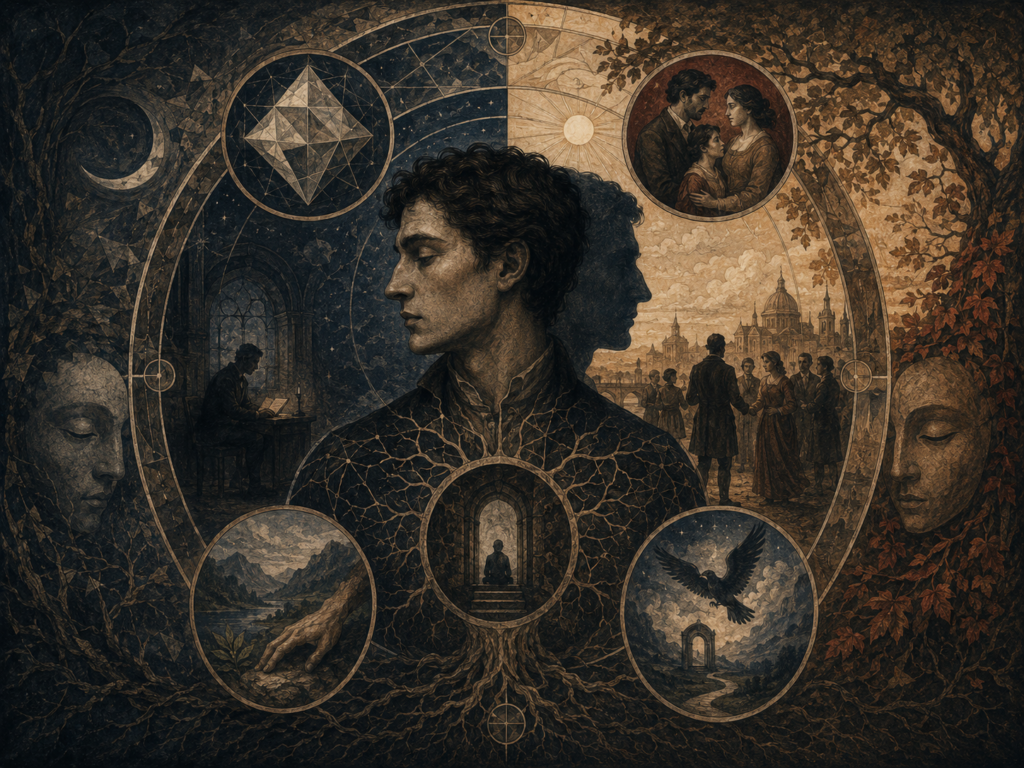
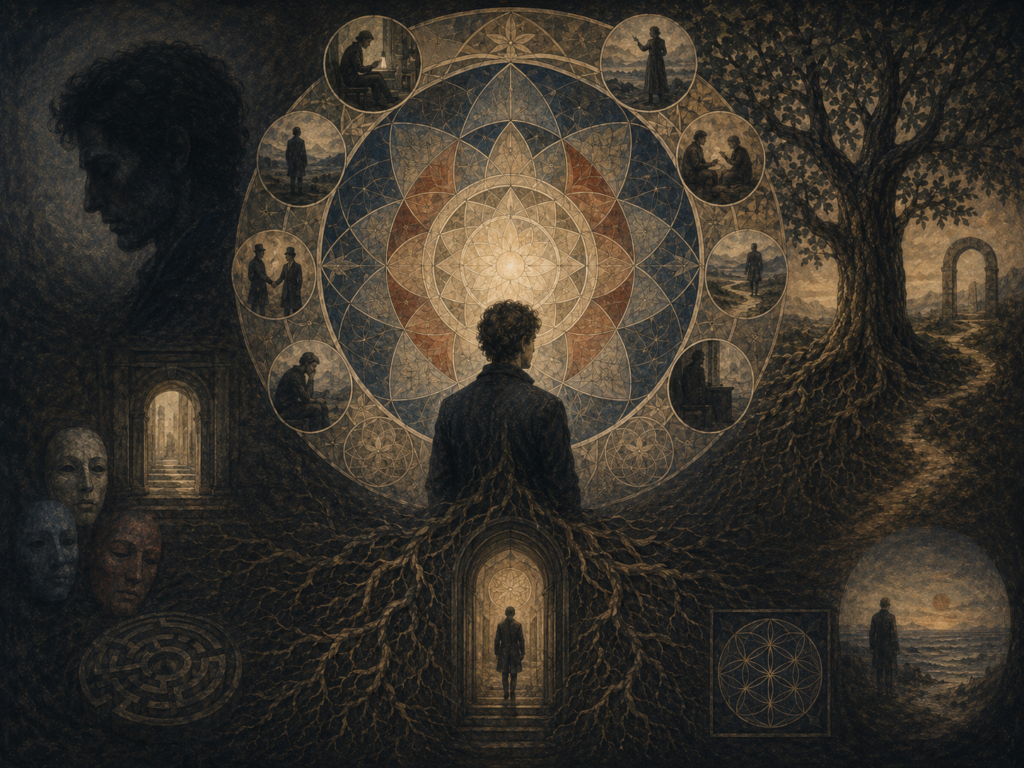
A central figure stands between shadowed inward space and outward social light, surrounded by symbolic circles for sensing, intuition, thinking, and feeling.

Psychological Types: Introversion, Extraversion, and the Four Functions

Jung’s theory of psychological types is far richer than the simplified type labels that later popular culture often associates with it. In analytical psychology, introversion and extraversion describe the basic attitudes of psychic orientation, while thinking, feeling, sensation, and intuition describe the principal functions through which consciousness perceives and evaluates reality. This article explains how Jung understood these attitudes and functions as a dynamic structure of conscious organization rather than as a static set of personality boxes. It also explores dominant and inferior functions, the problem of one-sided development, and the role of typology in psychic differentiation, showing that type theory is ultimately a psychology of both strength and imbalance rather than a flattering vocabulary of fixed identity.

A seated figure writes in a journal while symbolic figures, mandala geometry, masks, roots, birds, and dreamlike presences emerge in the room.

Active Imagination and the Practice of Symbolic Dialogue

Active imagination is one of Jung’s most original methods because it asks consciousness to enter into disciplined dialogue with symbolic material rather than merely interpreting it after the fact. Instead of drifting into fantasy or being passively overwhelmed by imaginal content, the practitioner remains reflectively present while figures, scenes, moods, and symbols unfold with relative autonomy. This article explains what Jung meant by active imagination, how it differs from ordinary fantasy and dream interpretation, why it can deepen relation to shadow and inner conflict, and how it supports individuation through symbolic encounter. It also emphasizes the method’s risks, showing why active imagination requires ego strength, interpretive restraint, and ethical seriousness rather than mystical surrender or imaginative excess.

A contemplative figure stands before a symbolic mythic landscape with masks, moon and sun imagery, ancient ruins, a labyrinth, birds, trees, and archetypal figures.

Myth, Symbol, and the Archetypal Imagination

In analytical psychology, myth and symbol are treated as enduring expressions of the archetypal imagination through which the psyche gives form to conflict, transformation, order, and meaning. Jung regarded myths not merely as old stories or mistaken cosmologies, but as symbolic dramas that reveal recurrent psychic structures also visible in dreams, rituals, religions, and works of art. This article examines how myth functions as psychic drama, how symbols mediate between consciousness and what exceeds it, and how the archetypal imagination helps explain recurring forms such as descent, sacrifice, sacred center, shadow, guide, and rebirth. It also emphasizes the need for interpretive discipline, showing that symbolic recurrence must always be read in relation to history, culture, ritual context, and lived experience rather than reduced to empty universalism.

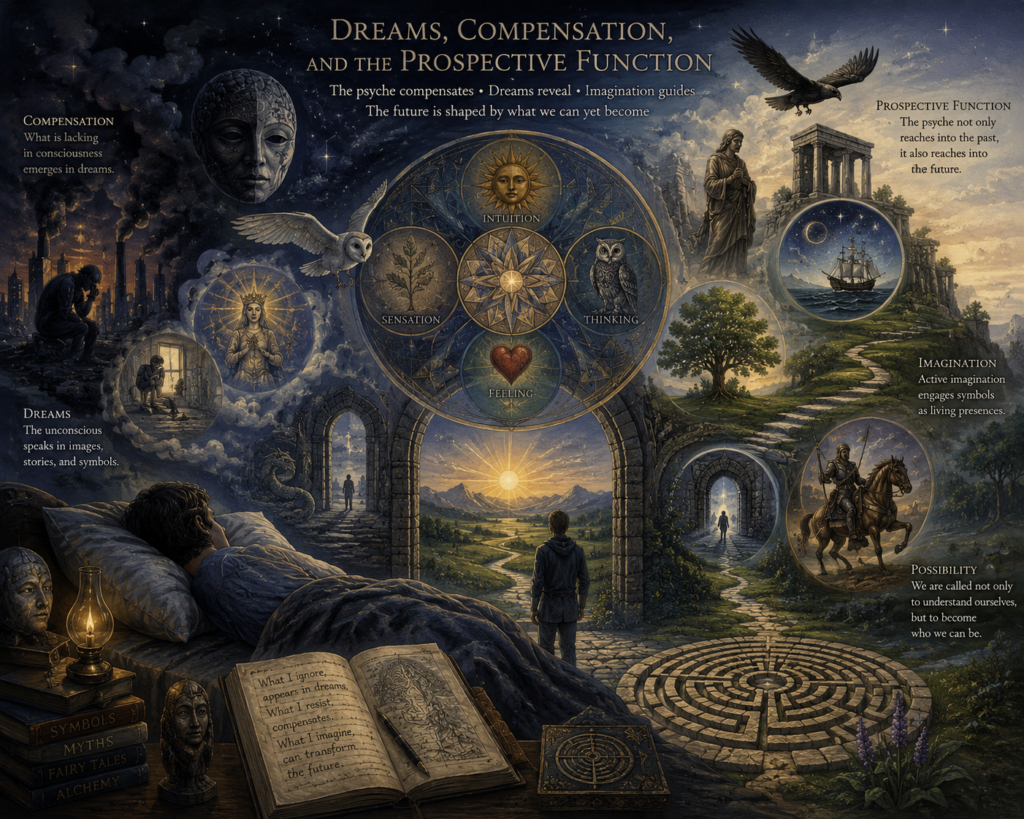
A sleeping figure enters a symbolic dreamscape divided between night and dawn, with masks, birds, portals, ruins, trees, a labyrinth, and a path toward possibility.

Dreams, Compensation, and the Prospective Function

Jung’s theory of dreams goes beyond retrospective explanation by arguing that dreams often compensate for conscious one-sidedness and may also serve a prospective function. Rather than merely expressing hidden residues of past conflict, dreams can symbolically anticipate directions of psychological becoming before the waking ego has fully grasped them. This article examines how compensation works in Jungian dream theory, what Jung meant by the prospective function of the unconscious, and how retrospective and prospective meanings can coexist in the same dream. It also clarifies why prospective dreams are not prophecy, why dream series are crucial for interpretation, and how this bold idea expands dream work from symptom analysis toward a developmental understanding of psyche, symbol, and individuation.

A sleeping figure rests beside open journals as a symbolic dreamscape unfolds with masks, birds, moonlight, portals, ruins, trees, shadow figures, and a labyrinth.

Dream Interpretation in Analytical Psychology

In analytical psychology, dreams are treated as meaningful symbolic productions through which the unconscious reveals conflict, compensation, one-sidedness, and unrealized development. Jungian dream interpretation rejects both fixed dream dictionaries and reductive decoding systems, insisting instead that dream images must be understood in relation to the dreamer’s conscious attitude, emotional context, and wider symbolic life. This article explains how Jung understood dreams as spontaneous self-portraits of the psyche, why compensation is central to dream meaning, how amplification differs from personal association, and why dream series often reveal development more clearly than isolated dreams. It presents dream work as one of the most rigorous and symbolically rich methods in analytical psychology rather than as mystical speculation or mechanical decoding.

A solitary figure stands before a luminous mandala-like center, surrounded by roots, shadow, masks, thresholds, memory scenes, and a symbolic tree.

The Self in Jungian Thought: Totality, Center, and Symbol

In Jungian thought, the Self is not the ego enlarged but the totality of the psyche and the symbolic center that orders its differentiated parts. Jung used the concept to explain how psychic life tends toward integration, compensation, and forms of inward wholeness that exceed conscious identity alone. This article examines the Self as totality, center, regulator, and symbolic horizon, showing why it appears through mandalas, quaternities, sacred centers, and other images of psychic order rather than through direct conceptual grasp. It also explores the relation between the Self and individuation, the tension between psychology and religious symbolism in Jung’s language, and the enduring value and risks of one of analytical psychology’s most ambitious concepts.

A central figure emerges from a shadowed unconscious field toward a mirror and mandala-like light, surrounded by masks, thresholds, memory scenes, and symbolic pathways.

Ego, Consciousness, and Psychic Differentiation

In analytical psychology, the ego is not the whole self but the center of consciousness through which memory, judgment, intention, and identity are organized. Jung’s account of ego and psychic differentiation shows how consciousness emerges as a necessary but limited achievement within a larger psychic field that exceeds it. This article examines the formation of the ego, the selective nature of consciousness, the differentiation of psychic functions, and the risks of ego rigidity, inflation, and one-sided development. It also explores how ego-consciousness relates to persona, shadow, and individuation, presenting Jung’s model as a serious theory of selfhood in which consciousness is both indispensable and radically incomplete.

A contemplative figure stands between opposing symbolic profiles, masks, roots, thresholds, mandala geometry, and fractured gendered forms.

Anima, Animus, and the Problem of Gendered Symbolism

Jung’s concepts of anima and animus remain among the most suggestive and controversial ideas in analytical psychology because they try to explain how the psyche encounters inner difference through symbolic figures of otherness, projection, desire, and imagination. Traditionally framed as the inner feminine in a man and the inner masculine in a woman, these concepts carry both interpretive power and major problems, especially where they rely on binary and essentialist assumptions about gender. This article examines what Jung was trying to describe, why these figures matter for understanding projection and relational fantasy, and how the concepts can be rethought today without preserving outdated metaphysics of masculinity and femininity. It treats anima and animus as historically important but critically revisable tools for thinking about psyche, symbolism, and relational life.

A solitary figure stands between light and shadow, surrounded by mirrors, masks, fractured panels, roots, thresholds, and hidden faces.

The Shadow and the Psychology of Disowned Selfhood

In analytical psychology, the shadow is not simply the “dark side” of the personality, but the broader field of traits, affects, desires, vulnerabilities, and conflicts that the conscious self refuses to recognize as its own. Jung’s concept of shadow helps explain why moral certainty can coexist with blindness, why projection distorts relationships, and why disowned selfhood continues to act even when it is excluded from conscious identity. This article examines how the shadow forms, how it relates to persona and projection, why it can contain vitality as well as destructiveness, and why shadow integration is essential to individuation. It treats the shadow as a serious concept of divided selfhood rather than a slogan about darkness or transgression.

Scroll to Top