
Last Updated May 29, 2026
One of Jung’s most distinctive contributions to dream theory is the claim that dreams are not only retrospective expressions of conflict or disguised residues of past experience, but also compensatory and sometimes prospective psychic events. They respond to the present condition of consciousness, reveal what waking life excludes, and may also orient the dreamer toward possibilities of development not yet consciously realized. The dream, in this view, is not merely a nocturnal replay of what has already happened. It is an imaginal act of psychic regulation, correction, and sometimes symbolic anticipation.
This prospective dimension does not mean that dreams predict the future in a supernatural or literal sense. Jung’s claim is more subtle and more psychologically disciplined. A dream may anticipate future development because the psyche is already reorganizing itself beneath the level of conscious awareness. The dream gives image, scene, figure, mood, or dramatic structure to what is beginning to form before the ego can name it. A bridge appears before the dreamer has crossed it in life. A house gains new rooms before consciousness knows how to inhabit them. A child, guide, center, road, threshold, or dawn light appears before the waking personality understands what kind of change is being prepared.
This claim matters because it changes the entire task of dream interpretation. If dreams are only backward-looking, then interpretation is primarily a search for hidden causes in prior experience. Jung did not deny the importance of personal history, repression, unresolved conflict, trauma, or infantile material. But he argued that dreams often do more than repeat the past. They may correct the present attitude of consciousness, compensate for its one-sidedness, and disclose symbolic tendencies that point toward future psychological reorganization. A dream can therefore be retrospective, compensatory, and prospective at the same time.
Main Library
Publications
Article Map
Analytical Psychology
Related Topic
Personality Psychology
Related Topic
Cognitive Psychology
Related Topic
Developmental Psychology
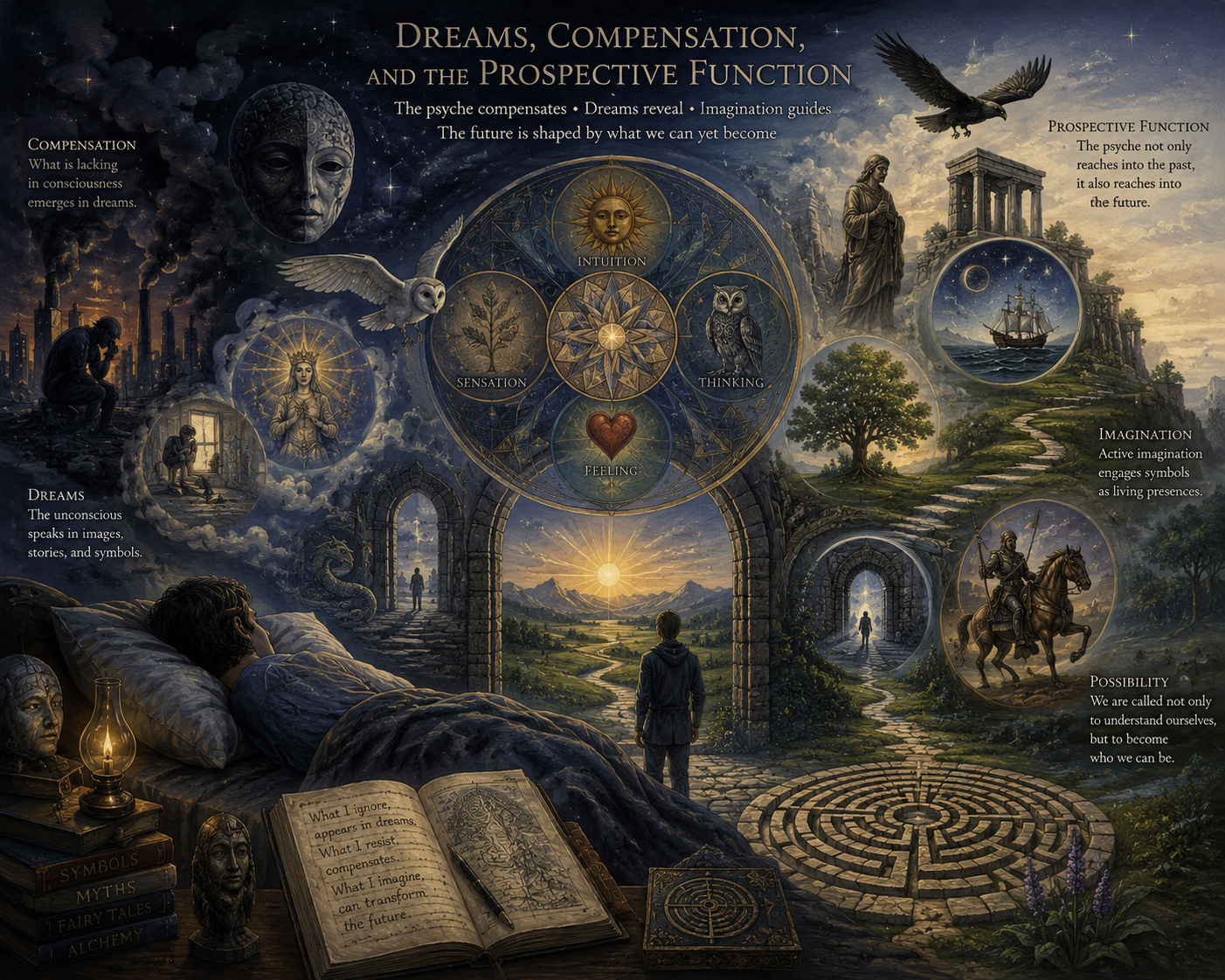
The compensatory function is central. Consciousness narrows itself through identity, role, conviction, defense, ideology, adaptation, and habit. The dream often answers that narrowing by presenting contrary material: weakness to pride, grief to emotional dryness, disorder to excessive control, danger to complacency, body to abstraction, solitude to social overadaptation, or center to fragmentation. Compensation is the psyche’s way of restoring relation where waking life has become too lopsided. Yet sometimes the dream does more than rebalance. It introduces images, figures, spaces, or symbolic movements that suggest what the psyche is trying to become.
This is what Jung called the prospective function of the unconscious. The psyche is not only a repository of the past. It is dynamic, self-organizing, symbolic, and developmentally active. Dreams may therefore be read not only as symptoms of what has been, but as symbolic intimations of what is psychically in formation. This does not authorize fantasy, prediction, or inflated certainty. The prospective function is not a license to treat every dream as prophecy. It is a disciplined interpretive claim that some dreams disclose latent directions of psychological becoming.
This article examines compensation and the prospective function in Jungian dream theory. It explains how dreams answer one-sided consciousness, how prospective images differ from literal prediction, how retrospective and prospective meanings can coexist, why dream series are especially important, how compensatory symbolism relates to individuation, what contemporary psychological frameworks can and cannot contribute, and why the prospective view remains one of the boldest and most controversial elements of analytical psychology’s approach to dreams.
Why Compensation and Prospection Matter
Compensation and prospection matter because they make Jungian dream theory more than a method for recovering hidden causes. They allow dreams to be understood as active responses of the psyche to the present condition of consciousness and as symbolic indications of psychological movement beyond the present. This makes dream life developmental rather than merely residual. The dream does not simply explain why the person is as they are. It may also show where the psyche is trying to move.
This matters especially in analytical psychology because Jung did not view the unconscious as inert storage. The unconscious is dynamic. It reacts, balances, remembers, disturbs, organizes, and sometimes anticipates. It may preserve unresolved conflict, but it may also produce symbolic forms that correct the ego’s present attitude and hint at future reorganization. Dreams therefore occupy a unique position between history and possibility. They may disclose what consciousness has forgotten, refused, exaggerated, underestimated, or not yet become capable of living.
The compensatory view gives dreams psychological seriousness without making them supernatural. A dream may answer a conscious attitude not because some external force is sending a message, but because the psyche itself seeks balance. Consciousness is necessarily selective. It cannot include every feeling, value, memory, bodily signal, instinct, fear, wish, or symbolic possibility at once. The dream brings excluded material back into view, often in a form more vivid than ordinary reflection.
The prospective view gives dreams developmental seriousness without turning them into prophecy. A dream may anticipate because psychic development often begins unconsciously. The ego may experience only confusion, crisis, boredom, collapse, or repetition, while the unconscious is already forming images of transition. A door appears before a decision is conscious. A new room appears before a new psychic space is inhabited. A guide appears before the ego trusts guidance. A path appears before the person has language for direction. These images do not guarantee outcomes. They symbolize tendencies, pressures, and possibilities.
Compensation and prospection also matter because they change the ethics of interpretation. A dream is not only a puzzle to decode. It is a response to how the person is living. It may critique the ego. It may reveal the cost of a persona. It may show the shadow of a moral position. It may expose the poverty of a purely intellectual attitude. It may show that what appears to be breakdown also contains the beginnings of reorganization. Interpretation therefore requires humility. The dream may know something consciousness does not yet know, but that knowledge remains symbolic, partial, and in need of careful testing against life.
In this sense, dreams become one of the psyche’s major forms of self-regulation. They compensate for imbalance and may prospectively image development. They reveal the unconscious not only as a place of buried pasts, but as an active field of symbolic intelligence.
The Compensatory Function of Dreams
The compensatory function of dreams is among Jung’s clearest and most enduring ideas. Consciousness becomes one-sided. It identifies with some role, mood, value, function, defense, ideology, persona, or interpretation and neglects other psychic realities. The dream frequently answers this one-sidedness by presenting contrary, missing, exaggerated, or neglected material. Compensation is therefore not punishment but correction. It is the psyche’s attempt to reintroduce what waking life has excluded.
A person who feels invulnerable may dream of injury. Someone who lives only in abstract thought may dream of bodily scenes, animals, hunger, sexuality, disease, or raw emotion. Someone trapped in social adaptation may dream of hidden chambers, neglected children, wild landscapes, strange animals, or figures who refuse polite behavior. Someone who imagines themselves morally pure may dream shadow figures, contamination, theft, anger, betrayal, or aggression. Someone who is overwhelmed by chaos may dream ordering images: houses, maps, centers, rituals, grids, mandalas, teachers, or measured roads.
Compensation can be local and personal, or it can be archetypal and dramatic. A local compensation may correct a simple imbalance in daily life. A person overworking may dream of exhaustion, illness, or a neglected house. A more archetypal compensation may appear when the imbalance touches deeper psychic structure. A person identified with rational control may dream flood, fire, monsters, descent, or threatening animals. A person cut off from feeling may dream wounded children, abandoned women or men, grieving figures, or broken vessels. The larger the one-sidedness, the more powerful the compensatory image may become.
The dream’s compensatory function is not always pleasant. Dreams may shame, disturb, terrify, irritate, or humiliate the ego because the ego often resists what it excludes. Compensation may appear as contradiction: the dreamer who feels successful dreams failure; the dreamer who feels innocent dreams guilt; the dreamer who feels autonomous dreams dependency. These dreams are not necessarily “negative.” They may be psychologically necessary because they puncture the ego’s inflated or impoverished self-understanding.
Compensation is also not mechanical opposition. The dream does not always present the simple reverse of the conscious attitude. It may amplify, exaggerate, parody, deepen, or symbolically reframe the attitude. If consciousness is too passive, the dream may present danger or demand. If consciousness is too aggressive, the dream may present vulnerability or consequence. If consciousness is too spiritualized, the dream may present body and earth. If consciousness is too materialistic, the dream may present mystery, symbol, or sacred presence. The dream compensates according to the actual psychic situation, not by formula.
| Conscious one-sidedness | Possible compensatory dream image | Psychological function |
|---|---|---|
| Inflated confidence | Injury, failure, collapse, exposure | Restores humility and awareness of vulnerability |
| Excessive rational control | Flood, animal, fire, chaos, wild landscape | Reintroduces affect, instinct, body, and unconscious force |
| Social overadaptation | Hidden room, mask, neglected child, wild figure | Questions persona and reveals disowned inner life |
| Emotional dryness | Grieving figure, wounded animal, broken vessel | Brings feeling, grief, tenderness, and relational need into view |
| Fragmentation or overwhelm | Center, circle, house, map, guide, ritual order | Offers orientation and symbolic containment |
| Moral certainty | Shadow double, crime, contamination, enemy figure | Reveals projection, disowned motive, or hidden contradiction |
The compensatory function gives dream interpretation a relational structure. The question is not simply “What does this symbol mean?” but “What is this dream doing in relation to the dreamer’s conscious attitude?” A symbol becomes intelligible when read against the waking imbalance it answers. In this sense, every serious Jungian dream interpretation must ask: what has consciousness left out, and how is the dream trying to restore relation?
What Jung Meant by the Prospective Function
By the prospective function, Jung meant that the unconscious may symbolically anticipate future psychic development. This is not the future as a calendar event already fixed in advance. It is the future as latent direction. The dream may show a movement consciousness has not yet undertaken, a possibility not yet lived, a conflict not yet admitted, a relation not yet established, or a form of integration not yet achieved. The dream, in this sense, is not only reactive but orienting.
The prospective function becomes visible when dream imagery seems to point beyond the dreamer’s current standpoint. A road appears where the dreamer has felt stuck. A bridge appears between two divided regions. A child appears where life has been sterile or exhausted. A guide appears where orientation is lacking. A new room appears in an old house. A dead landscape begins to green. A broken object is repaired. A circular image emerges after fragmentation. These images do not necessarily predict external events. They symbolize psychic tendencies moving toward form.
The key term is latent. Prospective dreams often represent something already present in the psyche but not yet consciously recognized. The future they anticipate is not imported from outside time; it is developing within the psychic field. The dream may therefore be ahead of the ego because the unconscious has registered a pattern, conflict, need, or possibility before the waking personality can articulate it. The dream is prospective because it images what is emerging.
This view depends on Jung’s broader understanding of the psyche as self-regulating and teleological in a limited psychological sense. The psyche is not only pushed by causes; it is also drawn toward forms of relation, differentiation, and wholeness. That does not mean every psychic movement is healthy, inevitable, or wise. It means that some dreams can be read as symbolic attempts by the psyche to orient itself toward a more adequate form of organization.
Prospective dreams may be encouraging, but they may also be difficult. A dream may prospectively show not a beautiful future but a necessary confrontation. A blocked road may reveal where the person cannot yet go. A collapsed bridge may show that a transition is not ready. A hostile guide may reveal mistrust of guidance. A dark water crossing may suggest that development requires affective descent. A new room filled with dust may indicate potential that has been neglected. Prospection does not always appear as promise. Sometimes it appears as the shape of the task.
Jung’s claim is therefore neither magical nor simplistic. The dream does not announce destiny. It symbolically represents the psyche’s incipient movement. A prospective image should be treated as a hypothesis about psychological direction, not as an instruction to be obeyed. It requires interpretation, comparison with other dreams, relation to waking life, and ethical judgment.
| Prospective image | Possible developmental meaning | Interpretive caution |
|---|---|---|
| Bridge | Movement between divided attitudes, worlds, affects, or life stages | Does not guarantee that the transition is ready or safe |
| New room | Previously unknown psychic capacity, memory, possibility, or inner space | Must be interpreted through the dreamer’s actual life and house symbolism |
| Child | Emerging life, vulnerability, renewal, future potential, or undeveloped self | Can also represent dependency, regression, or unresolved childhood material |
| Guide | Orientation, inner mediation, wisdom figure, or symbolic support | Should not be obeyed blindly or inflated into authority |
| Dawn or light | Emergent consciousness, hope, clarity, or psychic reorientation | May be aspirational rather than already achieved |
| Blocked path | Developmental obstruction, unreadiness, fear, or necessary delay | May reveal the task rather than the solution |
The prospective function is therefore best understood as symbolic anticipation. The dream may show where development is pressing, but the dreamer must still live, test, discern, and integrate what the image suggests.
Retrospective and Prospective Meaning Together
Retrospective and prospective meanings are not mutually exclusive. A dream may arise from unresolved past material while also orienting the dreamer toward a new relation to that material. Indeed, many dreams do both. They show how the past is still active and how the psyche is attempting to move through or beyond its current fixation. The dream’s symbol may carry memory and possibility at once.
This is why Jung objected to rigidly reductive dream theories. A dream image should not be explained only by tracing it backward to cause. That may illuminate part of its meaning, but not all. The psyche is historical, but it is also developmental. Dreams often belong to both dimensions simultaneously: they are shaped by what has been and point toward what may be psychically required next.
A dream of a childhood home, for example, may be retrospective because it returns to early family experience. But if the dreamer discovers a new room in that house, meets a changed figure, repairs a broken stairway, opens a locked door, or leaves through a previously unknown passage, the dream may also be prospective. The old setting carries memory; the new movement carries possible transformation. Interpretation must hold both.
Similarly, a dream of a former relationship may return to unresolved grief, longing, guilt, or projection. But the dream may also show a changed relation to the figure: the dreamer speaks differently, sets a boundary, receives an object, refuses an old pattern, or sees the person from a new perspective. The dream refers backward to emotional history and forward to a new psychic attitude. To reduce it to either dimension alone would distort its structure.
Dreams often work this way because the psyche does not separate past and future as neatly as consciousness does. The future is frequently built through a new relation to the past. What has not been mourned may block development. What has not been owned may return as projection. What has not been symbolized may repeat as symptom. A prospective dream may therefore begin in retrospective material because the next development requires a different relation to what has already happened.
| Dream feature | Retrospective dimension | Prospective dimension |
|---|---|---|
| Childhood house | Family history, early memory, formative psychic structure | New room, repaired space, or exit may symbolize emerging capacity |
| Former partner | Unresolved attachment, grief, desire, guilt, or projection | Changed interaction may symbolize new relational attitude |
| Wound or illness | Past injury, trauma, vulnerability, or neglected body | Healing figure or treatment scene may symbolize movement toward care |
| Locked door | Defended memory, fear, taboo, or exclusion | Key, opening, or waiting may symbolize future access or timing |
| Flood or storm | Overwhelming affect or unresolved emotional history | Ark, bridge, shore, or dawn may symbolize emergent containment |
A serious Jungian reading therefore asks not whether the dream is retrospective or prospective, but how these dimensions interact. What past material is still alive? What present imbalance does the dream compensate? What future relation is beginning to appear? The dream may be most meaningful precisely where these questions converge.
One-Sided Consciousness and Dream Correction
Jung’s theory depends on the idea that consciousness is limited and often one-sided. The ego stabilizes itself by privileging certain values, roles, functions, narratives, defenses, and social identities over others. This is necessary for practical life. A person must be able to choose, act, identify, decide, and maintain continuity. But the same selectivity becomes psychologically costly when it hardens into rigidity. Dreams correct that rigidity.
One-sided consciousness is not always obvious from the inside. A person may experience their attitude as normal, moral, rational, necessary, or mature. The dream may reveal its cost. The person who values independence above all may dream of abandoned children or neglected animals. The person who prides themselves on kindness may dream aggression. The person who lives through achievement may dream poverty, humiliation, or collapse. The person who trusts only facts may dream symbols that cannot be reduced to fact. The dream undermines the ego’s monopoly on truth.
Dream correction is often dramatic because the dream does not argue discursively. It stages. It imagines. It exaggerates. It puts the dreamer in a symbolic situation that cannot be ignored. If consciousness has been too controlled, the dream may produce disorder. If consciousness has been too chaotic, the dream may produce order. If consciousness has been too detached, the dream may produce feeling. If consciousness has been too sentimental, the dream may produce hard clarity. If consciousness has been too spiritualized, the dream may produce body, dirt, hunger, and limitation.
Correction can also appear through figures who challenge the ego directly. A stranger refuses to cooperate. A child asks a question. An animal blocks the path. A dead person speaks. A shadow figure pursues. A teacher gives an impossible task. A house collapses. A road disappears. These images are not simply decorative. They confront the ego with what its conscious standpoint cannot include.
The corrective function of the dream is especially important in relation to persona. The persona is the social face through which the individual adapts to outer life. It is necessary, but it becomes dangerous when mistaken for the whole self. Dreams often compensate persona identification by revealing hidden rooms, masks, nakedness, public exposure, backstage spaces, neglected interiors, animal figures, or socially unacceptable impulses. The dream reminds the person that adaptation is not wholeness.
Dream correction also belongs to typology. A dominant thinking attitude may be corrected by feeling, body, or relational images. A dominant feeling attitude may be corrected by impersonal structure or difficult judgment. A dominant sensation attitude may be corrected by symbolic possibility. A dominant intuitive attitude may be corrected by concrete detail, body, maintenance, or ordinary reality. The dream brings forward the inferior or neglected function when the conscious attitude becomes too narrow.
Correction and prospect belong together because the dream does not correct merely to negate. It corrects in order to restore movement. By challenging one-sidedness, the dream opens a possible future relation. A person cannot develop from a standpoint that excludes too much of the psyche. Dream correction is therefore not simply criticism. It is the first step toward reorganization.
Symbols of Emergence, Transition, and Development
Certain dream motifs are especially relevant to the prospective function: paths, bridges, roads, doors, gates, stairways, new rooms, children, seeds, dawn light, guides, centers, unfinished buildings, hidden treasure, thresholds, changing landscapes, vehicles, rivers, mountains, gardens, vessels, keys, and circles. Such images often suggest movement, transition, or latent development. Their prospective value lies not in fixed symbolic meanings but in their function within the dream’s drama.
A road may symbolize direction, but the kind of road matters. Is it paved, broken, flooded, narrow, familiar, unknown, blocked, descending, ascending, shared, lonely, dangerous, or newly appearing? A bridge may symbolize connection, but is it stable, collapsing, unfinished, too high, guarded, or already crossed? A child may symbolize emerging life, but is the child healthy, abandoned, demanding, silent, luminous, sick, hidden, or threatened? Prospective interpretation depends on the image’s behavior, not merely its category.
Symbols of emergence often appear before the waking personality understands what is emerging. A new room in a house may appear before the person knows they have access to a new capacity. A seed may appear before change is visible. Dawn may appear before conscious hope returns. A guide may appear before the ego trusts guidance. A threshold may appear before the person knows what transition is required. These images may feel strange because they are ahead of ordinary self-description.
Symbols of transition may also appear during crisis. When identity collapses, the psyche may dream of bridges, vehicles, stations, roads, rivers, airports, crossings, or liminal places. Such dreams do not necessarily mean that the transition is complete. They may show that the psyche is between forms. A blocked bridge, missed train, lost road, or inaccessible room may be just as prospective as a successful crossing because it reveals the structure of the unfinished task.
Symbols of development may be collective or archetypal. A circle, mandala, tree, temple, mountain, or center may appear during periods of fragmentation. These images can suggest emerging order, but they require caution. A center-symbol is not proof that integration has been achieved. It may indicate that the psyche is constellating an image of wholeness because consciousness needs orientation. The symbol points toward a task rather than confirming its completion.
| Symbolic family | Common images | Prospective meaning | Caution |
|---|---|---|---|
| Movement | Road, path, train, vehicle, river, crossing | Direction, transition, developmental movement | Movement may be blocked, premature, dangerous, or unclear |
| Threshold | Door, gate, bridge, stairway, border, entrance | Passage between states or attitudes | Thresholds may require preparation before crossing |
| Emergence | Child, seed, dawn, spring, new animal, new room | Latent life, new capacity, future possibility | Emergent life may be vulnerable, undeveloped, or threatened |
| Orientation | Map, guide, star, compass, teacher, light | Direction, mediation, guidance, perspective | Guidance must be tested rather than obeyed blindly |
| Integration | Circle, center, tree, temple, mandala, city | Ordering image, psychic center, wholeness tendency | Image of wholeness is not the same as achieved wholeness |
| Obstruction | Blocked road, locked door, collapsed bridge, lost key | Unmet task, unreadiness, resistance, psychic barrier | Obstacle may be protective as well as frustrating |
Prospective symbols should therefore be read dynamically. Their meaning lies in what they do within the dream: opening, blocking, guiding, dividing, growing, repairing, threatening, illuminating, or transforming. The dream’s future orientation is symbolic action, not symbolic vocabulary alone.
Prospective Dreams Are Not Prophecy
It is crucial to distinguish the prospective function from prophecy. Jung did not mean that dreams literally foretell external events in a simple supernatural sense. Although he remained open to synchronicity and acausal correspondence in other contexts, the prospective function in dream theory is fundamentally psychological. It concerns emergent direction, not guaranteed prediction. It names the psyche’s symbolic anticipation of its own development.
This distinction matters because prospective interpretation can easily become inflated. Dreamers may be tempted to treat symbolic anticipation as certainty, as though the dream were announcing destiny. Analysts may be tempted to read development into ambiguous material because it creates a compelling narrative. Communities may treat dreams, visions, or symbolic images as confirmation of mission, election, warning, or fate. Such inflation turns symbolic possibility into literal claim.
A disciplined Jungian view resists this. The dream may indicate possibility, readiness, conflict, danger, developmental pressure, or psychic preparation, but it does not relieve the person of interpretation, judgment, and actual life. Prospection is symbolic orientation, not fate delivered in images. A dream of a road does not prove that a life direction is correct. A dream of a guide does not prove that the guide should be obeyed. A dream of union does not prove that a relationship is destined. A dream of catastrophe does not prove that catastrophe will occur.
The future in prospective dream theory is not an external event already known by the dream. It is a psychological horizon. It may represent what the psyche is preparing, fearing, needing, avoiding, or imagining. Sometimes the dream anticipates growth. Sometimes it anticipates danger. Sometimes it shows a possibility that never becomes actual because the waking life does not support it. Sometimes it reveals a psychic tendency that must be consciously refused. Prospective does not mean prescriptive.
This is especially important for dreams that feel numinous or emotionally powerful. A dream’s intensity does not automatically make it true in a literal sense. Numinous images can orient development, but they can also inflate. The stronger the dream, the more necessary interpretation becomes. The ego must neither dismiss the image nor surrender judgment to it.
| Misreading | Why it is risky | More disciplined interpretation |
|---|---|---|
| “The dream predicts what will happen.” | Turns symbolic material into literal certainty | The dream may symbolize a psychic tendency or developmental pressure |
| “The guide figure must be obeyed.” | Confuses inner authority with ethical truth | The guide may represent orientation, but must be questioned and tested |
| “The relationship in the dream is destined.” | Projects symbolic union onto outer life | The dream may symbolize an inner relation, desire, projection, or task |
| “The catastrophic dream proves disaster is coming.” | Inflates fear and literalizes affect | The dream may symbolize anxiety, danger, transition, or psychic overwhelm |
| “The beautiful dream proves integration is achieved.” | Confuses image of wholeness with actual development | The dream may present an orienting symbol rather than a completed state |
Prospective dreams are therefore not prophecy. They are symbolic anticipations, and symbolic anticipations require interpretation. Their value lies precisely in the fact that they speak from ahead of conscious understanding without becoming literal commands about the future.
Dream Series and Psychic Direction
The prospective function becomes especially visible in dream series. A single dream may hint at development, but a sequence of dreams can show direction more clearly. Recurring figures evolve, symbolic spaces become more accessible, feared encounters change tone, and images of center or transition become more coherent over time. The psyche thinks developmentally, and dream series make that temporal movement visible.
Jung valued such series because they reveal not only static conflict but unfolding reorganization. A patient may dream first of a locked house, later of entering one room, and later still of discovering a center within it. The meaning of the early dream may only become clear in light of the later sequence. Dream interpretation is therefore often cumulative rather than instantaneous.
A dream series can show whether compensation is working. If dreams repeatedly present the same warning, obstacle, figure, or conflict without change, consciousness may not yet be responding. The psyche continues to compensate because the waking attitude remains one-sided. But if later dreams show altered relation—a door opens, a figure speaks differently, the dreamer responds more actively, a threatening animal becomes less hostile, a new path appears—then the series may indicate development.
Dream series also help guard against overinterpretation. A single prospective image may be ambiguous. A sequence can clarify whether the image belongs to genuine psychic movement or momentary fantasy. If a road, child, bridge, center, or guide appears repeatedly in changing forms, its prospective significance becomes more plausible. If it appears once without further development, interpretation should remain cautious.
Series work also reveals that dreams can revise one another. An early dream may seem hopeful, but later dreams may show that the hope was inflated. A frightening dream may later reveal itself as protective. A guide may later become ambiguous. A shadow figure may gradually disclose its value. A house may become more complex. A landscape may change from wasteland to garden. Meaning emerges through temporal pattern.
| Dream-series pattern | Possible meaning | Interpretive value |
|---|---|---|
| Repeating obstacle with no change | Persistent one-sidedness or unresolved complex | Shows where consciousness has not yet responded |
| Same figure becomes less threatening | Improved relation to shadow, affect, or unconscious content | Suggests integration or reduced projection |
| New rooms appear in a familiar house | Expansion of psychic space or access to neglected capacities | Indicates developmental unfolding within old structure |
| Roads, bridges, or paths become clearer | Emergent direction or transition | Suggests increasing psychic orientation |
| Center-symbols become more coherent | Constellation of ordering tendency | May indicate movement toward integration, not its completion |
| Hopeful image is later corrected | Inflation or premature interpretation | Shows the self-correcting nature of dream series |
Dream-series interpretation requires patience. It resists the desire to force meaning from a single image. The dreamer and analyst watch how symbols behave over time. The prospective function becomes more credible when images do not merely appear, but develop.
Clinical Value of the Prospective View
Clinically, the prospective view helps analyst and patient avoid being trapped entirely in explanation by origin. Origins matter, but therapy also concerns becoming. A dream may show what the patient has suffered, but also what they are moving toward, what they fear to become, what symbolic task is emerging, or what inner development is beginning before it can be consciously enacted. This widens the horizon of treatment considerably.
Such a view is especially valuable in periods of transition, crisis, depression, grief, midlife reorganization, identity collapse, or loss of meaning. At these moments, the ego may feel only breakdown. The dream may reveal that breakdown is also reorganization in disguised form. This does not romanticize suffering. It simply means that the psyche may be doing more than repeating injury; it may be struggling toward a new form of relation.
The prospective view can also help prevent therapeutic reductionism. A patient’s dream of a child may relate to childhood history, but it may also indicate emerging vulnerability or future psychic life. A dream of death may relate to loss or fear, but it may also symbolize the end of a psychic attitude. A dream of a new room may relate to family memory, but it may also symbolize an undiscovered capacity. Therapy becomes richer when it can hold both origin and direction.
Prospective interpretation can support hope, but its clinical value is not mere reassurance. A dream may prospectively show difficult work ahead. The psyche may be moving toward shadow confrontation, grief, moral repair, bodily awareness, relational honesty, or surrender of persona. Such dreams can be challenging because they do not simply comfort the ego. They ask the ego to grow in a direction it may resist.
The clinician’s task is therefore to hold prospective meaning with restraint. If the analyst overstates the future-oriented meaning, they risk imposing a narrative. If they ignore it entirely, they may miss the psyche’s own movement. The dream should be interpreted in relation to the patient’s life, affect, associations, dream series, therapeutic process, and actual capacity. Prospective interpretation is a hypothesis that must remain open to revision.
| Clinical situation | Possible prospective dream function | Clinical caution |
|---|---|---|
| Identity collapse | Images of new rooms, paths, containers, or guides may suggest reorganization | Do not prematurely frame collapse as growth without attending to distress |
| Depression or grief | Descent, underworld, water, dead figures, or dawn may symbolize transformation through loss | Do not romanticize suffering or ignore clinical risk |
| Midlife transition | Old houses, unknown spaces, children, centers, or roads may show emerging direction | Distinguish symbolic development from impulsive life decisions |
| Persona breakdown | Masks, exposure, backstage spaces, or neglected interiors may reveal need for authenticity | Support integration without forcing abrupt social rupture |
| Shadow work | Threatening figures may gradually become dialogue partners | Maintain boundaries and avoid acting out shadow material |
| Creative block | Seeds, children, tools, workshops, animals, or unfinished buildings may show latent form | Interpret in relation to actual practice, discipline, and context |
The clinical value of the prospective view lies in its capacity to see the psyche as unfinished rather than merely damaged. Dreams may reveal wounds, but they may also reveal the symbolic beginning of a new relation to those wounds. Therapy becomes not only a recovery of the past, but a collaboration with what the psyche is trying to form.
Criticisms and Interpretive Risks
The prospective function is one of the most vulnerable Jungian ideas because it invites overinterpretation. Critics rightly worry that it can become a way of projecting hopeful narratives onto ambiguous material. Analysts may see development where there is only fantasy, or destiny where there is ordinary symbolic variation. Dreamers may seize on prospective images to justify decisions they already want to make. This is why prospective interpretation must be disciplined by context, dream series, actual life situation, and interpretive modesty.
There is also a theoretical risk. If every dream is treated as forward-moving, then conflict, repetition, trauma, and pathology may be romanticized. Some dreams are largely repetitive, defensive, traumatic, or compulsive in structure. They may not point toward development in any obvious way. The prospective function should never erase the reality of psychic stuckness. A serious Jungian account must hold both truths together: the psyche repeats, and the psyche may also anticipate transformation.
Another risk is confirmation bias. Once an analyst believes a dream is prospective, later details may be interpreted to fit that developmental narrative. Ambiguous images are made to point in the desired direction. Contradictions are ignored. This is especially dangerous when the analyst’s preferred theory, spiritual worldview, or personal hope replaces the dreamer’s actual material. Prospective interpretation must remain accountable to the dream, the dreamer, and the unfolding series.
There is also the risk of inflation. Prospective dreams may feel numinous because they seem to come from beyond the ego. This can lead to exaggerated certainty: “The dream told me what my future is,” “The figure gave me my mission,” “The symbol proves I am chosen,” “The dream means I must leave, marry, quit, convert, fight, or obey.” A psychologically serious approach refuses such literalism. The dream may disclose psychic possibility, but the ego remains responsible for judgment.
A further risk involves clinical safety. Dreams of death, catastrophe, transformation, or rebirth can be meaningful symbolically, but they must be handled carefully when the dreamer is in acute distress, suicidal crisis, psychosis, mania, severe dissociation, or unstable reality testing. Symbolic interpretation should never replace clinical assessment, grounding, safety planning, or appropriate treatment. Jungian language must not romanticize destabilization.
| Risk | How it appears | Responsible correction |
|---|---|---|
| Overinterpretation | Every image is treated as developmental direction | Keep prospective claims provisional and context-bound |
| Wishful projection | The dream is made to confirm the dreamer’s desire | Ask what the dream actually shows, including resistance and contradiction |
| Inflation | The dream is treated as destiny, mission, or command | Distinguish symbolic orientation from literal instruction |
| Romanticizing suffering | Breakdown is too quickly interpreted as transformation | Attend to pain, risk, and support before symbolic meaning |
| Ignoring repetition | Traumatic or compulsive dreams are forced into growth narratives | Recognize stuckness, defense, trauma, and repetition where present |
| Analyst imposition | The interpretation reflects theory more than dream material | Use dreamer association, series pattern, and alternative readings |
These criticisms do not invalidate the prospective function. They clarify its responsible use. The prospective view is strongest when it remains modest: dreams may symbolize emerging development, but only careful interpretation can determine whether, how, and to what extent this is true.
Relation to Individuation
The prospective function is closely related to individuation. Individuation is developmental, symbolic, and often only partly conscious. The psyche may therefore present its next movement before the ego understands it. Dreams become one of the main ways the larger psyche signals the direction of individuation: toward shadow encounter, toward better relation with feeling, toward symbolic center, toward less rigid persona, toward a more differentiated life.
Individuation is not simple self-improvement. It is not merely becoming more confident, expressive, productive, or successful. It involves the difficult movement toward greater wholeness through confrontation with shadow, withdrawal of projection, differentiation of ego, relation to the unconscious, and orientation toward the Self as a symbolic center. Dreams participate in this movement because they bring forward what the ego cannot produce by will alone.
The prospective dream often appears at moments when the ego’s old form is no longer adequate. A persona may be failing. A relationship pattern may be exhausted. A career identity may no longer carry meaning. A spiritual attitude may have become hollow. A family role may have become suffocating. The dream may then present images of threshold, descent, death, child, road, guide, or center. These are not decorations. They are symbolic forms of developmental pressure.
Prospective dreams may also reveal the next needed relation to shadow. A frightening figure may appear repeatedly until the dreamer stops fleeing. A hostile animal may become wounded or protective. A dark room may become accessible. A pursuer may become a speaker. Such changes can show that the psyche is moving from projection toward relation. This is one of the practical ways dreams serve individuation.
Dreams may also show the emergence of the Self-symbolically, though such interpretation requires caution. Circles, mandalas, stones, trees, temples, cities, luminous centers, or ordering images may appear when the psyche seeks a broader orientation than the ego can provide. These images may be prospective because they symbolize an order not yet consciously realized. But they should not be treated as proof that wholeness has been achieved. Often they show the need for orientation precisely because the dreamer is not yet integrated.
The prospective function also explains why some dreams feel meaningful only in retrospect. What first appeared strange later reveals itself as anticipatory. The dream had already symbolized a movement the person was only beginning to live. A dream of a bridge may become meaningful months later when two parts of life begin to connect. A dream of a child may gain meaning when new vulnerability or creativity emerges. A dream of a house may become clear when the person enters a new psychological space.
Relation to individuation therefore gives the prospective function its deepest context. Dreams are not prospective because they provide privileged information about external events. They are prospective because the psyche is already moving toward more adequate relation with itself, and dreams may image that movement before consciousness can fully understand it.
Contemporary Psychological Parallels
Contemporary psychology rarely uses Jung’s exact terminology, but related ideas exist. Predictive processing frameworks suggest that minds are always oriented toward expectation and future adjustment. Developmental theories emphasize emerging capacities not yet stabilized in behavior. Narrative identity theories show that persons organize experience through future-oriented meaning as well as past explanation. Trauma therapy increasingly recognizes that healing involves not only remembering but generating new forms of anticipation and safety.
These frameworks do not replicate Jung. They arise from different methods, assumptions, and evidence bases. But they do suggest that mental life is not only retrospective. Human beings do not simply store the past. They anticipate, simulate, expect, narrate, regulate, and prepare. The psyche is future-oriented in ordinary perception, emotion, planning, attachment, threat detection, and identity formation. Jung’s distinctive contribution was to see symbolic dreams as one place where this future orientation becomes imaginal.
Predictive processing frameworks emphasize that perception and cognition are shaped by models of what is expected. From a Jungian angle, one might say that dreams sometimes dramatize the mismatch between conscious models and unconscious realities. A compensatory dream may reveal that the ego’s predictive model is too narrow. A prospective dream may image a new model before it becomes conscious behavior.
Developmental psychology also offers parallels. Human capacities often begin as potentials before they become stable skills. A child, adolescent, adult, or older person may show emerging capacities in fantasy, play, dream, or symbolic expression before those capacities are fully lived. Jung’s prospective function can be read as a depth-psychological account of such emergence: the psyche imagines what is developing.
Narrative identity research is relevant because people organize lives through stories that connect past, present, and future. Dreams may contribute to this narrative process, not as deliberate autobiography, but as symbolic narrative fragments generated by the unconscious. A dream series may reorganize the person’s sense of self by introducing new figures, plots, endings, or beginnings.
Trauma-informed perspectives provide an important caution. The future orientation of the psyche can be impaired by trauma, which may produce repetitive dreams, threat simulations, and anticipatory fear. Not every dream that repeats is developmental. Some dreams show the nervous system and psyche caught in unresolved danger. Yet even here, prospective change may appear when dreams begin to include escape, witness, protection, repair, or new response.
| Contemporary framework | Relevant parallel | Difference from Jungian dream theory |
|---|---|---|
| Predictive processing | Mind anticipates and updates models of reality | Usually not focused on symbolic dream compensation or individuation |
| Developmental psychology | Emerging capacities appear before stabilization | Often studies observable behavior more than symbolic dream imagery |
| Narrative identity | Persons organize life through past-present-future meaning | Focuses more on conscious or semi-conscious narrative than unconscious symbolism |
| Trauma therapy | Healing involves new forms of safety, anticipation, and response | Requires clinical grounding and does not romanticize symbolic intensity |
| Affective neuroscience | Emotion organizes memory, threat, motivation, and action readiness | Does not generally interpret symbolic images as compensatory psychic productions |
These parallels do not prove Jung’s theory, but they make it harder to dismiss the prospective function as merely mystical. The psyche is deeply oriented toward future adjustment. Jung’s unique claim is that dreams may symbolize that orientation in images before conscious life can articulate it.
Mathematical Lens
Compensation and the prospective function can be modeled as a dynamic relation between present conscious one-sidedness, unconscious pressure, affective intensity, and latent developmental direction. Let \(C_t\) represent conscious stance, \(U_t\) unconscious configuration, \(G_t\) latent growth tendency, and \(A_t\) affective intensity. Dream output \(D_t\) may be expressed as:
D_t = \alpha + \beta_1 (U_t – C_t) + \beta_2 G_t + \beta_3 A_t + \varepsilon_t
\]
Interpretation: The term \((U_t – C_t)\) captures compensation: the greater the discrepancy between conscious stance and broader unconscious configuration, the stronger the corrective pressure in the dream. The term \(G_t\) captures prospectivity: latent developmental movement contributes to dream formation even before it is consciously lived.
A recursive dream-series model makes the temporal dimension clearer:
D_{t+1} = f(C_{t+1}, U_{t+1}, G_{t+1}, D_t)
\]
Interpretation: Later dreams respond not only to current imbalance but also to the unfinished symbolic work of previous dreams. A dream series can therefore show development, repetition, correction, or failed integration across time.
One-sidedness can be represented as distance between the conscious attitude and a broader psychic configuration:
O_t = \lVert C_t – U_t \rVert
\]
Interpretation: \(O_t\) represents one-sidedness. Higher distance suggests a stronger discrepancy between conscious identity and unconscious reality, increasing the likelihood of compensatory dream material.
Prospective symbolic activation can also be modeled as the early emergence of future-oriented motifs within a dream series:
P_t = \sum_{m \in M_p} w_m x_{m,t}
\]
Interpretation: \(P_t\) represents prospective motif activation, \(M_p\) is a set of motifs associated with transition, emergence, and developmental direction, \(x_{m,t}\) indicates whether motif \(m\) appears at time \(t\), and \(w_m\) weights the motif’s interpretive relevance.
In network terms, prospective dreaming can be represented as the increasing centrality of developmental motifs over time. Let \(G_t = (V_t,E_t)\) represent a dream-symbol network at time \(t\). If motifs such as bridge, road, child, center, guide, new room, or threshold become increasingly connected across a series, the dream sequence may be symbolically orienting toward development.
\Delta B_m = B_{m,t_2} – B_{m,t_1}
\]
Interpretation: \(\Delta B_m\) represents the change in betweenness centrality for motif \(m\) between two phases of a dream series. A rise in centrality for developmental motifs may suggest increasing symbolic importance, though interpretation still requires clinical and contextual judgment.
This mathematical lens does not claim to measure dreams literally. It makes the Jungian logic explicit: dreams compensate for discrepancy, carry affective intensity, repeat unfinished symbolic work, and may activate motifs associated with future development before waking consciousness catches up. The model clarifies assumptions without replacing dream interpretation.
R Workflow: Simulating Compensatory and Prospective Dream Dynamics
The following R workflow simulates dream output as a joint function of conscious one-sidedness, unconscious pressure, affective intensity, previous dream material, and latent developmental movement. It formalizes the Jungian idea that dreams may both correct the present and anticipate what is emerging. The data are synthetic and illustrative. They are not clinical, diagnostic, therapeutic, or predictive.
# ============================================================
# Dreams, Compensation, and the Prospective Function
# R Workflow: Compensatory and prospective dream dynamics
# ============================================================

# This workflow uses synthetic data for conceptual demonstration.
# It is not a clinical tool, diagnostic instrument, dream interpretation
# system, treatment recommendation system, or empirical validation of
# Jungian dream theory.

library(dplyr)
library(ggplot2)
library(lme4)
library(broom.mixed)
library(tidyr)

set.seed(2026)

# ------------------------------------------------------------
# 1. Create synthetic person-period data
# ------------------------------------------------------------

n_people <- 260
n_periods <- 20

person_level <- tibble(
  person_id = 1:n_people,
  baseline_reflective_capacity = rnorm(n_people, 0, 1),
  baseline_symbolic_literacy = rnorm(n_people, 0, 1),
  latent_growth_tendency = rnorm(n_people, 0, 1),
  dream_series_type = sample(
    c(
      "repetitive_compensatory",
      "developmental_transition",
      "shadow_confrontation",
      "center_symbol_emergence",
      "trauma_repetition",
      "persona_correction"
    ),
    size = n_people,
    replace = TRUE
  )
)

panel <- expand.grid(
  person_id = 1:n_people,
  time = 1:n_periods
) |>
  arrange(person_id, time) |>
  left_join(person_level, by = "person_id") |>
  mutate(
    developmental_time = time / max(time),

    conscious_onesidedness =
      rnorm(n(), 0, 1) +
      ifelse(dream_series_type == "persona_correction", 0.32, 0) +
      ifelse(dream_series_type == "repetitive_compensatory", 0.28, 0),

    unconscious_pressure =
      rnorm(n(), 0, 1) +
      ifelse(dream_series_type == "shadow_confrontation", 0.40, 0) +
      ifelse(dream_series_type == "trauma_repetition", 0.52, 0),

    affective_intensity =
      rnorm(n(), 0, 1) +
      ifelse(dream_series_type == "trauma_repetition", 0.48, 0) +
      ifelse(dream_series_type == "shadow_confrontation", 0.28, 0),

    reflective_capacity =
      baseline_reflective_capacity +
      0.04 * time +
      rnorm(n(), 0, 0.35),

    symbolic_literacy =
      baseline_symbolic_literacy +
      0.03 * time +
      rnorm(n(), 0, 0.30),

    latent_growth =
      latent_growth_tendency +
      0.05 * time +
      ifelse(dream_series_type == "developmental_transition", 0.30, 0) +
      ifelse(dream_series_type == "center_symbol_emergence", 0.36, 0) +
      rnorm(n(), 0, 0.34)
  )

# ------------------------------------------------------------
# 2. Recursive dream-output model
# ------------------------------------------------------------

panel$previous_dream_output <- NA_real_
panel$dream_output <- NA_real_
panel$compensatory_intensity <- NA_real_
panel$prospective_intensity <- NA_real_
panel$integration_signal <- NA_real_

for (i in unique(panel$person_id)) {
  idx <- which(panel$person_id == i)
  previous_dream <- rnorm(1, 0, 0.35)

  for (j in idx) {
    compensatory_intensity <- (
      0.72 * (panel$unconscious_pressure[j] - panel$conscious_onesidedness[j]) +
      0.36 * panel$affective_intensity[j] -
      0.22 * panel$reflective_capacity[j] +
      rnorm(1, 0, 0.42)
    )

    prospective_intensity <- (
      0.64 * panel$latent_growth[j] +
      0.28 * panel$symbolic_literacy[j] +
      0.22 * panel$reflective_capacity[j] +
      0.18 * previous_dream +
      rnorm(1, 0, 0.42)
    )

    dream_output <- (
      0.55 * compensatory_intensity +
      0.52 * prospective_intensity +
      0.40 * panel$affective_intensity[j] +
      0.32 * previous_dream +
      rnorm(1, 0, 0.50)
    )

    integration_signal <- (
      0.44 * prospective_intensity +
      0.36 * panel$reflective_capacity[j] +
      0.30 * panel$symbolic_literacy[j] -
      0.24 * abs(compensatory_intensity) +
      rnorm(1, 0, 0.36)
    )

    panel$previous_dream_output[j] <- previous_dream
    panel$compensatory_intensity[j] <- compensatory_intensity
    panel$prospective_intensity[j] <- prospective_intensity
    panel$dream_output[j] <- dream_output
    panel$integration_signal[j] <- integration_signal

    previous_dream <- dream_output
  }
}

# ------------------------------------------------------------
# 3. Estimate mixed-effects model
# ------------------------------------------------------------

model <- lmer(
  dream_output ~ conscious_onesidedness +
    unconscious_pressure +
    latent_growth +
    affective_intensity +
    reflective_capacity +
    symbolic_literacy +
    previous_dream_output +
    time +
    (1 | person_id),
  data = panel
)

summary(model)

fixed_effects <- broom.mixed::tidy(model, effects = "fixed")
print(fixed_effects)

# ------------------------------------------------------------
# 4. Summarize by dream-series type
# ------------------------------------------------------------

series_summary <- panel |>
  group_by(dream_series_type) |>
  summarize(
    mean_conscious_onesidedness = mean(conscious_onesidedness),
    mean_unconscious_pressure = mean(unconscious_pressure),
    mean_affective_intensity = mean(affective_intensity),
    mean_latent_growth = mean(latent_growth),
    mean_compensatory_intensity = mean(compensatory_intensity),
    mean_prospective_intensity = mean(prospective_intensity),
    mean_integration_signal = mean(integration_signal),
    mean_dream_output = mean(dream_output),
    .groups = "drop"
  ) |>
  arrange(desc(mean_integration_signal))

print(series_summary)

# ------------------------------------------------------------
# 5. Developmental trajectory across the dream series
# ------------------------------------------------------------

trajectory <- panel |>
  group_by(time) |>
  summarize(
    mean_conscious_onesidedness = mean(conscious_onesidedness),
    mean_unconscious_pressure = mean(unconscious_pressure),
    mean_compensatory_intensity = mean(compensatory_intensity),
    mean_prospective_intensity = mean(prospective_intensity),
    mean_integration_signal = mean(integration_signal),
    mean_dream_output = mean(dream_output),
    .groups = "drop"
  ) |>
  pivot_longer(
    cols = c(
      mean_conscious_onesidedness,
      mean_unconscious_pressure,
      mean_compensatory_intensity,
      mean_prospective_intensity,
      mean_integration_signal,
      mean_dream_output
    ),
    names_to = "measure",
    values_to = "value"
  )

ggplot(trajectory, aes(x = time, y = value, linetype = measure)) +
  geom_line(linewidth = 1) +
  labs(
    title = "Simulated Compensatory and Prospective Dream Dynamics",
    subtitle = "Dream output reflects present imbalance, latent growth, affective intensity, and prior dream material",
    x = "Dream-series time",
    y = "Mean synthetic score"
  ) +
  theme_minimal()

# ------------------------------------------------------------
# 6. Compare dream-series types
# ------------------------------------------------------------

series_long <- series_summary |>
  pivot_longer(
    cols = c(
      mean_conscious_onesidedness,
      mean_unconscious_pressure,
      mean_affective_intensity,
      mean_latent_growth,
      mean_compensatory_intensity,
      mean_prospective_intensity,
      mean_integration_signal,
      mean_dream_output
    ),
    names_to = "measure",
    values_to = "value"
  )

ggplot(
  series_long,
  aes(x = reorder(dream_series_type, value), y = value, fill = measure)
) +
  geom_col(position = "dodge") +
  coord_flip() +
  labs(
    title = "Synthetic Dream-Series Profiles",
    subtitle = "Different series types show different balances of compensation, prospection, and integration",
    x = "Dream-series type",
    y = "Mean synthetic score"
  ) +
  theme_minimal()

# ------------------------------------------------------------
# 7. Optional export
# ------------------------------------------------------------

dir.create("outputs/tables", recursive = TRUE, showWarnings = FALSE)

write.csv(panel, "outputs/tables/compensatory_prospective_dream_panel.csv", row.names = FALSE)
write.csv(series_summary, "outputs/tables/dream_series_type_summary.csv", row.names = FALSE)
write.csv(trajectory, "outputs/tables/dream_developmental_trajectory.csv", row.names = FALSE)

# ------------------------------------------------------------
# Extensions
# ------------------------------------------------------------

# 1. Separate compensatory and prospective motif families.
# 2. Model changes in latent_growth after therapeutic shifts.
# 3. Estimate when dream intensity increases during crisis.
# 4. Compare repetitive vs developmental dream trajectories.
# 5. Add dream-series interpretation as a moderator.
# 6. Distinguish local personal compensation from archetypal compensation.
# 7. Add center-symbol emergence as a nonlinear developmental effect.
A richer design could differentiate local conflict motifs from developmental center-symbols, allowing the model to estimate when dreams begin moving from correction toward clearer symbolic anticipation of reorganization. That would align more closely with Jung’s distinction between dreams that compensate a present attitude and dreams that disclose a broader direction of individuation.
Python Workflow: Modeling Dream Series as Developmental Symbol Networks
The following Python workflow treats a dream series as a symbolic network whose motifs may become more central over time as latent developmental tendencies strengthen. This helps visualize the prospective function as emergent symbolic patterning rather than literal prediction. The workflow is conceptual and synthetic, not clinical, diagnostic, therapeutic, or predictive.
# ============================================================
# Dreams, Compensation, and the Prospective Function
# Python Workflow: Dream series as developmental symbol networks
# ============================================================
#
# This workflow is a conceptual network demonstration.
# It is not a clinical tool, diagnostic instrument, dream interpretation
# system, treatment recommendation system, or proof of Jungian theory.

from pathlib import Path
from collections import Counter
from itertools import combinations
import re

import pandas as pd
import networkx as nx

# ------------------------------------------------------------
# 1. Load dream series corpus
# ------------------------------------------------------------

# Expected columns:
# dream_id, person_id, time, phase, text
#
# phase may be: early, middle, late
# text should be synthetic, public-domain, or ethically approved material.

DATA_PATH = Path("data/raw/synthetic_dream_series.csv")
OUTPUT_DIR = Path("outputs/tables")
OUTPUT_DIR.mkdir(parents=True, exist_ok=True)

df = pd.read_csv(DATA_PATH)

# ------------------------------------------------------------
# 2. Define motif dictionary
# ------------------------------------------------------------

motif_dictionary = {
    "house_structure": {"house", "room", "door", "stairway", "window"},
    "transition_path": {"bridge", "road", "path", "gate", "threshold"},
    "emergent_life": {"child", "seed", "garden", "dawn", "birth"},
    "shadow_encounter": {"shadow", "snake", "monster", "stranger", "animal"},
    "center_orientation": {"circle", "center", "temple", "tree", "stone"},
    "affective_depth": {"water", "flood", "sea", "river", "rain"},
    "transformation_fire": {"fire", "ash", "flame", "burning"},
    "guidance": {"guide", "teacher", "map", "star", "compass"},
}

term_to_motif = {}
for motif, terms in motif_dictionary.items():
    for term in terms:
        term_to_motif[term] = motif

prospective_motifs = {
    "transition_path",
    "emergent_life",
    "center_orientation",
    "guidance",
    "house_structure",
}

compensatory_motifs = {
    "shadow_encounter",
    "affective_depth",
    "transformation_fire",
}

# ------------------------------------------------------------
# 3. Extract motifs by dream
# ------------------------------------------------------------

records = []

for _, row in df.iterrows():
    words = re.findall(r"[a-zA-Z]+", str(row["text"]).lower())
    motif_counts = Counter(term_to_motif[word] for word in words if word in term_to_motif)

    for motif, count in motif_counts.items():
        records.append(
            {
                "dream_id": row["dream_id"],
                "person_id": row["person_id"],
                "time": row["time"],
                "phase": row["phase"],
                "motif": motif,
                "count": count,
                "motif_family": (
                    "prospective" if motif in prospective_motifs
                    else "compensatory" if motif in compensatory_motifs
                    else "other"
                ),
            }
        )

motif_df = pd.DataFrame(records)

if motif_df.empty:
    raise ValueError("No motifs found. Check the corpus and motif dictionary.")

# ------------------------------------------------------------
# 4. Build full dream-series motif co-occurrence graph
# ------------------------------------------------------------

G = nx.Graph()

for motif in motif_dictionary:
    G.add_node(motif)

for dream_id, group in motif_df.groupby("dream_id"):
    motifs = sorted(group["motif"].unique())

    for source, target in combinations(motifs, 2):
        if G.has_edge(source, target):
            G[source][target]["weight"] += 1
        else:
            G.add_edge(source, target, weight=1)

active_nodes = [node for node, degree in dict(G.degree()).items() if degree > 0]
G_active = G.subgraph(active_nodes).copy()

degree_centrality = nx.degree_centrality(G_active)
betweenness_centrality = nx.betweenness_centrality(G_active, weight="weight")

metrics_df = pd.DataFrame(
    {
        "motif": list(G_active.nodes()),
        "degree_centrality": [degree_centrality[m] for m in G_active.nodes()],
        "betweenness_centrality": [betweenness_centrality[m] for m in G_active.nodes()],
        "weighted_degree": [G_active.degree(m, weight="weight") for m in G_active.nodes()],
    }
).sort_values("betweenness_centrality", ascending=False)

# ------------------------------------------------------------
# 5. Compare early, middle, and late dream phases
# ------------------------------------------------------------

phase_metrics = []

for phase, subset in motif_df.groupby("phase"):
    H = nx.Graph()

    for motif in motif_dictionary:
        H.add_node(motif)

    for dream_id, group in subset.groupby("dream_id"):
        motifs = sorted(group["motif"].unique())

        for source, target in combinations(motifs, 2):
            if H.has_edge(source, target):
                H[source][target]["weight"] += 1
            else:
                H.add_edge(source, target, weight=1)

    phase_active_nodes = [node for node, degree in dict(H.degree()).items() if degree > 0]
    H_active = H.subgraph(phase_active_nodes).copy()

    if len(H_active.nodes()) > 1:
        phase_degree = nx.degree_centrality(H_active)
        phase_betweenness = nx.betweenness_centrality(H_active, weight="weight")

        for motif in H_active.nodes():
            phase_metrics.append(
                {
                    "phase": phase,
                    "motif": motif,
                    "degree_centrality": phase_degree[motif],
                    "betweenness_centrality": phase_betweenness[motif],
                    "weighted_degree": H_active.degree(motif, weight="weight"),
                }
            )

phase_metrics_df = pd.DataFrame(phase_metrics)

# ------------------------------------------------------------
# 6. Track prospective and compensatory motif activation over time
# ------------------------------------------------------------

motif_family_trajectory = (
    motif_df.groupby(["time", "motif_family"], as_index=False)["count"]
    .sum()
    .rename(columns={"count": "motif_count"})
)

dream_level = (
    motif_df.groupby(["dream_id", "person_id", "time", "phase", "motif_family"], as_index=False)["count"]
    .sum()
    .pivot_table(
        index=["dream_id", "person_id", "time", "phase"],
        columns="motif_family",
        values="count",
        fill_value=0,
    )
    .reset_index()
)

for col in ["prospective", "compensatory", "other"]:
    if col not in dream_level.columns:
        dream_level[col] = 0

dream_level["prospective_minus_compensatory"] = (
    dream_level["prospective"] - dream_level["compensatory"]
)

# ------------------------------------------------------------
# 7. Centrality change for prospective motifs
# ------------------------------------------------------------

if not phase_metrics_df.empty:
    pivot = phase_metrics_df.pivot_table(
        index="motif",
        columns="phase",
        values="betweenness_centrality",
        fill_value=0,
    ).reset_index()

    for phase in ["early", "middle", "late"]:
        if phase not in pivot.columns:
            pivot[phase] = 0

    pivot["late_minus_early"] = pivot["late"] - pivot["early"]
    centrality_change_df = pivot.sort_values("late_minus_early", ascending=False)
else:
    centrality_change_df = pd.DataFrame()

# ------------------------------------------------------------
# 8. Export outputs
# ------------------------------------------------------------

motif_df.to_csv(OUTPUT_DIR / "dream_motif_counts.csv", index=False)
metrics_df.to_csv(OUTPUT_DIR / "dream_symbol_network_metrics.csv", index=False)
phase_metrics_df.to_csv(OUTPUT_DIR / "dream_phase_network_metrics.csv", index=False)
motif_family_trajectory.to_csv(OUTPUT_DIR / "motif_family_trajectory.csv", index=False)
dream_level.to_csv(OUTPUT_DIR / "dream_level_motif_family_scores.csv", index=False)
centrality_change_df.to_csv(OUTPUT_DIR / "prospective_motif_centrality_change.csv", index=False)

edge_df = nx.to_pandas_edgelist(G_active)
edge_df.to_csv(OUTPUT_DIR / "dream_symbol_network_edges.csv", index=False)

print("Full network metrics")
print(metrics_df)

print("\nMotif family trajectory")
print(motif_family_trajectory)

print("\nDream-level prospective vs compensatory scores")
print(dream_level)

print("\nProspective motif centrality change")
print(centrality_change_df)

# ------------------------------------------------------------
# Extensions
# ------------------------------------------------------------

# 1. Use separate motif dictionaries for personal and archetypal imagery.
# 2. Add affect coding for each dream.
# 3. Detect when center-symbols become more central over time.
# 4. Compare repetitive trauma dreams with developmental dream series.
# 5. Use embeddings for motif similarity beyond exact terms.
# 6. Link dream phases to life-transition annotations.
# 7. Pair network outputs with qualitative close reading.
This approach reflects Jung’s core insight that a dream series may reveal developmental direction before waking life makes it obvious. If motifs such as paths, centers, guides, children, bridges, or new rooms become increasingly central across the series, the analyst may cautiously infer that the psyche is not only correcting imbalance but orienting toward a new form of organization. The inference must remain cautious because symbolic centrality is not clinical proof; it is an interpretive clue.
GitHub Repository
The companion repository extends this article’s argument into reproducible, multi-language research scaffolding. It supports synthetic dream-series data, compensatory and prospective motif dictionaries, dream-output simulation, recursive dream-series workflows, developmental symbol-network models, phase-based centrality comparisons, structured documentation, SQL schemas, and reusable methods for examining how conscious one-sidedness, unconscious pressure, affective intensity, latent growth, prior dream material, compensation, prospectivity, and integration interact in Jungian dream theory.
| Repository area | Purpose | Use in this article context |
|---|---|---|
python |
Dream-series network modeling and motif analysis | Maps compensatory and prospective motifs, tracks centrality changes across dream phases, and models symbolic development across a series |
r |
Simulation, statistical modeling, and visualization | Simulates dream output as a function of conscious one-sidedness, unconscious pressure, affective intensity, latent growth, and prior dream material |
sql |
Structured data design and query examples | Stores synthetic dream records, motif dictionaries, dream-phase metrics, compensatory/prospective scores, and responsible-use notes |
julia |
Numerical simulation and scenario analysis | Can extend dream-series modeling into nonlinear growth, crisis, repetition, and symbolic centrality scenarios |
c, cpp, fortran, go, rust |
Compiled-language examples and computational scaffolds | Provide simple reproducibility and systems-modeling examples for compensation, prospectivity, motif scoring, and dream-series indices |
data, notebooks, outputs, docs |
Inputs, notebooks, generated figures/tables, and documentation | Keep synthetic dream data, exploratory notebooks, outputs, method notes, validation plans, and responsible-use documentation organized |
These materials are for synthetic-data research, methods demonstration, conceptual modeling, symbolic-process analysis, institutional learning, and reproducible workflows. They are not intended for diagnosis, therapy, dream interpretation for real people, psychological assessment, clinical decision-making, treatment recommendation, mental-health evaluation, crisis intervention, employment screening, workplace surveillance, individual performance management, or individual evaluation.
Complete Code Repository
Access the full companion repository for this article, including reproducible analysis materials, synthetic dream-series data, compensatory and prospective motif workflows, developmental symbol-network models, recursive dream-series simulations, and multi-language code scaffolding for analytical psychology research.
Conclusion
Dreams, in Jungian theory, do more than preserve traces of the past. They compensate for conscious one-sidedness and may also symbolize emerging directions of psychic development. The prospective function does not make dreams magical predictions. It makes them dynamic expressions of a psyche that is not only wounded, repetitive, and historical, but also self-organizing, symbolic, and unfinished.
This is one of Jung’s boldest ideas because it expands dream interpretation beyond causal reduction without abandoning psychological discipline. A dream can look backward and forward at once. It can reveal the present imbalance, uncover the living past, and hint at what the psyche is already beginning to become. To interpret such dreams responsibly is not to claim prophecy, but to recognize that symbolic life often reaches beyond the ego before the ego knows where it is being led.
The compensatory function protects the dreamer from the arrogance and narrowness of consciousness. It reveals what the waking personality has neglected, denied, exaggerated, or failed to include. The prospective function reveals that correction is not the whole story. The psyche may also begin to image new forms of relation, transition, integration, and symbolic orientation before those forms are available in waking life.
The strongest Jungian interpretation holds these functions together. It asks what the dream corrects, what past material it carries, what present imbalance it answers, what future possibility it images, and how its meaning changes across a dream series. It refuses both reduction and inflation. The dream is not merely a disguised wish, but neither is it an oracle. It is a symbolic event in a living psyche.
Dreams matter, then, because they show that the psyche speaks from more than one direction. It speaks from memory, from conflict, from the body, from shadow, from the collective imagination, from affect, from wound, and sometimes from the edge of becoming. Jung’s prospective function gives language to that edge. It names the strange and serious fact that the dream may already be forming an image of the road before the waking ego has learned how to walk it.
Related articles
- Dream Interpretation in Analytical Psychology
- Active Imagination and the Practice of Symbolic Dialogue
- Myth, Symbol, and the Archetypal Imagination
- What Is Analytical Psychology?
- The Personal Unconscious and the Theory of Complexes
- The Self in Jungian Thought: Totality, Center, and Symbol
- Ego, Consciousness, and Psychic Differentiation
- Individuation and the Development of the Depth Self
- What Is an Archetype? Pattern, Image, and Psychic Structure
- Analytical Psychology, Symbolism & the Depth Mind
Further reading
- Jung, C.G. (1974) Dreams, trans. R.F.C. Hull. Princeton, NJ: Princeton University Press. Available via Princeton University Press.
- Jung, C.G. (1960) The Structure and Dynamics of the Psyche, trans. R.F.C. Hull. 2nd edn. Princeton, NJ: Princeton University Press. Available via Princeton University Press.
- Jung, C.G. (1966) Two Essays on Analytical Psychology, trans. R.F.C. Hull. 2nd edn. Princeton, NJ: Princeton University Press. Available via Princeton University Press.
- Jung, C.G. (1989) The Symbolic Life: Miscellaneous Writings, trans. R.F.C. Hull. Princeton, NJ: Princeton University Press. Available via Princeton University Press.
- Mattoon, M.A. (1978) Understanding Dreams. Dallas, TX: Spring Publications. Available via Spring Publications.
- Whitmont, E.C. and Perera, S.B. (1989) Dreams, a Portal to the Source. London: Routledge. Available via Routledge.
- von Franz, M.-L. (1986) Dreams. Boston, MA: Shambhala. Available via Shambhala.
- Samuels, A., Shorter, B. and Plaut, F. (1986) A Critical Dictionary of Jungian Analysis. London: Routledge. Available via Routledge.
- Stein, M. (1998) Jung’s Map of the Soul: An Introduction. Chicago, IL: Open Court. Available via Open Court.
- Young-Eisendrath, P. and Dawson, T. (eds.) (2008) The Cambridge Companion to Jung. 2nd edn. Cambridge: Cambridge University Press. Available via Cambridge University Press.
References
- Jung, C.G. (1960) The Structure and Dynamics of the Psyche, trans. R.F.C. Hull. 2nd edn. Princeton, NJ: Princeton University Press. Available via Princeton University Press.
- Jung, C.G. (1966) Two Essays on Analytical Psychology, trans. R.F.C. Hull. 2nd edn. Princeton, NJ: Princeton University Press. Available via Princeton University Press.
- Jung, C.G. (1968) The Archetypes and the Collective Unconscious, trans. R.F.C. Hull. 2nd edn. Princeton, NJ: Princeton University Press. Available via Princeton University Press.
- Jung, C.G. (1974) Dreams, trans. R.F.C. Hull. Princeton, NJ: Princeton University Press. Available via Princeton University Press.
- Jung, C.G. (1976) Aion: Researches into the Phenomenology of the Self, trans. R.F.C. Hull. Princeton, NJ: Princeton University Press. Available via Princeton University Press.
- Jung, C.G. (1989) The Symbolic Life: Miscellaneous Writings, trans. R.F.C. Hull. Princeton, NJ: Princeton University Press. Available via Princeton University Press.
- Mattoon, M.A. (1978) Understanding Dreams. Dallas, TX: Spring Publications. Available via Spring Publications.
- Samuels, A., Shorter, B. and Plaut, F. (1986) A Critical Dictionary of Jungian Analysis. London: Routledge. Available via Routledge.
- Stein, M. (1998) Jung’s Map of the Soul: An Introduction. Chicago, IL: Open Court. Available via Open Court.
- Whitmont, E.C. and Perera, S.B. (1989) Dreams, a Portal to the Source. London: Routledge. Available via Routledge.
- von Franz, M.-L. (1986) Dreams. Boston, MA: Shambhala. Available via Shambhala.
- Young-Eisendrath, P. and Hall, J.A. (eds.) (1991) Jung’s Self Psychology: A Constructivist Perspective. New York: Guilford Press. Available via Guilford Press.
- Young-Eisendrath, P. and Dawson, T. (eds.) (2008) The Cambridge Companion to Jung. 2nd edn. Cambridge: Cambridge University Press. Available via Cambridge University Press.