Analytical Psychology, Symbolism & the Depth Mind

Analytical Psychology, Symbolism & the Depth Mind examines the psychological traditions through which scholars have sought to understand the unconscious, symbolic life, inner conflict, and the deeper structures of selfhood that shape the human person beyond conscious awareness alone. In the history of psychology, the field has linked complexes, dreams, archetypes, typology, persona, shadow, individuation, and symbolic interpretation in ways that illuminate how human beings are formed not only through traits and development, but through image, projection, inward contradiction, and the difficult process of becoming more whole.

This category explores the major theories, concepts, and debates of analytical psychology, including the personal and collective unconscious, archetypes, complexes, dreams, psychological types, individuation, post-Jungian developments, and the relation of depth psychology to myth, religion, literature, and symbolic imagination. It considers how analytical psychology interprets the psyche as a domain of meaning-bearing images and unfinished tensions, how inner life unfolds through symbolic process and transformation, and how the tradition contributes to wider reflection on selfhood, spirituality, narrative, and the depth structure of the mind.

Analytical psychology, symbolism, and the depth mind play an important role in psychological and cultural inquiry because they preserve a serious account of inward life that cannot be reduced to surface behavior, information processing, or explicit belief alone. By engaging this tradition critically and rigorously, this category deepens understanding of the unconscious, symbolic imagination, dreams, projection, inner development, and the enduring problem of how the psyche becomes intelligible to itself.

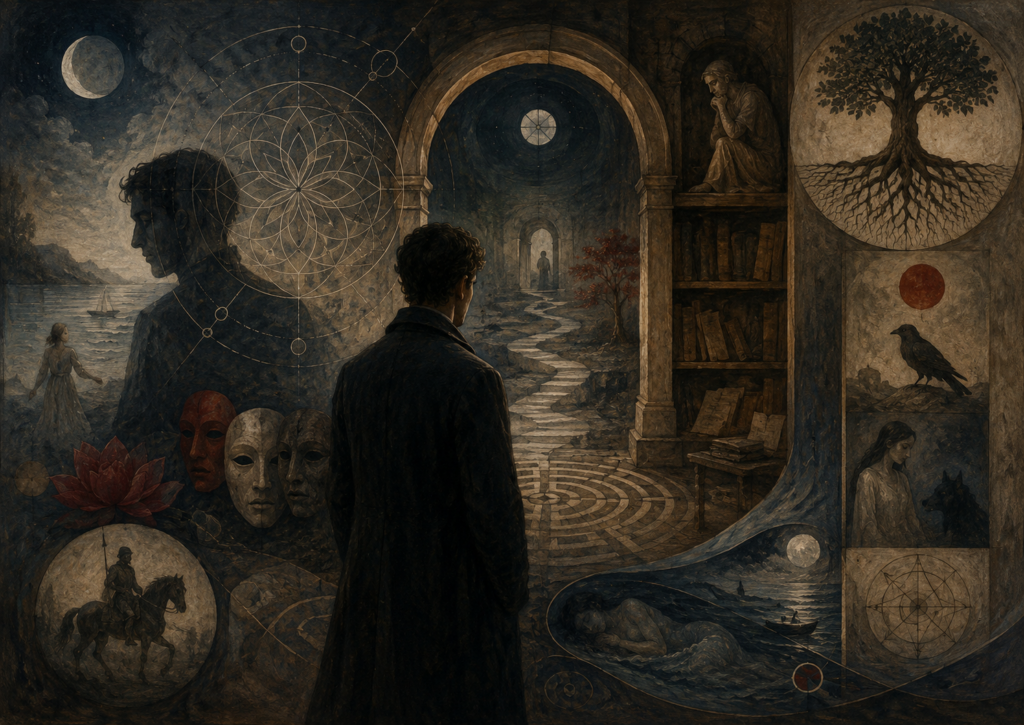
A contemplative figure stands before a shadowed inner archive surrounded by mandala geometry, masks, roots, moonlight, and dreamlike symbolic panels.

Why Analytical Psychology Still Matters

Analytical psychology still matters because it addresses dimensions of human life that remain undertheorized whenever psychology narrows itself to behavior, symptom management, cognition, or adaptation alone. Human beings do not merely cope and perform; they dream, symbolize, project, mythologize, ritualize, and suffer crises of meaning that cannot be reduced to efficiency or diagnosis. This article examines why Jungian thought remains relevant despite its criticisms, focusing on symbol, dream, shadow, culture, midlife development, spirituality, and therapy beyond symptom suppression. It argues that analytical psychology endures not because every Jungian concept is beyond dispute, but because it continues to protect a truth modern life repeatedly forgets: that the psyche is imaginal, symbolic, and in search of forms of meaning that exceed conscious design.

A contemplative figure studies symbolic evidence in a dim archival room, surrounded by mandala diagrams, masks, case materials, scales, and dreamlike panels.

Epistemology and Evidence in Analytical Psychology

Analytical psychology has always stood between science, symbolic interpretation, clinical practice, and phenomenology, which makes questions of epistemology and evidence central to its credibility. This article examines what kind of knowledge Jungian psychology actually claims to produce, what counts as evidence for its central concepts, and how empirical, hermeneutic, clinical, and phenomenological standards of warrant differ. It explores case material, dream interpretation, archetypes, the collective unconscious, comparative symbolism, and therapy outcomes, arguing that the tradition becomes strongest when it distinguishes more clearly among its different kinds of claims rather than borrowing authority indiscriminately from science, philosophy, and symbolic depth. Rather than weakening analytical psychology, this methodological clarification may be what allows it to remain intellectually serious.

A diverse group of scholars studies a wall of non-Western symbolic systems, with geometric, cosmological, textile, mandala, and star-map patterns surrounding an incomplete central diagram.

Non-Western Symbol Systems and the Limits of Jungian Universality

Non-Western symbol systems reveal both the appeal and the limits of Jungian universality. Jung’s comparative psychology remains powerful where it notices real symbolic recurrences across civilizations and refuses the narrowing of psyche to modern secular categories alone. But it becomes vulnerable where cross-cultural comparison turns too quickly into abstraction, flattening ritual, theology, history, and local meaning into one universal archetypal map. This article examines Jung’s comparative ambition, the strengths and weaknesses of symbolic universality, the risks of appropriation and epistemic flattening, and the challenge of reading South Asian, East Asian, Islamic, Indigenous, and African symbolic worlds without reducing them to illustrations of European depth psychology. It argues for a more culturally humble symbolic psychology that can compare without colonizing difference.

Scholars examine a fractured central mandala surrounded by symbolic evidence, cultural motifs, masks, diagrams, scales, and archival materials.

Critiques of Jungian Psychology: Evidence, Culture, and Universality

Jungian psychology has offered one of the richest symbolic vocabularies in modern thought, yet it has also drawn sustained criticism on empirical, cultural, and philosophical grounds. This article examines major critiques of the tradition, including problems of testability, the ambiguous status of archetypes and the collective unconscious, risks of symbolic overinterpretation, gender essentialism in anima and animus, and the tendency to universalize culturally specific materials. It also considers clinical questions about effectiveness and the politics of comparative symbolism in relation to coloniality, race, and appropriation. Rather than dismissing Jungian psychology outright, the article asks what remains valuable after critique and how a more historically aware, culturally situated, and methodologically modest Jungianism might still endure.

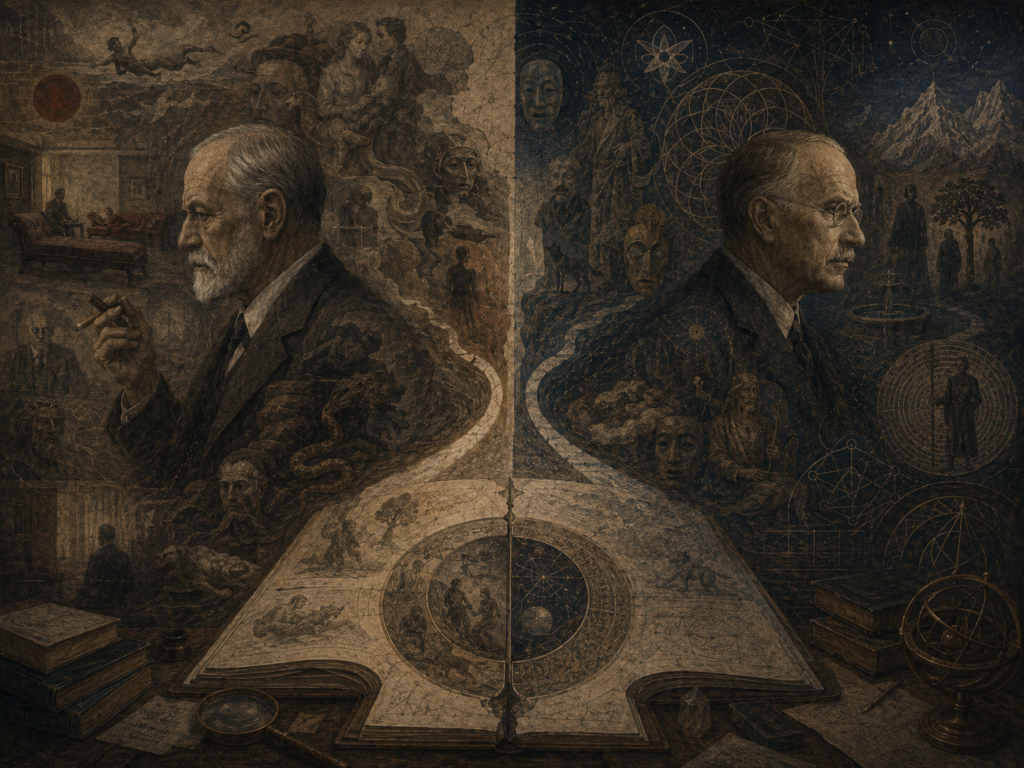
Two opposing thinker figures represent Freud and Jung, with psychoanalytic dream imagery on one side and archetypal mandala symbolism on the other.

Jung, Freud, and the Divergence of Depth Psychologies

The divergence between Jung and Freud marks one of the defining fault lines in modern psychology because it was not merely a personal break, but a profound theoretical split over what the unconscious is, how symbols should be interpreted, what role sexuality plays in psychic life, how religion ought to be understood, and what depth psychology is for. This article examines their early alliance, their growing disagreement over libido, dream theory, repression, archetype, myth, and teleology, and the lasting consequences of their separation for psychoanalysis and analytical psychology. It argues that the Freud-Jung split created two enduring lineages of depth thought: one centered on conflict, repression, and historical causality, and the other on symbol, compensation, archetype, and the possibility of individuation.

A contemplative figure studies an open symbolic manuscript as mandala geometry unfolds into masks, mythic figures, animals, dream scenes, and archetypal landscapes.

Archetypal Psychology After Jung

Archetypal psychology after Jung represents one of the most radical post-Jungian developments because it shifts the focus of depth psychology away from integration and developmental wholeness toward image, imagination, plurality, soul-making, and the many gods of the psyche. Associated especially with James Hillman, this movement treats psyche not primarily as a structure to be healed into unity, but as a field of images, moods, fantasies, and personified presences that should be deepened into rather than explained away. This article examines how archetypal psychology revises Jung, critiques individuation, revalues symptom and fantasy, and turns depth psychology toward aesthetics, metaphor, and polytheistic multiplicity. It presents archetypal psychology as a major reimagining of what psychology is for and how soul should be read.

An analyst and analysand sit in a symbolic consulting room as branching mandala pathways unfold into dream scenes, masks, papers, and therapeutic images.

Post-Jungian Developments in Clinical Analytical Psychology

Post-Jungian developments in clinical analytical psychology transformed Jung’s original framework into a more plural, relational, developmental, and trauma-aware field. While preserving the depth orientation of dreams, symbols, complexes, and individuation, later analysts revised the tradition through attachment theory, developmental psychoanalysis, intersubjectivity, countertransference, trauma studies, embodiment, and cultural critique. This article examines those major clinical developments, including Michael Fordham’s developmental turn, relational and intersubjective revisions, post-Jungian work on fragmentation and trauma, and the growing integration of affect regulation, neuroscience, and clinical pragmatism. It argues that contemporary analytical psychology is best understood not as a static inheritance from Jung, but as an evolving clinical tradition that deepened by confronting the limits of Jung’s original model.

A scholar studies open books while Jungian symbols, archetypal masks, mythic figures, mandala geometry, shadow imagery, and literary scenes unfold across a richly layered wall.

Analytical Psychology and Literary Interpretation

Analytical psychology has had lasting influence on literary interpretation because it offers a way of reading literature as symbolic drama rather than as plot and theme alone. Jungian literary criticism attends to archetypes, shadow projection, dream logic, mythic recurrence, symbolic imagery, psychic doubles, and narrative transformation, asking how texts imagine conflict, desire, fear, division, and the search for wholeness. This article examines Jung’s distinction between psychological and visionary literature, the uses of archetype and symbol in literary reading, and the ways Jungian interpretation can illuminate character, plot, and mythic pattern without reducing literature to theory. It also addresses the major criticisms of the method, arguing that Jungian literary criticism is strongest when it remains historically aware, textually disciplined, and resistant to reductive archetypal formulas.

Jung studies an alchemical manuscript as symbolic figures, mandala geometry, sun and moon imagery, vessels, fire, masks, and transformation motifs unfold around him.

Jung, Alchemy, and Symbolic Transformation

Jung turned to alchemy because he believed its strange texts, images, and symbolic operations preserved one of the richest historical languages of psychological transformation ever produced. Rather than treating alchemy as failed chemistry or occult curiosity alone, he read it as a symbolic record of the psyche’s labor of breakdown, purification, conjunction, and integration. This article examines why alchemy became so central to analytical psychology, how Jung understood projection, the opus, nigredo, albedo, rubedo, Mercurius, the coniunctio, and the philosopher’s stone, and why alchemical symbolism became a major framework for thinking individuation. It also considers the historical limits of Jung’s interpretation, showing that alchemy remains most valuable when read as both a real historical tradition and a profound symbolic map of psychic transformation.

Scroll to Top