
Last Updated May 29, 2026
For Jung, alchemy mattered not because medieval and early modern alchemists had secretly discovered modern psychology, but because alchemical texts, images, and operations preserved an extraordinary symbolic record of psychic transformation before psychology possessed a language of its own. What fascinated him was not literal metallurgy, failed chemistry, or occult curiosity as such, but the way alchemy staged processes of dissolution, purification, union, death, rebirth, conflict, incubation, containment, and integration in symbolic form. In the strange imagery of vessels, kings, queens, dragons, suns, moons, mercurial substances, blackening, whitening, reddening, and the philosopher’s stone, Jung believed he had found a symbolic language for the transformation of the psyche.
This made alchemy central to analytical psychology. Jung had long been concerned with dreams, myth, religion, and symbol as expressions of unconscious life, but alchemy gave him something distinctive: a vast historical archive in which psychic transformation appeared not only as narrative, doctrine, or isolated image, but as process. Alchemical symbolism was procedural, sequential, and imaginally dense. It showed psyche not merely as divided, but as undergoing work. The alchemical imagination did not simply describe disorder or wholeness. It dramatized the difficult operations through which fragmentation, conflict, impurity, volatility, and oppositional tension might be transformed into a new state of relation.
Alchemy also gave Jung a bridge between religious symbolism and modern psychological development. In Christian Europe, the official religious imagination emphasized doctrine, salvation, sin, grace, sacrament, and divine order. Alchemy, by contrast, preserved a darker, more experimental, more ambiguous symbolic language: matter suffered, substances died, kings decomposed, queens appeared in vessels, dragons were confronted, opposites entered conjunction, and precious stones emerged from corruption. Jung saw in this imagery a symbolic counter-tradition—one in which transformation took place not by escaping matter, shadow, body, and impurity, but by entering them.
Main Library
Publications
Article Map
Analytical Psychology
Related Topic
Foundations of Religion
Related Topic
Comparative Sacred Themes
Related Topic
Religion and Law
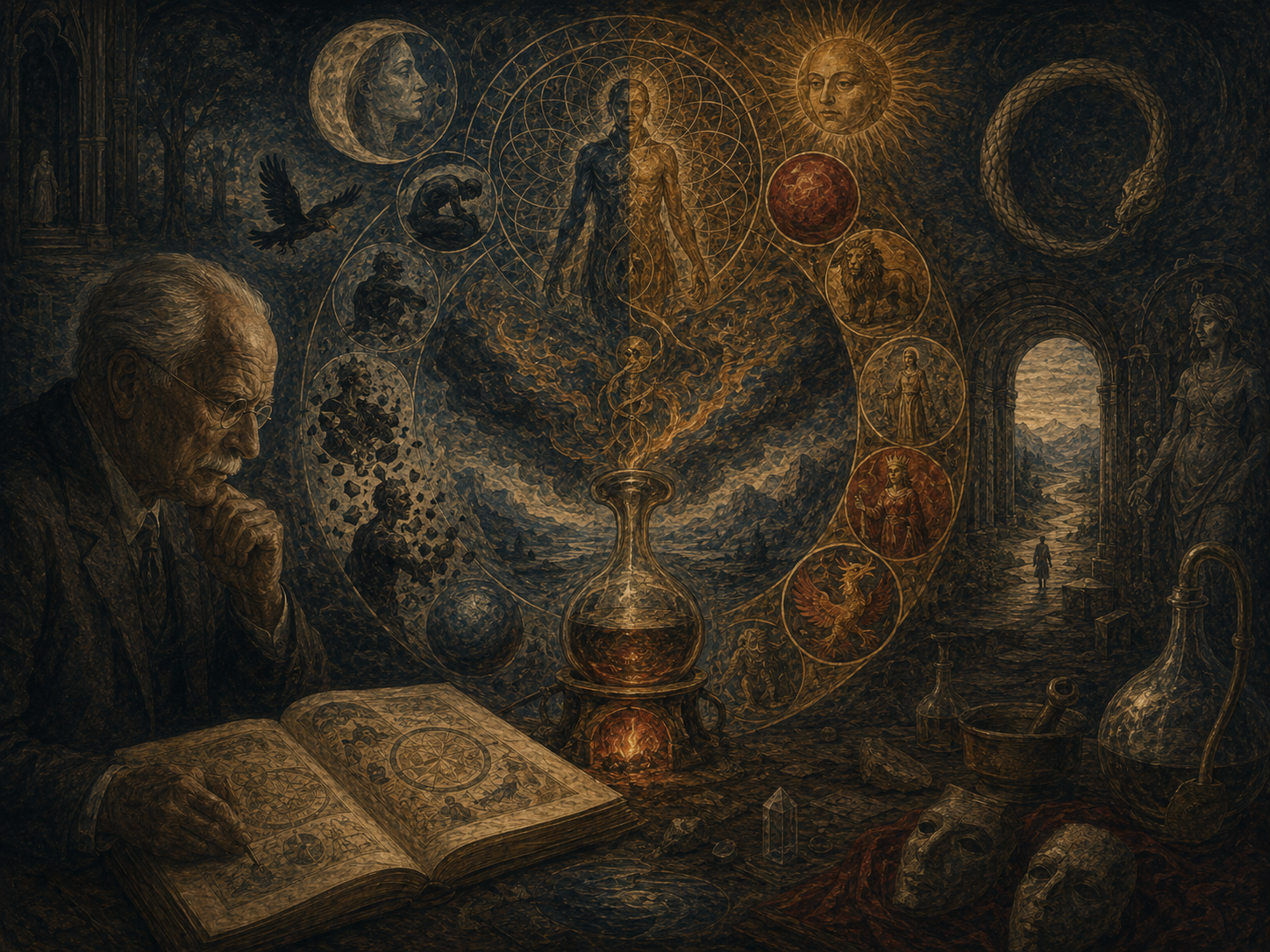
That insight is crucial to his psychology. Jung’s individuation is not an ascent into purified consciousness. It is a work of relation with the unconscious: with shadow, inferior function, dream, body, projection, fantasy, contradiction, and symbolic forms that exceed the ego’s control. Alchemy offered him a vocabulary for this work. It pictured psychic transformation as an opus: prolonged, hazardous, repetitive, obscure, easily spoiled, and dependent on containment. The alchemist’s vessel became a symbol of the analytic container. The blackening became a symbol of psychological disorientation and shadow encounter. The whitening became a symbol of clarification and differentiation. The reddening became a symbol of embodied integration. The coniunctio became a symbol of the relation of opposites. Mercurius became a figure of the volatile, paradoxical, healing and poisonous unconscious.
At the same time, Jung’s reading of alchemy is controversial and must be handled carefully. Historians have rightly noted that alchemy was also a real historical practice concerned with matter, experiment, craft traditions, medicine, metallurgy, cosmology, theology, secrecy, patronage, laboratory technique, and proto-chemical speculation. It cannot be reduced without remainder to psychology. Jung knew that alchemists worked with matter, but his interpretive emphasis lay elsewhere. He believed that alchemists, often unconsciously, projected psychic processes into matter and symbolic procedure. Their work therefore became a mirror of transformation at the border of psyche and world. Whether one fully accepts this interpretation or not, it remains one of Jung’s boldest and most influential ideas.
The phrase symbolic transformation is crucial because it clarifies what Jung sought in alchemy. He did not mean transformation in the sense of magic trick, self-help reinvention, surface optimism, or mere improvement of mood. He meant a reorganization of psychic life through conflict, suffering, confrontation with shadow, union of opposites, and the gradual emergence of a more integrated relation to the Self. Alchemical symbolism gave him a language for such change: the nigredo of breakdown and blackening, the albedo of clarification, the rubedo of achieved vitality, the conjunction of opposites, the mercurial instability of the unconscious, the vessel of containment, and the stone as symbol of enduring wholeness.
This article examines Jung’s interpretation of alchemy as a symbolic psychology of transformation. It explores why alchemy became so important to his thought, how he read alchemical processes and imagery, how transformation is symbolized in alchemical stages, and what is gained and lost when alchemy is treated as a mirror of the psyche. It also considers historical and conceptual criticisms of Jung’s approach. The goal is not to collapse alchemy into metaphor, but to understand why Jung believed that in its obscure language of matter and process, alchemy preserved one of the richest symbolic maps of psychological transformation ever produced.
Why Alchemy Mattered to Jung
Alchemy mattered to Jung because it gave him a historical bridge between ancient religious symbolism and modern depth psychology. He had already come to believe that dreams and myths expressed unconscious processes in symbolic form, but alchemy showed him something even more elaborate: a sustained symbolic tradition devoted to transformation itself. In alchemy, psychic drama became procedure, sequence, experiment, and image. This was profoundly important for a thinker seeking to understand not only psychic content but psychic change.
Jung believed that after the decline of a shared symbolic religious world in Europe, alchemy had become one of the places where the symbolic life of transformation survived. Its obscure texts and emblems preserved imagery that resonated strongly with dreams, fantasies, and processes of individuation emerging in modern analysis. Alchemy thus became, for Jung, an unsuspected archive of the unconscious: not because it was “really” psychology in disguise, but because it held images of transformation that psychology could later recognize as psychologically meaningful.
Alchemy also mattered because it took matter seriously. This is often missed in simplified accounts of Jung. He was not interested only in spiritual ascent, abstract symbolism, or inner meaning detached from embodiment. Alchemy fascinated him because it joined spirit and matter, imagination and substance, symbol and operation. Its images were not floating metaphors. They appeared in vessels, furnaces, metals, colors, liquids, salts, fires, and bodily substances. This made alchemy especially valuable for Jung because it resisted the split between spiritual aspiration and material reality. Transformation did not occur by escaping matter. It occurred through a symbolic engagement with matter.
This was crucial for Jung’s criticism of one-sided spirituality. He believed that modern consciousness often tries to purify itself by rejecting the body, shadow, instinct, sexuality, ambiguity, and the dark underside of moral life. Alchemy offered a different image. The work begins with confused, impure, dark, heavy, contradictory matter. The prima materia is not noble. It is base, neglected, despised, and difficult. Yet it contains the secret of transformation. Psychologically, this means that the rejected material of life—the shadow, wound, symptom, depression, envy, fear, anger, bodily disturbance, or shame—may contain the very substance through which growth becomes possible.
Alchemy also gave Jung a way to understand transformation as labor rather than inspiration. Spiritual and psychological traditions often speak of awakening, insight, conversion, liberation, or enlightenment. Alchemy speaks of work: heating, sealing, dissolving, separating, washing, joining, distilling, repeating, failing, beginning again. This suited Jung’s clinical realism. Real psychological change is often slow, obscure, repetitive, and uncertain. A patient does not become whole simply by recognizing a symbol. The psyche must remain in the vessel long enough for symbolic material to be worked through.
Jung’s late work on alchemy therefore represents more than a specialized interest. It became a major interpretive key to his understanding of individuation. The alchemical opus gave him a model of the psyche undergoing transformation through stages, tensions, symbolic images, and paradoxes. Alchemy mattered because it pictured the soul’s work as a work of matter, darkness, containment, opposition, and eventual reorganization.
That is why alchemy became one of the defining languages of mature analytical psychology. It allowed Jung to think transformation not as improvement, not as moral purification, not as escape from the world, but as the difficult symbolic work by which psyche and life are remade from within their own contradictions.
Alchemy as a Symbolic Language of Process
One reason Jung valued alchemy so highly is that it offered a symbolic language of process rather than static meaning. Alchemical texts did not simply name good and evil, purity and corruption, spirit and matter. They described operations: calcination, dissolution, separation, conjunction, putrefaction, sublimation, coagulation, distillation, and circulation. Whether these were enacted materially, imagined symbolically, or projected into substances, they presented transformation as work.
This processual character mattered because Jung’s psychology is developmental and dynamic. The psyche does not merely contain archetypes and complexes as finished contents. It moves through conflict, breakdown, compensation, reorganization, and renewed relation. A dream is not simply an image. It belongs to a sequence. A symptom is not simply a defect. It may be part of an emerging transformation. A crisis is not only collapse. It may be a phase in the dissolution of a false psychic order. Alchemy gave Jung a language in which such movement was already pictured as labor, ordeal, and succession of states.
Alchemical process also differs from simple linear progress. The opus is cyclical, repetitive, and unstable. Substances must be cooked again, washed again, joined again, separated again. The work may regress. The vessel may break. The material may burn or fail to transform. Psychologically, this is an important correction to simplistic developmental models. Individuation is not a smooth ascent from immaturity to wholeness. It is a repeated confrontation with the same psychic material at deeper levels of relation.
The process language of alchemy is also symbolic because the operations are both material and imaginal. Calcination burns; psychologically, it may symbolize the burning away of inflation, false certainty, or rigid identity. Dissolution liquefies; psychologically, it may symbolize the loosening of hardened ego structures. Separation distinguishes; psychologically, it may symbolize differentiation of what had been fused. Conjunction joins; psychologically, it may symbolize the relation of opposites. Coagulation solidifies; psychologically, it may symbolize the embodiment of insight in life. These meanings are not mechanically fixed. They depend on context. But the operations offer a rich grammar for psychic change.
| Alchemical operation | Material sense | Jungian symbolic reading | Clinical or existential caution |
|---|---|---|---|
| Calcination | Burning, heating, reducing through fire | Breaking down inflation, pride, rigidity, or false identity | Fire can purify, but it can also destroy if containment fails |
| Dissolution | Liquefaction, melting, returning solid form to fluidity | Loosening fixed attitudes, dissolving defensive structures | Dissolution may become disorientation or collapse without vessel |
| Separation | Distinguishing parts from mixed substance | Differentiating complexes, affects, projections, and psychic opposites | Separation can clarify, but may also intensify splitting |
| Conjunction | Joining separated elements | Relating opposites without erasing their difference | Premature conjunction may create false unity or inflation |
| Sublimation | Raising, vaporizing, refining through ascent | Lifting material into symbolic awareness or reflection | Ascent can become escape from body, matter, or shadow |
| Coagulation | Solidifying, fixing, giving form | Embodying insight in durable life, relation, practice, or character | Solidification can become new rigidity if the process closes too soon |
What made alchemy so powerful for Jung was that it did not treat transformation as an abstract ideal. It gave transformation texture, heat, danger, sequence, repetition, substance, and image. The psyche changes through operations. It must be held, heated, broken down, clarified, joined, and embodied. In alchemy, Jung found a symbolic process language adequate to the complexity of real psychological change.
Projection, Psyche, and Matter
Jung’s theory of alchemy depends heavily on the idea of projection. He argued that alchemists often projected unconscious contents into matter and into the substances with which they worked. Because the psyche was not yet clearly differentiated from the world in modern psychological terms, inner processes appeared as transformations in metals, vessels, colors, planets, substances, and symbolic figures. The alchemist did not merely imagine the work; he saw it as happening in the material operation itself.
This claim is central but controversial. Historians rightly insist that alchemists were not just disguised psychologists; they were practitioners working within real cosmological, artisanal, medicinal, theological, and proto-scientific frameworks. They had laboratories, recipes, equipment, patrons, secret languages, technical vocabularies, and material ambitions. To treat their work only as unconscious psychology risks erasing historical alchemy as a real body of practice. Still, Jung’s point was not that matter was irrelevant, but that psyche and matter were entangled in symbolic projection. Alchemy therefore became a hybrid domain in which inward and outward transformation mirrored one another.
Projection, in Jung’s sense, does not mean simple error. It is not merely that the alchemist mistakenly imagined inner contents to be outside. Projection is one of the ways unconscious material first becomes visible. What cannot yet be recognized inwardly appears in object, person, substance, enemy, beloved, god, monster, or world. In alchemy, Jung believed, the unconscious appeared through matter because the modern separation between psyche and objective material process had not yet fully taken hold. The alchemical vessel became a stage on which psyche could perceive itself indirectly.
This gives alchemy psychological depth, but it also raises a philosophical problem. If unconscious contents are projected into matter, what is the status of matter itself? Is it merely a screen? Jung’s best readings avoid that reduction. Matter is not empty. The physical properties of substances—their color, volatility, corrosion, melting, resistance, luminosity, crystallization, and transformation under heat—provide the symbolic occasion for psychic projection. The projection is not arbitrary. It is drawn into relation with qualities of the material world.
That relation is why alchemy remains important for thinking symbol. A symbol is not only an internal image. It forms at the border of psyche and world. The alchemist’s sulfur, mercury, gold, salt, vessel, fire, and stone are material and symbolic at once. They are not reducible to either chemistry or psychology. Their power lies in the ambiguous zone where matter becomes imaginally charged and psyche discovers itself through material form.
In contemporary terms, Jung’s reading of projection can be used cautiously. It reminds us that human beings do not encounter the world as neutral observers. We meet the world through imagination, affect, fear, desire, cultural inheritance, and unconscious expectation. Matter, body, technology, institutions, landscapes, and objects can become charged with psychic meaning. Yet the caution remains: projection should not become a way to deny the reality of the external world. A historically responsible Jungian reading must preserve both psyche and matter.
Alchemy becomes compelling precisely because it occupies this border. It is neither merely chemistry nor merely dream. It is a symbolic field in which matter and psyche become mutually illuminating, even when the historian and psychologist must interpret that field differently.
The Opus and the Work of Transformation
The opus, the great work, is one of the master symbols of Jung’s reading of alchemy. It names the labor of transformation itself: prolonged, uncertain, repetitive, and often obscure. In psychological terms, the opus corresponds to the work of individuation, where the person must remain with confusion, contradiction, shadow material, suffering, and symbolic pressure without premature resolution. Transformation is not instantaneous. It requires repeated operations and sustained containment.
This is one of the reasons alchemy appealed so strongly to Jung. It refused fantasies of easy enlightenment. The work was dangerous, dirty, secretive, frustrating, and easily ruined. So too, in Jung’s view, was real psychic transformation. The opus names the disciplined endurance required when psyche is being remade. It is not a mood, insight, technique, or moment of inspiration. It is a long process in which unconscious material must be suffered, differentiated, symbolized, and embodied.
The opus is also important because it is impersonal as well as personal. The alchemist performs the work, but the work exceeds conscious intention. The material behaves according to its own logic. The process requires patience, humility, repetition, and attention. Psychologically, this means that the ego cannot simply command transformation. It can participate, but the unconscious has its own timing, imagery, resistance, and symbolic necessity. The ego must submit to a process it does not fully control.
The great work also implies a discipline of staying. Many people want transformation without remaining in the vessel. They want relief without decomposition, clarity without confusion, wholeness without conflict, and new life without the death of old form. Alchemical imagery refuses this bypass. The substance must be cooked. It must undergo putrefaction. It must be sealed. It must be returned to the fire. Psychologically, this means that suffering cannot always be escaped if it is part of the transformation of a false organization of the self.
Yet this must be stated carefully. Jungian alchemical language can become dangerous if it romanticizes suffering. Not every breakdown is transformative. Not every depression is nigredo. Not every trauma is an initiation. Not every crisis should be endured without intervention. The opus requires containment, not abandonment. The alchemical metaphor is clinically useful only when it includes the vessel, the timing, the heat, and the careful preservation of life. Transformation is not the same as destruction.
The opus therefore names a paradoxical discipline: active patience. The alchemist works, but also waits. The analyst listens, but also refrains. The patient suffers, but also observes. The process is neither passive nor forced. It requires attention to symbolic material without rushing to close it. Jung’s alchemical psychology is strongest when it preserves this paradox: transformation demands work, but not domination; endurance, but not masochism; symbolic imagination, but not escape from concrete care.
In this sense, the opus remains one of Jung’s most powerful images for psychological development. It reminds us that the psyche becomes transformed not by linear instruction, but by a difficult symbolic labor in which dark, volatile, divided, and neglected material is gradually brought into relation.
Nigredo, Blackening, and Psychic Breakdown
The nigredo, or blackening, is among the most psychologically important alchemical stages for Jung. It symbolizes darkness, decomposition, confusion, death of old form, melancholy, putrefaction, and collapse of prior certainty. In clinical or developmental terms, Jung associated it with periods of depression, disorientation, loss of meaning, confrontation with shadow, and the breakdown of a too-confident conscious standpoint. The blackening is not yet transformation accomplished. It is the necessary descent into disorder through which false coherence dies.
This is why the nigredo remains so important in later Jungian writing. It captures the painful truth that transformation often begins in dissolution rather than light. The person may feel ruined, lost, or inwardly dead before any new form appears. The nigredo gives symbolic dignity to that phase without romanticizing it. It is ordeal, not decorative darkness.
Psychologically, the nigredo often begins when a conscious identity can no longer organize life. The persona fails. A role collapses. A relationship ends. A belief system no longer holds. A moral certainty is exposed as partial. A symptom interrupts ordinary functioning. A dream brings disturbing material. A shadow figure appears. The ego may experience this as defeat, shame, depression, confusion, rage, or loss of meaning. In alchemical language, the old substance has entered blackening.
Jung valued this stage because it prevents premature optimism. Many spiritual and psychological systems move too quickly toward healing, integration, light, and renewal. The nigredo insists that darkness has its own work. What is rotten must be seen. What has been denied must decompose. What has been inflated must be humbled. What has been split off must return. The psyche cannot move toward wholeness while maintaining a false innocence.
But the nigredo must also be bounded by clinical responsibility. Depression, trauma, despair, and psychic collapse are not automatically meaningful in a healing sense. People in acute danger need help, not symbolic romanticization. A person overwhelmed by suicidal despair, psychosis, dissociation, or severe trauma may require stabilization, medication, relational holding, and direct care. Alchemical symbolism becomes harmful if it tells people to remain in destructive suffering because transformation may eventually come. The nigredo is useful as a symbolic frame only when it supports containment, meaning, and careful relation to darkness.
The blackening is also a shadow phase. It exposes the inferior, rejected, guilty, envious, resentful, instinctual, shameful, and morally ambiguous parts of the personality. This is why it is so often resisted. The ego would rather purify itself than admit its own darkness. But alchemy begins with black matter. Jung’s psychology similarly begins serious transformation with recognition of what consciousness has excluded.
In the larger sequence of the opus, the nigredo prepares later clarification. It is not an end. It is a dissolution of what can no longer carry life. The danger is despair; the possibility is new relation. The alchemical image helps hold both truths: the blackening is terrible, but it may also be the beginning of the psyche’s deeper work.
Albedo, Clarification, and Differentiation
The albedo, or whitening, follows blackening in many alchemical sequences and symbolizes purification, clarification, washing, illumination, and differentiation. Psychologically, Jung read it as a stage in which confusion begins to yield to greater reflectiveness. The psyche is not yet fully integrated, but some separation has occurred. What was fused becomes more distinguishable. Consciousness gains cleaner relation to what previously overwhelmed it.
This does not mean simple happiness after the darkness. The albedo is subtle. It often involves discrimination, cooling, distance, and a more lucid apprehension of inner reality. The person begins to see what the breakdown was about. Symbolic life may become more legible. The whitening is therefore a stage of clearer relation, not final wholeness.
Clinically, the albedo may correspond to the moment when a person begins to differentiate affect from fact, projection from perception, complex from situation, shadow from enemy, grief from guilt, or fantasy from action. The material is still charged, but it is no longer entirely fused with the ego’s immediate experience. There is space to reflect. The person can begin to say, “This is in me,” “This is a projection,” “This belongs to an old wound,” or “This image is trying to show me something.”
Albedo is therefore linked to symbolic clarity. After the blackening, images may become more readable. Dreams may show patterns. Repetitions may be recognized. The patient may begin to distinguish the different substances of the psyche: fear, desire, shame, anger, longing, memory, persona, shadow, and genuine value. This differentiation is not sterile analysis. It is the washing and clarifying phase of the work.
The albedo also has a lunar quality in much alchemical symbolism. It is reflective rather than solar; cool rather than fiery; clarifying rather than triumphant. This matters psychologically because reflection is not the same as domination. The ego does not conquer the unconscious. It learns to see by reflected light. Albedo consciousness is receptive, discriminating, and patient. It allows symbolic material to become visible without prematurely fixing its meaning.
The risk of albedo is abstraction. A person may become clearer but not yet alive. Insight may remain cool, distant, and detached from the body. The psyche may understand but not yet embody. This is why the albedo is not the final stage. It prepares the way for a more vital, incarnate integration. The whitening clarifies the material, but the reddening must bring transformation into blood, body, action, and life.
In Jung’s psychology, the albedo is valuable because transformation requires discrimination. One cannot integrate what one cannot distinguish. The washing of the material allows consciousness to enter a new relation with the unconscious. It is a movement from undifferentiated darkness toward reflective awareness, from possession toward relation, from confusion toward symbolic readability.
Rubedo, Integration, and Living Wholeness
The rubedo, or reddening, is often treated in alchemical traditions as the culmination of the work. Jung associated it with integration, living vitality, embodiment, and a more durable union of previously divided elements. If the nigredo is death of old form and the albedo is clarification, the rubedo suggests the return of life at a higher level of relation. Transformation becomes incarnate rather than merely conceived.
For Jung this stage was closely linked to individuation. The person does not become perfect, purified, or free from conflict, but becomes more inwardly related, less one-sided, and more capable of bearing the tension of opposites. The red stage suggests that transformation must become lived. Symbolic insight alone is not enough. The psyche must take new form in life.
Rubedo is important because it corrects a common misunderstanding of psychological growth. Insight is not transformation unless it enters conduct, relationship, body, speech, choice, and responsibility. A person may understand their shadow intellectually but still act it out. They may recognize a projection but continue to live by it. They may dream of wholeness but avoid the demands of actual relationship. Rubedo implies that the symbolic work has become blood-warm, embodied, and ethically consequential.
The reddening also suggests vitality. The transformed psyche is not merely purified or clarified. It is alive. This is why the red color matters symbolically: blood, fire, eros, embodiment, passion, and incarnate life return after the cooling clarifications of albedo. Jung’s psychology is not ultimately a psychology of detachment. It seeks a fuller relation to life, including instinct, feeling, body, love, work, conflict, and mortality.
Yet rubedo should not be interpreted as final perfection. In psychological terms, there is no permanent end-state in which conflict disappears forever. Individuation is ongoing. The stone may symbolize an enduring center, but the lived psyche remains dynamic. The rubedo is better understood as a more durable organization of personality: an achieved relation that can hold tensions that once split the person apart. It is a form of living wholeness, not a static ideal.
Rubedo also reveals the ethical dimension of alchemical psychology. If transformation becomes embodied, it must change how the person lives. Shadow recognition should affect behavior. The union of opposites should affect relationship. The encounter with matter should affect the body and world. Symbolic depth is not an excuse for abstraction. A Jungian reading of rubedo asks whether the work has become real.
This is why the alchemical sequence remains psychologically powerful. Nigredo breaks false coherence. Albedo clarifies and differentiates. Rubedo incarnates a new relation. The reddening is not simply the happy ending of the opus. It is the test of whether symbolic transformation has become life.
Coniunctio: The Union of Opposites
The coniunctio, or conjunction, is one of the master motifs in Jung’s alchemical psychology. Alchemical texts repeatedly stage unions of king and queen, sun and moon, sulfur and mercury, spirit and body, fixed and volatile, masculine and feminine, above and below. Jung read these as symbolic expressions of the psyche’s struggle to relate opposites that consciousness had previously kept apart. Transformation requires not victory of one pole but relation between them.
This is crucial in analytical psychology because much suffering is organized around split oppositions: reason against feeling, spirit against body, purity against instinct, persona against shadow, conscious attitude against unconscious compensation, autonomy against dependence, order against chaos, masculine against feminine, tradition against transformation. The coniunctio symbolizes the difficult and often paradoxical process by which opposites become mutually transformative rather than mutually annihilating.
The conjunction is not a simple compromise. It is not the averaging of two positions. Nor is it the domination of one side by the other. In Jung’s strongest sense, the coniunctio requires that both sides remain real while entering a new relation. If one pole absorbs the other, there is no true conjunction. If opposites merely remain split, there is no transformation. The coniunctio is a third thing: a symbolic relation that changes both sides.
Psychologically, this is difficult because opposites often carry strong affect. A person may identify with reason and experience feeling as weakness. Another may identify with spirituality and experience the body as shameful. Another may identify with moral purity and project instinct onto others. Another may identify with autonomy and experience dependency as humiliation. In each case, the rejected pole returns as symptom, fantasy, projection, dream, or relational conflict. The conjunction requires contact with what the ego has excluded.
Jung’s alchemical imagery helped him think this relation without reducing it to ordinary rational synthesis. The union of king and queen, sun and moon, sulfur and mercury, or spirit and matter is symbolic because the psyche cannot fully grasp the transformation conceptually before it happens. The image carries what the ego cannot yet formulate. The coniunctio is therefore not only an idea; it is an imaginal event.
The concept also requires contemporary caution. Jung’s language of masculine and feminine opposites can become essentialist if treated as timeless gender truth. A responsible modern reading should understand gendered alchemical symbols as historically powerful but not biologically fixed. Opposites may be gendered in traditional imagery, but the psychological relation of difference cannot be reduced to male and female categories. Spirit and body, conscious and unconscious, order and desire, vulnerability and power, dependence and autonomy, grief and action—these may be more clinically useful oppositions in many contexts.
The coniunctio remains valuable because it addresses one of the deepest problems of psychic life: how to hold tension without splitting, projecting, collapsing, or forcing premature unity. Jung’s alchemical psychology teaches that transformation is not achieved by eliminating conflict but by entering a symbolic relation to it. The opposites must meet in the vessel, not in theory only.
Mercurius, the Unstable Spirit of Transformation
Few alchemical figures mattered more to Jung than Mercurius. Mercurius is unstable, elusive, dual, mediating, poisonous, healing, spiritual, bodily, masculine, feminine, earthly, divine. He is one of the great paradoxical symbols of alchemy, and precisely for that reason one of the richest psychological images. Jung saw in Mercurius a symbolic form of the unconscious itself: slippery, transformative, impossible to fix, and always threatening to escape rigid conceptual control.
Mercurius matters because transformation is never mechanically orderly. The psyche contains volatile elements that disrupt simple plans. The unconscious mediates and destabilizes at once. Mercurius therefore becomes a symbol not only of the transformative principle but of the ambiguity inherent in all real change. What heals may also poison. What connects may also deceive. What dissolves rigidity may also destroy structure. What mediates opposites may also intensify confusion.
This mercurial quality is clinically important. Unconscious material often appears first in ambiguous forms. A dream image may be terrifying and healing. A symptom may be destructive and meaningful. A fantasy may reveal truth and seduce the ego into inflation. A relationship may activate both old wound and new possibility. The analyst cannot treat the unconscious as simply benevolent or simply pathological. It is Mercurius-like: transformative, unstable, and morally ambiguous.
Mercurius also symbolizes mediation. In alchemy, mercury often moves between states and elements. Psychologically, the mercurial function links what had been separated: conscious and unconscious, spirit and body, fixed and volatile, thought and image, language and affect. This makes Mercurius a figure of psychic communication. Dreams, fantasies, slips, symptoms, and symbols may all have mercurial character because they cross boundaries and carry messages in unstable form.
But Mercurius also resists possession. The ego may want to capture the unconscious in a theory, doctrine, method, diagnosis, or spiritual identity. Mercurius escapes. The unconscious remains unpredictable. This is one reason Jung’s alchemical psychology is resistant to simple formulas. The process cannot be fully controlled because the transformative factor is itself paradoxical and alive.
The figure also warns against inflation. Mercurial energy can make a person feel special, chosen, inspired, prophetic, or above ordinary limits. Symbolic material can intoxicate. A person may identify with the mediator, trickster, healer, or alchemist and lose humility. Jung was deeply aware of this danger. The alchemical work requires containment precisely because mercurial energies can destabilize the ego.
Mercurius remains one of the most sophisticated symbols in Jung’s alchemical vocabulary because it names the reality that transformation is not clean. It moves through ambiguity, contradiction, poison, medicine, deception, and revelation. Any psychology of change that cannot account for this mercurial instability becomes too simple for the psyche it claims to understand.
The Vessel, Containment, and the Temenos
Alchemy is filled with vessels, flasks, sealed containers, furnaces, baths, and enclosed spaces. Jung interpreted the alchemical vessel as a symbol of containment: the protected space in which transformation can occur without immediate dispersal or destruction. In psychological terms, this corresponds to the temenos, the guarded inner or relational space in which unconscious material may be worked through.
This insight has powerful clinical relevance. Whether in analysis, dream work, ritual, writing, art, or private reflective practice, transformation requires containment. Without vessel, psychic material spills into chaos, acting out, inflation, dissociation, or fragmentation. The vessel symbolizes the form strong enough to hold the work until a new relation becomes possible.
The vessel also regulates heat. In alchemy, too much heat destroys the work; too little heat prevents transformation. Psychologically, this is an extraordinarily precise image. If affective intensity is too low, nothing changes. If intensity is too high, the person may become overwhelmed. Clinical work often requires careful modulation of heat: enough contact with unconscious material to activate transformation, enough containment to prevent collapse. The analytic setting, therapeutic alliance, boundaries, rhythm, and interpretive timing all function as vessel.
The temenos is not merely a safe space in a vague sense. It is a bounded space for dangerous work. The alchemical vessel does not eliminate fire; it contains it. Similarly, psychological containment does not remove conflict, grief, rage, sexuality, shame, or shadow. It creates a form in which such material can be encountered without immediate enactment or disintegration. This is why analytic boundaries matter. They are not administrative details. They are part of the vessel.
Containment is also internal. A person gradually develops the capacity to hold opposites, affects, images, and conflicts without immediate discharge. This internal vessel may be weak in trauma, dissociation, severe anxiety, or fragile self-structure. In such cases, symbolic work must be paced carefully. The clinician or reflective practice may first need to build vessel before intensifying the fire. Jungian alchemy becomes clinically irresponsible if it emphasizes transformation without containment.
The vessel also has cultural and ritual dimensions. Many traditional societies provided symbolic containers for suffering, initiation, mourning, confession, purification, and transformation. Modern life often lacks such forms. Jung believed that analytical psychology partly responds to this loss by creating a new kind of symbolic vessel. The consulting room becomes one place where images can be held, dreams spoken, projections examined, and psychic transformation given time.
In alchemical symbolism, the vessel must be sealed. Psychologically, this suggests privacy, inwardness, discipline, and protection from premature exposure. Not all psychic material should be immediately broadcast, acted out, explained, or shared. Some symbols need incubation. Some insights require time. Some transformations fail because the vessel opens too early.
The vessel is therefore one of Jung’s most important alchemical images because it names the condition of transformation itself. The psyche needs a container. Without it, the opus becomes not transformation but scattering.
The Philosopher’s Stone and the Symbol of Totality
The philosopher’s stone is perhaps the most famous symbol in alchemy, and Jung treated it as an image of achieved wholeness, totality, and the enduring product of transformation. This does not mean that the stone is simply the Self in a one-to-one equivalence, but Jung often read it as a symbol closely related to the Self because it represents something compact, unified, incorruptible, and precious emerging from chaotic process.
The stone matters psychologically because it condenses the whole opus into a single image. What was once dispersed, volatile, and conflicted has become gathered. Yet the stone is never simply ego achievement. It symbolizes a wholeness produced through relation to what transcends the ego’s original control. That is why it remains such a potent image of symbolic transformation.
In many alchemical traditions, the stone is paradoxical. It is common and rare, worthless and priceless, hidden and obvious, despised and divine. Jung found this psychologically meaningful because the Self is often discovered not in what the ego prizes, but in what it neglects. The precious stone may be hidden in base matter. The transformative center may be found in the symptom, shadow, wound, dream, failure, or rejected part of life. What is most valuable may first appear as worthless.
The stone also represents durability. Alchemical transformation does not culminate in passing inspiration. It produces something stable enough to endure. Psychologically, this suggests that individuation creates a more durable center of relation. The person is still human, conflicted, mortal, and unfinished, but less easily dispersed by every affect, projection, collective pressure, or unconscious possession. The stone is an image of a center that has been forged through process.
Yet the stone also risks inflation if interpreted too literally. The ego may identify with wholeness, imagine itself complete, or claim possession of the Self. Jung’s own psychology warns against this. The Self is not an ego trophy. The philosopher’s stone should not be confused with personal perfection, spiritual superiority, or final enlightenment. It is a symbol of totality that relativizes the ego rather than glorifying it.
The stone’s symbolic richness also lies in its union of opposites. It is material and spiritual, humble and precious, fixed and transformative, found and made. It is the product of work and yet appears as gift. Psychologically, this captures the paradox of transformation. One must work, but the deepest transformation cannot be manufactured by will alone. It emerges when the conditions of the opus have been sustained long enough for a new center to constellate.
The philosopher’s stone therefore remains one of the most powerful Jungian images of the Self: not as doctrine, not as metaphysical certainty, but as a symbol of gathered wholeness produced through the long labor of shadow, differentiation, conjunction, and embodiment.
Alchemy, Dreams, and Individuation
Jung’s alchemical studies were deeply connected to his work on dreams and individuation. He believed that many modern dream symbols and imaginal processes resembled alchemical motifs because the psyche continues to stage transformation through comparable structures: black waters, dead kings, sacred marriages, strange substances, vessels, circular images, transformative fires, serpents, stones, and symbols of center. Alchemy provided a comparative symbolic vocabulary for understanding these processes.
This does not mean every dream is secretly alchemical. It means that alchemy gave Jung a way to recognize recurrent symbolic patterns in transformation. It helped him interpret individuation not as abstract self-development but as a difficult work of symbolic reorganization already pictured in a great historical tradition.
Dreams often show process before the conscious mind understands it. A person may dream of a flooded house, a dark cellar, a sealed room, a fire, a dead king, a strange child, a circular stone, or a conjunction of opposing figures. A Jungian analyst does not need to force these images into alchemical categories, but alchemical symbolism can offer a comparative lens. It asks whether the dream belongs to a larger sequence of dissolution, clarification, containment, union, or renewal.
Alchemy is especially useful in dream interpretation because it respects symbolic sequence. A single dream image may be ambiguous, but a series of dreams may show a process unfolding over time. Jung was interested in such sequences because individuation often appears not through one decisive image but through repeated motifs that transform gradually. Water becomes vessel; darkness becomes fire; deadness becomes child; conflict becomes conjunction; scattered material becomes center. Alchemy provided a language for reading this movement.
Individuation also becomes less sentimental through alchemical imagery. The process includes blackening, putrefaction, and death of old forms. A dream sequence may not immediately offer reassurance. It may first intensify confrontation with shadow, grief, humiliation, bodily reality, or moral ambiguity. Alchemy helps prevent the analyst from interpreting every symbol as positive too quickly. Transformation may begin in images of decay.
At the same time, alchemical dream work requires restraint. A dream should not be colonized by the analyst’s alchemical knowledge. The patient’s associations, life situation, affective response, cultural context, and dream sequence matter first. Alchemy can amplify, but it should not replace the dream’s own specificity. A vessel in a dream may be alchemical, maternal, bodily, culinary, religious, domestic, artistic, or personal before it is anything else. The alchemical lens should deepen the image, not flatten it.
In relation to individuation, alchemy offers perhaps its most important contribution: it shows that psychological development is not merely personal growth, but symbolic transformation of the relation between conscious and unconscious life. The person becomes more whole not by accumulating insight, but by undergoing a difficult work in which psychic material changes state.
Alchemy, Symbol, and the Body
Alchemy is valuable for analytical psychology because it refuses to separate symbol from body, matter, and sensation. Its language is full of heat, moisture, decay, corrosion, burning, coagulation, washing, vapor, salt, blood, stone, metal, and vessel. Jung’s interpretation of alchemy therefore offers a corrective to overly abstract psychology. Transformation is not only mental. It is also embodied, affective, and material in its imagery.
This matters because psychic transformation is often felt bodily before it is understood conceptually. Shame burns. Grief weighs. Anxiety tightens. Depression darkens and slows. Rage heats. Dissociation numbs. Desire pulls. Fear freezes. Jung’s alchemical symbols help give form to such bodily psychic realities. The psyche does not speak only in thoughts. It speaks through images that are often saturated with bodily texture.
The vessel is also bodily. A person’s body can hold or fail to hold affect. Trauma may disrupt containment at the bodily level. Panic may flood the system. Dissociation may remove the person from embodied presence. In such cases, alchemical symbolism must be linked with clinical care. The work requires not only interpretation but regulation, grounding, pacing, and relational safety. The vessel must be strong enough in body and relationship before the fire can be intensified.
Alchemy’s materiality also has ecological and philosophical implications. It challenges the modern tendency to treat matter as dead stuff and psyche as private interiority. In alchemy, matter is animated, symbolic, and participatory. Jung’s reading may not satisfy historians of science, but it remains psychologically provocative because it suggests that human beings experience matter imaginally. Objects, substances, landscapes, and bodies are not psychologically neutral. They become charged with meaning.
This does not mean returning to premodern cosmology uncritically. It means recognizing that the symbolic relation to matter still matters. Modern people may no longer speak of sulfur and mercury in alchemical terms, but they continue to invest matter with psychic life: machines become magical, screens become mirrors, homes become containers, medicines become salvation, bodies become battlegrounds, landscapes become wounds, and technologies become projections of power or transcendence. The alchemical imagination remains alive in new forms.
Jung’s alchemical psychology is therefore not only about old manuscripts. It is about the symbolic relation between psyche and matter. The body, object, and world are not outside psychological meaning. They are among the places where transformation becomes visible.
Historical Criticism and the Limits of Jung’s Reading
Jung’s reading of alchemy has been enormously influential, but it also has clear limits. Historians of science, religion, and esotericism have argued that he often psychologized alchemical materials too quickly, neglecting their technical, cosmological, medicinal, theological, artisanal, and socio-historical dimensions. Alchemy was not merely an unconscious dream of the psyche. It was a complex body of real historical practices and ideas.
These criticisms matter and should be admitted. A responsible use of Jung’s interpretation should not erase historical alchemy in favor of psychology alone. But the continuing value of Jung’s work lies in showing how rich these materials are for thinking transformation symbolically. His alchemy is not a complete history. It is a depth-psychological appropriation, and it is strongest when understood as such.
The historical problem begins with method. Jung often read alchemical texts retrospectively through the lens of analytical psychology. This allowed him to discover profound symbolic parallels, but it also risked making alchemical authors appear as if they were unconsciously saying what Jungian psychology later formulated. That is a powerful interpretive move, but not the same as historical reconstruction. Historians ask what alchemists thought they were doing in their own intellectual, religious, technical, and social worlds. Jung asked what their images reveal about the psyche. These are related but distinct questions.
Alchemy also varied enormously across time and place. Greek, Arabic, Latin medieval, Renaissance, early modern, medicinal, metallurgical, Paracelsian, Rosicrucian, Christian, Islamic, Jewish, Hermetic, laboratory, and spiritual alchemies should not be collapsed into one symbolic system. Jung sometimes treated alchemical symbolism as a relatively unified archive of psychic transformation. That can be useful psychologically, but historically it needs qualification. Different alchemical traditions had different aims, vocabularies, materials, and theological assumptions.
Another criticism concerns projection. Jung’s claim that alchemists projected unconscious contents into matter may illuminate symbolic imagery, but it can also sound patronizing if it suggests that alchemists did not know what they were doing. Many alchemists were sophisticated thinkers and practitioners. Their cosmologies were not simply psychological errors. They belonged to coherent worlds in which matter, spirit, nature, medicine, salvation, and cosmic order were understood differently from modern science and psychology.
A responsible contemporary approach should therefore distinguish three levels. First, historical alchemy should be studied in its own terms. Second, Jung’s alchemical psychology should be understood as a twentieth-century depth-psychological interpretation. Third, alchemical symbols can still be used comparatively and psychologically, provided their historical specificity is not erased. These levels can enrich one another, but they should not be confused.
The limits of Jung’s reading do not make it worthless. They make it necessary to use with discipline. Jung gave psychology a profound symbolic interpretation of alchemy; he did not give historians the final word on what alchemy was. His achievement is interpretive, not exhaustive. Its value lies in showing how alchemical images can illuminate psychological transformation, while its limitation lies in the temptation to make that illumination the whole story.
Contemporary Relevance of Jung’s Alchemical Psychology
Jung’s alchemical psychology remains relevant because modern people still undergo transformation without adequate symbolic containers for it. A person may experience depression, burnout, spiritual crisis, identity collapse, creative blockage, grief, bodily disturbance, moral disillusionment, or a breakdown of meaning, yet possess only clinical, productivity-based, or self-improvement vocabularies for what is happening. Alchemical symbolism gives another language: blackening, vessel, fire, separation, conjunction, stone. These terms do not replace clinical care, but they can deepen the way transformation is understood.
The contemporary relevance is especially clear in periods of breakdown. Modern culture often wants darkness solved quickly: medicated, optimized, reframed, branded, or converted into resilience. Alchemical psychology does not deny the need for relief or treatment, but it refuses to treat all darkness as meaningless malfunction. Some breakdowns may also reveal that an old identity, role, or symbolic order can no longer carry life. The nigredo may name the experience of being brought into contact with what consciousness has avoided.
The image of the vessel is equally relevant. Modern life often lacks containment. Attention is scattered, private suffering is publicly exposed, crises are processed through screens, and symbolic material is rapidly converted into content, commentary, or performance. Alchemy reminds us that transformation needs bounded space. Not everything should be immediately externalized. Some experiences require incubation, privacy, ritual, therapy, disciplined practice, or protected reflection.
The coniunctio also speaks to contemporary fragmentation. Modern life is full of split oppositions: body and technology, ecology and extraction, reason and affect, science and meaning, identity and plurality, personal healing and collective crisis, tradition and innovation. Jung’s alchemical psychology does not solve these conflicts, but it offers a symbolic model for holding opposites without reducing one to the other. This is valuable not only personally but culturally.
Alchemy also matters for creative work. Artists, writers, researchers, and builders often recognize the opus: confusion, failed drafts, incubation, breakdown, recombination, clarification, and eventual form. The creative process is alchemical in structure, not because it literally repeats old laboratory operations, but because it transforms undifferentiated material into embodied expression. The vessel may be a studio, notebook, code repository, laboratory, ritual practice, or long-term discipline.
The danger of contemporary alchemical language is aestheticization. It can become a beautiful vocabulary that avoids reality. A person may call a crisis “nigredo” while avoiding practical help. A spiritual community may romanticize suffering. A writer may use alchemical symbolism as atmosphere without discipline. A clinician may impose symbolic meaning too soon. Jung’s alchemical psychology remains useful only when tied to real containment, humility, history, and care.
Its relevance therefore lies in balance. Alchemy gives symbolic dignity to transformation, but it also warns that transformation is dangerous work. Fire needs vessel. Darkness needs containment. Opposites need time. The stone cannot be faked. In a culture impatient with process, that may be one of Jung’s most valuable alchemical lessons.
Mathematical Lens
Alchemical transformation can be modeled as a staged dynamic process in which psychic organization passes through destabilization, clarification, containment, opposition, and reintegration. Let \(N_t\) represent blackening or destabilization pressure, \(A_t\) differentiating clarity, \(R_t\) reintegrative vitality, \(V_t\) vessel strength, and \(W_t\) unresolved one-sidedness at time \(t\).
T_t = \alpha + \beta_1 N_t + \beta_2 A_t + \beta_3 R_t + \beta_4 V_t – \beta_5 W_t + \varepsilon_t
\]
Interpretation: Transformation depends not only on blackening, clarification, and reintegration, but also on vessel strength. Destabilization may become transformative only when containment prevents collapse into disorganization.
This model should not be read as an empirical law. It clarifies Jung’s symbolic logic. Blackening initially lowers stability but may be necessary for later transformation. Clarification differentiates what was fused. Reddening brings vitality and embodiment. The vessel moderates whether the process can be held long enough to become meaningful.
The union of opposites can be represented as a tension-relation function. Let \(x_t\) and \(y_t\) represent opposing psychic poles, such as spirit and body, persona and shadow, autonomy and dependence, or conscious attitude and unconscious compensation.
C_t = \gamma_1 (x_t \cdot y_t) – \gamma_2 |x_t – y_t|
\]
Interpretation: Conjunction becomes more possible when opposing poles remain active yet increasingly related. If the distance between them becomes too great, polarization overwhelms relation.
One can also represent vessel failure. Let \(H_t\) represent heat or affective intensity and \(V_t\) vessel strength. If heat exceeds containment, symbolic transformation may become destabilization rather than integration.
F_t = \max(0, H_t – V_t)
\]
Interpretation: Vessel failure occurs when affective heat exceeds containment. In psychological terms, unconscious material may overwhelm the ego or relational field if intensity rises faster than the capacity to hold it.
In network terms, the alchemical opus is the reorganization of previously split nodes into a more integrated graph with stronger mediating connections, less destructive polarization, and greater containment. Transformation is not a simple increase in positivity. It is a change in structure: dark material becomes related, opposites become linked, volatility becomes held, and symbolic insight becomes embodied.
R Workflow: Simulating Alchemical Stages as Symbolic Transformation Dynamics
The following R workflow simulates alchemical transformation as a staged process involving destabilization, clarification, reintegration, containment, and decreasing one-sidedness. It reflects the Jungian view that transformation requires passing through disorder rather than skipping directly to wholeness. The data are synthetic and illustrative. They do not measure real patients, dreams, clinical outcomes, or psychological development.
# ============================================================
# Jung, Alchemy, and Symbolic Transformation
# R Workflow: Simulating Alchemical Stages as Transformation Dynamics
# ============================================================

# This workflow uses synthetic data for conceptual demonstration.
# It is not a clinical tool, diagnostic instrument, treatment
# recommendation system, or empirical validation of Jungian theory.

library(dplyr)
library(ggplot2)
library(lme4)
library(broom.mixed)
library(tidyr)

set.seed(2026)

# ------------------------------------------------------------
# 1. Create synthetic panel data
# ------------------------------------------------------------

n_people <- 260
n_periods <- 18

panel <- expand.grid(
  person_id = 1:n_people,
  time = 1:n_periods
) |>
  arrange(person_id, time) |>
  mutate(
    symbolic_stage = sample(
      c("nigredo", "albedo", "rubedo", "coniunctio", "vessel_work"),
      size = n(),
      replace = TRUE
    ),
    nigredo_pressure = rnorm(n(), 0, 1),
    albedo_clarity = rnorm(n(), 0, 1),
    rubedo_vitality = rnorm(n(), 0, 1),
    vessel_strength = rnorm(n(), 0, 1),
    onesidedness = rnorm(n(), 0, 1),
    mercurial_volatility = rnorm(n(), 0, 1),
    shadow_intensity = rnorm(n(), 0, 1),
    affective_heat = rnorm(n(), 0, 1)
  )

# ------------------------------------------------------------
# 2. Simulate transformation score
# ------------------------------------------------------------

panel <- panel |>
  mutate(
    transformation_score =
      0.42 * nigredo_pressure +
      0.55 * albedo_clarity +
      0.66 * rubedo_vitality +
      0.58 * vessel_strength -
      0.60 * onesidedness -
      0.30 * abs(mercurial_volatility) +
      rnorm(n(), 0, 0.50)
  )

# ------------------------------------------------------------
# 3. Simulate conjunction index
# ------------------------------------------------------------

panel <- panel |>
  mutate(
    pole_x = rnorm(n(), 0, 1),
    pole_y = rnorm(n(), 0, 1),
    coniunctio_index =
      0.55 * (pole_x * pole_y) -
      0.40 * abs(pole_x - pole_y) +
      0.35 * vessel_strength +
      rnorm(n(), 0, 0.50)
  )

# ------------------------------------------------------------
# 4. Simulate vessel failure risk
# ------------------------------------------------------------

panel <- panel |>
  mutate(
    vessel_failure_risk =
      pmax(0, affective_heat + shadow_intensity - vessel_strength) +
      rnorm(n(), 0, 0.25)
  )

# ------------------------------------------------------------
# 5. Estimate mixed-effects model
# ------------------------------------------------------------

model <- lmer(
  transformation_score ~ nigredo_pressure +
    albedo_clarity +
    rubedo_vitality +
    vessel_strength +
    onesidedness +
    mercurial_volatility +
    time +
    (1 | person_id),
  data = panel
)

summary(model)

fixed_effects <- broom.mixed::tidy(model, effects = "fixed")
print(fixed_effects)

# ------------------------------------------------------------
# 6. Summarize by symbolic stage
# ------------------------------------------------------------

stage_summary <- panel |>
  group_by(symbolic_stage) |>
  summarize(
    mean_transformation = mean(transformation_score),
    mean_coniunctio = mean(coniunctio_index),
    mean_vessel_failure_risk = mean(vessel_failure_risk),
    mean_vessel_strength = mean(vessel_strength),
    mean_onesidedness = mean(onesidedness),
    .groups = "drop"
  ) |>
  arrange(desc(mean_transformation))

print(stage_summary)

# ------------------------------------------------------------
# 7. Transformation trajectory
# ------------------------------------------------------------

trajectory <- panel |>
  group_by(time) |>
  summarize(
    mean_transformation = mean(transformation_score),
    mean_coniunctio = mean(coniunctio_index),
    mean_vessel_failure_risk = mean(vessel_failure_risk),
    .groups = "drop"
  ) |>
  pivot_longer(
    cols = c(mean_transformation, mean_coniunctio, mean_vessel_failure_risk),
    names_to = "measure",
    values_to = "value"
  )

ggplot(trajectory, aes(x = time, y = value, linetype = measure)) +
  geom_line(linewidth = 1) +
  labs(
    title = "Simulated Alchemical Transformation Dynamics",
    subtitle = "Transformation depends on blackening, clarification, vitality, containment, and reduced one-sidedness",
    x = "Time period",
    y = "Synthetic measure"
  ) +
  theme_minimal()

# ------------------------------------------------------------
# 8. Stage comparison
# ------------------------------------------------------------

stage_long <- stage_summary |>
  pivot_longer(
    cols = c(mean_transformation, mean_coniunctio, mean_vessel_failure_risk),
    names_to = "measure",
    values_to = "value"
  )

ggplot(stage_long, aes(x = reorder(symbolic_stage, value), y = value, fill = measure)) +
  geom_col(position = "dodge") +
  coord_flip() +
  labs(
    title = "Synthetic Alchemical Stage Comparison",
    subtitle = "Different stages emphasize transformation, conjunction, and containment risk differently",
    x = "Symbolic stage",
    y = "Mean synthetic score"
  ) +
  theme_minimal()

# ------------------------------------------------------------
# Possible extensions
# ------------------------------------------------------------

# 1. Model explicit stage transitions among nigredo, albedo, and rubedo.
# 2. Add containment/vessel as a moderator of nigredo intensity.
# 3. Estimate dream intensity during nigredo phases.
# 4. Compare rigid and flexible psyches under symbolic transformation.
# 5. Simulate conjunction failure when poles remain too polarized.
# 6. Add Mercurius as both mediator and destabilizer.
# 7. Distinguish transformative darkness from clinical crisis requiring stabilization.
This workflow makes visible a key Jungian-alchemical idea: transformation is not the same as positivity. Blackening may be necessary, but it must be contained. Clarification must differentiate what was fused. Reddening must embody change. The conjunction requires relation between opposites rather than victory of one pole. The vessel determines whether symbolic heat can transform or merely overwhelm.
Python Workflow: Modeling the Alchemical Opus as a Dynamic Symbol Network
The following Python workflow models the alchemical opus as a symbolic network linking blackening, clarification, vitality, opposition, containment, Mercurius, and integration. The aim is to visualize transformation as changing relations among psychic processes rather than as a single linear improvement score. The workflow is conceptual and synthetic, not clinical or diagnostic.
# ============================================================
# Jung, Alchemy, and Symbolic Transformation
# Python Workflow: Dynamic Alchemical Symbol Network
# ============================================================
#
# This workflow is a conceptual network demonstration.
# It is not a clinical, diagnostic, treatment recommendation,
# or empirical validation tool.

import networkx as nx
import pandas as pd
import numpy as np

np.random.seed(2026)

# ------------------------------------------------------------
# 1. Build a simplified alchemical transformation network
# ------------------------------------------------------------

G = nx.DiGraph()

nodes = {
    "nigredo": {"activation": 0.64, "node_type": "stage"},
    "albedo": {"activation": 0.42, "node_type": "stage"},
    "rubedo": {"activation": 0.34, "node_type": "stage"},
    "mercurius": {"activation": 0.58, "node_type": "mediator"},
    "opposition_x": {"activation": 0.66, "node_type": "opposition"},
    "opposition_y": {"activation": 0.62, "node_type": "opposition"},
    "vessel": {"activation": 0.52, "node_type": "containment"},
    "shadow_material": {"activation": 0.70, "node_type": "prima_materia"},
    "coniunctio": {"activation": 0.30, "node_type": "relation"},
    "integration": {"activation": 0.28, "node_type": "outcome"},
    "vessel_failure": {"activation": 0.20, "node_type": "risk"},
}

for node, attrs in nodes.items():
    G.add_node(node, **attrs)

edges = [
    ("shadow_material", "nigredo", 0.50),
    ("nigredo", "albedo", 0.40),
    ("albedo", "rubedo", 0.50),
    ("rubedo", "integration", 0.62),
    ("opposition_x", "coniunctio", -0.20),
    ("opposition_y", "coniunctio", -0.20),
    ("mercurius", "coniunctio", 0.38),
    ("mercurius", "vessel_failure", 0.30),
    ("vessel", "albedo", 0.36),
    ("vessel", "coniunctio", 0.44),
    ("vessel", "integration", 0.48),
    ("vessel", "vessel_failure", -0.52),
    ("coniunctio", "integration", 0.54),
    ("albedo", "integration", 0.28),
    ("nigredo", "vessel_failure", 0.24),
    ("shadow_material", "vessel_failure", 0.26),
]

for source, target, weight in edges:
    G.add_edge(source, target, weight=weight)

# ------------------------------------------------------------
# 2. Simulate activation over time
# ------------------------------------------------------------

history = []

for step in range(18):
    opus_pressure = np.random.normal(0.65, 0.20)
    heat = np.random.normal(0.50, 0.15)
    new_activations = {}

    for node in G.nodes():
        incoming = 0.0

        for predecessor in G.predecessors(node):
            incoming += (
                G.nodes[predecessor]["activation"] *
                G[predecessor][node]["weight"]
            )

        base = G.nodes[node]["activation"]
        node_type = G.nodes[node]["node_type"]

        if node_type == "stage":
            updated = base + 0.10 * opus_pressure + 0.10 * incoming
        elif node_type == "mediator":
            updated = base + 0.08 * opus_pressure + 0.08 * incoming
        elif node_type == "containment":
            updated = base + 0.04 * opus_pressure + 0.08 * incoming
        elif node_type == "risk":
            updated = base + 0.08 * heat + 0.10 * incoming
        else:
            updated = base + 0.08 * incoming

        new_activations[node] = max(0.0, min(updated, 3.0))

    # containment gradually strengthens if it does not fail
    new_activations["vessel"] = min(new_activations["vessel"] + 0.03, 3.0)

    for node in G.nodes():
        G.nodes[node]["activation"] = new_activations[node]

    history.append({"step": step, **new_activations})

results_df = pd.DataFrame(history)

print("Activation history")
print(results_df)

# ------------------------------------------------------------
# 3. Centrality metrics
# ------------------------------------------------------------

centrality_df = pd.DataFrame({
    "node": list(G.nodes()),
    "node_type": [G.nodes[n]["node_type"] for n in G.nodes()],
    "betweenness": list(nx.betweenness_centrality(G, weight="weight").values()),
    "degree_centrality": list(nx.degree_centrality(G).values()),
    "out_degree": [G.out_degree(n) for n in G.nodes()],
    "in_degree": [G.in_degree(n) for n in G.nodes()],
    "final_activation": [G.nodes[n]["activation"] for n in G.nodes()],
}).sort_values(
    ["betweenness", "degree_centrality"],
    ascending=False
)

print("\nNetwork centrality")
print(centrality_df)

# ------------------------------------------------------------
# 4. Inspect inputs to integration
# ------------------------------------------------------------

integration_inputs = []

for predecessor in G.predecessors("integration"):
    integration_inputs.append({
        "source": predecessor,
        "source_type": G.nodes[predecessor]["node_type"],
        "weight": G[predecessor]["integration"]["weight"],
        "final_activation": G.nodes[predecessor]["activation"],
        "weighted_contribution": (
            G.nodes[predecessor]["activation"] *
            G[predecessor]["integration"]["weight"]
        ),
    })

integration_input_df = pd.DataFrame(integration_inputs).sort_values(
    "weighted_contribution",
    ascending=False
)

print("\nInputs to integration")
print(integration_input_df)

# ------------------------------------------------------------
# 5. Track transformation balance
# ------------------------------------------------------------

results_df["stage_activation"] = results_df[["nigredo", "albedo", "rubedo"]].mean(axis=1)
results_df["opposition_pressure"] = results_df[["opposition_x", "opposition_y"]].mean(axis=1)
results_df["containment_minus_failure"] = results_df["vessel"] - results_df["vessel_failure"]
results_df["integration_minus_opposition"] = results_df["integration"] - results_df["opposition_pressure"]

balance_df = results_df[
    [
        "step",
        "stage_activation",
        "opposition_pressure",
        "vessel",
        "vessel_failure",
        "containment_minus_failure",
        "coniunctio",
        "integration",
        "integration_minus_opposition",
    ]
]

print("\nTransformation balance")
print(balance_df)

# ------------------------------------------------------------
# Possible extensions
# ------------------------------------------------------------

# 1. Model explicit stage transition rules among nigredo, albedo, and rubedo.
# 2. Make Mercurius both healing mediator and destabilizing trickster.
# 3. Simulate vessel failure and symbolic disorganization.
# 4. Compare dream-rich and dream-poor transformation pathways.
# 5. Track when integration overtakes opposition pressure.
# 6. Add philosopher's stone as a durable attractor state.
# 7. Compare historical alchemical motifs with modern dream-symbol sequences.
This model reflects a core Jungian insight: symbolic transformation is not mere uplift. It passes through destabilization, depends on containment, and culminates only when opposed elements can enter more durable relation. The opus is therefore a network reorganization rather than a simple increase in positivity.
GitHub Repository
The companion repository extends this article’s alchemical argument into reproducible, multi-language research scaffolding. It supports synthetic transformation-stage data, alchemical stage simulation, dynamic symbol-network modeling, structured documentation, SQL schemas, and reusable workflows for examining how nigredo, albedo, rubedo, coniunctio, Mercurius, vessel strength, shadow material, one-sidedness, and integration interact in Jungian symbolic transformation.
| Repository area | Purpose | Use in this article context |
|---|---|---|
python |
Dynamic network modeling and tabular analysis | Models the alchemical opus as a symbolic network of stages, oppositions, containment, Mercurius, conjunction, integration, and vessel-failure risk |
r |
Simulation, statistical modeling, and visualization | Simulates transformation scores, conjunction indices, vessel failure risk, and staged symbolic dynamics |
sql |
Structured data design and query examples | Stores synthetic alchemical-stage variables, transformation scores, vessel measures, opposition measures, and integration indicators |
julia |
Numerical simulation and scenario analysis | Can extend alchemical transformation models into dynamic stage-transition and containment scenarios |
c, cpp, fortran, go, rust |
Compiled-language examples and computational scaffolds | Provide simple scoring, reproducibility, and systems-modeling examples for symbolic transformation dynamics |
data, notebooks, outputs, docs |
Inputs, notebooks, generated figures/tables, and documentation | Keep synthetic data, exploratory notebooks, results, method notes, validation plans, and responsible-use documentation organized |
These materials are for synthetic-data research, methods demonstration, conceptual modeling, symbolic-process analysis, institutional learning, and reproducible workflows. They are not intended for diagnosis, therapy, psychological assessment, clinical decision-making, spiritual direction, employment screening, workplace surveillance, individual performance management, or individual evaluation.
Complete Code Repository
Access the full companion repository for this article, including reproducible analysis materials, synthetic alchemical-stage data, symbolic transformation workflows, dynamic opus-network scripts, and multi-language code scaffolding for analytical psychology research.
Conclusion
Jung turned to alchemy because it gave him one of the richest symbolic vocabularies ever devised for understanding transformation. In its operations, colors, vessels, paradoxical substances, strange figures, and sacred objects, he found a historical language for the psyche’s labor of breakdown, clarification, conjunction, and integration. Whether or not one accepts every part of his historical interpretation, the depth-psychological power of his reading remains undeniable.
Alchemy matters in Jungian thought because it shows that transformation is neither instant nor pure. It requires blackening as well as illumination, vessel as well as volatility, conflict as well as union, suffering as well as symbol, matter as well as spirit. That is why Jung saw in alchemy not an obsolete curiosity, but a profound mirror of the work the psyche must undertake when it is remade. Alchemy, in this sense, becomes one of the great symbolic grammars of individuation.
The strongest contemporary use of Jung’s alchemical psychology must hold two truths at once. Historically, alchemy was a complex field of real practices, technical operations, cosmologies, medical theories, religious meanings, craft traditions, and material experiments. It should not be reduced to psychology. Psychologically, however, its images continue to illuminate how human beings experience transformation: as dissolution, containment, clarification, union, embodiment, and the emergence of a more durable center from dark and difficult material.
Jung’s achievement was not to explain alchemy away. It was to show why alchemy still speaks to psychic life. The alchemical imagination knows that change often begins in what the ego despises. It knows that fire without vessel destroys. It knows that opposites must meet without erasing one another. It knows that volatile energies mediate and destabilize. It knows that the work must be repeated. It knows that the stone is found only through the transformation of what first appears base.
For that reason, alchemy remains one of the most powerful symbolic languages in analytical psychology. It gives depth psychology a way to speak about transformation as process rather than slogan, as ordeal rather than inspiration, as embodied work rather than abstract ideal. In Jung’s hands, alchemy becomes a mirror of the psyche’s long labor: the work of entering darkness, holding the fire, washing the material, joining what was split, and allowing a new form of life to emerge.
Related articles
- Myth, Symbol, and the Archetypal Imagination
- The Self in Jungian Thought: Totality, Center, and Symbol
- Individuation and the Development of the Depth Self
- Numinous Experience, Spiritual Emergency, and Symbolic Crisis
- Analytical Psychology, Religion, and Spiritual Experience
- Dream Interpretation in Analytical Psychology
- Active Imagination and the Practice of Symbolic Dialogue
- Archetypal Psychology After Jung
- Analytical Psychology, Symbolism & the Depth Mind
Further reading
- Jung, C.G. (1968) Psychology and Alchemy, trans. R.F.C. Hull. 2nd edn. Princeton, NJ: Princeton University Press. Available via Princeton University Press.
- Jung, C.G. (1970) Mysterium Coniunctionis, trans. R.F.C. Hull. Princeton, NJ: Princeton University Press. Available via Princeton University Press.
- Jung, C.G. (1989) The Symbolic Life: Miscellaneous Writings, trans. R.F.C. Hull. Princeton, NJ: Princeton University Press. Available via Princeton University Press.
- Edinger, E.F. (1994) Anatomy of the Psyche: Alchemical Symbolism in Psychotherapy. Chicago, IL: Open Court. Available via Open Court.
- von Franz, M.-L. (1980) Alchemical Active Imagination. Boston, MA: Shambhala. Available via Shambhala.
- Hanegraaff, W.J. (2013) Western Esotericism: A Guide for the Perplexed. London: Bloomsbury.
- Principe, L.M. (2013) The Secrets of Alchemy. Chicago, IL: University of Chicago Press. Available via University of Chicago Press.
- Newman, W.R. (2018) Newton the Alchemist: Science, Enigma, and the Quest for Nature’s Secret Fire. Princeton, NJ: Princeton University Press. Available via Princeton University Press.
- Stein, M. (1998) Jung’s Map of the Soul: An Introduction. Chicago, IL: Open Court. Available via Open Court.
References
- Edinger, E.F. (1994) Anatomy of the Psyche: Alchemical Symbolism in Psychotherapy. Chicago, IL: Open Court. Available via Open Court.
- Hanegraaff, W.J. (2013) Western Esotericism: A Guide for the Perplexed. London: Bloomsbury.
- Jung, C.G. (1968) Psychology and Alchemy, trans. R.F.C. Hull. 2nd edn. Princeton, NJ: Princeton University Press. Available via Princeton University Press.
- Jung, C.G. (1970) Mysterium Coniunctionis, trans. R.F.C. Hull. Princeton, NJ: Princeton University Press. Available via Princeton University Press.
- Jung, C.G. (1989) The Symbolic Life: Miscellaneous Writings, trans. R.F.C. Hull. Princeton, NJ: Princeton University Press. Available via Princeton University Press.
- Newman, W.R. (2018) Newton the Alchemist: Science, Enigma, and the Quest for Nature’s Secret Fire. Princeton, NJ: Princeton University Press. Available via Princeton University Press.
- Principe, L.M. (2013) The Secrets of Alchemy. Chicago, IL: University of Chicago Press. Available via University of Chicago Press.
- Shamdasani, S. (2003) Jung and the Making of Modern Psychology: The Dream of a Science. Cambridge: Cambridge University Press. Available via Cambridge University Press.
- Stein, M. (1998) Jung’s Map of the Soul: An Introduction. Chicago, IL: Open Court. Available via Open Court.
- Tilton, H. (2013) ‘Alchemy’, in Hanegraaff, W.J. (ed.) Dictionary of Gnosis & Western Esotericism. Leiden: Brill.
- von Franz, M.-L. (1980) Alchemical Active Imagination. Boston, MA: Shambhala. Available via Shambhala.
- Yates, F.A. (1979) The Rosicrucian Enlightenment. London: Routledge & Kegan Paul.