
Last Updated May 29, 2026
Few issues expose both the power and the limits of Jungian psychology more clearly than its encounter with non-Western symbol systems. Jung’s work drew widely from Hindu, Buddhist, Daoist, Confucian, alchemical, Gnostic, Islamic-adjacent, Indigenous, African, and comparative religious materials, and he repeatedly argued that recurring symbols across civilizations pointed toward deep structures of psyche that exceeded local history. This comparative boldness helped make analytical psychology one of the most globally ambitious symbolic psychologies ever proposed. It also made it vulnerable to one of the strongest criticisms it faces: that in seeking psychic universality, it sometimes flattened cultural difference, translated traditions too quickly into its own conceptual language, and treated historically specific worlds as if they were primarily raw material for a universal theory of the mind.
This tension matters because Jungian psychology is often most compelling when it notices real cross-cultural resonances. Human beings across different societies do generate myths of descent, rebirth, sacred center, divine child, trickster figures, underworld journeys, ritual death, cosmic order, transformative union, sacred speech, ancestor presence, and journeys between visible and invisible worlds. These recurrences are not trivial. They may indeed suggest durable features of imagination, existential life, social order, ritual practice, and symbolic response to mortality, kinship, power, suffering, ecological dependence, and transcendence.
Yet recurrence is not the same as identity. Similar symbols do not automatically carry the same social function, theological meaning, ritual use, political force, cosmological status, or historical significance. A mandala in Tibetan Buddhism, a diagram of cosmic order in Hindu traditions, a sacred geometric form in Islamic contexts, a cosmogram in African diasporic traditions, a land-based ceremonial pattern in Indigenous worlds, and a circular image in a modern dream may be comparable in some respects without being reducible to one universal psychic code. The problem is not comparison itself. The problem is comparison without sufficient attention to language, ritual, power, history, ontology, and the authority of the traditions being compared.
Main Library
Publications
Article Map
Analytical Psychology
Related Topic
Foundations of Religion
Related Topic
Comparative Sacred Themes
Related Topic
Religion and Society
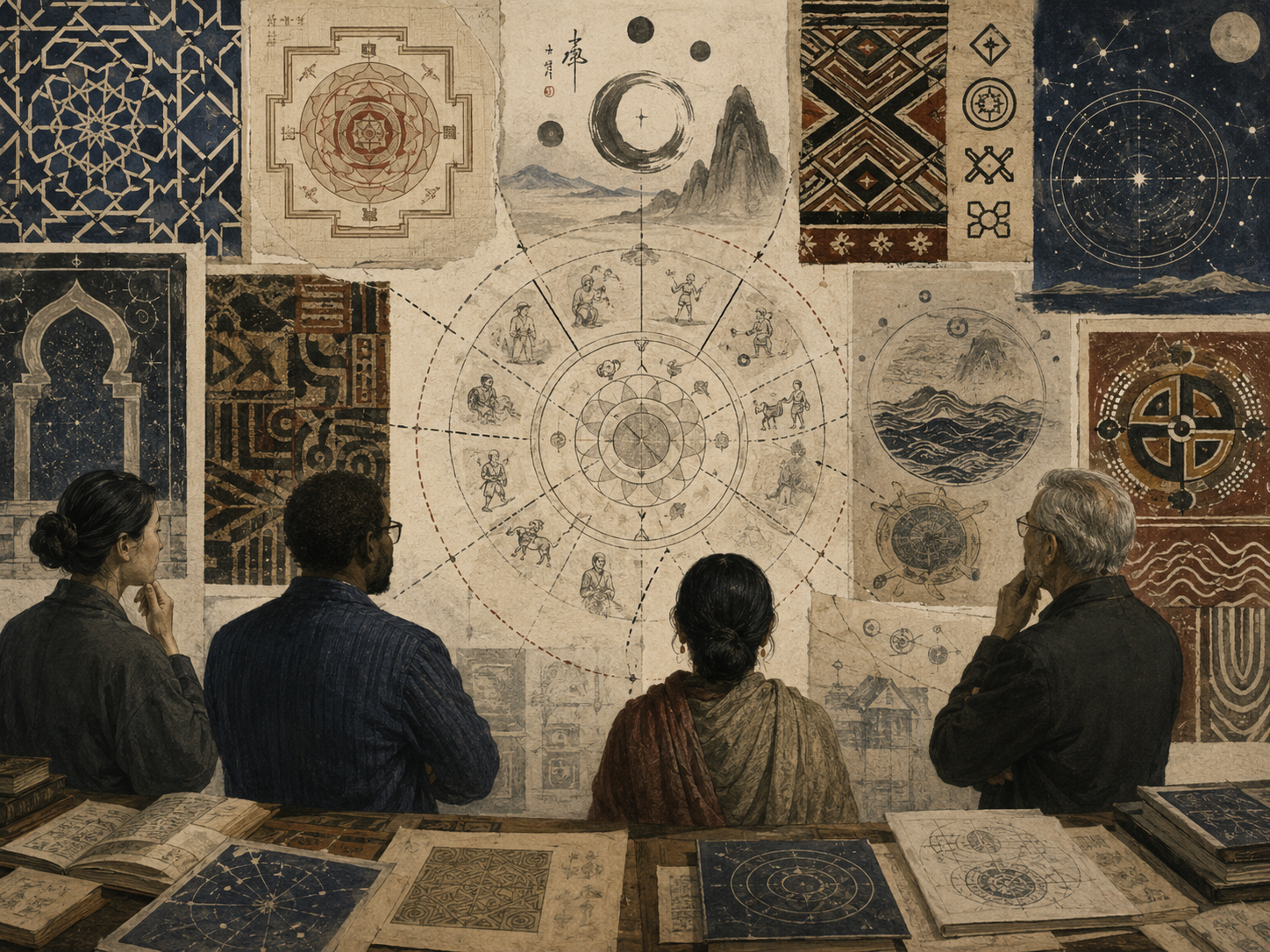
The issue is therefore not whether Jung should be forbidden to compare, but how comparison is done. When Jungian thought reads non-Western traditions carefully, it can illuminate how symbolic life exceeds modern secular literalism and how psyche may be more imaginal, ritual, relational, and cosmological than Western rationalist psychology has often admitted. When it reads carelessly, however, it risks appropriation, abstraction, and epistemic hierarchy. Traditions with their own philosophical vocabularies, metaphysical claims, sacred languages, ritual disciplines, and interpretive authorities may be re-described in Jungian terms so quickly that their internal categories disappear. At that point, universality becomes less discovery than interpretive conquest.
The phrase non-Western symbol systems also requires care. It can easily become a flattening category in its own right, gathering together traditions from South Asia, East Asia, the Islamic world, Africa, Indigenous societies, Oceania, the Americas, and other civilizational formations as though they were united mainly by not being European. A critical discussion therefore has to resist two simplifications at once: the simplification of all cultures into one psychic universal, and the simplification of all non-Western traditions into one comparative counter-Europe. The question is not whether symbolic commonality exists, but how to hold commonality and difference together without erasing either.
This article examines non-Western symbol systems and the limits of Jungian universality. It explores Jung’s comparative ambitions, the appeal of archetypal recurrence, the methodological and political problems of overgeneralization, the critique of cultural appropriation and epistemic flattening, and the possibility of a more historically grounded, philologically careful, theologically literate, and culturally humble symbolic psychology. It argues that the strongest future for Jungian thought may lie not in abandoning comparison, but in learning how to compare without colonizing the traditions it seeks to understand.
Why This Question Matters
This question matters because Jungian psychology rises or falls partly on its treatment of symbolic recurrence across cultures. Much of the tradition’s force comes from the claim that myths, dreams, religious images, ritual forms, artistic figures, and literary structures across civilizations reveal durable patterns of psychic life. If that claim is entirely false, then Jungian universality collapses into loose analogy. If it is partially true but badly handled, then the tradition remains suggestive yet methodologically compromised. Either way, the question cannot be avoided.
It also matters ethically and politically. Comparative interpretation is never innocent. When a powerful theoretical framework from modern Europe reads Buddhist mandalas, Hindu cosmologies, Daoist paradoxes, Sufi symbols, Islamic geometries, Indigenous cosmologies, African ritual forms, or diasporic spiritual practices as illustrations of its own universal categories, it risks transforming living traditions into supporting evidence for a system not their own. The issue is not whether comparison should cease, but whether it can proceed without domination.
Jungian psychology has often been strongest where modern Western psychology was weakest: in taking dreams, symbols, myth, ritual, religion, and numinous experience seriously. It refused the narrow assumption that modern secular categories had exhausted the psyche. It made room for symbolic life, not as decorative culture, but as a deep part of psychic organization. This remains important. Many non-Western and Indigenous traditions do not separate mind, cosmos, ritual, community, land, body, ancestor, and sacred order in the same way that modern European psychology often does. Jung’s comparative imagination was sometimes able to glimpse this broader symbolic field.
But precisely because Jungian psychology took these materials seriously, it also had the power to misread them seriously. A reductive psychology may dismiss religious symbols as illusion or superstition. A careless depth psychology may do something more subtle: it may honor symbols while translating them into its own framework so completely that the traditions themselves lose interpretive authority. In this sense, symbolic seriousness can become another form of possession. The tradition being interpreted is treated as profound, but not allowed to define the terms of its profundity.
This is why the question of non-Western symbol systems is not a side issue for analytical psychology. It touches the credibility of archetypal theory, the status of the collective unconscious, the ethics of symbolic interpretation, the limits of comparison, and the politics of knowledge. It asks whether analytical psychology can become genuinely dialogical or whether it remains structurally tempted to turn difference into confirmation.
A contemporary analytical psychology must therefore ask harder questions than earlier comparative psychology often asked. Who is interpreting whom? What languages are being used? What traditions are being translated? What is lost in translation? Which voices inside the tradition are being heard? Are symbols being read through their ritual, legal, theological, ecological, and communal life, or only through their visual resemblance to Jungian categories? Does comparison illuminate both sides, or does it make one tradition serve the theory of another?
The challenge is to keep the comparative courage of Jungian thought while rejecting the entitlement of interpretive mastery. The aim is not to abandon the possibility of shared human symbolic patterns. The aim is to prevent universality from becoming a way of erasing the worlds through which symbols become meaningful.
Jung’s Comparative Ambition
Jung’s comparative ambition was enormous. He drew on Indian philosophy and religious symbolism, Chinese texts, alchemy, Gnosticism, Christian mysticism, classical myth, astrology, dream reports, fairy tales, ethnographic materials, and many other sources in order to construct a psychology capable of thinking beyond the narrow horizons of secular European rationalism. In this sense, his project was unusually expansive for its time. He did not confine psyche to laboratory behavior or clinical symptom alone. He insisted that symbolic life had to be read across civilizations and ages.
That ambition remains intellectually impressive. It challenged a psychology that had become too small for the full range of human symbolic experience. Jung saw that people do not live by rational concepts alone. They live through images, rites, stories, sacred figures, relational patterns, metaphysical intuitions, and structures of meaning that far exceed immediate conscious intention. His willingness to read psychology alongside religion, myth, art, and ancient texts opened a field of inquiry that remains fertile.
Yet ambition is not the same as adequacy. Jung often approached traditions through translations, secondary reports, selective texts, orientalist scholarship, symbolically charged excerpts, and comparative anthologies rather than through full immersion in the internal debates, linguistic nuances, ritual disciplines, historical stratifications, social conflicts, and living authorities of those traditions. His comparisons are therefore often brilliant but uneven. They open doors and overstep them at the same time.
Jung’s historical context matters. He worked in an intellectual world shaped by colonial scholarship, European philology, comparative religion, romantic fascination with “the East,” racialized theories of culture, and uneven access to non-European traditions. Some of his work resisted European provincialism by taking non-Western traditions seriously. Some of it reproduced European authority by making those traditions available to a European psychological system. Both realities need to be held together.
His comparative method also reflected a particular theory of psyche. Jung was not usually comparing traditions for their own sake. He was searching for evidence that symbolic patterns emerged from deep psychic structures. This search gave his work its coherence, but also shaped what he noticed. Materials that appeared to support archetypal recurrence became especially visible. Materials that resisted Jungian classification, or whose meaning depended on specific doctrinal, ritual, linguistic, or political conditions, could be subordinated to the larger pattern.
Jung’s comparative ambition therefore remains a double inheritance. It pushed psychology beyond the narrow modern Western ego. It also left later Jungians with a difficult task: to preserve the seriousness of symbolic comparison while revising the assumptions under which comparison was conducted. The question is not whether Jung should have remained provincial. The question is whether a global symbolic psychology can be built without repeating the epistemic asymmetries that shaped earlier comparison.
Why Jungian Comparison Can Be Compelling
Jungian comparison can be compelling because it notices something many strictly historicist or reductionist approaches neglect: that certain symbolic patterns do recur across cultural worlds in ways that feel too persistent to dismiss casually. Circular symbols of totality, sacred ascent and descent, death-rebirth sequences, divine child figures, wise guides, tricksters, cosmic trees, underworld passages, ritual purifications, sacred mountains, world centers, transformative unions, shadow figures, monstrous thresholds, and oppositional pairs appear with striking regularity. These recurrences may indeed speak to enduring structures of imagination and to recurrent existential conditions of human life.
Jung’s great strength was to refuse the flattening assumption that all such repetition is coincidence or literary borrowing alone. He made it possible to ask whether human beings repeatedly generate deep symbolic responses to embodiment, kinship, mortality, violence, sexuality, fertility, loss, transcendence, social order, and the mystery of consciousness itself. The trouble begins not with noticing recurrence, but with leaping too quickly from recurrence to one explanatory model.
There are real reasons symbolic recurrence happens. Human beings share bodies. They are born, fed, held, wounded, sexualized, aged, and made mortal. They experience darkness and light, sleep and waking, hunger and fullness, separation and return, fear and protection, burial and birth, kinship and exile, land and sky. They organize communities around authority, obligation, memory, taboo, mourning, initiation, and transmission. They encounter dreams and altered states. They develop rituals around danger, passage, fertility, death, and renewal. It would be surprising if no symbolic patterns recurred across human societies.
Jungian comparison is compelling because it recognizes this shared symbolic pressure. It suggests that human beings repeatedly produce images at the intersection of bodily life, social order, ecological setting, religious imagination, and psychic need. It allows modern readers to see myth and ritual not as primitive error, but as sophisticated symbolic engagements with enduring human problems. This remains a major contribution.
But the strength of this insight depends on the care of its use. A recurring pattern may be real without proving a single universal meaning. A motif may appear widely because of shared embodiment, historical transmission, colonial contact, trade, migration, ecological similarity, political form, narrative constraint, or common existential pressure. Jungian interpretation is one possible layer of explanation, not the only one.
Comparison is strongest when it does not force closure. A circular diagram may invite reflection on wholeness, orientation, cosmos, ritual space, divine order, meditation, geometry, kingship, sacred law, calendrical time, or psychic integration. Which of these matters depends on tradition and context. Jungian psychology is most useful when it adds a psychological layer without claiming to exhaust all other meanings.
The appeal of Jungian comparison, then, should not be dismissed. It remains valuable because symbols do travel across private and collective life in ways that purely local interpretation may miss. But its credibility depends on methodological humility: symbolic recurrence can invite comparison without authorizing reduction.
Recurrence Is Not Identity
The central methodological warning is simple: recurrence is not identity. A symbol may recur across traditions without carrying the same ontology, ritual use, ethical demand, social meaning, or theological status. A serpent in one context may signify healing, wisdom, danger, royal power, cyclical renewal, temptation, fertility, ancestral force, cosmic mediation, or spiritual testing. The mere fact of symbolic similarity does not establish sameness of meaning, much less sameness of psychic origin.
This is where Jungian universality often meets its sharpest limit. By abstracting symbols to a high enough level—mother, child, center, shadow, journey, sacrifice, union, descent, rebirth—one can indeed produce impressive cross-cultural parallels. But the higher the abstraction, the more historical thickness is lost. A symbol becomes universally comparable by becoming increasingly detached from the very worlds that made it meaningful in the first place.
Abstraction is not always wrong. It is necessary for comparison. Without abstraction, no cross-cultural analysis would be possible. The problem is abstraction without return. A responsible method may move upward from local symbol to broader pattern, but it must also move back down into language, ritual, history, social function, and doctrinal meaning. When comparison only moves upward, toward the universal, it risks leaving the tradition behind.
Consider the figure of the divine child. Jungian interpretation may see the child as a symbol of future potential, renewal, vulnerability, transformation, or the emergence of a new psychic center. This may be illuminating. But child figures in specific traditions may also be tied to incarnation, royal succession, fertility rites, clan mythology, divine play, ritual calendrics, national destiny, messianic expectation, or devotional practice. These meanings are not interchangeable. The Jungian reading may be one layer, but it cannot replace the tradition’s own world.
The same is true of descent and underworld imagery. A descent into darkness may be compared psychologically to depression, initiation, confrontation with the unconscious, or symbolic death. Yet underworld motifs may also belong to specific cosmologies of the dead, ritual obligations, ancestor relations, moral judgment, agricultural cycles, shamanic journeying, or imperial mythology. The image recurs, but recurrence does not erase the local grammar of meaning.
Jungian universality is most credible when it becomes modest. Instead of saying, “This symbol means the same thing everywhere,” it can say: “This symbol belongs to a family of recurring human concerns, but its meaning must be read in relation to the tradition that sustains it.” This formulation preserves comparison while preventing symbolic identity from becoming interpretive domination.
| Comparative temptation | Methodological correction | Why it matters |
|---|---|---|
| Assume similar images share one meaning | Ask how each image functions in its own ritual, linguistic, and social context | Prevents visual resemblance from replacing cultural knowledge |
| Translate symbols immediately into Jungian archetypes | First examine the tradition’s own categories and interpretive authorities | Preserves local meaning before psychological reinterpretation |
| Use recurrence as proof of universal psychic structure | Consider multiple explanations: embodiment, diffusion, history, ecology, social form, and cognition | Reduces overclaiming and confirmation bias |
| Treat non-Western traditions as corrective mirrors for the West | Engage them as living intellectual worlds, not therapeutic resources for European modernity | Avoids romanticization and appropriation |
| Abstract symbols away from practice | Study ritual use, communal transmission, sacred language, and embodied discipline | Recognizes that symbols are lived, not merely imagined |
The phrase “recurrence is not identity” is therefore not anti-Jungian. It is a necessary discipline for any Jungianism that wants to remain credible in a global intellectual field. It allows analytical psychology to notice patterns without claiming too much, to compare without collapsing, and to interpret without erasing.
Symbol, Function, Ritual, and Worldview
Symbols do not float freely. They live inside ritual systems, cosmologies, ethical orders, kinship forms, theological claims, artistic conventions, legal practices, ecological relations, and embodied disciplines. A mandala is not only a circle. A shrine is not only a center. An ancestor figure is not only a wise old man archetype. A ritual death is not only a symbolic transformation sequence. Without attention to function, practice, and worldview, Jungian reading can become too image-centered and insufficiently contextual.
This matters because symbols are not simply mental pictures. They are enacted, inhabited, disciplined, transmitted, contested, and lived. A culturally serious depth psychology must therefore ask not just what a symbol resembles, but what it does in its own world. Does it consecrate space? Organize memory? Legitimate authority? Heal illness? Structure initiation? Bind a community to land? Transmit revelation? Mark gendered status? Protect the dead? Regulate moral life? Orient meditation? Establish legal or ritual obligation? Preserve ecological knowledge? The answer changes the meaning of the symbol.
Jungian psychology often privileges image. This is understandable because dreams and fantasies appear as images, and because symbolic forms often reveal psychic structure visually. But many traditions do not treat symbols primarily as images to be interpreted. They may treat them as presences, relations, obligations, names, sounds, gestures, patterns, cosmological maps, ritual technologies, sacred inheritances, or forms of disciplined attention. A symbol may not be something one “reads” from a distance. It may be something one performs, receives, obeys, protects, or becomes responsible to.
This is one reason the modern psychological category of “symbol” can be insufficient. In some traditions, what a modern interpreter calls a symbol may not be understood as symbolic in the sense of representing something else. It may be a living relation, a sacred trace, a revealed sign, an ancestral presence, a ritual form, a legal marker, a cosmological reality, or a site of power. To psychologize it too quickly may reduce its ontological status. It becomes “inner meaning” when the tradition understands it as relation to a world beyond the individual psyche.
Function also matters because the same image may do different things. A mask may conceal, reveal, transform, authorize, protect, embody, ridicule, initiate, or mediate between worlds. A drum may communicate, summon, regulate, remember, heal, or establish communal rhythm. A geometric pattern may decorate, instruct, protect, orient prayer, represent cosmology, discipline attention, or evoke divine order. A psychological reading that ignores function risks mistaking the surface of the symbol for its life.
Worldview is equally important. Jungian psychology often operates with a distinction between psyche and world, even when it complicates that distinction. Many traditions do not begin there. They may understand personhood as relational, porous, ancestral, ecological, communal, or cosmological. In such contexts, the symbol is not a private image rising from an individual unconscious. It may be part of a shared world in which mind, land, ritual, law, spirit, ancestor, and community cannot be cleanly separated.
A culturally serious analytical psychology must therefore become more interdisciplinary. It needs help from anthropology, religious studies, philology, theology, Indigenous studies, African studies, Islamic studies, South Asian studies, East Asian studies, art history, oral-history methods, ritual studies, and decolonial critique. These disciplines do not destroy depth psychology. They protect it from becoming shallow in the name of depth.
South Asian Symbolic Worlds and Jungian Reading
Jung was deeply interested in South Asian materials, especially yoga, mandalas, philosophical symbolism, meditation, religious psychology, and images of psychic transformation. He often found in these traditions confirmation that psyche could not be reduced to secular rational categories. South Asian traditions presented forms of consciousness, ritual, liberation, embodied discipline, cosmology, and symbolic practice that seemed to challenge the narrowness of modern Western psychology.
Yet critics note that Jung sometimes re-read South Asian symbols primarily as psychic structures for modern Western individuation, even where those symbols were embedded in soteriological, metaphysical, devotional, ritual, and doctrinal frameworks not reducible to psychology. This can distort as much as it illuminates. For example, a mandala may indeed function as a symbol of psychic order or wholeness in Jungian terms, but within Buddhist or Hindu traditions it may also belong to precise ritual, cosmological, contemplative, initiatory, and doctrinal worlds. To translate it too quickly into “the Self” may make it legible to modern psychology while obscuring what it is in the tradition from which it comes.
South Asian symbolic worlds are internally plural. Hindu, Buddhist, Jain, Sikh, Tantric, Vedantic, devotional, ritual, philosophical, folk, regional, and diasporic traditions cannot be collapsed into one “Indian symbolism.” Even within one tradition, symbols may function differently across language, caste, region, sect, text, ritual, gendered practice, and historical period. A lotus, chakra, yantra, deity image, mantra, sacred mountain, river, guru figure, serpent, or cosmic diagram cannot be responsibly interpreted apart from these layers.
The Jungian temptation is to read such symbols as expressions of psychic individuation. That reading may sometimes produce insight, especially for modern individuals engaging South Asian materials outside traditional contexts. But it becomes problematic when it treats traditions of liberation, devotion, metaphysics, ritual discipline, or divine relation as though their deepest truth were psychological integration. The concept of individuation cannot simply replace moksha, nirvana, bhakti, dharma, shakti, tantra, or contemplative realization. These terms belong to their own worlds of practice and thought.
South Asian materials also challenge Western psychology by refusing simplistic distinctions between body and spirit, ritual and psychology, sound and meaning, practice and doctrine. Mantra, posture, breath, visualization, offering, image, teacher-disciple relation, textual recitation, and sacred geography may all be symbolically and spiritually consequential. A Jungian reading that focuses only on inner imagery may miss the embodied and transmitted disciplines through which symbols become transformative.
A more responsible Jungian engagement with South Asian traditions would therefore proceed in stages. First, it would learn the tradition’s own terms. Second, it would attend to linguistic and historical specificity. Third, it would distinguish between living practice and modern Western reception. Fourth, it would ask what a psychological reading can illuminate without claiming to exhaust the symbol’s meaning. Fifth, it would remain open to being corrected by practitioners, scholars, and textual traditions.
Such an approach does not forbid Jungian interpretation. It deepens it. A mandala may still matter psychologically. But it also matters ritually, cosmologically, doctrinally, aesthetically, and historically. The task is to let all of those layers remain visible.
East Asian Thought, Symbol, and Misreading
Jung’s engagement with Chinese thought, especially Daoism and the I Ching, has been influential and contested. He admired forms of thought that seemed less committed to Western dualism and more attuned to pattern, transformation, paradox, complementarity, and correspondence. This helped him articulate synchronicity and symbolic patterning in ways that many readers still find generative.
Yet critics argue that such engagement sometimes romanticized East Asian traditions as repositories of ancient wisdom available to correct Western fragmentation. This can turn living intellectual traditions into mirrors for European psychological needs. Daoist, Confucian, Buddhist, Shinto, and other East Asian concepts risk being recruited into a symbolic therapy of the Western self rather than engaged on their own philosophical, ritual, political, and historical terms.
East Asian traditions also resist easy generalization. Daoist cosmology, Confucian ethics, Chan and Zen Buddhist practice, Pure Land devotion, Shinto ritual, Korean religious traditions, Japanese esoteric Buddhism, Chinese folk religion, ancestor rites, divination practices, and literati symbolism all involve different understandings of self, cosmos, practice, order, authority, and transformation. To speak of “Eastern thought” as though it were one symbolic field is already a methodological problem.
The I Ching illustrates both the appeal and danger of Jungian comparison. Jung saw in it a model of meaningful pattern, acausal correspondence, and symbolic consultation that challenged Western causal rationalism. This reading helped him think about synchronicity. But the I Ching also belongs to long Chinese traditions of divination, commentary, cosmology, statecraft, ethics, textual interpretation, and philosophical debate. To treat it mainly as evidence for Jungian synchronicity risks narrowing its historical life.
Daoist symbolism presents a similar problem. Concepts such as dao, yin-yang, wu wei, transformation, emptiness, spontaneity, and return can seem attractive to depth psychology because they unsettle rigid ego-centered categories. But they should not be converted too quickly into psychological principles for Western individuation. Daoist terms belong to cosmological, textual, ritual, meditative, political, and practical contexts that cannot be replaced by modern therapeutic language.
Confucian traditions complicate Jungian readings further because they emphasize ritual propriety, relational ethics, cultivation, hierarchy, family, governance, and moral formation. A Jungian lens might focus on symbolic order or persona, but Confucian thought cannot be reduced to psychological adaptation. Its account of personhood is deeply relational and ethical. It challenges modern individualist assumptions embedded in many Western psychologies, including some Jungian accounts of individuation.
A responsible engagement with East Asian symbolic systems therefore requires caution against romantic reversal. It is not enough to say that “the East” is holistic while “the West” is fragmented. That binary is itself a Western construction. The better path is more specific: which East Asian tradition, in which language, in which period, in which practice, under which interpretive authority, and for what purpose? Only then can Jungian comparison become dialogue rather than projection.
Indigenous Symbol Systems and the Problem of Abstraction
Indigenous symbol systems pose an especially sharp challenge to Jungian universality. Many Indigenous cosmologies are not organized around the same distinction between psyche and world, inner and outer, symbol and reality, human and nonhuman, that Jungian thought often presumes. A spirit figure, land relation, ancestor presence, animal form, ceremonial object, sacred story, or ecological pattern may not be primarily symbolic in the modern psychological sense at all. It may be relational, territorial, juridical, cosmological, and communal in ways that exceed inner interpretation.
When such systems are psychologized too quickly, their ontological claims are neutralized. A sacred relation becomes a symbol of inner transformation. A collective ceremony becomes an expression of archetypal pattern. A land-based obligation becomes a metaphor for psychic grounding. An ancestral presence becomes an inner figure. Something is gained in comparability, but much may be lost in truthfulness to the tradition itself. This is one of the clearest limits of Jungian universalization.
Indigenous traditions are also not simply “ancient symbolic systems.” They are living, contested, colonized, resilient, adaptive, and politically situated worlds. Their symbols cannot be responsibly separated from histories of dispossession, missionization, forced assimilation, land theft, language suppression, cultural extraction, and ongoing struggles for sovereignty. A Jungian interpretation that treats Indigenous material as universal dream imagery while ignoring colonial history participates in the very abstraction it should be questioning.
Land is especially important. In many Indigenous traditions, meaning is not primarily organized around an interior psyche but around place, relation, obligation, story, and law. Sacred geography may not be a symbol of inner life. It may be a living field of relation and responsibility. To translate land into psyche can become a form of erasure when land itself is the site of memory, law, ancestor relation, ecological knowledge, and political struggle.
The same caution applies to animals, masks, ceremonies, and stories. An animal figure may not be an “animal archetype” in a generic sense. It may belong to a clan system, hunting relation, ecological teaching, ceremonial role, kinship structure, or sacred narrative governed by protocols of transmission. A story may not be public material for universal interpretation. It may have restrictions, seasonal contexts, initiatory conditions, or community-specific meanings.
A culturally humble Jungian approach must therefore begin by accepting limits. Some materials should not be interpreted by outsiders. Some symbols are not available for extraction. Some knowledge is not public. Some ceremonial meanings are not reducible to psychological translation. Some traditions require permission, relationship, accountability, and community authority before interpretation can responsibly occur.
This does not mean analytical psychology has nothing to learn from Indigenous worlds. It may learn that psyche is not best understood as an isolated individual interior. It may learn that dreams can be communal, ecological, ancestral, and relational. It may learn that symbol and land cannot always be separated. It may learn that healing may be ceremonial, collective, and place-based rather than primarily intrapsychic. But these lessons require listening before interpretation. They require a depth psychology that is willing to be decentered.
Islamic Symbolic Traditions and Translation Limits
Islamic symbolic traditions, including Qur’anic imagery, Sufi metaphors, dream interpretation, sacred geometry, calligraphy, cosmological symbolism, poetic language, devotional practice, and philosophical theology, reveal the limits of universalizing comparison with particular force. Jungian readers may notice familiar motifs: ascent, center, light, heart, journey, purification, kingly or prophetic figures, garden, desert, mirror, bridal symbolism, union language, and sacred order. Yet the meanings of these motifs are shaped by a dense theological and legal-intellectual world in which revelation, prophecy, transcendence, divine unity, moral accountability, and sacred law carry specific implications not reducible to archetypal generality.
To read such materials responsibly requires more than noticing resonance. It requires awareness that symbolic language may be doctrinally disciplined and theologically bounded in ways that resist psychological translation. Jungian universality reaches its limit when it assumes that symbolic similarity authorizes conceptual equivalence.
Light, for example, may be psychologically suggestive as illumination, consciousness, revelation, insight, or divine presence. But in Islamic traditions, light imagery may be tied to Qur’anic language, theological reflection, prophetic inheritance, metaphysics, devotional practice, philosophical cosmology, and Sufi accounts of the heart. To read it only as an archetype of consciousness may flatten its relation to divine speech, prophetic authority, and the disciplined life of worship.
The heart offers another example. A Jungian reading may associate the heart with feeling, center, interiority, or psychic wholeness. Islamic traditions often give the heart deep spiritual, moral, epistemic, and theological significance. It may be the site of remembrance, veiling, purification, receptivity, knowledge, hardness, mercy, or nearness to God. It is not simply an emotional symbol. It belongs to a moral and spiritual anthropology.
Sufi poetry also raises translation limits. Language of union, intoxication, beloved, annihilation, journey, poverty, and unveiling can seem immediately available to depth psychology. But Sufi terms have technical, devotional, theological, and initiatory dimensions. They belong to lineages, practices, commentaries, and debates. Psychological readings may illuminate aspects of longing, transformation, and self-transcendence, but they should not replace the tradition’s own account of divine relation, discipline, and metaphysical orientation.
Islamic sacred geometry and calligraphy further complicate psychological interpretation. A geometric pattern may suggest mandala-like order, but its function may involve aniconism, divine unity, mathematical beauty, architectural theology, contemplative orientation, or the disciplined visual culture of sacred space. Calligraphy is not merely beautiful symbolic form; it may be bound to revelation, recitation, script, and the visible honor given to divine speech. A Jungian reading that treats geometry or script primarily as psychic image risks missing its scriptural and theological grounding.
A culturally careful analytical psychology can still learn from Islamic symbolic traditions. It can learn that symbol may be inseparable from revelation, law, recitation, discipline, beauty, and communal practice. It can learn that inner transformation is not always framed as self-realization, but may be framed as surrender, remembrance, purification, and ethical accountability before God. It can learn that the symbolic life of the psyche may be disciplined by a tradition rather than spontaneously generated by individual imagination alone. But to learn these things, Jungian psychology must allow Islamic categories to speak before translating them into its own.
African Symbolic Systems, Oral Worlds, and Collective Forms
African symbolic systems and oral traditions further complicate Jungian universality because many of them are transmitted through performance, proverb, ritual, music, lineage, initiation, dance, textile, architecture, healing practice, praise poetry, and communal memory rather than through the kinds of textual archives Jung most often privileged. Symbol here may live less as isolated image and more as enacted social knowledge. Ancestors, masks, drums, praise names, trickster figures, sacred kingship, divination systems, healing rituals, initiatory forms, and cosmograms can be psychologically rich while remaining inseparable from specific political, ecological, and ritual worlds.
A Jungian reading can illuminate psychic depth in such forms, but it risks distortion when it privileges inner universality over social embodiment. Symbols are not only in minds; they are in institutions, ceremonies, landscapes, rhythms, lineages, and inherited communal practices. A comparative psychology that forgets this becomes too privatized and too textual.
African traditions also resist continental generalization. Yoruba, Akan, Kongo, Mande, Igbo, Zulu, Dogon, Ethiopian, Nubian, Berber, Swahili, diasporic, and many other traditions cannot be reduced to one African symbolic field. Their religious systems, political histories, aesthetic forms, oral literatures, and ritual practices differ profoundly. A Jungian category such as trickster, mother, ancestor, king, shadow, or initiation may illuminate certain patterns, but it can also obscure local specificity if applied too quickly.
Ancestor symbolism is a powerful example. Jungian psychology might read ancestors as inner figures, inherited psychic patterns, or manifestations of collective memory. But in many African and African diasporic contexts, ancestors may be part of living ritual, moral authority, family continuity, land relation, social identity, and spiritual reciprocity. They are not merely symbols of psychic inheritance. They are participants in a world of obligation and relation.
Masks also reveal the limits of image-based interpretation. A mask may appear to a modern viewer as a visual object, inviting archetypal interpretation. But in many contexts, the mask is inseparable from dance, costume, music, initiation, secrecy, gendered authority, public performance, social regulation, healing, and community memory. A museum display or psychological reading can detach the mask from the event that makes it meaningful. A depth psychology that reads only the image may miss the living form.
Orality matters as well. Symbolic knowledge transmitted through proverb, praise, rhythm, story, and performance does not always behave like textual symbolism. Its meaning may depend on speaker, occasion, audience, tone, gesture, repetition, and social setting. Jungian comparison, shaped heavily by textual and visual materials, must be revised if it is to engage oral worlds with integrity.
African diasporic traditions add another layer. Symbols carried through enslavement, forced migration, conversion, resistance, syncretism, secrecy, and survival cannot be interpreted apart from history. Their meanings may involve trauma, memory, coded continuity, spiritual resilience, racial oppression, communal healing, and the preservation of sacred forms under domination. To treat these symbols simply as archetypal recurrence would miss the historical and political force of their survival.
A culturally humble Jungian approach would therefore treat African symbolic systems not as a storehouse of archetypal examples, but as complex intellectual, ritual, aesthetic, and communal worlds. It would ask how symbol operates in performance, lineage, healing, politics, and memory. It would attend to oral knowledge and embodied transmission. It would recognize that the psyche is not always best understood as individual interiority; it may be formed through communal rhythm, ancestor relation, ritual obligation, and collective memory.
Appropriation or Dialogue?
The question is not whether Jungian psychology must abandon all cross-cultural work. The more important question is whether it can move from appropriation toward dialogue. Appropriation occurs when traditions are mined selectively for symbols that confirm a preexisting framework. Dialogue requires learning the categories, tensions, limits, and self-understandings of a tradition before translating it into one’s own terms. It also requires accepting that some symbolic worlds may resist translation.
This shift would make Jungian comparison slower, less triumphant, and more modest. It would also likely make it better. A symbol can be both comparable and irreducibly particular. Dialogue begins when comparison no longer assumes mastery.
Appropriation has several recognizable features. It extracts symbols from context. It treats sacred material as publicly available psychological evidence. It cites traditions through secondary sources while ignoring living interpreters. It uses non-Western materials to solve Western problems without accountability to the communities from which those materials come. It translates theological, ritual, or cosmological concepts into Jungian language so completely that the original categories disappear. It treats difference as decoration and similarity as proof.
Dialogue has different features. It begins with listening. It studies languages where possible. It respects internal disagreements within traditions. It distinguishes between public and restricted knowledge. It attends to ritual use, historical trauma, social function, gender, class, colonial history, and political context. It allows practitioners and scholars from the tradition to correct the comparison. It accepts that not every symbol belongs in a Jungian framework. It recognizes that the interpreter may be changed by the encounter rather than simply using the encounter to confirm a prior theory.
A dialogical Jungianism would also distinguish between personal symbolic use and scholarly interpretation. A modern person may encounter a non-Western symbol in a dream, artwork, or spiritual practice and experience it psychologically. That experience may be meaningful. But the personal meaning of a borrowed symbol is not the same as the tradition’s meaning. A dreamer’s association to a mandala, for example, does not authorize claims about Tibetan Buddhism. Personal symbolism and cultural interpretation require different standards.
Dialogue also requires attention to power. Western scholars and therapists have often had disproportionate access to publication, institutional authority, translation networks, and global intellectual legitimacy. When they interpret non-Western traditions, their frameworks may circulate more widely than the voices of practitioners or scholars from those traditions. A culturally humble analytical psychology must be aware of this asymmetry and resist making Jungian language the final court of symbolic meaning.
| Appropriation | Dialogue |
|---|---|
| Selects symbols that confirm a preexisting Jungian framework | Studies symbols within their own ritual, linguistic, theological, and historical worlds |
| Treats living traditions as evidence for universal archetypes | Allows traditions to challenge, revise, or exceed Jungian categories |
| Privatizes collective or sacred material as inner psychological imagery | Recognizes communal, legal, land-based, devotional, and ritual dimensions of meaning |
| Uses resemblance as proof | Tests resemblance against difference, function, and context |
| Assumes all symbolic material is available for interpretation | Respects restricted, sacred, community-governed, or non-public knowledge |
| Centers the Jungian interpreter | Centers accountable encounter, shared inquiry, and correction by tradition-specific knowledge |
The future of Jungian comparison depends on this shift. Analytical psychology can still compare, but it must become more accountable. Its interpretive ambition must be matched by humility, scholarship, and ethical relation.
Universality, Particularity, and Method
A more careful method would distinguish among several levels of claim. One may observe formal recurrence without claiming identical meaning. One may propose shared human existential pressures without positing one inherited symbolic structure. One may identify family resemblances among symbols without declaring them manifestations of one archetype in a strong ontological sense. These distinctions matter because they reduce the pressure to choose between absolute universalism and total incommensurability.
The strongest future for Jungian thought may lie in this middle space. Universalism becomes weaker but more defensible; particularity becomes stronger without abolishing comparison. Symbolic psychology can then remain comparative without claiming too much.
The methodological problem can be stated as a set of layered questions. First, is there a formal resemblance? Second, does the resemblance occur at the level of image, narrative structure, ritual sequence, social function, theological claim, affective pattern, or existential problem? Third, what explanations might account for the resemblance? Fourth, what differences matter? Fifth, what does the tradition itself say the symbol is? Sixth, what does the Jungian interpretation add? Seventh, what might it erase?
This layered method allows comparison to proceed without collapsing levels. A sacred tree, for example, may appear in multiple traditions. Formal recurrence may be real. But the tree may function as world axis, ancestor marker, fertility symbol, legal meeting place, ecological relation, divine presence, mythic origin, ritual object, or poetic image. A Jungian interpretation might identify a symbol of life, rootedness, vertical connection, or psychic growth. That reading may be useful, but it should not displace the tree’s local function.
Such method also allows for degrees of universality. Some universals may be thin and formal: human beings repeatedly symbolize centers, thresholds, journeys, darkness, light, birth, death, danger, transformation, and relation to invisible powers. These thin universals are plausible. Thicker universals—specific archetypal meanings, inherited psychic structures, or identical symbolic functions across cultures—require stronger evidence. Jungian thought becomes more credible when it distinguishes thin recurrence from thick universality.
Particularity also has levels. A symbol may be specific to a tradition, a region, a sect, a ritual office, a gendered practice, a lineage, a historical moment, a colonial encounter, a family story, or an individual dream. Jungian interpretation often moves toward the general. A more careful method must be able to move toward the particular with equal seriousness.
Methodological humility does not mean comparison becomes impossible. It means comparison becomes more precise. Instead of claiming that all circular symbols are mandalas of the Self, one might say: circular forms often organize experiences of center, boundary, orientation, order, enclosure, cosmos, or completion, but the meaning of any given circular form depends on its tradition, function, and use. This is less grand than classical universalism. It is also more defensible.
In this revised method, Jungian psychology becomes one interpretive voice among others. It can ask what a symbol may reveal about psyche. It cannot claim that psyche is the only or final meaning of the symbol. The result is a comparative depth psychology that is dialogical rather than imperial.
Toward a Culturally Humble Depth Psychology
A culturally humble depth psychology would retain Jung’s insistence that symbolic life matters deeply while revising how universality is claimed. It would use philology, anthropology, theology, area studies, Indigenous studies, African studies, Islamic studies, Asian studies, ritual studies, oral-history methods, and decolonial critique not as enemies of depth but as disciplines that prevent depth psychology from becoming interpretive empire. It would ask what counts as symbol in each world, who gets to interpret it, how it is lived, and what is lost when it is generalized.
Such a revision would not destroy Jungian thought. It might deepen it. The universal, if it exists, is not weakened by careful encounter with difference. It is tested by it. A truly serious symbolic psychology should be able to survive that test without forcing the world into one map.
Cultural humility begins by recognizing that analytical psychology is itself a tradition. It is not a view from nowhere. It emerged from European intellectual history, psychiatry, psychoanalysis, comparative religion, romanticism, Christian and post-Christian concerns, colonial-era scholarship, and modern crises of meaning. Its categories are powerful, but they are not neutral. Terms such as archetype, individuation, collective unconscious, shadow, anima, animus, Self, and compensation are not universal languages into which all traditions must be translated. They are concepts from one intellectual lineage.
A culturally humble depth psychology would also attend to who speaks. Non-Western traditions have their own scholars, practitioners, ritual authorities, theologians, artists, elders, healers, philosophers, poets, and communities of interpretation. Jungian scholarship becomes stronger when it engages these voices not merely as sources of material but as interpreters with authority. The task is not to collect symbols from elsewhere. The task is to enter a field of accountable interpretation.
It would also take internal plurality seriously. There is no single Hindu symbolism, Buddhist symbolism, Islamic symbolism, African symbolism, Indigenous symbolism, or East Asian symbolism. Traditions contain debate, hierarchy, reform, dissent, esotericism, regional variation, gendered practice, caste and class dynamics, sectarian disagreement, colonial disruption, and diasporic transformation. Jungian comparison must resist the desire for a clean symbolic essence.
A culturally humble depth psychology would be careful with therapeutic appropriation. It would not use sacred forms as aesthetic supplements for modern self-development without attention to their origins and meanings. It would distinguish between respectful learning, scholarly interpretation, clinical metaphor, artistic inspiration, and extractive borrowing. It would ask whether a symbol is being used with permission, context, and accountability, or whether it is being consumed as an image of depth.
Finally, a culturally humble depth psychology would accept that some symbols remain opaque. Opacity is not failure. It may be a sign of respect. Not everything needs to be translated into Jungian terms. Not every symbolic world exists to confirm analytical psychology. Some traditions may challenge Jungian assumptions so deeply that they require revision of the theory itself.
This is the future in which analytical psychology remains most valuable: comparative, but not conquering; symbolic, but not extractive; universal in aspiration, but disciplined by particularity; psychologically attentive, but willing to be corrected by history, language, ritual, theology, and community. Such a psychology would not abandon Jung’s boldness. It would make that boldness more responsible.
Mathematical Lens
Cross-cultural symbolic interpretation can be modeled as a balance between formal recurrence and contextual specificity. Let \(Q_t\) represent comparative quality at time \(t\), \(R_t\) symbolic recurrence across traditions, \(S_t\) contextual specificity, \(L_t\) linguistic and philological depth, \(D_t\) dialogical accountability, and \(U_t\) universalizing force.
Q_t = \alpha + \beta_1 R_t + \beta_2 S_t + \beta_3 L_t + \beta_4 D_t – \beta_5 U_t + \varepsilon_t
\]
Interpretation: Comparative quality improves when recurrence is acknowledged while contextual specificity, language competence, and dialogical accountability are preserved. It declines when universalizing force outruns the evidence supplied by tradition-specific knowledge.
This model captures a central methodological point: comparison is not made better by recurrence alone. A weak comparison may notice resemblance while ignoring meaning. A stronger comparison asks whether the resemblance survives attention to language, ritual, function, history, theology, power, and the tradition’s own categories.
A second expression can represent flattening risk. Let \(F_t\) represent flattening risk, \(U_t\) universalizing force, \(A_t\) abstraction pressure, \(S_t\) contextual specificity, and \(D_t\) dialogical accountability.
F_t = \gamma_1 U_t + \gamma_2 A_t – \gamma_3 S_t – \gamma_4 D_t + \eta_t
\]
Interpretation: Flattening risk rises when universalization and abstraction increase faster than contextual specificity and accountability. It falls when interpreters remain grounded in local meaning and allow traditions to correct the comparison.
A third expression can distinguish formal recurrence from functional equivalence. Let \(E_t\) represent equivalence claim strength, \(R_t\) formal recurrence, \(V_t\) functional convergence, and \(C_t\) contextual divergence.
E_t = \delta_1 R_t + \delta_2 V_t – \delta_3 C_t + \nu_t
\]
Interpretation: A strong equivalence claim requires more than visual or formal recurrence. It becomes more plausible when symbols also share function, use, and interpretive role, and weaker when contextual divergence is high.
In network terms, cross-cultural psychology should not be modeled as one center pulling all symbols inward, but as overlapping symbolic networks with partial bridges and strong local clustering. Good comparison strengthens bridges without erasing clusters. Bad comparison increases bridge weights so aggressively that local structure disappears. A responsible Jungian method should preserve both connection and distance.
R Workflow: Simulating Symbolic Recurrence and Cultural Specificity
The following R workflow sketches a simple way to model comparative symbolic analysis by balancing recurrence, specificity, linguistic depth, dialogical accountability, abstraction pressure, and universalizing force. The data are synthetic and illustrative. They are not a measurement of real traditions, symbols, cultures, or religious systems.
# ============================================================
# Non-Western Symbol Systems and the Limits of Jungian Universality
# R Workflow: Simulating Symbolic Recurrence and Cultural Specificity
# ============================================================

# This workflow uses synthetic data for conceptual demonstration.
# It is not a tool for ranking traditions, measuring cultures,
# validating archetypes, or evaluating sacred systems.

library(dplyr)
library(ggplot2)
library(lme4)
library(broom.mixed)

set.seed(2026)

# ------------------------------------------------------------
# 1. Create synthetic panel data for symbol comparisons
# ------------------------------------------------------------

n_symbols <- 260
n_periods <- 18

panel <- expand.grid(
  symbol_id = 1:n_symbols,
  time = 1:n_periods
) |>
  arrange(symbol_id, time) |>
  mutate(
    tradition_layer = sample(
      c("south_asian",
        "east_asian",
        "islamic",
        "indigenous",
        "african",
        "diasporic",
        "comparative_bridge"),
      size = n(),
      replace = TRUE
    ),
    recurrence = rnorm(n(), 0, 1),
    specificity = rnorm(n(), 0, 1),
    linguistic_depth = rnorm(n(), 0, 1),
    ritual_context = rnorm(n(), 0, 1),
    dialogical_accountability = rnorm(n(), 0, 1),
    universalizing_force = rnorm(n(), 0, 1),
    abstraction_pressure = rnorm(n(), 0, 1),
    contextual_divergence = rnorm(n(), 0, 1),
    functional_convergence = rnorm(n(), 0, 1)
  )

# ------------------------------------------------------------
# 2. Simulate comparative quality
# ------------------------------------------------------------

panel <- panel |>
  mutate(
    comparative_quality =
      0.52 * recurrence +
      0.68 * specificity +
      0.58 * linguistic_depth +
      0.54 * ritual_context +
      0.62 * dialogical_accountability -
      0.66 * universalizing_force -
      0.42 * abstraction_pressure +
      rnorm(n(), 0, 0.50)
  )

# ------------------------------------------------------------
# 3. Simulate flattening risk
# ------------------------------------------------------------

panel <- panel |>
  mutate(
    flattening_risk =
      0.70 * universalizing_force +
      0.64 * abstraction_pressure -
      0.58 * specificity -
      0.54 * dialogical_accountability -
      0.38 * linguistic_depth +
      rnorm(n(), 0, 0.50)
  )

# ------------------------------------------------------------
# 4. Simulate equivalence-claim strength
# ------------------------------------------------------------

panel <- panel |>
  mutate(
    equivalence_claim_strength =
      0.44 * recurrence +
      0.54 * functional_convergence -
      0.62 * contextual_divergence +
      rnorm(n(), 0, 0.45)
  )

# ------------------------------------------------------------
# 5. Estimate a mixed-effects model for comparative quality
# ------------------------------------------------------------

quality_model <- lmer(
  comparative_quality ~ recurrence +
    specificity +
    linguistic_depth +
    ritual_context +
    dialogical_accountability +
    universalizing_force +
    abstraction_pressure +
    time +
    (1 | symbol_id),
  data = panel
)

summary(quality_model)

fixed_effects <- broom.mixed::tidy(quality_model, effects = "fixed")
print(fixed_effects)

# ------------------------------------------------------------
# 6. Summarize by tradition layer
# ------------------------------------------------------------

layer_summary <- panel |>
  group_by(tradition_layer) |>
  summarize(
    mean_comparative_quality = mean(comparative_quality),
    mean_flattening_risk = mean(flattening_risk),
    mean_equivalence_claim_strength = mean(equivalence_claim_strength),
    mean_specificity = mean(specificity),
    mean_dialogical_accountability = mean(dialogical_accountability),
    .groups = "drop"
  ) |>
  arrange(desc(mean_comparative_quality))

print(layer_summary)

# ------------------------------------------------------------
# 7. Visualize comparative quality by tradition layer
# ------------------------------------------------------------

ggplot(layer_summary, aes(x = reorder(tradition_layer, mean_comparative_quality),
                          y = mean_comparative_quality)) +
  geom_col() +
  coord_flip() +
  labs(
    title = "Synthetic Cross-Cultural Comparative Quality",
    subtitle = "Quality rises when recurrence is balanced with specificity, language depth, ritual context, and accountability",
    x = "Tradition layer",
    y = "Mean comparative quality"
  ) +
  theme_minimal()

# ------------------------------------------------------------
# 8. Visualize flattening risk by tradition layer
# ------------------------------------------------------------

ggplot(layer_summary, aes(x = reorder(tradition_layer, mean_flattening_risk),
                          y = mean_flattening_risk)) +
  geom_col() +
  coord_flip() +
  labs(
    title = "Synthetic Flattening Risk in Comparative Symbolic Interpretation",
    subtitle = "Risk rises when universalizing force and abstraction pressure exceed contextual grounding",
    x = "Tradition layer",
    y = "Mean flattening risk"
  ) +
  theme_minimal()

# ------------------------------------------------------------
# 9. Compare high and low dialogical accountability
# ------------------------------------------------------------

accountability_comparison <- panel |>
  mutate(
    accountability_group = if_else(
      dialogical_accountability > median(dialogical_accountability),
      "Higher dialogical accountability",
      "Lower dialogical accountability"
    )
  ) |>
  group_by(accountability_group, time) |>
  summarize(
    mean_quality = mean(comparative_quality),
    mean_flattening_risk = mean(flattening_risk),
    .groups = "drop"
  )

ggplot(accountability_comparison, aes(x = time, y = mean_quality, group = accountability_group)) +
  geom_line(linewidth = 1) +
  labs(
    title = "Dialogical Accountability and Synthetic Comparative Quality",
    x = "Time period",
    y = "Mean comparative quality"
  ) +
  theme_minimal()

ggplot(accountability_comparison, aes(x = time, y = mean_flattening_risk, group = accountability_group)) +
  geom_line(linewidth = 1) +
  labs(
    title = "Dialogical Accountability and Synthetic Flattening Risk",
    x = "Time period",
    y = "Mean flattening risk"
  ) +
  theme_minimal()

# ------------------------------------------------------------
# Possible extensions
# ------------------------------------------------------------

# 1. Split symbols by specific tradition rather than broad region.
# 2. Compare text-based, oral, ritual, visual, and land-based symbolic systems.
# 3. Add translation fidelity as a separate variable.
# 4. Model philological depth as a moderator of comparison quality.
# 5. Compare weak universality claims and strong universality claims.
# 6. Add disconfirming examples and divergent functions.
# 7. Simulate how flattening risk rises when all cross-cultural bridges are over-weighted.
This workflow turns the article’s methodological argument into a transparent conceptual simulation. It shows why recurrence alone is not enough. Comparative quality rises when recurrence is balanced by specificity, linguistic depth, ritual context, and accountability. Flattening risk rises when universalizing force and abstraction pressure dominate. The model also makes room for a crucial distinction: formal resemblance may support comparison, but equivalence requires stronger evidence about function, context, and meaning.
Python Workflow: Modeling Cross-Cultural Symbol Systems as Layered Networks
The following Python workflow models cross-cultural symbol systems as layered networks with both local clusters and bridge motifs. The aim is to represent comparison as partial connection rather than total fusion. Each symbolic node belongs to a tradition layer, and some nodes are connected by bridge motifs that suggest resonance without erasing local embeddedness.
# ============================================================
# Non-Western Symbol Systems and the Limits of Jungian Universality
# Python Workflow: Layered Cross-Cultural Symbol Network
# ============================================================

# This workflow is a conceptual network demonstration.
# It is not a tool for ranking traditions, measuring cultures,
# validating archetypes, or interpreting sacred materials without context.

import networkx as nx
import pandas as pd

# ------------------------------------------------------------
# 1. Create graph
# ------------------------------------------------------------

G = nx.Graph()

# Tradition-specific nodes.
# These are schematic examples, not exhaustive representations.

symbol_layers = {
    "south_asian": [
        "mandala",
        "lotus",
        "chakra",
        "sacred_mountain",
        "mantra",
        "river"
    ],
    "east_asian": [
        "dao",
        "yin_yang",
        "mirror",
        "immortal",
        "hexagram",
        "ancestor_tablet"
    ],
    "islamic": [
        "light",
        "garden",
        "heart",
        "calligraphy",
        "geometric_pattern",
        "journey"
    ],
    "indigenous": [
        "ancestor_presence",
        "animal_relation",
        "sacred_land",
        "ceremony",
        "story_cycle",
        "seasonal_protocol"
    ],
    "african": [
        "mask",
        "ancestor_king",
        "trickster",
        "initiation",
        "drum",
        "cosmogram"
    ],
    "diasporic": [
        "crossroads",
        "coded_song",
        "ritual_circle",
        "protective_sign",
        "memory_object",
        "spirit_house"
    ]
}

for layer, symbols in symbol_layers.items():
    for symbol in symbols:
        G.add_node(symbol, layer=layer)

# ------------------------------------------------------------
# 2. Add local within-tradition links
# Strong local links represent embedded meaning within traditions.
# ------------------------------------------------------------

local_edges = [
    ("mandala", "lotus"), ("lotus", "chakra"), ("chakra", "sacred_mountain"),
    ("mantra", "mandala"), ("river", "sacred_mountain"),

    ("dao", "yin_yang"), ("yin_yang", "hexagram"), ("hexagram", "mirror"),
    ("mirror", "immortal"), ("ancestor_tablet", "dao"),

    ("light", "heart"), ("heart", "garden"), ("garden", "calligraphy"),
    ("calligraphy", "geometric_pattern"), ("journey", "heart"),

    ("ancestor_presence", "animal_relation"), ("animal_relation", "sacred_land"),
    ("sacred_land", "ceremony"), ("ceremony", "story_cycle"),
    ("story_cycle", "seasonal_protocol"),

    ("mask", "ancestor_king"), ("ancestor_king", "trickster"),
    ("trickster", "initiation"), ("initiation", "drum"),
    ("drum", "cosmogram"),

    ("crossroads", "coded_song"), ("coded_song", "ritual_circle"),
    ("ritual_circle", "protective_sign"), ("protective_sign", "memory_object"),
    ("memory_object", "spirit_house")
]

for source, target in local_edges:
    G.add_edge(source, target, relation="local", weight=1.0)

# ------------------------------------------------------------
# 3. Add cross-cultural bridge motifs
# Bridge links are deliberately weaker than local links.
# They represent partial resonance, not total equivalence.
# ------------------------------------------------------------

bridge_edges = [
    ("mandala", "geometric_pattern"),
    ("mandala", "ritual_circle"),
    ("sacred_mountain", "sacred_land"),
    ("heart", "ancestor_presence"),
    ("trickster", "crossroads"),
    ("trickster", "animal_relation"),
    ("light", "lotus"),
    ("journey", "sacred_mountain"),
    ("cosmogram", "geometric_pattern"),
    ("drum", "coded_song"),
    ("ancestor_tablet", "ancestor_presence"),
    ("mirror", "heart")
]

for source, target in bridge_edges:
    G.add_edge(source, target, relation="bridge", weight=0.35)

# ------------------------------------------------------------
# 4. Compute centrality metrics
# ------------------------------------------------------------

degree = nx.degree_centrality(G)
betweenness = nx.betweenness_centrality(G, weight="weight")
clustering = nx.clustering(G, weight="weight")

metrics = pd.DataFrame({
    "symbol": list(G.nodes()),
    "layer": [G.nodes[n]["layer"] for n in G.nodes()],
    "degree_centrality": [degree[n] for n in G.nodes()],
    "betweenness_centrality": [betweenness[n] for n in G.nodes()],
    "local_clustering": [clustering[n] for n in G.nodes()]
}).sort_values(
    ["betweenness_centrality", "degree_centrality"],
    ascending=False
)

print("Layered symbol network metrics")
print(metrics)

# ------------------------------------------------------------
# 5. Summarize local and bridge structure
# ------------------------------------------------------------

edge_summary = pd.DataFrame([
    {
        "source": source,
        "target": target,
        "relation": data["relation"],
        "weight": data["weight"],
        "source_layer": G.nodes[source]["layer"],
        "target_layer": G.nodes[target]["layer"]
    }
    for source, target, data in G.edges(data=True)
])

relation_summary = (
    edge_summary
    .groupby("relation")
    .agg(
        edge_count=("relation", "count"),
        mean_weight=("weight", "mean")
    )
    .reset_index()
)

print("\nRelation summary")
print(relation_summary)

bridge_summary = edge_summary[edge_summary["relation"] == "bridge"].sort_values(
    ["source_layer", "target_layer", "source", "target"]
)

print("\nBridge motifs")
print(bridge_summary)

# ------------------------------------------------------------
# 6. Simulate flattening by increasing bridge weights
# ------------------------------------------------------------

G_flattened = G.copy()

for source, target, data in G_flattened.edges(data=True):
    if data["relation"] == "bridge":
        data["weight"] = 1.0

flattened_betweenness = nx.betweenness_centrality(G_flattened, weight="weight")
flattened_metrics = pd.DataFrame({
    "symbol": list(G_flattened.nodes()),
    "layer": [G_flattened.nodes[n]["layer"] for n in G_flattened.nodes()],
    "original_betweenness": [betweenness[n] for n in G_flattened.nodes()],
    "flattened_betweenness": [flattened_betweenness[n] for n in G_flattened.nodes()]
})

flattened_metrics["betweenness_change"] = (
    flattened_metrics["flattened_betweenness"] -
    flattened_metrics["original_betweenness"]
)

print("\nFlattening simulation")
print(flattened_metrics.sort_values("betweenness_change", ascending=False))

# ------------------------------------------------------------
# Possible extensions
# ------------------------------------------------------------

# 1. Add node attributes for ritual, theology, social function, and language.
# 2. Distinguish visual motifs from doctrinal meanings.
# 3. Compare weak bridges and strong bridges.
# 4. Simulate flattening by increasing all bridge weights.
# 5. Visualize layered networks for publication.
# 6. Add community-governed or restricted-knowledge flags.
# 7. Add source-quality metadata for comparative scholarship.
This network structure reflects a key critical insight: cross-cultural symbols may indeed connect, but they are also locally embedded. A responsible comparative psychology should model both bridge and context rather than dissolving all symbolic worlds into one universal mesh. The flattening simulation shows what happens when bridge weights become too strong: local symbolic clusters lose their distinctiveness, and comparison becomes fusion rather than dialogue.
GitHub Repository
The companion repository extends this article’s argument into reproducible, multi-language research scaffolding. It supports synthetic-data simulation, layered symbolic-network modeling, structured documentation, SQL schemas, and reusable workflows for examining how recurrence, specificity, dialogical accountability, universalizing force, and flattening risk interact in comparative symbolic interpretation.
| Repository area | Purpose | Use in this article context |
|---|---|---|
python |
Network modeling and tabular analysis | Models cross-cultural symbol systems as layered networks with local clusters and partial bridge motifs |
r |
Simulation, statistical modeling, and visualization | Simulates comparative quality, flattening risk, and equivalence-claim strength |
sql |
Structured data design and query examples | Stores synthetic symbol comparisons, tradition layers, recurrence measures, and risk variables |
julia |
Numerical simulation and scenario analysis | Can extend recurrence, specificity, and flattening-risk models into dynamic comparative simulations |
c, cpp, fortran, go, rust |
Compiled-language examples and computational scaffolds | Provide simple scoring, reproducibility, and systems-modeling examples for comparative symbolic analysis |
data, notebooks, outputs, docs |
Inputs, notebooks, generated figures/tables, and documentation | Keep synthetic data, exploratory notebooks, results, method notes, validation plans, and responsible-use documentation organized |
These materials are for synthetic-data research, methods demonstration, conceptual modeling, institutional learning, and reproducible workflows. They are not intended for diagnosis, therapy, psychological assessment, cultural ranking, religious evaluation, employment screening, workplace surveillance, individual performance management, or individual evaluation.
Complete Code Repository
Access the full companion repository for this article, including reproducible analysis materials, synthetic cross-cultural comparison data, layered-network modeling, simulation workflows, and multi-language code scaffolding for analytical psychology research.
Conclusion
Non-Western symbol systems expose the limits of Jungian universality because they show how easily symbolic recurrence can be mistaken for sameness. Jung’s comparative imagination remains valuable where it helps modern thought recover the depth, rituality, and imaginal richness of human symbolic life. But it becomes less credible when it turns diverse traditions into illustrations of one theory without sufficient historical, theological, linguistic, ritual, ecological, or political care.
The strongest future for Jungian thought may therefore lie in a humbler universalism: one that notices recurrence without claiming total identity, that compares without appropriating, and that accepts that some symbols can be partially shared while still belonging irreducibly to particular worlds. A depth psychology worthy of global comparison must be able to honor both resonance and difference. Without that balance, universality becomes flattening. With it, comparison may yet become more truthful.
This means that analytical psychology does not need to abandon its comparative vocation. It needs to transform it. The question is no longer whether symbols recur across cultures. Many do. The question is what kind of recurrence is being observed, what explanatory claim is being made, what context has been preserved, what authority has been consulted, and what forms of difference resist assimilation into the Jungian map.
Non-Western and Indigenous symbolic worlds do not exist to complete Western psychology. They are not reservoirs of archetypal evidence waiting to be gathered. They are living intellectual, ritual, theological, oral, artistic, ecological, and communal worlds. A serious depth psychology must approach them with reverence, study, restraint, and willingness to be changed. Its task is not to possess the universal, but to enter comparison humbly enough that the universal, if it exists, can appear without erasing the particular.
A culturally accountable analytical psychology would therefore be less certain, but more trustworthy. It would speak of family resemblance rather than automatic equivalence, of partial bridges rather than total fusion, of symbolic recurrence rather than universal sameness, of dialogue rather than extraction. It would recognize that the psyche may indeed be deep, but cultures are deep too. Any psychology that forgets that will mistake its own categories for the world.
Related articles
- Critiques of Jungian Psychology: Evidence, Culture, and Universality
- Analytical Psychology, Religion, and Spiritual Experience
- Myth, Symbol, and the Archetypal Imagination
- The Collective Unconscious: Meaning, Scope, and Controversy
- Jung, Alchemy, and Symbolic Transformation
- Analytical Psychology and Literary Interpretation
- Archetypal Psychology After Jung
- Analytical Psychology, Symbolism & the Depth Mind
Further reading
- Clarke, J.J. (1994) Jung and Eastern Thought: A Dialogue with the Orient. London: Routledge.
- Coward, H. (1985) Jung and Eastern Thought. Albany, NY: State University of New York Press.
- Kakar, S. (1982) Shamans, Mystics and Doctors: A Psychological Inquiry into India and Its Healing Traditions. New York: Knopf.
- Said, E.W. (1978) Orientalism. New York: Pantheon.
- Shamdasani, S. (2003) Jung and the Making of Modern Psychology: The Dream of a Science. Cambridge: Cambridge University Press. Available via Cambridge University Press.
- Spivak, G.C. (1988) ‘Can the subaltern speak?’, in Nelson, C. and Grossberg, L. (eds.) Marxism and the Interpretation of Culture. Urbana: University of Illinois Press, pp. 271–313.
- Young-Eisendrath, P. and Dawson, T. (eds.) (2008) The Cambridge Companion to Jung. 2nd edn. Cambridge: Cambridge University Press. Available via Cambridge University Press.
References
- Clarke, J.J. (1994) Jung and Eastern Thought: A Dialogue with the Orient. London: Routledge.
- Coward, H. (1985) Jung and Eastern Thought. Albany, NY: State University of New York Press.
- Jung, C.G. (1969) Psychology and Religion: West and East, trans. R.F.C. Hull. Princeton, NJ: Princeton University Press. Available via Princeton University Press.
- Kakar, S. (1982) Shamans, Mystics and Doctors: A Psychological Inquiry into India and Its Healing Traditions. New York: Knopf.
- Said, E.W. (1978) Orientalism. New York: Pantheon.
- Samuels, A. (1985) Jung and the Post-Jungians. London: Routledge. Available via Routledge.
- Shamdasani, S. (2003) Jung and the Making of Modern Psychology: The Dream of a Science. Cambridge: Cambridge University Press. Available via Cambridge University Press.
- Spivak, G.C. (1988) ‘Can the subaltern speak?’, in Nelson, C. and Grossberg, L. (eds.) Marxism and the Interpretation of Culture. Urbana: University of Illinois Press, pp. 271–313.
- Young-Eisendrath, P. and Dawson, T. (eds.) (2008) The Cambridge Companion to Jung. 2nd edn. Cambridge: Cambridge University Press. Available via Cambridge University Press.
- Zweig, C. and Abrams, J. (eds.) (1991) Meeting the Shadow: The Hidden Power of the Dark Side of Human Nature. New York: Tarcher/Putnam.