Strategic Ideation

Strategic ideation focuses on the structured generation of ideas, conceptual frameworks, and narratives that guide long-term strategy. Unlike informal brainstorming, strategic ideation involves disciplined methods for exploring complex problems, reframing assumptions, and developing innovative approaches to emerging challenges.

Strategic ideation is widely used in fields such as innovation management, content strategy, design research, and organizational development. Techniques often include concept mapping, scenario exploration, narrative framing, and interdisciplinary synthesis.

The goal of strategic ideation is not simply to produce more ideas, but to generate ideas that clarify problems, reveal hidden opportunities, and inform strategic decision-making. Effective ideation requires both creative thinking and analytical rigor.

In knowledge-intensive fields, strategic ideation also supports the development of intellectual architectures—frameworks that organize complex information into coherent systems of thought. These frameworks enable organizations and research communities to identify emerging trends, develop strategic insights, and communicate ideas that shape future innovation.

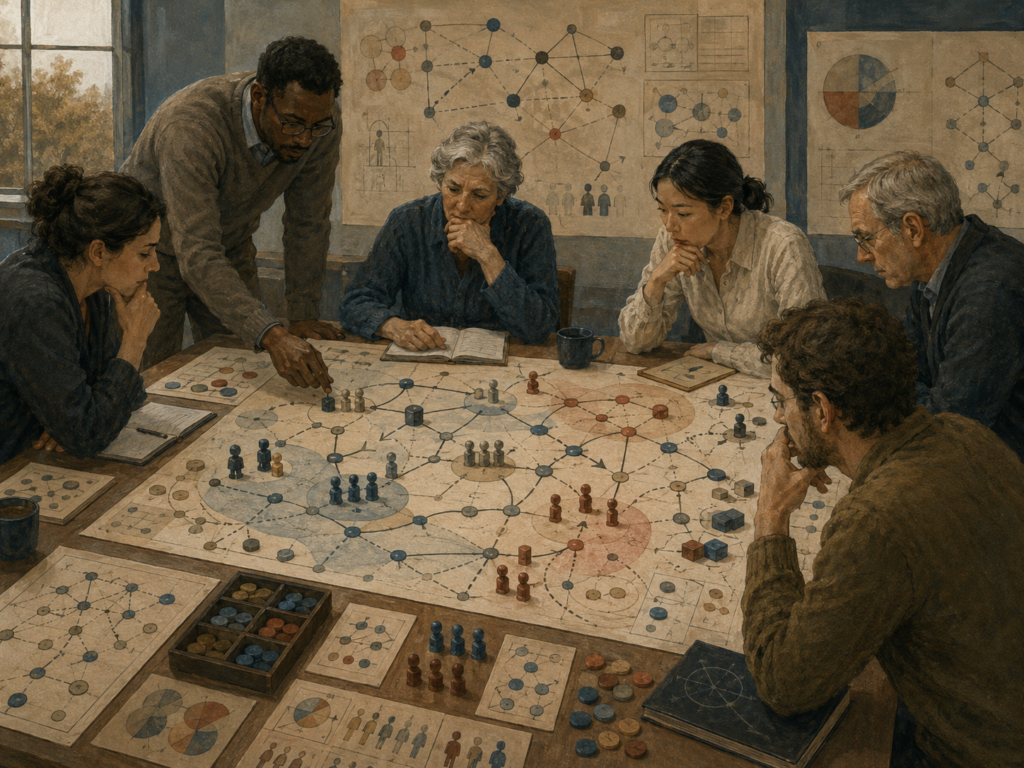
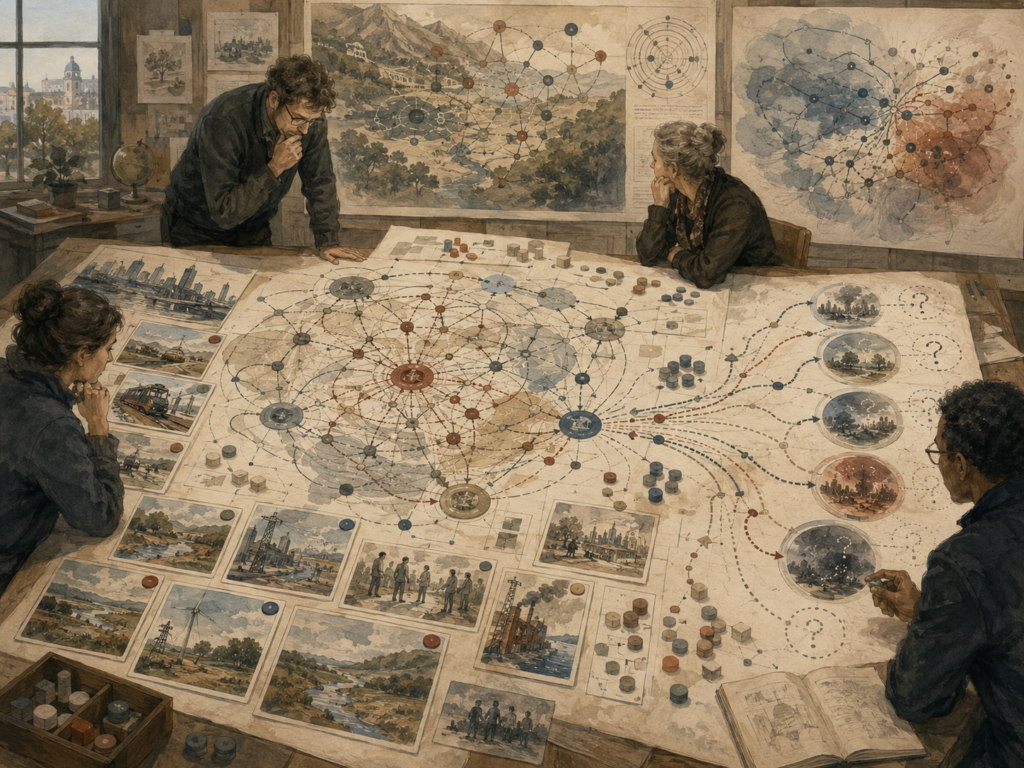
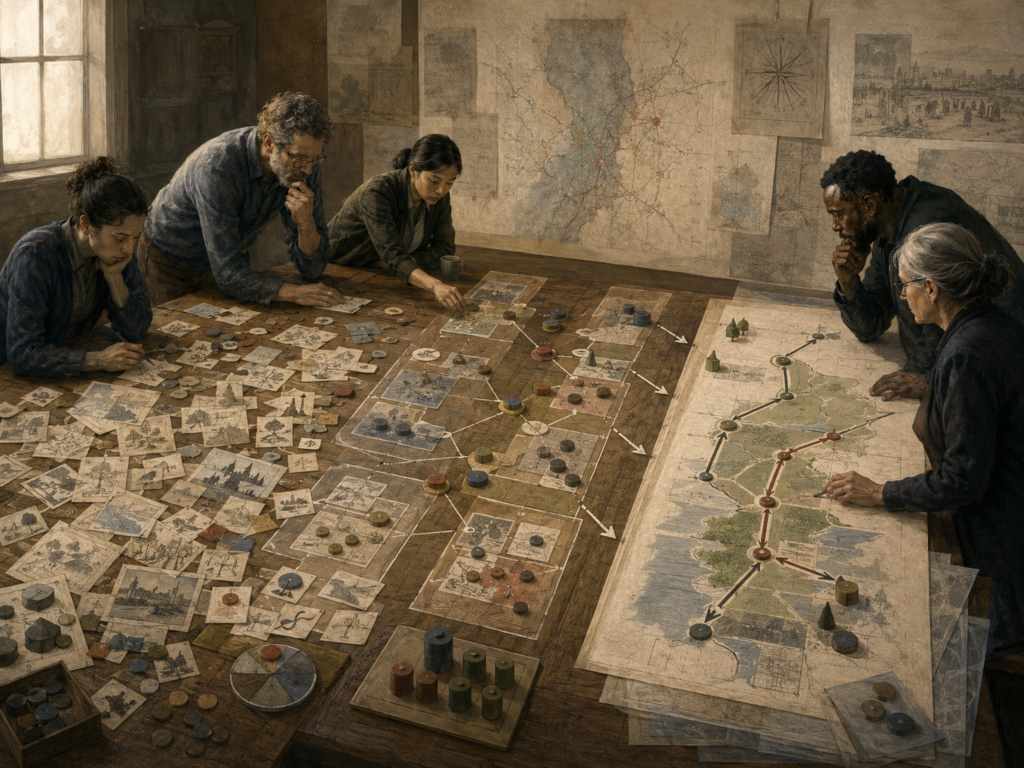
Researchers organize scattered idea cards, tokens, concept fragments, pathway maps, and strategic routes across a large institutional planning table.

From Ideas to Strategy: Turning Concepts into Action

From Ideas to Strategy examines how raw concepts and creative possibilities are transformed into coherent, actionable commitments that can guide decisions, coordinate action, and absorb real-world constraints. The article argues that the central challenge of strategic ideation is not generating possibilities, but narrowing them through disciplined selection, tradeoff management, feasibility and viability testing, integration, and resource commitment until a direction becomes executable. It develops this through the gap between ideas and strategy, the movement from divergence to convergence, the role of constraints, the structuring of ideas into frameworks, uncertainty during execution, alignment, and the importance of evaluation and feedback. The article emphasizes that strategy is not simply a better idea, but an organized commitment to act under constraint.

Strategists examine opportunity clusters, evidence cards, evaluation grids, risk tokens, and pathway maps on a large institutional planning table.

Opportunity Recognition and Evaluation: How Strategic Opportunities Are Found and Tested

Opportunity Recognition and Evaluation examines how individuals and institutions identify possible pathways for value creation and decide which ones are truly worth pursuing under uncertainty. The article argues that opportunities are not simply objective features waiting to be discovered, but relational and cognitive constructions shaped by perception, capability, timing, institutional context, and strategic intent. It develops this through the cognitive foundations of recognition, cross-domain sources of opportunity, recombination, uncertainty, false positives and missed opportunities, bias, capability alignment, timing, portfolio logic, complex systems, and social and institutional feasibility. The article emphasizes that strong strategic actors do not merely spot opportunities; they build systems for recognizing, testing, filtering, and refining them before committing resources.

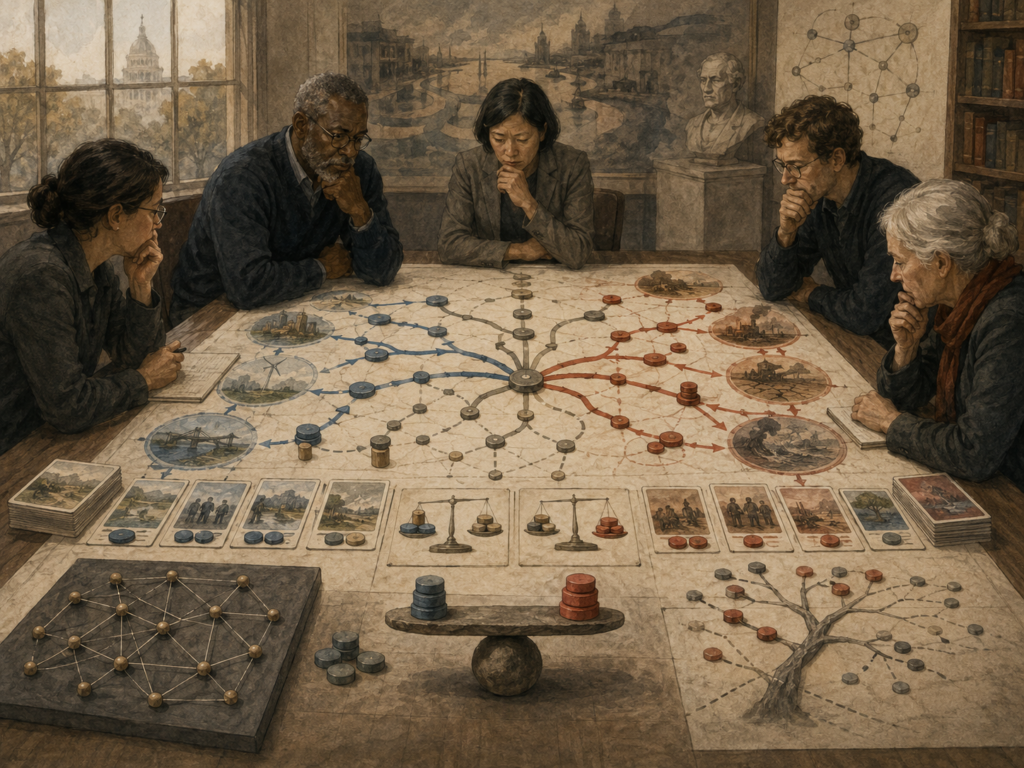
Strategists examine branching decision paths, risk outcomes, trade-off scales, tokens, and scenario cards on a large planning table.

Risk, Tradeoffs, and Strategic Choices: How to Make Better Decisions

Risk, Tradeoffs, and Strategic Choices examines how decision-makers act when every meaningful option carries costs, uncertainty, and competing value claims. The article argues that strategy is not the search for a perfect solution, but a disciplined process of choosing among imperfect alternatives whose benefits and burdens are distributed unevenly across time, stakeholders, and system dimensions. It develops this through scarcity, opportunity cost, time-horizon conflict, the distinction between risk and deeper uncertainty, expected utility, bounded rationality, behavioral bias, competing values, complex-systems effects, and the tension between optimization and resilience. The article emphasizes that serious strategy begins when tradeoffs are made visible rather than hidden behind vague language about balance or win-win outcomes.

Researchers study a strategic interaction map with players, choices, incentives, payoffs, coalition patterns, and branching decision pathways.

Game Theory and Strategic Interaction: How to Make Strategy More Response-Aware

Game Theory and Strategic Interaction examines how strategy changes once outcomes depend on the choices, expectations, and responses of other actors rather than on isolated decision-making alone. The article argues that serious strategy must account for interdependence: competitors react, partners negotiate, regulators intervene, and stakeholders cooperate, defect, imitate, or retaliate in ways that reshape the value of any move. It develops this through the core elements of a game, mixed-interest environments, equilibrium, the prisoner’s dilemma, repeated interaction, coordination problems, signaling, mechanism design, and the limits of overly formal models. The article emphasizes that better strategic ideas are not only analytically strong, but interaction-aware: they consider incentives, information, response patterns, and the possibility that better outcomes may require changing the rules of the game rather than merely playing harder within them.

Researchers study branching scenario pathways, uncertain outcomes, system maps, tokens, and future-condition panels in a strategic planning room.

Decision-Making Under Uncertainty: How to Make Better Strategic Choices

Decision-Making Under Uncertainty examines how strategic choices are made when outcomes are only partly knowable, probabilities are incomplete, and the future cannot be specified with confidence. The article argues that uncertainty is not a temporary obstacle to strategy but one of its core conditions, requiring decision-makers to act before the world has fully revealed itself. It develops this through distinctions among risk, uncertainty, and ambiguity; expected utility and bounded rationality; heuristics and framing effects; complexity and adaptive systems; probabilistic reasoning and scenario judgment; robustness, resilience, and optionality; experimentation; and the difference between outcome quality and process quality. The article emphasizes that the strongest strategic systems do not promise certainty, but build the capacity to reason, choose, and learn within uncertainty while preserving adaptability and honesty about what remains unknown.

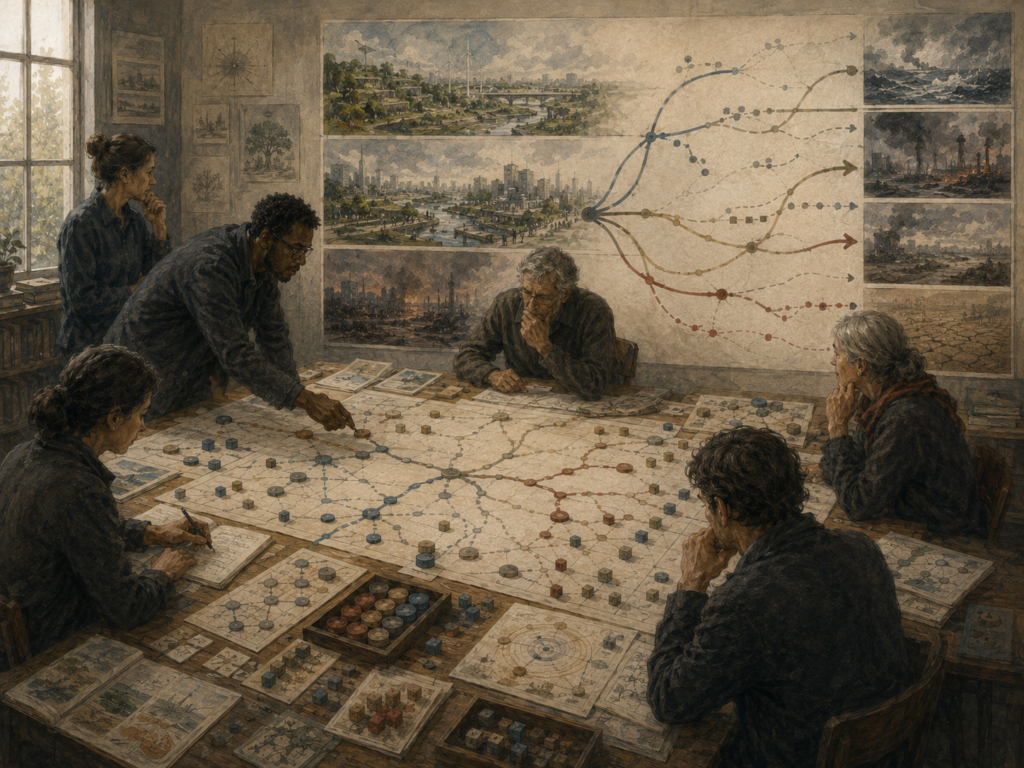
Researchers study long-term scenario pathways, branching timelines, future landscapes, uncertainty markers, and systems maps in an institutional planning room.

Strategic Foresight and Long-Term Thinking: How to Build Strategy for an Uncertain Future

Strategic Foresight and Long-Term Thinking examines how organizations prepare for structural change by widening their temporal horizon beyond short-term optimization and single-line forecasting. The article argues that foresight is not prediction, but a disciplined practice of exploring multiple plausible futures, questioning default assumptions, interpreting weak signals, and building strategies that remain robust under changing conditions. It develops this through the importance of long-term thinking, the distinction between foresight and forecasting, temporal depth, scenario planning, path dependence, resilience, adaptive capacity, weak signals, anticipatory governance, and the institutional barriers that make sustained long-range thinking difficult. The article emphasizes that foresight matters not only because it helps institutions prepare for the future, but because it changes how the present is understood by revealing which current trajectories are contingent, fragile, or quietly becoming locked in.

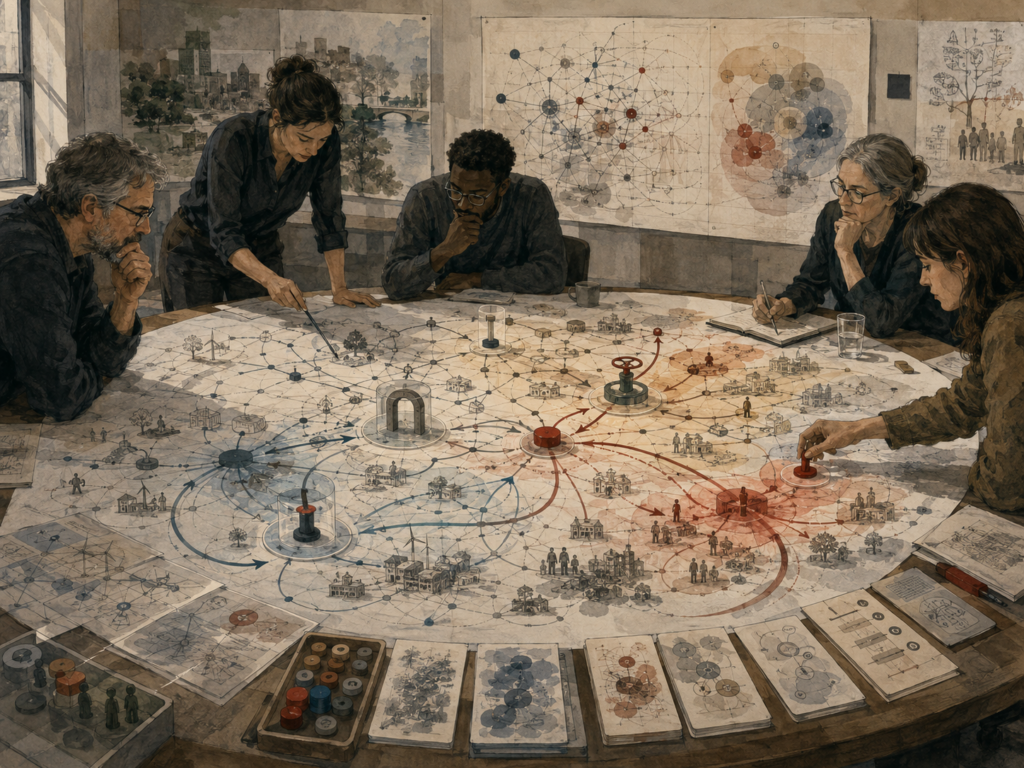
Analysts study a complex systems map with highlighted intervention points, feedback loops, pathways, and ripple effects across civic, ecological, and infrastructure networks.

Leverage Points in Systems Change: Strategic Ideation for Systemic Impact

Leverage Points in Systems Change examines where small, well-placed interventions can produce disproportionately large shifts in complex systems. The article argues that strategic effectiveness depends not only on effort or intent, but on systemic position: whether an intervention acts on shallow parameters, deeper feedback structures, information flows, rules, goals, or the paradigms that organize the system itself. It develops this through the Meadows hierarchy, the distinction between symptoms and structure, the role of buffers and delays, feedback loops, transparency and information, institutional rules, system goals, paradigm change, unintended consequences, and positive tipping dynamics. The article emphasizes that transformative strategy begins when decision-makers stop asking only what to fix and start asking where the system is most structurally sensitive to change.

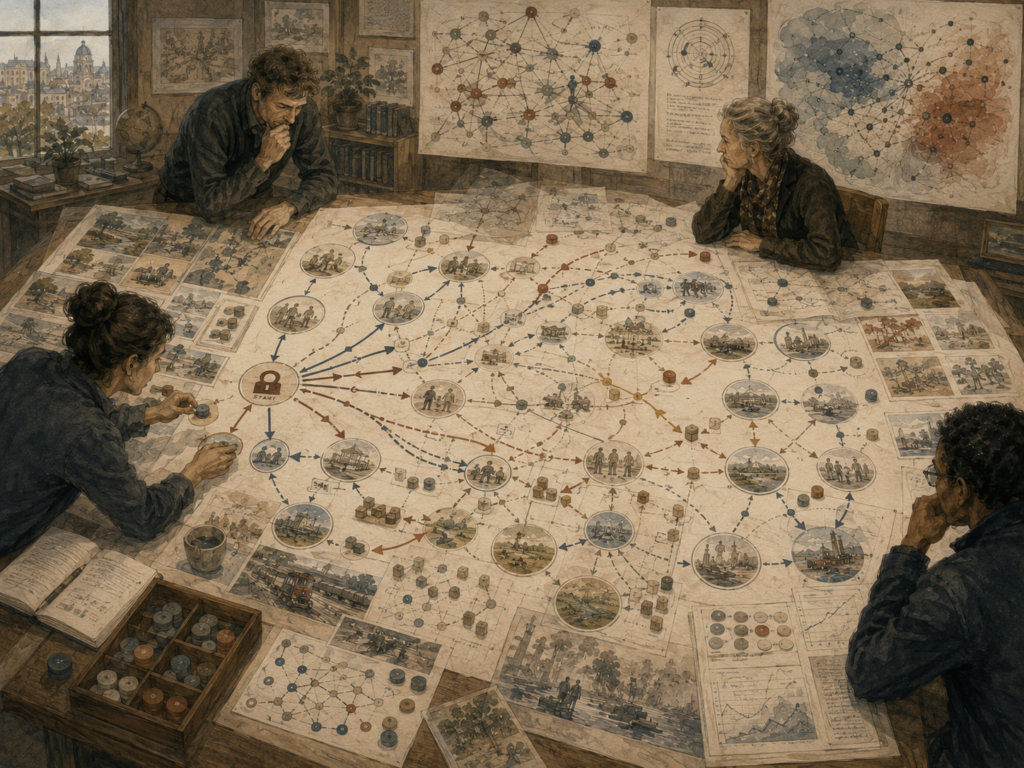
Analysts study a systems map where one initial decision creates cascading pathways, feedback loops, delayed effects, and unexpected outcomes across multiple domains.

Second-Order Effects and Unintended Consequences

Second-Order Effects and Unintended Consequences examines how strategic interventions continue to reshape a system long after their immediate objective appears to be met. The article argues that a decision cannot be judged solely by its first-order result, because every intervention also changes incentives, feedback loops, behavior, institutional context, and future conditions in ways that may generate delayed fragility, policy resistance, or beneficial cascades. It develops this through the difference between first- and second-order effects, Merton’s classic problem of unintended consequences, the dynamics of complex systems, feedback resistance, short-term optimization, behavioral adaptation, technological cascades, and the relationship between second-order reasoning and leverage-point strategy. The article emphasizes that strategic competence requires a wider causal imagination: not only asking whether an intervention worked, but what it set in motion, what it changed around itself, and what new conditions it created for the future.

Analysts study dense systems maps, scenario pathways, feedback loops, risk cards, and uncertain future outcomes on a large planning table.

Complex Systems and Strategic Uncertainty

Complex Systems and Strategic Uncertainty examines environments where outcomes emerge from interaction, feedback, adaptation, and path dependence rather than from stable, linear chains of cause and effect. The article argues that strategic uncertainty in such settings is not merely a temporary lack of information, but often a structural property of the system itself, because the environment evolves as actors respond to one another and to the interventions made within it. It develops this through the distinction between complicated and complex systems, nonlinearity, recursive feedback, emergence, adaptive actors, historical lock-in, foresight, scenario reasoning, and the need for organizational sensing and revision. The article emphasizes that strategy in complex systems cannot rely on one forecast or one optimized plan, but must generate options that remain adaptive, resilient, and coherent as the terrain itself changes.

Scroll to Top