
Last Updated June 4, 2026
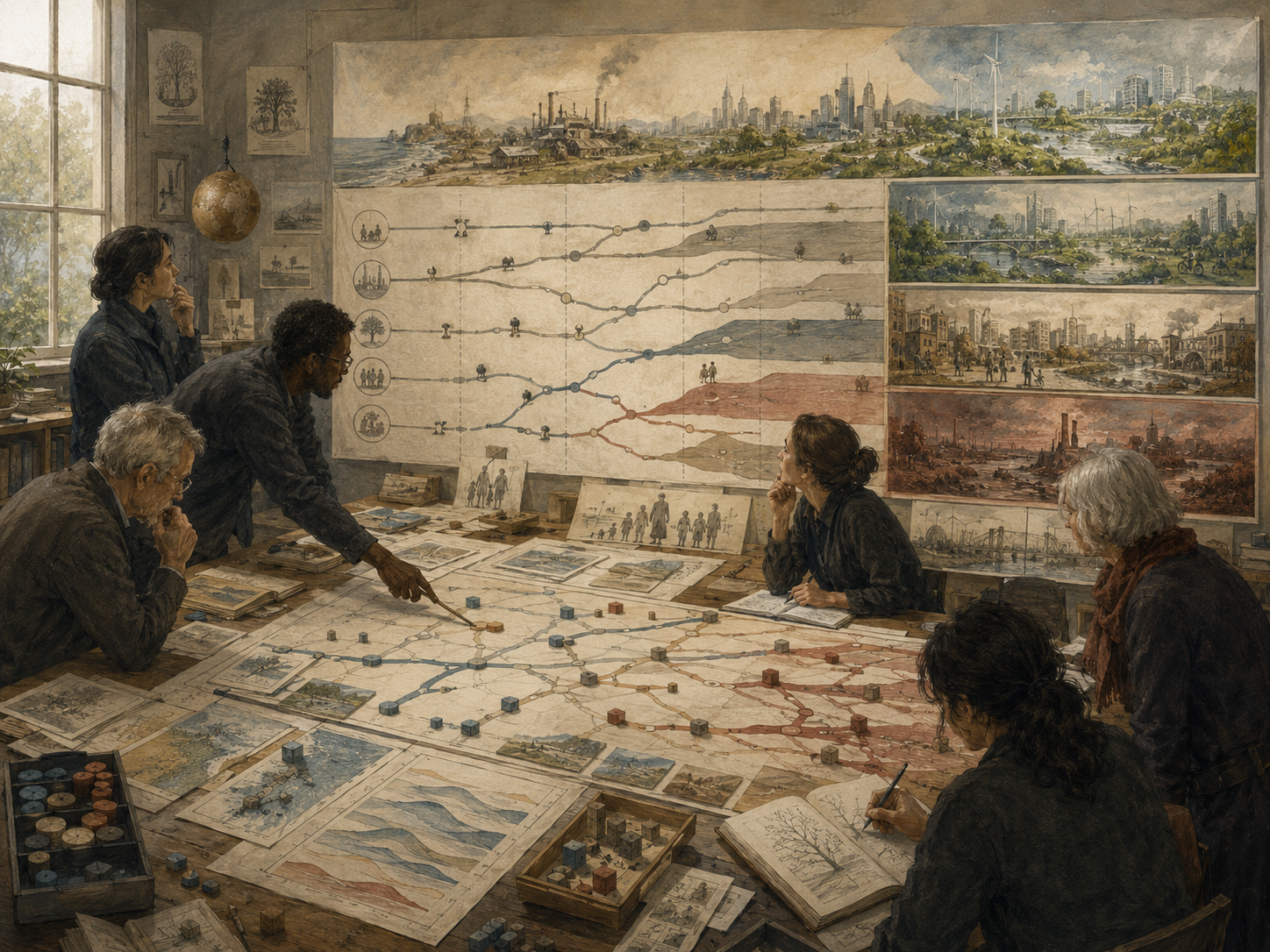
Strategic foresight and long-term thinking refer to the disciplined practice of anticipating change, exploring multiple possible futures, and designing strategies that remain robust under conditions of uncertainty. In complex environments, organizations cannot rely exclusively on short-term optimization or linear forecasting. Technological disruption, geopolitical instability, ecological stress, institutional change, demographic transition, infrastructure constraint, and shifting social expectations create conditions in which the future cannot be treated as a simple extension of the present.
Strategic foresight responds to this challenge by helping decision-makers widen their temporal horizon, question default assumptions, examine weak signals, explore alternative futures, and prepare for plausible developments before they become unavoidable. Long-term thinking complements this practice by shifting attention from immediate performance metrics to enduring trajectories, structural risks, path dependence, intergenerational consequences, and cumulative system effects.
Together, foresight and long-term thinking help organizations move from reactive adaptation to anticipatory strategy. They do not eliminate uncertainty. They create a more intelligent relationship to it. UNESCO’s Futures Literacy work is especially clear that future-oriented capability is not only about prediction, but about improving how people understand and act in the present as change unfolds. OECD, UNDP, and the UK Government Office for Science similarly frame foresight as a structured practice for exploring futures rather than forecasting one deterministic outcome.
At its deepest level, foresight is not merely a planning technique. It is a way of changing how the present is interpreted. Once multiple futures are brought into view, current arrangements begin to look less fixed and more contingent. Long-term thinking therefore matters not only because it extends the planning horizon, but because it widens the field of strategic imagination from which present action is chosen.
This article examines strategic foresight and long-term thinking as core practices in strategic ideation. It explores why long-term thinking matters, how foresight differs from forecasting, how horizon scanning and weak-signal interpretation work, how scenarios and alternative futures support strategy, how path dependence shapes future choice, why public institutions need anticipatory capacity, what organizational barriers prevent long-term thinking, and how futures literacy can change present judgment.
Main Library
Publications
Article Map
Strategic Ideation
Related Topic
Futures Thinking
Related Topic
Systems Thinking
Related Topic
Resilience Thinking
Why Long-Term Thinking Matters
Many institutions are structurally biased toward the short term. Quarterly reporting cycles, annual budgets, election calendars, funding rounds, performance dashboards, campaign timelines, and operational urgency all encourage immediate action. These structures are not irrational. They reflect real constraints. Yet they can also narrow strategic imagination. When organizations become overly focused on near-term efficiency, they often underinvest in resilience, ignore slow-moving risks, misread structural change, and fail to prepare for future conditions that do not yet impose obvious costs.
Long-term thinking matters because many of the most consequential strategic shifts are gradual before they become visible. Ecological degradation, demographic transition, technological diffusion, institutional erosion, infrastructure lock-in, changing public expectations, and geopolitical realignment may accumulate over years or decades before producing sudden strategic consequences. An organization that waits until such changes are fully obvious often discovers that its room for maneuver has already narrowed.
The UK Government’s Futures Toolkit frames futures tools as methods for building strategies that are robust to uncertainty rather than tied only to immediate conditions. OECD foresight materials similarly emphasize the anticipatory function of foresight: decision-makers need structured ways to prepare before change arrives in full force.
| Short-term bias | Strategic risk | Long-term thinking response |
|---|---|---|
| Quarterly or annual performance pressure | Underinvestment in future capability. | Balance present performance with future viability. |
| Operational urgency | Slow-moving risks remain invisible until they become crises. | Use horizon scanning and long-range risk review. |
| Budget-cycle thinking | Long-term benefits are discounted or delayed. | Evaluate cumulative effects and future option value. |
| Executive or political turnover | Institutions avoid investments whose value appears later. | Create governance that protects long-horizon priorities. |
| Dashboard-driven management | Measurable near-term indicators crowd out structural signals. | Pair metrics with scenario, systems, and weak-signal review. |
| Baseline forecasting | Organizations assume the future will resemble the present. | Explore multiple plausible futures and stress test strategy. |
Long-term thinking matters because the future often becomes strategically decisive before it becomes institutionally convenient.
Strategic Foresight as Structured Anticipation
Strategic foresight is not prediction in the narrow sense. It does not claim that a single future can be forecast with precision and then managed accordingly. Instead, it is a structured process for identifying signals of change, exploring critical uncertainties, constructing plausible scenarios, stress-testing assumptions, and developing strategies that can perform across different future conditions.
This distinction is essential. Forecasting tends to ask what is most likely. Foresight asks what is possible, what is consequential, what is changing, what remains uncertain, what should be monitored, and what present choices may shape future pathways. It broadens the strategic conversation by examining not only probability, but also preparedness, resilience, optionality, and consequence.
OECD describes strategic foresight as a structured and systematic approach to exploring plausible futures. Its foresight toolkit presents foresight as a practical process for challenging assumptions, creating scenarios, stress-testing strategies, and developing actionable plans. UNDP’s foresight manual likewise frames foresight as working with alternative futures rather than forecasting a single future. The UK Government toolkit similarly presents futures thinking as a practical way to build robust strategies under uncertainty.
| Foresight activity | Purpose | Strategic output |
|---|---|---|
| Horizon scanning | Identify emerging signals, weak trends, and possible change. | Signal map and watchlist. |
| Driver analysis | Clarify forces shaping possible futures. | Driver map. |
| Critical uncertainty review | Identify high-impact uncertainties that cannot be confidently predicted. | Uncertainty matrix. |
| Scenario construction | Develop plausible alternative futures. | Scenario set. |
| Strategy stress testing | Evaluate how strategies perform under different futures. | Robustness and fragility review. |
| Adaptive pathway design | Preserve future choice and avoid premature lock-in. | Trigger conditions and staged decisions. |
| Learning memory | Preserve assumptions, signals, decisions, and remaining uncertainty. | Foresight record. |
Strategic foresight is structured anticipation: not knowing the future, but improving present judgment by exploring futures rigorously.
The Intellectual Foundations of Foresight
Strategic foresight draws from several traditions, including systems thinking, scenario planning, futures studies, policy analysis, organizational learning, risk analysis, design thinking, resilience thinking, and strategic management. Its deeper premise is that the future should not be treated merely as a destination to be predicted, but as a field of possibility that helps decision-makers reinterpret the present.
In this sense, foresight is both analytical and imaginative. It combines evidence, structured exploration, disciplined narrative construction, uncertainty analysis, and practical decision design. It asks decision-makers to treat the present not as fixed, but as one possible pathway among many. Once alternative futures are made visible, current assumptions can be examined more clearly.
Futures-oriented work has long emphasized that the images societies hold about the future influence present behavior. If the future is imagined as fixed, institutions tend to become reactive. If it is imagined as open but structured, organizations can begin to act more deliberately in the present. This is one reason foresight is closely linked to anticipatory governance, resilience planning, long-term institutional design, and futures literacy.
| Foundation | Contribution to foresight | Strategic implication |
|---|---|---|
| Systems thinking | Reveals feedback loops, delays, interdependencies, and cascading effects. | Futures are shaped by dynamic systems, not isolated trends. |
| Scenario planning | Explores multiple plausible futures. | Strategy should be tested across conditions. |
| Futures studies | Examines long-range possibilities, images of the future, and social imagination. | The future influences present action through expectation and narrative. |
| Risk analysis | Identifies uncertainty, consequence, vulnerability, and preparedness gaps. | Foresight must include high-consequence possibilities. |
| Organizational learning | Connects evidence, interpretation, decision, and memory. | Foresight should change institutional learning, not just produce reports. |
| Resilience thinking | Focuses on adaptive capacity under disruption. | Foresight should support robustness and flexibility. |
Foresight is strongest when imagination is disciplined by evidence, systems awareness, and decision relevance.
Core Dimensions of Strategic Foresight
Strategic foresight can be evaluated through several core dimensions. These dimensions help distinguish serious anticipatory strategy from trend commentary, prediction theater, speculative imagination, or long-range reports that do not influence decisions.
1. Temporal Depth
Temporal depth is the ability to examine decisions across multiple time horizons. It prevents short-term optimization from crowding out future resilience, path dependence, and cumulative consequences.
2. Horizon Scanning
Horizon scanning identifies emerging signals, weak trends, anomalies, policy shifts, technological developments, and social changes that may become strategically important over time.
3. Driver Analysis
Driver analysis clarifies the forces shaping possible futures. These may include technological, economic, political, ecological, social, demographic, infrastructural, and institutional forces.
4. Critical Uncertainty Review
Foresight focuses on uncertainties that are both consequential and difficult to predict. These uncertainties often structure scenario development and adaptive pathway design.
5. Scenario Thinking
Scenario thinking creates plausible alternative futures that help organizations test assumptions and evaluate strategy beyond a single expected pathway.
6. Strategy Stress Testing
Stress testing evaluates whether current and proposed strategies remain viable under different future conditions, including disruption, scarcity, legitimacy loss, technological shift, and institutional change.
7. Adaptive Pathways
Adaptive pathways preserve future choice through staged commitments, trigger conditions, monitoring systems, modular investments, and reversible decisions.
8. Futures Literacy
Futures literacy is the capacity to use futures thinking to reinterpret the present. It helps decision-makers see that current arrangements are contingent rather than inevitable.
| Dimension | Diagnostic question | Useful output |
|---|---|---|
| Temporal depth | How does the decision look across short, medium, and long horizons? | Time-horizon map. |
| Horizon scanning | What weak signals and emerging changes matter? | Signal register. |
| Driver analysis | What forces are shaping future conditions? | Driver map. |
| Critical uncertainty review | Which uncertainties are consequential and unpredictable? | Uncertainty matrix. |
| Scenario thinking | What plausible futures should strategy be tested against? | Scenario set. |
| Strategy stress testing | Where is the strategy robust or fragile? | Robustness review. |
| Adaptive pathways | What should change if signals indicate a new pathway is emerging? | Trigger and pathway map. |
| Futures literacy | How does thinking about futures change present understanding? | Present-assumption review. |
Strategic foresight becomes useful when temporal depth, signals, uncertainties, scenarios, stress testing, adaptive pathways, and present interpretation are connected to decisions.
Foresight versus Forecasting
Forecasting is often useful in bounded domains where patterns are stable enough for extrapolation. Demand projections, budget assumptions, demographic estimates, and operational planning can all benefit from careful forecasting. But in complex systems, extrapolation becomes less reliable when feedback loops, threshold effects, political disruption, technological discontinuities, or ecological constraints reshape the environment.
Foresight differs because it does not assume that the future can be reduced to a single expected line. It is especially useful when the strategic task is not merely to estimate next-period values but to prepare for structural change, contested pathways, and emerging uncertainty. In that sense, foresight complements forecasting rather than replacing it.
UNDP’s foresight manual uses similar language, describing foresight as an umbrella for strategic planning and solution-design methods that do not predict or forecast the future, but work with alternative futures. OECD’s foresight materials also distinguish foresight from prediction by stressing alternative futures, strategic readiness, and resilience rather than point forecasts.
| Forecasting | Strategic foresight |
|---|---|
| Often emphasizes the most likely future. | Explores multiple plausible futures. |
| Works best when systems are stable and measurable. | Works best when uncertainty, disruption, and complexity matter. |
| Uses extrapolation, projections, and probabilistic estimates. | Uses scenarios, signals, uncertainty mapping, and stress testing. |
| Supports operational planning and near-term estimation. | Supports strategic preparedness and long-term resilience. |
| Can create false confidence when conditions shift. | Protects against dependence on one expected future. |
| Asks: what is likely to happen? | Asks: what could happen, what would matter, and what should we do now? |
Forecasting helps estimate. Foresight helps prepare.
Time Horizons and Strategic Depth
One of the most important contributions of long-term thinking is temporal depth. Strategic problems often look different depending on the horizon through which they are viewed. A decision that appears efficient over one year may generate fragility over five. A policy that looks expensive in the short run may reduce systemic risk over twenty. A technology that seems marginal today may become infrastructure tomorrow.
Time horizon therefore functions as a strategic filter. Short horizons privilege optimization and immediate return. Longer horizons bring into view durability, path dependence, externalities, capability development, institutional trust, intergenerational responsibility, and cumulative system effects. Effective strategic foresight does not ignore the short term. It situates the short term within a broader temporal architecture.
| Time horizon | What it tends to reveal | Strategic danger if ignored |
|---|---|---|
| Immediate horizon | Operational pressure, current performance, urgent constraints. | Strategy becomes detached from feasibility. |
| Short horizon | Budget cycles, near-term risks, implementation needs. | Plans may lack accountability and traction. |
| Medium horizon | Capability needs, market shifts, stakeholder expectations, policy movement. | Organizations miss emerging change. |
| Long horizon | Structural transformation, infrastructure lock-in, ecological stress, institutional legitimacy. | Present decisions create future fragility. |
| Intergenerational horizon | Consequences for people and systems beyond current leadership cycles. | Strategy externalizes cost to future communities. |
Temporal depth helps strategy see what short-term metrics hide.
Scenario Planning and Alternative Futures
Scenario planning is one of the most widely used foresight methods because it translates uncertainty into structured alternatives. Rather than asking which future will occur, scenario planning explores multiple plausible worlds shaped by different combinations of drivers and uncertainties. This helps organizations identify assumptions embedded in their current strategy and discover where those assumptions may fail.
Scenarios also improve strategic conversation. They make long-term uncertainty discussable. Teams can examine which strategies remain effective across several scenarios, which strategies are brittle, which assumptions are fragile, and what early indicators might suggest that one future pathway is becoming more plausible than another.
Scenario planning also supports ideation. A future defined by regulatory disruption may generate ideas about transparency, governance, public trust, and compliance infrastructure. A future shaped by climate stress may generate ideas about redundancy, adaptation, energy systems, and distributed resilience. A future shaped by rapid automation may generate ideas about workforce transition, human oversight, data governance, and institutional accountability.
| Scenario planning function | Strategic value | Example output |
|---|---|---|
| Tests assumptions | Shows where current strategy depends on one expected future. | Assumption vulnerability map. |
| Expands strategic imagination | Creates new ideas under alternative conditions. | Scenario-based idea portfolio. |
| Stress tests strategy | Reveals robustness and fragility. | Scenario stress-test matrix. |
| Identifies signals | Connects futures to monitoring. | Early-warning indicator dashboard. |
| Preserves option value | Avoids premature lock-in. | Adaptive pathway map. |
| Improves governance | Clarifies when decisions should be reviewed. | Trigger condition protocol. |
Scenario planning strengthens foresight by making uncertainty concrete enough to test strategy against it.
Long-Term Thinking and Path Dependence
Long-term strategy must account for path dependence: the fact that present choices shape future options. Infrastructure, regulation, institutional design, technology standards, platform architectures, funding models, procurement choices, and cultural narratives all create trajectories that may become difficult to reverse later. A short-term decision can therefore have long-term lock-in effects.
This is especially important in sustainability, urban planning, digital governance, energy systems, education, health systems, logistics, public infrastructure, artificial intelligence, and social policy. A system that is cheap to build now may be expensive to redesign later. A platform architecture that accelerates deployment today may constrain future accountability. A policy designed for immediate efficiency may create long-term exclusion or fragility.
Strategic foresight helps decision-makers recognize these lock-in dynamics before they become entrenched. It encourages them to ask not only what is efficient now, but what future pathway is being built by today’s decision.
| Path-dependent choice | Future constraint | Foresight response |
|---|---|---|
| Infrastructure investment | Long-lived physical systems shape future options. | Stress test infrastructure across climate, demand, and governance scenarios. |
| Technology architecture | Standards and platforms create future dependency. | Design modular, interoperable, and accountable systems. |
| Policy design | Rules create incentives and institutional routines. | Review second-order effects and future adaptability. |
| Organizational capability | Skills and routines define what strategies remain feasible. | Invest in future-oriented capabilities early. |
| Financial commitment | Capital allocation narrows future choices. | Use staged investment and option-value review. |
| Public narrative | Expectations shape legitimacy and political possibility. | Communicate future pathways honestly and responsibly. |
Long-term thinking matters because every strategy is also a pathway-building decision.
Anticipation, Resilience, and Adaptive Capacity
Foresight is valuable not because it provides certainty, but because it improves preparedness. One of its main strategic functions is to strengthen resilience by helping organizations anticipate disruption, diversify options, avoid overcommitting to narrow assumptions, and build capabilities before crisis conditions force rushed action.
This can include investing in modular systems, developing contingency plans, building learning capacity, identifying strategic pivots, monitoring early signals, preserving option value, and developing governance systems that know when to revise strategy. Strategic foresight supports resilience by linking long-term awareness with present capabilities for monitoring, interpretation, and adaptation.
Adaptive capacity is central here. Organizations cannot prepare in detail for every possible future, but they can prepare structurally to learn, respond, and adjust. Foresight therefore does not ask institutions to know everything in advance. It asks them to become better prepared to act when conditions change.
| Preparedness capability | What it enables | Foresight contribution |
|---|---|---|
| Monitoring | Detects emerging change before it becomes obvious. | Signal scanning and indicator review. |
| Interpretation | Distinguishes signal from noise. | Weak-signal analysis and scenario comparison. |
| Option design | Preserves future choice. | Adaptive pathway and option-value analysis. |
| Resilience investment | Reduces exposure to disruption. | Scenario stress testing and vulnerability review. |
| Governance | Clarifies when and how strategy should change. | Trigger conditions and decision rights. |
| Learning memory | Prevents repeated mistakes and forgotten assumptions. | Foresight records and assumption tracking. |
Foresight improves resilience by helping organizations prepare before the future becomes urgent.
Signals, Weak Signals, and Emerging Change
Not every future transformation begins with a dramatic event. Many begin as weak signals: small anomalies, marginal innovations, emerging behaviors, early policy experiments, fringe narratives, unexpected failures, local disruptions, or low-salience shifts that seem minor until they compound. Horizon scanning helps organizations pay attention to such developments before they become dominant trends.
The challenge is interpretive. Weak signals are ambiguous by definition. Most do not become decisive, but some indicate deeper structural change. Foresight helps institutions avoid dismissing all weak signals as noise while also avoiding overreaction to every novelty. It creates a disciplined way to interpret emerging change.
| Signal type | What it may indicate | Interpretive caution |
|---|---|---|
| Anomaly | A deviation from expected patterns. | May be noise, measurement error, or early structural shift. |
| Emerging behavior | Changing user, public, worker, or community practice. | May remain marginal or become mainstream. |
| Policy experiment | New governance pathway under trial. | May signal future regulation or isolated experimentation. |
| Technological niche | Early capability that may scale later. | May be overhyped or underestimated. |
| Institutional stress | Fragility in existing systems. | May indicate temporary strain or structural breakdown. |
| Cultural narrative shift | Changing legitimacy, expectation, or social meaning. | May alter strategy before formal policy or markets respond. |
Weak signals matter because strategic change often appears first as something easy to dismiss.
Strategic Foresight in Public Systems and Institutions
Public institutions often have a special need for long-term thinking because they govern infrastructures, environments, social systems, and public goods whose consequences unfold over long periods. Yet they also face short-term political pressures. Strategic foresight can help address this tension by providing structured methods for exploring emerging risks, long-range scenarios, anticipatory governance options, and future public value.
This is why foresight is increasingly associated with resilience, policy innovation, public-sector capacity, and future-fit institutions. Public organizations cannot be judged only by how efficiently they manage current conditions. They must also be assessed by how well they prepare societies for conditions not yet fully visible.
UNDP’s foresight manual and future-of-development materials frame foresight in developmental and governance terms. OECD’s work on anticipatory capacity in government similarly treats foresight as vital for effective decision-making on complex public issues.
| Public-system challenge | Why foresight matters | Possible foresight output |
|---|---|---|
| Infrastructure planning | Assets last for decades and may face changing risks. | Long-horizon scenario stress test. |
| Climate adaptation | Risks accumulate and cascade across systems. | Scenario pathways and resilience investment map. |
| Public health | Emerging threats may be invisible until rapidly amplified. | Weak-signal monitoring and preparedness scenarios. |
| Digital governance | Technology can outpace regulation and accountability. | Governance futures and trigger conditions. |
| Education and workforce | Capability needs change over long time horizons. | Future capability and transition analysis. |
| Demographic change | Slow shifts alter demand, finance, care, housing, and infrastructure. | Long-range population and service scenarios. |
Public foresight is not only about future risk. It is about institutional responsibility over time.
Organizational Barriers to Long-Term Thinking
Despite its importance, long-term thinking is difficult to sustain institutionally. Several barriers recur. Immediate incentives often dominate deferred benefits. Decision-makers may be rewarded for short-term results rather than durable preparedness. Information systems may prioritize near-term metrics. Political or executive cycles may discourage investments whose value becomes visible only later. Organizational culture may also treat uncertainty as something to suppress rather than explore.
These barriers do not make foresight impossible, but they do mean that it must be institutionalized deliberately. It cannot remain a one-off workshop or symbolic exercise. It needs process, leadership attention, interpretive capacity, governance, and links to resource allocation and strategy review.
| Barrier | How it weakens foresight | Corrective practice |
|---|---|---|
| Short-term incentives | Leaders prioritize immediate performance over future preparedness. | Include long-horizon resilience and capability metrics. |
| Operational overload | Teams lack time to examine future change. | Create protected foresight cadence and roles. |
| Prediction culture | Uncertainty is treated as analysis failure. | Normalize plausible futures and structured uncertainty. |
| Siloed expertise | Signals remain fragmented across departments. | Use cross-functional horizon scanning. |
| Weak decision linkage | Foresight reports do not alter strategy or investment. | Connect scenarios to decisions, options, and triggers. |
| Institutional politics | Uncomfortable futures are ignored or softened. | Protect dissenting futures and assumption challenge. |
| No learning memory | Signals, assumptions, and scenario logic disappear over time. | Maintain foresight records and decision traces. |
Long-term thinking must be designed into institutions, or short-term pressure will usually defeat it.
Core Principles of Long-Term Strategic Foresight
Strategic foresight requires discipline. The following principles help organizations use futures thinking to strengthen strategy rather than produce speculative reports, trend lists, or symbolic workshops.
1. Prepare Rather Than Predict
The goal of foresight is not to identify one correct future. It is to improve preparedness, option design, and strategic judgment across multiple plausible futures.
2. Extend the Temporal Horizon
Foresight should examine how decisions unfold over time, including delayed effects, path dependence, lock-in, cumulative risk, and intergenerational consequences.
3. Structure Uncertainty
Uncertainty should be organized into drivers, signals, critical uncertainties, scenarios, assumptions, and adaptive pathways rather than reduced to vague anxiety.
4. Test Assumptions
Foresight should reveal what present strategies assume about future conditions and identify where those assumptions may fail.
5. Monitor Signals Over Time
Scenario work should produce signals and indicators that can be tracked as future pathways begin to emerge.
6. Preserve Option Value
Long-term strategy should avoid premature lock-in when uncertainty is high. Staged commitments, modular design, and adaptive pathways preserve future choice.
7. Include Affected Futures
Foresight should examine whose futures are represented, whose burdens are modeled, and whose knowledge is included in the process.
8. Connect to Decisions
Foresight becomes strategic only when it affects choices, investments, governance, sequencing, monitoring, and implementation.
| Principle | Protects against | Practical test |
|---|---|---|
| Prepare rather than predict | False certainty. | Does the work improve readiness across futures? |
| Extend the temporal horizon | Short-termism. | Are delayed and cumulative consequences visible? |
| Structure uncertainty | Vague speculation. | Are drivers, uncertainties, scenarios, and signals explicit? |
| Test assumptions | Strategic tunnel vision. | Which assumptions fail under different futures? |
| Monitor signals | Static scenario reports. | What evidence will be tracked over time? |
| Preserve option value | Premature lock-in. | Can future decisions still adjust? |
| Include affected futures | Institutional bias and burden shifting. | Whose futures are missing? |
| Connect to decisions | Foresight theater. | What changes because of the foresight work? |
Long-term foresight is serious when it changes what the organization monitors, protects, invests in, and is willing to question.
The Limits of Foresight
Strategic foresight has limits, and acknowledging them makes the practice stronger. It does not eliminate uncertainty. It does not guarantee that the right scenario has been imagined. It can become overly speculative if not grounded in evidence, or overly abstract if not tied to decisions. It may also become performative if organizations use the language of foresight without allowing it to challenge present assumptions, budgets, priorities, or power structures.
Foresight can also suffer from participation bias. The people invited to imagine the future shape what futures are treated as plausible. Institutional interests may narrow the scenario set. Technical experts may overemphasize technological change while underemphasizing legitimacy, culture, equity, or implementation. Leaders may prefer scenarios that preserve current strategy. Stakeholders without institutional power may be excluded.
| Limit | Risk | Corrective discipline |
|---|---|---|
| Cannot eliminate uncertainty | Foresight is mistaken for certainty. | Document assumptions and remaining uncertainty. |
| Scenario incompleteness | Important futures may be missed. | Revise scenario sets over time. |
| Speculative drift | Futures work becomes imaginative but ungrounded. | Use evidence, drivers, systems analysis, and signals. |
| Weak decision linkage | Foresight does not change action. | Connect outputs to choices, triggers, and resources. |
| Institutional bias | Preferred futures crowd out uncomfortable ones. | Use diverse participation and assumption challenge. |
| Performative foresight | Organizations appear future-oriented without changing strategy. | Track decisions influenced by foresight work. |
Foresight should sharpen decision quality, not become a substitute for decision.
Ethics and Intergenerational Responsibility
Long-term thinking is ethically charged because present decisions affect people who may not be represented in current decision processes. Future generations cannot attend today’s strategy meetings. Communities affected by future infrastructure, climate exposure, automation, environmental degradation, or institutional failure may have little voice in the choices that shape their conditions.
Strategic foresight should therefore include ethical review. It should ask who benefits, who bears risk, whose future is being imagined, whose knowledge counts, and whether the organization is externalizing cost into the future. It should also examine intergenerational responsibility: the obligation to consider long-term consequences beyond current leadership, customers, voters, or investors.
| Ethical question | Why it matters | Responsible foresight practice |
|---|---|---|
| Whose futures are represented? | Excluded groups may disappear from strategy. | Include affected stakeholders and diverse knowledge. |
| Who bears future burden? | Short-term gains may shift costs to others. | Conduct burden-shift and externality review. |
| What future options are being foreclosed? | Lock-in can reduce later freedom and resilience. | Use option-value and reversibility analysis. |
| How are future generations considered? | They cannot directly participate in current governance. | Evaluate intergenerational consequences. |
| What futures are treated as plausible? | Power shapes the boundaries of imagination. | Make assumptions and exclusions explicit. |
| Who is accountable for long-term consequences? | Responsibility can diffuse over time. | Create decision records and governance review. |
Ethical foresight asks not only what futures are possible, but whose futures are being made more or less possible by present strategy.
Futures Literacy and the Present
A deeper contribution of long-term thinking is that it changes how the present is understood. Considering multiple futures reveals that current systems are neither inevitable nor fixed. It becomes easier to see which arrangements are contingent, which assumptions are narrow, which pathways are being reproduced through habit, and which alternatives have been excluded by institutional routine.
UNESCO’s conception of Futures Literacy is especially important here because it presents future-awareness as a capability that enables people to rethink what they see and do in the present. Futures literacy is not merely a skill for imagining tomorrow. It is a way of improving present perception.
In this sense, futures thinking is not only about what lies ahead. It is also about what becomes visible now when the present is viewed through a wider temporal lens. That is one reason foresight is not just an adjunct to strategy, but part of how strategy becomes more reflective, less brittle, and more capable of confronting structural change early enough to matter.
| Without futures literacy | With futures literacy |
|---|---|
| The present feels fixed or inevitable. | The present appears as one pathway among alternatives. |
| Strategy extends current assumptions forward. | Strategy questions assumptions through possible futures. |
| Uncertainty produces anxiety or avoidance. | Uncertainty becomes structured inquiry. |
| Future work is treated as prediction. | Future work becomes a way to improve present judgment. |
| Institutions react after change becomes obvious. | Institutions learn to notice change earlier. |
Futures literacy matters because it helps decision-makers see that the present is not destiny.
A Practical Strategic Foresight and Long-Term Thinking Audit
A foresight audit helps teams determine whether long-term thinking is rigorous, decision-relevant, ethically responsible, and institutionally connected. It can be used before a strategic planning cycle, during scenario development, after a horizon-scanning process, or when reviewing whether current strategy is too dependent on near-term assumptions.
1. Define the Focal Strategic Question
Clarify what decision, uncertainty, system, or strategic concern requires foresight. Avoid beginning with a vague desire to “think long term.”
2. Map Time Horizons
Compare the decision across immediate, short, medium, long, and intergenerational horizons. Identify what becomes visible at each horizon.
3. Identify Drivers of Change
Map technological, social, political, economic, ecological, demographic, institutional, and infrastructural drivers.
4. Review Signals and Weak Signals
Identify emerging evidence that may indicate early change. Distinguish signals from noise and assign monitoring responsibilities.
5. Select Critical Uncertainties
Prioritize uncertainties that are both highly consequential and difficult to predict. Use these to structure scenario thinking.
6. Develop or Review Scenarios
Ensure that scenarios are plausible, divergent, internally coherent, ethically reviewed, and connected to strategic decisions.
7. Stress Test Current Strategy
Evaluate whether current strategy remains viable across alternative futures. Identify assumptions, vulnerabilities, and lock-in risks.
8. Design Adaptive Pathways
Define options, staged commitments, trigger conditions, and decision points that preserve future flexibility.
9. Conduct Ethics and Representation Review
Ask whose futures are represented, whose burdens are modeled, and how intergenerational consequences are considered.
10. Preserve Foresight Memory
Document assumptions, drivers, scenarios, signals, decisions, rationale, remaining uncertainty, and future review cadence.
| Audit step | Core question | Useful output |
|---|---|---|
| Focal question | What decision requires long-term thinking? | Foresight brief. |
| Time horizons | What becomes visible at different horizons? | Temporal depth map. |
| Drivers | What forces are shaping future conditions? | Driver map. |
| Signals | What early evidence should be monitored? | Signal register. |
| Uncertainties | Which uncertainties are most consequential? | Critical uncertainty matrix. |
| Scenarios | What plausible futures should be explored? | Scenario set. |
| Stress test | Where is current strategy robust or fragile? | Robustness review. |
| Adaptive pathways | How can future choice be preserved? | Trigger and pathway map. |
| Ethics | Whose futures and burdens are included? | Ethics and representation review. |
| Memory | How will foresight learning be preserved? | Foresight learning record. |
A serious foresight audit should leave behind decisions, signals, assumptions, pathways, and learning records—not only future-oriented discussion.
Mathematical Lens: Foresight, Temporal Depth, and Strategic Robustness
A stylized representation of short-term optimization can be written as:
S_t = \max U_t
\]
Interpretation: \(S_t\) is a strategy optimized for present-period utility \(U_t\). This captures the logic of short-term decision-making, but not the broader problem of long-horizon consequences.
Strategic foresight instead treats decision quality as depending on performance across multiple plausible futures:
R(a) = \min_{s \in S} V(a,s)
\]
Interpretation: \(R(a)\) is the robustness of action \(a\) across a scenario set \(S\), and \(V(a,s)\) is the value of action \(a\) in scenario \(s\). This reflects the fact that foresight is often less about maximizing one expected line than about preserving viability under more than one future condition.
Temporal depth can also be represented conceptually as:
D = \sum_{t=0}^{T} \delta^t C_t
\]
Interpretation: \(D\) is the long-term strategic consequence of a decision, \(C_t\) represents consequences across time, and \(\delta\) is the weight assigned to future effects. This formulation makes visible one of the central problems of long-term strategy: how much weight institutions give to deferred consequences when making present choices.
Path dependence can be represented as:
O_{t+1} = O_t – L_t + A_t
\]
Interpretation: \(O_t\) represents available future options, \(L_t\) represents lock-in created by present commitments, and \(A_t\) represents adaptive capacity or option-generating investment. Long-term strategy improves when organizations reduce unnecessary lock-in and build adaptive capacity.
The mathematical lens clarifies a central foresight problem: strategies should be evaluated not only by present payoff, but by their robustness, future consequences, and effect on later choice.
Advanced R Workflow: Comparing Long-Term Strategy Profiles
The R workflow below compares stylized strategies across short-term return, foresight depth, resilience, flexibility, and path-dependence risk. It is designed as an evergreen illustration of how long-term thinking changes strategic evaluation.
# Install packages if needed.
# install.packages(c("tidyverse"))

library(tidyverse)

# ------------------------------------------------------------
# R Workflow: Comparing Long-Term Strategy Profiles
# Purpose:
#   Build stylized profiles across strategies using
#   short-term return, foresight depth, resilience,
#   flexibility, and path dependence risk.
# ------------------------------------------------------------

strategies <- tibble(
  strategy = c(
    "Short-Term Efficiency Strategy",
    "Balanced Foresight Strategy",
    "Resilience-Biased Long-Horizon Strategy",
    "Lock-In Prone Growth Strategy"
  ),
  short_term_return = c(0.86, 0.72, 0.61, 0.83),
  foresight_depth = c(0.24, 0.79, 0.84, 0.31),
  resilience = c(0.32, 0.76, 0.88, 0.37),
  flexibility = c(0.28, 0.74, 0.79, 0.26),
  path_dependence_risk = c(0.71, 0.39, 0.34, 0.82)
)

strategies <- strategies %>%
  mutate(
    foresight_profile =
      0.16 * short_term_return +
      0.24 * foresight_depth +
      0.24 * resilience +
      0.20 * flexibility -
      0.16 * path_dependence_risk,
    short_term_bias =
      short_term_return - ((foresight_depth + resilience + flexibility) / 3),
    future_viability =
      0.30 * resilience +
      0.25 * flexibility +
      0.25 * foresight_depth -
      0.20 * path_dependence_risk
  )

print(strategies)

strategies_long <- strategies %>%
  pivot_longer(
    cols = c(
      short_term_return,
      foresight_depth,
      resilience,
      flexibility,
      path_dependence_risk
    ),
    names_to = "dimension",
    values_to = "value"
  )

ggplot(strategies_long, aes(x = dimension, y = value, fill = strategy)) +
  geom_col(position = "dodge") +
  labs(
    title = "Stylized Strategic Foresight Dimensions",
    x = "Dimension",
    y = "Value",
    fill = "Strategy"
  ) +
  theme_minimal(base_size = 12) +
  coord_flip()

ggplot(strategies, aes(x = reorder(strategy, foresight_profile), y = foresight_profile)) +
  geom_col() +
  coord_flip() +
  labs(
    title = "Stylized Long-Term Strategy Profile",
    x = "Strategy",
    y = "Profile Score"
  ) +
  theme_minimal(base_size = 12)

ggplot(strategies, aes(x = reorder(strategy, future_viability), y = future_viability)) +
  geom_col() +
  coord_flip() +
  labs(
    title = "Future Viability Profile",
    x = "Strategy",
    y = "Future Viability"
  ) +
  theme_minimal(base_size = 12)

write_csv(strategies, "strategic_foresight_profiles.csv")
This workflow is not a universal scoring system. Its value is methodological: it helps teams see how short-term return can conflict with future viability, resilience, flexibility, and lock-in risk.
Advanced Python Workflow: Simulating Strategic Foresight Across Alternative Futures
The Python workflow below simulates stylized strategies across changing future conditions, showing how brittle short-term strategies can weaken as uncertainty unfolds while foresight-oriented strategies preserve viability more effectively.
# Install packages if needed:
# pip install pandas numpy matplotlib

import numpy as np
import pandas as pd
import matplotlib.pyplot as plt

# ------------------------------------------------------------
# Python Workflow: Simulating Strategic Foresight
# Purpose:
#   Compare stylized strategies across changing conditions
#   using return, resilience, flexibility, and lock-in risk.
# ------------------------------------------------------------

time_steps = np.arange(1, 41)

def simulate_strategy(return_fit, resilience, flexibility, lock_in_risk, foresight_depth, initial_state=1.0):
    state = np.zeros(len(time_steps))
    option_value = np.zeros(len(time_steps))
    state[0] = initial_state
    option_value[0] = 0.70

    for t in range(1, len(time_steps)):
        if t < 20:
            shock = 0.03
            gain = 0.18 * return_fit + 0.06 * flexibility + 0.04 * foresight_depth
        else:
            shock = 0.15
            gain = (
                0.08 * return_fit +
                0.18 * resilience +
                0.14 * flexibility +
                0.10 * foresight_depth -
                0.14 * lock_in_risk
            )

        option_value[t] = option_value[t - 1] + 0.05 * flexibility + 0.04 * foresight_depth - 0.08 * lock_in_risk
        option_value[t] = np.clip(option_value[t], 0, 1.2)

        state[t] = state[t - 1] + gain / 4 - shock / 5 + option_value[t] / 40
        state[t] = np.clip(state[t], 0, 1.8)

    return state, option_value

strategies = {
    "Short-Term Efficiency Strategy": {
        "return_fit": 0.86,
        "resilience": 0.32,
        "flexibility": 0.28,
        "lock_in_risk": 0.71,
        "foresight_depth": 0.24
    },
    "Balanced Foresight Strategy": {
        "return_fit": 0.72,
        "resilience": 0.76,
        "flexibility": 0.74,
        "lock_in_risk": 0.39,
        "foresight_depth": 0.79
    },
    "Resilience-Biased Long-Horizon Strategy": {
        "return_fit": 0.61,
        "resilience": 0.88,
        "flexibility": 0.79,
        "lock_in_risk": 0.34,
        "foresight_depth": 0.84
    },
    "Lock-In Prone Growth Strategy": {
        "return_fit": 0.83,
        "resilience": 0.37,
        "flexibility": 0.26,
        "lock_in_risk": 0.82,
        "foresight_depth": 0.31
    }
}

df = pd.DataFrame({"time": time_steps})
option_df = pd.DataFrame({"time": time_steps})

for name, params in strategies.items():
    path, options = simulate_strategy(**params)
    df[name] = path
    option_df[name] = options

print(df.head())

plt.figure(figsize=(10, 6))
for col in df.columns[1:]:
    plt.plot(df["time"], df[col], label=col)

plt.xlabel("Time Step")
plt.ylabel("Strategic Viability")
plt.title("Strategic Foresight Across Alternative Futures")
plt.legend()
plt.tight_layout()
plt.show()

summary = df.drop(columns=["time"]).iloc[-1].sort_values(ascending=False)
print(summary)

df.to_csv("strategic_foresight_simulation.csv", index=False)
option_df.to_csv("strategic_option_value_simulation.csv", index=False)
This simulation is intentionally stylized. Its value is conceptual: a strategy that performs well in the short run may become brittle if it lacks foresight depth, flexibility, resilience, and option value.
GitHub Repository
The companion repository for this article will provide advanced strategist-facing workflows for strategic foresight diagnostics, horizon scanning, weak-signal interpretation, driver mapping, long-term strategy scoring, scenario stress testing, temporal-depth analysis, path-dependence review, option-value modeling, anticipatory governance review, futures ethics, and foresight learning memory.
Complete Code Repository
The companion code includes Python, R, Julia, SQL, Rust, Go, C++, Fortran, C, documentation, synthetic datasets, outputs, and notebook placeholders for applied strategic foresight and long-term thinking analysis.
The repository structure is designed to support professional strategic analysis rather than generic coding demonstrations. The python/ folder can model foresight depth, resilience, flexibility, lock-in risk, signal monitoring, scenario stress tests, and long-term strategic viability. The r/ folder can compare long-term strategy profiles and visualize future viability. The julia/ folder can support sensitivity analysis for time horizons, shocks, option value, and path dependence. The sql/ folder can define schemas for signals, drivers, scenarios, long-term strategies, path dependencies, adaptive pathways, governance reviews, ethics reviews, and learning memory.
Additional folders can support command-line diagnostics, lower-level scoring utilities, and reproducible documentation. The rust/ folder can provide a command-line foresight diagnostics scaffold. The go/ folder can provide long-term strategy comparison utilities. The cpp, fortran, and c folders can provide efficient scoring examples and low-level utilities. The docs, data, outputs, and notebooks folders can support article notes, modeling principles, synthetic datasets, generated outputs, and notebook placeholders.
This code should be understood as a transparent learning and modeling scaffold. It is intended for synthetic-data research, methods demonstration, institutional learning, strategic analysis, and reproducible workflow development. It is not a substitute for participatory foresight, ethical review, domain expertise, expert judgment, accountable governance, or responsible implementation.
Conclusion
Strategic foresight and long-term thinking are essential for navigating uncertainty in complex systems because they expand the temporal horizon of strategy, challenge default assumptions, and prepare organizations to act under multiple plausible futures. They shift the focus from prediction alone to preparedness, from short-term optimization to durable resilience, and from reactive management to anticipatory design.
The future cannot be controlled, but it can be engaged more intelligently. Organizations that cultivate foresight are better positioned to identify emerging change, avoid brittle commitments, preserve future choice, and develop strategies that remain coherent under shifting conditions. In a world defined by interdependence, uncertainty, and accelerating transformation, that capability is not a luxury. It is a foundation of serious strategic thinking.
Used poorly, foresight becomes trend commentary, speculative theater, or long-range reporting detached from decisions. Used well, it becomes a disciplined practice for seeing present choices through the lens of future consequence.
Better strategies emerge when organizations stop treating the future as either predictable or unknowable and begin treating it as a disciplined field of strategic inquiry.
Related Articles
- Strategic Ideation
- Scenario Planning and Futures Thinking
- Decision-Making Under Uncertainty
- Risk, Tradeoffs, and Strategic Choices
- Option Value and Strategic Flexibility
- Portfolio Thinking in Strategic Ideation
- Adaptive Strategy and Iteration
- Futures Thinking
- Systems Thinking
- Resilience Thinking
Further Reading
- Organisation for Economic Co-operation and Development (OECD) (no date) Strategic Foresight. Available at: OECD.
- Organisation for Economic Co-operation and Development (OECD) (2025) Foresight Toolkit for Resilient Public Policy. Paris: OECD Publishing. Available at: OECD.
- United Nations Development Programme (UNDP) (2018) Foresight Manual: Empowered Futures for the 2030 Agenda. New York: UNDP. Available at: UNDP.
- United Nations Educational, Scientific and Cultural Organization (UNESCO) (no date) Futures Literacy & Foresight. Available at: UNESCO.
- UK Government Office for Science (2024) The Futures Toolkit. London: Government Office for Science. Available at: UK Government.
- Voros, J. (2003) ‘A generic foresight process framework’, Foresight, 5(3), pp. 10–21.
- Wack, P. (1985) ‘Scenarios: Uncharted waters ahead’, Harvard Business Review, 63(5), pp. 73–89.
References
- Organisation for Economic Co-operation and Development (OECD) (no date) Strategic Foresight. Available at: OECD.
- Organisation for Economic Co-operation and Development (OECD) (2025) Foresight Toolkit for Resilient Public Policy. Paris: OECD Publishing. Available at: OECD.
- United Nations Development Programme (UNDP) (2018) Foresight Manual: Empowered Futures for the 2030 Agenda. New York: UNDP. Available at: UNDP.
- United Nations Development Programme (UNDP) (no date) Future of Development. Available at: UNDP.
- United Nations Educational, Scientific and Cultural Organization (UNESCO) (no date) Futures Literacy & Foresight. Available at: UNESCO.
- United Nations Educational, Scientific and Cultural Organization (UNESCO) (no date) About Futures Literacy. Available at: UNESCO.
- UK Government Office for Science (2024) The Futures Toolkit. London: Government Office for Science. Available at: UK Government.
- Voros, J. (2003) ‘A generic foresight process framework’, Foresight, 5(3), pp. 10–21.
- Wack, P. (1985) ‘Scenarios: Uncharted waters ahead’, Harvard Business Review, 63(5), pp. 73–89.