Strategic Ideation

Strategic ideation focuses on the structured generation of ideas, conceptual frameworks, and narratives that guide long-term strategy. Unlike informal brainstorming, strategic ideation involves disciplined methods for exploring complex problems, reframing assumptions, and developing innovative approaches to emerging challenges.

Strategic ideation is widely used in fields such as innovation management, content strategy, design research, and organizational development. Techniques often include concept mapping, scenario exploration, narrative framing, and interdisciplinary synthesis.

The goal of strategic ideation is not simply to produce more ideas, but to generate ideas that clarify problems, reveal hidden opportunities, and inform strategic decision-making. Effective ideation requires both creative thinking and analytical rigor.

In knowledge-intensive fields, strategic ideation also supports the development of intellectual architectures—frameworks that organize complex information into coherent systems of thought. These frameworks enable organizations and research communities to identify emerging trends, develop strategic insights, and communicate ideas that shape future innovation.

Strategists organize assumption cards, evidence markers, dependency paths, confidence zones, and high-risk nodes on a large planning table.

Assumption Mapping for Strategic Ideas: Testing What Strategy Depends On

Assumption mapping for strategic ideas is the disciplined practice of identifying the beliefs that must be true for an idea to work. This article examines how hidden assumptions shape problem framing, option evaluation, stakeholder judgment, implementation capacity, evidence confidence, system response, and future readiness. It shows why strategic ideas often fail when teams mistake coherence for validation, treating plausible beliefs as if they were proven facts. Strong assumption mapping helps strategists distinguish critical assumptions from minor uncertainties, prioritize what must be tested first, connect prototypes to learning, and define revision triggers before major commitments are made. Rather than weakening ideas, assumption mapping strengthens them by turning uncertainty into a structured learning agenda. It gives teams a practical way to test what strategy depends on before belief becomes cost, risk, or institutional momentum.


Strategists study a circular planning map with bounded zones, gates, scope markers, idea cards, and tokens that separate included, excluded, and contested possibilities.

Boundary Setting in Strategic Ideation: Scope, Stakeholders, and Strategic Clarity

Boundary setting in strategic ideation is the disciplined practice of deciding what belongs inside a problem frame, what remains outside it, and why that distinction matters. This article examines how boundaries shape problem definition, stakeholder inclusion, causal reasoning, time horizons, institutional responsibility, evidence standards, ethical review, and option evaluation. It shows why weak boundaries lead to symptom fixing, stakeholder exclusion, short-termism, causal convenience, evidence narrowing, and boundary drift. Strong boundary work does not mean including everything. It means choosing scope consciously, testing alternative frames, recognizing who benefits or bears burden, and defining when the boundary should change. For strategists, boundary setting is a practical discipline for making ideas clearer, more responsible, and more capable of addressing the system they will actually affect. It connects problem framing to action without pretending the chosen boundary is the whole strategic reality itself.

Researchers study imaginative sketches, structured diagrams, pathway maps, tokens, notebooks, and decision grids on a large planning table.

Imagination, Discipline, and Strategic Creativity

Imagination, discipline, and strategic creativity are the combined capacities that help strategists generate ideas that are not only novel, but coherent, testable, ethical, and capable of becoming action. This article examines why imagination and discipline should not be treated as opposites. Imagination expands the field of possibility, while discipline gives ideas structure, evidence pathways, stakeholder grounding, systems awareness, and revision logic. The article distinguishes strategic creativity from surface novelty, explains how constraints can sharpen rather than suppress creative work, and shows why mature ideas require evaluative patience. It also explores organizational conditions that support creative strategy, including psychological safety, frame diversity, experimentation capacity, leadership restraint, and decision memory. Strategic creativity becomes strongest when possibility is developed through rigorous learning rather than either premature rejection or undisciplined enthusiasm. It is responsible imagination made useful through structured strategic judgment and revision.

Researchers study evidence fragments, inference pathways, hypothesis clusters, and scenario cards on a large planning table, representing abductive reasoning in strategy.

Abductive Reasoning and Strategic Hypotheses

Abductive reasoning is the strategic discipline of forming plausible hypotheses from incomplete evidence, weak signals, anomalies, and emerging patterns. In strategic ideation, it helps teams move from observation to explanation without confusing early plausibility with proof. This article examines how abductive reasoning supports problem framing, opportunity recognition, prototype learning, scenario interpretation, implementation review, and decision-making under uncertainty. It distinguishes abduction from deduction and induction, explains what makes a strategic hypothesis useful, and shows how rival explanations, evidence pathways, disconfirmation tests, commitment levels, and revision triggers can improve strategic judgment. Rather than treating hypotheses as fixed beliefs, abductive strategy treats them as structured inquiries that can be tested, compared, revised, archived, or reopened as learning develops. It is essential for strategy under uncertainty.

Strategists study layered maps, narrative pathways, stakeholder scenes, directional arcs, and future-oriented planning sequences on a large institutional table.

Strategic Narratives and the Logic of Direction: How Stories Guide Strategy

Strategic narratives and the logic of direction examine how coherent stories organize action, meaning, priorities, and long-term commitment. A strategy is not only a plan, roadmap, or list of initiatives. It is also an interpretation of the present, a diagnosis of what matters, a choice among possible futures, and a disciplined explanation of why one path should be pursued over another. When narratives are weak, organizations drift into slogans, fragmented projects, false alignment, and communication that no longer matches action. This article shows how strategic narratives connect situation, diagnosis, purpose, choice, sequence, roles, and future state into a usable logic of direction. It also examines narrative-performance gaps, stakeholder interpretation, power, contestation, systems thinking, and narrative drift, showing why serious strategy requires stories that are truthful, coherent, accountable, and capable of guiding action over time under uncertainty and institutional change.

Strategists organize layered maps, diagrams, concept clusters, comparison matrices, and structured frameworks on a large planning table.

Conceptual Clarity in Strategic Work: Why Vague Ideas Weaken Strategy

Conceptual clarity in strategic work is the discipline of defining the ideas that guide decisions before they become plans, metrics, roles, budgets, narratives, or institutional commitments. Strategy depends on concepts such as value, growth, resilience, innovation, alignment, transformation, legitimacy, impact, sustainability, and success. When these concepts remain vague, teams may appear aligned while acting from different assumptions. Weak definitions create false consensus, brittle execution, poor measurement, and strategic drift. This article examines why conceptual clarity is not cosmetic language work, but strategic infrastructure. It shows how clear definitions, boundaries, distinctions, operational implications, metric-validity reviews, and revision rules help organizations move from shared vocabulary to shared understanding. Conceptual clarity does not flatten complexity. It makes complexity usable by ensuring that the concepts guiding strategy are strong enough to support judgment, action, and accountability.

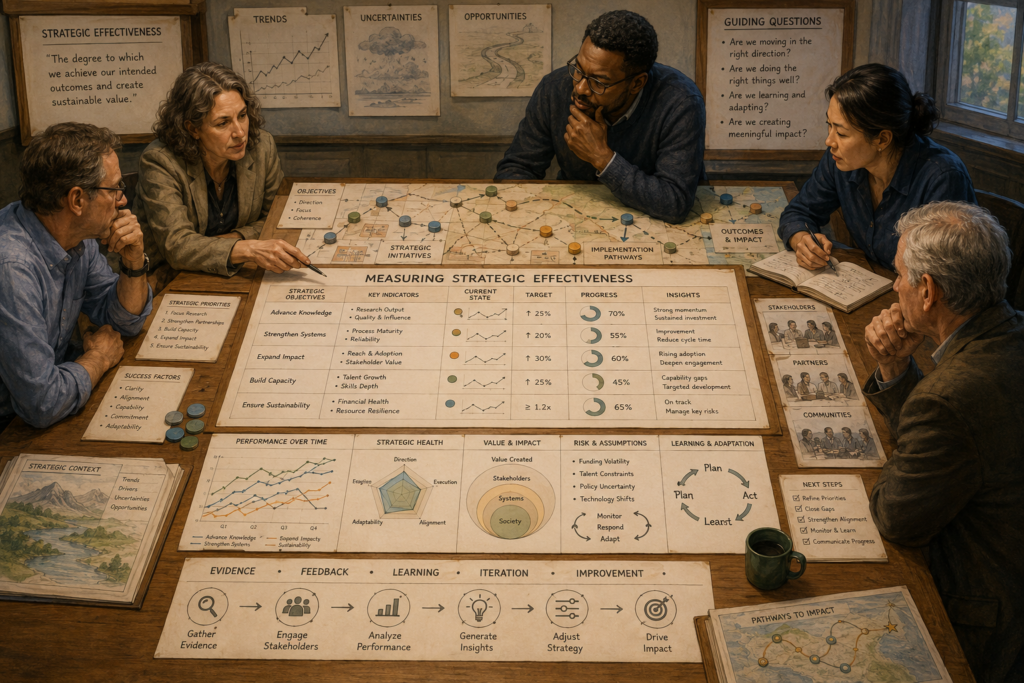
Strategists examine performance indicators, progress charts, outcome pathways, feedback loops, and implementation maps on a large planning table

Measuring Strategic Effectiveness: KPIs, Feedback Loops, and Strategic Learning

Measuring Strategic Effectiveness examines how organizations evaluate whether a strategy is actually working under real-world conditions rather than merely appearing successful on a dashboard. The article argues that strategic effectiveness is inherently multidimensional, involving not only performance, but also alignment, resilience, adaptability, impact, and learning across time. It develops this through the limits of single KPIs, the value of balanced measurement systems, the distinction between leading and lagging indicators, the challenge of attribution and causality, and the role of feedback loops in adaptive strategy. The article emphasizes that measurement is not simply a control function but a learning system that helps institutions refine strategy under uncertainty, especially in complex environments where outcomes are delayed, indirect, and difficult to trace cleanly.

Strategists revise interconnected planning maps, pathway routes, feedback loops, action cards, and tokens across a large institutional table.

Adaptive Strategy and Iteration: How Organizations Learn and Adjust Under Uncertainty

Adaptive Strategy and Iteration explains why strategy must function as a living process rather than a fixed plan in environments shaped by uncertainty, feedback, and change. The article argues that effective strategy depends on continuous learning: decisions are treated as hypotheses, outcomes are read through feedback loops, and strategic direction is repeatedly refined through evidence, experimentation, and structured revision. It develops this through the limits of static planning, strategy as a learning system, the role of iteration, exploration versus exploitation, path dependence, timing, organizational capabilities, leadership, and the risks of over-adaptation. The article emphasizes that adaptation is not endless improvisation but disciplined adjustment in service of coherent purpose.

Strategists organize implementation pathways, alignment maps, action cards, tokens, dependencies, and strategic routes on a large institutional planning table.

Strategy Implementation and Alignment: How Strategy Becomes Coordinated Action

Strategy Implementation and Alignment examines how strategic intent is translated into coordinated action across an organization rather than remaining an abstract plan. The article argues that many strategic failures come not from weak ideas but from the implementation gap: the distance between stated priorities and what structures, incentives, communication systems, and behaviors actually produce in practice. It develops this through cross-level alignment, structural and cultural fit, incentive design, coordination, resource allocation, tradeoff management, adaptive execution, leadership, accountability, and system-level alignment beyond the organization itself. The article emphasizes that implementation is where strategy encounters organizational reality, and that alignment must be strong enough to create coherence without becoming so rigid that it suppresses adaptation.

Scroll to Top