
Problem Solving

Problem solving refers to the cognitive and strategic processes used to identify challenges, analyze underlying causes, and develop effective solutions. In complex environments, problem solving requires more than analytical reasoning; it involves integrating creative thinking, structured analysis, and systems-level understanding.

Traditional models of problem solving emphasized linear processes such as defining the problem, generating alternatives, and selecting optimal solutions. Contemporary research recognizes that many real-world problems are complex, dynamic, and interconnected, requiring iterative approaches that incorporate experimentation, feedback, and adaptive learning.

Modern problem-solving frameworks often draw from multiple disciplines, including cognitive psychology, systems thinking, design research, and decision science. These approaches help individuals and organizations understand how problems emerge within broader systems and how interventions may produce both intended and unintended consequences.

Effective problem solving is central to innovation, policy development, and strategic planning. In rapidly changing environments, organizations increasingly rely on interdisciplinary problem-solving methods that combine analytical rigor with creative exploration.

Institutional research studio with a large regional systems model showing energy, land use, industry, cities, forests, water systems, agriculture, coastlines, and climate-related infrastructure.

Integrated Assessment Models: Climate, Energy, Economics, and Policy Pathways

Integrated Assessment Models (IAMs) are large-scale computational frameworks that connect economic systems, energy systems, land use, environmental change, technological development, and policy dynamics in order to analyze long-term sustainability challenges. Rather than predicting a single future, IAMs generate structured scenarios showing how human development and Earth systems may interact under different assumptions about emissions, energy transition, technological change, and public policy. They are especially important in climate and sustainability research because they make cross-system trade-offs visible, linking mitigation, development, land use, and temperature outcomes within a single analytical framework. The article explains why integrated modeling is necessary, outlines the major components of IAMs, reviews prominent models such as DICE, IMAGE, GCAM, REMIND, and MESSAGEix, and examines both their policy value and their limitations as tools for scenario comparison, uncertainty analysis, and long-horizon sustainability reasoning.

Institutional policy evidence room with a large community systems model showing neighborhoods, schools, clinics, transit routes, public buildings, housing, green space, industry, and linked policy pathways.

Public Policy Modeling: Designing Policy for Complex Systems

Public policy modeling examines how governments design, evaluate, and implement policy within complex social, economic, environmental, and institutional systems. Rather than treating policy as a simple linear intervention, it models how decisions alter incentives, reshape information flows, interact with infrastructure and markets, and generate delayed or unintended consequences over time. This article explains why policy analysis is inherently a systems problem and shows how approaches such as system dynamics, agent-based modeling, scenario analysis, and network modeling can help policymakers reason more clearly about trade-offs, uncertainty, institutional capacity, and long-term effects. It also argues that policy outcomes depend not only on formal policy design but on governance structures, feedback processes, and adaptive behavior within society itself. In that sense, public policy modeling is one of the clearest practical applications of systems thinking to governance, sustainability, and evidence-based institutional decision-making.

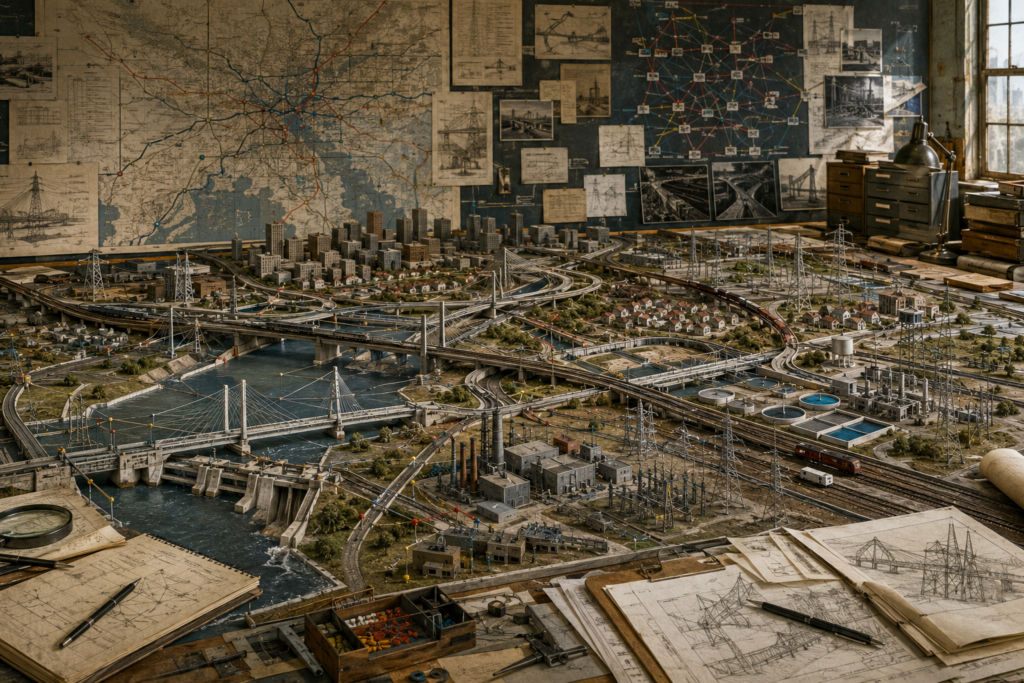
Engineering workshop with a large infrastructure model showing bridges, highways, rail lines, power grids, water systems, substations, city districts, and wall-mounted planning maps.

Infrastructure Systems Modeling: Invisible Networks That Power Modern Society

Infrastructure systems modeling examines how critical networks such as energy grids, transportation systems, water infrastructure, communications, and logistics operate as interconnected systems rather than isolated assets. Because failures in one network can propagate into others, infrastructure risk is often systemic, shaped by interdependence, cascading disruption, delayed effects, and long-term investment dynamics. This article explains why infrastructure requires systems modeling, reviews major approaches such as network models, system dynamics, discrete-event simulation, and hybrid methods, and shows how these tools help researchers and planners analyze resilience, vulnerability, redundancy, and long-horizon capacity change. It also explores how smart infrastructure, digital monitoring, and sustainability transitions are reshaping infrastructure analysis. In practice, infrastructure systems modeling matters because modern societies depend on tightly coupled service networks whose stability, failure, and recovery cannot be understood adequately through asset-by-asset engineering alone.

Institutional map room with a large city model, wall-mounted urban maps, transport routes, infrastructure networks, waterways, districts, planning sketches, and archival research materials.

Urban Systems Modeling: Understanding the Dynamics of Modern Cities

Urban systems modeling examines how cities function as complex, spatially structured systems shaped by interactions among transportation, housing, infrastructure, governance, environmental pressure, and economic activity. Rather than treating cities as collections of separate sectors, it models how urban outcomes emerge through feedback loops, delays, spatial proximity, accessibility, and long-term institutional choices. This article explains why cities require systems modeling, reviews major approaches such as land-use and transportation models, agent-based models, network models, and system dynamics, and shows how these methods help researchers analyze urban growth, congestion, housing supply, resilience, sustainability, and smart-city data systems. It also emphasizes that urban systems are not only technical but deeply political and institutional, since zoning, transit investment, infrastructure finance, and environmental regulation all shape urban evolution. In practice, urban systems modeling helps make reasoning about cities more explicit, testable, and structurally informed.

River basin landscape from mountains to coast with wetlands, settlements, industry, water flows, weather patterns, field instruments, soil samples, notebooks, and environmental survey materials.

Environmental Systems Modeling: Understanding Ecosystems, Climate, and Sustainability

Economic systems modeling examines how markets, institutions, finance, policy, production, and human decision-making interact through feedback-rich dynamics rather than as isolated variables or static equilibria. Instead of assuming that the economy naturally settles into stable balance, systems-based approaches analyze how growth, recession, inequality, financial instability, and technological change emerge from recursive interactions among firms, households, governments, and financial networks over time. This article explains why economic systems require modeling, outlines major approaches such as system dynamics, agent-based models, network models, complexity economics, and stock–flow consistent models, and shows how these methods help researchers analyze macroeconomic cycles, contagion, credit expansion, sustainability transitions, and policy scenarios. In practice, economic systems modeling matters because it treats the economy as an evolving adaptive system shaped by accumulation, delay, interdependence, and institutional change rather than as a purely static market-clearing mechanism.

Comparative evidence table in an archival research room showing a modeled economy with households, farms, factories, ports, warehouses, public institutions, trade routes, and interconnected exchange pathways.

Economic Systems Modeling: Understanding Markets as Complex Systems

Economic systems modeling examines how markets, institutions, finance, policy, technology, and human decision-making interact through feedback-rich dynamics rather than as isolated variables or static equilibria. Instead of assuming that economic systems naturally settle into stable balance, systems-based approaches analyze how growth, recession, inequality, financial instability, and structural change emerge from recursive interactions among households, firms, governments, and financial networks over time. This article explains why economic systems require modeling, outlines major approaches such as system dynamics, agent-based models, network models, stock–flow consistent models, and complexity economics, and shows how these methods help researchers analyze macroeconomic cycles, contagion, sustainability transitions, and policy scenarios. In practice, economic systems modeling matters because it treats the economy as an evolving adaptive system shaped by accumulation, delay, interdependence, and institutional change rather than as a purely static market-clearing mechanism.

Editorial scientific illustration of decision science as an architecture-of-judgment systems framework, showing uncertainty, probability, risk, decision pathways, evidence layers, scenario comparison, trade-offs, cognitive bias, systems modeling, public policy, sustainability, healthcare, finance, organizational strategy, governance, accountability, and learning.

Decision Science: How Decisions Are Made Under Uncertainty

Decision science is the interdisciplinary study of how choices are structured, evaluated, and improved under uncertainty, complexity, and competing objectives. Drawing on economics, statistics, operations research, psychology, and organizational research, it provides a framework for making judgment more explicit, transparent, and defensible when knowledge is incomplete and trade-offs are unavoidable. The field connects normative models of rational choice with descriptive research on how people and institutions actually decide under limits of time, information, and cognitive capacity. It also emphasizes uncertainty, system dynamics, and the need for robust reasoning in environments where prediction is fragile and consequences may unfold over time. As a knowledge series, this pillar introduces the core foundations, methods, and applications of decision science, while linking to related work on risk, Bayesian reasoning, heuristics, trade-offs, complex systems, and long-horizon strategic decision-making.

Layered systems model on a research table showing a landscape divided between stable and transformed states, with translucent analytical planes, clustered nodes, network shifts, and a bright transition boundary.

Phase Transitions in Complex Systems

Phase transitions describe abrupt qualitative changes in the behavior of complex systems when gradual pressures push key parameters across critical thresholds. Originally developed in statistical physics to explain transformations such as freezing, boiling, and magnetic alignment, the concept now provides a powerful framework for understanding sudden change in ecosystems, climate systems, infrastructure networks, and social systems. This article explains how critical points, order parameters, collective behavior, alternative stable states, and hysteresis help reveal why systems can appear stable while resilience is quietly eroding. It also shows how phase-transition thinking connects statistical physics to resilience theory, network science, and tipping-point research. In systems modeling, the importance of phase transitions lies in their challenge to gradualist assumptions: small incremental changes do not always produce small effects, and once thresholds are crossed, large-scale structural reorganization can happen quickly and sometimes irreversibly.

Layered systems model on a research table with mapped landscapes, monitoring points, translucent analytical planes, signal traces, network stress patterns, and highlighted disturbance zones.

Early Warning Signals of System Collapse

Early warning signals are statistical, structural, and dynamical indicators suggesting that a complex system may be approaching a critical transition. As resilience weakens and restoring forces decline, systems often begin to display measurable patterns such as critical slowing down, rising variance, stronger autocorrelation, spatial reorganization, or increasing network fragility. This article explains why those indicators matter, how they connect to tipping points and resilience theory, and why systems modeling is essential for testing when such signals are meaningful. It also emphasizes an important caution: early warning signals are neither universal nor foolproof. In noisy real-world systems, false positives, false negatives, sparse data, and external shocks can all complicate interpretation. Used well, however, early warning analysis offers one of the most practical ambitions of systems science: identifying declining stability early enough to support intervention before abrupt systemic change becomes irreversible.

Scroll to Top