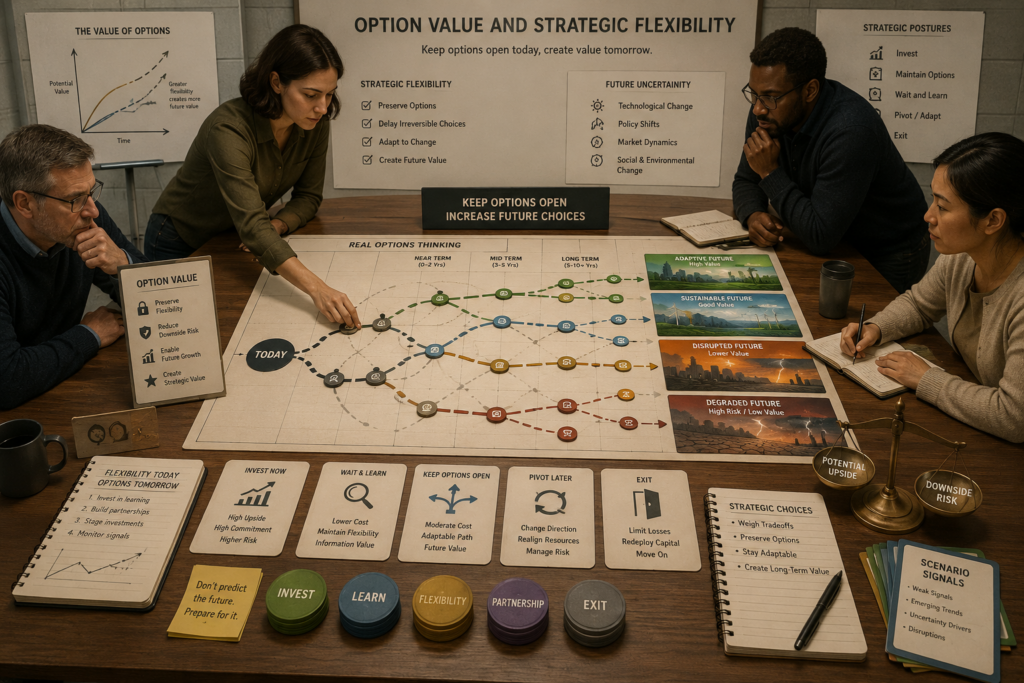
Option Value and Strategic Flexibility: How to Make Better Decisions Under Uncertainty
Option value and strategic flexibility explain why the best strategy under uncertainty is not always the one that commits fastest or optimizes most tightly. When future conditions are unclear and choices are difficult to reverse, organizations need ways to preserve future action while still moving forward. This article examines how pilots, prototypes, staged investments, modular architectures, adaptive policies, switching options, and decision gates create strategic value by allowing teams to learn before locking in. It distinguishes disciplined flexibility from indecision, showing how uncertainty, irreversibility, learning value, timing, governance, ethics, and option expiration shape strategic choice. The article also explores the risks of excessive optionality, including drift, stakeholder uncertainty, delayed capability building, and asymmetric burden. Better strategy preserves the right options long enough to learn, then commits with evidence, accountability, and adaptive capacity without mistaking flexibility for endless strategic delay.