
Last Updated June 5, 2026
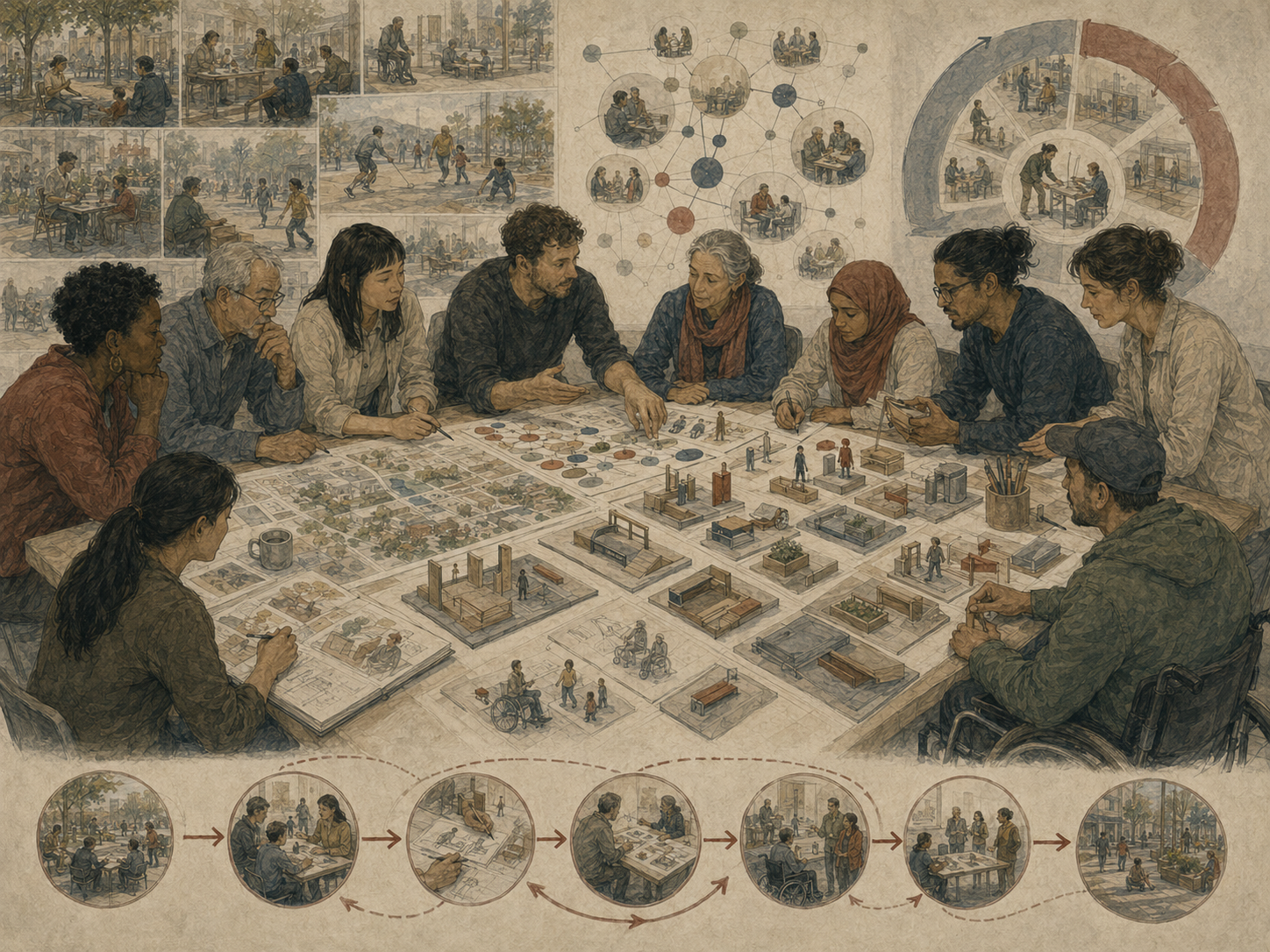
Participatory ideation and co-design are strategic practices for developing ideas with the people who are affected by them, rather than merely designing for them from a distance. They challenge the assumption that strategy should be produced primarily by experts, executives, consultants, designers, analysts, or institutional insiders and then validated by users after the main decisions have already been made.
In strategic ideation, participation is not just a workshop format, stakeholder-engagement activity, or user-research technique. It is a question of authority: who gets to define the problem, whose knowledge counts, who helps shape possible futures, who carries the burden of implementation, and who has the power to accept, revise, reject, or redirect proposed ideas. Co-design matters because many strategic failures begin when institutions frame problems without the lived experience, practical knowledge, cultural context, and ethical concerns of those most affected.
This does not mean that every decision can or should be made by consensus, nor does it mean that professional expertise becomes irrelevant. Participatory ideation works best when lived experience, technical knowledge, organizational judgment, systems analysis, and strategic responsibility are brought into structured conversation. The goal is not to replace expertise with opinion. The goal is to create better ideas by widening the intelligence available to the strategy process.
Participation also changes the moral structure of ideation. If a strategy affects workers, communities, users, customers, patients, students, residents, citizens, suppliers, ecosystems, or future generations, then the idea is not merely an internal object. It is an intervention in someone else’s conditions of life. Co-design asks whether affected people are treated as sources of insight, partners in judgment, subjects of experimentation, recipients of decisions, or obstacles to implementation.
This article examines participatory ideation and co-design as disciplined practices in strategic work. It explains why participation matters, how co-design differs from consultation, how power shapes participation, how stakeholder knowledge improves idea quality, what methods support collaborative ideation, how conflict and disagreement should be handled, how participation connects with design thinking and systems thinking, where participatory processes fail, and how responsible co-design can strengthen strategic legitimacy, implementation quality, and institutional learning.
Main Library
Publications
Article Map
Strategic Ideation
Related Topic
Systems Thinking
Related Topic
Design Thinking
Related Topic
Futures Thinking
Why Participation Matters in Strategic Ideation
Strategic ideas are often produced in rooms that exclude the people most affected by the resulting decisions. A leadership team may define the problem. A consulting team may create the framework. A design team may generate concepts. A product team may prioritize features. A policy team may draft the intervention. A communications team may package the narrative. Only after this work is substantially complete are users, workers, communities, or affected stakeholders asked to react.
This pattern creates predictable weaknesses. Problems are framed from institutional convenience rather than lived reality. Burdens are underestimated. Trust risks are missed. Cultural context is flattened. Implementation constraints are misunderstood. Stakeholder resistance is interpreted as irrational rather than as evidence that the strategy did not account for actual conditions. Participation matters because it brings those conditions into the ideation process before decisions harden.
Participatory ideation also improves the quality of strategic imagination. People closest to a system often understand its informal routines, workarounds, contradictions, pain points, hidden dependencies, and failure modes. They may know where official processes differ from actual practice, where rules create unintended burden, where trust has been damaged, and where small changes would make a large difference. This knowledge is not secondary to strategy. It is strategic material.
| Without participation | With meaningful participation | Strategic value |
|---|---|---|
| Problems are framed by institutional insiders. | Problems are informed by lived experience and affected stakeholders. | Reduces misdiagnosis and false problem framing. |
| Users are asked to validate decisions after they are mostly formed. | Users and stakeholders help shape assumptions, options, and criteria earlier. | Improves idea relevance and legitimacy. |
| Burden is estimated abstractly. | Burden is described by people who experience it directly. | Reveals hidden cost, friction, and exclusion. |
| Implementation is treated as delivery. | Implementation is treated as a shared learning process. | Improves adoption, fit, and adaptation. |
| Resistance is treated as a communication problem. | Resistance is interpreted as possible evidence about power, trust, risk, or context. | Improves strategic judgment. |
Participation matters because ideas are stronger when they are informed by the people, systems, and contexts they are meant to affect.
From Consultation to Co-Design
Consultation and co-design are not the same. Consultation usually asks stakeholders to respond to an already-defined issue, option, proposal, or plan. Co-design invites stakeholders into the formation of the problem, the generation of options, the interpretation of evidence, the design of prototypes, and sometimes the governance of implementation. Consultation can be valuable, but it can also be superficial when it arrives too late or when feedback has no power to change the decision.
Co-design requires a deeper shift. It asks institutions to share at least some control over framing, meaning, evaluation, and revision. This does not require that every participant has identical authority over every decision. It does require clarity about what is open, what is constrained, what decisions have already been made, what participants can influence, how their contributions will be used, and how the organization will remain accountable after participation ends.
Many organizations claim to co-design when they are actually consulting, testing, informing, or persuading. A workshop is not automatically co-design. A survey is not automatically participation. A focus group is not automatically empowerment. Co-design depends on timing, authority, representation, reciprocity, transparency, and decision linkage.
| Mode | Typical question | Level of participant influence |
|---|---|---|
| Informing | How can we explain the decision? | Participants receive information but do not shape the decision. |
| Consultation | What do stakeholders think of this proposal? | Participants provide input, but decision authority remains mostly unchanged. |
| User research | What do users experience, need, or struggle with? | Participants shape insight but may not shape strategic choices directly. |
| Participatory ideation | What ideas should be considered, and what assumptions should be questioned? | Participants influence problem framing and idea generation. |
| Co-design | How should we define, design, test, and revise this together? | Participants help shape options, prototypes, criteria, and learning. |
| Shared governance | How should decisions and accountability be shared over time? | Participants have formal influence over implementation, revision, or oversight. |
Co-design begins when participation can change the problem frame, not merely comment on a solution already moving toward approval.
Affected Communities and Situated Knowledge
Participatory ideation recognizes that knowledge is situated. People understand systems from different positions within them. A senior executive may understand institutional constraints, budgets, and strategic priorities. A frontline worker may understand where processes fail in practice. A community member may understand trust, history, access, and dignity. A user may understand the lived experience of a service journey. A technical specialist may understand feasibility and risk. A policy expert may understand regulatory boundaries. A strategist may understand coherence, tradeoffs, and long-term direction.
Strategic work becomes stronger when these forms of knowledge are not treated as competitors in a hierarchy of legitimacy. Instead, they are treated as partial views of a more complex reality. Co-design helps bring these views into relation. It does not assume that lived experience automatically solves strategic problems. It recognizes that strategic problems are incomplete without lived experience.
Affected communities often hold knowledge that is invisible to formal systems. They may know which channels people actually use, which terms are trusted or distrusted, which interventions have failed before, which institutions carry historical baggage, which support structures already exist, and which proposed solutions would create burden. They may also name harms that official metrics do not capture.
| Knowledge source | What it often reveals | Strategic contribution |
|---|---|---|
| Users | Experience, comprehension, friction, trust, burden, workarounds. | Improves fit between idea and lived journey. |
| Frontline workers | Operational reality, informal processes, failure points, hidden labor. | Improves feasibility and implementation design. |
| Affected communities | History, legitimacy, access, cultural context, collective impact. | Improves ethical grounding and social relevance. |
| Technical specialists | Build constraints, system architecture, data limitations, security risk. | Improves feasibility and risk assessment. |
| Strategic leaders | Resources, priorities, institutional commitments, tradeoffs. | Improves alignment and decision realism. |
| Researchers and analysts | Evidence, patterns, uncertainty, evaluation design. | Improves interpretation and learning quality. |
| Future or indirect stakeholders | Long-term, downstream, or externalized consequences. | Improves systems awareness and responsibility. |
Participatory ideation expands the knowledge base of strategy by treating experience, practice, evidence, and expertise as complementary forms of intelligence.
Participation, Power, and Agency
Participation is never neutral. It occurs inside power relations. Institutions decide who is invited, what questions are asked, what language is used, how time is structured, how conflict is handled, what evidence counts, which ideas are recorded, who interprets the results, and whether contributions affect decisions. These choices shape the outcome before the workshop begins.
Power also appears through participation burdens. People may be asked to share painful experiences, provide unpaid labor, attend meetings at inconvenient times, speak in unfamiliar institutional language, or represent an entire community. Participation can become extractive when organizations gather insight without sharing power, credit, compensation, or accountability.
Responsible co-design therefore requires explicit attention to agency. Participants should understand what they can influence, how their contributions will be used, what constraints exist, what decisions remain with the institution, what support is available, and how they can challenge interpretation. Participation is stronger when people are not merely sources of data but partners in meaning-making and judgment.
| Power issue | Risk | Responsible practice |
|---|---|---|
| Invitation power | Only convenient or agreeable participants are included. | Map affected groups and actively include missing voices. |
| Framing power | The institution defines the problem too narrowly. | Allow participants to challenge the problem frame. |
| Language power | Professional jargon excludes lived experience. | Use accessible language and translation where needed. |
| Interpretive power | Institutions reinterpret feedback to fit existing plans. | Share synthesis and allow correction or challenge. |
| Decision power | Participation has no effect on actual choices. | Define influence boundaries and decision pathways in advance. |
| Labor burden | Participants contribute time and experience without support. | Provide compensation, care, accessibility, and reciprocity where appropriate. |
| Accountability power | Organizations collect input and disappear. | Close the loop with decisions, rationale, and follow-up. |
Participation without attention to power can reproduce the very exclusions that co-design claims to overcome.
Stakeholder Mapping for Participatory Ideation
Participatory ideation begins with careful stakeholder mapping. The goal is not merely to list people who have an interest in the strategy. It is to understand who is affected, who has knowledge, who has authority, who bears risk, who is excluded, who influences implementation, who may resist, who may benefit, who may be harmed, and who is absent from ordinary decision processes.
Weak stakeholder mapping focuses on visibility and power. It includes leaders, funders, customers, formal partners, and vocal groups while missing people who are indirectly affected, hard to reach, historically excluded, or structurally burdened. Strong stakeholder mapping includes both institutional stakeholders and experience stakeholders.
Stakeholder mapping should also distinguish between participation needs. Some groups should help frame the problem. Some should participate in ideation. Some should test prototypes. Some should review ethical risks. Some should govern implementation. Some should be informed and protected. Treating every stakeholder as if they need the same level of involvement can create confusion, fatigue, or tokenism.
| Stakeholder category | Key question | Possible participation role |
|---|---|---|
| Direct users | Who will use or experience the proposed idea directly? | Problem framing, journey mapping, prototype testing, evaluation. |
| Indirectly affected groups | Who may experience consequences without being primary users? | Systems-impact review and ethical assessment. |
| Frontline implementers | Who must make the idea work in practice? | Feasibility review, workflow design, service prototyping. |
| Community or civil-society actors | Who understands local context, trust, legitimacy, or history? | Framing, legitimacy review, co-design, governance. |
| Decision authorities | Who controls resources, policy, timing, or approval? | Constraint clarification and decision linkage. |
| Technical and domain experts | Who understands feasibility, risk, evidence, or system constraints? | Assumption testing and implementation design. |
| Excluded or missing voices | Who is usually absent but materially affected? | Targeted inclusion, access review, harm assessment. |
| Future stakeholders | Who may inherit long-term consequences? | Scenario review, sustainability assessment, future impact analysis. |
Stakeholder mapping is not a communications exercise. It is a strategic method for identifying whose knowledge, risk, agency, and accountability must shape the idea.
Methods for Participatory Ideation and Co-Design
Participatory ideation uses structured methods to help diverse participants contribute to problem framing, idea generation, evaluation, prototyping, and learning. These methods must be chosen carefully. A method that works for a professional design team may not work for a community group, frontline workforce, multilingual participant group, youth group, public-sector context, or trauma-affected population.
Method choice should follow the participation purpose. If the goal is to understand lived experience, interviews, listening sessions, story circles, journey mapping, or contextual inquiry may be appropriate. If the goal is to generate ideas, facilitated ideation, card sorting, speculative scenarios, design games, or co-creation workshops may help. If the goal is to test feasibility, role-play, service walkthroughs, prototypes, tabletop exercises, or pilots may be stronger. If the goal is governance, advisory boards, participatory budgeting, community review panels, or shared decision structures may be needed.
| Method | Best suited for | Strategic value |
|---|---|---|
| Listening sessions | Understanding experience, trust, context, and history. | Improves problem framing and legitimacy. |
| Contextual inquiry | Observing real practices, workflows, environments, and constraints. | Reveals hidden friction and informal systems. |
| Participatory journey mapping | Mapping lived experience across time and touchpoints. | Identifies pain points, emotional states, and handoff failures. |
| Co-creation workshops | Generating options with users, workers, or stakeholders. | Expands the idea space beyond institutional assumptions. |
| Design games and prompts | Helping non-designers generate, compare, or combine ideas. | Makes ideation more accessible and creative. |
| Role-play and service walkthroughs | Testing interaction, handoffs, scripts, and support pathways. | Reveals experiential and operational feasibility. |
| Participatory prototyping | Building and revising concepts with affected stakeholders. | Converts feedback into tangible design changes. |
| Community review panels | Reviewing ethical risks, access, trust, and implementation effects. | Strengthens accountability and legitimacy. |
| Participatory evaluation | Defining success measures with affected groups. | Prevents institutions from measuring only internal priorities. |
The best co-design method is not the most creative workshop technique. It is the method that fits the people, question, power context, and decision being shaped.
Facilitation and Knowledge Translation
Participatory ideation depends heavily on facilitation. Good facilitation creates conditions in which participants can contribute meaningfully, differences can surface, quieter voices can be heard, technical constraints can be understood, and ideas can be translated across forms of knowledge. Poor facilitation allows dominant voices, institutional assumptions, jargon, hierarchy, speed, or conflict avoidance to control the process.
Facilitation is not neutral moderation. It is design of the participation environment. It includes agenda structure, language, accessibility, materials, timekeeping, emotional safety, conflict handling, synthesis, decision transparency, and follow-up. Facilitators must pay attention to who speaks, who withdraws, which ideas are taken seriously, which terms are unclear, and how institutional power enters the room.
Knowledge translation is equally important. Participants may express insight through stories, examples, frustration, gestures, drawings, metaphors, or accounts of everyday practice. Strategists may need to translate these contributions into assumptions, requirements, design principles, prototypes, decision criteria, risks, and implementation pathways without stripping away meaning. Translation should be accountable: participants should be able to see whether the synthesis reflects what they meant.
| Facilitation task | Purpose | Risk if neglected |
|---|---|---|
| Accessible framing | Make the purpose and question understandable. | Participants respond to unclear or misleading prompts. |
| Power balancing | Reduce domination by high-status or highly verbal participants. | Participation reproduces hierarchy. |
| Multiple expression modes | Allow speech, writing, drawing, mapping, ranking, and storytelling. | Only certain communication styles count. |
| Constraint transparency | Explain what is open, fixed, funded, required, or unavailable. | Participants are misled about influence. |
| Conflict support | Allow disagreement without collapse or avoidance. | Important tradeoffs remain hidden. |
| Accountable synthesis | Translate input into usable strategic material without distortion. | Organizations reinterpret participation to fit existing plans. |
| Follow-up | Show what changed, what did not, and why. | Trust declines and participation becomes extractive. |
Facilitation is the infrastructure that determines whether participation produces shared intelligence or merely collects scattered input.
Conflict, Disagreement, and Tradeoffs
Participatory ideation does not eliminate disagreement. It often reveals disagreement more clearly. Users may want convenience while staff worry about capacity. Communities may prioritize trust while institutions prioritize efficiency. Technical teams may emphasize feasibility while affected groups emphasize dignity. Funders may want measurable outcomes while participants value relational or long-term change. These tensions are not failures of participation. They are part of the reality that strategy must address.
Weak participatory processes avoid conflict by smoothing differences into vague consensus. Strong participatory processes help participants and decision-makers understand where values, interests, risks, and tradeoffs diverge. Not every disagreement can be resolved, but unresolved disagreement should be visible and documented. This prevents institutions from claiming consensus where none exists.
Conflict can also improve idea quality. It reveals assumptions, hidden costs, competing definitions of success, and boundary choices. It can expose where a proposed solution helps one group while burdening another. It can force teams to clarify priorities, criteria, and ethical commitments.
| Source of disagreement | Strategic meaning | Useful response |
|---|---|---|
| Different definitions of the problem | The initial frame may be incomplete or contested. | Document alternative frames and test their implications. |
| Conflicting success criteria | Stakeholders value different outcomes. | Make tradeoffs explicit before prioritizing ideas. |
| Resource constraints | Some ideas may be desirable but difficult to implement. | Separate desirability, feasibility, viability, and justice concerns. |
| Trust concerns | Past harm or institutional credibility may shape response. | Address trust as a design condition, not a communications afterthought. |
| Burden shifts | One group’s improvement may become another group’s labor. | Map burden across stakeholders and redesign accordingly. |
| Value conflict | Efficiency, equity, privacy, autonomy, safety, and cost may compete. | Use explicit ethical and strategic criteria. |
Co-design is not successful because everyone agrees. It is successful when disagreement becomes visible enough to improve judgment.
Co-Design and Systems Thinking
Co-design becomes stronger when paired with systems thinking. Participants can help reveal not only what they experience, but how the system produces that experience. They can identify delays, handoffs, workarounds, feedback loops, informal dependencies, policy contradictions, resource constraints, and unintended consequences that may not be visible from formal process maps.
Systems thinking also helps participatory ideation avoid over-focusing on isolated preferences. A participant may request a feature, rule, service, or communication change. The deeper question is what system condition the request reveals. Is the request about trust? Time burden? Lack of status visibility? Accessibility? Coordination failure? Fear of error? Institutional history? Misaligned incentives? A systems lens helps translate participant input into structural insight.
Participation also improves systems thinking by grounding it. System maps created only by experts can become abstract and detached from experience. Participatory system mapping can reveal how people actually move through the system, where power is felt, where informal support matters, and where official pathways break down.
| Systems concept | Participatory contribution | Strategic use |
|---|---|---|
| Feedback loops | Participants describe how actions produce repeated effects. | Identify reinforcing and balancing dynamics. |
| Delays | Participants reveal waiting, uncertainty, and timing mismatch. | Improve sequencing and expectation management. |
| Handoffs | Frontline workers and users show where context is lost. | Redesign transitions and accountability. |
| Workarounds | Participants show how the real system differs from the official one. | Use informal practice as evidence for redesign. |
| Leverage points | Participants identify small changes that could produce major relief. | Prioritize high-impact interventions. |
| Burden shifts | Participants reveal who absorbs hidden labor or risk. | Prevent strategies from externalizing cost. |
| Boundary critique | Participants challenge what the institution includes or excludes. | Improve problem framing and responsibility. |
Systems thinking helps interpret participation structurally; participation helps systems thinking stay grounded in lived reality.
Co-Design and Design Thinking
Participatory ideation is closely related to design thinking, but it adds a stronger emphasis on shared authorship and power. Design thinking often begins with empathy, problem framing, ideation, prototyping, testing, and iteration. Co-design asks who participates in each of these stages and whether participation has meaningful influence.
In a conventional design-thinking process, users may be interviewed during the empathy phase and asked to test prototypes later. In a co-design process, users, workers, communities, or stakeholders may help define the problem, generate ideas, decide what should be prototyped, interpret test results, and shape implementation criteria. The difference is not simply more user input. It is a different distribution of design agency.
Co-design also strengthens prototyping. When affected stakeholders help build or revise prototypes, teams can detect issues that internal designers may miss: stigma, accessibility barriers, trust signals, language problems, hidden labor, cultural mismatch, safety concerns, or implementation burden. This makes prototypes more than validation tools. They become shared learning objects.
| Design-thinking stage | Participatory extension | Strategic benefit |
|---|---|---|
| Empathy | Move from observing users to listening, compensating, and sharing interpretation. | Reduces extractive research and improves trust. |
| Problem definition | Allow affected groups to challenge the problem frame. | Improves strategic diagnosis. |
| Ideation | Generate ideas with users, workers, communities, and stakeholders. | Expands the idea space and reveals practical constraints. |
| Prototyping | Build and revise prototypes collaboratively. | Improves relevance, access, and implementation realism. |
| Testing | Interpret results with participants, not only about participants. | Improves learning quality and reduces misinterpretation. |
| Iteration | Show what changed and invite correction. | Builds accountability and trust. |
| Implementation | Include affected stakeholders in monitoring and adaptation. | Improves legitimacy and long-term fit. |
Co-design deepens design thinking by asking not only whether users are understood, but whether they have meaningful influence over what is designed.
Core Dimensions of Participatory Ideation and Co-Design
Participatory ideation can be evaluated through several core dimensions. These dimensions help teams distinguish meaningful co-design from symbolic engagement, extractive consultation, or workshop theater.
1. Representation
Participation should include people who are directly affected, indirectly affected, responsible for implementation, historically excluded, or likely to experience burden. Representation should not depend only on convenience, visibility, or institutional familiarity.
2. Influence
Participants should know what they can shape. Influence may apply to framing, ideation, criteria, prototype design, evaluation, governance, or implementation. Participation without influence becomes symbolic.
3. Accessibility
Participation must be designed so people can actually take part. This includes language, time, location, technology, disability access, compensation, care responsibilities, psychological safety, and cultural fit.
4. Reciprocity
Participants should not be treated as free sources of insight. Responsible participation considers compensation, credit, shared learning, capacity building, and visible response.
5. Power Awareness
Co-design must account for hierarchy, institutional authority, facilitation power, interpretive power, and decision power. These dynamics shape what can be said and what is heard.
6. Knowledge Integration
Participatory ideation works when lived experience, professional expertise, evidence, systems analysis, and strategic constraints are brought into disciplined relation.
7. Decision Linkage
Participation should connect to real decisions. Teams should document how input shaped options, tradeoffs, prototypes, criteria, implementation, or learning.
8. Accountability
Organizations should close the loop by showing what changed, what did not, why decisions were made, and how participants can challenge or continue influencing the process.
| Dimension | Diagnostic question | Useful output |
|---|---|---|
| Representation | Who is present, and who is missing? | Participation map. |
| Influence | What can participants actually shape? | Influence boundary statement. |
| Accessibility | Can affected people realistically participate? | Participation access plan. |
| Reciprocity | What do participants receive in return? | Compensation, credit, or response plan. |
| Power awareness | How might hierarchy shape the process? | Power-risk review. |
| Knowledge integration | How will different forms of knowledge be combined? | Synthesis protocol. |
| Decision linkage | How will participation affect decisions? | Decision traceability record. |
| Accountability | How will the organization close the loop? | Follow-up and accountability plan. |
Participatory ideation becomes strategically serious when representation, influence, accessibility, reciprocity, power awareness, knowledge integration, decision linkage, and accountability are designed together.
Core Principles of Responsible Co-Design
Responsible co-design requires more than inviting people into a room. The following principles help teams design participation that improves ideas, respects participants, and supports accountable strategy.
1. Invite Participation Early Enough to Matter
Participation should begin before the problem frame, solution path, and evaluation criteria are locked. Late-stage consultation may improve details but rarely changes strategic direction.
2. Clarify What Is Open and What Is Constrained
Participants should understand what they can influence, what is fixed, what constraints exist, and who will make final decisions.
3. Design for Access
Participation must account for language, disability, time, transportation, technology, compensation, safety, and cultural context.
4. Balance Power in the Process
Facilitation should prevent dominant voices, institutional authority, professional jargon, or social hierarchy from controlling the conversation.
5. Value Different Forms of Knowledge
Lived experience, professional expertise, evidence, local practice, technical knowledge, and systems analysis should each contribute to strategic judgment.
6. Work With Conflict Honestly
Co-design should not erase disagreement. It should make tradeoffs visible and help participants understand competing needs, constraints, and values.
7. Trace Participation to Decisions
Teams should document how participant input shaped framing, options, prototypes, criteria, implementation, or learning.
8. Close the Loop
Participants should receive a clear account of what changed, what did not, why, and how future involvement or challenge is possible.
| Principle | Protects against | Practical test |
|---|---|---|
| Early participation | Tokenistic late consultation. | Can participants change the problem frame? |
| Influence clarity | False expectations or hidden constraints. | Do participants know what is open and what is fixed? |
| Access design | Exclusion by format, language, time, or technology. | Can affected groups realistically participate? |
| Power balancing | Domination by high-status voices. | Are facilitation methods protecting quieter and marginalized voices? |
| Knowledge pluralism | Overreliance on one kind of expertise. | Are lived experience, evidence, and technical expertise integrated? |
| Conflict honesty | False consensus. | Are disagreements documented rather than smoothed over? |
| Decision traceability | Input disappears into opaque synthesis. | Can participants see how contributions shaped choices? |
| Loop closure | Extractive engagement. | Did the organization report back with rationale and next steps? |
Responsible co-design is not defined by the number of participants involved, but by whether participation is accessible, influential, accountable, and connected to decisions.
Evidence, Learning, and Strategic Interpretation
Participatory ideation generates evidence, but that evidence must be interpreted carefully. Participant input may include stories, preferences, needs, complaints, ideas, warnings, aspirations, critiques, emotional responses, and practical suggestions. These contributions are valuable, but they do not interpret themselves. Teams must ask what the input reveals about the system, what assumptions it challenges, what patterns appear across groups, what tensions remain unresolved, and what decisions it should influence.
Participatory evidence is often qualitative, contextual, and relational. This does not make it weak. It means it should be interpreted using appropriate standards. A story may reveal a failure mode that metrics hide. A single account may expose a dignity risk that deserves immediate attention. Repeated participant workarounds may reveal a design flaw. Divergent views may reveal a strategic tradeoff.
Strong strategic interpretation combines participatory evidence with other forms of evidence: data, observation, prototype testing, operational analysis, systems modeling, domain expertise, and evaluation. The goal is not to let any one form of evidence dominate. The goal is to create a richer evidence environment for judgment.
| Participatory evidence | What it may reveal | Interpretive caution |
|---|---|---|
| Stories and lived experience | Friction, harm, trust, meaning, and hidden burden. | Do not reduce stories to anecdotes without examining pattern and context. |
| Participant-generated ideas | Practical options and unmet needs. | Ideas still need feasibility, systems, and ethical review. |
| Workarounds | How people adapt to broken or misfit systems. | Workarounds may signal structural failure, not user creativity alone. |
| Disagreement | Competing values, interests, risks, and success criteria. | Do not force false consensus. |
| Emotional response | Trust, fear, dignity, stigma, frustration, or hope. | Emotion is evidence about experience and legitimacy. |
| Silence or absence | Fear, exclusion, fatigue, mistrust, or access barriers. | Do not assume absence means lack of concern. |
Participatory evidence improves strategy when it is interpreted as insight into systems, not merely as feedback on preferences.
Limitations and Failure Modes
Participatory ideation is powerful, but it can also fail. Poorly designed participation can waste time, extract insight, create false legitimacy, reproduce hierarchy, or produce ideas that are disconnected from implementation constraints. Serious co-design requires awareness of these risks.
1. Tokenism
Participants are invited to create the appearance of inclusion, but their input cannot meaningfully change decisions. This damages trust and weakens strategic legitimacy.
2. Extractive Participation
Organizations gather stories, time, cultural knowledge, emotional labor, or community insight without compensation, reciprocity, credit, or accountability.
3. Representation Bias
Participation includes the easiest-to-reach, most available, most institutionally familiar, or most agreeable participants while missing people most affected by barriers.
4. False Consensus
Facilitators smooth over disagreement to produce a clean synthesis. Important tradeoffs, value conflicts, and dissent disappear.
5. Power Capture
Dominant participants, institutional actors, funders, or professional experts shape the process while others are formally present but practically marginalized.
6. Method Theater
Workshops, sticky notes, canvases, or creative exercises create energy without producing decision-relevant learning or implementation pathways.
7. Unbounded Expectations
Participants are led to believe they have more influence than they actually do. This creates disappointment and mistrust when decisions remain constrained.
8. Implementation Disconnect
Ideas generated through participation are not connected to resources, governance, feasibility, measurement, or institutional responsibility.
| Failure mode | Strategic risk | Corrective practice |
|---|---|---|
| Tokenism | Participation legitimizes decisions without influence. | Define influence and decision linkage in advance. |
| Extraction | Participants provide value without reciprocity. | Compensate, credit, reciprocate, and close the loop. |
| Representation bias | Missing voices distort the idea space. | Map affected groups and design targeted inclusion. |
| False consensus | Important disagreement disappears. | Document dissent, tradeoffs, and unresolved tensions. |
| Power capture | Dominant voices control the process. | Use facilitation methods that balance participation. |
| Method theater | Workshop energy substitutes for strategic learning. | Connect activities to assumptions, prototypes, and decisions. |
| Unbounded expectations | Trust declines when influence is overstated. | Clarify constraints and decision authority. |
| Implementation disconnect | Participatory ideas never become action. | Link ideas to resources, governance, metrics, and next steps. |
Participation fails when it is used to decorate strategy rather than shape it.
Ethics and Governance of Participatory Ideation
Participatory ideation has ethical responsibilities because it asks people to contribute time, attention, experience, judgment, stories, critique, and sometimes vulnerability. These contributions may involve personal difficulty, community history, trauma, discrimination, exclusion, labor conditions, public-service failures, or institutional mistrust. Organizations have a duty to protect participants and use contributions responsibly.
Ethical participation requires clarity about purpose, consent, influence, confidentiality, compensation, accessibility, data use, emotional safety, representation, and follow-up. It also requires accountability for what happens after participation. If people contribute to co-design but never hear what happened, the process can become extractive even when the workshop itself felt respectful.
Governance matters because participatory input can otherwise disappear into ambiguous synthesis. Teams should document how participation shaped problem framing, assumptions, prototypes, criteria, implementation plans, decisions, and unresolved tensions. They should also document where participation did not change the decision and why. This transparency helps prevent co-design from becoming a legitimacy ritual.
| Ethical concern | Why it matters | Responsible practice |
|---|---|---|
| Consent | Participants should know the purpose, use, and limits of involvement. | Use plain-language consent and influence statements. |
| Compensation | Participation requires time, labor, and expertise. | Compensate or reciprocate where appropriate. |
| Accessibility | Participation formats can exclude people. | Provide accessible formats, language support, timing flexibility, and accommodations. |
| Confidentiality | Participants may share sensitive experiences or critique institutions. | Protect identities and clarify attribution rules. |
| Emotional safety | Participation may involve difficult stories or harms. | Use trauma-informed facilitation and opt-out pathways where needed. |
| Representation | Participants should not be asked to speak for entire groups. | Avoid tokenism and document limits of representation. |
| Decision transparency | Participants deserve to know how input was used. | Close the loop with decisions, rationale, and next steps. |
| Accountability | Co-design affects trust and legitimacy. | Create governance records and ongoing review mechanisms. |
Ethical co-design treats participants as partners in judgment, not as raw material for institutional insight.
A Practical Participatory Ideation and Co-Design Audit
A participatory ideation audit helps teams determine whether co-design is meaningful, inclusive, accountable, and strategically useful. It can be used before beginning engagement, after stakeholder mapping, before a workshop, after synthesis, or before implementation.
1. Define the Participation Purpose
Clarify whether participation is intended for problem framing, idea generation, prototype design, evaluation, governance, implementation, or learning.
2. Clarify Influence Boundaries
State what participants can shape, what is constrained, who decides, and how contributions will be used.
3. Map Affected Stakeholders
Identify direct users, indirect stakeholders, implementers, excluded groups, community actors, decision authorities, technical experts, and future stakeholders.
4. Design for Access
Review language, disability access, schedule, location, technology, compensation, care responsibilities, psychological safety, and cultural context.
5. Choose Participation Methods
Select methods that fit the question and participants: listening sessions, journey mapping, co-creation workshops, design games, role-play, prototypes, panels, or participatory evaluation.
6. Review Power Dynamics
Assess hierarchy, facilitation power, interpretive power, institutional authority, participant risk, and possible domination by high-status voices.
7. Create an Accountable Synthesis Plan
Define how input will be translated into assumptions, insights, criteria, prototypes, options, risks, and decision records.
8. Document Conflict and Tradeoffs
Record disagreement, unresolved tensions, competing values, burden shifts, and alternative problem frames.
9. Link Participation to Decisions
Show how participation influenced strategy, what changed, what did not, why, and what remains uncertain.
10. Close the Loop
Report back to participants with decisions, rationale, next steps, implementation status, and future opportunities for review or challenge.
| Audit step | Core question | Useful output |
|---|---|---|
| Purpose | Why are we inviting participation? | Participation purpose statement. |
| Influence | What can participants shape? | Influence boundary statement. |
| Stakeholders | Who is affected, powerful, burdened, or missing? | Stakeholder and inclusion map. |
| Access | Can people realistically participate? | Accessibility and support plan. |
| Method | Which participation format fits the question? | Co-design method plan. |
| Power | How might hierarchy shape the process? | Power-risk review. |
| Synthesis | How will input become strategic material? | Accountable synthesis protocol. |
| Conflict | What disagreement or tradeoff must remain visible? | Conflict and tradeoff register. |
| Decision linkage | How did participation affect choices? | Decision traceability record. |
| Accountability | How will participants hear what happened? | Close-the-loop plan. |
A serious co-design audit should leave behind not only workshop notes, but a traceable record of influence, evidence, disagreement, decisions, and accountability.
Mathematical Lens: Participation, Representation, and Idea Quality
A stylized participatory idea-quality score can be represented as:
Q_i = r + a + k + p + d + g
\]
Interpretation: \(Q_i\) represents idea quality, where \(r\) is relevance to lived experience, \(a\) is accessibility of participation, \(k\) is knowledge diversity, \(p\) is power awareness, \(d\) is decision linkage, and \(g\) is governance accountability.
Representation coverage can be represented conceptually as:
C_r = \frac{S_p}{S_a}
\]
Interpretation: \(C_r\) is representation coverage, \(S_p\) is the set of stakeholder groups meaningfully participating, and \(S_a\) is the set of stakeholder groups materially affected. The expression is conceptual, but it emphasizes the gap between who participates and who is affected.
Participation influence can be represented as:
I_p = \frac{D_c}{D_t}
\]
Interpretation: \(I_p\) is participation influence, \(D_c\) is the number or significance of decisions changed by participation, and \(D_t\) is the total set of decisions relevant to the strategy. Low influence suggests tokenism risk.
Extraction risk can be represented conceptually as:
E_r = L_p – R_p
\]
Interpretation: \(E_r\) is extraction risk, \(L_p\) is participant labor or burden, and \(R_p\) is reciprocity, compensation, credit, accountability, or benefit returned to participants. Extraction risk rises when participant labor exceeds reciprocal value.
The mathematical lens clarifies a central point: participation improves strategy when affected groups are meaningfully represented, influence is real, knowledge diversity improves judgment, and reciprocity reduces extraction.
Advanced R Workflow: Comparing Participatory Ideation Profiles
The R workflow below compares stylized participatory ideation systems across representation, influence, accessibility, reciprocity, power awareness, knowledge integration, decision linkage, and accountability. It is designed as an evergreen illustration of how participation quality can be evaluated as a strategic capability.
# Install packages if needed.
# install.packages(c("tidyverse"))

library(tidyverse)

# ------------------------------------------------------------
# R Workflow: Comparing Participatory Ideation Profiles
# Purpose:
#   Build stylized profiles across participatory design systems
#   using representation, influence, accessibility, reciprocity,
#   power awareness, knowledge integration, decision linkage,
#   and accountability.
# ------------------------------------------------------------

systems <- tibble(
  system = c(
    "Token Consultation System",
    "Balanced Co-Design System",
    "Expert-Led User Research System",
    "Community-Governed Design System",
    "Workshop Theater System"
  ),
  representation = c(0.34, 0.76, 0.52, 0.86, 0.42),
  influence = c(0.22, 0.72, 0.38, 0.84, 0.26),
  accessibility = c(0.40, 0.74, 0.56, 0.82, 0.46),
  reciprocity = c(0.24, 0.68, 0.42, 0.80, 0.30),
  power_awareness = c(0.28, 0.70, 0.46, 0.86, 0.34),
  knowledge_integration = c(0.42, 0.78, 0.68, 0.84, 0.44),
  decision_linkage = c(0.20, 0.72, 0.40, 0.82, 0.24),
  accountability = c(0.18, 0.70, 0.36, 0.86, 0.22)
)

systems <- systems %>%
  mutate(
    participation_quality =
      0.14 * representation +
      0.16 * influence +
      0.12 * accessibility +
      0.12 * reciprocity +
      0.14 * power_awareness +
      0.12 * knowledge_integration +
      0.10 * decision_linkage +
      0.10 * accountability,
    tokenism_risk =
      0.18 * (1 - influence) +
      0.16 * (1 - decision_linkage) +
      0.15 * (1 - accountability) +
      0.14 * (1 - reciprocity) +
      0.13 * (1 - power_awareness) +
      0.12 * (1 - representation) +
      0.12 * (1 - accessibility)
  )

print(systems)

systems_long <- systems %>%
  pivot_longer(
    cols = c(
      representation,
      influence,
      accessibility,
      reciprocity,
      power_awareness,
      knowledge_integration,
      decision_linkage,
      accountability
    ),
    names_to = "dimension",
    values_to = "value"
  )

ggplot(systems_long, aes(x = dimension, y = value, fill = system)) +
  geom_col(position = "dodge") +
  labs(
    title = "Participatory Ideation and Co-Design Dimensions",
    x = "Dimension",
    y = "Value",
    fill = "System"
  ) +
  theme_minimal(base_size = 12) +
  coord_flip()

ggplot(systems, aes(x = reorder(system, participation_quality), y = participation_quality)) +
  geom_col() +
  coord_flip() +
  labs(
    title = "Participatory Ideation Quality",
    x = "System",
    y = "Quality Score"
  ) +
  theme_minimal(base_size = 12)

ggplot(systems, aes(x = reorder(system, tokenism_risk), y = tokenism_risk)) +
  geom_col() +
  coord_flip() +
  labs(
    title = "Tokenism and Extractive Participation Risk",
    x = "System",
    y = "Risk Score"
  ) +
  theme_minimal(base_size = 12)

write_csv(systems, "participatory_ideation_profiles.csv")
This workflow is not a universal scoring system. Its value is methodological: it helps teams compare participation systems across the dimensions that determine whether co-design produces meaningful strategic learning or merely the appearance of inclusion.
Advanced Python Workflow: Simulating Participation and Idea Quality
The Python workflow below simulates how representation, influence, accessibility, power awareness, knowledge integration, decision linkage, and accountability can affect idea quality over repeated cycles of participatory learning.
# Install packages if needed:
# pip install pandas numpy matplotlib

import numpy as np
import pandas as pd
import matplotlib.pyplot as plt

# ------------------------------------------------------------
# Python Workflow: Simulating Participation and Idea Quality
# Purpose:
#   Compare participatory design systems whose strategic learning
#   depends on representation, influence, accessibility, power
#   awareness, knowledge integration, decision linkage, and accountability.
# ------------------------------------------------------------

time_steps = np.arange(1, 41)

def simulate_system(
    representation,
    influence,
    accessibility,
    reciprocity,
    power_awareness,
    knowledge_integration,
    decision_linkage,
    accountability,
    noise,
    initial_quality=0.30
):
    quality = np.zeros(len(time_steps))
    quality[0] = initial_quality

    for t in range(1, len(time_steps)):
        learning_gain = (
            0.12 * representation +
            0.15 * influence +
            0.10 * accessibility +
            0.10 * reciprocity +
            0.13 * power_awareness +
            0.12 * knowledge_integration +
            0.10 * decision_linkage +
            0.10 * accountability
        )

        tokenism_penalty = (
            0.08 * (1 - influence) +
            0.06 * (1 - decision_linkage) +
            0.06 * (1 - accountability)
        )

        extraction_penalty = 0.05 * (1 - reciprocity)
        power_penalty = 0.05 * (1 - power_awareness)
        disturbance = 0.08 * noise * np.sin(t / 4)

        quality[t] = (
            quality[t - 1]
            + learning_gain / 5
            - tokenism_penalty / 5
            - extraction_penalty / 5
            - power_penalty / 5
            + disturbance / 10
        )

        quality[t] = np.clip(quality[t], 0, 1.8)

    return quality

token_consultation = simulate_system(
    representation=0.34,
    influence=0.22,
    accessibility=0.40,
    reciprocity=0.24,
    power_awareness=0.28,
    knowledge_integration=0.42,
    decision_linkage=0.20,
    accountability=0.18,
    noise=0.28
)

balanced_codesign = simulate_system(
    representation=0.76,
    influence=0.72,
    accessibility=0.74,
    reciprocity=0.68,
    power_awareness=0.70,
    knowledge_integration=0.78,
    decision_linkage=0.72,
    accountability=0.70,
    noise=0.16
)

expert_led_research = simulate_system(
    representation=0.52,
    influence=0.38,
    accessibility=0.56,
    reciprocity=0.42,
    power_awareness=0.46,
    knowledge_integration=0.68,
    decision_linkage=0.40,
    accountability=0.36,
    noise=0.20
)

community_governed = simulate_system(
    representation=0.86,
    influence=0.84,
    accessibility=0.82,
    reciprocity=0.80,
    power_awareness=0.86,
    knowledge_integration=0.84,
    decision_linkage=0.82,
    accountability=0.86,
    noise=0.10
)

workshop_theater = simulate_system(
    representation=0.42,
    influence=0.26,
    accessibility=0.46,
    reciprocity=0.30,
    power_awareness=0.34,
    knowledge_integration=0.44,
    decision_linkage=0.24,
    accountability=0.22,
    noise=0.30
)

df = pd.DataFrame({
    "time": time_steps,
    "Token Consultation System": token_consultation,
    "Balanced Co-Design System": balanced_codesign,
    "Expert-Led User Research System": expert_led_research,
    "Community-Governed Design System": community_governed,
    "Workshop Theater System": workshop_theater
})

print(df.head())

plt.figure(figsize=(10, 6))
for col in df.columns[1:]:
    plt.plot(df["time"], df[col], label=col)

plt.xlabel("Participation Cycle")
plt.ylabel("Strategic Idea Quality")
plt.title("Participatory Ideation and Idea Quality Over Time")
plt.legend()
plt.tight_layout()
plt.show()

final_scores = df.drop(columns=["time"]).iloc[-1].sort_values(ascending=False)
print(final_scores)

df.to_csv("participatory_ideation_simulation.csv", index=False)
This simulation is intentionally stylized. Its value is conceptual: participatory ideation improves strategic learning when representation, influence, accessibility, reciprocity, power awareness, knowledge integration, decision linkage, and accountability reinforce one another. Participation without influence or accountability produces weaker learning even when many activities occur.
GitHub Repository
The companion repository for this article will provide advanced strategist-facing workflows for stakeholder mapping, participation-quality diagnostics, representation analysis, influence-boundary review, accessibility assessment, reciprocity scoring, power-risk analysis, knowledge-integration modeling, conflict and tradeoff registers, decision-traceability records, accountability review, and participatory learning-memory systems.
Complete Code Repository
The companion code includes Python, R, Julia, SQL, Rust, Go, C++, Fortran, C, documentation, synthetic datasets, outputs, and notebook placeholders for applied participatory ideation and co-design analysis in strategic workflows.
The repository structure is designed to support professional strategic analysis rather than generic coding demonstrations. The python/ folder can model representation coverage, influence quality, accessibility, reciprocity, power risk, knowledge integration, decision linkage, accountability, tokenism risk, and participatory learning over time. The r/ folder can compare participatory ideation profiles and visualize tokenism or extraction risk. The julia/ folder can support sensitivity analysis for participation, representation, and decision influence. The sql/ folder can define schemas for stakeholders, participation sessions, influence boundaries, access supports, contributions, synthesis, conflict registers, decision traceability, accountability records, and learning memory.
Additional folders can support command-line diagnostics, lower-level scoring utilities, and reproducible documentation. The rust/ folder can provide a command-line co-design diagnostics scaffold. The go/ folder can provide participation-quality evaluation utilities. The cpp, fortran, and c folders can provide efficient scoring examples and low-level utilities. The docs, data, outputs, and notebooks folders can support article notes, modeling principles, synthetic datasets, generated outputs, and notebook placeholders.
This code should be understood as a transparent learning and modeling scaffold. It is intended for synthetic-data research, methods demonstration, institutional learning, strategic analysis, and reproducible workflow development. It is not a substitute for genuine participation, ethical review, community accountability, accessibility planning, domain expertise, facilitation judgment, or responsible governance.
Conclusion
Participatory ideation and co-design strengthen strategy by expanding who helps define problems, generate ideas, interpret evidence, assess tradeoffs, and shape implementation. They recognize that affected people are not merely users of finished ideas. They are holders of knowledge about context, burden, trust, access, workarounds, history, and feasibility. Their participation can reveal what institutional strategy often misses.
But participation is not automatically good strategy. It can become tokenistic, extractive, biased, performative, or disconnected from decisions. Co-design requires structure, access, facilitation, influence, power awareness, accountable synthesis, and governance. It requires honesty about constraints and openness about what participation can change. It requires organizations to close the loop when decisions are made.
The strongest participatory processes do not romanticize consensus or assume that lived experience alone resolves strategic complexity. Instead, they bring lived experience, professional expertise, evidence, systems thinking, implementation realism, and ethical responsibility into disciplined relation. They make disagreement visible, clarify tradeoffs, improve prototypes, strengthen trust, and help ideas become more legitimate and workable.
Better strategies emerge when the people affected by ideas are invited not only to react to them, but to help shape what those ideas become.
Related Articles
- Strategic Ideation
- Design Thinking Foundations
- Empathy and User-Centered Ideation
- Journey Mapping and Experience Design
- Prototyping and Rapid Experimentation
- Feedback Loops in Design Thinking
- Prototype Evidence and Strategic Learning
- Ethics of Strategic Ideation
- Strategic Ideation and Institutional Power
- Systems Thinking in Ideation
Further Reading
- Arnstein, S.R. (1969) ‘A ladder of citizen participation’, Journal of the American Institute of Planners, 35(4), pp. 216–224.
- Björgvinsson, E., Ehn, P. and Hillgren, P.-A. (2012) ‘Design things and design thinking: Contemporary participatory design challenges’, Design Issues, 28(3), pp. 101–116.
- Costanza-Chock, S. (2020) Design Justice: Community-Led Practices to Build the Worlds We Need. Cambridge, MA: MIT Press.
- Freire, P. (1970) Pedagogy of the Oppressed. New York: Continuum.
- Manzini, E. (2015) Design, When Everybody Designs: An Introduction to Design for Social Innovation. Cambridge, MA: MIT Press.
- Ostrom, E. (1990) Governing the Commons: The Evolution of Institutions for Collective Action. Cambridge: Cambridge University Press.
- Sanders, E.B.-N. and Stappers, P.J. (2008) ‘Co-creation and the new landscapes of design’, CoDesign, 4(1), pp. 5–18.
- Schuler, D. and Namioka, A. (eds.) (1993) Participatory Design: Principles and Practices. Hillsdale, NJ: Lawrence Erlbaum Associates.
References
- Arnstein, S.R. (1969) ‘A ladder of citizen participation’, Journal of the American Institute of Planners, 35(4), pp. 216–224.
- Björgvinsson, E., Ehn, P. and Hillgren, P.-A. (2012) ‘Design things and design thinking: Contemporary participatory design challenges’, Design Issues, 28(3), pp. 101–116.
- Costanza-Chock, S. (2020) Design Justice: Community-Led Practices to Build the Worlds We Need. Cambridge, MA: MIT Press.
- Freire, P. (1970) Pedagogy of the Oppressed. New York: Continuum.
- Manzini, E. (2015) Design, When Everybody Designs: An Introduction to Design for Social Innovation. Cambridge, MA: MIT Press.
- Ostrom, E. (1990) Governing the Commons: The Evolution of Institutions for Collective Action. Cambridge: Cambridge University Press.
- Sanders, E.B.-N. and Stappers, P.J. (2008) ‘Co-creation and the new landscapes of design’, CoDesign, 4(1), pp. 5–18.
- Schuler, D. and Namioka, A. (eds.) (1993) Participatory Design: Principles and Practices. Hillsdale, NJ: Lawrence Erlbaum Associates.
- Spinuzzi, C. (2005) ‘The methodology of participatory design’, Technical Communication, 52(2), pp. 163–174.