
Last Updated June 4, 2026
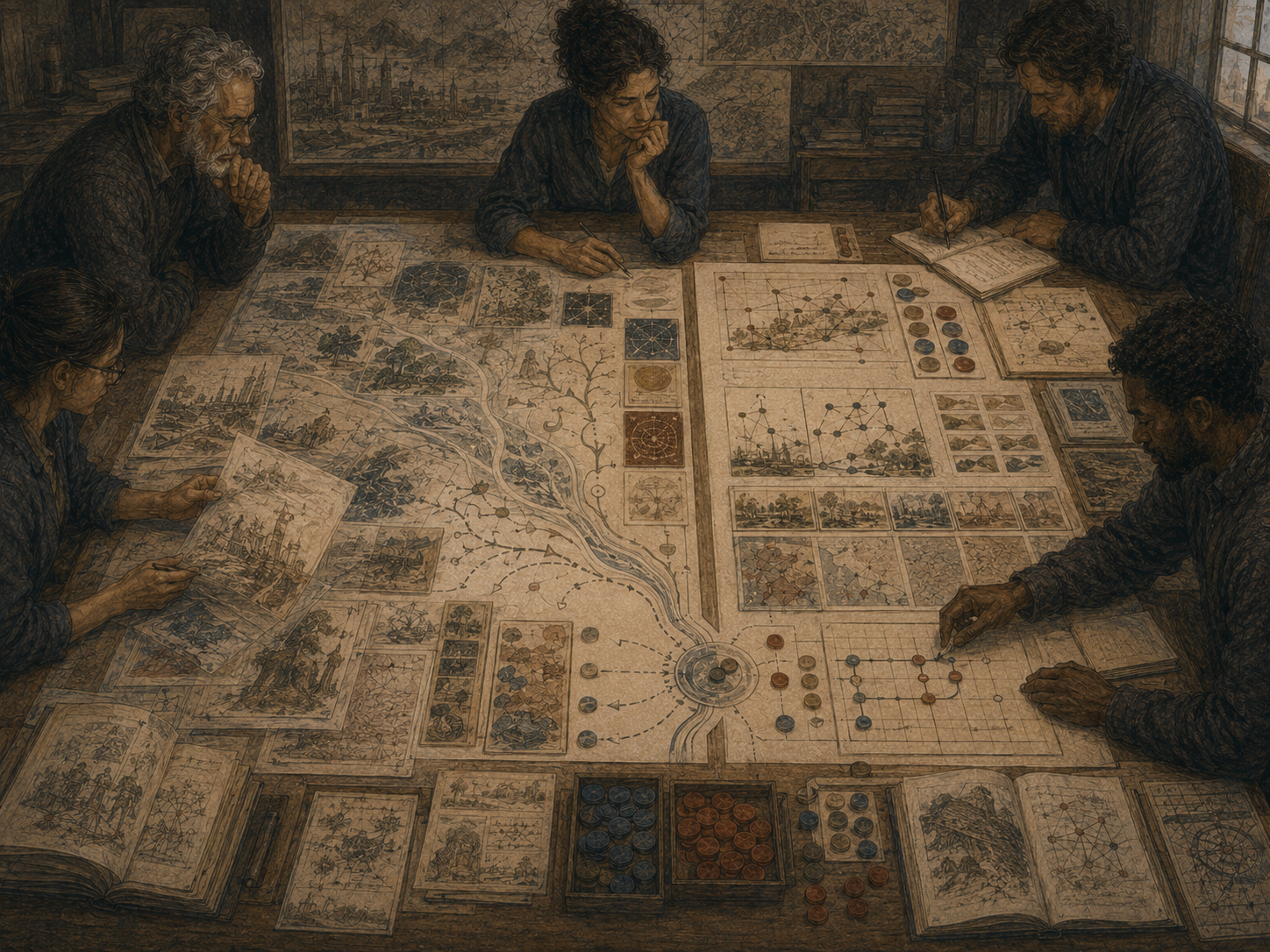
Imagination, discipline, and strategic creativity are the combined capacities that allow individuals and organizations to generate ideas that are not only novel, but also coherent, testable, ethically grounded, structurally aware, and capable of becoming strategy. Imagination opens the field of possibility. Discipline gives that possibility shape. Strategic creativity emerges when these two forces work together rather than compete.
In weak ideation systems, imagination is treated as free association and discipline is treated as restriction. Creative work is imagined as the escape from structure, while disciplined work is imagined as the narrowing of possibility. This opposition is misleading. Serious strategic creativity depends on both. Without imagination, strategy becomes repetition, optimization, and incremental adjustment inside inherited assumptions. Without discipline, imagination becomes scattered, untested, performative, or disconnected from implementation.
Strategic creativity is therefore not the opposite of rigor. It is rigor applied to possibility. It requires the courage to generate ideas beyond familiar categories and the patience to examine whether those ideas actually make sense. It requires divergent exploration, but also conceptual clarity. It requires analogy, reframing, and abductive hypothesis formation, but also evidence, constraint, sequencing, stakeholder judgment, and revision.
This matters because strategic environments are rarely stable enough for routine planning alone. Organizations must imagine alternative futures, new models, different frames, better institutions, stronger systems, and more humane forms of action. Yet they must also avoid the fantasy that every imaginative idea is strategically sound. Mature creativity does not romanticize novelty. It asks what an idea assumes, what it changes, what it risks, who it affects, how it might fail, and what form of disciplined learning could improve it.
This article examines imagination, discipline, and strategic creativity as a core capability in strategic ideation. It explores the relationship between creative freedom and constraint, why mature creativity requires evaluative patience, how imagination generates possibility, how discipline prevents premature convergence and irresponsible novelty, how strategic creativity differs from generic brainstorming, how organizations can build creative systems, and how advanced workflows can help assess whether ideas are imaginative, coherent, testable, and strategically useful.
Main Library
Publications
Article Map
Strategic Ideation
Related Topic
Cognitive Psychology
Related Topic
Design Thinking
Related Topic
Systems Thinking
Why Imagination and Discipline Belong Together
Strategic creativity requires a difficult balance. It must be free enough to question inherited assumptions, but disciplined enough to avoid becoming fantasy. It must generate ideas beyond present constraints, but not ignore constraints so completely that the ideas cannot be tested, communicated, sequenced, or implemented. It must open possibility without confusing possibility with strategy.
This balance is often misunderstood. Some organizations overvalue discipline and suppress imagination. Their strategy work becomes procedural, incremental, and excessively tied to past models. They generate ideas that are realistic because they are familiar, not because they are strategically strong. Other organizations overvalue imagination and underdevelop discipline. Their ideas may be exciting, visionary, or rhetorically compelling, but they remain vague, untested, poorly sequenced, or detached from institutional capacity.
Neither extreme is sufficient. Strategy needs imagination because existing categories often reproduce existing failures. It needs discipline because novelty alone does not produce direction. A new idea may be memorable, emotionally appealing, or rhetorically powerful while still being conceptually weak, ethically careless, or operationally brittle.
The strongest strategic ideation systems therefore treat imagination and discipline as reciprocal capacities. Imagination supplies alternative frames, analogies, hypotheses, futures, and pathways. Discipline tests coherence, assumptions, evidence, stakeholder consequences, system effects, and implementation logic. Imagination asks, “What else could be possible?” Discipline asks, “What would have to be true, and how would we learn?”
This is why mature strategic creativity is not simply brainstorming. It is the disciplined development of ideas that can withstand scrutiny without losing their capacity to change the field of action.
| Creative capacity | What it contributes | Risk when isolated | Strategic correction |
|---|---|---|---|
| Imagination | Expands possibility beyond existing assumptions. | Can become vague, performative, or disconnected from reality. | Connect ideas to mechanisms, evidence, constraints, and action. |
| Discipline | Gives ideas structure, clarity, testability, and coherence. | Can become rigid, risk-averse, or overly procedural. | Use discipline to develop possibility rather than suppress it. |
| Strategic creativity | Combines novelty, relevance, evidence, ethics, and implementation logic. | Can be weakened by either premature convergence or undisciplined novelty. | Build processes that alternate expansion, refinement, testing, and revision. |
Imagination without discipline produces possibility without direction. Discipline without imagination produces direction without renewal.
What Makes Creativity Strategic?
Creativity becomes strategic when it contributes to direction, choice, adaptation, learning, or institutional capacity. Not every creative idea is a strategic idea. A creative idea may be clever, original, beautiful, provocative, or technically impressive without meaningfully changing the organization’s relationship to its environment, stakeholders, constraints, risks, or future possibilities.
Strategic creativity is different because it is relational. It connects novelty to purpose, context, mechanisms, consequences, and action. An idea is strategically creative when it opens a meaningful option space, reframes a problem in a useful way, reveals a hidden assumption, connects domains productively, creates a new pathway, changes stakeholder understanding, improves system leverage, or enables action under uncertainty.
This means strategic creativity has at least three requirements. First, it must introduce difference. It must change how the situation is understood or what options are visible. Second, it must create relevance. The difference must matter for the problem, opportunity, system, or institution. Third, it must support disciplined development. The idea must be capable of clarification, testing, sequencing, critique, or revision.
These requirements distinguish strategic creativity from novelty theater. Organizations often celebrate ideas that appear innovative because they use new language, new technology, new branding, or new formats. But surface novelty can preserve old assumptions. A new platform may reproduce the same service burden. A new strategy may preserve the same incentive logic. A new campaign may repeat the same misunderstanding of stakeholders. A new “innovation” process may simply repackage institutional habits.
Strategic creativity therefore requires depth. It asks whether an idea changes the underlying logic of the situation, not merely its appearance. It evaluates whether the idea has a plausible mechanism, whether it fits the system, whether it clarifies rather than obscures, and whether it can survive contact with evidence and implementation.
| Creative form | Primary feature | Strategic strength | Strategic risk |
|---|---|---|---|
| Surface novelty | New language, format, imagery, or technology. | Can attract attention and refresh engagement. | May hide unchanged assumptions or weak mechanisms. |
| Conceptual creativity | New frame, category, analogy, or interpretation. | Can change how the problem is understood. | May remain abstract if not tied to evidence or action. |
| Mechanism creativity | New way of producing change. | Can improve strategic leverage. | May fail if system constraints are ignored. |
| Institutional creativity | New roles, routines, incentives, governance, or knowledge structures. | Can change capacity and coordination. | May encounter resistance or implementation drift. |
| Adaptive creativity | New learning loops, experiments, and revision pathways. | Can improve strategy under uncertainty. | May be weakened by impatience or poor decision memory. |
Creativity becomes strategic when novelty is connected to purpose, structure, evidence, consequences, and the capacity to act.
Imagination as the Expansion of Possibility
Imagination is the capacity to think beyond what is immediately present, habitual, visible, or institutionally recognized. In strategic ideation, imagination allows teams to generate alternative frames, futures, analogies, mechanisms, interventions, narratives, and pathways. It enables the organization to ask not only what is likely, but what is possible, preferable, neglected, suppressed, or not yet named.
Strategic imagination is especially important because institutions often confuse present constraints with permanent realities. A constraint may be real in the current system, but not inevitable. A category may be useful, but not complete. A market boundary may be visible, but not fixed. A policy mechanism may be inherited, but not necessary. A stakeholder relationship may be damaged, but not beyond repair. Imagination allows strategists to see that the current configuration is only one arrangement among many.
But imagination is not only future-oriented. It also works backward and sideways. It can reconstruct hidden causes, imagine alternative explanations, transfer structures from other domains, simulate stakeholder experience, anticipate second-order effects, and generate hypotheses under incomplete information. In this sense, imagination is closely connected to Analogical Thinking and Idea Transfer, Lateral Thinking in Strategy, and Abductive Reasoning and Strategic Hypotheses.
Imagination expands the search space. It helps teams ask questions like: What if this is not the real problem? What would this look like from the stakeholder’s side? What would a different field do with the same structure? What future condition would make today’s idea obsolete? What assumption are we treating as fixed? What would be possible if we changed the boundary of the system?
These questions matter because strategic failure often begins with a failure of imagination. The organization cannot solve what it cannot imagine, cannot imagine what it cannot frame, and cannot frame what its inherited language prevents it from seeing.
Imagination is the strategic capacity to make alternatives visible before existing systems make them obvious.
Discipline as the Architecture of Creative Judgment
Discipline is often misunderstood as the force that limits creativity. In mature strategic work, discipline is the architecture that allows creativity to become useful. It provides structure, criteria, evidence, sequence, accountability, and revision. It helps imaginative ideas develop rather than evaporate.
Disciplined creativity does not mean rejecting ideas too early. It means giving ideas the conditions under which they can be clarified, strengthened, tested, compared, and improved. A premature critic can kill imagination. But the absence of critique can leave ideas fragile. Strategic discipline must therefore be staged carefully. Early discipline protects the process by clarifying prompts, constraints, participation, and frames. Later discipline tests assumptions, consequences, feasibility, and learning pathways.
Strategic discipline asks several questions. What problem does the idea address? What frame produced it? What mechanism would make it work? What assumptions does it require? What evidence would strengthen or weaken it? Who would be affected? What would implementation demand? What could go wrong? How reversible is the commitment? What would be learned from a small test? How should the idea be revised?
These questions do not destroy creativity. They separate mature creativity from impulsive novelty. They also make imagination more trustworthy. When a team knows that ideas will be tested fairly rather than dismissed reflexively, it can generate more courageously. When discipline is transparent, it supports creativity. When discipline is hidden, punitive, or politically selective, it suppresses it.
This is why strategic creativity requires evaluative patience. Not every early idea should be judged by final feasibility. Some ideas need time to mature, combine with others, be reframed, or reveal their mechanism. Discipline should not be a gate that closes too early. It should be a developmental process that helps ideas become clearer and stronger.
| Disciplinary function | How it supports creativity | How it can harm creativity | Better practice |
|---|---|---|---|
| Clarification | Makes ideas understandable and discussable. | Can force premature simplification. | Clarify without reducing complexity too soon. |
| Constraint | Focuses search and reveals design requirements. | Can be mistaken for a fixed limit. | Distinguish real constraints from inherited assumptions. |
| Evaluation | Tests relevance, coherence, and strategic fit. | Can suppress novelty through early judgment. | Separate early exploration from later evaluation. |
| Evidence | Connects ideas to learning and reality. | Can overvalue what is already measurable. | Use mixed evidence and prototype learning. |
| Sequencing | Turns ideas into implementable pathways. | Can narrow ambition too quickly. | Stage commitment while preserving long-term intent. |
| Revision | Improves ideas through feedback. | Can become endless churn if criteria are unclear. | Define revision triggers and decision memory. |
Discipline is not the enemy of imagination. It is the means by which imagination becomes strategically consequential.
The False Opposition Between Freedom and Constraint
Creative work is often romanticized as liberation from constraint. Strategic creativity is more complicated. Some constraints suppress imagination, but others make creativity more powerful. A blank field can be paralyzing. A well-defined constraint can focus attention, sharpen search, reveal tradeoffs, and force recombination.
This is why Creative Constraints and Innovation is central to strategic ideation. Constraints are not merely limits. They are conditions that shape the search space. Scarcity, regulation, time pressure, stakeholder needs, ethical commitments, technical limits, institutional capacity, ecological boundaries, and public legitimacy all influence what kind of creativity is possible and necessary.
The important distinction is between productive constraints and dead constraints. Productive constraints clarify the work. They help the team ask better questions. They may limit the surface form of an idea while deepening its strategic relevance. Dead constraints, by contrast, are inherited assumptions disguised as realities. They narrow the search without improving the quality of thought.
For example, “we must protect user trust” is a productive constraint. It makes creativity more serious. “We must use the same engagement model because that is how we have always reported performance” may be a dead constraint. It preserves institutional habit at the expense of strategic imagination. “We must design for low-resource implementation” can be productive. “We cannot change the operating model because the template does not allow it” may be dead.
Strategic creativity depends on the ability to interrogate constraints. Which constraints are ethical? Which are physical? Which are financial? Which are technical? Which are political? Which are institutional habits? Which are mental models? Which could be changed? Which must be honored? Which should be used as creative design conditions?
| Constraint type | Strategic role | Creative opportunity | Review question |
|---|---|---|---|
| Ethical constraint | Protects rights, dignity, legitimacy, and responsibility. | Forces better design and accountability. | What must not be sacrificed for novelty? |
| Resource constraint | Defines capacity, time, budget, and attention limits. | Encourages focus, sequencing, and lean testing. | What is the smallest meaningful test? |
| Technical constraint | Defines what current systems can support. | Reveals architecture, integration, and feasibility requirements. | Is the limit technical or organizational? |
| Stakeholder constraint | Reflects needs, burden, trust, and participation. | Improves relevance and legitimacy. | Whose experience should shape the idea? |
| Institutional constraint | Reflects governance, approval, incentives, and routines. | May reveal the need for organizational redesign. | Is this constraint real or inherited? |
| Conceptual constraint | Reflects categories, frames, and assumptions. | Creates opportunities for reframing. | What would change if we renamed the problem? |
Strategic creativity does not escape all constraints. It learns which constraints to honor, which to redesign, and which to expose as assumptions.
Core Dimensions of Strategic Creativity
Strategic creativity can be evaluated through multiple dimensions. These dimensions help prevent creativity from being reduced to novelty alone. A strategically creative idea should be imaginative, relevant, coherent, testable, ethically aware, and capable of development.
1. Novelty
Novelty refers to the degree to which an idea differs from existing assumptions, models, practices, categories, or routines. Strategic novelty does not require total originality. It may involve recombination, transfer, reframing, inversion, or a new mechanism applied to a familiar problem. The key question is whether the idea changes what can be seen or done.
2. Strategic Relevance
An idea must matter for the strategic situation. It should connect to a real problem, opportunity, system, stakeholder need, future risk, institutional constraint, or implementation pathway. Novel ideas with low relevance may be interesting but not strategic.
3. Conceptual Coherence
Coherence means the idea has internal logic. Its claims, assumptions, mechanism, and intended outcomes fit together. A coherent idea can be explained without flattening complexity. It does not rely on vague aspiration or contradictory premises.
4. Mechanism Clarity
A strategic idea should state how it is expected to work. Does it change incentives, reduce friction, build trust, alter information flows, create new capacity, shift behavior, change a feedback loop, or open a new option space? Without a mechanism, creativity remains rhetorical.
5. Testability
Strategic creativity becomes stronger when ideas can be explored through evidence. Testability does not mean every idea must be proven immediately. It means the idea can generate learning through prototypes, interviews, pilots, simulations, scenarios, or operational experiments.
6. Stakeholder Grounding
Strategic ideas affect people. Stakeholder grounding ensures that creativity does not remain inside the imagination of decision-makers alone. It asks how the idea appears from the perspective of those who experience the problem, bear the burden, implement the change, or live with the consequences.
7. Systems Fit
An idea must be tested against the system in which it will operate. Systems fit asks whether the idea accounts for feedback loops, incentives, dependencies, delays, second-order effects, and boundary conditions. A creative idea that ignores system structure may become fragile or harmful.
8. Developmental Potential
Some ideas are weak in their first form but strong in potential. Developmental potential asks whether an idea can be refined, combined, tested, sequenced, or reframed into something better. Mature creativity requires patience with early forms without romanticizing them.
| Dimension | Strategic question | Weak signal | Strong signal |
|---|---|---|---|
| Novelty | Does this idea change what is visible or possible? | New language around old assumptions. | Meaningful reframing, transfer, or mechanism change. |
| Relevance | Does it matter for the strategic problem? | Interesting but disconnected idea. | Clear connection to problem, opportunity, or system. |
| Coherence | Does the idea hold together conceptually? | Contradictory claims or vague aspirations. | Clear logic and explainable structure. |
| Mechanism | How would it work? | No causal or operational pathway. | Clear change mechanism. |
| Testability | Can we learn whether it has promise? | No evidence pathway. | Prototype, pilot, simulation, interview, or metric plan. |
| Stakeholder grounding | Whose experience shapes it? | Designed from internal assumptions only. | Informed by affected users, communities, or implementers. |
| Systems fit | Will it survive the system it enters? | Ignores feedback and dependencies. | Accounts for incentives, delays, and second-order effects. |
| Developmental potential | Can the idea mature? | Either dismissed too early or protected too long. | Clear path for refinement and revision. |
Strategic creativity is not a single trait. It is a structured relationship among novelty, relevance, coherence, mechanism, evidence, stakeholders, systems, and development.
The Strategic Creative Process
Strategic creativity benefits from a staged process that protects imagination early, introduces discipline at the right moments, and preserves learning across cycles. The process below is not a rigid formula. It is a disciplined pattern for moving from possibility to strategic judgment without collapsing into either chaos or premature convergence.
1. Orient the Field
Clarify the strategic situation without prematurely defining the solution. Identify the problem, opportunity, uncertainty, stakeholder context, system boundary, constraints, and purpose of ideation. Orientation creates a shared starting point while leaving room for reframing.
2. Expand the Possibility Space
Generate ideas through multiple frames, analogies, futures, stakeholder perspectives, first principles, systems maps, and lateral prompts. The goal is not volume alone. It is diversity of pathways, mechanisms, assumptions, and source domains.
3. Clarify Concepts
Turn vague ideas into clearer propositions. State what the idea is, what problem it addresses, what mechanism it uses, what assumptions it makes, and what change it seeks to produce. Clarification is the first discipline of creative development.
4. Challenge Assumptions
Ask what must be true for the idea to work. Identify inherited assumptions, hidden constraints, stakeholder effects, evidence gaps, and system risks. This stage prevents attractive ideas from becoming protected narratives.
5. Test and Prototype
Use low-risk experiments, interviews, prototypes, simulations, scenario reviews, or implementation probes to learn whether the idea has promise. Testing should be designed to produce learning, not simply validation.
6. Refine and Recombine
Ideas often improve through recombination. A weak idea may contain a strong mechanism. A discarded idea may become useful in another frame. A prototype failure may reveal a better hypothesis. Refinement turns creative fragments into stronger strategic options.
7. Select and Sequence
Strategic creativity eventually requires choice. Ideas must be prioritized, sequenced, resourced, and connected to roles, incentives, communication, and implementation pathways. Selection should be based on strategic value, not merely novelty or political comfort.
8. Preserve Learning
Record what was tried, rejected, deferred, revised, and learned. Decision memory prevents organizations from repeatedly rediscovering the same ideas or losing valuable alternatives when conditions change.
| Process stage | Primary creative task | Primary disciplinary task | Useful artifact |
|---|---|---|---|
| Orient | Open the field of inquiry. | Clarify purpose and boundaries. | Strategic situation brief. |
| Expand | Generate diverse possibilities. | Use multiple prompts and source domains. | Idea-space map. |
| Clarify | Develop promising ideas. | State concepts, mechanisms, and assumptions. | Concept brief. |
| Challenge | Improve ideas through critique. | Review assumptions, risks, and stakeholders. | Assumption map. |
| Test | Learn from contact with reality. | Design evidence pathways. | Prototype or pilot plan. |
| Refine | Revise and recombine ideas. | Compare evidence and update hypotheses. | Revision log. |
| Select | Choose strategic options. | Prioritize, sequence, and resource. | Option portfolio. |
| Learn | Preserve creative memory. | Archive decisions and reopen triggers. | Decision-memory record. |
Strategic creativity is not a moment of inspiration. It is a learning process that moves ideas through expansion, clarification, challenge, testing, refinement, selection, and memory.
Constraints, Scarcity, and Creative Focus
Scarcity often improves creative focus because it forces prioritization. Limited resources, limited time, limited attention, regulatory limits, technical constraints, and stakeholder requirements can sharpen creativity by making vague ambition impossible. A team with infinite resources can produce sprawling ideas. A team with meaningful constraints must discover what matters most.
This does not mean scarcity is always good. Severe scarcity can produce exhaustion, risk aversion, short-termism, and weak learning. But realistic constraints can help strategic teams define the creative problem more sharply. The question becomes not simply “What could we do?” but “What is the most meaningful change we can test with the capacity we have?”
Constraints also reveal strategic priorities. If an idea cannot survive basic constraints, the team must decide whether the idea should be abandoned, redesigned, sequenced differently, or used to challenge the constraint itself. Some ideas fail because they are poorly conceived. Others fail because the institutional system cannot yet support them. Strategic creativity requires knowing the difference.
For example, a participatory strategy process may appear too time-consuming under current planning cycles. The disciplined question is not only whether the idea is feasible inside the cycle. It is whether the cycle itself is part of the strategic problem. A low-resource prototype may appear too modest to matter. But if it generates high-quality learning, it may be more strategically creative than a polished initiative that teaches little.
Constraints therefore should be used as design material. They should not automatically shrink ambition. They should help teams ask where ambition should be concentrated, staged, tested, protected, or translated into implementation logic.
Creative discipline treats constraints not only as limits, but as information about what strategy must learn, redesign, or sequence.
Evaluative Patience and the Maturity of Ideas
One of the most important disciplines in strategic creativity is evaluative patience. Many ideas are not born fully formed. Early ideas are often partial, awkward, overbroad, impractical, or poorly named. They may contain a strong insight inside a weak proposal. They may need another frame, another stakeholder perspective, another analogy, or another test before their value becomes clear.
Premature evaluation can destroy creative potential. When ideas are judged too early by final-stage feasibility criteria, teams learn to offer only safe ideas. They avoid ambiguity, uncertainty, and conceptual risk. The organization becomes efficient at selecting from a narrow idea pool and weak at imagining alternatives.
But patience does not mean protecting every idea indefinitely. Mature creativity requires timing. Early stages should protect generative exploration. Middle stages should clarify and develop ideas. Later stages should evaluate rigorously. The mistake is not evaluation itself. The mistake is applying the wrong form of evaluation at the wrong stage.
A useful early-stage question is not “Will this work?” but “What might be valuable inside this?” A useful middle-stage question is “What would have to be true for this to work?” A useful later-stage question is “What evidence justifies commitment?” These questions allow discipline to mature with the idea.
| Idea stage | Primary need | Useful question | Evaluation risk |
|---|---|---|---|
| Emergent idea | Protection and exploration. | What possibility is this pointing toward? | Killing novelty through premature feasibility critique. |
| Clarified concept | Structure and definition. | What is the idea, mechanism, and assumption set? | Allowing vagueness to persist too long. |
| Developed hypothesis | Evidence and testability. | What would strengthen or weaken it? | Testing only for confirmation. |
| Strategic option | Prioritization and sequencing. | What commitment is justified? | Choosing based on novelty, politics, or comfort. |
| Implemented pathway | Learning and adaptation. | What is happening, and what must change? | Defending the original idea against evidence. |
Evaluative patience means giving ideas enough time to become clear before judging them, and enough discipline to become useful before committing to them.
Organizational Conditions for Strategic Creativity
Strategic creativity is not only an individual trait. It is shaped by organizational conditions. Teams generate better ideas when the environment supports inquiry, dissent, psychological safety, stakeholder engagement, cross-domain learning, disciplined experimentation, and decision memory. They generate weaker ideas when incentives reward conformity, speed without reflection, polished certainty, authority alignment, or novelty theater.
Organizations often claim to value creativity while designing systems that suppress it. If only fully formed ideas are acceptable, early-stage imagination is punished. If dissent is risky, assumptions remain unchallenged. If leadership anchors the session too early, divergent thinking collapses. If metrics reward only short-term outputs, strategic creativity becomes incremental. If failed experiments are treated as embarrassment, learning disappears. If rejected ideas are not documented, institutional memory is lost.
Strong creative organizations design conditions that allow ideas to develop responsibly. They separate generation from evaluation. They use multiple frames. They invite affected stakeholders early. They protect constructive dissent. They preserve abandoned alternatives. They reward learning from prototypes. They examine institutional constraints rather than treating them as neutral. They build knowledge systems that allow ideas to mature across time.
This connects strategic creativity to Content Frameworks in Strategic Ideation, Knowledge Architecture in Strategic Ideation, and Learning Loops in Strategic Execution. Creativity becomes more powerful when the organization can store, retrieve, compare, revise, and recombine ideas rather than repeatedly starting over.
| Organizational condition | Effect on creativity | Failure pattern when absent | Useful practice |
|---|---|---|---|
| Psychological safety | Allows uncertain, dissenting, and early-stage ideas to surface. | People offer safe, familiar ideas. | Independent generation and protected challenge. |
| Frame diversity | Expands how problems and opportunities are understood. | All ideas cluster around one interpretation. | Frame rotation and source-domain mapping. |
| Stakeholder grounding | Improves relevance, legitimacy, and lived accuracy. | Ideas reflect internal assumptions. | Participatory inquiry and burden mapping. |
| Experimentation capacity | Turns ideas into learning rather than speculation. | Ideas are debated abstractly or overcommitted. | Prototype, pilot, and evidence-pathway design. |
| Decision memory | Preserves rejected, deferred, and revised ideas. | Organizations forget why choices were made. | Idea archives and reopen triggers. |
| Leadership restraint | Prevents authority from anchoring ideation too early. | Teams generate ideas around leadership preference. | Silent start, anonymous input, and delayed executive judgment. |
Strategic creativity is not produced by slogans about innovation. It is produced by systems that protect imagination, discipline judgment, and preserve learning.
Strategic Creativity in Systems and Uncertainty
Strategic creativity becomes more difficult and more important in complex systems. In simple environments, an idea can be evaluated mainly by direct cause and effect. In complex systems, ideas interact with feedback loops, incentives, stakeholder behavior, institutional memory, technical dependencies, and changing conditions. A creative idea may produce unexpected consequences because the system adapts around it.
This means strategic creativity must be systems-aware. An idea should not only be judged by its internal appeal. It should be examined in relation to the system it enters. What feedback loop does it alter? What incentives does it create? What behavior might it unintentionally reward? What stakeholder adaptation could occur? What delays could hide consequences? What boundaries determine whether the idea appears successful?
Systems-aware creativity often shifts the focus from solutions to leverage. The most imaginative idea may not be the most visible intervention. It may be a change in information flow, governance, incentives, definitions, feedback, narrative, capacity, or institutional memory. A flashy new initiative may matter less than a quiet redesign of how decisions are made. A new program may matter less than changing the assumptions that define what counts as success.
Uncertainty also changes creative discipline. When the future is unclear, ideas should be evaluated not only by present feasibility but by robustness, adaptability, option value, and learning potential. A strategy may need multiple creative hypotheses, staged commitments, and feedback loops rather than a single grand solution. This connects strategic creativity to Scenario Planning and Futures Thinking, Strategic Foresight and Long-Term Thinking, and Option Value and Strategic Flexibility.
| System condition | Creative risk | Disciplined creative response |
|---|---|---|
| Feedback loops | An intervention may reinforce the problem. | Map feedback before selecting ideas. |
| Delayed effects | Early success may hide later harm. | Define short-term and long-term indicators. |
| Stakeholder adaptation | People may respond in unexpected ways. | Prototype with affected groups and monitor behavior. |
| Boundary ambiguity | The idea may solve a local problem while shifting burden elsewhere. | Compare narrow and expanded system boundaries. |
| Uncertain futures | A creative idea may fit only one future. | Test across scenarios and preserve strategic flexibility. |
| Institutional inertia | The system may absorb the idea without changing. | Link creative ideas to governance, incentives, and roles. |
In complex systems, strategic creativity must imagine not only new ideas, but the system behavior those ideas may trigger.
Common Failure Modes
Strategic creativity fails in recognizable ways. Some failures come from too little imagination. Others come from too little discipline. Many come from confusing novelty, confidence, or institutional enthusiasm with strategic value.
1. Novelty Theater
The organization celebrates new language, tools, formats, or branding while leaving the underlying logic unchanged. The idea appears innovative but does not alter the mechanism, system, stakeholder experience, or strategic pathway.
2. Premature Convergence
The team selects an idea too early because it is familiar, easy to explain, politically safe, or already aligned with leadership expectations. The idea space closes before stronger alternatives have been generated.
3. Undisciplined Imagination
Ideas remain vague, expansive, and inspirational but lack mechanism, evidence, stakeholder grounding, or implementation logic. The organization confuses imagination with strategic readiness.
4. Overdiscipline
The process applies feasibility, measurement, or risk criteria too early. Novel ideas are rejected before they can be clarified, reframed, or developed. The organization becomes efficient at selecting familiar options.
5. Frame Imprisonment
All creativity occurs inside the same inherited problem frame. The team generates many ideas, but all assume the same category, boundary, mechanism, or institutional logic.
6. Stakeholder Blindness
The idea is creative from the institution’s perspective but burdensome, irrelevant, illegible, or harmful from the perspective of those affected by it. Internal imagination substitutes for lived understanding.
7. No Learning Loop
The organization generates ideas but does not preserve what was tested, rejected, deferred, or revised. Creativity becomes episodic rather than cumulative.
| Failure mode | Symptom | Strategic consequence | Corrective practice |
|---|---|---|---|
| Novelty theater | New surface form, old logic. | Appearance of innovation without strategic change. | Test mechanism, system effect, and stakeholder value. |
| Premature convergence | Early selection of a comfortable idea. | Better alternatives never appear. | Separate divergence from selection. |
| Undisciplined imagination | Ideas are exciting but vague. | Weak translation into strategy or action. | Clarify mechanism, assumptions, and evidence pathway. |
| Overdiscipline | Feasibility critique arrives too early. | Novelty is suppressed before development. | Use stage-appropriate evaluation. |
| Frame imprisonment | Many ideas share one frame. | The problem remains partially understood. | Rotate frames and source domains. |
| Stakeholder blindness | Internal creativity ignores affected experience. | Low legitimacy, poor adoption, hidden burden. | Use participatory inquiry and burden analysis. |
| No learning loop | Ideas disappear after workshops. | Creative memory is lost. | Build decision memory and reopen triggers. |
Strategic creativity fails when novelty is not disciplined, or discipline is used to prevent novelty from developing.
A Practical Audit for Strategic Creativity
A strategic creativity audit helps teams determine whether an idea or idea process has the right balance of imagination and discipline. It can be used after workshops, during portfolio review, before prototype selection, or when an organization repeatedly produces familiar ideas despite claiming to seek innovation.
1. Test the Depth of Novelty
Ask whether the idea changes the underlying frame, mechanism, pathway, stakeholder relationship, or system logic. If only the language or format is new, the idea may be surface novelty rather than strategic creativity.
2. Identify the Frame
Name the problem frame that produced the idea. Then generate at least two alternative frames. If the idea only works inside one narrow frame, the team should examine whether the frame is limiting the creative field.
3. State the Mechanism
Explain how the idea is expected to produce change. Does it alter incentives, trust, access, information, capacity, behavior, governance, or feedback? Ideas without mechanisms require further development.
4. Map Assumptions
List what must be true for the idea to work. Separate assumptions about users, systems, evidence, institutions, technology, incentives, resources, and future conditions.
5. Review Stakeholder Grounding
Ask whose experience shaped the idea and whose burden may be hidden. Creative ideas should be examined from the perspective of affected stakeholders, implementers, and those who may bear risk.
6. Define the Evidence Pathway
Identify what could be learned through prototype, interview, simulation, pilot, scenario, or operational test. The evidence pathway should include both supporting and weakening evidence.
7. Test Systems Fit
Ask how the idea interacts with feedback loops, incentives, dependencies, delays, boundaries, and second-order effects. Creativity that ignores the system may produce unintended consequences.
8. Preserve Creative Memory
Record ideas that are selected, rejected, deferred, combined, or revised. Include why decisions were made and what evidence would justify reopening an idea later.
| Audit step | Core question | Useful output |
|---|---|---|
| Depth of novelty | What is actually new? | Novelty-depth note. |
| Frame identification | Which problem frame generated the idea? | Frame comparison table. |
| Mechanism statement | How would the idea work? | Mechanism map. |
| Assumption mapping | What must be true? | Assumption register. |
| Stakeholder review | Who shaped the idea and who bears consequences? | Stakeholder visibility map. |
| Evidence pathway | How could we learn whether it has promise? | Prototype or pilot plan. |
| Systems fit | What feedback or second-order effects matter? | Systems review. |
| Creative memory | What should be preserved for future learning? | Decision-memory record. |
A strategic creativity audit helps organizations distinguish meaningful imagination from surface novelty and useful discipline from premature rejection.
Mathematical Lens: Novelty, Fit, and Strategic Usefulness
Strategic creativity can be represented as a relationship between novelty, relevance, coherence, testability, stakeholder grounding, systems fit, and risk:
C_s = \alpha N + \beta R + \gamma K + \delta T + \epsilon S – \lambda F
\]
Interpretation: Strategic creativity \(C_s\) depends on novelty \(N\), relevance \(R\), coherence \(K\), testability \(T\), stakeholder and systems grounding \(S\), and failure risk \(F\). The weights vary by context, but the equation captures the central point: novelty alone is not strategic creativity.
Idea maturity can be represented as a staged development process:
I_{t+1} = r(I_t, E_t, C_t, S_t)
\]
Interpretation: The idea at the next stage \(I_{t+1}\) is a revision of the current idea \(I_t\) based on evidence \(E_t\), constraints \(C_t\), and stakeholder or system feedback \(S_t\). Strategic creativity improves through disciplined revision.
Premature convergence can be represented as a closure threshold that is reached too early:
P_c = f(A, F_m, S_p, T_p)
\]
Interpretation: Premature convergence \(P_c\) increases with anchoring \(A\), familiarity \(F_m\), social or political pressure \(S_p\), and time pressure \(T_p\). When closure pressure is high, teams may select ideas before sufficient exploration has occurred.
Developmental potential can be represented as:
D_p = g(M, E, R_v, X)
\]
Interpretation: Developmental potential \(D_p\) depends on mechanism clarity \(M\), evidence pathway \(E\), revision capacity \(R_v\), and recombination potential \(X\). Some ideas are not immediately strong, but have high potential if developed through the right process.
The mathematical lens shows why strategic creativity should not be measured by novelty alone. A useful creative idea must become coherent, testable, grounded, revisable, and strategically consequential.
Advanced R Workflow: Comparing Strategic Creativity Profiles
The R workflow below compares stylized ideas across novelty, relevance, conceptual coherence, mechanism clarity, testability, stakeholder grounding, systems fit, developmental potential, and implementation risk. It is designed as an evergreen illustration of how strategic creativity can be assessed without reducing creativity to novelty alone.
# Install packages if needed.
# install.packages(c("tidyverse"))

library(tidyverse)

# ------------------------------------------------------------
# R Workflow: Comparing Strategic Creativity Profiles
# Purpose:
#   Score ideas across novelty, relevance, coherence,
#   mechanism clarity, testability, stakeholder grounding,
#   systems fit, developmental potential, and risk.
# ------------------------------------------------------------

ideas <- tibble(
  idea = c(
    "New campaign around an old service model",
    "Stakeholder-burden redesign concept",
    "Cross-domain analogy from public health",
    "AI-assisted personalization feature",
    "Governance redesign for implementation learning"
  ),
  novelty = c(0.42, 0.72, 0.84, 0.66, 0.76),
  strategic_relevance = c(0.54, 0.86, 0.78, 0.68, 0.88),
  conceptual_coherence = c(0.58, 0.78, 0.70, 0.62, 0.82),
  mechanism_clarity = c(0.38, 0.80, 0.72, 0.56, 0.84),
  testability = c(0.72, 0.70, 0.62, 0.78, 0.66),
  stakeholder_grounding = c(0.34, 0.92, 0.66, 0.48, 0.70),
  systems_fit = c(0.36, 0.78, 0.74, 0.52, 0.90),
  developmental_potential = c(0.46, 0.82, 0.84, 0.68, 0.86),
  implementation_risk = c(0.34, 0.56, 0.60, 0.58, 0.66)
)

ideas <- ideas %>%
  mutate(
    strategic_creativity_score =
      0.14 * novelty +
      0.16 * strategic_relevance +
      0.13 * conceptual_coherence +
      0.14 * mechanism_clarity +
      0.11 * testability +
      0.13 * stakeholder_grounding +
      0.13 * systems_fit +
      0.12 * developmental_potential -
      0.10 * implementation_risk,
    diagnosis = case_when(
      novelty >= 0.70 & mechanism_clarity < 0.55 ~ "undisciplined_novelty_risk",
      stakeholder_grounding < 0.45 ~ "stakeholder_grounding_gap",
      systems_fit < 0.50 ~ "systems_fit_gap",
      strategic_creativity_score >= 0.68 ~ "strong_strategic_creativity_candidate",
      strategic_creativity_score >= 0.55 ~ "develop_with_testing",
      TRUE ~ "revise_or_reframe"
    )
  )

print(ideas)

ideas_long <- ideas %>%
  pivot_longer(
    cols = c(
      novelty,
      strategic_relevance,
      conceptual_coherence,
      mechanism_clarity,
      testability,
      stakeholder_grounding,
      systems_fit,
      developmental_potential,
      implementation_risk
    ),
    names_to = "dimension",
    values_to = "score"
  )

ggplot(ideas_long, aes(x = dimension, y = score, fill = idea)) +
  geom_col(position = "dodge") +
  coord_flip() +
  labs(
    title = "Strategic Creativity Profile by Idea",
    x = "Dimension",
    y = "Score",
    fill = "Idea"
  ) +
  theme_minimal(base_size = 12)

ggplot(ideas, aes(x = reorder(idea, strategic_creativity_score), y = strategic_creativity_score)) +
  geom_col() +
  coord_flip() +
  labs(
    title = "Strategic Creativity Scores",
    x = "Idea",
    y = "Score"
  ) +
  theme_minimal(base_size = 12)

write_csv(ideas, "strategic_creativity_scores.csv")
This workflow can be extended with real ideation data, stakeholder research, prototype results, evidence strength, systems mapping, and decision-memory records. Its purpose is not to mechanize creativity, but to make creative judgment more transparent and strategically useful.
Advanced Python Workflow: Simulating Idea Maturation
The Python workflow below simulates how ideas mature over time as they receive clarification, evidence, stakeholder feedback, systems review, and revision. It illustrates a central principle: some ideas become strategically stronger through disciplined development rather than immediate selection or rejection.
# Install packages if needed:
# pip install pandas numpy matplotlib

import numpy as np
import pandas as pd
import matplotlib.pyplot as plt

# ------------------------------------------------------------
# Python Workflow: Simulating Strategic Idea Maturation
# Purpose:
#   Model how ideas mature through clarification, evidence,
#   stakeholder feedback, systems review, and revision.
# ------------------------------------------------------------

np.random.seed(42)

ideas = {
    "surface_novelty_campaign": {
        "novelty": 0.42,
        "coherence": 0.58,
        "mechanism": 0.38,
        "evidence": 0.50,
        "stakeholders": 0.34,
        "systems": 0.36,
        "revision_capacity": 0.44
    },
    "stakeholder_burden_redesign": {
        "novelty": 0.72,
        "coherence": 0.78,
        "mechanism": 0.80,
        "evidence": 0.62,
        "stakeholders": 0.92,
        "systems": 0.78,
        "revision_capacity": 0.82
    },
    "cross_domain_public_health_analogy": {
        "novelty": 0.84,
        "coherence": 0.70,
        "mechanism": 0.72,
        "evidence": 0.54,
        "stakeholders": 0.66,
        "systems": 0.74,
        "revision_capacity": 0.84
    },
    "governance_learning_redesign": {
        "novelty": 0.76,
        "coherence": 0.82,
        "mechanism": 0.84,
        "evidence": 0.60,
        "stakeholders": 0.70,
        "systems": 0.90,
        "revision_capacity": 0.86
    }
}

def creativity_score(profile):
    return (
        0.14 * profile["novelty"] +
        0.14 * profile["coherence"] +
        0.15 * profile["mechanism"] +
        0.13 * profile["evidence"] +
        0.14 * profile["stakeholders"] +
        0.15 * profile["systems"] +
        0.15 * profile["revision_capacity"]
    )

history = []

for idea_name, profile in ideas.items():
    current = profile.copy()

    for stage in range(1, 9):
        # Disciplined development improves non-novelty dimensions.
        learning_gain = 0.02 + 0.04 * current["revision_capacity"]

        current["coherence"] = min(1.0, current["coherence"] + learning_gain * 0.8)
        current["mechanism"] = min(1.0, current["mechanism"] + learning_gain * 0.9)
        current["evidence"] = min(1.0, current["evidence"] + learning_gain * 0.7)
        current["stakeholders"] = min(1.0, current["stakeholders"] + learning_gain * 0.6)
        current["systems"] = min(1.0, current["systems"] + learning_gain * 0.7)

        # Novelty may decline slightly as ideas become clearer,
        # but mature novelty remains useful if the idea gains structure.
        current["novelty"] = max(0.0, current["novelty"] - 0.005)

        history.append({
            "idea": idea_name,
            "stage": stage,
            "strategic_creativity_score": creativity_score(current),
            "novelty": current["novelty"],
            "coherence": current["coherence"],
            "mechanism": current["mechanism"],
            "evidence": current["evidence"],
            "stakeholders": current["stakeholders"],
            "systems": current["systems"]
        })

df = pd.DataFrame(history)

print(df.head())

plt.figure(figsize=(10, 6))

for idea_name in df["idea"].unique():
    subset = df[df["idea"] == idea_name]
    plt.plot(
        subset["stage"],
        subset["strategic_creativity_score"],
        marker="o",
        label=idea_name
    )

plt.xlabel("Development Stage")
plt.ylabel("Strategic Creativity Score")
plt.title("Strategic Idea Maturation Through Disciplined Development")
plt.legend()
plt.tight_layout()
plt.show()

df.to_csv("strategic_idea_maturation.csv", index=False)
This simulation can be developed into a more serious workflow by using real idea portfolios, workshop logs, prototype evidence, stakeholder interviews, systems-review results, and revision records. The central point is that strategic creativity should be managed as a developmental process rather than a one-time selection event.
GitHub Repository
The companion repository for this article will provide advanced strategist-facing workflows for evaluating strategic creativity, comparing idea profiles, diagnosing novelty theater, assessing stakeholder grounding, testing systems fit, modeling idea maturation, mapping assumptions, designing evidence pathways, and preserving creative decision memory.
Complete Code Repository
The companion code includes Python, R, Julia, SQL, Rust, Go, C++, Fortran, C, documentation, synthetic datasets, outputs, and notebook placeholders for applied strategic creativity and disciplined ideation workflows.
The repository structure is designed to support professional strategic analysis rather than generic coding demonstrations. The python/ folder can model strategic creativity scores, idea maturation, novelty-depth review, mechanism clarity, stakeholder grounding, systems fit, evidence pathways, and revision capacity. The r/ folder can compare creativity profiles, visualize idea maturity, and flag novelty-theater or stakeholder-blindness risks. The julia/ folder can support scenario-based sensitivity analysis for creative options under different strategic conditions. The sql/ folder can define schemas for ideas, frames, constraints, assumptions, stakeholders, evidence, prototypes, revisions, portfolios, and decision memory.
Additional folders can support command-line diagnostics, lower-level scoring utilities, and reproducible documentation. The rust/ folder can provide a command-line strategic creativity diagnostics scaffold. The go/ folder can provide an idea-profile comparison utility. The cpp, fortran, and c folders can provide efficient scoring examples and low-level utilities. The docs, data, outputs, and notebooks folders can support article notes, modeling principles, synthetic datasets, generated outputs, and notebook placeholders.
This code should be understood as a transparent learning and modeling scaffold. It is intended for synthetic-data research, methods demonstration, institutional learning, strategic analysis, and reproducible workflow development. It is not a substitute for stakeholder engagement, ethical review, domain expertise, accountable governance, or participatory judgment.
Conclusion
Imagination, discipline, and strategic creativity belong together. Imagination expands the field of possibility. Discipline helps that possibility become coherent, testable, ethical, and actionable. Strategic creativity emerges when these capacities are held in productive tension rather than forced into opposition.
The mature creative organization does not treat creativity as spontaneous magic or as decorative novelty. It designs systems that make imagination possible, protect early ideas long enough to develop, challenge assumptions without crushing exploration, involve stakeholders before ideas harden, test ideas through evidence, and preserve learning across cycles.
This is especially important in strategic environments defined by uncertainty, complexity, institutional constraint, and long-term consequence. In such environments, familiar ideas may be too weak and undisciplined novelty may be too dangerous. The strongest ideas are not always the loudest, newest, or easiest to explain. They are the ideas that reframe the situation meaningfully, state a plausible mechanism, account for stakeholders and systems, generate evidence, survive revision, and open better pathways for action.
Strategic creativity is therefore a discipline of responsible possibility. It asks organizations to imagine more courageously and judge more patiently. It asks them to build conditions in which ideas can move from fragments to hypotheses, from hypotheses to prototypes, from prototypes to strategy, and from strategy to learning.
Strategic ideation becomes stronger when imagination is not left undisciplined, and discipline is not allowed to become the enemy of imagination.
Related Articles
- Strategic Ideation
- Abductive Reasoning and Strategic Hypotheses
- Heuristics in Strategic Ideation
- Cognitive Bias in Idea Generation
- Divergent vs Convergent Thinking
- Creative Constraints and Innovation
- Analogical Thinking and Idea Transfer
- Lateral Thinking in Strategy
- First Principles Thinking in Strategy
- Systems Thinking in Ideation
- Prototype Evidence and Strategic Learning
Further Reading
- Amabile, T.M. (1996) Creativity in Context: Update to The Social Psychology of Creativity. Boulder, CO: Westview Press.
- Boden, M.A. (2004) The Creative Mind: Myths and Mechanisms. 2nd edn. London: Routledge.
- Brown, T. (2009) Change by Design: How Design Thinking Creates New Alternatives for Business and Society. New York: HarperBusiness.
- Csikszentmihalyi, M. (1996) Creativity: Flow and the Psychology of Discovery and Invention. New York: HarperCollins.
- Dorst, K. (2015) Frame Innovation: Create New Thinking by Design. Cambridge, MA: MIT Press.
- Runco, M.A. (2014) Creativity: Theories and Themes: Research, Development, and Practice. 2nd edn. San Diego: Academic Press.
- Schön, D.A. (1983) The Reflective Practitioner: How Professionals Think in Action. New York: Basic Books.
- Simon, H.A. (1996) The Sciences of the Artificial. 3rd edn. Cambridge, MA: MIT Press. Available at: https://mitpress.mit.edu/9780262690232/the-sciences-of-the-artificial/
- Sternberg, R.J. and Lubart, T.I. (1995) Defying the Crowd: Cultivating Creativity in a Culture of Conformity. New York: Free Press.
- Ward, T.B., Smith, S.M. and Finke, R.A. (1999) Creative Cognition. Cambridge, MA: MIT Press.
References
- Amabile, T.M. (1983) The Social Psychology of Creativity. New York: Springer.
- Amabile, T.M. (1996) Creativity in Context: Update to The Social Psychology of Creativity. Boulder, CO: Westview Press.
- Boden, M.A. (2004) The Creative Mind: Myths and Mechanisms. 2nd edn. London: Routledge.
- Brown, T. (2009) Change by Design: How Design Thinking Creates New Alternatives for Business and Society. New York: HarperBusiness.
- Csikszentmihalyi, M. (1996) Creativity: Flow and the Psychology of Discovery and Invention. New York: HarperCollins.
- Dorst, K. (2015) Frame Innovation: Create New Thinking by Design. Cambridge, MA: MIT Press.
- Rhodes, M. (1961) ‘An analysis of creativity’, Phi Delta Kappan, 42(7), pp. 305–310.
- Runco, M.A. (2014) Creativity: Theories and Themes: Research, Development, and Practice. 2nd edn. San Diego: Academic Press.
- Schön, D.A. (1983) The Reflective Practitioner: How Professionals Think in Action. New York: Basic Books.
- Simon, H.A. (1996) The Sciences of the Artificial. 3rd edn. Cambridge, MA: MIT Press. Available at: https://mitpress.mit.edu/9780262690232/the-sciences-of-the-artificial/
- Sternberg, R.J. and Lubart, T.I. (1995) Defying the Crowd: Cultivating Creativity in a Culture of Conformity. New York: Free Press.
- Ward, T.B., Smith, S.M. and Finke, R.A. (1999) Creative Cognition. Cambridge, MA: MIT Press.