Problem Solving

Problem solving refers to the cognitive and strategic processes used to identify challenges, analyze underlying causes, and develop effective solutions. In complex environments, problem solving requires more than analytical reasoning; it involves integrating creative thinking, structured analysis, and systems-level understanding.

Traditional models of problem solving emphasized linear processes such as defining the problem, generating alternatives, and selecting optimal solutions. Contemporary research recognizes that many real-world problems are complex, dynamic, and interconnected, requiring iterative approaches that incorporate experimentation, feedback, and adaptive learning.

Modern problem-solving frameworks often draw from multiple disciplines, including cognitive psychology, systems thinking, design research, and decision science. These approaches help individuals and organizations understand how problems emerge within broader systems and how interventions may produce both intended and unintended consequences.

Effective problem solving is central to innovation, policy development, and strategic planning. In rapidly changing environments, organizations increasingly rely on interdisciplinary problem-solving methods that combine analytical rigor with creative exploration.

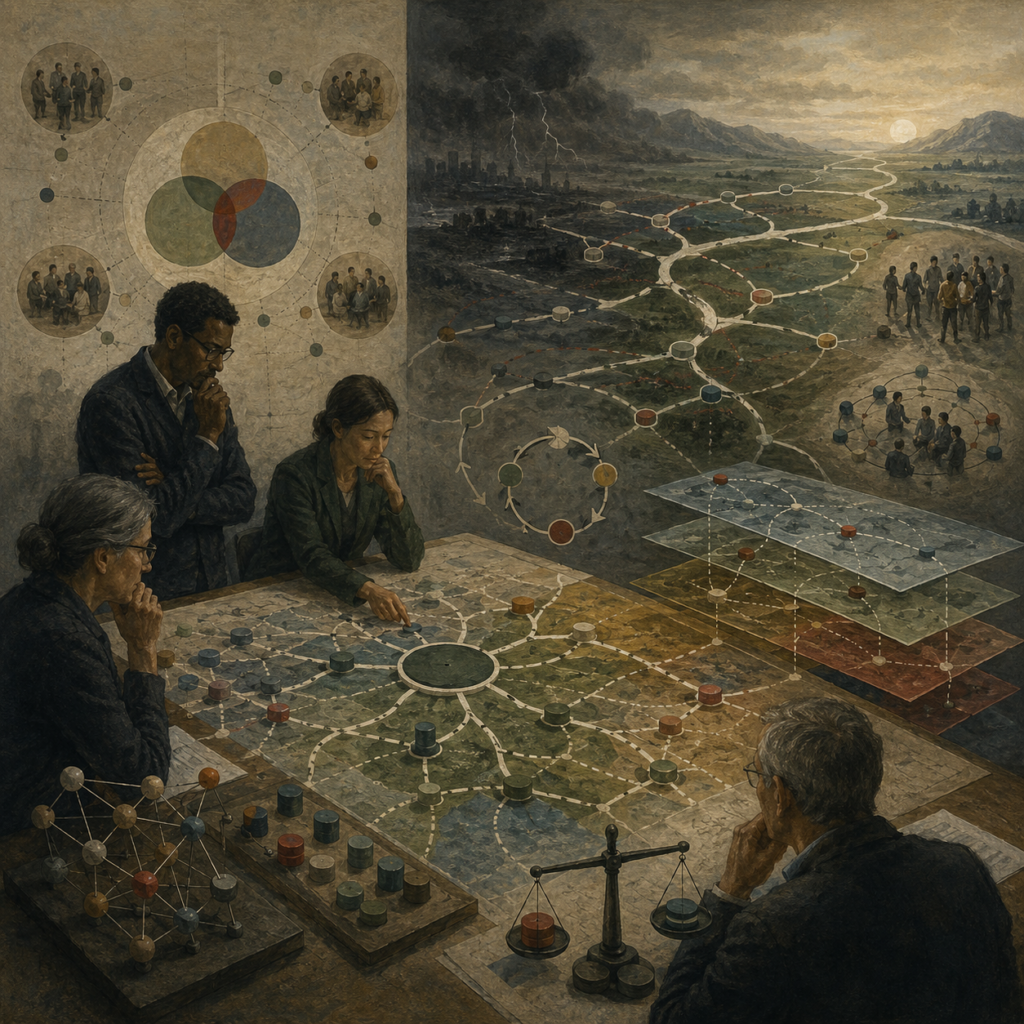
Strategists organize layered maps, diagrams, concept clusters, comparison matrices, and structured frameworks on a large planning table.

Conceptual Clarity in Strategic Work: Why Vague Ideas Weaken Strategy

Conceptual clarity in strategic work is the discipline of defining the ideas that guide decisions before they become plans, metrics, roles, budgets, narratives, or institutional commitments. Strategy depends on concepts such as value, growth, resilience, innovation, alignment, transformation, legitimacy, impact, sustainability, and success. When these concepts remain vague, teams may appear aligned while acting from different assumptions. Weak definitions create false consensus, brittle execution, poor measurement, and strategic drift. This article examines why conceptual clarity is not cosmetic language work, but strategic infrastructure. It shows how clear definitions, boundaries, distinctions, operational implications, metric-validity reviews, and revision rules help organizations move from shared vocabulary to shared understanding. Conceptual clarity does not flatten complexity. It makes complexity usable by ensuring that the concepts guiding strategy are strong enough to support judgment, action, and accountability.


Editorial scientific illustration of differential equations for systems modeling as a dynamic-systems architecture, showing trajectory pathways, coupled feedback loops, equilibrium basins, stability fields, oscillation patterns, diffusion structures, ecological interaction, climate feedback, infrastructure stress, epidemiological pathways, public-policy systems, and responsible model interpretation.

Differential Equations for Systems Modeling: Dynamics, Stability, R, and Python

Differential Equations for Systems Modeling examines how relationships of change can be formally represented when the behavior of a system depends on rates of change, feedback, interaction, forcing, and time-dependent adjustment across economics, infrastructure, ecology, climate, engineering, epidemiology, governance, and public policy. Moving from first-order and higher-order equations to coupled systems, stability analysis, phase behavior, nonlinearity, diffusion, and numerical methods, this pillar treats differential equations as both a formal mathematical language and a practical modeling framework. It also connects differential equations to computational implementation in R and Python, showing how dynamic systems can be solved, simulated, visualized, and interpreted in applied settings.

Editorial scientific illustration of statistics for systems modeling as an evidence-and-uncertainty architecture, showing data fields, measurement systems, sampling pathways, distribution clouds, uncertainty bands, regression surfaces, model diagnostics, resampling loops, forecasting structures, ecological monitoring, infrastructure sensors, climate data streams, public-policy evaluation, and responsible statistical interpretation.

Statistics for Systems Modeling: Inference, Evidence, Forecasting, R, and Python

Statistics for Systems Modeling examines how data, measurement, variation, uncertainty, and inference support the study of complex systems. This article explains statistics as a modeling language for evidence rather than a set of isolated formulas, connecting descriptive statistics, sampling, estimation, confidence intervals, hypothesis testing, regression, model diagnostics, causal inference, bias, missing data, resampling, simulation, time series, forecasting, prediction error, and responsible interpretation. It also shows why statistical reasoning matters for ecology, climate, infrastructure, epidemiology, economics, public policy, governance, and scientific computing. By combining formal statistical concepts with R and Python workflows, the article frames statistics as a disciplined way to reason from imperfect observations toward credible, transparent, and revisable claims about real-world systems.

Editorial illustration of storytelling as a narrative systems architecture, showing oral tradition, myth, ritual, folklore, public narrative, memory, character arcs, motifs, symbolic pathways, collective transmission, media adaptation, and the architecture of meaning over time.

Storytelling: Narrative Form, Mythic Structure, and Human Meaning

Storytelling is one of the oldest ways humans organize meaning, transmit knowledge, build trust, and make complexity understandable. This article map introduces the Storytelling series as a structured guide to narrative theory, communication strategy, audience understanding, ethics, memory, persuasion, identity, and public meaning-making. It connects foundational concepts with practical methods for shaping stories across institutions, education, research, leadership, media, advocacy, and digital platforms. The map treats storytelling not as decoration, entertainment, or branding alone, but as a disciplined way of arranging events, values, evidence, conflict, and consequence into coherent understanding. It also emphasizes responsibility: stories can clarify reality, but they can also distort, manipulate, exclude, or oversimplify. Across the series, storytelling is examined as a powerful framework for explanation, strategy, learning, cultural interpretation, and ethical communication in complex public contexts.

Editorial scientific illustration of mathematical modeling as a formal representation systems architecture, showing abstraction, assumptions, variables, parameters, constraints, simulation, calibration, validation, sensitivity analysis, uncertainty, robustness, scientific computing, systems modeling, decision support, infrastructure, sustainability, AI systems, and responsible model governance.

Mathematical Modeling: Abstraction, Uncertainty, and the Structure of Reality

Mathematical modeling translates real-world systems into formal structures that can be analyzed, simulated, tested, and revised. This article explains modeling as a disciplined practice of abstraction, assumption-making, variable selection, mathematical formulation, calibration, validation, sensitivity analysis, uncertainty assessment, and interpretation. It shows why models are not reality itself, but purposeful representations that help clarify mechanisms, compare scenarios, expose trade-offs, and support judgment under incomplete knowledge. The article also connects mathematical modeling to systems modeling, decision science, scientific computing, engineering, public policy, sustainability, infrastructure, public health, ecology, artificial intelligence, and reproducible research workflows, emphasizing both the power and limits of formal representation.

Painterly editorial illustration of organizational strategy decision-making with leaders studying strategic pathways, stakeholder groups, layered systems maps, tradeoff scales, and uncertain future conditions.

Decision Science in Organizational Strategy: Strategy, Uncertainty, and Institutional Judgment

Decision Science in Organizational Strategy examines how firms make consequential choices when uncertainty, competition, capability, cognition, time, and institutional constraint interact. The article argues that strategy is best understood not as planning or positioning alone, but as organized judgment under conditions where information is incomplete, assumptions are contestable, and adaptation matters as much as commitment. It develops this through strategy as an architecture of choice, the foundations of bounded rationality and dynamic capabilities, different forms of uncertainty, the limits of static competitive analysis, behavioral distortion, systems effects, governance, and the role of data and AI as decision support rather than substitutes for judgment. The article emphasizes that stronger organizational strategy depends not on eliminating uncertainty, but on building decision processes that remain coherent, revisable, and institutionally aligned in its presence.

Painterly editorial illustration of financial risk management with analysts studying systemic risk networks, storm scenarios, balance structures, fragile institutions, uncertainty layers, and protective safeguards.

Decision Science in Financial Risk Management: Risk, Models, and Institutional Judgment

Decision Science in Financial Risk Management examines how banks, insurers, asset managers, treasury functions, and regulators make high-stakes choices when capital, liquidity, solvency, regulation, behavior, and systemic interdependence interact at once. It argues that financial risk management is not simply a technical exercise in volatility measurement or model calibration, but a problem of structured institutional judgment: deciding which exposures to hold, which uncertainties to tolerate, which models to trust, and how to preserve resilience when the future remains only partly knowable. The article develops this argument through portfolio theory, derivatives pricing, behavioral finance, stress testing, model risk, governance, AI oversight, and climate and geopolitical risk. It concludes that stronger risk management depends less on the illusion of perfect measurement than on building architectures of judgment that remain robust when models are fragile, incentives are distorted, and shocks spread through the wider financial system.

Painterly editorial illustration of healthcare decision-making with clinicians and analysts studying care pathways, patient needs, public health risks, evidence, resource tradeoffs, and health system networks.

Decision Science in Healthcare: Better Decisions for Patients, Systems, and Care

Decision Science in Healthcare examines how analytical frameworks, probabilistic reasoning, behavioral insight, systems thinking, and ethical deliberation shape decisions across clinical care, hospital operations, and public health policy. It argues that healthcare is one of the most demanding domains for decision science because choices must be made under uncertainty, constrained resources, institutional complexity, and direct consequences for human well-being. The article develops this through Bayesian updating in clinical judgment, cost-effectiveness and QALY-based evaluation, systems modeling, behavioral distortion, shared decision-making, public policy, and ethical trade-offs. It emphasizes that better healthcare decisions depend not on isolated optimization alone, but on building architectures of choice that remain clinically credible, ethically justified, operationally workable, and responsive to patient values under real conditions of uncertainty.

Painterly editorial illustration of decision science in sustainability with ecosystems, energy systems, cities, industry, public institutions, community groups, tradeoff scales, and interconnected decision networks.

Decision Science in Sustainability: Evidence, Trade-Offs, and Long-Term Responsibility

Decision Science in Sustainability examines how analytical frameworks, systems thinking, behavioral insight, and ethical reasoning shape decisions that affect environmental, social, and economic systems over long time horizons. The article argues that sustainability is one of the most demanding domains for decision science because choices must be made under deep uncertainty, interdependence, stakeholder conflict, and competing objectives that cannot be reduced to a single metric. It develops this through trade-offs and multi-criteria evaluation, systems dynamics, robust and adaptive planning, resilience, behavioral and ethical dimensions, policy design, and sustainability-specific mathematical and computational workflows. The article emphasizes that stronger sustainability decisions depend not on narrow short-term optimization, but on building transparent, adaptive, and long-horizon architectures of choice that remain resilient, equitable, and systemically aware under real conditions of uncertainty.

Scroll to Top