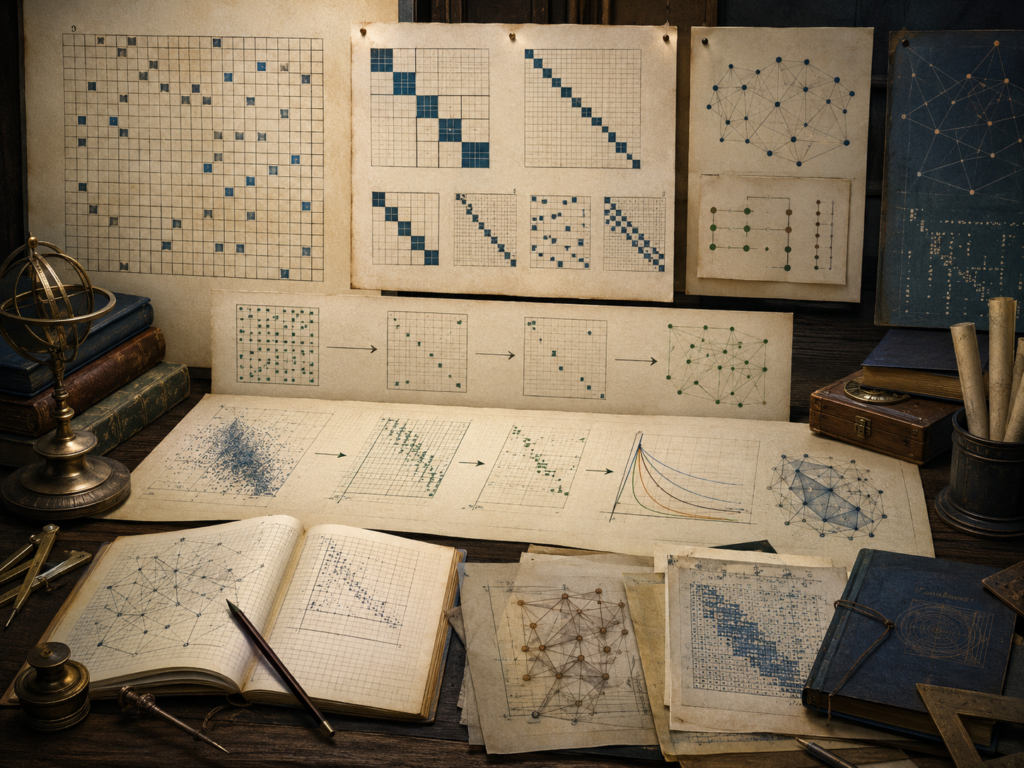
Representation Choices and Model Assumptions: How Linear Algebra Defines What Systems Models Can See
Representation choices and model assumptions explain how linear algebra models decide what counts as structure before computation begins. This article introduces matrix construction, row and column meaning, feature design, coordinate systems, basis choices, units, scale, comparability, zero meaning, missingness, aggregation, discretization, categorical encoding, network representation, state definitions, assumption registers, representation sensitivity, and responsible interpretation. It shows how infrastructure networks, economic input-output models, machine learning feature matrices, climate and energy models, public health systems, and knowledge retrieval workflows depend on choices about what is included, excluded, measured, transformed, normalized, encoded, and compared. The article emphasizes that matrices are not neutral containers: they are modeling objects shaped by assumptions, boundaries, units, categories, measurement limits, interpretive purposes, evidence standards, validation needs, governance context, uncertainty, scale decisions, system boundaries, and responsible modeling judgment across complex systems analysis and public-interest computational workflows and decisions.