
Last Updated May 28, 2026
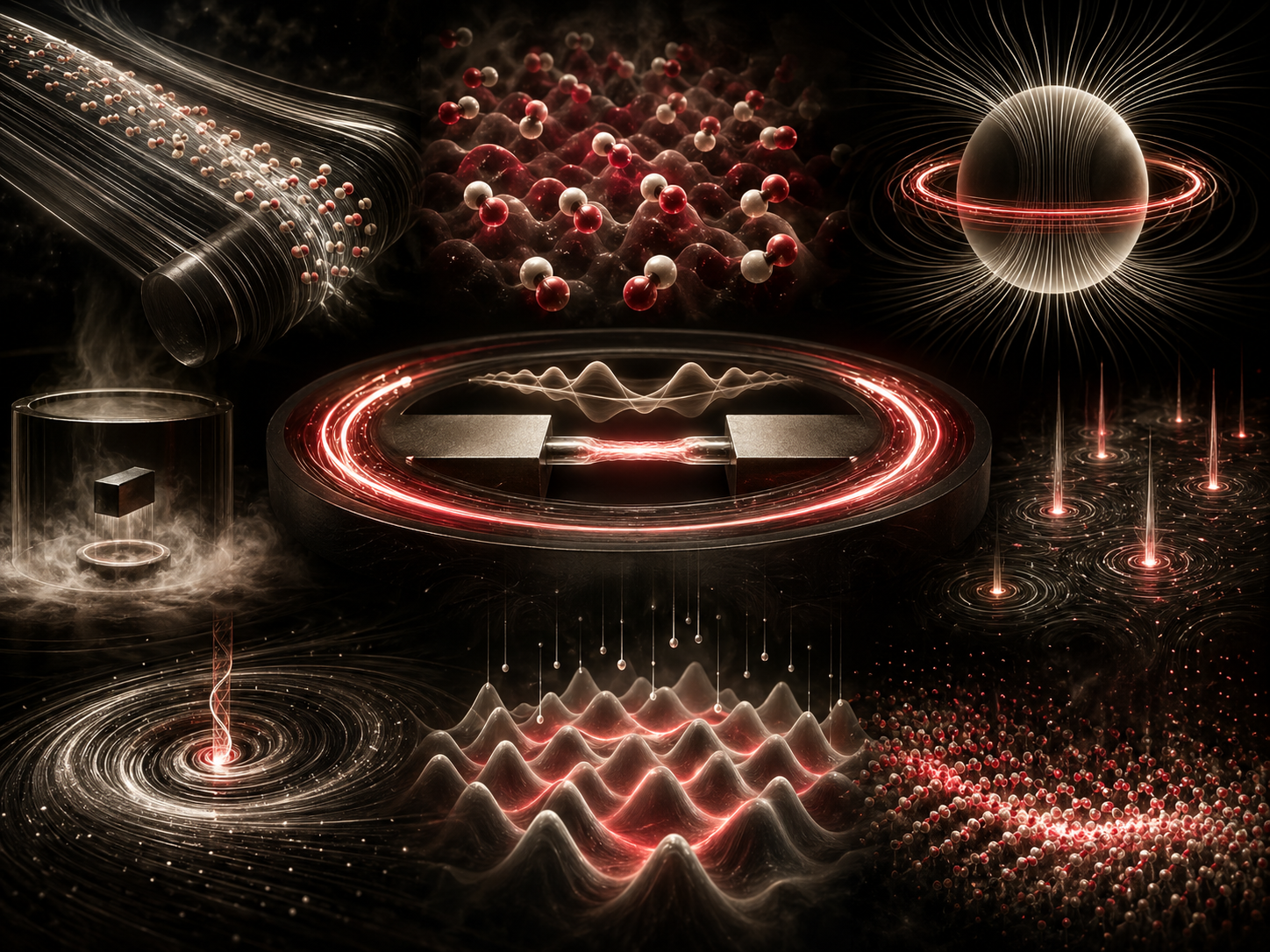
Superconductivity and superfluidity are macroscopic quantum states in which quantum coherence becomes visible at the scale of matter itself. In a superconductor, electrical resistance vanishes, magnetic fields are expelled, magnetic flux becomes quantized, and currents can persist without ordinary dissipation. In a superfluid, liquid flow can occur without ordinary viscosity, circulation becomes quantized, vortices become topological objects, and phase coherence organizes motion across macroscopic distances. These phenomena are not merely low-temperature curiosities. They reveal how many interacting particles can form a single collective quantum state.
The shared language of superconductivity and superfluidity is macroscopic quantum order. Both are described by an order parameter with an amplitude and a phase. Both involve long-range phase coherence. Both show quantized circulation or flux because the condensate wavefunction must remain single-valued. Both are governed by broken continuous symmetry, collective modes, phase stiffness, topological defects, and the distinction between microscopic particles and emergent coherent matter. Superconductors are charged condensates; superfluids are neutral condensates. That difference changes their electromagnetic behavior, but the deeper order-parameter logic is shared.
This article develops Superconductivity, Superfluidity, and Macroscopic Quantum Order as a research-grade article within the Physics knowledge series. It explains macroscopic wavefunctions, broken \(U(1)\) symmetry, phase coherence, Cooper pairing, BCS theory, Ginzburg–Landau theory, London equations, Meissner effect, penetration depth, coherence length, type-I and type-II superconductivity, Abrikosov vortices, flux quantization, Josephson effects, SQUIDs, Bose–Einstein condensation, helium-4 superfluidity, helium-3 pairing, Landau’s criterion, quantized circulation, superfluid vortices, two-fluid behavior, phase stiffness, topological defects, unconventional superconductivity, quantum fluids, superconducting devices, and computational modeling of order parameters. Selected R and Python workflows appear in the article body, while the companion GitHub repository contains expanded computational resources for Ginzburg–Landau free energy, superconducting order-parameter profiles, Josephson dynamics, flux quantization, superfluid vortices, BCS gap approximations, SQL provenance tables, C/C++/Fortran/Rust examples, and reproducible macroscopic-quantum-order workflows.
Main Library
Publications
Article Map
Physics
Related Topic
Mathematics
Related Topic
Data Systems & Analytics
Related Topic
Astronomy
Why Macroscopic Quantum Order Matters
Macroscopic quantum order matters because it shows that quantum mechanics is not confined to atoms, photons, or microscopic particles. Under the right conditions, an enormous number of particles can organize into a collective state described by a coherent phase. This turns quantum theory into a material phenomenon: persistent currents, quantized vortices, flux quantization, phase interference, tunneling between condensates, superfluid flow, superconducting circuits, and precision quantum standards all become measurable at laboratory scales.
Superconductivity and superfluidity also matter because they reveal the limits of single-particle thinking. A superconductor is not merely a metal with fewer collisions. A superfluid is not merely a liquid with lower viscosity. Both are many-body quantum phases. Their distinctive behavior emerges from collective organization, not from isolated particles acting independently.
The deeper point is that matter can acquire a phase. This phase is not just a mathematical label. Its gradients produce flow. Its winding produces quantization. Its stiffness produces collective rigidity. Its coupling to gauge fields produces electromagnetic screening. Its defects become vortices. Its difference across a weak link becomes a measurable current. This is one of the clearest examples of an abstract quantum degree of freedom becoming an experimentally accessible physical variable.
For the Physics knowledge series, this article belongs near Many-Body Physics and Emergent Collective Behavior, Phase Transitions, Critical Phenomena, and the Renormalization Group, Quantum Field Theory I: Fields, Particles, and Second Quantization, Semiconductor Physics and Electronic Materials, Group Theory and Representation Theory in Physics, Path Integrals and the Functional Formulation of Physics, and Computational Physics and Scientific Simulation. It is one of the clearest examples of emergent order becoming physically measurable.
Superconductivity and Superfluidity as Quantum Phases
Superconductivity and superfluidity are phases of matter. They are not just behaviors that occur inside ordinary phases. A superconducting material undergoes a transition below a critical temperature \(T_c\), and its electromagnetic, thermodynamic, and quantum properties change. A superfluid likewise forms below a transition temperature, where ordinary hydrodynamic behavior is replaced by quantum-coherent flow.
The transition is associated with an order parameter. In the simplest cases, the order parameter is a complex scalar field:
\Psi(\mathbf{r}) = |\Psi(\mathbf{r})|e^{i\theta(\mathbf{r})}
\]
Interpretation: A complex order parameter has an amplitude and phase.
The amplitude \( |\Psi| \) measures the strength of the condensate or coherent order, while the phase \( \theta \) controls supercurrents, superfluid velocity, interference, tunneling, vortex winding, and quantization conditions.
In a superconductor, the condensate consists of charged Cooper pairs. In a superfluid helium-4 system or dilute Bose–Einstein condensate, the condensate involves bosonic atoms. In helium-3, fermionic atoms pair into bosonic composite objects, producing a richer anisotropic superfluid order parameter. The microscopic constituents differ, but the emergence of a coherent order parameter is the common structural principle.
The phrase “macroscopic quantum” should be taken literally. The order parameter is not a wavefunction for one particle. It is a collective field that describes the coherent many-body state. Its phase can be manipulated, measured, and coupled to devices. That is why superconducting and superfluid systems are both fundamental laboratories for many-body quantum physics and practical platforms for quantum technology.
Order Parameters and Broken \(U(1)\) Symmetry
The complex order parameter has a phase. Above the transition temperature, there is no preferred phase. Below the transition temperature, the system selects a coherent phase. This is described as spontaneous breaking of a continuous \(U(1)\) symmetry associated with particle-number phase rotations.
A global phase transformation has the form:
\Psi \rightarrow e^{i\alpha}\Psi
\]
Interpretation: A global \(U(1)\) phase rotation changes the condensate phase by a constant amount.
The microscopic equations may remain symmetric under this transformation, but the ordered state chooses a particular phase. This is the central symmetry-breaking structure shared by superconductors and superfluids.
The phrase “broken symmetry” must be interpreted carefully. The underlying laws retain the symmetry. The state does not. This is why one can have a symmetric Hamiltonian but an ordered phase with a preferred phase, magnetization direction, crystal orientation, or condensate configuration.
In neutral superfluids, broken \(U(1)\) symmetry leads to a gapless phase mode associated with sound-like collective excitation. In charged superconductors, electromagnetic coupling changes the story: the would-be phase mode is tied to the gauge field, giving rise to the Meissner effect and massive electromagnetic response inside the material.
This distinction shows why superconductivity and superfluidity are similar but not identical. Both have phase coherence. Both involve a complex order parameter. But the charged nature of the superconducting condensate couples the order parameter to electromagnetism, while the neutral superfluid condensate couples most directly to hydrodynamic motion, rotation, and boundary conditions.
Phase Coherence and Rigidity
Phase coherence means that the order parameter phase is meaningfully related across macroscopic distances. Phase rigidity means the system resists spatial variation in the phase. A simple phase-stiffness energy has the form:
F_{\theta}
=
\frac{\rho_s}{2}
\int d^3x\,|\nabla\theta|^2
\]
Interpretation: Phase stiffness penalizes spatial variation in the condensate phase.
where \(\rho_s\) is a stiffness parameter. If the phase varies in space, the system pays energy. This is why phase gradients are physically important. In a neutral superfluid, a phase gradient produces superfluid velocity:
\mathbf{v}_s
=
\frac{\hbar}{m}\nabla\theta
\]
Interpretation: Superfluid velocity is proportional to the gradient of the condensate phase.
For paired particles of mass \(2m\), the mass in the denominator changes accordingly. In a superconductor, the phase gradient couples to the electromagnetic vector potential, and the gauge-invariant combination becomes:
\nabla\theta
–
\frac{q}{\hbar}\mathbf{A}
\]
Interpretation: Gauge-invariant phase gradients combine condensate phase and electromagnetic vector potential.
where \(q=2e\) for Cooper pairs. This coupling is the mathematical bridge between phase coherence and electromagnetic phenomena such as persistent current, flux quantization, and the Meissner effect.
Phase rigidity also explains why vortices are costly but possible. A vortex forces the phase to wind around a core, creating a large gradient energy outside the core. The system can accommodate this only by suppressing the order-parameter amplitude near the vortex center. Thus a vortex is both a phase defect and an amplitude defect: the phase winds, and the coherent order weakens where the phase would otherwise become singular.
Gauge Symmetry and the Charged Condensate
Superconductivity requires special care because the condensate is charged. A charged order parameter does not merely have a global phase; it couples to electromagnetic gauge fields. The physically meaningful phase gradient is not \(\nabla\theta\) alone, but the gauge-invariant combination involving the vector potential.
For a charged condensate, the covariant derivative in Ginzburg–Landau theory is:
-i\hbar\nabla-q\mathbf{A}
\]
Interpretation: The covariant derivative combines quantum phase gradients with electromagnetic vector potential.
This structure means that electromagnetic fields and condensate phase are not independent. The superconductor can lower its free energy by generating screening currents that expel magnetic field from its bulk. In field-theoretic language, the electromagnetic field acquires an effective mass inside the superconductor, producing a finite penetration depth. This is closely related to the Anderson–Higgs mechanism in condensed matter form.
The gauge perspective clarifies a common confusion. A superconductor does not simply “choose an absolute phase” in a directly observable way. Absolute phase is gauge-dependent. Observable quantities involve phase differences, gauge-invariant gradients, flux, current, interference, and tunneling. Josephson junctions are so important because they make phase difference physically measurable.
Thus, superconductivity is not only a phase of low resistance. It is a charged coherent quantum state whose phase, gauge field, and electromagnetic response are locked together.
Superconductivity: Zero Resistance and the Meissner Effect
Superconductivity is often introduced through zero electrical resistance. A superconducting current can persist without ordinary Ohmic dissipation. But zero resistance alone is not the full definition of superconductivity. The Meissner effect is equally fundamental: a superconductor expels magnetic field from its interior under appropriate conditions.
The Meissner effect distinguishes a superconductor from a merely perfect conductor. A perfect conductor would preserve whatever magnetic field configuration existed when resistance vanished. A superconductor actively reorganizes its electromagnetic state so that magnetic fields are expelled from the bulk, except over a characteristic penetration depth or in vortex states for type-II materials.
The magnetic field in a simple superconducting half-space decays approximately as:
B(x)=B_0e^{-x/\lambda_L}
\]
Interpretation: Magnetic fields decay exponentially into a superconductor over the London penetration depth.
where \(\lambda_L\) is the London penetration depth. This exponential screening is one of the most direct signatures of the charged condensate’s electromagnetic rigidity.
The Meissner effect also shows that superconductivity is an equilibrium thermodynamic phase, not merely a transport anomaly. The superconducting state selects a magnetic configuration that minimizes its free energy. Zero resistance describes how current flows; the Meissner effect describes what electromagnetic state the material chooses.
Real superconductors complicate this ideal picture. Geometry, surface barriers, impurities, temperature, critical fields, vortex pinning, and sample history can affect observed magnetic behavior. But the basic principle remains: superconductivity is characterized by coherent charged order with magnetic-field expulsion or quantized flux penetration, not simply by high conductivity.
Cooper Pairs and BCS Theory
BCS theory explains conventional superconductivity through Cooper pairing. Near the Fermi surface, an effective attractive interaction can bind electrons into pairs. In conventional superconductors, the attraction is often mediated by lattice vibrations, or phonons. The paired electrons form a coherent condensate.
A schematic BCS ground state is:
|\mathrm{BCS}\rangle
=
\prod_{\mathbf{k}}
\left(
u_{\mathbf{k}}
+
v_{\mathbf{k}}
c_{\mathbf{k}\uparrow}^{\dagger}
c_{-\mathbf{k}\downarrow}^{\dagger}
\right)
|0\rangle
\]
Interpretation: The BCS state is a coherent superposition of paired and unpaired momentum states.
This expression says that the superconducting state is a coherent superposition of pair occupancy across momentum states. It is not a state in which one can assign each pair to a simple classical orbit. The condensate is collective, phase-coherent, and many-body in character.
BCS theory also explains why an arbitrarily weak attractive interaction can destabilize the normal Fermi surface at sufficiently low temperature. The Fermi surface is special because many low-energy states are available for pairing. Pairs form from time-reversed momentum states near the Fermi surface, producing a coherent state with a well-defined phase and an excitation gap.
The Cooper pair is therefore not merely a small molecule inside a metal. In many conventional superconductors, the pair size can be much larger than the lattice spacing, and many pairs strongly overlap. The superconducting condensate is not a gas of independent pairs; it is a coherent many-body state built from correlated fermions.
Energy Gap and Quasiparticles
BCS theory predicts an excitation energy gap. A common quasiparticle dispersion is:
E_{\mathbf{k}}
=
\sqrt{
\xi_{\mathbf{k}}^2+\Delta^2
}
\]
Interpretation: The superconducting quasiparticle spectrum has an energy gap \(\Delta\).
where \(\xi_{\mathbf{k}}\) is the single-particle energy relative to the Fermi level and \(\Delta\) is the superconducting gap. The gap reflects the energy required to break the coherent paired state and create quasiparticle excitations.
The energy gap is central to dissipationless behavior. If low-energy excitations are unavailable, ordinary scattering processes are suppressed. At finite temperature, thermal quasiparticles can appear, reducing superfluid density, modifying penetration depth, and producing dissipation under some conditions.
The gap is also experimentally visible. Tunneling spectroscopy, microwave response, heat capacity, optical conductivity, angle-resolved spectroscopy, and other probes can reveal gap magnitude and symmetry. In conventional \(s\)-wave superconductors, the gap is often isotropic. In unconventional superconductors, the gap may have nodes, sign changes, or multiple components.
This matters because gap structure is a clue to pairing mechanism. A nodal or sign-changing gap may indicate unconventional pairing mediated by electronic correlations, spin fluctuations, or more complex interactions rather than simple phonon-mediated attraction.
Ginzburg–Landau Theory
Ginzburg–Landau theory describes superconductivity through a complex order parameter and a free-energy functional. Near the transition temperature, a standard form is:
F
=
\int d^3x
\left[
\alpha |\Psi|^2
+
\frac{\beta}{2}|\Psi|^4
+
\frac{1}{2m^*}
\left|
\left(
-i\hbar\nabla-q\mathbf{A}
\right)\Psi
\right|^2
+
\frac{|\mathbf{B}|^2}{2\mu_0}
\right]
\]
Interpretation: Ginzburg–Landau free energy combines order-parameter amplitude, gradients, gauge coupling, and magnetic-field energy.
Here \(m^*\) and \(q\) are the effective mass and charge of the condensate carrier, often \(2m_e\) and \(2e\) for Cooper pairs. The coefficient \(\alpha\) changes sign at the transition. A common approximation is:
\alpha(T)=\alpha_0(T-T_c)
\]
Interpretation: The quadratic coefficient changes sign at the critical temperature.
For \(T<T_c\), \(\alpha<0\), and the free energy is minimized by a nonzero order-parameter amplitude:
|\Psi_0|^2
=
-\frac{\alpha}{\beta}
\]
Interpretation: Below \(T_c\), the equilibrium condensate amplitude becomes nonzero.
Ginzburg–Landau theory is phenomenological, but it is enormously powerful. It explains order-parameter variation, coherence length, penetration depth, type-I and type-II behavior, vortex states, critical fields, and the interface between normal and superconducting regions.
The theory is especially useful because it is spatial. BCS theory explains pairing microscopically, but Ginzburg–Landau theory describes how the order parameter varies near surfaces, defects, vortices, junctions, and normal-superconducting boundaries. It is therefore a bridge between microscopic superconductivity and real material geometry.
London Equations and Penetration Depth
The London equations provide a macroscopic description of superconducting electrodynamics. In simplified form, they imply that magnetic fields are screened inside a superconductor. One London relation connects supercurrent density to vector potential:
\mathbf{J}_s
=
-\frac{n_sq^2}{m^*}\mathbf{A}
\]
Interpretation: In a suitable gauge, supercurrent is proportional to the electromagnetic vector potential.
Combining this with Maxwell’s equations leads to:
\nabla^2\mathbf{B}
=
\frac{1}{\lambda_L^2}\mathbf{B}
\]
Interpretation: The London equation gives exponential magnetic-field screening.
where:
\lambda_L
=
\sqrt{
\frac{m^*}{\mu_0 n_s q^2}
}
\]
Interpretation: The London penetration depth depends on carrier mass, condensate density, charge, and magnetic permeability.
The London penetration depth \(\lambda_L\) measures how far magnetic fields penetrate into a superconductor. A smaller penetration depth corresponds to stronger electromagnetic screening.
The London model does not explain pairing microscopically, but it captures a key macroscopic consequence of superconducting order: electromagnetic response is collective, coherent, and nondissipative.
Penetration depth is also a diagnostic. Its temperature dependence can reveal information about quasiparticle excitations and gap structure. A fully gapped superconductor and a nodal superconductor can show different low-temperature penetration-depth behavior. Thus even a macroscopic electromagnetic length scale can carry information about microscopic pairing symmetry.
Coherence Length and Type-II Superconductivity
The superconducting coherence length \(\xi\) measures the characteristic length over which the order parameter can vary. In Ginzburg–Landau theory:
\xi
=
\sqrt{
\frac{\hbar^2}{2m^*|\alpha|}
}
\]
Interpretation: Coherence length sets the spatial scale over which the order parameter changes.
The ratio of penetration depth to coherence length defines the Ginzburg–Landau parameter:
\kappa
=
\frac{\lambda}{\xi}
\]
Interpretation: The Ginzburg–Landau parameter classifies type-I and type-II superconducting behavior.
This parameter separates type-I and type-II superconductors. In the standard Ginzburg–Landau classification:
\kappa < \frac{1}{\sqrt{2}}
\]
Interpretation: Values below \(1/\sqrt{2}\) correspond to type-I behavior in the standard classification.
corresponds to type-I behavior, while:
\kappa > \frac{1}{\sqrt{2}}
\]
Interpretation: Values above \(1/\sqrt{2}\) correspond to type-II behavior in the standard classification.
corresponds to type-II behavior.
Type-II superconductors can support magnetic flux penetration in quantized vortices between lower and upper critical fields. This makes them essential for high-field superconducting magnets and many technological applications. The coexistence of superconductivity and magnetic flux is made possible by vortex structure rather than uniform field penetration.
The difference between type-I and type-II behavior is fundamentally an energy-balance question. It depends on the cost of suppressing the order parameter over a coherence length compared with the cost of magnetic-field penetration over a penetration depth. Vortices become favorable when quantized flux tubes reduce total free energy under applied field.
Flux Quantization and Abrikosov Vortices
Flux quantization follows from phase single-valuedness. Around a closed loop in a superconducting region, the order parameter phase must return to itself modulo \(2\pi\):
\oint \nabla\theta\cdot d\mathbf{l}
=
2\pi n
\]
Interpretation: Phase winding around a closed loop must be an integer multiple of \(2\pi\).
The gauge-invariant phase gradient leads to quantized magnetic flux:
\Phi
=
n\Phi_0
\]
Interpretation: Magnetic flux through a superconducting loop is quantized.
where the superconducting flux quantum is:
\Phi_0
=
\frac{h}{2e}
\]
Interpretation: The superconducting flux quantum reflects Cooper-pair charge \(2e\).
The factor \(2e\) appears because the condensate is made of Cooper pairs. This is one of the cleanest experimental signs that superconducting current is carried by paired electrons rather than single electrons.
In type-II superconductors, magnetic flux penetrates through Abrikosov vortices. Each vortex has a core where superconducting order is suppressed and a surrounding circulating supercurrent. In many cases, vortices arrange into a lattice. The physics of vortex pinning, vortex motion, flux creep, and flux flow is central to superconducting materials engineering.
Vortices also show that superconductivity is both a phase-coherent and topological phenomenon. A vortex cannot be removed by a small smooth deformation of the phase field. Its winding number is discrete. Motion of vortices can create dissipation, so practical high-current superconductors often depend on pinning vortices strongly enough to prevent flux flow.
Josephson Effects and Macroscopic Phase Difference
The Josephson effects occur when two superconductors are separated by a thin insulating barrier, weak link, or constriction. The current depends on the phase difference between the superconducting order parameters:
I
=
I_c\sin\varphi
\]
Interpretation: The DC Josephson current depends sinusoidally on superconducting phase difference.
where \(\varphi\) is the gauge-invariant phase difference and \(I_c\) is the critical current. This is the DC Josephson effect.
When a voltage is applied across the junction, the phase evolves according to:
\frac{d\varphi}{dt}
=
\frac{2eV}{\hbar}
\]
Interpretation: Voltage drives time evolution of the superconducting phase difference.
This produces the AC Josephson effect. The Josephson relation connects voltage to frequency with extraordinary precision:
f
=
\frac{2e}{h}V
\]
Interpretation: Josephson frequency is proportional to applied voltage.
Josephson junctions are fundamental to SQUIDs, superconducting qubits, quantum voltage standards, sensitive magnetometry, and superconducting electronics. Their importance lies in turning a macroscopic phase difference into a measurable current, voltage, and frequency relation.
The Josephson effect is also conceptually important because it makes the condensate phase operational. A phase difference between two superconductors is not merely an abstract property of a wavefunction. It can drive current across a barrier, oscillate under voltage, interfere around a loop, and become the dynamical coordinate of a superconducting circuit.
SQUIDs and Superconducting Circuits
A superconducting quantum interference device, or SQUID, uses Josephson junctions and flux quantization to measure magnetic flux with extraordinary sensitivity. The basic idea is that phase differences around a superconducting loop must be consistent with the magnetic flux through the loop. As flux changes, interference between Josephson currents changes the measurable critical current or voltage response.
In a superconducting loop, the phase constraint includes flux:
\Delta\theta_{\mathrm{loop}}
–
\frac{2e}{\hbar}\Phi
=
2\pi n
\]
Interpretation: Superconducting phase winding around a loop is constrained by enclosed magnetic flux.
This makes the device sensitive to changes in \(\Phi\) on the scale of the flux quantum \(\Phi_0=h/(2e)\). SQUIDs are used in magnetometry, biomagnetism, geophysics, materials characterization, and fundamental physics experiments.
Superconducting circuits extend the same phase-based physics into engineered quantum devices. Josephson junctions provide nonlinear circuit elements without ordinary dissipation. Combined with capacitors, inductors, resonators, and microwave control, they form qubits, amplifiers, sensors, and quantum simulation platforms.
The central device principle is that phase coherence can be engineered. Once phase, flux, charge, and tunneling become controllable circuit variables, superconductivity becomes not only a material state but also a platform for macroscopic quantum information processing.
Superfluidity and Flow Without Ordinary Viscosity
Superfluidity is the neutral-fluid counterpart of macroscopic quantum coherence. A superfluid can flow through narrow channels without ordinary viscous dissipation under appropriate conditions. It supports quantized vortices, second sound, and collective excitations. Its velocity field is tied to the phase of the order parameter:
\mathbf{v}_s
=
\frac{\hbar}{m}\nabla\theta
\]
Interpretation: Superfluid flow is controlled by the phase gradient of the order parameter.
This equation shows why superfluid flow is irrotational except at singular vortex cores:
\nabla\times\mathbf{v}_s=0
\]
Interpretation: Away from vortices, superfluid flow has zero vorticity.
away from vortices. Vortices are possible because the phase can wind around a core where the order parameter amplitude vanishes.
Superfluidity differs from classical ideal flow. It is not simply the absence of friction in a classical liquid. It is a quantum phase with phase coherence, quantized circulation, topological defects, and collective excitation constraints.
Because superfluid velocity is tied to phase, the flow cannot vary arbitrarily. Rotation is accommodated through vortices rather than through smooth rigid-body vorticity. This is why rotating superfluids form vortex arrays: the system approximates classical rotation through many quantized vortex lines rather than through continuous vorticity.
Bose–Einstein Condensation and Helium-4
Bose–Einstein condensation occurs when a macroscopic number of bosons occupies the same quantum state. For an ideal Bose gas, the occupation of a state with energy \(E\) is:
n(E)
=
\frac{1}{e^{(E-\mu)/(k_BT)}-1}
\]
Interpretation: Bose–Einstein occupation can become large near the chemical potential.
As the temperature falls and the chemical potential approaches the ground-state energy, macroscopic occupation of the lowest state can occur. In dilute atomic gases, Bose–Einstein condensation can be observed in relatively clean form.
Helium-4 is more strongly interacting than an ideal Bose gas, yet its superfluid phase is closely tied to Bose condensation and macroscopic phase coherence. The liquid nature of helium-4 makes the problem richer than an ideal gas: interactions, collective modes, rotons, vortices, and two-fluid behavior all matter.
Superfluid helium-4 therefore sits between simple Bose condensation and strongly interacting quantum fluids. It shows that macroscopic quantum order can survive and organize behavior even when microscopic interactions are substantial.
The relationship between Bose–Einstein condensation and superfluidity is subtle. Condensation indicates macroscopic occupation of a quantum state, while superfluidity involves phase stiffness and dissipationless response. They often appear together, but they are not identical concepts. Interactions, dimensionality, and finite-temperature fluctuations can complicate the relationship between condensate fraction and superfluid density.
Helium-3 and Paired-Fermion Superfluidity
Helium-3 is a fermion, so it cannot undergo simple Bose condensation as individual atoms in the same way helium-4 atoms can. Yet helium-3 can become superfluid at extremely low temperature because helium-3 atoms form Cooper-pair-like paired states. These pairs behave as composite bosonic objects.
Helium-3 superfluidity is especially rich because the pairs are not simple isotropic spin-singlet pairs. They involve spin-triplet and orbital structure, leading to multiple superfluid phases and a multi-component order parameter. This makes helium-3 a major platform for studying broken symmetries, anisotropic pairing, topological defects, and analogies with particle physics and cosmology.
The broader lesson is that superconductivity and superfluidity are not limited to simple bosons. Paired fermions can also produce macroscopic quantum order. This connects helium-3, conventional superconductors, ultracold Fermi gases, neutron-star matter, and unconventional superconductors within a larger paired-fermion framework.
Helium-3 also shows why order-parameter structure matters. A scalar order parameter is only the simplest case. In more complex quantum fluids, the order parameter can carry spin, orbital, matrix, or tensor structure. That internal structure determines collective modes, vortices, textures, boundary states, and response to external fields.
Landau Criterion and Collective Excitations
Landau’s criterion explains why a superfluid can flow without dissipation below a critical velocity. If the excitation spectrum is \(E(p)\), then the critical velocity is:
v_c
=
\min_p
\frac{E(p)}{p}
\]
Interpretation: Landau’s critical velocity is set by the minimum excitation energy per momentum.
If the superfluid moves more slowly than this threshold, it cannot create excitations while conserving energy and momentum. Dissipation is therefore suppressed.
This criterion shows that superfluidity depends on the excitation spectrum, not merely on condensate occupation. Phonons, rotons, quasiparticles, vortices, and pair-breaking excitations determine the stability of superfluid or superconducting flow.
In superconductors, dissipationless current similarly depends on the stability of the paired condensate and the absence of available low-energy scattering channels. If current, magnetic field, disorder, temperature, or vortex motion creates excitations, dissipation can appear.
Landau’s criterion is powerful because it connects microscopic spectrum to macroscopic flow. A fluid is superfluid not because motion is magically frictionless, but because the allowed excitations do not permit ordinary energy loss below a threshold. The spectrum constrains the dynamics.
Quantized Circulation and Superfluid Vortices
In a neutral superfluid, circulation is quantized because the condensate phase must be single-valued. The circulation around a closed loop is:
\Gamma
=
\oint \mathbf{v}_s\cdot d\mathbf{l}
\]
Interpretation: Circulation is the loop integral of superfluid velocity.
Using \(\mathbf{v}_s=(\hbar/m)\nabla\theta\), one obtains:
\Gamma
=
\frac{h}{m}n
\]
Interpretation: Superfluid circulation is quantized in units of \(h/m\).
for particles of mass \(m\). For paired condensates, the relevant mass is the pair mass.
Vortices are topological defects in the order parameter. Around a vortex, the phase winds by \(2\pi n\), and the order-parameter amplitude falls near the core. Vortex dynamics are central to rotating superfluids, quantum turbulence, type-II superconductors, neutron-star interiors, and ultracold atomic condensates.
Quantized vortices also show how topology enters fluid mechanics. Classical fluids can have arbitrary circulation. Superfluids cannot. The requirement that the condensate wavefunction remain single-valued discretizes circulation. As a result, macroscopic rotation becomes granular at the quantum level, organized by vortex number and vortex arrangement.
Two-Fluid Model and Finite-Temperature Behavior
At finite temperature, a superfluid can be described as having both superfluid and normal components. The total density is written as:
\rho
=
\rho_s+\rho_n
\]
Interpretation: The two-fluid model separates total density into superfluid and normal components.
where \(\rho_s\) is the superfluid density and \(\rho_n\) is the normal density. As temperature approaches zero, the superfluid fraction often grows. As temperature approaches the transition, the superfluid density vanishes.
The two-fluid model explains phenomena such as second sound, in which temperature or entropy waves propagate through the fluid. It also clarifies why a system can be superfluid while still containing thermal excitations that carry entropy and normal-fluid response.
In superconductors, finite temperature reduces the condensate density, changes penetration depth, modifies the gap, and increases quasiparticle excitations. Macroscopic quantum order is robust below the transition, but it is not unaffected by temperature.
The two-fluid perspective also helps explain why different measurements can report different aspects of the same phase. Heat capacity, penetration depth, sound modes, viscosity, thermal conductivity, and transport all probe different combinations of condensate and excitations. A superfluid or superconductor is therefore not completely described by the order parameter alone; its excitation spectrum and finite-temperature response are also essential.
Dimensionality, Phase Fluctuations, and BKT Physics
Dimensionality strongly affects macroscopic quantum order. In lower-dimensional systems, phase fluctuations become more important. A material may have a substantial pairing amplitude while long-range phase coherence is weakened by thermal or quantum fluctuations. This distinction is especially important in thin superconducting films, layered materials, ultracold gases, and two-dimensional quantum fluids.
In two dimensions, a Berezinskii–Kosterlitz–Thouless transition can occur through vortex-antivortex binding and unbinding. Below the transition, vortices and antivortices tend to bind in pairs, preserving quasi-long-range phase coherence. Above the transition, free vortices proliferate and destroy coherent superfluid or superconducting response.
The phase-stiffness perspective is natural here. The transition is not simply about the order-parameter amplitude becoming zero. It is about whether phase coherence survives the proliferation of topological defects. Vortices are not peripheral; they are the mechanism of the transition.
This is one reason superconductivity and superfluidity are central to modern phase-transition theory. They connect symmetry breaking, topology, finite-size effects, dimensionality, fluctuations, and defects in one physical setting.
Unconventional Superconductors and Quantum Materials
Not all superconductors are well described by simple conventional BCS theory. Unconventional superconductors may have non-\(s\)-wave pairing symmetry, strong electronic correlations, magnetic fluctuations, nodal gaps, multiple bands, topological features, or pairing mechanisms not dominated by ordinary phonon attraction.
Examples include cuprate superconductors, iron-based superconductors, heavy-fermion superconductors, organic superconductors, some oxide interfaces, and candidate topological superconductors. These materials often sit near competing phases such as antiferromagnetism, charge order, nematic order, or Mott insulating behavior.
Unconventional superconductivity remains a major frontier because it connects macroscopic quantum order to strong correlation, topology, low-dimensional materials, emergent gauge fields, and quantum criticality. The order parameter may have internal structure, nodes, sign changes, or multiple components. This makes group theory, many-body physics, spectroscopy, and computational modeling essential.
In unconventional superconductors, identifying the pairing symmetry is often the central problem. Experiments may examine phase-sensitive Josephson effects, quasiparticle interference, penetration depth, thermal conductivity, neutron scattering, tunneling spectra, and response to disorder. The goal is not only to show that a material superconducts, but to infer what kind of coherent paired state it forms.
This frontier also connects directly to topological matter. Some superconducting states can host protected boundary modes, Majorana modes, or nontrivial quasiparticle topology. In such cases, superconductivity is not only a broken-symmetry phase; it is also a possible topological phase.
Macroscopic Quantum Devices
Macroscopic quantum order is not only a topic in fundamental physics. It is also a technological platform. Superconducting magnets enable magnetic resonance imaging, particle accelerators, fusion devices, and high-field research. SQUIDs provide extremely sensitive magnetometry. Josephson junctions support voltage standards and superconducting electronics. Superconducting circuits are central to several quantum-computing architectures.
Superfluid systems also support precision measurement, rotation sensing, low-temperature physics, quantum turbulence studies, analog gravity experiments, and tests of many-body quantum theory. Ultracold atomic gases allow controlled study of BEC, BCS–BEC crossover, vortices, optical lattices, and synthetic gauge fields.
The technological lesson is that phase coherence can be engineered. Once an order parameter becomes controllable, devices can be built around phase difference, tunneling, interference, flux quantization, vortices, and collective response.
Superconducting and superfluid devices also show that macroscopic quantum order is not fragile in a simple sense. Quantum coherence can be robust enough to support large magnets, precision standards, and engineered circuits. At the same time, it must be protected from thermal excitations, quasiparticles, vortex motion, decoherence, material defects, and environmental noise. Practical quantum technology is therefore a discipline of preserving useful coherence while managing unavoidable coupling to the world.
Measurement, Units, and SI Interpretation
Macroscopic quantum order uses a mixture of thermodynamic, electromagnetic, and quantum units. Temperature is measured in kelvin. Energy gaps may be expressed in joules, electronvolts, or kelvin through \(k_BT\). Magnetic field is measured in tesla. Magnetic flux is measured in webers. The superconducting flux quantum is:
\Phi_0
=
\frac{h}{2e}
\approx
2.07\times10^{-15}\,\mathrm{Wb}
\]
Interpretation: The superconducting flux quantum is measured in webers.
Current is measured in amperes. Josephson junction voltage is measured in volts. The Josephson frequency relation:
f=\frac{2e}{h}V
\]
Interpretation: Josephson frequency links voltage to a measurable oscillation frequency.
connects voltage to frequency. This relation is one reason superconductivity is central to precision metrology.
Length scales include the coherence length \(\xi\), penetration depth \(\lambda\), vortex-core radius, healing length, and device dimensions. In superfluid systems, circulation has units of area per time:
[\Gamma]=\mathrm{m^2\,s^{-1}}
\]
Interpretation: Circulation has dimensions of area per unit time.
and is quantized in units of \(h/m\), or \(h/(2m)\) for paired systems.
Computational workflows must document unit conventions carefully. Many teaching models set \(\hbar=1\), \(k_B=1\), \(2e=1\), lattice spacing equal to one, or dimensionless critical current \(I_c=1\). These choices are useful, but they must be stated. Otherwise, quantities such as phase velocity, Josephson frequency, coherence length, penetration depth, and flux quantum can be misinterpreted.
Mathematical Lens
A mathematics-first view begins with the complex order parameter:
\Psi(\mathbf{r})
=
|\Psi(\mathbf{r})|e^{i\theta(\mathbf{r})}
\]
Interpretation: Macroscopic quantum order is represented by an amplitude and phase.
The superfluid velocity is:
\mathbf{v}_s
=
\frac{\hbar}{m}\nabla\theta
\]
Interpretation: Phase gradients generate neutral superfluid flow.
For superconductors, the gauge-invariant phase-gradient structure is:
\nabla\theta-\frac{q}{\hbar}\mathbf{A}
\]
Interpretation: Charged condensates couple phase gradients to electromagnetic vector potential.
The Ginzburg–Landau free energy is:
F
=
\int d^3x
\left[
\alpha |\Psi|^2
+
\frac{\beta}{2}|\Psi|^4
+
\frac{1}{2m^*}
\left|
\left(
-i\hbar\nabla-q\mathbf{A}
\right)\Psi
\right|^2
+
\frac{|\mathbf{B}|^2}{2\mu_0}
\right]
\]
Interpretation: Ginzburg–Landau theory expresses superconducting order through a free-energy functional.
The equilibrium uniform order-parameter amplitude below \(T_c\) is:
|\Psi_0|^2
=
-\frac{\alpha}{\beta}
\]
Interpretation: Below the transition, the stable order-parameter amplitude is nonzero.
The London penetration depth is:
\lambda_L
=
\sqrt{
\frac{m^*}{\mu_0n_sq^2}
}
\]
Interpretation: Penetration depth measures magnetic-field screening length.
The Ginzburg–Landau coherence length is:
\xi
=
\sqrt{
\frac{\hbar^2}{2m^*|\alpha|}
}
\]
Interpretation: Coherence length measures the scale over which superconducting order varies.
The Ginzburg–Landau parameter is:
\kappa=\frac{\lambda}{\xi}
\]
Interpretation: \(\kappa\) compares magnetic screening length with order-parameter variation length.
Flux quantization is:
\Phi=n\frac{h}{2e}
\]
Interpretation: Superconducting flux is quantized in units set by Cooper-pair charge.
Josephson relations are:
I=I_c\sin\varphi
\]
Interpretation: Josephson current depends on phase difference across a weak link.
\frac{d\varphi}{dt}
=
\frac{2eV}{\hbar}
\]
Interpretation: Voltage drives Josephson phase evolution.
Quantized circulation in a neutral superfluid is:
\oint \mathbf{v}_s\cdot d\mathbf{l}
=
n\frac{h}{m}
\]
Interpretation: Superfluid circulation is quantized by phase single-valuedness.
Landau’s critical velocity is:
v_c=\min_p\frac{E(p)}{p}
\]
Interpretation: Critical velocity depends on the excitation spectrum.
This mathematical lens shows that superconductivity and superfluidity are governed by phase, topology, coherence, symmetry breaking, electromagnetic coupling, and collective excitations. The same few mathematical structures—complex order parameter, phase stiffness, gauge coupling, quantized winding, and excitation spectrum—organize a wide range of physical phenomena.
Variables, Units, and Physical Interpretation
Superconductivity and superfluidity depend on variables that connect order-parameter structure, electromagnetic response, phase rigidity, critical behavior, and quantization. The table below summarizes several central quantities.
| Symbol or Term | Meaning | Typical Unit or Dimension | Physical Interpretation |
|---|---|---|---|
| \(\Psi\) | Order parameter | depends on normalization | Macroscopic condensate wavefunction |
| \(\theta\) | Condensate phase | dimensionless | Controls supercurrent, superfluid velocity, interference, and quantization |
| \(T_c\) | Critical temperature | K | Transition temperature into superconducting or superfluid order |
| \(\Delta\) | Superconducting gap | J or eV | Energy scale for quasiparticle excitation |
| \(\lambda_L\) | London penetration depth | m | Magnetic-field screening length in a superconductor |
| \(\xi\) | Coherence length | m | Length over which order parameter varies |
| \(\kappa\) | Ginzburg–Landau parameter | dimensionless | Classifies type-I versus type-II behavior |
| \(\Phi_0\) | Flux quantum | Wb | Quantized magnetic flux unit \(h/(2e)\) |
| \(I_c\) | Critical Josephson current | A | Maximum zero-voltage supercurrent through a weak link |
| \(\rho_s\) | Superfluid density or stiffness | context-dependent | Measures phase rigidity and coherent response |
| \(\Gamma\) | Circulation | m²/s | Line integral of superfluid velocity around a closed loop |
| \(v_c\) | Critical velocity | m/s | Threshold below which excitation creation is suppressed |
| \(\mathbf{A}\) | Electromagnetic vector potential | V s m\(^{-1}\) | Gauge field coupling to superconducting phase |
| \(\mathbf{B}\) | Magnetic field | T | Expelled, screened, or quantized in superconducting states |
Note: The key quantities in macroscopic quantum order often describe phase coherence, electromagnetic screening, quantization, and collective response rather than isolated-particle motion.
Worked Example: Flux Quantization
For a superconducting loop, the gauge-invariant phase condition is:
\oint
\left(
\nabla\theta-\frac{2e}{\hbar}\mathbf{A}
\right)
\cdot d\mathbf{l}
=
2\pi n
\]
Interpretation: Around a closed loop, gauge-invariant phase winding must be quantized.
In a region where the supercurrent vanishes far from the surface or vortex core, the gauge-invariant phase gradient is zero:
\nabla\theta
=
\frac{2e}{\hbar}\mathbf{A}
\]
Interpretation: Vanishing supercurrent relates phase gradient to vector potential.
Integrating around a closed loop gives:
\oint \nabla\theta\cdot d\mathbf{l}
=
\frac{2e}{\hbar}
\oint \mathbf{A}\cdot d\mathbf{l}
\]
Interpretation: The phase winding is related to the loop integral of the vector potential.
The left side must equal \(2\pi n\), while the vector-potential integral is the magnetic flux:
\Phi
=
\oint \mathbf{A}\cdot d\mathbf{l}
\]
Interpretation: Magnetic flux through a loop is the circulation of vector potential.
Therefore:
2\pi n
=
\frac{2e}{\hbar}\Phi
\]
Interpretation: Integer phase winding constrains magnetic flux.
Solving for \(\Phi\):
\Phi
=
n\frac{2\pi\hbar}{2e}
=
n\frac{h}{2e}
=
n\Phi_0
\]
Interpretation: Magnetic flux is quantized in units of the superconducting flux quantum.
The magnetic flux is quantized in units of \(h/(2e)\). The denominator \(2e\) encodes the paired nature of the superconducting condensate.
This derivation shows why flux quantization is not an arbitrary rule. It follows from three principles: the condensate has a single-valued phase, the condensate is charged, and the physically meaningful phase gradient is gauge-invariant. The result is a macroscopic quantum measurement of microscopic pair charge.
Computational Modeling
Computational modeling makes macroscopic quantum order concrete. A Ginzburg–Landau workflow can compute free-energy landscapes and equilibrium order-parameter amplitude as temperature crosses \(T_c\). A Josephson workflow can simulate phase dynamics under applied current or voltage. A flux-quantization workflow can compute flux quanta and loop states. A superfluid-vortex workflow can model phase winding and circulation. A BCS workflow can estimate gap behavior under simplified assumptions. A metadata system can preserve material parameters, transition temperatures, units, coupling assumptions, numerical methods, source provenance, and reproducibility notes.
The selected examples below focus on Ginzburg–Landau free energy and Josephson dynamics because they are foundational, readable, and directly reusable. The GitHub repository extends the same logic into richer computational resources: R free-energy landscapes, Python Josephson dynamics, superconducting order-parameter profiles, flux-quantization tables, superfluid vortex maps, BCS gap approximations, Julia order-parameter calculations, C++ phase sweeps, Fortran free-energy tables, SQL macroscopic-quantum-order provenance, Rust command-line utilities, C examples, documentation, and reproducible sample data.
These workflows are intentionally compact. Their purpose is not to replace specialized superconductivity, device, or quantum-fluid solvers. Their purpose is to show the computational habits that matter: define the order parameter, document units, preserve model parameters, compute phase-dependent observables, test limiting cases, and connect numerical output to physical interpretation.
R Workflow: Ginzburg–Landau Free Energy Below \(T_c\)
R is useful for transparent parameter sweeps and reproducible phase-transition tables. The following workflow computes a simplified uniform Ginzburg–Landau free-energy density:
f(|\Psi|)
=
\alpha(T)|\Psi|^2
+
\frac{\beta}{2}|\Psi|^4
\]
Interpretation: Uniform Ginzburg–Landau free energy depends on quadratic and quartic order-parameter terms.
with \(\alpha(T)=\alpha_0(T-T_c)\).
# Ginzburg-Landau Free Energy for a Uniform Superconductor
#
# This workflow evaluates:
#
#   f(|Psi|) = alpha(T) |Psi|^2 + beta/2 |Psi|^4
#
# with:
#
#   alpha(T) = alpha_0 * (T - T_c)
#
# The model is a simple uniform-order-parameter example.
# Spatial gradients, magnetic fields, and gauge fields are omitted.

library(tibble)
library(dplyr)
library(tidyr)

critical_temperature <- 9.2
alpha_0 <- 1.0
beta <- 1.0

temperature_grid <- tibble(
  temperature_k = seq(2, 14, by = 0.5)
)

amplitude_grid <- tibble(
  psi_amplitude = seq(0, 4, length.out = 300)
)

free_energy_table <- crossing(
  temperature_grid,
  amplitude_grid
) %>%
  mutate(
    alpha = alpha_0 * (temperature_k - critical_temperature),
    free_energy_density =
      alpha * psi_amplitude^2 +
      0.5 * beta * psi_amplitude^4
  )

minimum_table <- free_energy_table %>%
  group_by(temperature_k) %>%
  slice_min(free_energy_density, n = 1, with_ties = FALSE) %>%
  ungroup() %>%
  mutate(
    analytic_equilibrium_amplitude =
      if_else(
        temperature_k < critical_temperature,
        sqrt(-alpha / beta),
        0
      )
  )

print(free_energy_table)
print(minimum_table)
This workflow shows the basic Landau transition structure. Above \(T_c\), the free energy is minimized at zero order-parameter amplitude. Below \(T_c\), the minimum shifts to a nonzero amplitude, representing the emergence of superconducting order.
The model is intentionally uniform. Real superconductors require gradient terms, electromagnetic coupling, boundary conditions, material geometry, critical fields, disorder, and vortex configurations. Still, the uniform free-energy model captures the essential symmetry-breaking structure: the ordered phase appears when the coefficient of the quadratic term changes sign and the quartic term stabilizes a nonzero amplitude.
Python Workflow: Josephson Junction Dynamics
Python is useful for dynamical simulation and numerical experiments. The following workflow simulates a simple resistively shunted Josephson junction in dimensionless form:
\frac{d\varphi}{dt}
=
i_{\mathrm{bias}}-\sin\varphi
\]
Interpretation: In the overdamped model, phase velocity is driven by bias current minus Josephson current.
where \(i_{\mathrm{bias}}=I/I_c\). This simplified overdamped model illustrates how phase dynamics change below and above the critical current.
"""
Overdamped Josephson Junction Phase Dynamics

This workflow simulates a dimensionless resistively shunted Josephson junction:

    dphi/dt = i_bias - sin(phi)

where:
    phi     = superconducting phase difference
    i_bias  = applied current normalized by critical current

For i_bias < 1, the phase can settle into a static solution.
For i_bias > 1, the phase runs, corresponding to a finite
average voltage in the Josephson relation.

This is a teaching example, not a full circuit simulator.
"""

from __future__ import annotations

import numpy as np
import pandas as pd

TIME_STEP = 0.01
N_STEPS = 8000
INITIAL_PHASE = 0.1

def simulate_junction(i_bias: float) -> pd.DataFrame:
    """
    Simulate overdamped Josephson phase dynamics for one bias current.
    """
    phase = INITIAL_PHASE
    rows = []

    for step in range(N_STEPS):
        time = step * TIME_STEP

        phase_velocity = i_bias - np.sin(phase)
        phase = phase + TIME_STEP * phase_velocity

        josephson_current = np.sin(phase)

        rows.append(
            {
                "time": time,
                "i_bias": i_bias,
                "phase": phase,
                "phase_velocity": phase_velocity,
                "josephson_current_normalized": josephson_current,
            }
        )

    return pd.DataFrame(rows)

def summarize_case(data: pd.DataFrame) -> dict:
    """
    Summarize late-time phase dynamics.
    """
    late = data.iloc[len(data) // 2 :]

    return {
        "i_bias": data["i_bias"].iloc[0],
        "mean_phase_velocity_late": late["phase_velocity"].mean(),
        "mean_josephson_current_late": late[
            "josephson_current_normalized"
        ].mean(),
        "phase_range_late": late["phase"].max() - late["phase"].min(),
    }

def main() -> None:
    """
    Run several normalized current-bias cases.
    """
    bias_values = [0.25, 0.75, 1.00, 1.25, 1.75]

    simulations = [
        simulate_junction(i_bias)
        for i_bias in bias_values
    ]

    full_table = pd.concat(simulations, ignore_index=True)
    summary_table = pd.DataFrame(
        [summarize_case(data) for data in simulations]
    )

    print("Josephson junction simulation sample:")
    print(full_table.groupby("i_bias").head(5).round(6).to_string(index=False))

    print("\nLate-time summary:")
    print(summary_table.round(6).to_string(index=False))

if __name__ == "__main__":
    main()
This workflow shows how the superconducting phase difference becomes a dynamical variable. Below critical bias, the phase can settle. Above critical bias, the phase runs, corresponding to a finite average voltage through the Josephson phase-voltage relation.
The workflow is deliberately simplified, but it captures the central device idea: superconducting phase is a circuit coordinate. More complete models may include capacitance, damping, noise, microwave drive, junction asymmetry, flux bias, nonlinear resonators, environmental impedance, and quantum dynamics. The same phase variable remains at the center.
GitHub Repository
The article body includes only selected computational examples so the conceptual and mathematical argument remains readable. The full repository contains the expanded computational infrastructure: R Ginzburg–Landau free-energy landscapes, Python Josephson dynamics, superconducting order-parameter profiles, flux-quantization tables, superfluid vortex maps, BCS gap approximations, Julia order-parameter calculations, C++ phase sweeps, Fortran free-energy tables, SQL macroscopic-quantum-order provenance, Rust command-line utilities, C examples, documentation, and reproducible sample data.
Complete Code RepositoryThe full code distribution for this article, including examples, computational workflows, metadata, reproducibility documentation, and extended scientific computing resources for superconductivity, superfluidity, Ginzburg–Landau theory, BCS gap behavior, Josephson dynamics, flux quantization, vortex phase fields, and macroscopic quantum order, is available on GitHub.
From Quantum Particles to Coherent Matter
Superconductivity and superfluidity reveal how quantum mechanics becomes matter-scale organization. Electrons form Cooper pairs. Bosons condense. Fermions pair into composite bosons. A complex order parameter develops amplitude and phase. Phase gradients produce flow. Gauge coupling produces magnetic screening. Single-valuedness produces quantization. Topological defects become vortices. Devices turn phase difference into current, voltage, and measurement.
Within the Physics knowledge series, this article belongs near Many-Body Physics and Emergent Collective Behavior, Phase Transitions, Critical Phenomena, and the Renormalization Group, Quantum Field Theory I: Fields, Particles, and Second Quantization, Group Theory and Representation Theory in Physics, Semiconductor Physics and Electronic Materials, Topological Matter and Quantum Phases, and Computational Physics and Scientific Simulation. It provides one of the clearest bridges from microscopic quantum rules to emergent coherent matter.
The next conceptual steps are natural. Topological Matter and Quantum Phases develops the topology side. Quantum Materials and Correlated Electron Systems develops the strongly correlated materials frontier. Low-Temperature Physics and Quantum Fluids develops helium, ultracold gases, and cryogenic phenomena. Superconducting Circuits and Quantum Devices develops the device and quantum-information side.
The deeper lesson is methodological. Superconductivity and superfluidity show that quantum theory becomes macroscopic when many particles share coherent order. The resulting state is not reducible to single-particle motion. It is a collective phase of matter whose amplitude, phase, vortices, excitations, and gauge response define what the material can do.
Related Articles
- What Is Physics?
- Measurement, Mathematics, and the Structure of Physical Inquiry
- Many-Body Physics and Emergent Collective Behavior
- Phase Transitions, Critical Phenomena, and the Renormalization Group
- Quantum Field Theory I: Fields, Particles, and Second Quantization
- Group Theory and Representation Theory in Physics
- Path Integrals and the Functional Formulation of Physics
- Semiconductor Physics and Electronic Materials
- Quantum Information, Decoherence, and Measurement
- Topological Matter and Quantum Phases
- Quantum Materials and Correlated Electron Systems
- Low-Temperature Physics and Quantum Fluids
- Superconducting Circuits and Quantum Devices
- Computational Physics and Scientific Simulation
Further Reading
- Bardeen, J., Cooper, L.N. and Schrieffer, J.R. (1957) ‘Theory of Superconductivity’, Physical Review, 108(5), pp. 1175–1204. Available at: https://journals.aps.org/pr/abstract/10.1103/PhysRev.108.1175 (Accessed: 25 April 2026).
- Donnelly, R.J. (1991) Quantized Vortices in Helium II. Cambridge: Cambridge University Press. Publisher information available at: https://www.cambridge.org/core/books/quantized-vortices-in-helium-ii/EBCA17B908DD72F2B5B858CB8A5360C0 (Accessed: 25 April 2026).
- Ginzburg, V.L. and Landau, L.D. (1950) ‘On the Theory of Superconductivity’. English translation and related discussion available through Landau collected works. Publisher information available at: https://www.sciencedirect.com/book/9780080105864/collected-papers-of-l-d-landau (Accessed: 25 April 2026).
- Leggett, A.J. (2006) Quantum Liquids: Bose Condensation and Cooper Pairing in Condensed-Matter Systems. Oxford: Oxford University Press. Publisher information available at: https://global.oup.com/academic/product/quantum-liquids-9780198526438 (Accessed: 25 April 2026).
- MIT OpenCourseWare (2005) Applied Superconductivity. Available at: https://ocw.mit.edu/courses/6-763-applied-superconductivity-fall-2005/ (Accessed: 25 April 2026).
- MIT OpenCourseWare (2009) Theory of Solids II: Lecture 9, Superconductor Diamagnetism. Available at: https://ocw.mit.edu/courses/8-512-theory-of-solids-ii-spring-2009/resources/mit8_512s09_lec09/ (Accessed: 25 April 2026).
- Nobel Prize (1972) The Nobel Prize in Physics 1972. Available at: https://www.nobelprize.org/prizes/physics/1972/summary/ (Accessed: 25 April 2026).
- Nobel Prize (1996) The Nobel Prize in Physics 1996: Advanced Information. Available at: https://www.nobelprize.org/prizes/physics/1996/advanced-information/ (Accessed: 25 April 2026).
- Nobel Prize (2001) The Nobel Prize in Physics 2001. Available at: https://www.nobelprize.org/prizes/physics/2001/summary/ (Accessed: 25 April 2026).
- Nobel Prize (2003) Advanced Information on the Nobel Prize in Physics 2003: Superfluids and Superconductors. Available at: https://www.nobelprize.org/uploads/2018/06/advanced-physicsprize2003-1.pdf (Accessed: 25 April 2026).
- Tilley, D.R. and Tilley, J. (1990) Superfluidity and Superconductivity, 3rd edn. Bristol: Institute of Physics Publishing. Publisher information available at: https://www.routledge.com/Superfluidity-and-Superconductivity/Tilley-Tilley/p/book/9780750300339 (Accessed: 25 April 2026).
- Tinkham, M. (2004) Introduction to Superconductivity, 2nd edn. Mineola, NY: Dover. Publisher information available at: https://store.doverpublications.com/products/9780486435039 (Accessed: 25 April 2026).
References
- Bardeen, J., Cooper, L.N. and Schrieffer, J.R. (1957) ‘Theory of Superconductivity’, Physical Review, 108(5), pp. 1175–1204. Available at: https://journals.aps.org/pr/abstract/10.1103/PhysRev.108.1175 (Accessed: 25 April 2026).
- Ginzburg, V.L. and Landau, L.D. (1950) ‘On the Theory of Superconductivity’. English translation and related discussion available through Landau collected works. Publisher information available at: https://www.sciencedirect.com/book/9780080105864/collected-papers-of-l-d-landau (Accessed: 25 April 2026).
- Leggett, A.J. (2006) Quantum Liquids: Bose Condensation and Cooper Pairing in Condensed-Matter Systems. Oxford: Oxford University Press. Publisher information available at: https://global.oup.com/academic/product/quantum-liquids-9780198526438 (Accessed: 25 April 2026).
- MIT OpenCourseWare (2005) Applied Superconductivity. Available at: https://ocw.mit.edu/courses/6-763-applied-superconductivity-fall-2005/ (Accessed: 25 April 2026).
- MIT OpenCourseWare (2009) Theory of Solids II: Lecture 9, Superconductor Diamagnetism. Available at: https://ocw.mit.edu/courses/8-512-theory-of-solids-ii-spring-2009/resources/mit8_512s09_lec09/ (Accessed: 25 April 2026).
- Nobel Prize (1972) The Nobel Prize in Physics 1972. Available at: https://www.nobelprize.org/prizes/physics/1972/summary/ (Accessed: 25 April 2026).
- Nobel Prize (1996) The Nobel Prize in Physics 1996: Advanced Information. Available at: https://www.nobelprize.org/prizes/physics/1996/advanced-information/ (Accessed: 25 April 2026).
- Nobel Prize (2001) The Nobel Prize in Physics 2001. Available at: https://www.nobelprize.org/prizes/physics/2001/summary/ (Accessed: 25 April 2026).
- Nobel Prize (2003) Advanced Information on the Nobel Prize in Physics 2003: Superfluids and Superconductors. Available at: https://www.nobelprize.org/uploads/2018/06/advanced-physicsprize2003-1.pdf (Accessed: 25 April 2026).
- Tilley, D.R. and Tilley, J. (1990) Superfluidity and Superconductivity, 3rd edn. Bristol: Institute of Physics Publishing. Publisher information available at: https://www.routledge.com/Superfluidity-and-Superconductivity/Tilley-Tilley/p/book/9780750300339 (Accessed: 25 April 2026).
- Tinkham, M. (2004) Introduction to Superconductivity, 2nd edn. Mineola, NY: Dover. Publisher information available at: https://store.doverpublications.com/products/9780486435039 (Accessed: 25 April 2026).