
Last Updated May 28, 2026
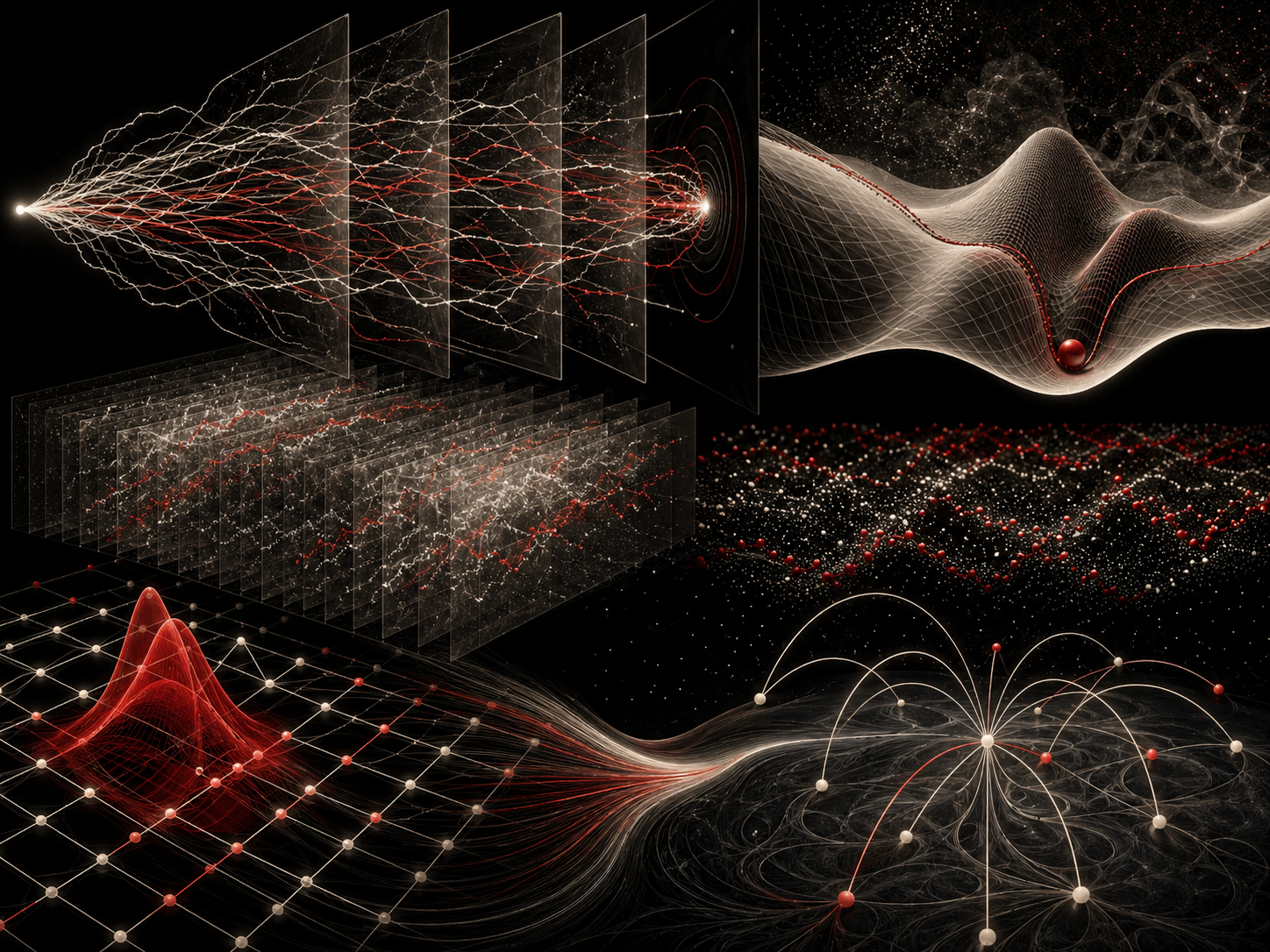
Path integrals and the functional formulation of physics recast dynamics as a sum over histories: instead of following one trajectory, one assigns amplitudes or statistical weights to entire paths, fields, and configurations. In classical mechanics, a physical path is selected by stationary action. In quantum mechanics, all paths contribute, weighted by a phase involving the action. In statistical physics, Euclidean path integrals connect quantum amplitudes to partition functions. In quantum field theory, functional integrals organize fields, correlation functions, perturbation theory, Feynman diagrams, gauge symmetry, renormalization, and lattice simulation.
The path integral is therefore not just another computational trick. It is one of the deepest reformulations of physics because it unifies action principles, quantum amplitudes, statistical ensembles, field theory, stochastic processes, and computational simulation. It makes the relationship between classical and quantum physics visually and mathematically explicit: classical trajectories dominate when phases interfere destructively away from stationary action, while quantum behavior emerges from coherent sums over alternative histories.
This article develops Path Integrals and the Functional Formulation of Physics as a research-grade introduction within the Physics knowledge series. It explains propagators, amplitudes, the classical action, stationary phase, time slicing, configuration-space path integrals, phase-space path integrals, Euclidean continuation, partition functions, Gaussian functional integrals, generating functionals, source terms, correlation functions, Wick’s theorem, perturbation theory, Feynman diagrams, effective actions, saddle-point methods, instantons, fermionic Grassmann integrals, gauge fixing, Fadeev–Popov determinants, lattice path integrals, Monte Carlo sampling, and the conceptual limits of functional methods. Selected R and Python workflows appear here, while the full GitHub repository contains expanded computational resources for discretized path integrals, Euclidean harmonic oscillators, Gaussian functional integrals, generating functionals, Monte Carlo sampling, lattice scalar fields, stochastic paths, SQL metadata, C/C++/Fortran/Rust examples, and reproducible path-integral workflows.
Main Library
Publications
Article Map
Physics
Related Topic
Mathematics
Related Topic
Data Systems & Analytics
Related Topic
Astronomy
Series context: This article is part of the Physics knowledge series. It connects action principles, quantum mechanics, statistical physics, quantum field theory, functional methods, gauge theory, lattice simulation, stochastic processes, and computational physics into one integrated framework.
Why Path Integrals Matter
Path integrals matter because they change the way physics thinks about motion, fields, probability, and quantum amplitudes. In Newtonian mechanics, one often imagines a particle following a single trajectory determined by forces. In Hamiltonian mechanics, one tracks a point moving through phase space. In the path-integral formulation, the central object is not one path but the space of all possible histories, each weighted by an action-dependent factor.
For quantum mechanics, this gives a vivid reformulation of interference. A particle traveling from one point to another is not described as choosing one classical route. The quantum amplitude is built from contributions associated with possible paths. Most paths interfere destructively. Near the classical path, phases vary slowly, and contributions reinforce. This is how the classical principle of stationary action emerges from the quantum sum over histories.
For quantum field theory, path integrals become even more central. A field theory does not sum over particle paths only. It sums over field configurations. Scalar fields, gauge fields, fermion fields, order-parameter fields, and collective fields can all be treated functionally. Correlation functions, scattering amplitudes, perturbation theory, and renormalization can be organized through generating functionals.
For the Physics knowledge series, this article belongs near Lagrangian and Hamiltonian Mechanics, Quantum Mechanics and the Limits of Classical Intuition, Quantum Field Theory I: Fields, Particles, and Second Quantization, Statistical Physics and the Emergence of Macroscopic Order, Phase Transitions, Critical Phenomena, and the Renormalization Group, Many-Body Physics and Emergent Collective Behavior, and Computational Physics and Scientific Simulation. It is the formal bridge between action, amplitude, field, ensemble, and simulation.
From Action Principles to Quantum Amplitudes
The classical action is defined as:
\[
S[x(t)] = \int_{t_i}^{t_f} L(x,\dot{x},t)\,dt \]
Interpretation: The classical action is the time integral of the Lagrangian along a path.
where \(L\) is the Lagrangian. In classical mechanics, the physical trajectory makes the action stationary:
\[
\delta S = 0 \]
Interpretation: Classical motion follows from stationary action.
This condition leads to the Euler–Lagrange equation:
\[
\frac{d}{dt}\left(\frac{\partial L}{\partial \dot{x}}\right) – \frac{\partial L}{\partial x} = 0 \]
Interpretation: The Euler–Lagrange equation gives the classical equation of motion implied by the action principle.
The path-integral formulation retains the classical action but changes its role. Rather than selecting only the stationary path, quantum mechanics assigns a phase to each path:
\[
e^{iS[x]/\hbar} \]
Interpretation: In real time, each path contributes a complex phase determined by its action.
The propagator is then expressed as a sum over paths weighted by this phase. The action remains central, but quantum theory no longer discards nonclassical histories. Instead, it lets them interfere.
This is one reason path integrals are so powerful. They keep the Lagrangian and action at the center of the theory, making symmetries, constraints, fields, and classical limits more transparent than in some operator-only formulations.
The Propagator
The propagator is the amplitude for a system to move from an initial configuration to a final configuration. In nonrelativistic quantum mechanics, a position-space propagator can be written as:
\[
K(x_f,t_f;x_i,t_i) = \langle x_f,t_f|x_i,t_i\rangle \]
Interpretation: The propagator is the amplitude for transition from an initial spacetime point to a final spacetime point.
It evolves a wavefunction according to:
\[
\psi(x_f,t_f) = \int dx_i\, K(x_f,t_f;x_i,t_i)\psi(x_i,t_i) \]
Interpretation: The propagator evolves an initial wavefunction into a later wavefunction.
The propagator satisfies a composition law. If \(t_i<t_m<t_f\), then:
\[
K(x_f,t_f;x_i,t_i) = \int dx_m\, K(x_f,t_f;x_m,t_m) K(x_m,t_m;x_i,t_i) \]
Interpretation: Propagators compose by integrating over intermediate configurations.
This composition property is the doorway to the path integral. By slicing time into many small intervals, inserting intermediate positions, and multiplying short-time propagators, one obtains an integral over all intermediate configurations. In the continuum limit, the product becomes a functional integral over paths.
For a particle with Lagrangian:
\[
L=\frac{1}{2}m\dot{x}^2 – V(x) \]
Interpretation: This Lagrangian combines kinetic energy and potential energy for a nonrelativistic particle.
the formal path-integral expression is:
\[
K(x_f,t_f;x_i,t_i) = \int_{x(t_i)=x_i}^{x(t_f)=x_f} \mathcal{D}x(t)\, e^{iS[x]/\hbar} \]
Interpretation: The propagator is represented as a functional integral over all paths connecting the endpoints.
This expression is compact, but it carries deep conceptual and mathematical content. The symbol \(\mathcal{D}x(t)\) represents integration over paths, not an ordinary finite-dimensional integral.
Sum Over Histories
The phrase “sum over histories” captures the core intuition. A quantum amplitude is obtained by adding contributions from possible histories. Each history contributes a complex phase determined by the action. Histories with rapidly varying phase tend to cancel. Histories near stationary action tend to reinforce.
In a double-slit experiment, the amplitude for arrival at a screen can be thought of as a sum of alternatives. With two slits, there are two broad classes of paths. With a full path integral, there are infinitely many possible paths. The resulting interference pattern reflects amplitude addition, not classical probability addition.
Classically, probabilities add:
\[
P = P_1 + P_2 \]
Interpretation: Classical probabilities add when alternatives are exclusive and no interference is present.
when alternatives are exclusive. Quantum mechanically, amplitudes add:
\[
\mathcal{A}=\mathcal{A}_1+\mathcal{A}_2 \]
Interpretation: Quantum alternatives combine through amplitude addition.
and probabilities are obtained by taking squared magnitude:
\[
P=|\mathcal{A}|^2 \]
Interpretation: Quantum probabilities are obtained from squared amplitudes.
The cross terms in \(|\mathcal{A}_1+\mathcal{A}_2|^2\) produce interference. Path integrals generalize this principle from a small number of alternatives to a continuum of possible histories.
Stationary Phase and the Classical Limit
The classical limit emerges through stationary phase. When \(\hbar\) is small compared with characteristic actions, the phase:
\[
\frac{S[x]}{\hbar} \]
Interpretation: The action measured in units of \(\hbar\) controls phase oscillation in the path integral.
oscillates rapidly for most paths. Contributions from neighboring paths tend to cancel unless the action changes slowly. The dominant contribution comes from paths satisfying:
\[
\delta S = 0 \]
Interpretation: Stationary paths dominate in the classical or semiclassical limit.
which is the classical action principle.
This does not mean that quantum mechanics becomes literally one path. It means that the path integral becomes sharply concentrated around stationary-action contributions in the appropriate limit. Corrections around the classical path can be treated by expanding the action:
\[
S[x_{\mathrm{cl}}+\eta] = S[x_{\mathrm{cl}}] + \frac{1}{2} \int dt\,dt’\, \eta(t) \left. \frac{\delta^2 S}{\delta x(t)\delta x(t’)} \right|_{x_{\mathrm{cl}}} \eta(t’) + \cdots \]
Interpretation: Semiclassical expansion separates the stationary classical path from quantum fluctuations around it.
The first variation vanishes because \(x_{\mathrm{cl}}\) is stationary. The quadratic term governs Gaussian fluctuations around the classical path. Higher-order terms encode nonlinear corrections.
This expansion links classical mechanics, semiclassical physics, wave optics, quantum fluctuations, and perturbation theory. It is also the logic behind saddle-point approximations, instantons, steepest descent methods, and semiclassical propagators.
Time Slicing and the Measure Problem
The path integral is usually introduced through time slicing. Divide the time interval into \(N\) steps of width:
\[
\Delta t = \frac{t_f-t_i}{N} \]
Interpretation: Time slicing approximates continuous histories using finite time steps.
Then approximate a path by intermediate positions:
\[
x_1,x_2,\ldots,x_{N-1} \]
Interpretation: A discretized path is represented by intermediate configuration values.
The finite-dimensional integral has the schematic form:
\[
K \approx \int dx_1\cdots dx_{N-1} \prod_{n=0}^{N-1} K(x_{n+1},t_{n+1};x_n,t_n) \]
Interpretation: The finite time-sliced propagator integrates over all intermediate positions.
The continuum path integral is obtained by taking \(N\rightarrow\infty\). This limiting process is conceptually powerful but mathematically delicate. The formal symbol \(\mathcal{D}x\) is not a standard Lebesgue measure over an infinite-dimensional space in the ordinary sense.
In real-time quantum mechanics, the oscillatory factor \(e^{iS/\hbar}\) makes rigorous definition difficult. Euclidean path integrals are often better behaved because oscillatory phases become exponentially damped weights. But even there, careful definitions depend on the system, regularization, boundary conditions, and limiting procedures.
For physics, time slicing is often sufficient to derive correct rules and build computational approximations. For mathematical foundations, the measure problem remains important. A responsible treatment recognizes both the power and the formal subtlety of path integrals.
Configuration-Space and Phase-Space Path Integrals
The configuration-space path integral integrates over paths \(x(t)\). It is most directly associated with a Lagrangian action:
\[
S[x]=\int dt\,L(x,\dot{x},t) \]
Interpretation: Configuration-space path integrals use Lagrangian actions over coordinate paths.
The phase-space path integral integrates over both positions and momenta:
\[
K = \int \mathcal{D}p\,\mathcal{D}x\, \exp\left[ \frac{i}{\hbar} \int dt\, (p\dot{x}-H(p,x,t)) \right] \]
Interpretation: Phase-space path integrals integrate over both coordinate and momentum histories.
The phase-space form is closely related to Hamiltonian mechanics. It is useful when the Hamiltonian structure, constraints, canonical variables, or momentum dependence is central.
For simple systems with quadratic momentum dependence, integrating over \(p\) can recover the configuration-space path integral. But in constrained systems, gauge theories, curved spaces, spin systems, and field theories, the relationship can be subtler.
The existence of multiple path-integral forms reflects a general principle: path integrals are not merely formulas. They encode choices of variables, measures, discretization, constraints, boundary conditions, and quantization procedures.
Euclidean Path Integrals and Statistical Physics
Euclidean path integrals arise by analytic continuation to imaginary time:
\[
t=-i\tau \]
Interpretation: Wick rotation replaces real time with imaginary time.
The real-time phase factor becomes an exponential weight:
\[
e^{iS/\hbar} \rightarrow e^{-S_E/\hbar} \]
Interpretation: Euclidean continuation converts oscillatory quantum phases into damping weights.
where \(S_E\) is the Euclidean action. For a particle in a potential:
\[
S_E[x] = \int d\tau \left[ \frac{1}{2}m\left(\frac{dx}{d\tau}\right)^2 + V(x) \right] \]
Interpretation: The Euclidean action contains positive kinetic and potential contributions for many stable systems.
The sign of the potential term changes compared with the real-time Lagrangian because Euclidean time transforms the oscillatory quantum amplitude into a statistical-like weight.
Euclidean continuation connects quantum mechanics to statistical mechanics. The thermal partition function can be written as:
\[
Z=\mathrm{Tr}\left(e^{-\beta \hat H}\right) \]
Interpretation: The thermal partition function is the trace of the Boltzmann operator.
and represented by a Euclidean path integral over periodic imaginary-time paths for bosonic degrees of freedom:
\[
Z = \int_{\mathrm{periodic}} \mathcal{D}x(\tau)\, e^{-S_E[x]/\hbar} \]
Interpretation: Euclidean thermal path integrals sum over periodic imaginary-time histories.
In quantum field theory, Euclidean path integrals are central to lattice field theory and Monte Carlo simulation because \(e^{-S_E}\) can sometimes be treated as a statistical weight. This is one of the deepest bridges between quantum theory and statistical physics.
Gaussian Path Integrals
Gaussian integrals are the foundation of perturbative path-integral physics. In finite dimensions:
\[
\int d^n x\, \exp\left( -\frac{1}{2}x^T A x + J^T x \right) = \sqrt{\frac{(2\pi)^n}{\det A}} \exp\left( \frac{1}{2}J^T A^{-1}J \right) \]
Interpretation: A finite-dimensional Gaussian integral produces an inverse determinant factor and a source-dependent quadratic form.
when \(A\) is positive definite. Functional Gaussian integrals generalize this structure to fields:
\[
Z[J] = \int \mathcal{D}\phi\, \exp\left[ -\frac{1}{2} \int dx\,dy\, \phi(x)A(x,y)\phi(y) + \int dx\,J(x)\phi(x) \right] \]
Interpretation: A Gaussian functional integral couples a field to an external source through a quadratic kernel.
The result is formally:
\[
Z[J] = Z[0] \exp\left[ \frac{1}{2} \int dx\,dy\, J(x)A^{-1}(x,y)J(y) \right] \]
Interpretation: The inverse kernel acts as the propagator for the Gaussian theory.
The inverse operator \(A^{-1}\) is the propagator. This is why Gaussian path integrals are so central: they connect quadratic actions to propagators, correlation functions, and perturbation theory.
Interacting theories are often treated by separating the action into a solvable quadratic part and an interaction:
\[
S[\phi]=S_0[\phi]+S_{\mathrm{int}}[\phi] \]
Interpretation: Perturbation theory separates the solvable free action from the interaction action.
The quadratic part defines the propagator. The interaction part generates vertices. Feynman diagrams organize the expansion.
Generating Functionals and Sources
A generating functional is a functional that produces correlation functions by differentiation with respect to sources. For a scalar field, one writes:
\[
Z[J] = \int \mathcal{D}\phi\, \exp\left[ \frac{i}{\hbar} \left( S[\phi] + \int d^dx\,J(x)\phi(x) \right) \right] \]
Interpretation: The source-dependent generating functional encodes field correlations.
The source \(J(x)\) is an external function coupled to the field. Functional derivatives with respect to \(J\) bring down factors of \(\phi\):
\[
\langle 0|T\phi(x_1)\cdots\phi(x_n)|0\rangle = \frac{1}{Z[0]} \left. \left(\frac{\hbar}{i}\frac{\delta}{\delta J(x_1)}\right) \cdots \left(\frac{\hbar}{i}\frac{\delta}{\delta J(x_n)}\right) Z[J] \right|_{J=0} \]
Interpretation: Time-ordered correlation functions are generated by differentiating \(Z[J]\) with respect to the source.
This is one of the defining strengths of the functional formulation. Instead of computing each correlation function separately, one builds a single object from which all correlation functions can be generated.
The connected generating functional is often defined by:
\[
W[J] = -i\hbar \ln Z[J] \]
Interpretation: The connected generating functional is the logarithm of \(Z[J]\), up to convention-dependent factors.
in real time, with convention-dependent factors. Connected correlation functions are generated by derivatives of \(W[J]\). The effective action is obtained by a Legendre transform and encodes one-particle-irreducible structure.
Correlation Functions
Correlation functions are central observables in functional physics. A two-point function measures how field values at two spacetime points are related:
\[
G(x,y) = \langle T\phi(x)\phi(y)\rangle \]
Interpretation: The two-point function measures time-ordered field correlation or propagation between two points.
Higher-order correlation functions measure more complex relationships:
\[
G^{(n)}(x_1,\ldots,x_n) = \langle T\phi(x_1)\cdots\phi(x_n)\rangle \]
Interpretation: Higher-order correlation functions encode multi-point field relationships.
In quantum field theory, correlation functions encode particle propagation, scattering amplitudes, response, spectra, and critical behavior. In statistical physics, they measure fluctuations, order, correlation length, and universality. In condensed matter, they describe Green’s functions, susceptibilities, structure factors, and response functions.
For a free Gaussian theory, Wick’s theorem reduces higher-order correlation functions to sums over products of two-point functions. For example:
\[
\langle \phi_1\phi_2\phi_3\phi_4\rangle = \langle \phi_1\phi_2\rangle \langle \phi_3\phi_4\rangle + \langle \phi_1\phi_3\rangle \langle \phi_2\phi_4\rangle + \langle \phi_1\phi_4\rangle \langle \phi_2\phi_3\rangle \]
Interpretation: Wick’s theorem expresses a Gaussian four-point function as a sum over pairwise contractions.
Interacting theories modify this structure through vertices, loops, self-energies, renormalization, and nonperturbative effects.
Perturbation Theory and Feynman Diagrams
Path integrals provide a systematic route to perturbation theory. Suppose a scalar field has action:
\[
S[\phi] = \int d^dx \left[ \frac{1}{2} \phi(-\partial^2-m^2)\phi – \frac{\lambda}{4!}\phi^4 \right] \]
Interpretation: A scalar action can be split into a quadratic free part and an interacting \(\phi^4\) term.
The quadratic part defines the free propagator. The \(\phi^4\) term defines an interaction vertex with coupling \(\lambda\). Expanding the exponential of the interaction generates a series of terms that can be represented diagrammatically.
Feynman diagrams are not merely pictures. They are bookkeeping devices for terms in a perturbative expansion. Lines represent propagators. Vertices represent interactions. Loops represent integrations over internal momenta. External legs represent inserted fields or asymptotic states.
Perturbation theory works when the interaction expansion is controlled by a small parameter. But many important systems are strongly coupled, nonperturbative, or dominated by collective effects. In those cases, other methods are needed: saddle-point expansions, instantons, lattice simulation, renormalization group, large-\(N\) methods, dualities, effective field theories, or numerical many-body methods.
Effective Actions and Saddle Points
The effective action is a functional that incorporates quantum or statistical fluctuations. It is often denoted:
\[
\Gamma[\phi_c] \]
Interpretation: The effective action encodes fluctuation-corrected dynamics for a mean or classical field.
where \(\phi_c\) is a classical or mean field obtained from the source-dependent generating functional. The effective action is related to the connected generating functional by a Legendre transform.
In many applications, one approximates the path integral by expanding around a saddle point. A saddle point satisfies:
\[
\left. \frac{\delta S}{\delta \phi(x)} \right|_{\phi=\phi_{\mathrm{cl}}} = 0 \]
Interpretation: A saddle-point field configuration makes the action stationary.
Then one writes:
\[
\phi=\phi_{\mathrm{cl}}+\eta \]
Interpretation: Fluctuation expansion decomposes the field into a saddle point plus deviations.
and expands the action in fluctuations \(\eta\). The quadratic fluctuation determinant gives one-loop corrections. Higher-order terms generate higher-loop effects.
Saddle-point methods appear in semiclassical quantum mechanics, instanton calculations, mean-field theory, statistical mechanics, quantum field theory, large-\(N\) expansions, and path-integral treatments of condensed matter systems.
Instantons, Tunneling, and Nonperturbative Physics
Instantons are nontrivial saddle points of the Euclidean action. They often describe tunneling between classically distinct configurations. In quantum mechanics, a particle in a double-well potential may tunnel from one well to another. In Euclidean time, this process can be described by a classical solution of the Euclidean equations of motion.
The semiclassical contribution of an instanton is typically of the form:
\[
e^{-S_E[\phi_{\mathrm{inst}}]/\hbar} \]
Interpretation: Instanton effects are weighted by the exponential of the Euclidean instanton action.
This is nonperturbative because it cannot be obtained by expanding in powers of a coupling around zero. Exponentially small effects of this kind are invisible to ordinary perturbation theory.
Instantons and related saddle configurations appear in quantum tunneling, field theory, gauge theory, false vacuum decay, solitons, topological sectors, and statistical mechanics. They show that path integrals can capture physics beyond small fluctuations around a single vacuum.
Fermions and Grassmann Functional Integrals
Fermions require anticommuting variables in path integrals. These are Grassmann variables, satisfying:
\[
\theta_i\theta_j=-\theta_j\theta_i \]
Interpretation: Grassmann variables anticommute with one another.
and therefore:
\[
\theta_i^2=0 \]
Interpretation: The square of a Grassmann variable vanishes.
Fermionic path integrals use Grassmann-valued fields such as \(\psi\) and \(\bar{\psi}\). A quadratic fermionic integral has the schematic form:
\[
\int \mathcal{D}\bar{\psi}\mathcal{D}\psi\, e^{-\bar{\psi}A\psi} = \det A \]
Interpretation: Gaussian Grassmann integrals produce determinants rather than inverse square roots of determinants.
This determinant structure contrasts with bosonic Gaussian integrals, which typically produce inverse square roots of determinants.
Grassmann path integrals are essential for quantum field theory, many-body fermion systems, condensed matter physics, superconductivity, lattice gauge theory, and finite-temperature field theory. They encode fermionic statistics directly into the functional formalism.
Gauge Fields and Gauge Fixing
Gauge theories introduce redundancy. Gauge-related field configurations represent the same physical state. A naive path integral over all gauge fields overcounts equivalent configurations:
\[
Z = \int \mathcal{D}A_\mu\, e^{iS[A]/\hbar} \]
Interpretation: A naive gauge-field path integral overcounts physically equivalent gauge configurations.
To define the integral properly, one must account for gauge redundancy. Gauge fixing imposes a condition such as:
\[
G[A]=0 \]
Interpretation: Gauge fixing selects representatives from gauge-equivalent configurations.
and introduces a determinant factor associated with the change of variables along gauge orbits. In nonabelian gauge theory, this leads to Fadeev–Popov ghosts and ghost fields in the functional integral.
The gauge-fixed generating functional has the schematic form:
\[
Z = \int \mathcal{D}A\,\mathcal{D}c\,\mathcal{D}\bar{c}\, e^{iS_{\mathrm{gauge-fixed}}[A,c,\bar{c}]/\hbar} \]
Interpretation: Gauge-fixed path integrals include gauge fields and ghost fields to account for redundancy consistently.
Gauge fixing is not merely a technicality. It reflects the difference between physical degrees of freedom and descriptive redundancy. The path-integral formulation makes this issue explicit and provides tools for perturbative and nonperturbative gauge theory.
Lattice Path Integrals
Lattice path integrals discretize spacetime or Euclidean spacetime. Instead of fields defined at every point in a continuum, fields are defined on lattice sites or links. A scalar field lattice action might look schematically like:
\[
S_E[\phi] = a^d \sum_x \left[ \frac{1}{2} \sum_\mu \left( \frac{\phi(x+a\hat{\mu})-\phi(x)}{a} \right)^2 + \frac{1}{2}m^2\phi(x)^2 + \frac{\lambda}{4!}\phi(x)^4 \right] \]
Interpretation: A lattice scalar-field action approximates continuum gradients and interactions on a discrete grid.
where \(a\) is the lattice spacing. The continuum theory is recovered by taking:
\[
a\rightarrow 0 \]
Interpretation: The continuum limit is approached by sending lattice spacing to zero while controlling physical quantities.
while controlling renormalized quantities.
Euclidean lattice path integrals are especially important because they can sometimes be sampled numerically using Monte Carlo methods. The probability-like weight:
\[
e^{-S_E[\phi]} \]
Interpretation: Euclidean lattice field configurations can often be sampled using their exponential action weight.
allows field configurations to be generated according to their contribution to the partition function.
Lattice gauge theory is one of the most important applications of this idea. Gauge fields are placed on links, Wilson loops diagnose confinement, and numerical simulations can study nonperturbative quantum chromodynamics. Lattice methods turn the formal path integral into a computational laboratory.
Stochastic Path Integrals and Statistical Fields
Path integrals also appear in stochastic processes, statistical fields, nonequilibrium dynamics, and systems driven by noise. Brownian motion, diffusion, Langevin equations, reaction-diffusion systems, turbulence models, polymer physics, population dynamics, and financial stochastic processes can all be expressed using path-like probability weights or action functionals.
A Langevin equation may be written as:
\[
\frac{dx}{dt}=F(x)+\eta(t) \]
Interpretation: Langevin dynamics combine deterministic drift with stochastic noise.
where \(\eta(t)\) is noise. Under suitable assumptions, path probabilities can be expressed through an action-like functional. The resulting formalism connects stochastic dynamics to field theory.
In statistical physics, the functional integral often uses real exponential weights rather than oscillatory quantum phases. The formal similarity is profound: quantum amplitudes, thermal fluctuations, and stochastic histories can all be organized through functionals over paths or fields.
This is why path integrals serve as a bridge between physics domains. They connect quantum mechanics, statistical mechanics, field theory, stochastic processes, complex systems, and computational modeling.
Mathematical Rigor and Physical Usefulness
Path integrals are extraordinarily useful, but they are not always mathematically straightforward. In many physical applications, they are formal expressions that become precise through discretization, regularization, perturbation theory, Euclidean continuation, lattice definition, or limiting procedures.
This does not make them unscientific. Many successful physical theories use intermediate formal objects that are later interpreted through controlled calculations, renormalization, measurement comparison, or limiting procedures. But it does mean that path-integral expressions should be used with care.
Important questions include: What is being integrated over? What is the measure? What are the boundary conditions? Is the integral real-time or Euclidean? Is a regulator present? Are gauge redundancies removed? Are fermionic variables Grassmann-valued? Is the continuum limit defined? Is the perturbation series convergent, asymptotic, or only formal?
The best use of path integrals combines physical intuition with mathematical discipline. They are among the most powerful languages in theoretical physics precisely because they expose structure, but that structure must be handled responsibly.
Measurement, Units, and SI Interpretation
The action has units of angular momentum:
\[
[S]=\mathrm{J\,s} \]
Interpretation: Action has SI units of joule seconds.
The reduced Planck constant has the same units:
\[
[\hbar]=\mathrm{J\,s} \]
Interpretation: The reduced Planck constant sets the quantum scale of action.
Therefore the phase:
\[
\frac{S}{\hbar} \]
Interpretation: The ratio of action to \(\hbar\) is dimensionless.
is dimensionless, as required inside an exponential. In Euclidean path integrals, \(S_E/\hbar\) is also dimensionless.
For a particle with mass \(m\), position \(x\), and velocity \(\dot{x}\), the kinetic term:
\[
\frac{1}{2}m\dot{x}^2 \]
Interpretation: The kinetic term has units of energy.
has units of energy. Integrating over time gives units of action. In field theory, the Lagrangian density has units of energy per volume, and the action is:
\[
S=\int d^4x\,\mathcal{L} \]
Interpretation: Field-theory action is the spacetime integral of the Lagrangian density.
with units depending on whether SI, natural units, or high-energy conventions are used.
In natural units, one often sets:
\[
\hbar=c=k_B=1 \]
Interpretation: Natural units simplify formulas by measuring action, speed, and thermal energy scales in compatible units.
This simplifies formulas but hides dimensional structure. Computational workflows should document whether variables are in SI units, natural units, lattice units, dimensionless units, or normalized simulation units.
Mathematical Lens
A mathematics-first view begins with the action:
\[
S[q]=\int_{t_i}^{t_f}L(q,\dot{q},t)\,dt \]
Interpretation: The action functional assigns a value to each path.
Classical motion satisfies:
\[
\delta S=0 \]
Interpretation: Classical paths make the action stationary.
The quantum propagator is formally:
\[
K(q_f,t_f;q_i,t_i) = \int_{q(t_i)=q_i}^{q(t_f)=q_f} \mathcal{D}q(t)\, e^{iS[q]/\hbar} \]
Interpretation: The path integral represents the propagator as a sum over all paths between endpoints.
The phase-space form is:
\[
K = \int \mathcal{D}p\,\mathcal{D}q\, \exp\left[ \frac{i}{\hbar} \int dt\, (p\dot{q}-H(p,q,t)) \right] \]
Interpretation: Phase-space path integrals sum over position and momentum histories.
Euclidean continuation gives:
\[
Z = \int \mathcal{D}q(\tau)\, e^{-S_E[q]/\hbar} \]
Interpretation: Euclidean path integrals use damped statistical weights rather than real-time phases.
For a field theory:
\[
Z[J] = \int \mathcal{D}\phi\, \exp\left[ \frac{i}{\hbar} \left( S[\phi] + \int d^dx\,J(x)\phi(x) \right) \right] \]
Interpretation: The field-theory generating functional integrates over field configurations with a source term.
Correlation functions are generated by functional derivatives:
\[
G^{(n)}(x_1,\ldots,x_n) = \frac{1}{Z[0]} \left. \left(\frac{\hbar}{i}\frac{\delta}{\delta J(x_1)}\right) \cdots \left(\frac{\hbar}{i}\frac{\delta}{\delta J(x_n)}\right) Z[J] \right|_{J=0} \]
Interpretation: Functional derivatives of \(Z[J]\) generate \(n\)-point correlation functions.
The Euclidean lattice scalar-field action can be represented schematically as:
\[
S_E[\phi] = \sum_x \left[ \frac{1}{2} \sum_\mu (\nabla_\mu\phi)^2 + \frac{1}{2}m^2\phi^2 + \frac{\lambda}{4!}\phi^4 \right] \]
Interpretation: Lattice Euclidean actions discretize gradients, mass terms, and interactions over field configurations.
This mathematical lens shows that the path integral is a unifying form for particles, fields, ensembles, fluctuations, and simulations.
Variables, Units, and Physical Interpretation
Path-integral physics uses variables that connect action, amplitude, field, source, correlation, and simulation. The table below summarizes several central quantities.
| Symbol or Term | Meaning | Typical Unit or Dimension | Physical Interpretation |
|---|---|---|---|
| \(S\) | Action | J·s | Functional whose stationary value gives classical motion and whose phase weights quantum histories |
| \(S_E\) | Euclidean action | J·s or dimensionless in natural units | Imaginary-time action used for statistical weights and lattice simulation |
| \(\hbar\) | Reduced Planck constant | J·s | Sets quantum scale of action |
| \(K\) | Propagator | depends on normalization | Amplitude for transition between configurations |
| \(\mathcal{D}x\) | Path measure | formal | Integration over paths or histories |
| \(\mathcal{D}\phi\) | Functional field measure | formal | Integration over field configurations |
| \(J(x)\) | Source | field-dependent | External function used to generate correlation functions |
| \(Z[J]\) | Generating functional | often dimensionless after normalization | Functional from which correlation functions are derived |
| \(G(x,y)\) | Two-point function | field-dependent | Correlation or propagation between two spacetime points |
| \(a\) | Lattice spacing | m | Discretization scale in lattice path integrals |
| \(\beta\) | Inverse thermal energy | J⁻¹ or dimensionless convention | \(1/(k_BT)\), imaginary-time extent in thermal field theory |
| \(\lambda\) | Interaction coupling | dimension depends on theory | Strength of nonlinear field interaction |
Note: Path integrals are formally compact, but their physical interpretation depends on units, variables, normalization, boundary conditions, and measure conventions.
Worked Example: Euclidean Harmonic Oscillator Action
Consider a harmonic oscillator with real-time Lagrangian:
\[
L = \frac{1}{2}m\dot{x}^2 – \frac{1}{2}m\omega^2x^2 \]
Interpretation: The real-time harmonic oscillator Lagrangian is kinetic energy minus potential energy.
The real-time action is:
\[
S[x] = \int dt \left[ \frac{1}{2}m\dot{x}^2 – \frac{1}{2}m\omega^2x^2 \right] \]
Interpretation: The real-time action integrates the oscillator Lagrangian over time.
After Wick rotation to imaginary time \(t=-i\tau\), the Euclidean action becomes:
\[
S_E[x] = \int d\tau \left[ \frac{1}{2}m \left(\frac{dx}{d\tau}\right)^2 + \frac{1}{2}m\omega^2x^2 \right] \]
Interpretation: The Euclidean harmonic oscillator action has positive kinetic and potential terms.
Now discretize imaginary time into \(N\) steps of size \(\Delta\tau\). Let \(x_n=x(\tau_n)\). The derivative is approximated by:
\[
\frac{dx}{d\tau} \approx \frac{x_{n+1}-x_n}{\Delta\tau} \]
Interpretation: Finite differences approximate derivatives on a discrete imaginary-time lattice.
The discretized Euclidean action is:
\[
S_E \approx \sum_{n=0}^{N-1} \Delta\tau \left[ \frac{1}{2}m \left( \frac{x_{n+1}-x_n}{\Delta\tau} \right)^2 + \frac{1}{2}m\omega^2x_n^2 \right] \]
Interpretation: The discretized action sums kinetic and potential contributions over imaginary-time sites.
or equivalently:
\[
S_E \approx \sum_{n=0}^{N-1} \left[ \frac{m}{2\Delta\tau}(x_{n+1}-x_n)^2 + \frac{\Delta\tau}{2}m\omega^2x_n^2 \right] \]
Interpretation: The finite-difference form separates nearest-neighbor kinetic cost from local potential cost.
The Euclidean path weight is:
\[
e^{-S_E/\hbar} \]
Interpretation: Euclidean paths are weighted by the exponential of negative action in units of \(\hbar\).
Paths with large kinetic roughness or large potential displacement are suppressed. This turns the quantum oscillator into a statistical sampling problem over imaginary-time paths. It is the basic logic behind many Monte Carlo path-integral methods.
Computational Modeling
Computational modeling makes path integrals concrete. A discretized path workflow can approximate the Euclidean action. A Monte Carlo workflow can sample paths according to \(e^{-S_E/\hbar}\). A Gaussian integral workflow can compare finite-dimensional determinants with analytic expectations. A generating-functional workflow can compute correlation functions by differentiating source-dependent expressions. A lattice scalar-field workflow can sample field configurations. A stochastic-path workflow can simulate Brownian paths and compare action-like weights. A metadata workflow can preserve discretization choices, boundary conditions, action conventions, random seeds, units, sources, and reproducibility details.
The selected examples below focus on Euclidean oscillator paths because they are foundational, readable, and directly reusable. The GitHub repository extends the same logic into richer computational resources: R discretized path actions, Python Monte Carlo path sampling, Gaussian functional-integral diagnostics, generating functionals, correlation-function estimation, lattice scalar fields, stochastic paths, Julia path-integral calculations, C++ Euclidean-action sweeps, Fortran discretized-action tables, SQL path-integral metadata, Rust command-line utilities, C examples, documentation, and reproducible sample data.
R Workflow: Discretized Euclidean Action for Sample Paths
R is useful for transparent grids, parameter sweeps, reproducible tables, and statistical summaries. The following workflow computes the discretized Euclidean action for several sample harmonic oscillator paths.
# Discretized Euclidean Action for Sample Paths
#
# This workflow evaluates the Euclidean harmonic oscillator action:
#
#   S_E = sum_n [
#       m / (2 Delta tau) * (x_{n+1} - x_n)^2
#       + Delta tau / 2 * m * omega^2 * x_n^2
#   ]
#
# The examples are deterministic teaching paths, not Monte Carlo samples.

library(tibble)
library(dplyr)
library(tidyr)
library(purrr)

mass <- 1.0
omega <- 1.0
hbar <- 1.0
n_steps <- 100
beta <- 4.0
delta_tau <- beta / n_steps

time_grid <- tibble(
  step = 0:(n_steps - 1),
  tau = step * delta_tau
)

path_table <- time_grid %>%
  mutate(
    zero_path = 0.0,
    sine_path = sin(2 * pi * tau / beta),
    rough_path = sin(2 * pi * tau / beta) + 0.25 * sin(10 * pi * tau / beta)
  ) %>%
  pivot_longer(
    cols = c(zero_path, sine_path, rough_path),
    names_to = "path_name",
    values_to = "x"
  ) %>%
  group_by(path_name) %>%
  arrange(step, .by_group = TRUE) %>%
  mutate(
    x_next = lead(x, default = first(x)),
    kinetic_term =
      mass / (2 * delta_tau) * (x_next - x)^2,
    potential_term =
      delta_tau * 0.5 * mass * omega^2 * x^2,
    action_density =
      kinetic_term + potential_term
  ) %>%
  ungroup()

action_summary <- path_table %>%
  group_by(path_name) %>%
  summarise(
    euclidean_action = sum(action_density),
    path_weight = exp(-euclidean_action / hbar),
    mean_x = mean(x),
    mean_x_squared = mean(x^2),
    .groups = "drop"
  )

print(path_table)
print(action_summary)
This workflow shows how path smoothness and potential displacement contribute to Euclidean action. The zero path has minimal oscillator action. The sine path costs action through both kinetic and potential terms. The rough path is more heavily penalized because rapid variation increases the kinetic contribution.
Python Workflow: Monte Carlo Sampling of Euclidean Harmonic Oscillator Paths
Python is useful for Monte Carlo path sampling, numerical experiments, and reproducible scientific workflows. The following workflow uses local Metropolis updates to sample periodic Euclidean paths for a harmonic oscillator.
"""
Monte Carlo Sampling of Euclidean Harmonic Oscillator Paths

This workflow samples paths with weight:

    exp(-S_E / hbar)

where the discretized Euclidean action is:

    S_E = sum_n [
        m / (2 Delta tau) * (x[n+1] - x[n])^2
        + Delta tau / 2 * m * omega^2 * x[n]^2
    ]

Periodic boundary conditions are used in imaginary time.
The workflow is a compact teaching example, not an optimized production sampler.
"""

import numpy as np
import pandas as pd

RANDOM_SEED = 42
MASS = 1.0
OMEGA = 1.0
HBAR = 1.0
BETA = 4.0
N_STEPS = 128
DELTA_TAU = BETA / N_STEPS
N_THERMALIZATION_SWEEPS = 1000
N_MEASUREMENT_SWEEPS = 3000
PROPOSAL_WIDTH = 0.8

def local_action(path: np.ndarray, index: int) -> float:
    """
    Compute the action contribution involving one site and its nearest links.

    Because the action contains nearest-neighbor kinetic terms, changing x[index]
    affects the links (index-1, index) and (index, index+1), plus the local
    potential term.
    """
    n = len(path)
    x_prev = path[(index - 1) % n]
    x_curr = path[index]
    x_next = path[(index + 1) % n]

    kinetic_left = MASS / (2.0 * DELTA_TAU) * (x_curr - x_prev) ** 2
    kinetic_right = MASS / (2.0 * DELTA_TAU) * (x_next - x_curr) ** 2
    potential = 0.5 * DELTA_TAU * MASS * OMEGA**2 * x_curr**2

    return kinetic_left + kinetic_right + potential

def metropolis_sweep(path: np.ndarray, rng: np.random.Generator) -> int:
    """
    Perform one Metropolis sweep over all imaginary-time sites.

    Returns the number of accepted local proposals.
    """
    accepted = 0
    n = len(path)

    for _ in range(n):
        index = rng.integers(0, n)

        old_value = path[index]
        old_action = local_action(path, index)

        proposal = old_value + rng.normal(0.0, PROPOSAL_WIDTH)
        path[index] = proposal

        new_action = local_action(path, index)
        delta_action = new_action - old_action

        if delta_action <= 0.0:
            accepted += 1
        else:
            acceptance_probability = np.exp(-delta_action / HBAR)

            if rng.random() < acceptance_probability:
                accepted += 1
            else:
                path[index] = old_value

    return accepted

def total_action(path: np.ndarray) -> float:
    """
    Compute the full discretized Euclidean action.
    """
    shifted = np.roll(path, -1)

    kinetic_terms = MASS / (2.0 * DELTA_TAU) * (shifted - path) ** 2
    potential_terms = 0.5 * DELTA_TAU * MASS * OMEGA**2 * path**2

    return float(np.sum(kinetic_terms + potential_terms))

def run_sampler() -> pd.DataFrame:
    """
    Run the Euclidean path-integral Monte Carlo sampler.
    """
    rng = np.random.default_rng(RANDOM_SEED)
    path = np.zeros(N_STEPS, dtype=float)

    for _ in range(N_THERMALIZATION_SWEEPS):
        metropolis_sweep(path, rng)

    rows = []

    for sweep in range(N_MEASUREMENT_SWEEPS):
        accepted = metropolis_sweep(path, rng)

        rows.append(
            {
                "sweep": sweep,
                "euclidean_action": total_action(path),
                "mean_x": float(np.mean(path)),
                "mean_x_squared": float(np.mean(path**2)),
                "acceptance_rate": accepted / N_STEPS,
            }
        )

    return pd.DataFrame(rows)

def main() -> None:
    """
    Run the sampler and print summary statistics.
    """
    measurements = run_sampler()

    summary = pd.DataFrame(
        [
            {
                "n_steps": N_STEPS,
                "beta": BETA,
                "delta_tau": DELTA_TAU,
                "mean_action": measurements["euclidean_action"].mean(),
                "mean_x": measurements["mean_x"].mean(),
                "mean_x_squared": measurements["mean_x_squared"].mean(),
                "mean_acceptance_rate": measurements["acceptance_rate"].mean(),
            }
        ]
    )

    print("Euclidean path-integral Monte Carlo measurements:")
    print(measurements.head(10).round(6).to_string(index=False))

    print("\nSummary:")
    print(summary.round(6).to_string(index=False))

if __name__ == "__main__":
    main()
This workflow shows the computational structure of Euclidean path integration. The path is discretized, local proposals are accepted or rejected according to the change in Euclidean action, and observables are estimated from sampled paths. More serious implementations would add autocorrelation analysis, binning, uncertainty estimates, improved updates, continuum extrapolation, and comparison with analytic oscillator results.
GitHub Repository
The article body includes only selected computational examples so the conceptual and mathematical argument remains readable. The full repository contains the expanded computational infrastructure: R discretized path actions, Python Monte Carlo path sampling, Gaussian functional-integral diagnostics, generating functionals, correlation-function estimation, lattice scalar fields, stochastic paths, Julia path-integral calculations, C++ Euclidean-action sweeps, Fortran discretized-action tables, SQL path-integral metadata, Rust command-line utilities, C examples, documentation, and reproducible sample data.
Complete Code Repository
The full code distribution for this article, including examples, computational workflows, metadata, reproducibility documentation, and expanded scientific computing resources for path integrals, functional methods, Euclidean actions, Gaussian integrals, generating functionals, Monte Carlo sampling, lattice scalar fields, stochastic paths, and provenance-aware research workflows, is available on GitHub.
From Paths to Fields
Path integrals reveal a unifying architecture beneath modern physics. Classical mechanics selects stationary paths. Quantum mechanics sums over histories. Statistical physics weights configurations. Quantum field theory integrates over fields. Lattice methods turn functional integrals into computational ensembles. Stochastic systems use action-like functionals to describe noisy histories.
Within the Physics knowledge series, this article belongs near Lagrangian and Hamiltonian Mechanics, Quantum Mechanics and the Limits of Classical Intuition, Quantum Field Theory I: Fields, Particles, and Second Quantization, Statistical Physics and the Emergence of Macroscopic Order, Phase Transitions, Critical Phenomena, and the Renormalization Group, Many-Body Physics and Emergent Collective Behavior, and Computational Physics and Scientific Simulation. It provides the functional bridge from action to amplitude, from amplitude to correlation, and from correlation to field-theoretic prediction.
The next conceptual steps are natural. Gauge Theory: Symmetry, Fields, and Interaction develops the gauge-field side. Renormalization: Scale, Divergence, and Effective Theory develops scale dependence and effective actions. Lattice Field Theory and Computational Quantum Fields develops the numerical Euclidean-field side. Quantum Statistical Field Theory develops finite-temperature and many-body functional methods.
Related Articles
- What Is Physics?
- Measurement, Mathematics, and the Structure of Physical Inquiry
- Mathematical Methods in Physics
- Lagrangian and Hamiltonian Mechanics
- Quantum Mechanics and the Limits of Classical Intuition
- Quantum Field Theory I: Fields, Particles, and Second Quantization
- Group Theory and Representation Theory in Physics
- Statistical Physics and the Emergence of Macroscopic Order
- Phase Transitions, Critical Phenomena, and the Renormalization Group
- Many-Body Physics and Emergent Collective Behavior
- Computational Physics and Scientific Simulation
- Nonlinear Dynamics, Chaos, and Complex Physical Systems
Further Reading
- Altland, A. and Simons, B. (2010) Condensed Matter Field Theory, 2nd edn. Cambridge: Cambridge University Press. Available at: https://www.cambridge.org/highereducation/books/condensed-matter-field-theory/50CCB6E159AB3B25F6F414C6D2A6910B (Accessed: 25 April 2026).
- Feynman, R.P. and Hibbs, A.R. (2010) Quantum Mechanics and Path Integrals. Mineola, NY: Dover. Publisher information available at: https://store.doverpublications.com/products/9780486477220 (Accessed: 25 April 2026).
- Kleinert, H. (2009) Path Integrals in Quantum Mechanics, Statistics, Polymer Physics, and Financial Markets. 5th edn. Singapore: World Scientific. Publisher information available at: https://www.worldscientific.com/worldscibooks/10.1142/7305 (Accessed: 25 April 2026).
- MIT OpenCourseWare (2017) Quantum Theory I, Lecture 10: Path Integral Formulation of Quantum Mechanics. Available at: https://ocw.mit.edu/courses/8-321-quantum-theory-i-fall-2017/e7c103b8e7ee71a613da948682f9a123_MIT8_321F17_lec10.pdf (Accessed: 25 April 2026).
- MIT OpenCourseWare (2017) Quantum Theory I, Lecture 11: Path Integrals. Available at: https://ocw.mit.edu/courses/8-321-quantum-theory-i-fall-2017/ea27e6d1653b49990d3d9d317d570328_MIT8_321F17_lec11.pdf (Accessed: 25 April 2026).
- MIT OpenCourseWare (2023) Relativistic Quantum Field Theory I, Lecture 8: Path Integral Formalism for Non-Relativistic Quantum Mechanics. Available at: https://ocw.mit.edu/courses/8-323-relativistic-quantum-field-theory-i-spring-2023/resources/ocw_8323_lecture08_2023mar03_mp4/ (Accessed: 25 April 2026).
- MIT OpenCourseWare (2023) Relativistic Quantum Field Theory I, Lecture 9: Path Integral Formalism for QFT; Computation of Time-Ordered Correlation Functions. Available at: https://ocw.mit.edu/courses/8-323-relativistic-quantum-field-theory-i-spring-2023/resources/ocw_8323_lecture09_2023mar06_mp4/ (Accessed: 25 April 2026).
- MIT OpenCourseWare (2023) Relativistic Quantum Field Theory I, Lecture 19: Path Integrals of Fermions. Available at: https://ocw.mit.edu/courses/8-323-relativistic-quantum-field-theory-i-spring-2023/resources/ocw_8323_lecture19_2023apr19_mp4/ (Accessed: 25 April 2026).
- Ryder, L.H. (1996) Quantum Field Theory, 2nd edn. Cambridge: Cambridge University Press. Publisher information available at: https://www.cambridge.org/highereducation/books/quantum-field-theory/ED69C5C4E15602E14AA63A7C3FC26DCE (Accessed: 25 April 2026).
- Schwartz, M.D. (2014) Quantum Field Theory and the Standard Model. Cambridge: Cambridge University Press. Publisher information available at: https://www.cambridge.org/highereducation/books/quantum-field-theory-and-the-standard-model/007A784D03FBD44B5D9176D5E02B77ED (Accessed: 25 April 2026).
- Stanford Encyclopedia of Philosophy (2004) ‘Quantum Theory and Mathematical Rigor’. Available at: https://plato.stanford.edu/entries/qt-nvd/ (Accessed: 25 April 2026).
- Zinn-Justin, J. (2021) Quantum Field Theory and Critical Phenomena. Oxford: Oxford University Press. Publisher information available at: https://global.oup.com/academic/product/quantum-field-theory-and-critical-phenomena-9780198834625 (Accessed: 25 April 2026).
References
- MIT OpenCourseWare (2017) Quantum Theory I, Lecture 10: Path Integral Formulation of Quantum Mechanics. Available at: https://ocw.mit.edu/courses/8-321-quantum-theory-i-fall-2017/e7c103b8e7ee71a613da948682f9a123_MIT8_321F17_lec10.pdf (Accessed: 25 April 2026).
- MIT OpenCourseWare (2017) Quantum Theory I, Lecture 11: Path Integrals. Available at: https://ocw.mit.edu/courses/8-321-quantum-theory-i-fall-2017/ea27e6d1653b49990d3d9d317d570328_MIT8_321F17_lec11.pdf (Accessed: 25 April 2026).
- MIT OpenCourseWare (2023) Relativistic Quantum Field Theory I, Lecture 8: Path Integral Formalism for Non-Relativistic Quantum Mechanics. Available at: https://ocw.mit.edu/courses/8-323-relativistic-quantum-field-theory-i-spring-2023/resources/ocw_8323_lecture08_2023mar03_mp4/ (Accessed: 25 April 2026).
- MIT OpenCourseWare (2023) Relativistic Quantum Field Theory I, Lecture 9: Path Integral Formalism for QFT; Computation of Time-Ordered Correlation Functions. Available at: https://ocw.mit.edu/courses/8-323-relativistic-quantum-field-theory-i-spring-2023/resources/ocw_8323_lecture09_2023mar06_mp4/ (Accessed: 25 April 2026).
- MIT OpenCourseWare (2023) Relativistic Quantum Field Theory I, Recitation 5. Available at: https://ocw.mit.edu/courses/8-323-relativistic-quantum-field-theory-i-spring-2023/mit8_323_s23_rec05.pdf (Accessed: 25 April 2026).
- Stanford Encyclopedia of Philosophy (2004) ‘Quantum Theory and Mathematical Rigor’. Available at: https://plato.stanford.edu/entries/qt-nvd/ (Accessed: 25 April 2026).