Natural Science

Natural Science examines the physical and living world through the systematic study of matter, energy, life, Earth systems, and the broader universe. It seeks to explain the structures, processes, laws, and transformations that govern the natural order, from the smallest physical interactions to the largest planetary and cosmic systems.

This field brings together disciplines that investigate how nature is organized, how change occurs, and how physical and biological systems develop across time and scale. It includes the study of material composition, chemical transformation, living organisms, planetary processes, celestial phenomena, and the environmental conditions that sustain or constrain life.

Natural Science plays a foundational role in human knowledge because it provides disciplined methods for understanding reality beyond opinion, intuition, or custom. By clarifying how the natural world functions, it shapes scientific reasoning, technological development, environmental awareness, and humanity’s broader understanding of life, matter, and the universe.

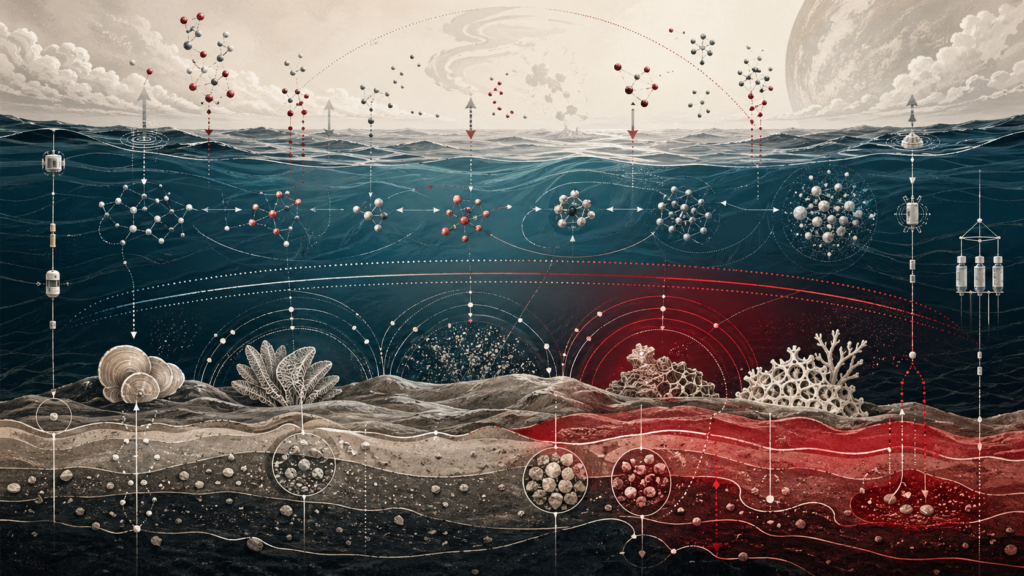
Editorial scientific illustration of ocean chemistry showing seawater layers, air-sea exchange, carbonate-system molecular pathways, marine calcification structures, sediment chemistry, monitoring instruments, deep-ocean carbon storage, and geochemical cycling in cream, black, white, muted gray, and deep red.

Ocean Chemistry and the Carbonate System

Ocean chemistry explains how seawater functions as a chemically active planetary system connecting climate, carbon storage, marine life, sediments, air-sea exchange, and long-term habitability. This article examines seawater composition, major ions, dissolved inorganic carbon, alkalinity, pH, pCO₂, carbonate equilibria, calcium carbonate saturation, ocean acidification, biological calcification, nutrients, oxygen, trace metals, sediments, carbon burial, and ocean monitoring. It shows how the carbonate system buffers atmospheric carbon dioxide while changing seawater chemistry, reducing carbonate ion availability, lowering pH, and affecting calcifying organisms, reefs, shellfish, sediments, and marine ecosystems. By linking carbonate equilibria, alkalinity, saturation state, air-sea flux, Revelle-factor intuition, and reproducible computational workflows, ocean chemistry becomes central to climate regulation and Earth-system habitability.
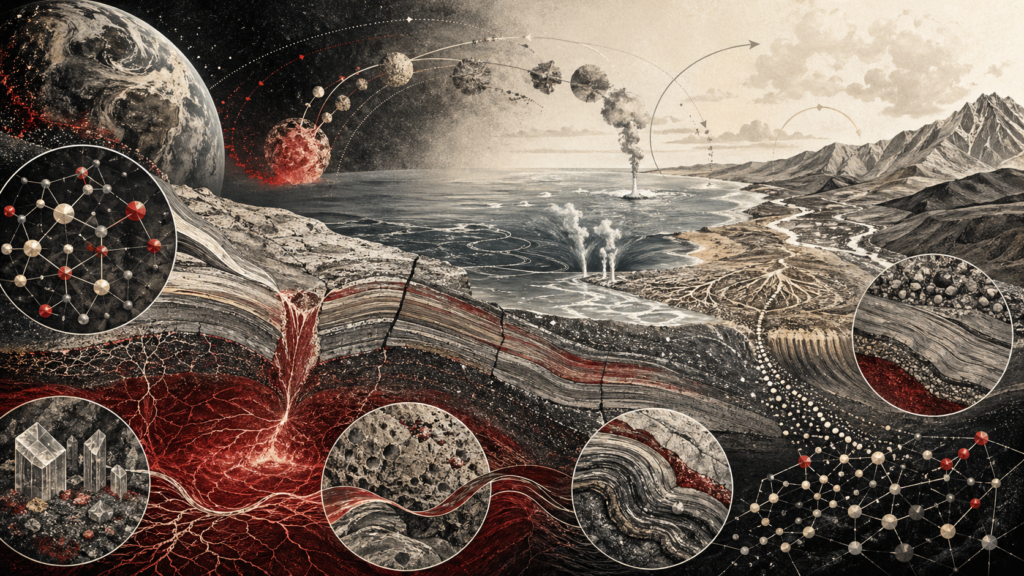
Editorial scientific illustration of geochemistry showing Earth, layered rock strata, mineral structures, volcanic and hydrothermal activity, ocean chemistry, weathering pathways, isotope-like networks, sediment records, and planetary chemical history in cream, black, white, muted gray, and deep red.

Geochemistry and the Chemical History of Earth

Geochemistry explains how Earth’s chemical history is recorded in rocks, minerals, sediments, fluids, gases, isotopes, ores, and planetary materials. This article examines planetary differentiation, element behavior, mineral records, igneous and sedimentary chemistry, stable and radiogenic isotopes, radiometric dating, weathering, crustal recycling, redox evolution, oxygenation, carbon-silicate climate regulation, hydrothermal systems, ore formation, and critical elements. It shows how geochemical evidence connects atomic-scale measurements to deep-time planetary change, including the formation of continents, oceans, atmosphere, climate feedbacks, biological evolution, and habitability. By linking isotope ratios, decay equations, weathering indices, trace-element patterns, mass balance, and reproducible computational workflows, geochemistry becomes a historical science of Earth as a chemically evolving planet.

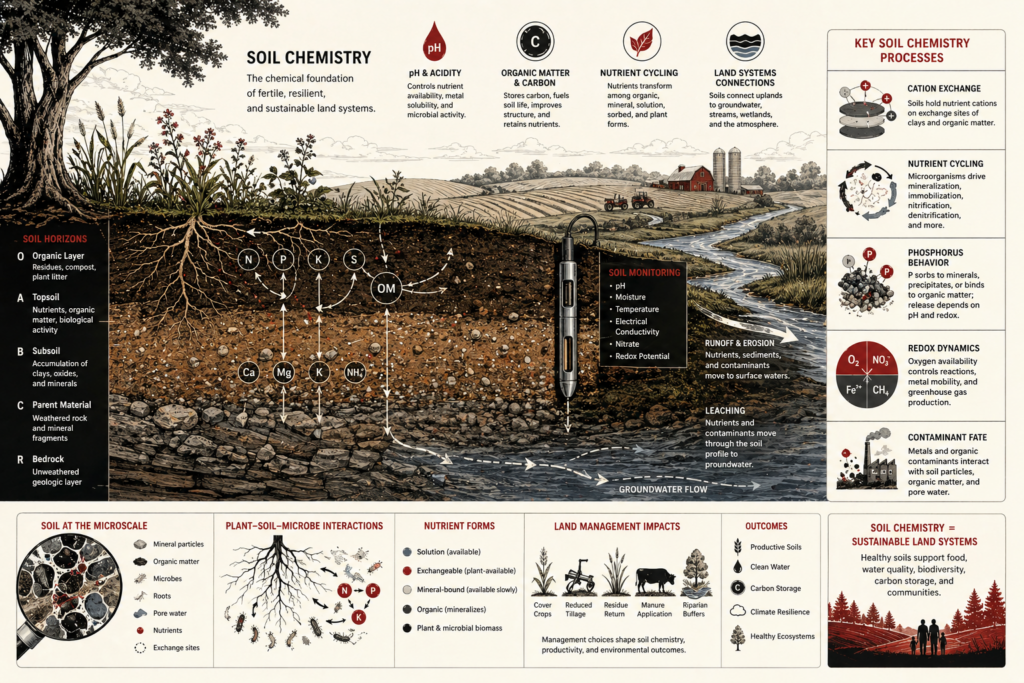
Detailed scientific illustration of soil chemistry showing layered soil horizons, roots, crops, nutrient movement, organic matter, groundwater flow, monitoring probes, land-use systems, and soil-process diagrams in cream, black, white, muted gray, and deep red.

Soil Chemistry, Nutrient Cycles, and Land Systems

Soil chemistry explains how land becomes fertile, resilient, contaminated, restored, or degraded through chemical interactions among minerals, organic matter, water, gases, roots, microbes, nutrients, metals, and reactive surfaces. This article examines soil pH, acidity, liming, cation exchange capacity, base saturation, soil organic carbon, nitrogen cycling, phosphorus behavior, potassium availability, micronutrients, contaminants, redox conditions, wetland soils, nutrient runoff, and land-system impacts on water quality. It connects soil chemical measurements to fertility, carbon storage, erosion, greenhouse-gas production, groundwater protection, downstream eutrophication, environmental justice, and sustainable land management. By linking soil stocks, nutrient balances, exchange chemistry, monitoring design, and reproducible data workflows, soil chemistry becomes essential to understanding how land systems sustain life and transmit chemical pressures across watersheds.

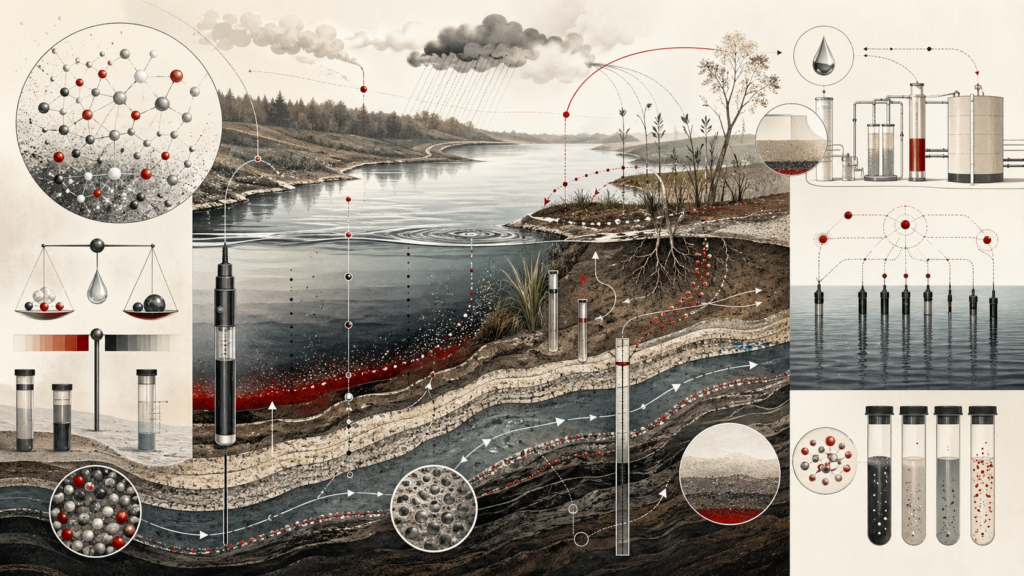
Editorial scientific illustration of water chemistry and environmental monitoring showing a river, subsurface flow, sediment layers, groundwater pathways, sampling tubes, sensor structures, molecular networks, contaminant movement, and laboratory-style water samples in cream, black, white, muted gray, and deep red.

Water Chemistry and Environmental Monitoring

Water chemistry explains how the dissolved, suspended, particulate, biological, and reactive composition of water shapes environmental quality and habitability. This article examines pH, alkalinity, hardness, conductivity, dissolved oxygen, redox conditions, nutrients, metals, organic contaminants, microbial indicators, turbidity, source-water chemistry, groundwater, stormwater, wastewater, and drinking-water systems. It shows why environmental monitoring must connect sampling design, field parameters, laboratory methods, detection limits, quality assurance, units, hydrology, benchmarks, and uncertainty. By linking concentration, chemical load, pH behavior, nutrient transport, oxygen demand, benchmark screening, and reproducible data workflows, water chemistry becomes a foundation for public health, aquatic ecosystems, infrastructure resilience, watershed governance, and sustainable water management.

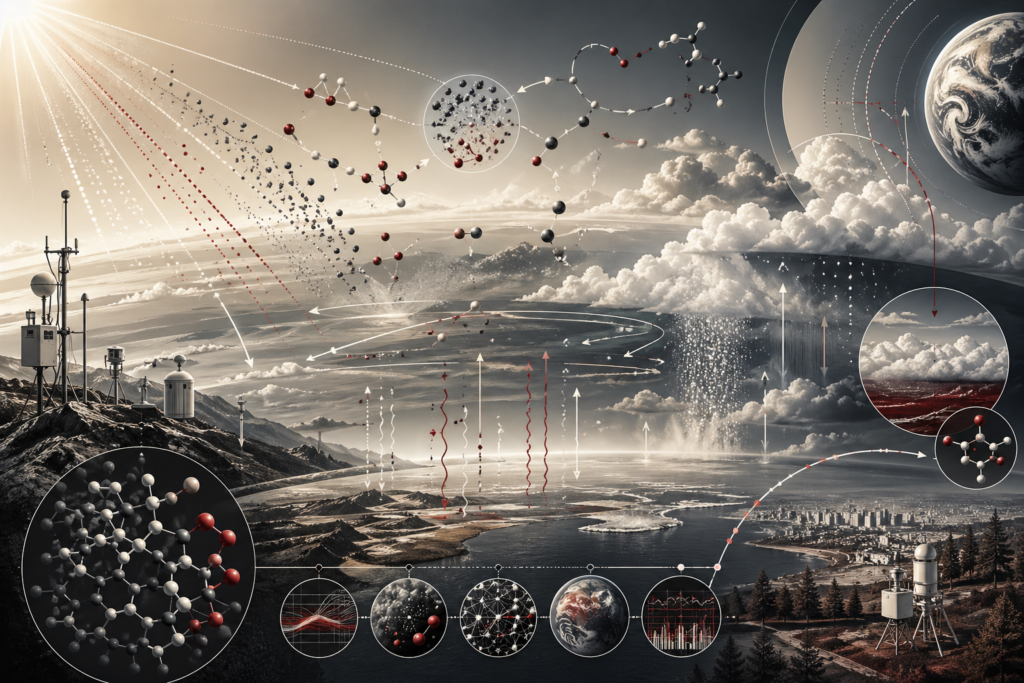
Editorial scientific illustration of atmospheric chemistry showing layered clouds, solar radiation, molecular reaction pathways, aerosols, monitoring instruments, greenhouse-gas dynamics, atmospheric circulation, and climate-process overlays in cream, black, white, muted gray, and deep red.

Atmospheric Chemistry and Climate Processes

Atmospheric chemistry explains how gases, particles, sunlight, radicals, clouds, emissions, deposition, and transport shape climate processes and air quality. This article examines the atmosphere as a chemically active system, connecting greenhouse gases, ozone, aerosols, nitrogen oxides, sulfur compounds, volatile organic compounds, methane oxidation, hydroxyl radical chemistry, photochemical smog, radiative forcing, atmospheric lifetimes, and climate feedbacks. It shows why climate is chemically mediated: molecular composition influences radiation, temperature, oxidation capacity, clouds, precipitation, ecosystem exposure, and human health. By linking reaction rates, first-order lifetimes, carbon dioxide forcing approximations, ozone screening, monitoring networks, and atmospheric evidence, atmospheric chemistry becomes one of the key bridges between molecular science, public health, environmental governance, and planetary habitability.

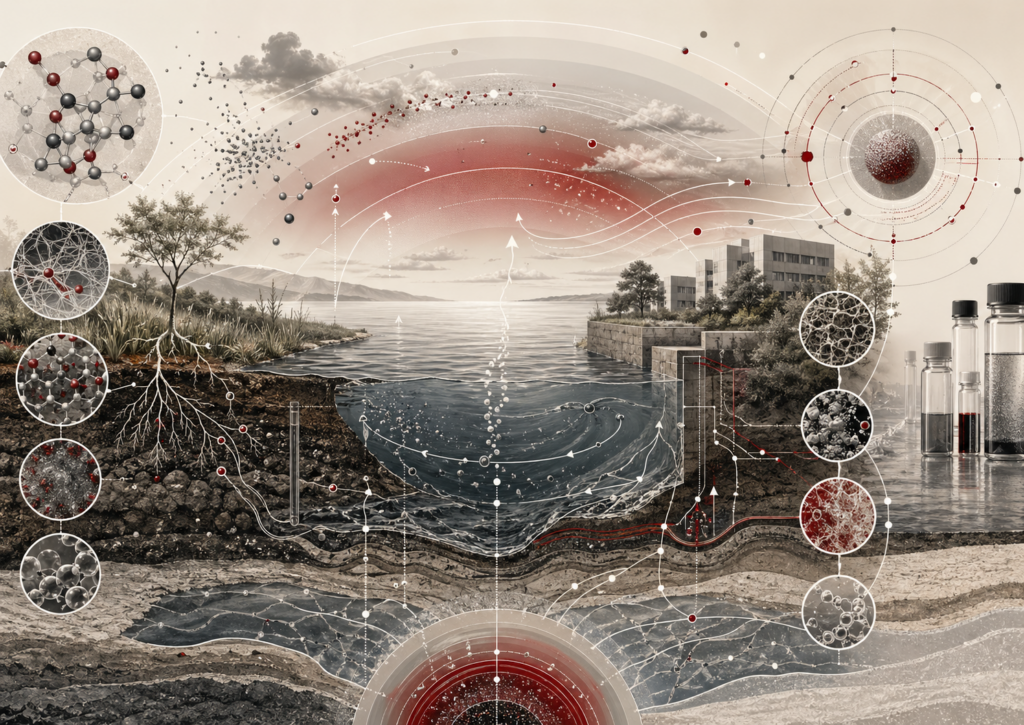
Editorial scientific illustration showing environmental chemistry as an interconnected system across atmosphere, surface water, soil, groundwater, sediments, ecological zones, laboratory monitoring structures, and built environments, with abstract molecular networks, transport pathways, and threshold-like overlays in cream, black, gray, white, and deep red.

Environmental Chemistry and the Chemical Conditions of Habitability

Environmental chemistry explains how the chemical organization of air, water, soil, sediments, organisms, and built environments shapes habitability. This article examines the sources, transport, fate, transformation, partitioning, speciation, persistence, and exposure pathways that determine whether chemical conditions remain compatible with life, ecosystem function, public health, and social use. It connects concentration, thresholds, first-order decay, acid-base behavior, partition coefficients, benchmark screening, monitoring design, quality assurance, and environmental risk interpretation. By treating habitability as a chemically maintained condition rather than a background assumption, environmental chemistry becomes a bridge between molecular science, Earth-system change, public health, ecological resilience, infrastructure, and responsible chemical governance.

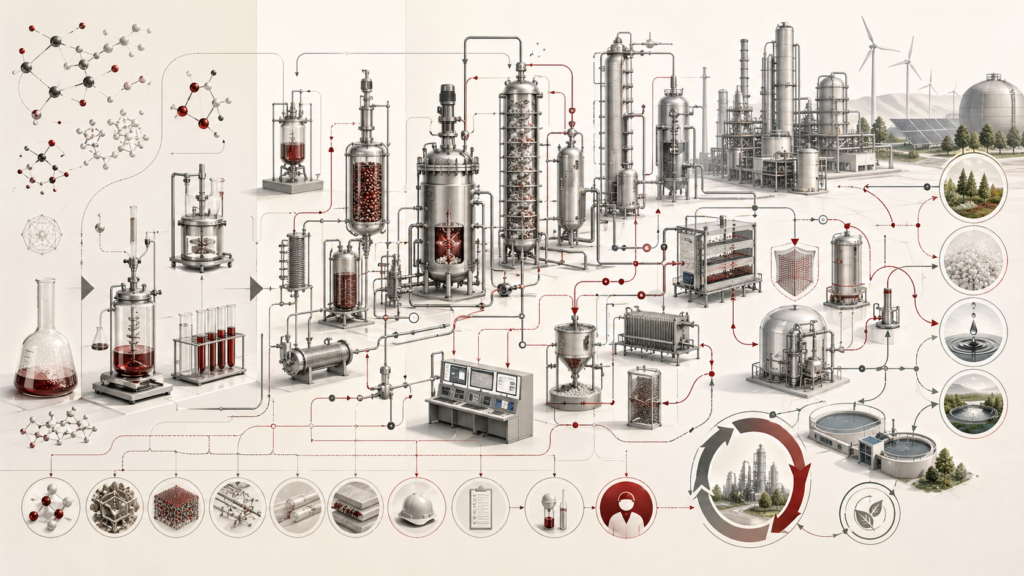
Abstract editorial scientific illustration showing industrial chemistry as a scale-up workflow connecting laboratory reactions, pilot equipment, reactors, separations, process control, safety systems, environmental management, and circular chemical production.

Industrial Chemistry and the Transformation of Scale

Industrial chemistry studies how chemical knowledge becomes reliable production at scale. This article explains why a reaction that works in a flask is not automatically a process, showing how industrial scale transforms chemistry through heat transfer, mass transfer, mixing, reactors, residence time, separations, purification, energy use, process control, safety systems, raw-material supply, waste management, economics, regulation, and lifecycle responsibility. It covers unit operations, process architecture, catalysis, feedstocks, solvent recovery, quality control, process safety, hazard management, industrial decarbonization, conversion, selectivity, yield, E-factor, space-time yield, and a full GitHub scaffold, the article presents industrial chemistry as the disciplined transformation of molecular knowledge into safe, efficient, auditable, and accountable production systems.

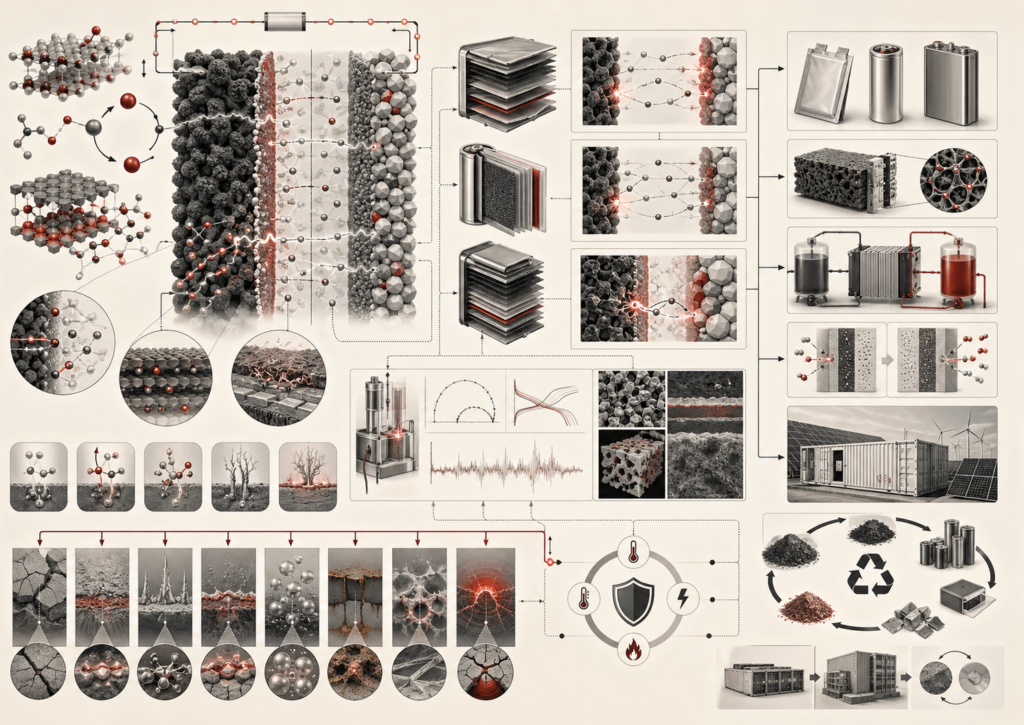
Abstract editorial scientific illustration showing electrochemistry as an energy-storage workflow connecting redox reactions, electrodes, electrolytes, ion transport, batteries, supercapacitors, fuel cells, degradation, safety, recycling, and circular design.

Electrochemistry, Batteries, and Energy Storage

Electrochemistry studies chemical systems in which electrons, ions, electrodes, electrolytes, interfaces, and redox reactions are linked. This article explains how chemical energy becomes electrical energy, how electrical energy drives chemical change, and how batteries, supercapacitors, fuel cells, electrolyzers, corrosion systems, electrochemical sensors, electrodeposition processes, and electrochemical reactors depend on charge transfer. It covers electrochemical cells, anodes, cathodes, electrolytes, separators, redox reactions, electrode potential, overpotential, lithium-ion batteries, intercalation chemistry, solid-electrolyte interphases, supercapacitors, pseudocapacitance, fuel cells, electrolyzers, degradation, safety, characterization, capacity, energy, power, efficiency, critical materials, recycling, and circular battery design.

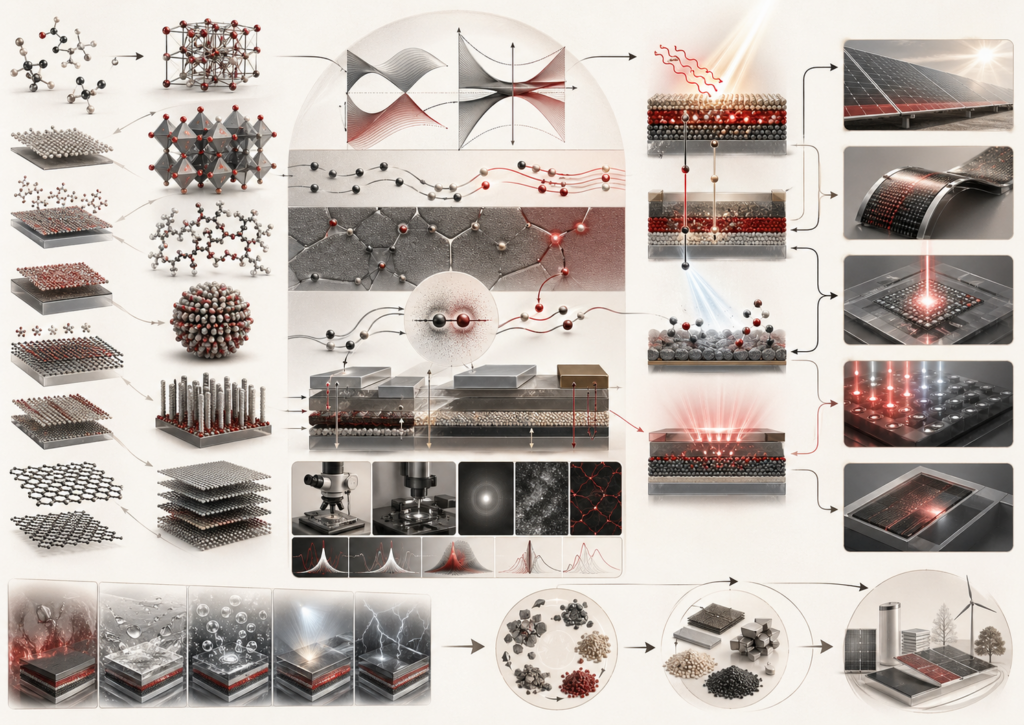
Abstract editorial scientific illustration showing semiconductor, electronic, and photochemical materials as a workflow connecting band structure, charge transport, excited states, photovoltaics, photocatalysis, interfaces, device testing, stability, and responsible lifecycle design.

Semiconductor, Electronic, and Photochemical Materials

Semiconductor, electronic, and photochemical materials connect chemistry to charge, light, information, sensing, energy conversion, and molecular transformation. This article explains how silicon, compound semiconductors, metal oxides, organic semiconductors, perovskites, quantum dots, conjugated polymers, photoactive dyes, photocatalysts, phosphors, dielectrics, electrodes, thin films, two-dimensional materials, nanowires, and hybrid organic-inorganic systems function through band structure, charge transport, defects, interfaces, excited states, recombination, morphology, processing, and stability. It introduces photovoltaic materials, photocatalysis, organic and molecular electronics, device characterization, quantum yield, photon energy, carrier mobility, diffusion length, degradation, critical materials, and lifecycle concerns.

Scroll to Top