
Last Updated May 28, 2026
Industrial chemistry studies how chemical knowledge becomes reliable production at scale. A reaction that works in a flask is not automatically a process. At industrial scale, chemistry becomes entangled with heat transfer, mass transfer, mixing, pressure, corrosion, separations, purification, energy use, process control, safety systems, raw-material supply, waste management, regulation, economics, labor, maintenance, equipment reliability, and lifecycle consequences. Industrial chemistry is therefore not simply “more chemistry.” It is chemistry transformed by scale.
The central thesis of industrial chemistry is that scale changes what counts as good chemistry. A laboratory reaction may be elegant because it gives a high yield under carefully controlled conditions. An industrial process must also be safe, controllable, selective, energy-efficient, separable, reproducible, economically viable, environmentally responsible, auditable, maintainable, and resilient under real operating conditions. Yield matters, but yield alone is not enough. A process that cannot remove heat, control impurities, recover solvent, maintain product quality, protect workers, or manage waste is not industrially mature chemistry.
Industrial chemistry is therefore a systems discipline. It connects molecular transformation to reactors, separations, catalysts, utilities, instrumentation, quality control, process safety, emissions, decarbonization, supply chains, circular material flows, and public accountability. Its core question is not only whether a chemical transformation can occur, but whether it can be operated repeatedly, safely, efficiently, and responsibly at the scale required by society.
Main Library
Publications
Article Map
Chemistry
Related Topic
Environmental Science
Related Topic
Risk & Resilience
Related Topic
Sustainable Development
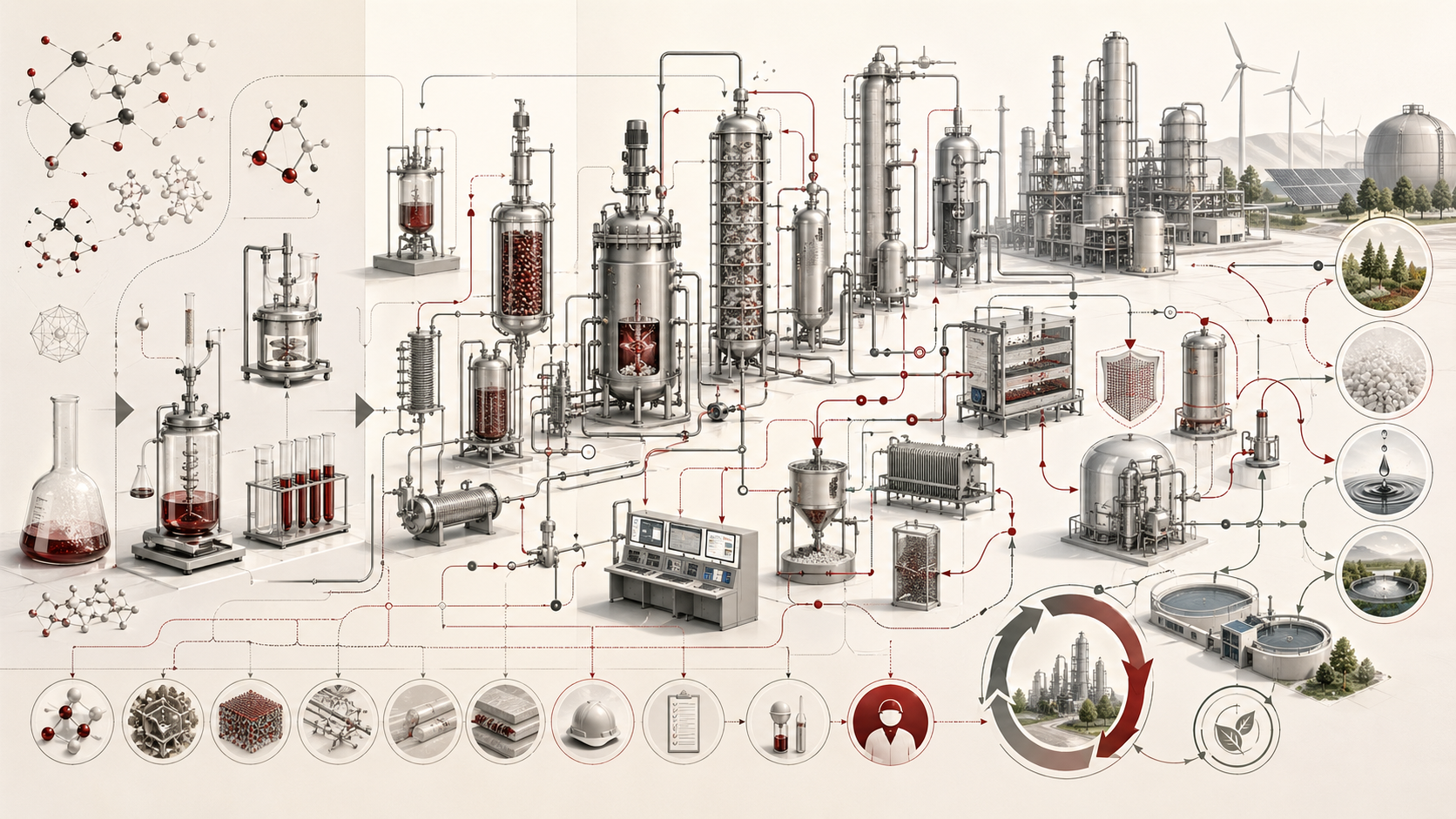
What Industrial Chemistry Studies
Industrial chemistry studies chemical production as a system. It includes reactions, but also the process architecture that makes those reactions repeatable, scalable, safe, and useful. The field covers commodity chemicals, specialty chemicals, polymers, pharmaceuticals, fertilizers, fuels, solvents, coatings, detergents, semiconductors, food ingredients, water-treatment chemicals, battery materials, catalysts, pigments, adhesives, surfactants, gases, electronic materials, construction chemicals, and advanced materials.
Industrial chemistry is concerned with questions that laboratory chemistry alone does not fully answer. Can the reaction be run safely at the required temperature, pressure, concentration, and volume? Can heat be removed or supplied fast enough? Can reactants, catalysts, solvents, gases, solids, and products be mixed effectively? Can the desired product be separated from byproducts, solvents, impurities, catalysts, and unreacted feedstocks? Can product quality be maintained across batches, shifts, seasons, equipment changes, and raw-material variation?
It also asks whether waste, emissions, energy use, hazards, and lifecycle burdens can be reduced before they are created. It asks whether the process can be monitored, controlled, maintained, audited, and improved over time. It asks whether a route is robust enough to survive real feedstock variation, equipment fouling, instrument drift, maintenance cycles, operator interventions, abnormal scenarios, and supply disruptions.
The industrial chemist therefore thinks across molecular chemistry, plant operation, process engineering, analytical chemistry, safety, environmental performance, supply chains, economic feasibility, and social responsibility. Industrial chemistry is not only the chemistry of manufacturing. It is the discipline of turning chemical possibility into dependable material reality.
For researchers and scientists, the key shift is that industrial chemistry evaluates a chemical transformation by its total process profile. A transformation may be scientifically interesting but industrially weak if it depends on rare reagents, hazardous intermediates, extreme dilution, difficult separations, unstable materials, high solvent use, unmanageable heat release, poor impurity control, or excessive waste. Conversely, a less glamorous route may be industrially superior because it is safer, more robust, cheaper to control, easier to separate, and less environmentally burdensome.
Why Scale Changes Chemistry
Scale changes chemistry because physical constraints grow with size. A small flask can often be stirred, heated, cooled, diluted, and quenched quickly. A large reactor cannot always be treated as a bigger flask. Heat removal may become difficult. Mixing may become nonuniform. Local concentration gradients may form. Solids may settle, cake, bridge, or plug. Gases may not disperse evenly. Foaming may become problematic. Corrosion may accelerate. Side reactions may appear because residence time, temperature history, impurity exposure, or mass-transfer behavior changes.
Surface-area-to-volume ratio is one reason scale matters. Small systems can often exchange heat efficiently relative to their volume. Large systems may store more thermal energy and remove heat less quickly. A mild laboratory exotherm can become a serious thermal hazard when scaled. A reaction that is easy to control in a vial may require calorimetry, staged addition, cooling capacity, emergency relief, and interlocks before it can be operated safely in production.
Scale also changes consequences. A minor impurity in a laboratory sample may become a quality failure in manufacturing. A small amount of waste in discovery chemistry may become tons of waste per year. A solvent that is convenient for bench chemistry may be expensive, flammable, toxic, hard to recover, regulated, corrosive, or incompatible with plant materials. A purification step that works by chromatography may be impractical for commodity production. A byproduct that seems minor on paper may control waste-treatment cost, odor, toxicity, color, regulatory status, or downstream catalyst life.
Scale changes uncertainty as well. Raw materials vary by supplier and batch. Equipment has dead zones, fouling, seals, gaskets, valves, welds, control limits, and maintenance histories. Operators work across shifts. Ambient temperature and humidity may change. Instruments drift. Catalyst lots differ. Process water composition varies. A robust industrial process must tolerate these variations without losing safety, quality, or environmental control.
This is why industrial chemistry requires scale-aware thinking from the beginning. The best route is not always the route with the highest laboratory yield. It may be the route with safer reagents, lower heat release, simpler separations, fewer unit operations, better atom economy, lower solvent burden, durable catalysts, recyclable streams, robust impurity control, and wider operating windows.
From Reaction to Process
A reaction becomes a process only when it is connected to feed preparation, charging, mixing, heating, cooling, reaction monitoring, quenching, separation, purification, recycling, waste handling, product isolation, quality control, and documentation. A chemical process is therefore a chain of transformations rather than a single equation. The reaction is central, but it is not the whole system.
A simplified industrial process may include raw-material receiving and qualification; feed pretreatment, drying, filtration, grinding, or purification; reactant metering and charging; reaction under controlled conditions; heat removal or heat supply; in-process sampling and analytical control; quench, neutralization, or phase adjustment; separation of products, solvents, catalysts, salts, solids, gases, or byproducts; solvent recovery or recycle; waste treatment and emissions control; final product purification and formulation; and quality assurance, packaging, storage, and distribution.
Each step has chemical meaning. A drying step may prevent hydrolysis. A filtration step may remove catalyst fines. A distillation step may recover solvent and reduce waste. A neutralization step may control corrosion and downstream compatibility. A crystallization step may determine purity, polymorph, particle size, and filtration performance. A sampling plan may prevent off-spec material from advancing downstream. A recycle stream may improve material efficiency while accumulating impurities if not controlled.
Industrial chemistry also requires process boundaries. A process must define what enters, what leaves, what is recycled, what is vented, what is treated, what is monitored, and what is counted as product, byproduct, waste, impurity, emission, or utility demand. These boundaries determine mass balance, energy balance, environmental reporting, economic analysis, and lifecycle interpretation.
For researchers, the movement from reaction to process is a movement from isolated yield to operational evidence. A reaction scheme is a hypothesis. A process is a controlled, monitored, documented, and repeatable system that survives scale, variation, safety review, environmental constraints, and quality expectations.
Unit Operations and Process Architecture
Unit operations are recurring process steps used across industries. They include mixing, pumping, heat exchange, evaporation, distillation, crystallization, filtration, drying, extraction, absorption, adsorption, membrane separation, compression, fluidization, milling, granulation, blending, packaging, and solids handling. These operations are not merely mechanical. They shape chemical outcomes by controlling residence time, temperature, concentration, phase contact, mass transfer, particle size, impurity profiles, moisture, and stability.
Distillation may determine whether a solvent can be economically recovered. Crystallization may determine product purity, particle size, polymorph, filtration behavior, washing performance, and drying time. Mixing may determine selectivity in fast reactions or prevent dangerous local concentration spikes. Heat exchange may determine whether an exothermic reaction is controllable. Filtration may determine whether catalyst recovery is feasible. Drying may determine product stability, residual solvent, and shelf life.
Process architecture links unit operations into a flowsheet. A flowsheet is a map of material and energy movement. It shows how feedstocks become products, byproducts, recycle streams, emissions, purge streams, wastewater, recovered solvents, and waste. A good flowsheet is not just efficient. It is understandable, controllable, maintainable, inspectable, and safe.
Unit operations also create tradeoffs. A recycle loop may reduce waste but increase impurity buildup. A more aggressive separation may improve purity but increase energy use. A safer solvent may be harder to remove. A continuous process may reduce inventory but require more demanding control. A membrane may save energy but foul under real feed conditions. Industrial chemistry is the craft of balancing these tradeoffs against product requirements, safety, cost, and environmental performance.
For researchers and process developers, unit operations turn chemical knowledge into plant reality. The reaction may define the transformation, but unit operations define whether that transformation can become a reliable manufacturing system.
Reactors, Residence Time, and Process Control
Reactors are the heart of many industrial chemical processes. Batch reactors, semi-batch reactors, continuous stirred-tank reactors, plug-flow reactors, packed-bed reactors, fluidized-bed reactors, tubular reactors, photochemical reactors, electrochemical reactors, microreactors, and flow reactors all create different chemical environments. Reactor choice affects heat transfer, mass transfer, mixing, conversion, selectivity, residence time, safety, scalability, inventory, and process control.
Batch reactors are flexible and useful for multiproduct manufacturing, specialty chemicals, and development settings where product portfolios change. Semi-batch operation can improve control by staging feed addition, limiting reactive inventory, or managing heat release. Continuous reactors can provide consistent operation, high throughput, smaller inventories, and improved heat-transfer control when designed well. Packed-bed reactors are central to many catalytic processes. Flow reactors can improve control of hazardous, fast, photochemical, or highly exothermic reactions by limiting inventory and improving heat and mass transfer.
Residence time is a central concept. Reactants must remain in the reactor long enough to achieve desired conversion, but not so long that side reactions, degradation, fouling, polymerization, decomposition, or overreaction dominate. Residence-time distribution matters because not all material experiences the same history in real equipment. Dead zones, channeling, back-mixing, dispersion, and nonideal flow can alter selectivity and impurity profiles.
Process control transforms chemistry into reliable operation. Sensors, analyzers, control valves, feedback loops, alarms, interlocks, shutdown systems, and advanced process control help maintain temperature, pressure, flow, pH, composition, level, and product quality. Good control does not eliminate chemical risk, but it makes the process observable, responsive, and auditable.
Industrial reactor design also requires abnormal-scenario thinking. What happens if cooling fails? What if feed addition continues after agitation stops? What if a valve sticks, a pump trips, a heat exchanger fouls, a catalyst bed plugs, or an impurity catalyzes a side reaction? A reactor is not only a vessel for chemistry. It is a controlled energy and mass-transfer system whose failure modes must be understood before scale-up.
Separation, Purification, and Product Quality
Separation often dominates industrial cost, energy use, and waste. A reaction that looks attractive in the laboratory may become unattractive if the product is difficult to separate. Solvent choice, boiling points, azeotropes, phase behavior, crystallinity, salt formation, catalyst solubility, impurity profiles, product stability, and water sensitivity all shape separation strategy.
Common separation and purification methods include distillation, evaporation, crystallization, recrystallization, liquid-liquid extraction, filtration, centrifugation, adsorption, ion exchange, membrane separation, drying, solvent removal, gas absorption, stripping, precipitation, phase separation, and chromatography in high-value specialty contexts. Each method has its own energy, waste, capital, safety, and quality implications.
Product quality depends on purity, impurity identity, particle size, moisture, color, odor, viscosity, stability, residual solvent, trace metals, microbial control where relevant, and performance specifications. Analytical chemistry becomes central because industrial production must prove that material meets defined specifications. In-process control, release testing, trend analysis, deviation investigation, and method validation are part of the chemistry of scale.
Separation also determines environmental performance. A process with high reaction yield may still have poor performance if it requires large solvent volumes, repeated washes, energy-intensive distillation, difficult drying, or disposal of salt-heavy aqueous streams. A route with slightly lower conversion may be superior if it simplifies purification, improves recycle, lowers solvent intensity, or avoids hazardous waste.
For researchers, separations should be considered early. It is a mistake to optimize only the reaction and postpone the separation problem. At scale, the separation is often where chemistry, energy, quality, cost, and waste converge.
Catalysis, Feedstocks, and Industrial Transformation
Catalysis is one of industrial chemistry’s most important tools because it can increase rate, improve selectivity, reduce energy demand, change process conditions, and reduce waste. Many large-scale processes depend on heterogeneous catalysts, homogeneous catalysts, enzymes, acid catalysts, base catalysts, redox catalysts, electrocatalysts, photocatalysts, organocatalysts, or supported metal catalysts.
Industrial catalysts must do more than work once. They must maintain activity, selectivity, stability, regenerability, and mechanical integrity under real process conditions. Catalyst poisoning, fouling, sintering, leaching, coking, attrition, hot spots, pressure drop, support degradation, and deactivation can determine whether a process succeeds economically and environmentally. Catalyst life can be as important as initial activity.
Feedstock choice is equally important. Industrial chemistry historically relies heavily on fossil feedstocks, but sustainable transformation increasingly requires attention to biomass, waste carbon, captured carbon dioxide, recycled plastics, low-carbon hydrogen, renewable electricity, nitrogen sources, water, minerals, and circular material streams. Feedstock substitution is not simple. Alternative feedstocks may have different impurity profiles, water content, oxygen content, logistics, seasonality, particle size, trace contaminants, and processing needs.
Industrial transformation also depends on supply resilience. A route that depends on a scarce catalyst metal, fragile supply chain, geopolitically concentrated mineral, or tightly regulated solvent may be vulnerable. A process may be chemically excellent but strategically weak if it cannot secure reliable, responsible feedstock supply. Industrial chemistry increasingly connects route design to material availability, circularity, and supply-chain ethics.
For researchers, catalysis and feedstock strategy should be evaluated together. A catalyst that performs beautifully on purified feed may fail when exposed to real recycled streams, biomass-derived impurities, sulfur, water, chlorides, metals, or variable composition. Industrial chemistry must test the chemistry against the world it will actually encounter.
Analytical Chemistry, Quality Systems, and Process Evidence
Industrial chemistry depends on evidence. A process cannot be controlled if its chemistry cannot be measured. Analytical chemistry provides that evidence through raw-material testing, in-process monitoring, impurity profiling, release testing, stability studies, environmental monitoring, catalyst analysis, residual solvent testing, particle characterization, moisture analysis, and trace-contaminant detection.
Industrial analytical methods include chromatography, spectroscopy, titration, mass spectrometry, elemental analysis, thermal analysis, particle sizing, rheology, microscopy, wet chemistry, online analyzers, process analytical technology, and sensor systems. The appropriate method depends on the decision: identity, purity, concentration, impurity, reaction endpoint, moisture, particle size, stability, or safety.
Quality systems convert measurements into trust. Specifications define acceptable material. Methods define how properties are measured. Calibration maintains instrument reliability. Reference standards support traceability. Control charts identify drift. Deviation investigations explain failures. Change control prevents unintended consequences. Data integrity preserves the evidence trail. A chemical process is not industrially reliable unless its measurements are reliable.
Quality also includes impurity control. At scale, impurities may arise from raw materials, solvents, catalysts, corrosion products, side reactions, degradation, carryover, recycle loops, packaging, cleaning residues, or environmental exposure. Some impurities affect performance; others affect safety, color, odor, regulatory status, shelf life, or customer use. Industrial chemistry must understand not only the product, but the impurity profile that comes with the process.
For researchers, analytical chemistry should be treated as part of process design. A process that cannot be monitored effectively is not ready for responsible scale. A measurement system that cannot distinguish meaningful variation from noise cannot support quality, safety, or improvement.
Process Safety and Hazard Management
Process safety addresses the prevention and mitigation of fires, explosions, toxic releases, runaway reactions, pressure events, incompatible mixing, dust explosions, corrosion failures, uncontrolled polymerization, and other major hazards. It is different from personal safety, though both matter. Personal safety may focus on slips, trips, protective equipment, and routine exposure. Process safety focuses on low-frequency, high-consequence events that can harm workers, communities, equipment, ecosystems, and surrounding infrastructure.
Industrial chemical processes require systematic hazard thinking. What can go wrong if cooling fails? What happens if a feed is charged too fast or in the wrong order? Can a reaction self-heat or run away? Can pressure rise faster than relief systems can respond? Can incompatible materials mix? Can solids plug a line, valve, filter, or vent? Can corrosion weaken equipment? Can dust, vapor, or gas form an explosive atmosphere? Can impurities, water, oxygen, or metals catalyze unwanted reactions? Can maintenance, startup, shutdown, or abnormal operation create conditions not present during normal operation?
Process safety uses tools such as hazard identification, process hazard analysis, layers of protection analysis, relief-system design, management of change, operating procedures, training, mechanical integrity, incident investigation, emergency planning, and audit systems. It also relies on chemical knowledge: reaction calorimetry, thermal stability, incompatibility screening, gas generation, decomposition pathways, pressure behavior, flammability, toxicity, corrosion, and dust explosibility.
Process safety is not a paperwork exercise. It is a way of respecting scale. Large inventories, high energy density, pressure, heat release, toxic materials, flammable vapors, reactive chemistry, and complex equipment demand disciplined design and disciplined operation. A safe process is not merely one that has not yet failed. It is one whose hazards are understood, controlled, monitored, and reviewed as conditions change.
For researchers and process developers, the safety lesson is clear: process hazards should be investigated before scale makes them consequential. A route should not be advanced simply because it works. It should be advanced only when its hazards can be responsibly managed.
Materials, Corrosion, Maintenance, and Mechanical Integrity
Industrial chemistry takes place inside equipment, and equipment is chemically vulnerable. Reactors, pipes, valves, heat exchangers, pumps, seals, gaskets, columns, tanks, filters, dryers, and instruments are exposed to acids, bases, salts, solvents, oxidizers, reducing agents, water, oxygen, pressure, temperature, abrasion, fouling, and microbial activity. Materials compatibility is therefore part of chemical design.
Corrosion can change process safety, product quality, equipment life, and environmental risk. Acidic streams may attack metals. Chlorides can promote localized corrosion. Wet conditions can change compatibility. High temperatures can accelerate degradation. Sulfur, oxygen, oxidants, caustic, ammonia, and halogens can create specific corrosion mechanisms. Corrosion products may contaminate product, poison catalysts, plug equipment, or weaken pressure boundaries.
Mechanical integrity is the operational discipline of ensuring that equipment remains fit for service. Inspection, testing, preventive maintenance, corrosion monitoring, relief-device maintenance, instrument calibration, piping checks, thickness measurements, and documentation all protect process reliability. Industrial chemistry cannot assume that equipment remains chemically neutral over time. Equipment ages, fouls, erodes, corrodes, fatigues, and changes.
Material selection also affects sustainability. A process that requires exotic alloys, frequent replacement, or corrosion-intensive operating conditions may carry higher cost and environmental burden. A route with milder conditions may reduce material stress, maintenance, downtime, and risk. Chemistry that is compatible with durable equipment is often more robust at scale.
For researchers, materials and maintenance are not afterthoughts. Industrial chemistry takes place in physical systems whose chemical interactions can determine safety, economics, and product quality.
Energy, Emissions, and Industrial Decarbonization
Industrial chemistry is energy-intensive because chemical transformation often requires heat, pressure, separation, compression, refrigeration, drying, pumping, or electrochemical work. Separations can be especially energy-demanding, particularly when they rely on repeated vaporization and condensation. Chemical manufacturing also creates process emissions when carbon-containing feedstocks are transformed, fuels are burned, fugitive emissions occur, or byproducts are released.
Industrial decarbonization strategies include energy efficiency and heat integration; electrification of process heat where feasible; low-carbon hydrogen and other low-carbon fuels; renewable electricity for electrochemical and power-intensive processes; carbon capture, utilization, and storage; process intensification and improved reactors; lower-temperature catalysts and separations; solvent recovery, recycling, and waste minimization; biobased, recycled, or captured-carbon feedstocks; and digital process control, optimization, and predictive maintenance.
Decarbonization must be system-aware. Electrifying a process helps most when electricity is low-carbon and the process is technically suitable. A low-carbon feedstock may still require energy-intensive upgrading. Carbon capture may reduce direct emissions but add energy demand. Recycling may reduce primary extraction but require purification, sorting, and compatible product design. A process that lowers plant emissions may shift burden upstream if feedstock production, mining, or transport is not considered.
Industrial chemistry also intersects with hard-to-abate sectors. Ammonia, methanol, ethylene, propylene, cement additives, polymers, solvents, specialty chemicals, battery materials, and fertilizers all sit within complex material and energy systems. Decarbonizing them requires chemistry, engineering, infrastructure, policy, and market alignment. There is no single universal solution.
For researchers, industrial decarbonization requires life-cycle reasoning. A route should be evaluated not only by direct plant efficiency, but by feedstock origin, energy source, emissions, co-products, waste, equipment life, product use, end-of-life options, and substitution consequences. Industrial chemistry is a major site where climate responsibility becomes technical design.
Waste, Circularity, and Resource Recovery
Industrial chemical production generates material flows beyond the desired product. These include solvents, salts, spent catalysts, aqueous streams, off-gases, purge streams, filter cakes, residues, packaging waste, wastewater, emissions-control media, cleaning solutions, and off-spec material. Waste is not only an environmental problem. It is often a sign of inefficient chemistry, poor selectivity, excessive solvent use, difficult separation, or weak process design.
Green chemistry and circular chemistry push industrial practice toward prevention. Waste should be reduced at the source where possible rather than treated only after formation. Atom economy, selectivity, catalyst recovery, solvent recovery, recycle loops, lower-hazard reagents, safer solvents, process intensification, and product design for end-of-life can all reduce waste burden. The strongest industrial chemistry avoids creating unnecessary waste rather than simply improving waste treatment.
Circularity is more demanding than recycling slogans suggest. Recycled streams may contain impurities, additives, degradation products, mixed polymers, colorants, moisture, metals, and variable composition. Chemical recycling may require substantial energy, catalysts, separations, and emissions control. Solvent recycling may accumulate impurities. Catalyst recycling may require metal recovery and purification. Circular chemistry requires real mass balances, energy balances, quality specifications, and contamination controls.
Resource recovery also includes water, heat, carbon, metals, nutrients, and solvents. Wastewater may contain recoverable chemicals or energy but also contaminants. Off-gases may contain recoverable solvents or carbon dioxide. Spent catalysts may contain valuable metals. Process heat may be integrated across operations. Industrial chemistry becomes more sustainable when it treats every stream as a material-flow question.
For researchers, waste and circularity should be quantified. Claims about circularity require evidence: mass recovered, quality achieved, energy used, emissions produced, contaminants managed, and whether the recovered material actually displaces virgin production. Industrial chemistry should make circular claims auditable.
Digital Industrial Chemistry and Process Intelligence
Industrial chemistry increasingly depends on data systems. Sensors, online analyzers, process historians, laboratory information management systems, control systems, manufacturing execution systems, maintenance records, quality databases, environmental reporting systems, and supply-chain records together form a digital evidence layer around chemical production.
Digital process intelligence can support process control, anomaly detection, predictive maintenance, energy optimization, yield improvement, impurity tracking, batch comparison, emissions monitoring, and safety review. However, digital tools are only as trustworthy as their data. Sensor drift, missing metadata, inconsistent units, manual entries, calibration gaps, changed operating conditions, and undocumented process modifications can weaken analysis.
Industrial chemistry also benefits from process analytical technology, digital twins, mechanistic models, statistical process control, machine learning, and advanced optimization. These methods can help detect deviations, improve control, identify process windows, reduce waste, and predict equipment or quality issues. But they cannot replace chemical understanding. A model that predicts an impurity trend without understanding chemistry may fail when raw materials, catalysts, equipment, or operating regimes change.
Data governance is therefore part of industrial chemistry. Process data should preserve units, timestamps, equipment identifiers, method context, calibration state, operating mode, batch genealogy, quality status, maintenance events, and change-control history. A process historian without chemical context can create false confidence. A well-governed data system can turn production into a learning system.
For researchers and engineers, digital industrial chemistry should be grounded in mechanism, measurement, and accountability. The goal is not simply automation. The goal is safer, cleaner, more reliable, more auditable chemical production.
Responsible Scale and Chemical Accountability
Industrial chemistry has enormous social value. It supplies medicines, fertilizers, clean-water chemicals, polymers, electronics, batteries, building materials, hygiene products, fuels, coatings, adhesives, food ingredients, and countless materials that support modern life. It also carries responsibility because industrial scale magnifies hazards, emissions, waste, extraction, transport, labor exposure, community risk, and end-of-life consequences.
Responsible industrial chemistry includes designing safer routes before hazards are locked into equipment; minimizing waste at the source rather than relying only on treatment; reducing solvent intensity and choosing safer solvents where possible; designing separations, catalysts, and recycles to reduce material loss; using process safety analysis before scale-up; testing thermal stability, incompatibilities, pressure relief, and abnormal scenarios; tracking energy, emissions, water, waste, and lifecycle impacts; and building processes that can be monitored, controlled, maintained, and audited.
It also includes protecting workers and surrounding communities. Industrial chemistry is often located in specific places: ports, industrial corridors, river valleys, mining regions, refinery zones, manufacturing parks, and communities with long histories of unequal environmental burden. A responsible process is not only one that meets product specifications. It is one that manages exposure, emergency risk, emissions, waste, transport hazards, and community trust.
The ethical strength of industrial chemistry lies in disciplined scale. Chemistry becomes socially powerful when it can produce useful materials reliably, safely, and responsibly. But that same scale requires humility: every reaction route, unit operation, solvent, catalyst, feedstock, waste stream, control system, and product pathway becomes part of a larger human and environmental system.
For institutions, accountability means making industrial chemistry auditable. Mass balances, emissions reports, incident histories, product stewardship, safety reviews, quality records, waste data, energy metrics, and lifecycle assessments should not be hidden behind vague claims of efficiency or innovation. Responsible scale requires evidence.
Mathematical Lens: Conversion, Selectivity, Yield, E-Factor, and Scale
Industrial chemistry uses quantitative metrics to compare routes and diagnose performance. Conversion describes how much of a reactant is consumed:
X_A = \frac{n_{A,0} – n_A}{n_{A,0}}
\]
Interpretation: \(X_A\) is conversion of reactant \(A\), \(n_{A,0}\) is the initial amount, and \(n_A\) is the final amount. High conversion does not necessarily mean high desired-product formation.
Selectivity describes how much desired product is formed relative to undesired products or consumed reactant. A simplified selectivity expression is:
S_P = \frac{n_P}{n_{\mathrm{byproducts}}}
\]
Interpretation: \(n_P\) is the amount of desired product and \(n_{\mathrm{byproducts}}\) is the amount of byproducts. In practice, selectivity definitions must state whether they are based on moles, carbon atoms, mass, limiting reactant, or product families.
Yield connects actual product formation to theoretical product formation:
Y_P = \frac{n_{P,\mathrm{actual}}}{n_{P,\mathrm{theoretical}}}
\]
Interpretation: \(Y_P\) measures how much product is obtained relative to the theoretical maximum. Yield must be interpreted with purity, isolation method, and mass-balance closure.
Atom economy measures how much reactant mass is incorporated into the desired product:
\mathrm{Atom\ Economy} = \frac{M_{\mathrm{desired\ product}}}{\sum M_{\mathrm{reactants}}}
\]
Interpretation: Atom economy helps evaluate intrinsic route efficiency, but it does not include solvent, energy, workup, separation, or yield losses.
E-factor measures waste per product mass:
E = \frac{m_{\mathrm{waste}}}{m_{\mathrm{product}}}
\]
Interpretation: Lower E-factor usually indicates less waste per product mass. Interpretation depends on what is counted as waste, whether water is included, and how recycle streams are handled.
Process mass intensity can be written as:
PMI = \frac{m_{\mathrm{total\ input}}}{m_{\mathrm{product}}}
\]
Interpretation: \(PMI\) measures total material input per product mass. It is often useful because it includes solvents, reagents, catalysts, and other process materials.
Space-time yield connects production rate to reactor volume:
STY = \frac{m_{\mathrm{product}}}{V_{\mathrm{reactor}}t}
\]
Interpretation: \(STY\) measures product mass produced per reactor volume per time. Higher values can indicate more intensive use of equipment, but must be interpreted with safety, control, heat transfer, and quality.
Residence time for a continuous reactor is often approximated by:
\tau = \frac{V}{\dot{V}}
\]
Interpretation: \(V\) is reactor volume and \(\dot{V}\) is volumetric flow rate. Real reactors may have residence-time distributions rather than one uniform residence time.
A simplified heat-release relation can be written as:
Q = n\Delta H
\]
Interpretation: \(Q\) is heat released or absorbed, \(n\) is extent of reaction or amount transformed, and \(\Delta H\) is reaction enthalpy. At scale, heat release becomes a central safety and control issue.
These metrics show why industrial chemistry must be judged by more than yield. A process may have high yield but poor atom economy, high solvent burden, slow throughput, difficult separation, excessive energy demand, unstable quality, or unacceptable safety risk. Quantitative metrics are useful because they expose tradeoffs that a reaction scheme alone can hide.
Computational Workflows for Industrial Chemistry
Computational industrial chemistry can make route selection, process screening, batch performance, quality variation, and scale-up review more transparent. A workflow can track route identifier, process type, theoretical product, actual product, waste mass, solvent mass, energy demand, reactor volume, batch time or residence time, hazard score, separation difficulty, feedstock risk, yield, E-factor, solvent intensity, energy intensity, space-time yield, quality flags, and review status.
Useful workflows include process-metric calculation, scale-up risk screening, solvent-intensity comparison, batch-replicate analysis, process capability estimation, impurity trend monitoring, energy-intensity tracking, waste-stream accounting, reactor-throughput comparison, catalyst-life tracking, deviation review, and quality-control dashboards. More advanced workflows may integrate process historians, laboratory information management systems, maintenance records, environmental reporting, production scheduling, and supply-chain data.
For researchers, computational workflows should preserve assumptions. What counts as waste? Is solvent recycled or consumed? Are water and cleaning streams included? Is yield based on isolated product or in-process assay? Is energy measured at the reactor, unit operation, plant, or lifecycle level? Are quality values based on validated methods? Is a hazard score from expert review, calorimetry, historical incident data, or simplified screening? These details determine whether a metric is useful or misleading.
Computational industrial chemistry should also avoid false optimization. A numerical score can rank process options, but the score depends on weights, thresholds, data quality, and missing variables. A model should support expert review, not replace process safety, environmental review, quality systems, or engineering design.
The examples below use synthetic data. They do not design a plant, approve a chemical process, determine regulatory compliance, certify process safety, or support investment decisions. Their purpose is to show how industrial chemistry can be structured as transparent decision evidence.
Python Example: Process Screening and Scale-Up Risk Flags
The following Python example uses synthetic educational data to screen candidate industrial routes. It calculates yield, E-factor, solvent intensity, energy intensity, space-time yield, and scale-up review flags. Real process development requires validated thermochemistry, reaction calorimetry, hazard studies, equipment design, process controls, environmental review, quality systems, and economic analysis.
from dataclasses import dataclass
from pathlib import Path
from typing import Dict, List
import json
import csv


@dataclass
class IndustrialRoute:
    """Synthetic educational industrial chemistry route.

    This example does not design, approve, or validate any real process.
    Real industrial development requires validated chemistry, thermochemistry,
    process safety review, engineering design, environmental assessment,
    quality systems, and economic analysis.
    """

    route_id: str
    process_type: str
    theoretical_product_kg: float
    actual_product_kg: float
    waste_kg: float
    solvent_kg: float
    energy_kwh: float
    reactor_volume_m3: float
    batch_or_residence_time_h: float
    hazard_score: float
    separation_difficulty_score: float
    feedstock_risk_score: float


def safe_divide(numerator: float, denominator: float) -> float:
    """Divide safely and return zero when denominator is unavailable."""
    if denominator <= 0: return 0.0 return numerator / denominator def route_metrics(route: IndustrialRoute) -> Dict[str, object]:
    """Calculate transparent industrial process-screening metrics."""

    yield_fraction = safe_divide(
        route.actual_product_kg,
        route.theoretical_product_kg
    )

    e_factor = safe_divide(route.waste_kg, route.actual_product_kg)
    solvent_intensity = safe_divide(route.solvent_kg, route.actual_product_kg)
    energy_intensity = safe_divide(route.energy_kwh, route.actual_product_kg)

    space_time_yield = safe_divide(
        route.actual_product_kg,
        route.reactor_volume_m3 * route.batch_or_residence_time_h
    )

    waste_review = e_factor > 1.0
    solvent_review = solvent_intensity > 2.0
    energy_review = energy_intensity > 3.0
    hazard_review = route.hazard_score > 0.60
    separation_review = route.separation_difficulty_score > 0.70

    scale_up_review = any([
        waste_review,
        solvent_review,
        energy_review,
        hazard_review,
        separation_review,
    ])

    # Lower score is better. Weights are illustrative and should be
    # replaced by project-specific expert review in real settings.
    screening_score = (
        1.5 * (1.0 - yield_fraction)
        + 1.2 * e_factor
        + 0.7 * solvent_intensity
        + 0.5 * energy_intensity
        + 1.4 * route.hazard_score
        + 1.0 * route.separation_difficulty_score
        + 0.6 * route.feedstock_risk_score
        - 0.04 * space_time_yield
    )

    return {
        "route_id": route.route_id,
        "process_type": route.process_type,
        "yield_fraction": round(yield_fraction, 3),
        "e_factor": round(e_factor, 3),
        "solvent_intensity": round(solvent_intensity, 3),
        "energy_intensity_kwh_kg": round(energy_intensity, 3),
        "space_time_yield_kg_m3_h": round(space_time_yield, 3),
        "waste_review_required": waste_review,
        "solvent_review_required": solvent_review,
        "energy_review_required": energy_review,
        "hazard_review_required": hazard_review,
        "separation_review_required": separation_review,
        "scale_up_review_required": scale_up_review,
        "screening_score": round(screening_score, 3),
    }


routes: List[IndustrialRoute] = [
    IndustrialRoute("ind_A", "batch_specialty", 1000, 820, 420, 1500, 2200, 12.0, 10.0, 0.42, 0.50, 0.46),
    IndustrialRoute("ind_B", "continuous_catalytic", 1000, 910, 210, 350, 1600, 8.0, 4.0, 0.35, 0.32, 0.58),
    IndustrialRoute("ind_C", "solvent_heavy_batch", 1000, 760, 1800, 4200, 3600, 15.0, 14.0, 0.68, 0.82, 0.40),
    IndustrialRoute("ind_D", "flow_intensified", 1000, 880, 260, 600, 1400, 3.0, 1.5, 0.38, 0.36, 0.44),
    IndustrialRoute("ind_E", "biobased_route", 1000, 790, 520, 1100, 1900, 10.0, 8.0, 0.31, 0.55, 0.35),
]

ranked = sorted(
    [route_metrics(route) for route in routes],
    key=lambda row: row["screening_score"]
)

for rank, row in enumerate(ranked, start=1):
    row["rank"] = rank

output_dir = Path("outputs")
output_dir.mkdir(exist_ok=True)

csv_path = output_dir / "industrial_process_screening_ranked.csv"
with csv_path.open("w", newline="", encoding="utf-8") as file:
    writer = csv.DictWriter(file, fieldnames=list(ranked[0].keys()))
    writer.writeheader()
    writer.writerows(ranked)

manifest = {
    "workflow": "synthetic_industrial_chemistry_process_screening",
    "metrics": [
        "yield_fraction",
        "e_factor",
        "solvent_intensity",
        "energy_intensity_kwh_kg",
        "space_time_yield_kg_m3_h",
        "scale_up_review_required",
    ],
    "best_candidate": ranked[0]["route_id"],
    "responsible_use": [
        "Synthetic educational data only.",
        "Real process development requires validated chemistry, thermochemistry, process safety review, equipment design, environmental assessment, quality systems, and economic analysis.",
    ],
}

with (output_dir / "industrial_chemistry_manifest.json").open("w", encoding="utf-8") as file:
    json.dump(manifest, file, indent=2)

for row in ranked:
    print({
        "rank": row["rank"],
        "route_id": row["route_id"],
        "process_type": row["process_type"],
        "yield_fraction": row["yield_fraction"],
        "e_factor": row["e_factor"],
        "solvent_intensity": row["solvent_intensity"],
        "energy_intensity_kwh_kg": row["energy_intensity_kwh_kg"],
        "space_time_yield_kg_m3_h": row["space_time_yield_kg_m3_h"],
        "screening_score": row["screening_score"],
        "scale_up_review_required": row["scale_up_review_required"],
    })
This workflow shows why industrial process selection is multi-objective. The best route is not necessarily the one with the highest yield. A route with moderate yield but low waste, manageable hazards, easy separation, lower solvent intensity, better throughput, and lower energy demand may be preferable. The important point is not the synthetic ranking itself, but the auditable structure of the comparison.
R Example: Batch Replicates, Yield Variation, and Process Capability
The following R example uses synthetic batch data to summarize yield variation, impurity levels, and process capability. In real manufacturing, batch variation can arise from raw-material impurities, mixing history, temperature control, equipment condition, sampling error, operator practice, aging catalysts, fouling, humidity, cleaning residues, or analytical variability.
batch_id <- paste0("B", sprintf("%03d", 1:12))

route_id <- rep(c("ind_B", "ind_D"), each = 6)

yield_fraction <- c(
  0.91, 0.90, 0.92, 0.89, 0.91, 0.90,
  0.88, 0.87, 0.89, 0.86, 0.88, 0.87
)

impurity_percent <- c(
  0.42, 0.45, 0.39, 0.51, 0.44, 0.47,
  0.62, 0.70, 0.58, 0.76, 0.65, 0.69
)

energy_kwh_kg <- c(
  1.72, 1.80, 1.69, 1.85, 1.76, 1.78,
  1.55, 1.61, 1.58, 1.66, 1.60, 1.63
)

batches <- data.frame(
  batch_id,
  route_id,
  yield_fraction,
  impurity_percent,
  energy_kwh_kg
)

summary_table <- aggregate(
  cbind(yield_fraction, impurity_percent, energy_kwh_kg) ~ route_id,
  data = batches,
  FUN = function(x) c(mean = mean(x), sd = sd(x), min = min(x), max = max(x))
)

summary_clean <- data.frame(
  route_id = summary_table$route_id,
  mean_yield_fraction = summary_table$yield_fraction[, "mean"],
  sd_yield_fraction = summary_table$yield_fraction[, "sd"],
  min_yield_fraction = summary_table$yield_fraction[, "min"],
  max_yield_fraction = summary_table$yield_fraction[, "max"],
  mean_impurity_percent = summary_table$impurity_percent[, "mean"],
  sd_impurity_percent = summary_table$impurity_percent[, "sd"],
  max_impurity_percent = summary_table$impurity_percent[, "max"],
  mean_energy_kwh_kg = summary_table$energy_kwh_kg[, "mean"]
)

# Simplified capability-like estimate for impurity specification.
# Assumes upper specification limit of 1.00% impurity.
upper_spec_impurity <- 1.00

capability <- aggregate(
  impurity_percent ~ route_id,
  data = batches,
  FUN = function(x) (upper_spec_impurity - mean(x)) / (3 * sd(x))
)

names(capability)[2] <- "simple_cpu_impurity"

summary_clean <- merge(summary_clean, capability, by = "route_id")

summary_clean$quality_review_required <- (
  summary_clean$max_impurity_percent > 0.80 |
  summary_clean$simple_cpu_impurity < 1.33
)

dir.create("outputs", showWarnings = FALSE)

write.csv(
  batches,
  file = "outputs/industrial_batch_data_processed.csv",
  row.names = FALSE
)

write.csv(
  summary_clean,
  file = "outputs/industrial_batch_process_summary.csv",
  row.names = FALSE
)

sink("outputs/industrial_chemistry_batch_report.txt")
cat("Synthetic Industrial Chemistry Batch Report\n")
cat("==========================================\n\n")
cat("Batch process summary:\n")
print(summary_clean)
cat("\nResponsible-use note:\n")
cat("Synthetic educational data only. Real industrial process capability requires validated sampling, analytical methods, specifications, statistical review, and quality systems.\n")
sink()

print(batches)
print(summary_clean)
This workflow highlights a core industrial principle: reproducibility is not just whether a reaction works once. It is whether the process stays within specifications over time, across variation, and under controlled operating conditions. A route with slightly lower average yield but tighter impurity control may be more attractive than a route with higher apparent yield and unstable quality.
SQL Example: Industrial Chemistry Evidence Register
Industrial chemistry interpretation becomes more reliable when route data, batch records, process metrics, quality results, safety reviews, and environmental indicators are traceable. A simple evidence register can preserve the structure needed to audit route selection, scale-up review, and process performance.
CREATE TABLE industrial_route (
    route_id TEXT PRIMARY KEY,
    process_type TEXT NOT NULL,
    route_description TEXT,
    feedstock_context TEXT,
    catalyst_context TEXT,
    solvent_context TEXT,
    development_stage TEXT,
    responsible_use_notes TEXT
);

CREATE TABLE process_screening_metric (
    metric_id INTEGER PRIMARY KEY,
    route_id TEXT NOT NULL,
    theoretical_product_kg REAL CHECK (theoretical_product_kg >= 0),
    actual_product_kg REAL CHECK (actual_product_kg >= 0),
    waste_kg REAL CHECK (waste_kg >= 0),
    solvent_kg REAL CHECK (solvent_kg >= 0),
    energy_kwh REAL CHECK (energy_kwh >= 0),
    reactor_volume_m3 REAL CHECK (reactor_volume_m3 >= 0),
    process_time_h REAL CHECK (process_time_h >= 0),
    hazard_score REAL CHECK (hazard_score BETWEEN 0 AND 1),
    separation_difficulty_score REAL CHECK (separation_difficulty_score BETWEEN 0 AND 1),
    feedstock_risk_score REAL CHECK (feedstock_risk_score BETWEEN 0 AND 1),
    review_status TEXT,
    FOREIGN KEY (route_id) REFERENCES industrial_route(route_id)
);

CREATE TABLE batch_quality_record (
    batch_id TEXT PRIMARY KEY,
    route_id TEXT NOT NULL,
    production_datetime TEXT,
    yield_fraction REAL CHECK (yield_fraction BETWEEN 0 AND 1),
    impurity_percent REAL CHECK (impurity_percent >= 0),
    residual_solvent_percent REAL CHECK (residual_solvent_percent >= 0),
    energy_kwh_kg REAL CHECK (energy_kwh_kg >= 0),
    quality_flag TEXT,
    deviation_notes TEXT,
    FOREIGN KEY (route_id) REFERENCES industrial_route(route_id)
);

CREATE TABLE process_safety_review (
    safety_review_id INTEGER PRIMARY KEY,
    route_id TEXT NOT NULL,
    review_type TEXT,
    review_date TEXT,
    thermal_hazard_review_completed INTEGER CHECK (thermal_hazard_review_completed IN (0, 1)),
    relief_review_completed INTEGER CHECK (relief_review_completed IN (0, 1)),
    incompatible_materials_review_completed INTEGER CHECK (incompatible_materials_review_completed IN (0, 1)),
    management_of_change_required INTEGER CHECK (management_of_change_required IN (0, 1)),
    review_notes TEXT,
    FOREIGN KEY (route_id) REFERENCES industrial_route(route_id)
);

CREATE TABLE environmental_process_indicator (
    environmental_id INTEGER PRIMARY KEY,
    route_id TEXT NOT NULL,
    indicator_name TEXT,
    indicator_value REAL,
    unit TEXT,
    boundary_definition TEXT,
    calculation_notes TEXT,
    quality_flag TEXT,
    FOREIGN KEY (route_id) REFERENCES industrial_route(route_id)
);

SELECT
    r.route_id,
    r.process_type,
    ROUND(m.actual_product_kg / NULLIF(m.theoretical_product_kg, 0), 3) AS yield_fraction,
    ROUND(m.waste_kg / NULLIF(m.actual_product_kg, 0), 3) AS e_factor,
    ROUND(m.solvent_kg / NULLIF(m.actual_product_kg, 0), 3) AS solvent_intensity,
    ROUND(m.energy_kwh / NULLIF(m.actual_product_kg, 0), 3) AS energy_intensity_kwh_kg,
    ROUND(
        m.actual_product_kg / NULLIF(m.reactor_volume_m3 * m.process_time_h, 0),
        3
    ) AS space_time_yield_kg_m3_h,
    CASE
        WHEN m.hazard_score > 0.60 THEN 'hazard review required'
        WHEN m.separation_difficulty_score > 0.70 THEN 'separation review required'
        WHEN (m.waste_kg / NULLIF(m.actual_product_kg, 0)) > 1.0 THEN 'waste review required'
        ELSE 'standard review'
    END AS screening_result
FROM industrial_route r
JOIN process_screening_metric m
    ON r.route_id = m.route_id
ORDER BY e_factor ASC, yield_fraction DESC;
The purpose of this register is to keep industrial chemistry attached to evidence. A route-selection decision should preserve how yield, waste, solvent intensity, energy intensity, throughput, hazard review, quality performance, and environmental indicators were calculated. Without provenance, process metrics can become polished but weak claims.
GitHub Repository
The companion repository for this article can support reproducible workflows for industrial process screening, yield and waste metrics, solvent and energy intensity, space-time yield, batch variation, process capability, quality flags, SQL provenance, and responsible industrial-chemistry interpretation.
Complete Code Repository
The full code distribution for this article, including selected industrial chemistry examples, expanded computational workflows, reproducible data structures, provenance documentation, process-screening metrics, batch-quality summaries, SQL evidence registers, and scientific-computing scaffolding, is available on GitHub.
Limits, Uncertainty, and Responsible Interpretation
Industrial chemistry is difficult to generalize because processes differ by product, scale, chemistry, equipment, regulatory context, market, feedstock, and risk profile. A metric that matters strongly for one process may be less central for another. A high E-factor may be unacceptable in commodity manufacturing but common in high-value pharmaceutical contexts, where purity and patient safety dominate. A continuous process may be superior for one chemistry and unsuitable for another. A biobased feedstock may lower fossil dependence but introduce variability, land-use concerns, or difficult separations.
Process data also contain uncertainty. Laboratory yields may not predict plant yields. Screening scores may omit important hazards. Energy calculations may exclude upstream burdens. Waste metrics may change depending on whether water, solvent recycle, purge streams, or cleaning operations are included. Quality data may reflect analytical method variation. Batch records may miss operator interventions, maintenance events, or raw-material differences. Process safety review may reveal hazards not visible in simplified models.
Uncertainty should not be hidden. Industrial chemistry is strongest when it distinguishes laboratory evidence, pilot evidence, plant evidence, modeled evidence, and operational evidence. It should also distinguish technical feasibility from responsible deployment. A process can be technically feasible but environmentally weak, economically fragile, unsafe under abnormal conditions, dependent on problematic feedstocks, or unjust in its distribution of risk.
The computational examples associated with this article are synthetic and educational. They do not design a chemical plant, validate a route, certify process safety, determine regulatory compliance, assess real environmental impacts, approve quality release, or replace professional chemical engineering, process safety, environmental, legal, economic, or industrial hygiene review. They are designed to show how industrial-chemistry reasoning can be structured and audited.
Responsible interpretation should avoid both technological optimism and blanket suspicion. Industrial chemistry has created extraordinary public benefits, but it has also produced severe harms when scale, waste, exposure, and community risk were treated as secondary. The task is not to reject chemical production. The task is to make chemical production safer, cleaner, more transparent, more circular, and more accountable.
Conclusion
Industrial chemistry transforms molecular possibility into material production. It is the discipline that asks whether a reaction can become a safe, reliable, efficient, controllable, separable, auditable, and responsible process. Scale changes chemistry because heat, mass transfer, mixing, pressure, impurities, corrosion, equipment, waste, and human systems become part of the chemical reality.
The field’s importance lies in its integration. Industrial chemistry connects reactions to reactors, catalysts to feedstocks, separations to energy, analytical methods to quality, process safety to worker and community protection, waste metrics to environmental responsibility, and decarbonization to route selection. It shows that chemistry is not only what happens at the molecular level, but what happens when molecular change is organized into production systems.
Industrial chemistry is therefore one of the places where chemistry’s social power becomes most visible. It supplies the materials of modern life, but it also carries responsibility for the hazards, emissions, waste, extraction, exposure, and end-of-life consequences of scale. Good industrial chemistry is not merely productive. It is disciplined, accountable, and designed for the world in which it operates.
Related articles
- What Is Chemistry?
- Stoichiometry and the Quantitative Language of Chemistry
- Chemical Kinetics and Reaction Mechanisms
- Chemical Thermodynamics and Energetics
- Surface Chemistry, Interfaces, and Catalysis
- Materials Chemistry and the Design of Function
- Electrochemistry, Batteries, and Energy Storage
- Analytical Chemistry and the Identification of Matter
- Laboratory Automation, Chemical Data, and Instrument Workflows
- Environmental Chemistry and the Chemical Conditions of Habitability
- Green Chemistry, Responsibility, and Sustainable Transformation
Further reading
- American Institute of Chemical Engineers Center for Chemical Process Safety (n.d.) CCPS. Available at: https://www.aiche.org/ccps
- Anastas, P.T. and Warner, J.C. (1998) Green Chemistry: Theory and Practice. Oxford: Oxford University Press.
- Fogler, H.S. (2016) Elements of Chemical Reaction Engineering. 5th edn. Boston: Pearson.
- McCabe, W.L., Smith, J.C. and Harriott, P. (2005) Unit Operations of Chemical Engineering. 7th edn. New York: McGraw-Hill.
- Perry, R.H. and Green, D.W. (eds.) (2007) Perry’s Chemical Engineers’ Handbook. 8th edn. New York: McGraw-Hill.
- Towler, G. and Sinnott, R. (2021) Chemical Engineering Design: Principles, Practice and Economics of Plant and Process Design. 3rd edn. Oxford: Butterworth-Heinemann.
- United States Department of Energy (2022) Industrial Decarbonization Roadmap. Available at: https://www.energy.gov/eere/doe-industrial-decarbonization-roadmap
References
- American Chemical Society (n.d.) 12 Principles of Green Chemistry. Available at: https://www.acs.org/green-chemistry-sustainability/principles/12-principles-of-green-chemistry.html
- American Institute of Chemical Engineers Center for Chemical Process Safety (n.d.) CCPS. Available at: https://www.aiche.org/ccps
- Anastas, P.T. and Warner, J.C. (1998) Green Chemistry: Theory and Practice. Oxford: Oxford University Press.
- International Union of Pure and Applied Chemistry (n.d.) Compendium of Chemical Terminology, the Gold Book. Available at: https://goldbook.iupac.org/
- National Institute of Standards and Technology (n.d.) NIST Chemistry WebBook. Available at: https://webbook.nist.gov/chemistry/
- Occupational Safety and Health Administration (n.d.) Process Safety Management. Available at: https://www.osha.gov/process-safety-management
- Occupational Safety and Health Administration (n.d.) Process Safety Management of Highly Hazardous Chemicals. Available at: https://www.osha.gov/laws-regs/regulations/standardnumber/1910/1910.119
- Sheldon, R.A. (1992) ‘Organic synthesis: past, present and future’, Chemistry & Industry, 23, pp. 903–906.
- United States Department of Energy (2022) Industrial Decarbonization Roadmap Fact Sheet. Available at: https://www.energy.gov/sites/default/files/2022-09/Industrial%20Decarbonization%20Roadmap%20Fact%20Sheet.pdf
- United States Department of Energy (2022) Industrial Decarbonization Roadmap. Available at: https://www.energy.gov/eere/doe-industrial-decarbonization-roadmap
- United States Environmental Protection Agency (n.d.) Green Chemistry. Available at: https://www.epa.gov/greenchemistry
- United States Environmental Protection Agency (n.d.) Basics of Green Chemistry. Available at: https://www.epa.gov/greenchemistry/basics-green-chemistry
- Ullmann’s Encyclopedia of Industrial Chemistry (2011) Weinheim: Wiley-VCH.