
Last Updated May 28, 2026
Soil chemistry studies the chemical conditions that make land biologically productive, ecologically resilient, hydrologically functional, and agriculturally useful. Soil is not inert dirt. It is a reactive, layered, living, mineral-organic system in which ions, minerals, organic matter, water, gases, roots, microbes, colloids, nutrients, contaminants, and redox gradients interact across space and time. Its chemistry governs fertility, acidity, nutrient retention, carbon storage, metal mobility, greenhouse-gas production, contaminant fate, erosion risk, and the chemical connection between land and water.
The central thesis of soil chemistry is that land systems are chemically mediated. Forests, farms, wetlands, grasslands, cities, watersheds, and restoration sites depend on soil pH, cation exchange capacity, organic matter, mineral weathering, nutrient availability, redox state, salinity, moisture, texture, microbial transformation, and contaminant partitioning. Soil chemistry determines whether nutrients remain available to plants, leach into groundwater, run off into rivers, bind to mineral surfaces, volatilize into air, or become immobilized in organic and mineral pools.
Soil chemistry is therefore a bridge discipline. It connects molecular reactions to land productivity, nutrient cycles to watershed pollution, organic matter to climate mitigation, redox gradients to wetlands, mineral surfaces to contaminant fate, and soil testing to governance. To understand soil chemically is to understand land as a living interface between geology, biology, water, atmosphere, agriculture, and society.
Main Library
Publications
Article Map
Chemistry
Related Topic
Environmental Science
Related Topic
Earth Science
Related Topic
Sustainable Development
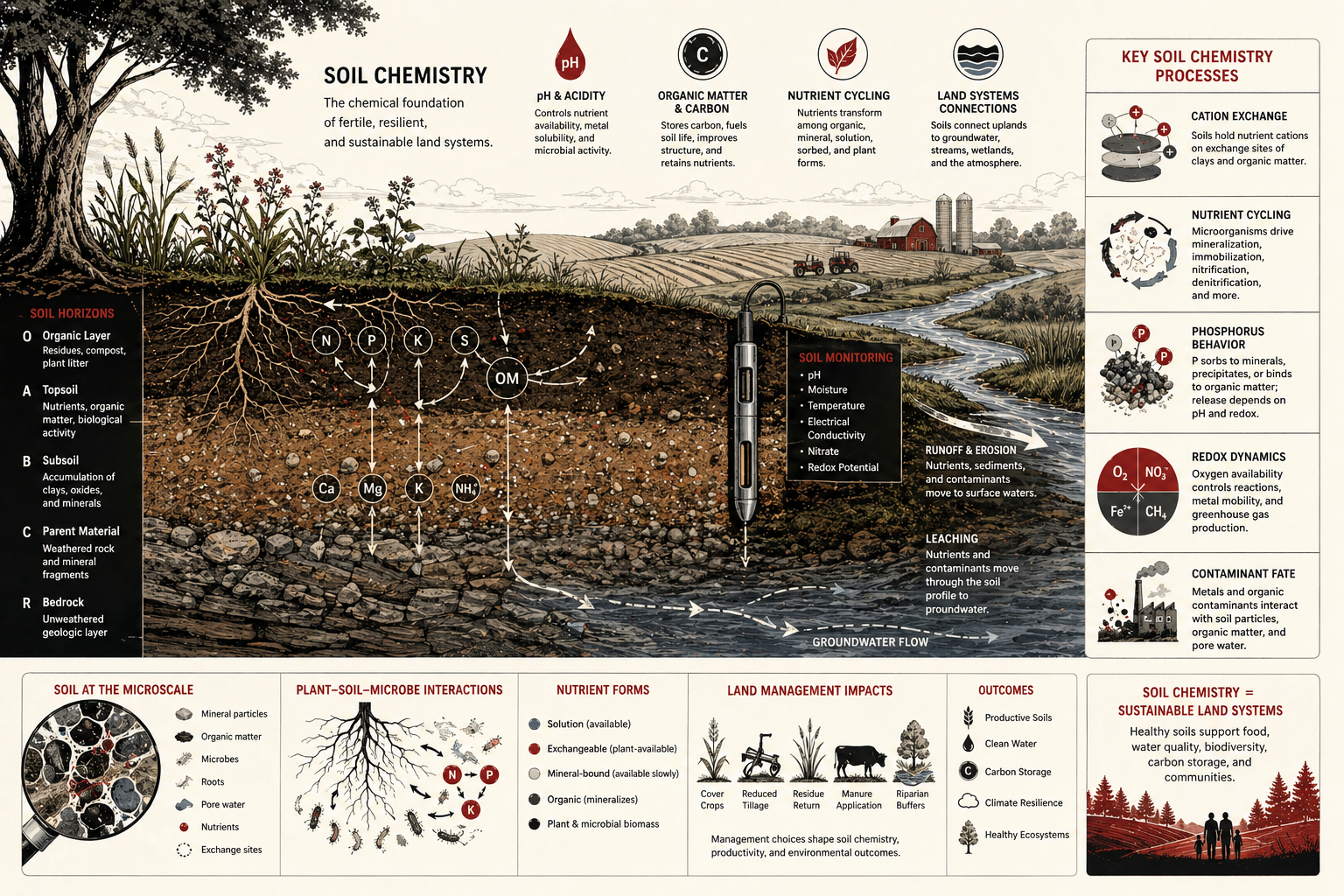
Soil as a Chemical System
Soil chemistry begins with the recognition that soil is a heterogeneous chemical environment rather than a uniform medium. A soil profile contains horizons shaped by mineral weathering, organic matter accumulation, leaching, clay translocation, biological activity, wetting and drying, oxidation and reduction, root growth, erosion, deposition, cultivation, compaction, and contamination history. Each horizon may differ in texture, pH, organic carbon, mineralogy, exchange capacity, moisture, nutrient availability, and redox state.
At the microscale, soil is a network of mineral particles, organic residues, microbial cells, roots, pores, aggregates, films of water, trapped gases, and reactive surfaces. Chemical reactions occur in soil solution, on clay surfaces, on iron and manganese oxides, within organic matter, at root interfaces, inside microbial biofilms, and along wetting fronts. A nutrient ion may be dissolved, adsorbed, exchangeable, precipitated, organically bound, mineralized, immobilized in microbial biomass, taken up by roots, leached downward, or transported with eroded sediment.
This complexity makes soil chemistry both difficult and powerful. It can explain why the same fertilizer produces different outcomes on different soils, why phosphorus can accumulate in fields yet remain unavailable to plants, why acidic soils mobilize aluminum, why organic matter improves nutrient retention, why flooded soils release phosphorus or produce methane, why salinity damages crops, and why land management affects downstream rivers and lakes.
Soil is also a boundary system. It sits between bedrock and atmosphere, between rainfall and groundwater, between plant roots and mineral particles, between carbon storage and carbon release, between nutrient retention and nutrient pollution, between food production and ecological degradation. Soil chemistry therefore connects land condition to broader Earth-system processes.
For researchers and scientists, soil chemistry requires attention to scale. A laboratory extraction, a field composite, a soil horizon, a watershed model, and a regional soil map all describe different parts of the system. Good interpretation asks which scale is being measured, which process is being inferred, and which uncertainty matters for the decision at hand.
Soil Solution, Minerals, and Reactive Surfaces
The soil solution is the water phase in which ions, dissolved organic molecules, gases, and colloidal particles move through pores and interact with roots and microbes. Although it represents only part of the total soil system, it is chemically important because plants take up many nutrients from solution and because dissolved species are more mobile than strongly sorbed or mineral-bound forms.
Soil minerals provide much of the reactive surface area that controls nutrient retention and contaminant fate. Clay minerals, iron oxides, aluminum oxides, manganese oxides, carbonates, phosphates, sulfides, and silicate minerals each have distinct chemical behavior. Some surfaces carry permanent charge from mineral structure. Others develop pH-dependent charge through protonation and deprotonation. These charges attract and repel ions, influence aggregation, and determine how strongly nutrients or contaminants are retained.
Organic matter adds another layer of chemical reactivity. Humic substances, decomposing plant residues, microbial products, root exudates, charcoal-like material, manure-derived carbon, compost, and mineral-associated organic matter can bind metals, retain nutrients, buffer pH, increase water holding capacity, support microbial activity, and influence aggregation. Organic matter also supplies energy and nutrients for soil organisms, making it both a chemical reservoir and a biological substrate.
Soil chemistry is therefore governed by partitioning among solution, exchange sites, mineral phases, organic matter, microbial biomass, and plant tissue. A measurement of total nutrient concentration may not reveal how much is immediately available. A measurement of extractable nutrient concentration may be operationally useful but method-dependent. A measurement of dissolved concentration may reveal mobility but not total reserve. Interpretation depends on the question being asked.
Reactive surfaces also create memory. Phosphate applied years earlier may remain sorbed to mineral surfaces. Lead from legacy paint may persist in urban soils. Organic carbon may become protected inside aggregates or bound to minerals. Clay minerals may retain potassium in interlayer positions. Soil chemical history is therefore not erased after each season; it accumulates in surfaces, pools, and exchange sites.
pH, Acidity, Liming, and Nutrient Availability
Soil pH is one of the most important indicators of soil chemical condition. It influences nutrient availability, metal solubility, microbial activity, root growth, pesticide behavior, organic matter decomposition, and the effectiveness of amendments. Because pH is logarithmic, a one-unit change represents a tenfold change in hydrogen ion activity under idealized interpretation.
Acidic soils can reduce the availability of some nutrients while increasing the solubility of aluminum, manganese, and certain metals. Strong acidity may restrict root growth, reduce microbial nitrogen cycling, and impair crop productivity. Alkaline soils can reduce the availability of iron, manganese, zinc, copper, and phosphorus through precipitation, sorption, or speciation changes. A soil may contain substantial total nutrient mass while still providing poor plant availability because pH shifts chemical form or surface-binding behavior.
Liming acidic soils adds carbonate, oxide, or hydroxide materials that neutralize acidity and raise pH. The effectiveness of lime depends on soil buffering capacity, texture, organic matter, exchangeable acidity, lime quality, particle size, incorporation depth, and time. Because soils resist pH change through buffering reactions, lime requirement is not determined by pH alone. Two soils with the same pH may require different lime rates because they differ in cation exchange capacity, clay content, organic matter, and reserve acidity.
Soil pH also affects nutrient cycling. Nitrification, mineralization, phosphorus sorption, metal complexation, carbonate equilibria, and microbial community composition are all pH-sensitive. Soil chemistry therefore treats pH not as an isolated number but as an organizing variable that connects fertility, toxicity, microbial function, and land management.
For researchers, pH measurement must preserve method. Soil pH can be measured in water, salt solution, or other media, and results may differ. A soil pH value should be interpreted with sampling depth, moisture context, extraction method, texture, organic matter, and land use. A pH number without method metadata is less useful for long-term comparison.
Cation Exchange Capacity and Base Saturation
Cation exchange capacity, often abbreviated CEC, is a measure of the soil’s capacity to hold exchangeable cations. These include nutrient cations such as calcium, magnesium, potassium, ammonium, and trace metals, as well as acidic cations such as hydrogen and aluminum. Exchange sites occur on clay minerals and organic matter, especially where negatively charged surfaces attract positively charged ions.
CEC is important because it affects nutrient retention, fertilizer efficiency, leaching risk, buffering capacity, and soil fertility. A sandy soil with low organic matter often has low CEC and limited capacity to retain cations. Nutrients may leach more readily, and smaller, more frequent nutrient applications may be needed. A clayey or organic-rich soil often has higher CEC, stronger nutrient retention, and greater buffering capacity.
Base saturation describes the fraction of exchange sites occupied by base cations such as calcium, magnesium, potassium, and sodium. It is often used alongside pH and CEC to interpret soil fertility and acidity. Low base saturation may indicate acidic conditions dominated by hydrogen and aluminum on exchange sites. High base saturation can indicate more neutral or alkaline conditions, although excessive sodium saturation can create serious structural and permeability problems in sodic soils.
CEC should not be treated as a simple ranking of soil quality. It must be interpreted with texture, mineralogy, pH, organic matter, climate, crop system, drainage, and management. High CEC can be beneficial, but it can also retain contaminants or interact with salinity and sodicity. Low CEC soils can be productive with careful management, irrigation, organic amendments, and nutrient timing. CEC is a chemical capacity, not a complete diagnosis.
For research and monitoring, CEC is also method-sensitive. Some methods estimate effective CEC at current soil pH, while others estimate potential CEC after adjusting conditions. The distinction matters because variable-charge soils can change CEC with pH. Long-term datasets should avoid mixing methods without documentation.
Soil Organic Matter and Carbon Storage
Soil organic matter is a central chemical, biological, and physical component of soil health. It stores carbon, nitrogen, phosphorus, sulfur, and other nutrients; supports microbial metabolism; improves aggregation; increases water holding capacity; contributes to cation exchange capacity; and affects contaminant sorption. It is also a major part of the global carbon cycle because soils contain enormous carbon pools.
Soil organic carbon is the carbon component of soil organic matter. It includes fresh residues, particulate organic matter, microbial biomass, dissolved organic carbon, mineral-associated organic matter, and more stable humified or protected forms. Different fractions have different turnover times. Some organic carbon cycles quickly through microbial decomposition. Some becomes physically protected in aggregates. Some binds to minerals and persists longer.
Land management affects soil organic carbon through residue return, tillage, cover crops, grazing, erosion, drainage, fertilization, crop rotation, manure application, fire, restoration, and land-use change. Practices that increase plant input, reduce erosion, maintain living roots, reduce excessive disturbance, and support aggregation can help maintain or build soil organic matter. However, carbon sequestration potential depends on climate, soil type, baseline condition, depth, saturation, measurement method, and time scale.
Soil organic matter also mediates nutrient cycling. As organic residues decompose, nutrients are mineralized into plant-available forms. Microbes may also immobilize nutrients into biomass when carbon-rich residues require additional nitrogen or phosphorus for decomposition. The balance between mineralization and immobilization determines whether organic matter temporarily supplies or withholds nutrients from plants.
For researchers, soil carbon measurement must distinguish concentration from stock. A soil with high carbon concentration but low bulk density and shallow sampling depth may not have the same carbon stock as a deeper or denser soil. Carbon accounting requires depth, bulk density, rock fragment correction, sampling design, and uncertainty. Claims about soil carbon gains should be made carefully because changes can be slow, spatially variable, and method-sensitive.
Nitrogen Cycling in Soil
Nitrogen cycling is one of the most important and most complex parts of soil chemistry. Nitrogen enters soil through biological nitrogen fixation, fertilizer, manure, atmospheric deposition, crop residues, irrigation water, and organic amendments. It leaves through crop harvest, leaching, runoff, erosion, volatilization, denitrification, and gaseous emissions.
Important soil nitrogen forms include organic nitrogen, ammonium, nitrate, nitrite, dissolved organic nitrogen, microbial biomass nitrogen, ammonia gas, nitrous oxide, nitric oxide, and nitrogen gas. Organic nitrogen is often the largest soil nitrogen pool, but plants generally take up mineral nitrogen, especially nitrate and ammonium. Microbes transform nitrogen among these forms through mineralization, immobilization, nitrification, denitrification, and fixation.
Ammonium can be held on cation exchange sites because it is positively charged. Nitrate is negatively charged and generally more mobile in many soils, making it vulnerable to leaching into groundwater and transport to surface waters. Under wet or anaerobic conditions, nitrate can be reduced through denitrification, producing nitrogen gases including nitrous oxide, a greenhouse gas.
Nitrogen management is therefore a timing problem as much as a mass problem. Fertilizer applied long before crop uptake may be lost through leaching or denitrification. Heavy rainfall can move nitrate through soil. Warm, moist conditions can accelerate microbial transformation. Compacted or waterlogged soils can increase denitrification. Soil chemistry links nitrogen availability to crop production, drinking-water protection, air quality, and climate.
Research-grade nitrogen interpretation should include weather, crop stage, soil moisture, drainage, texture, organic matter, fertilizer form, timing, placement, nitrification inhibitors where relevant, manure mineralization, cover-crop uptake, and yield removal. A soil nitrate value is most useful when connected to timing and process, not treated as a static property.
Phosphorus, Potassium, and Secondary Nutrients
Phosphorus is essential for energy transfer, genetic material, membranes, and plant growth, but it is often chemically constrained in soils. Unlike nitrate, phosphorus usually moves less readily in dissolved form because it sorbs to mineral surfaces, binds to iron and aluminum oxides in acidic soils, precipitates with calcium in alkaline soils, and associates with organic matter or eroded particles. This immobility can be beneficial for retention but problematic when phosphorus becomes unavailable to crops or accumulates near the surface and is lost with erosion or runoff.
Phosphorus availability depends strongly on pH, mineralogy, organic matter, redox state, microbial activity, and fertilizer placement. In waterlogged soils, reduction of iron oxides can release previously sorbed phosphorus, contributing to internal loading in wetlands, rice systems, lakes, and sediments. In eroding landscapes, particulate phosphorus can be transported to streams and reservoirs, contributing to eutrophication downstream.
Potassium is a major plant nutrient that exists in soil solution, exchangeable form, nonexchangeable interlayer positions in certain clay minerals, and mineral structures. Its availability depends on mineralogy, weathering, CEC, crop removal, moisture, and exchange dynamics. Potassium may be abundant in total mineral form while only a fraction is available on agronomic time scales.
Secondary nutrients such as calcium, magnesium, and sulfur also have important chemical roles. Calcium supports cell walls and soil aggregation. Magnesium is central to chlorophyll and enzyme function. Sulfur is needed for amino acids and proteins and participates in redox-sensitive transformations. Their availability depends on parent material, deposition, amendments, leaching, pH, salinity, and biological demand.
For researchers, phosphorus and potassium interpretation should distinguish agronomic sufficiency from environmental risk. A field may have enough phosphorus for crop production but still pose runoff risk if surface accumulation, erosion, drainage, and storm timing are unfavorable. A soil may have high total potassium but low plant availability if mineral release is slow. Soil chemistry connects these distinctions to management decisions.
Micronutrients, Metals, and Contaminants
Soil contains trace elements that may be essential, beneficial, toxic, or context-dependent. Iron, manganese, zinc, copper, boron, molybdenum, nickel, and chlorine are micronutrients for plants, but their availability depends on pH, redox state, organic complexation, mineral surfaces, moisture, and competing ions. Deficiency and toxicity can occur within relatively narrow ranges for some elements.
Metals and metalloids such as arsenic, cadmium, lead, mercury, chromium, and nickel can create environmental and health concerns when present in bioavailable or mobile forms. Sources include parent material, mining, smelting, industrial emissions, waste disposal, pesticides, sewage sludge, irrigation water, atmospheric deposition, traffic, construction materials, and legacy contamination. Total concentration is important, but speciation, extractability, bioaccessibility, particle size, pH, organic matter, and redox state often determine exposure risk.
Organic contaminants in soils include petroleum hydrocarbons, solvents, pesticides, herbicides, persistent organic pollutants, pharmaceuticals, PFAS, plastic additives, and transformation products. Their fate depends on sorption, volatility, solubility, biodegradation, photodegradation, hydrolysis, plant uptake, leaching, erosion, and soil organic carbon. Hydrophobic organic contaminants may bind strongly to organic matter, while more soluble or mobile compounds may reach groundwater.
Soil contamination is also an environmental justice issue. Urban soils, industrial corridors, mining regions, waste sites, informal settlements, and areas near high-traffic roads may bear disproportionate chemical burdens. Soil chemistry can identify hazards, but ethical interpretation requires attention to land history, exposure pathways, children’s soil ingestion, food gardens, dust, housing, redevelopment, and community trust.
For research and public communication, contaminant interpretation should avoid both panic and false reassurance. Detection does not automatically mean unacceptable risk, but total concentration below a generic benchmark may not address bioavailability, cumulative exposure, vulnerable populations, garden use, dust inhalation, or local history. Soil contaminant interpretation must be exposure-aware and context-specific.
Redox, Waterlogging, and Wetland Soils
Soil redox chemistry changes when oxygen availability changes. In well-aerated soils, oxygen is the dominant electron acceptor for microbial respiration. When soils become saturated or flooded, oxygen diffusion slows dramatically, and microbes begin using alternative electron acceptors. Nitrate, manganese oxides, iron oxides, sulfate, and carbon dioxide may be reduced in sequence depending on conditions.
These redox shifts transform soil chemistry. Nitrate may be denitrified to gaseous nitrogen species. Iron and manganese oxides may dissolve, releasing associated phosphorus or trace metals. Sulfate may be reduced to sulfide. Carbon dioxide may be reduced to methane under strongly reducing conditions. These processes shape wetlands, rice paddies, floodplains, riparian buffers, peatlands, and poorly drained agricultural soils.
Redox chemistry links soil to climate and water quality. Wet soils can reduce nitrate export through denitrification, but they can also produce nitrous oxide or methane. Reduced sediments can release phosphorus to water, fueling eutrophication. Drainage of organic soils can accelerate oxidation and carbon loss. Rewetting can restore some wetland functions while changing greenhouse-gas balances.
Wetland and waterlogged soils are therefore not simply “wet versions” of upland soils. Their chemistry can shift rapidly with oxygen availability, organic carbon, temperature, sulfate, nitrate, iron oxides, and hydrologic residence time. Soil chemistry is essential for evaluating wetland restoration, drainage, rice cultivation, peatland protection, floodplain management, and climate mitigation.
For researchers, redox interpretation should include hydrology, depth, time since saturation, soil temperature, organic matter, microbial activity, and electron acceptor availability. A single redox measurement may not capture the dynamic pattern of wetting, drying, oxidation, and reduction that controls soil function.
Salinity, Sodicity, and Soil Structural Chemistry
Salinity refers to the accumulation of soluble salts in soil. Sodicity refers specifically to high exchangeable sodium relative to other cations. Both conditions can damage plant growth and soil function, but they operate through different chemical and physical mechanisms. Salinity creates osmotic stress, making it harder for plants to take up water. Sodicity can disperse clay particles, reduce aggregation, lower infiltration, seal surfaces, and degrade soil structure.
Electrical conductivity is commonly used to screen soil salinity. Sodium adsorption ratio and exchangeable sodium percentage are used to interpret sodium hazard. However, salinity and sodicity must be interpreted with irrigation water quality, drainage, climate, crop tolerance, soil texture, gypsum availability, carbonate chemistry, and leaching potential.
Salinity can arise from arid climate, irrigation, shallow groundwater, poor drainage, seawater intrusion, road salts, industrial inputs, natural parent material, or evaporation concentrating salts near the surface. Sodic conditions may develop when sodium dominates exchange sites, especially where drainage is limited and calcium availability is low. Management often requires improving drainage, applying calcium amendments such as gypsum where appropriate, and leaching salts with suitable water.
For researchers, salinity and sodicity show why soil chemistry and soil physics cannot be separated. Ion composition changes aggregate stability, pore continuity, infiltration, plant water availability, and erosion risk. A soil solution chemistry problem can become a structural land-system problem.
Land Systems, Runoff, and Downstream Water Quality
Soil chemistry does not stay in soil. Land systems export dissolved nutrients, sediments, organic matter, salts, metals, pesticides, and microbes to water bodies through runoff, erosion, leaching, tile drainage, groundwater flow, and atmospheric exchange. The chemical condition of rivers, lakes, reservoirs, wetlands, estuaries, and coastal waters often reflects soil and land-use processes upstream.
Nutrient loss is a central example. Nitrogen and phosphorus applied to fields can support crop growth, but nutrients not taken up by plants may be lost. Nitrate can leach to groundwater or drain through tile systems. Phosphorus can move with eroded sediment or dissolved runoff, especially when soils are saturated, compacted, frozen, or heavily fertilized. Manure and fertilizer management, timing, placement, cover crops, riparian buffers, drainage design, soil structure, and rainfall intensity all influence nutrient loss.
Soil erosion transports both particles and particle-bound chemistry. Fine particles often carry organic matter, phosphorus, metals, and pesticides. Losing topsoil can reduce fertility, lower water holding capacity, expose subsoil, increase runoff, and deliver chemical loads to aquatic systems. Conversely, practices that improve aggregation, infiltration, cover, and root structure can reduce erosion and improve nutrient retention.
Land systems are therefore chemical systems at watershed scale. A farm field, urban lot, forest slope, wetland buffer, mine site, construction zone, or restored prairie all produce downstream chemical signals. Soil chemistry provides the bridge between land management and water quality.
For researchers and policymakers, the critical point is that watershed chemistry reflects both source and transport. High soil phosphorus may not create immediate water-quality risk if erosion and runoff are controlled, while moderate nutrient levels can still cause downstream harm under high transport conditions. Soil tests, hydrology, erosion, tile drainage, rainfall intensity, and land cover must be interpreted together.
Monitoring Soil Chemical Evidence
Soil monitoring begins with sampling design. A soil result depends on location, depth, timing, composite strategy, horizon, land use, crop history, moisture, laboratory method, extraction procedure, and sample handling. Because soils are spatially heterogeneous, a single grab sample may be misleading. Composite sampling, georeferenced sampling, depth-specific sampling, and repeated sampling over time are often needed for meaningful interpretation.
Important soil chemical measurements include pH, electrical conductivity, organic matter, soil organic carbon, total nitrogen, nitrate, ammonium, extractable phosphorus, exchangeable potassium, calcium, magnesium, sodium, sulfur, micronutrients, CEC, base saturation, carbonate content, salinity, sodicity, metals, pesticides, petroleum hydrocarbons, and other contaminants. Physical and biological indicators such as texture, bulk density, aggregate stability, infiltration, respiration, microbial biomass, and enzyme activity often provide essential context.
Laboratory methods matter because many soil measurements are operational. Extractable phosphorus depends on the extracting solution. Organic matter may be estimated by loss-on-ignition or carbon analysis. CEC may be measured by different exchange methods. Nitrate may change during storage if samples are not handled properly. pH may be measured in water, salt solution, or other extractants. Comparisons are meaningful only when methods, units, depths, and sampling designs are compatible.
Good soil data should preserve sample identifiers, coordinates, depth intervals, horizon designations, land use, crop history, management history, method codes, units, detection limits, laboratory information, quality-control flags, and date of sampling. Without that metadata, soil chemistry becomes difficult to audit, compare, or use for long-term land-system analysis.
Monitoring is strongest when it is repeated and decision-oriented. A single soil test can guide immediate management, but long-term monitoring can reveal acidification, organic carbon change, salinity buildup, nutrient accumulation, contaminant persistence, or recovery after restoration. Soil chemistry becomes governance infrastructure when data are consistent, transparent, and interpreted with uncertainty.
Soil Chemistry and Governance
Soil chemistry matters for governance because soil is both a productive resource and an environmental boundary. It supports food systems, stores carbon, filters water, cycles nutrients, supports biodiversity, regulates hydrology, and records pollution. Yet soils are vulnerable to erosion, acidification, salinization, compaction, contamination, organic matter loss, nutrient depletion, nutrient excess, and land sealing.
Governance requires soil data that can support decisions without oversimplifying local conditions. Agronomic soil tests guide nutrient management. Soil-health assessments support conservation planning. Contaminant tests inform redevelopment, gardening, exposure prevention, and remediation. Carbon measurements support climate and land-management claims. Watershed nutrient models connect soil and field management to downstream water quality. Each application requires different methods, sampling designs, time scales, and standards of evidence.
Soil chemistry also has equity dimensions. Communities may inherit contaminated soils from industrial activity, highways, demolition, lead paint, waste disposal, mining, or historic land use. Farmers may face economic pressure to maintain yield while reducing nutrient losses. Downstream communities may bear the cost of upstream runoff. Climate-mitigation claims may rely on soil carbon measurements that are difficult to verify. Responsible soil governance requires transparency, method rigor, community protection, and careful communication of uncertainty.
Soil governance should distinguish productivity, protection, restoration, and justice. A field can be productive while leaking nutrients. A city lot can support gardens while containing legacy lead. A wetland can remove nitrate while emitting methane. A soil carbon project can improve land condition while overstating sequestration if baselines, permanence, leakage, and measurement uncertainty are weak. Chemistry helps clarify these tradeoffs.
For institutions, the practical challenge is to make soil information usable without flattening complexity. Soil chemistry should inform nutrient plans, conservation programs, land redevelopment, environmental cleanup, carbon accounting, watershed restoration, food safety, and community health with enough rigor to be trustworthy and enough clarity to support action.
Mathematical Lens: Soil Stocks, Exchange, and Nutrient Balances
Soil chemistry uses measured concentrations, but land-system interpretation often requires stocks, fluxes, balances, and exchange capacities. A soil concentration can be converted into a stock when bulk density and sampling depth are known:
SOC_{\mathrm{stock}} = C_{\mathrm{SOC}} \times \rho_b \times d \times A
\]
Interpretation: \(SOC_{\mathrm{stock}}\) is soil organic carbon stock, \(C_{\mathrm{SOC}}\) is soil organic carbon fraction, \(\rho_b\) is bulk density, \(d\) is depth, and \(A\) is area. Stocks require mass and depth context, not concentration alone.
For a hectare-scale estimate in megagrams of carbon per hectare, a practical expression is:
SOC_{\mathrm{Mg/ha}} = SOC_{\%} \times \rho_b \times d_{\mathrm{cm}}
\]
Interpretation: \(SOC_{\%}\) is soil organic carbon percent, \(\rho_b\) is bulk density in g/cm³, and \(d_{\mathrm{cm}}\) is depth in centimeters. This compact expression works because the unit conversions cancel into Mg/ha under those units.
Cation exchange capacity can be represented conceptually as the sum of exchangeable cations:
CEC \approx Ca^{2+} + Mg^{2+} + K^+ + Na^+ + H^+ + Al^{3+}
\]
Interpretation: This expression is meaningful only when all quantities are expressed in compatible charge-equivalent units, such as cmolc/kg.
Base saturation is:
BS_{\%} = 100 \times \frac{Ca^{2+} + Mg^{2+} + K^+ + Na^+}{CEC}
\]
Interpretation: Base saturation estimates the fraction of exchange sites occupied by base cations rather than acidic cations.
A simple nutrient balance can be written as:
\Delta N = N_{\mathrm{inputs}} – N_{\mathrm{outputs}}
\]
Interpretation: Inputs may include fertilizer, manure, fixation, deposition, irrigation water, and residues, while outputs may include harvest removal, leaching, runoff, erosion, volatilization, and denitrification.
For phosphorus runoff screening, a simplified particulate export term can be written as:
P_{\mathrm{export}} = E \times C_P
\]
Interpretation: \(E\) is eroded sediment mass and \(C_P\) is phosphorus concentration associated with sediment. This illustrates why erosion control is also nutrient control.
Soil pH is expressed as:
pH = -\log_{10}(a_{\mathrm{H}^+})
\]
Interpretation: \(a_{\mathrm{H}^+}\) is hydrogen ion activity in the soil solution. Because soil is buffered by exchange sites, minerals, organic matter, and aluminum chemistry, changing soil pH is more complex than changing pH in pure water.
These equations make soil chemistry more transparent, but they are not universal decision rules. Each requires units, sampling depth, method, land-use context, and uncertainty. Soil calculations should support interpretation, not replace field knowledge and laboratory rigor.
Computational Workflows for Soil Chemistry
Computational soil chemistry can make land-system interpretation more transparent. A workflow can track sample location, land use, depth, bulk density, pH, electrical conductivity, organic carbon, nitrate, ammonium, phosphorus, potassium, CEC, exchangeable cations, base saturation, salinity indicators, contaminant values, laboratory methods, detection limits, quality flags, and interpretation notes.
Useful workflows include fertility screening, soil organic carbon stock calculation, base saturation calculation, nutrient-balance estimation, phosphorus runoff screening, nitrate leaching attention flags, salinity and sodicity screening, contaminant evidence registers, soil-test trend analysis, watershed nutrient aggregation, and data-quality review. More advanced workflows may integrate geospatial sampling, remote sensing, crop models, hydrologic models, drainage networks, climate data, uncertainty propagation, and long-term monitoring databases.
For researchers, computational workflows should preserve method and depth. A phosphorus value from one extraction method should not be merged casually with another. A 0–15 cm sample cannot be compared directly with a 0–30 cm sample without depth harmonization. A soil organic carbon percent is not a stock without bulk density and depth. A contaminant concentration should be linked to exposure pathway and land use.
The examples below use synthetic data and simplified thresholds. They do not provide agronomic recommendations, determine environmental compliance, evaluate contamination risk, certify soil carbon credits, or replace professional soil-science interpretation. Their purpose is to show how soil chemistry can be structured, audited, and communicated responsibly.
Python Example: Soil Fertility Screening and Carbon Stocks
The following Python example screens synthetic soil samples for pH, organic carbon, nitrate, phosphorus, cation exchange capacity, and base saturation. It also estimates soil organic carbon stock using bulk density and sampling depth. The workflow is educational and does not replace agronomic recommendations, soil-test interpretation, regulatory assessment, or site-specific land management.
from dataclasses import dataclass
from typing import Dict, List


@dataclass
class SoilSample:
    """Synthetic educational soil chemistry sample.

    Values are illustrative and should not be treated as agronomic
    recommendations, regulatory thresholds, contamination assessment,
    or site-specific land-management guidance.
    """

    site: str
    land_use: str
    depth_cm: float
    bulk_density_g_cm3: float
    ph: float
    soil_organic_carbon_percent: float
    nitrate_mg_kg: float
    phosphorus_mg_kg: float
    cec_cmolc_kg: float
    base_cations_cmolc_kg: float


def soc_stock_mg_ha(sample: SoilSample) -> float:
    """Estimate SOC stock in Mg C/ha using a compact teaching expression."""
    return (
        sample.soil_organic_carbon_percent
        * sample.bulk_density_g_cm3
        * sample.depth_cm
    )


def base_saturation_percent(sample: SoilSample) -> float:
    """Calculate base saturation from base cations and CEC."""
    if sample.cec_cmolc_kg <= 0:
        return 0.0

    return 100.0 * sample.base_cations_cmolc_kg / sample.cec_cmolc_kg


def interpret_sample(sample: SoilSample) -> Dict[str, object]:
    """Return simplified soil chemistry screening indicators."""

    ph_flag = "acidic_screen" if sample.ph < 5.8 else "within_general_screen"

    phosphorus_flag = (
        "high_phosphorus_runoff_attention"
        if sample.phosphorus_mg_kg > 60
        else "not_high_screen"
    )

    nitrate_flag = (
        "high_nitrate_leaching_attention"
        if sample.nitrate_mg_kg > 30
        else "not_high_screen"
    )

    return {
        "site": sample.site,
        "land_use": sample.land_use,
        "pH": sample.ph,
        "pH_flag": ph_flag,
        "SOC_percent": sample.soil_organic_carbon_percent,
        "SOC_stock_Mg_ha": round(soc_stock_mg_ha(sample), 2),
        "base_saturation_percent": round(base_saturation_percent(sample), 1),
        "phosphorus_flag": phosphorus_flag,
        "nitrate_flag": nitrate_flag,
    }


samples: List[SoilSample] = [
    SoilSample("Field-A", "row_crop", 30, 1.32, 6.4, 1.8, 18.0, 32.0, 12.0, 8.4),
    SoilSample("Field-B", "row_crop", 30, 1.45, 5.3, 1.1, 42.0, 68.0, 8.5, 4.2),
    SoilSample("Wetland-C", "wetland", 30, 0.82, 6.8, 7.5, 6.0, 18.0, 36.0, 28.0),
    SoilSample("Urban-D", "urban_garden", 15, 1.18, 7.6, 3.2, 22.0, 210.0, 18.0, 15.5),
    SoilSample("Pasture-E", "pasture", 30, 1.05, 6.1, 4.1, 14.0, 26.0, 24.0, 18.2),
]

for sample in samples:
    print(interpret_sample(sample))
The important point is not the thresholds used here, which are illustrative. The important point is the workflow structure: preserve units, depth, bulk density, land use, and method context; convert concentrations into stocks when needed; and avoid treating a soil result as meaningful without sampling design and interpretation rules.
R Example: Soil Monitoring Summary and Nutrient Balance
The following R example summarizes synthetic soil-monitoring data by land use and estimates a simple nitrogen balance. It uses base R for portability.
site <- c("Field-A", "Field-B", "Wetland-C", "Urban-D", "Pasture-E")
land_use <- c("row_crop", "row_crop", "wetland", "urban_garden", "pasture")
depth_cm <- c(30, 30, 30, 15, 30)
bulk_density_g_cm3 <- c(1.32, 1.45, 0.82, 1.18, 1.05)
pH <- c(6.4, 5.3, 6.8, 7.6, 6.1)
soil_organic_carbon_percent <- c(1.8, 1.1, 7.5, 3.2, 4.1)
nitrate_mg_kg <- c(18.0, 42.0, 6.0, 22.0, 14.0)
phosphorus_mg_kg <- c(32.0, 68.0, 18.0, 210.0, 26.0)
cec_cmolc_kg <- c(12.0, 8.5, 36.0, 18.0, 24.0)
base_cations_cmolc_kg <- c(8.4, 4.2, 28.0, 15.5, 18.2)

soil <- data.frame(
  site,
  land_use,
  depth_cm,
  bulk_density_g_cm3,
  pH,
  soil_organic_carbon_percent,
  nitrate_mg_kg,
  phosphorus_mg_kg,
  cec_cmolc_kg,
  base_cations_cmolc_kg
)

soil$soc_stock_Mg_ha <- soil$soil_organic_carbon_percent *
  soil$bulk_density_g_cm3 *
  soil$depth_cm

soil$base_saturation_percent <- 100 *
  soil$base_cations_cmolc_kg / soil$cec_cmolc_kg

soil$pH_flag <- ifelse(
  soil$pH < 5.8,
  "acidic_screen",
  "within_general_screen"
)

soil$phosphorus_flag <- ifelse(
  soil$phosphorus_mg_kg > 60,
  "high_phosphorus_runoff_attention",
  "not_high_screen"
)

nitrogen_balance <- data.frame(
  field = "Field-B",
  fertilizer_N_kg_ha = 165,
  manure_N_kg_ha = 35,
  biological_fixation_N_kg_ha = 20,
  harvest_removal_N_kg_ha = 145,
  leaching_estimate_N_kg_ha = 28,
  gaseous_loss_estimate_N_kg_ha = 22
)

nitrogen_balance$net_N_kg_ha <- with(
  nitrogen_balance,
  fertilizer_N_kg_ha +
    manure_N_kg_ha +
    biological_fixation_N_kg_ha -
    harvest_removal_N_kg_ha -
    leaching_estimate_N_kg_ha -
    gaseous_loss_estimate_N_kg_ha
)

land_use_summary <- aggregate(
  cbind(soil_organic_carbon_percent, soc_stock_Mg_ha, pH, cec_cmolc_kg) ~ land_use,
  data = soil,
  FUN = mean
)

land_use_summary <- land_use_summary[order(land_use_summary$soc_stock_Mg_ha, decreasing = TRUE), ]

print(soil)
print(land_use_summary)
print(nitrogen_balance)
A full soil-chemistry workflow would add sampling depth harmonization, method metadata, spatial uncertainty, crop-specific interpretation, soil texture, weather records, manure analysis, yield data, erosion estimates, drainage status, and long-term trend modeling. The example is meant to show how soil chemistry becomes computable only when measurements are tied to land use, depth, mass, and management context.
SQL Example: Soil Chemistry Evidence Register
Soil chemistry interpretation becomes more reliable when samples, methods, depths, units, laboratory results, and interpretation flags are traceable. A simple evidence register can preserve soil monitoring context and prevent soil-test results from becoming detached from method and land-use meaning.
CREATE TABLE soil_sample (
    sample_id TEXT PRIMARY KEY,
    site_name TEXT NOT NULL,
    land_use TEXT,
    latitude REAL,
    longitude REAL,
    sample_date TEXT,
    depth_top_cm REAL CHECK (depth_top_cm >= 0),
    depth_bottom_cm REAL CHECK (depth_bottom_cm > depth_top_cm),
    horizon TEXT,
    crop_or_cover TEXT,
    management_history TEXT,
    sampling_design TEXT,
    uncertainty_notes TEXT
);

CREATE TABLE soil_chemistry_result (
    result_id INTEGER PRIMARY KEY,
    sample_id TEXT NOT NULL,
    laboratory_name TEXT,
    method_code TEXT,
    ph_value REAL,
    ph_method TEXT,
    electrical_conductivity_ds_m REAL CHECK (electrical_conductivity_ds_m >= 0),
    soil_organic_carbon_percent REAL CHECK (soil_organic_carbon_percent >= 0),
    bulk_density_g_cm3 REAL CHECK (bulk_density_g_cm3 >= 0),
    nitrate_mg_kg REAL CHECK (nitrate_mg_kg >= 0),
    phosphorus_mg_kg REAL CHECK (phosphorus_mg_kg >= 0),
    potassium_mg_kg REAL CHECK (potassium_mg_kg >= 0),
    cec_cmolc_kg REAL CHECK (cec_cmolc_kg >= 0),
    base_cations_cmolc_kg REAL CHECK (base_cations_cmolc_kg >= 0),
    quality_flag TEXT,
    FOREIGN KEY (sample_id) REFERENCES soil_sample(sample_id)
);

CREATE TABLE soil_interpretation (
    interpretation_id INTEGER PRIMARY KEY,
    sample_id TEXT NOT NULL,
    indicator_name TEXT NOT NULL,
    indicator_value REAL,
    interpretation_label TEXT,
    calculation_notes TEXT,
    confidence_score REAL CHECK (confidence_score BETWEEN 0 AND 1),
    review_status TEXT,
    FOREIGN KEY (sample_id) REFERENCES soil_sample(sample_id)
);

SELECT
    s.sample_id,
    s.site_name,
    s.land_use,
    s.depth_top_cm,
    s.depth_bottom_cm,
    r.ph_value,
    r.ph_method,
    ROUND(
        r.soil_organic_carbon_percent *
        r.bulk_density_g_cm3 *
        (s.depth_bottom_cm - s.depth_top_cm),
        2
    ) AS soc_stock_Mg_ha_simplified,
    ROUND(
        100.0 * r.base_cations_cmolc_kg / NULLIF(r.cec_cmolc_kg, 0),
        1
    ) AS base_saturation_percent,
    CASE
        WHEN r.ph_value < 5.8 THEN 'acidic_screen'
        ELSE 'within_general_screen'
    END AS ph_screen,
    CASE
        WHEN r.phosphorus_mg_kg > 60 THEN 'high_phosphorus_runoff_attention'
        ELSE 'not_high_screen'
    END AS phosphorus_screen,
    r.quality_flag
FROM soil_sample s
JOIN soil_chemistry_result r
    ON s.sample_id = r.sample_id
ORDER BY s.site_name, s.sample_date;
The purpose of this register is to keep soil chemistry attached to evidence. A pH result should be linked to pH method. A soil carbon value should be linked to depth and bulk density. A phosphorus result should be linked to extraction method. A contaminant value should be linked to land use and exposure pathway. Soil data become more trustworthy when provenance is part of the record.
GitHub Repository
The companion repository for this article can support reproducible workflows for soil fertility screening, soil organic carbon stocks, base saturation, nutrient balances, phosphorus runoff flags, nitrate leaching attention flags, salinity and sodicity screening, SQL provenance, and responsible soil-chemistry interpretation.
Complete Code Repository
The full code distribution for this article, including selected soil chemistry examples, expanded computational workflows, reproducible data structures, provenance documentation, soil fertility screening, soil carbon stock calculations, nutrient-balance examples, SQL evidence registers, and scientific-computing scaffolding, is available on GitHub.
Limits, Uncertainty, and Responsible Interpretation
Soil chemistry is difficult to generalize because soils vary across short distances and long time scales. A field may contain multiple soil series, drainage classes, management histories, erosion patterns, and microtopographic zones. Soil chemistry also varies with season, moisture, crop stage, fertilizer timing, tillage, residue, microbial activity, and sampling depth. A single measurement rarely captures the whole system.
Laboratory methods introduce additional uncertainty. Different extractants may produce different phosphorus values. Organic matter estimates differ by method. Soil pH differs depending on whether it is measured in water or salt solution. Nitrate can change during storage. Metal bioavailability is not the same as total metal concentration. Soil carbon stocks require bulk density and depth, not just concentration. Method compatibility is essential for trend interpretation.
Uncertainty should not be treated as a weakness. It should be described, managed, and reduced where possible. Good soil chemistry reports sampling design, depth, method, units, detection limits, land use, uncertainty, and interpretation basis. It distinguishes agronomic sufficiency from environmental risk, total concentration from bioavailability, short-term fertility from long-term soil function, and local soil tests from watershed-scale consequences.
The computational examples associated with this article are synthetic and educational. They do not produce agronomic recommendations, evaluate contamination risk, determine regulatory compliance, certify soil carbon credits, replace soil-test interpretation, or substitute for professional soil science, environmental health, agronomy, hydrology, or land-management review. They are designed to show how soil chemistry reasoning can be structured and audited.
Responsible soil chemistry must also recognize unequal burdens. Contaminated urban soils, mining-affected land, degraded agricultural soils, nutrient-polluted watersheds, salinized irrigation districts, and eroding landscapes often affect communities with different capacities to respond. Soil chemistry should support protection, restoration, food security, and public trust—not only productivity metrics.
Conclusion
Soil chemistry reveals land as a chemically active system. The fertility of a field, the resilience of a wetland, the carbon storage of a grassland, the contamination risk of an urban garden, the nutrient export of a watershed, and the productivity of a forest all depend on chemical interactions among minerals, organic matter, water, gases, roots, microbes, and management.
The field is essential because it connects molecular processes to land-system outcomes. pH controls nutrient availability and metal solubility. Cation exchange capacity controls nutrient retention. Organic matter stores carbon and supports microbial cycling. Nitrogen transformations connect crop production, groundwater quality, and greenhouse gases. Phosphorus chemistry connects soil fertility to eutrophication. Redox processes connect waterlogging to methane, denitrification, metal mobility, and wetland function.
Soil chemistry is therefore a foundation for sustainable land management. It explains how land becomes productive, how it becomes degraded, how it transmits chemical pressure downstream, and how restoration can rebuild function. To understand nutrient cycles and land systems, chemistry must go below the surface.
Related articles
- Environmental Chemistry and the Chemical Conditions of Habitability
- Atmospheric Chemistry and Climate Processes
- Water Chemistry and Environmental Monitoring
- Geochemistry and the Chemical History of Earth
- Ocean Chemistry and the Carbonate System
- Acids, Bases, and Proton Transfer
- Equilibrium and the Dynamics of Reversible Systems
- Oxidation, Reduction, and Electron Transfer
- Reaction Networks and Chemical Systems Modeling
- Analytical Chemistry and the Identification of Matter
- Green Chemistry, Responsibility, and Sustainable Transformation
Further reading
- Brady, N.C. and Weil, R.R. (2016) The Nature and Properties of Soils. 15th edn. Boston: Pearson.
- Essington, M.E. (2015) Soil and Water Chemistry: An Integrative Approach. 2nd edn. Boca Raton: CRC Press.
- Sparks, D.L. (2003) Environmental Soil Chemistry. 2nd edn. San Diego: Academic Press.
- Stevenson, F.J. and Cole, M.A. (1999) Cycles of Soil: Carbon, Nitrogen, Phosphorus, Sulfur, Micronutrients. 2nd edn. New York: Wiley.
- Sumner, M.E. (ed.) (1999) Handbook of Soil Science. Boca Raton: CRC Press.
- National Academies of Sciences, Engineering, and Medicine (2019) Negative Emissions Technologies and Reliable Sequestration: A Research Agenda. Washington, DC: National Academies Press. Available at: https://nap.nationalacademies.org/catalog/25259/negative-emissions-technologies-and-reliable-sequestration-a-research-agenda
References
- Food and Agriculture Organization of the United Nations (n.d.) Global Soil Partnership: Soil Organic Carbon. Available at: https://www.fao.org/global-soil-partnership/areas-of-work/soil-organic-carbon/en/
- Food and Agriculture Organization of the United Nations (n.d.) What Is Soil Organic Carbon? Available at: https://www.fao.org/global-soil-partnership/areas-of-work/recsoil/what-is-soc/en/
- International Union of Pure and Applied Chemistry (n.d.) Compendium of Chemical Terminology, the Gold Book. Available at: https://publications.iupac.org/compendium/
- United States Department of Agriculture Natural Resources Conservation Service (n.d.) Soil Health Assessment. Available at: https://www.nrcs.usda.gov/conservation-basics/natural-resource-concerns/soil/soil-health/soil-health-assessment
- United States Department of Agriculture Natural Resources Conservation Service (2022) Soil Quality Indicators: Soil pH. Available at: https://www.nrcs.usda.gov/sites/default/files/2022-10/soil_ph.pdf
- United States Department of Agriculture Natural Resources Conservation Service (2022) Cation Exchange Capacity. Available at: https://www.nrcs.usda.gov/sites/default/files/2022-09/SoilTechNote15A.pdf
- United States Department of Agriculture Natural Resources Conservation Service (2023) Soil Survey Field and Laboratory Methods Manual. Available at: https://www.nrcs.usda.gov/sites/default/files/2023-01/SSIR51.pdf
- United States Department of Agriculture Natural Resources Conservation Service (2023) Kellogg Soil Survey Laboratory Methods Manual. Available at: https://www.nrcs.usda.gov/sites/default/files/2023-01/SSIR42.pdf
- United States Environmental Protection Agency (n.d.) Nutrient Pollution. Available at: https://www.epa.gov/nutrientpollution
- United States Environmental Protection Agency (n.d.) Sources and Solutions: Agriculture. Available at: https://www.epa.gov/nutrientpollution/sources-and-solutions-agriculture