
Last Updated May 28, 2026
Atmospheric chemistry studies the reactions, transport, lifetimes, radiative effects, and environmental consequences of gases and particles in the air. It explains why the atmosphere is not merely a physical envelope around Earth but a chemically active system in which sunlight, radicals, aerosols, clouds, emissions, deposition, circulation, and surface exchange continuously reshape the conditions of climate, air quality, ecological exposure, and habitability.
The central thesis of atmospheric chemistry is that climate is chemically mediated. Carbon dioxide, methane, nitrous oxide, ozone, water vapor, halogenated compounds, aerosols, nitrogen oxides, sulfur compounds, volatile organic compounds, ammonia, carbon monoxide, and reactive radicals all participate in processes that influence radiation, temperature, precipitation, atmospheric lifetime, air pollution, ecosystem exposure, human health, and Earth-system feedbacks. Some atmospheric constituents are long-lived and globally mixed. Others are short-lived, spatially uneven, chemically reactive, and strongly linked to local emissions and meteorology. Climate processes emerge from both categories.
Atmospheric chemistry is therefore a bridge between molecular science and planetary responsibility. It connects combustion chemistry to urban ozone, agriculture to nitrous oxide and ammonia, wetlands to methane, aerosols to clouds, industrial compounds to stratospheric ozone depletion, wildfire smoke to public health, greenhouse gases to radiative forcing, and monitoring networks to climate accountability. To understand the atmosphere chemically is to understand how molecules and particles help determine whether Earth remains breathable, climatically stable, and habitable.
Main Library
Publications
Article Map
Chemistry
Related Topic
Environmental Science
Related Topic
Earth Science
Related Topic
Physics
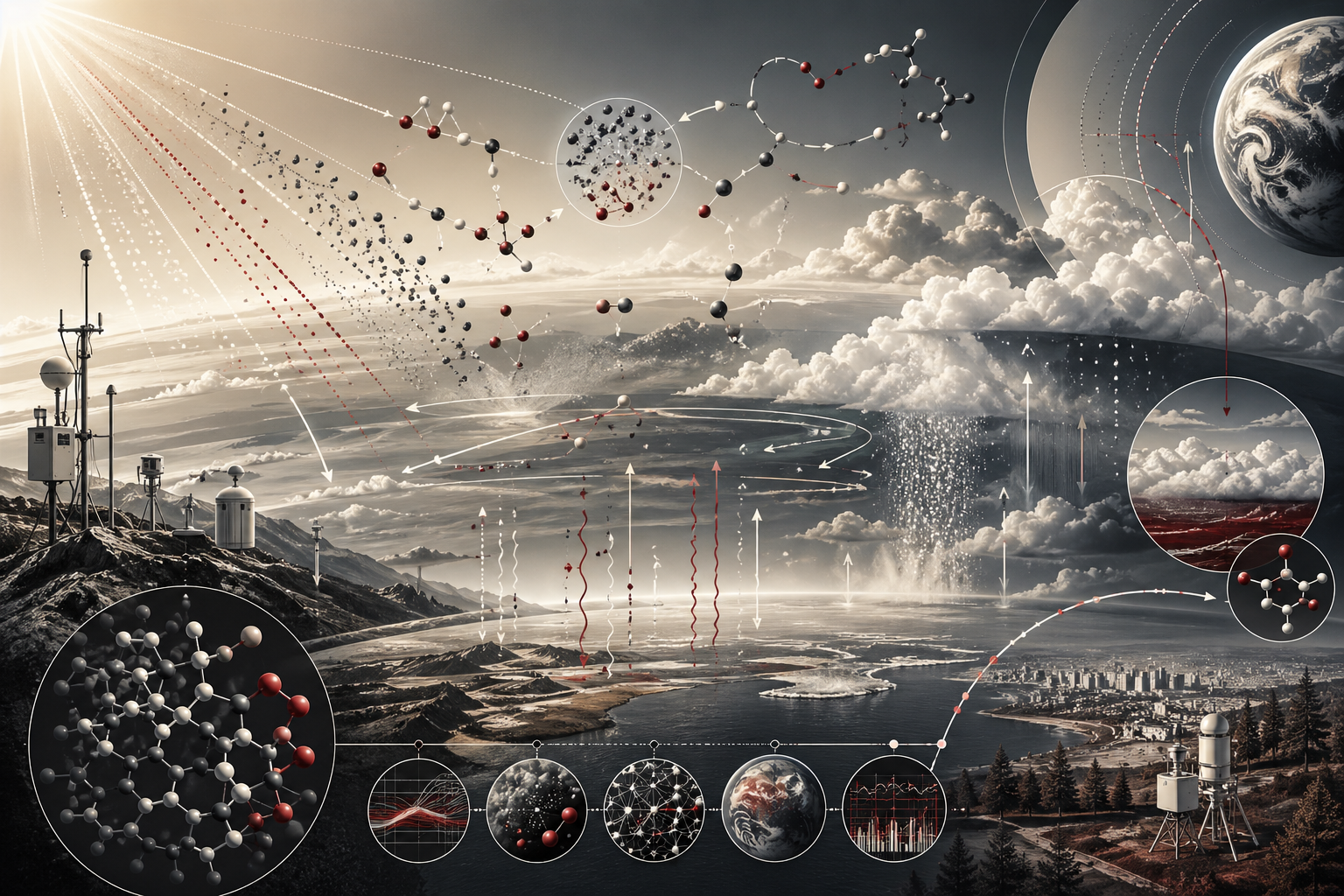
The Atmosphere as a Chemical Reactor
The atmosphere is a chemically dynamic reactor driven by solar radiation, emissions, transport, phase change, and surface exchange. It contains stable gases, trace gases, reactive intermediates, particles, droplets, radicals, ions, and condensed phases. It receives inputs from oceans, soils, plants, volcanoes, fires, lightning, microbial processes, agriculture, industry, transportation, energy systems, buildings, and urban activity. It loses material through deposition, precipitation, chemical transformation, stratosphere-troposphere exchange, uptake by vegetation and water, and transport to other regions.
Atmospheric chemistry is distinctive because many key reactions occur at low concentrations, large spatial scales, and short lifetimes. A trace compound measured in parts per billion can influence ozone formation, aerosol production, methane lifetime, or human exposure. A radical present at extremely low abundance can control the oxidation capacity of the entire troposphere. A particle too small to see can scatter sunlight, absorb radiation, serve as a cloud condensation nucleus, transport toxic metals or organic compounds, and alter respiratory risk.
The atmosphere is also an open reaction system. Unlike a laboratory flask, it has no fixed boundary, constant temperature, or single mixing condition. Chemical reactions occur while air masses move, mix, rise, sink, cool, warm, condense, evaporate, absorb sunlight, encounter clouds, pass over vegetation, flow through cities, and interact with oceans or land surfaces. Chemistry and transport cannot be cleanly separated. A molecule’s effect depends not only on what it is, but on where it is emitted, how long it lasts, what it reacts with, and where it is transported.
Climate processes depend on atmospheric chemistry because the atmosphere mediates Earth’s energy balance. Incoming solar radiation, outgoing infrared radiation, scattering, absorption, cloud formation, surface albedo, atmospheric lifetime, and feedbacks all depend partly on chemical composition. The chemistry of the atmosphere therefore links molecular structure to planetary temperature.
For researchers and scientists, the central challenge is coupling. Atmospheric chemistry must be studied through laboratory kinetics, field observation, emissions inventories, atmospheric transport, spectroscopy, satellite retrievals, chemical transport modeling, climate modeling, and public-health exposure analysis. The atmosphere is chemical, physical, biological, and social at once.
Composition, Structure, and Chemical Layers
Dry air is dominated by nitrogen and oxygen, with argon, carbon dioxide, neon, helium, methane, krypton, hydrogen, nitrous oxide, ozone, and many other trace gases present at much lower concentrations. Water vapor varies strongly with temperature, altitude, circulation, and local conditions. Although major gases provide the bulk composition, many climate-relevant and pollution-relevant processes depend on trace constituents.
The atmosphere is chemically layered. The troposphere contains most atmospheric mass, most water vapor, clouds, weather, surface emissions, and most direct human exposure. The stratosphere contains the ozone layer and is strongly shaped by photochemistry, temperature structure, and long-lived halogenated compounds. The mesosphere and thermosphere involve different photochemical and ionospheric processes, but most climate-chemistry and air-quality analysis focuses on the troposphere and stratosphere.
Vertical structure matters because the same molecule can have different meaning in different layers. Ozone in the stratosphere protects life by absorbing harmful ultraviolet radiation. Ozone near the surface is a pollutant that damages lungs, crops, and ecosystems. Water vapor in the troposphere is a major greenhouse gas and weather variable; water vapor entering the stratosphere has additional radiative and chemical consequences. Aerosols near the surface affect health and visibility; aerosols in the stratosphere can alter radiation and ozone chemistry.
Temperature structure also matters. In the troposphere, temperature generally decreases with height, allowing convection, clouds, and weather. In the stratosphere, temperature increases with height because ozone absorbs ultraviolet radiation. This temperature inversion restricts vertical mixing and helps create distinct chemical regimes. Long-lived gases can enter the stratosphere, while many short-lived pollutants remain concentrated near sources unless transported.
Atmospheric composition must also be interpreted through time. Carbon dioxide and nitrous oxide accumulate because their lifetimes are long relative to human decision cycles. Methane responds more quickly but still exerts strong climate influence. Tropospheric ozone and many aerosols have shorter lifetimes and stronger regional patterns. A chemically literate climate analysis must distinguish long-lived forcing agents from short-lived climate forcers and conventional air pollutants without treating them as separate worlds.
Photochemistry, Radicals, and Oxidizing Capacity
Sunlight drives much of atmospheric chemistry. A photochemical reaction begins when a molecule absorbs radiation and undergoes chemical change. In the atmosphere, photolysis can split molecules, generate radicals, initiate oxidation chains, and control the formation and destruction of ozone, nitrogen oxides, volatile organic compounds, sulfur species, halogen species, and many secondary pollutants.
The most important oxidizing agent in the troposphere is the hydroxyl radical, often described as the atmosphere’s detergent. Hydroxyl radicals react with methane, carbon monoxide, volatile organic compounds, reduced sulfur compounds, and many other species. By initiating oxidation, hydroxyl chemistry determines atmospheric lifetimes, transformation products, ozone formation, secondary organic aerosol formation, and the persistence of many pollutants.
Radical chemistry is chain chemistry. A single initiating event can generate reactive intermediates that propagate through multiple reactions before terminating. For example, volatile organic compounds can react with hydroxyl radicals to form peroxy radicals. These peroxy radicals can convert nitric oxide to nitrogen dioxide. Nitrogen dioxide can photolyze to produce atomic oxygen, which combines with molecular oxygen to form ozone. This is one reason ground-level ozone is a secondary pollutant rather than a substance emitted directly in most cases.
Atmospheric oxidizing capacity is not constant. It changes with sunlight, humidity, nitrogen oxides, methane, carbon monoxide, volatile organic compounds, aerosols, clouds, temperature, and emissions. Climate change can alter atmospheric chemistry by changing temperature, water vapor, biogenic emissions, wildfire activity, stratosphere-troposphere exchange, stagnation events, and deposition patterns.
For researchers, radical chemistry is difficult because radicals are short-lived and present at low concentrations. Direct measurement can be technically demanding. Models must represent complex reaction networks, branching ratios, photolysis rates, heterogeneous chemistry, cloud interactions, and meteorological variability. Yet the radical system is central because it determines how quickly the atmosphere cleans itself, what products are formed, and how pollutants interact with climate.
Greenhouse Gases and Radiative Forcing
Greenhouse gases absorb and emit infrared radiation. Their climatic importance depends on concentration, absorption spectrum, atmospheric lifetime, vertical distribution, overlap with other absorbing gases, and chemical interactions. Carbon dioxide, methane, nitrous oxide, ozone, water vapor, and halogenated compounds all influence the radiative balance of the atmosphere, but they differ greatly in lifetime, sources, sinks, chemistry, and governance.
Carbon dioxide is central because it is long-lived, globally influential, and directly connected to fossil fuel combustion, cement production, land-use change, and the carbon cycle. It also interacts with oceans, vegetation, soils, and geological reservoirs. Its atmospheric concentration is not controlled by a single reaction but by a coupled Earth-system balance among emissions, ocean uptake, biospheric exchange, and long-term carbon cycling.
Methane is shorter-lived than carbon dioxide but chemically powerful. It reacts primarily through oxidation initiated by hydroxyl radicals. Methane affects climate directly through infrared absorption and indirectly through tropospheric ozone, stratospheric water vapor, and atmospheric chemistry. Its sources include wetlands, fossil fuel systems, agriculture, waste, biomass burning, and other natural and anthropogenic processes.
Nitrous oxide is long-lived and connected to nitrogen cycling, agriculture, soils, oceans, and industrial activity. It is also relevant to stratospheric ozone chemistry. Halogenated gases, including chlorofluorocarbons, hydrochlorofluorocarbons, hydrofluorocarbons, and related compounds, can be powerful greenhouse gases. Some also participate in ozone depletion depending on their chemical structure, atmospheric lifetime, and ability to release reactive halogens in the stratosphere.
Water vapor is a major greenhouse gas but is usually treated as a feedback rather than a primary anthropogenic forcing because its atmospheric concentration is strongly controlled by temperature and circulation. A warmer atmosphere can hold more water vapor, which amplifies warming. This feedback does not make carbon dioxide unimportant; it helps explain why a change in non-condensing greenhouse gases can be amplified by the hydrological cycle.
Radiative forcing is a bridge between atmospheric chemistry and climate physics. It estimates how a change in atmospheric composition alters Earth’s energy balance. But forcing is not the same as temperature response, damage, or policy priority. Temperature response depends on climate sensitivity, feedbacks, ocean heat uptake, aerosols, land surface changes, and time scale. Atmospheric chemistry provides the molecular basis for forcing; Earth-system science traces the consequences.
Ozone in the Stratosphere and Troposphere
Ozone is one of the clearest examples of why atmospheric chemistry must be interpreted by altitude, context, and reaction pathway. In the stratosphere, ozone absorbs ultraviolet radiation and protects biological systems at Earth’s surface. Stratospheric ozone is produced and destroyed through photochemical cycles involving oxygen, ozone, nitrogen, hydrogen, chlorine, and bromine species. Human-produced ozone-depleting substances altered these cycles by delivering reactive halogens to the stratosphere.
The recovery of stratospheric ozone depends on atmospheric lifetimes, international controls, chemical replacement pathways, climate interactions, and continued monitoring. It also illustrates a major success of chemical governance: identifying a molecular mechanism of planetary harm, building a monitoring system, regulating production and use, and tracking recovery over decades.
Tropospheric ozone is different. It is a secondary pollutant formed through photochemical reactions involving nitrogen oxides, volatile organic compounds, carbon monoxide, methane, and sunlight. It is also a greenhouse gas. Its production depends on precursor emissions, meteorology, sunlight, chemical regime, background concentrations, transport, and deposition. In urban and industrial regions, ozone formation can be strongly influenced by nitrogen oxide and volatile organic compound ratios. In remote regions, methane and transported precursors become more important.
Ozone chemistry is nonlinear. Reducing one precursor does not always reduce ozone in a simple proportional way. In some chemical regimes, reducing nitrogen oxides can temporarily increase ozone locally by reducing ozone titration. In other regimes, nitrogen oxide reductions reduce ozone formation. This nonlinearity is why atmospheric chemistry models, emissions inventories, and measurements are essential for air-quality and climate policy.
Ozone also connects climate and public health. Higher temperatures, stagnation, sunlight, wildfire emissions, biogenic volatile organic compounds, and methane background concentrations can all influence ozone formation. Ozone damages respiratory health, crop productivity, forest function, and ecosystem carbon uptake. Atmospheric chemistry therefore links a molecule with both near-term exposure and long-term climate feedback.
Aerosols, Clouds, and Radiation
Aerosols are small solid or liquid particles suspended in air. They include sulfate, nitrate, ammonium, sea salt, mineral dust, black carbon, organic carbon, wildfire smoke, biological particles, secondary organic aerosol, and industrial or urban particulate matter. Aerosols influence climate by scattering and absorbing radiation and by altering cloud properties. They influence health by penetrating the respiratory system, carrying toxic substances, and contributing to fine particulate exposure.
Aerosol climate effects are complex because different particles have different optical properties. Sulfate particles tend to scatter sunlight and produce cooling effects. Black carbon absorbs radiation and can warm the atmosphere while darkening snow and ice after deposition. Organic aerosols vary in optical behavior. Mineral dust interacts with radiation, clouds, nutrient deposition, and atmospheric chemistry. Sea salt influences cloud condensation and heterogeneous reactions.
Aerosols also act as cloud condensation nuclei and ice-nucleating particles. By changing droplet number, droplet size, cloud brightness, cloud lifetime, and precipitation processes, aerosols link chemistry to cloud physics. This coupling is one of the most challenging areas of climate science because cloud-aerosol interactions depend on particle size distribution, composition, humidity, updraft velocity, background meteorology, and regional circulation.
Aerosol chemistry occurs in gas phase, particle phase, and cloud-water phase. Sulfur dioxide can oxidize to sulfate. Nitrogen oxides can produce nitrate aerosol. Volatile organic compounds can oxidize into lower-volatility products that condense into secondary organic aerosol. Ammonia can neutralize acidic species to form ammonium salts. Heterogeneous chemistry on particle surfaces can alter oxidant cycles and ozone chemistry.
Aerosols also illustrate why climate and air quality cannot be cleanly separated. Reducing sulfate pollution improves health and reduces acid deposition but can reduce aerosol cooling. Reducing black carbon can improve health and lower warming influence, especially where deposition on snow and ice matters. Reducing organic and nitrate aerosol precursors can improve visibility, exposure, and regional forcing. Aerosol policy must therefore consider health, climate, ecosystems, and equity together.
Methane, Carbon Monoxide, and Atmospheric Lifetime
Atmospheric lifetime is a bridge between chemistry and climate. A gas with a short lifetime may have strong regional gradients and rapid response to emissions changes. A gas with a long lifetime may become well mixed and influence climate globally for decades or longer. Lifetime depends on reaction rates, oxidant abundance, deposition, photolysis, transport, and the distribution of sources and sinks.
Methane and carbon monoxide are linked through oxidation chemistry. Carbon monoxide reacts with hydroxyl radicals and can reduce the atmosphere’s capacity to oxidize methane and other compounds. Methane oxidation produces intermediate species that participate in ozone and radical chemistry. Because hydroxyl radicals are limited and chemically coupled, emissions of one compound can affect the lifetime of another.
This coupling is one reason atmospheric chemistry cannot be reduced to isolated substances. A methane emission is not only a methane problem. It influences ozone, water vapor, oxidation capacity, and radiative forcing. A carbon monoxide emission is not only an air-pollution marker. It affects hydroxyl availability and therefore the lifetime of other reduced gases. A volatile organic compound emission may influence ozone, secondary aerosol, radical recycling, and exposure.
Lifetime also shapes policy timing. Reducing carbon dioxide emissions is essential because carbon dioxide accumulates and persists across long time scales. Reducing methane can produce faster climate benefits because methane is shorter-lived but radiatively strong. Reducing short-lived pollutants can improve air quality quickly, but chemical regime and co-pollutant effects matter. Atmospheric chemistry helps distinguish immediate exposure benefits, near-term climate benefits, and long-term stabilization needs.
For researchers, lifetime is not a single universal constant. It can vary with atmospheric composition, location, altitude, season, and oxidant levels. A global mean lifetime is useful, but regional chemistry and feedbacks can complicate interpretation. The strongest analyses track sources, sinks, reaction pathways, transport, and uncertainty together.
Nitrogen, Sulfur, and Reactive Carbon
Reactive nitrogen compounds include nitric oxide, nitrogen dioxide, nitric acid, peroxyacetyl nitrate, particulate nitrate, ammonia, ammonium, and organic nitrogen species. They connect combustion, agriculture, lightning, soils, deposition, ozone formation, aerosol formation, acidification, eutrophication, and human exposure. Nitrogen oxides are central to photochemical ozone chemistry. Ammonia is central to ammonium nitrate and ammonium sulfate aerosol formation.
Sulfur chemistry connects volcanoes, marine emissions, fossil fuel combustion, metal smelting, shipping, sulfate aerosol, acid deposition, cloud condensation nuclei, and climate forcing. Sulfur dioxide oxidation can occur in the gas phase, aqueous phase, and particle phase. Sulfate aerosol has historically contributed to cooling effects but also to particulate pollution and acid deposition. Reducing sulfur pollution improves air quality and acid-deposition burdens but can also reveal more of the warming influence of long-lived greenhouse gases by reducing masking aerosols.
Reactive carbon includes methane, carbon monoxide, and volatile organic compounds. Some volatile organic compounds are emitted by vegetation, solvents, fuels, fires, industry, and consumer products. Biogenic volatile organic compounds such as isoprene and monoterpenes can strongly influence ozone and secondary organic aerosol, especially in the presence of nitrogen oxides. The climate relevance of reactive carbon therefore depends on chemistry, emissions, land cover, temperature, and atmospheric regime.
These chemical families interact. Nitrogen oxides help determine whether volatile organic compound oxidation produces ozone efficiently. Ammonia neutralizes acidic sulfate and nitrate, affecting particle formation and deposition. Sulfur dioxide oxidation depends on oxidants and cloud-water chemistry. Reactive carbon changes radical budgets. Fine particulate matter often contains mixtures of sulfate, nitrate, ammonium, organics, black carbon, metals, dust, and water. Atmospheric composition is therefore a coupled chemical network rather than a list of pollutants.
For researchers and policymakers, the practical implication is that emissions control must account for chemical response. Reducing one precursor can change the behavior of another. Air-quality benefits depend on local and regional chemistry, meteorology, emissions timing, background concentrations, and transport. Atmospheric chemistry provides the mechanism needed to avoid simplistic source-to-outcome assumptions.
Halogens, Ozone Depletion, and Chemical Governance
Halogen chemistry is central to the history of stratospheric ozone depletion. Chlorine and bromine radicals can catalytically destroy ozone, meaning one reactive halogen atom can participate in many ozone-destroying cycles before being sequestered or removed. Long-lived human-produced compounds such as chlorofluorocarbons can reach the stratosphere, where ultraviolet radiation breaks them down and releases reactive halogens.
Polar stratospheric chemistry made ozone depletion especially severe over Antarctica. Cold temperatures allow polar stratospheric clouds to form. Heterogeneous reactions on cloud particles convert reservoir chlorine species into more reactive forms. When sunlight returns after polar winter, reactive chlorine chemistry accelerates ozone destruction. This chemistry explains why ozone depletion was not simply a uniform global thinning but included dramatic polar ozone loss.
The ozone-depletion story matters because it shows that molecular chemistry can become planetary policy. Laboratory studies, field observations, satellite measurements, atmospheric models, and international governance converged to identify a mechanism, restrict damaging compounds, and monitor recovery. It is one of the strongest examples of chemically informed environmental action.
Halogen chemistry remains relevant beyond historical ozone depletion. Some replacement compounds are greenhouse gases. Very short-lived halogenated substances, natural halogen emissions, iodine chemistry, bromine explosions in polar regions, marine boundary-layer chemistry, and heterogeneous reactions all remain active research areas. Chemical substitution must therefore consider full atmospheric lifetime, degradation products, radiative efficiency, ozone-depletion potential, global-warming potential, toxicity, and governance capacity.
For researchers, the lesson is not simply that one treaty worked. The lesson is that atmospheric chemistry can detect planetary-scale harm before it becomes fully visible to everyday experience. That makes measurement, mechanism, and precaution central to atmospheric responsibility.
Wildfire Smoke, Combustion Chemistry, and Climate Stress
Wildfire smoke is a chemically complex atmospheric mixture. It contains carbon dioxide, carbon monoxide, methane, nitrogen oxides, volatile organic compounds, oxygenated organic compounds, black carbon, organic aerosol, brown carbon, particulate matter, metals, ash, and many transformation products. Its composition depends on fuel type, combustion phase, moisture, temperature, fire intensity, plume chemistry, atmospheric aging, and transport.
Smoke affects climate, air quality, visibility, ecosystems, and health. Fine particulate matter can travel long distances and penetrate deep into the respiratory system. Black carbon absorbs radiation and can darken snow and ice. Organic aerosol can scatter sunlight and alter cloud condensation properties. Volatile organic compounds and nitrogen oxides can form ozone downwind. Carbon monoxide can affect hydroxyl radical budgets and atmospheric oxidation capacity.
Wildfire chemistry is also changing under climate stress. Higher temperatures, drought, fuel aridity, land management, invasive species, forest structure, ignition patterns, and extreme weather can influence fire behavior. As wildfire activity changes, atmospheric chemistry changes with it. Smoke events can transform air quality across regions far from the fire source, complicating monitoring, health advisories, emissions inventories, and climate analysis.
For researchers, wildfire smoke demonstrates the need for integrated measurement. Satellite fire detection, aerosol optical depth, surface PM2.5, chemical speciation, lidar profiles, aircraft campaigns, emissions factors, plume-rise models, meteorology, and health exposure data all contribute to interpretation. A smoke plume is not only a visible haze; it is a moving chemical reactor with public consequences.
Wildfire smoke also raises equity concerns. Outdoor workers, elderly people, children, people with respiratory or cardiovascular conditions, people without access to filtered indoor air, incarcerated populations, unhoused people, and communities near repeated fire corridors may face disproportionate exposure. Atmospheric chemistry becomes socially meaningful when it helps identify, reduce, and communicate exposure burdens.
Deposition, Surface Exchange, and Earth-System Coupling
The atmosphere exchanges chemicals continuously with land, water, vegetation, snow, ice, and built surfaces. This exchange occurs through dry deposition, wet deposition, gas uptake, particle settling, stomatal uptake, surface reactions, sea-spray emission, dust emission, ocean-atmosphere gas exchange, soil emissions, plant emissions, and resuspension. Atmospheric chemistry cannot be understood without these surface exchanges.
Deposition transfers atmospheric nitrogen, sulfur, metals, organic compounds, and particles to ecosystems. Nitrogen deposition can fertilize some ecosystems while acidifying soils, eutrophying waters, altering species composition, and increasing nitrous oxide production. Sulfur deposition can acidify soils and waters, though controls on sulfur emissions have reduced acid deposition in many regions. Mercury deposition can enter aquatic food webs. Dust deposition can supply iron and phosphorus to oceans, affecting productivity and carbon cycling.
Surface exchange also affects atmospheric composition. Vegetation emits volatile organic compounds and removes ozone, particles, and gases through deposition. Soils emit nitrous oxide, nitric oxide, carbon dioxide, methane, ammonia, and volatile compounds depending on moisture, temperature, oxygen, microbial activity, land use, and fertilizer. Oceans exchange carbon dioxide, dimethyl sulfide, sea salt, halogens, and other species. Snow and ice surfaces can photochemically process deposited compounds and release reactive gases.
The built environment is chemically active too. Urban surfaces absorb and emit heat, host surface films, react with oxidants, emit volatile compounds, resuspend dust, and concentrate combustion sources. Indoor-outdoor exchange adds another layer because humans experience air chemistry not only outside but also in buildings, vehicles, schools, workplaces, and homes.
For researchers, deposition and exchange are boundary conditions that strongly affect models. A chemical transport model that misrepresents deposition velocities, surface resistance, canopy uptake, soil emissions, or ocean exchange can misrepresent concentration, lifetime, exposure, and forcing. Atmospheric chemistry is a surface-coupled science.
Measurement, Observation, and Atmospheric Evidence
Atmospheric chemistry depends on observation. The atmosphere is too variable, chemically coupled, and spatially complex to understand from theory alone. Measurements are needed across surface stations, towers, aircraft, balloons, ships, satellites, remote sensing platforms, laboratory chambers, and field campaigns. Each measurement method has strengths and limits.
Greenhouse gases can be measured through flask sampling, in situ analyzers, tall towers, aircraft profiles, and satellite retrievals. Ozone can be monitored at the surface, measured in vertical profiles, and observed through remote sensing. Aerosols require particle mass, number, size distribution, composition, optical depth, absorption, scattering, hygroscopicity, and cloud-interaction measurements. Reactive gases require methods capable of detecting short-lived compounds at low concentrations while controlling calibration, interferences, humidity effects, and instrument drift.
Atmospheric evidence must preserve context. A concentration value without time, location, altitude, method, calibration, uncertainty, averaging period, meteorological state, and quality flag is difficult to interpret. Ozone measured during a sunny stagnation event means something different from ozone measured during a frontal passage. Fine particulate matter from wildfire smoke has different source implications from sulfate aerosol, nitrate aerosol, sea salt, or dust. Methane measured near a production basin may have different interpretation from methane measured at a remote background station.
Because atmospheric chemistry operates across local, regional, and global scales, monitoring systems need interoperability. Standardized units, calibration systems, reference scales, quality assurance, metadata, and open data structures are essential for comparing observations across networks and decades.
Measurement is also necessary for accountability. Emissions inventories estimate what sources release, but atmospheric observations can test whether those estimates are consistent with reality. Inverse modeling, satellite data, aircraft campaigns, tower networks, and ground monitors can help identify discrepancies, detect trends, locate sources, and evaluate policy outcomes. Atmospheric chemistry is therefore not only explanatory science; it is evidence infrastructure.
Climate Feedbacks and Earth-System Coupling
Atmospheric chemistry is coupled to the rest of the Earth system. Warming changes water vapor, which affects radiation and hydroxyl chemistry. Warming can increase biogenic volatile organic compound emissions, which can affect ozone and aerosol formation. Drought and heat can increase wildfire risk, releasing particles, carbon monoxide, nitrogen oxides, volatile organic compounds, and greenhouse gases. Ocean warming and acidification change air-sea gas exchange. Permafrost thaw can release carbon dioxide and methane. Vegetation changes alter deposition, evapotranspiration, albedo, and emissions.
These couplings create feedbacks. Some amplify change; others dampen it. Aerosols can cool by scattering sunlight but may also warm when absorbing radiation or darkening snow and ice. Methane emissions increase warming, while warming can influence methane sources. Ozone damages vegetation, which can reduce carbon uptake. Nitrogen deposition may fertilize some ecosystems while acidifying or eutrophying others. Atmospheric chemistry is therefore not simply a consequence of climate change. It is one of the mechanisms through which climate change unfolds.
This coupling also means that climate policy and air-quality policy interact. Reducing methane can lower warming influence and reduce background ozone formation. Reducing nitrogen oxides and volatile organic compounds can improve ozone pollution, but strategies must account for chemical regime. Reducing sulfur emissions improves air quality and acid deposition but can reduce aerosol cooling. Phasing down high-global-warming-potential compounds reduces future forcing. Climate and atmospheric chemistry must be governed together, not as separate problems.
Feedbacks also complicate time scale. Some atmospheric changes respond quickly to emissions reductions. Others persist because of long lifetimes or ocean heat uptake. Some responses are regional and seasonal; others are global and cumulative. Atmospheric chemistry helps identify which interventions can produce near-term benefits, which are necessary for long-term stabilization, and where tradeoffs must be managed.
For researchers, Earth-system coupling requires integrated models and observations. Chemistry-climate models, emissions scenarios, field campaigns, satellite retrievals, ocean-atmosphere exchange studies, land-surface modeling, and health exposure analysis must be interpreted together. No single measurement or model captures the full atmospheric system.
Governance, Responsibility, and Unequal Exposure
Atmospheric chemistry has produced some of the clearest examples of science-informed environmental governance. The identification of ozone-depleting substances, the development of stratospheric chemical mechanisms, the observation of ozone loss, and the international response through controls on ozone-depleting compounds show how molecular science can shape planetary policy. Greenhouse gases, aerosols, and reactive pollutants require similarly rigorous connections among measurement, mechanism, accountability, and action.
Governance requires accurate inventories, reliable monitoring, transparent models, chemical substitution analysis, uncertainty communication, and attention to unequal exposure. Air pollution and climate burdens are not distributed evenly. Communities near highways, ports, refineries, power plants, industrial corridors, wildfire-prone regions, agricultural emissions, and poorly ventilated housing may experience higher atmospheric chemical burdens. Global climate impacts are also unevenly distributed across regions, generations, and levels of responsibility.
Responsible atmospheric chemistry should therefore avoid two failures. The first is treating atmospheric composition as abstract global data detached from lived exposure. The second is treating local air pollution as separate from climate chemistry. The same atmosphere carries both immediate health burdens and long-term climate forcing. A serious chemistry of the atmosphere must account for both.
Chemical governance also requires substitution discipline. Replacing one harmful compound with another compound that later proves persistent, toxic, ozone-depleting, or climate-forcing is not progress. Atmospheric chemistry should evaluate full life cycles, degradation products, atmospheric lifetimes, radiative efficiencies, toxicological concerns, environmental persistence, and monitoring feasibility before replacement compounds become widespread.
For public institutions, atmospheric chemistry provides the evidence base for air-quality standards, emissions controls, greenhouse-gas inventories, methane monitoring, ozone-depletion policy, aerosol regulation, climate strategy, wildfire smoke communication, and environmental justice analysis. Its public value depends on transparency, independent measurement, method quality, and willingness to connect chemistry to protection.
Mathematical Lens: Lifetimes, Forcing, and Reaction Rates
Atmospheric chemistry often begins with concentration or mixing ratio:
C = \frac{n}{V}
\]
Interpretation: \(C\) is concentration, \(n\) is amount of substance, and \(V\) is volume. Atmospheric abundances are often expressed as mixing ratios, such as parts per million, parts per billion, or parts per trillion by volume.
A simple first-order lifetime model can be written as:
\frac{dC}{dt} = E – kC
\]
Interpretation: \(E\) represents an input term and \(kC\) represents first-order loss. This simplified model shows how emissions and chemical removal shape atmospheric abundance.
If emissions stop and no continuing source remains, first-order decay is:
C(t) = C_0 e^{-kt}
\]
Interpretation: \(C_0\) is initial concentration and \(k\) is the first-order loss rate constant. Real atmospheric decay may involve multiple reservoirs, transport, chemistry, and feedbacks.
The atmospheric lifetime is approximately:
\tau = \frac{1}{k}
\]
Interpretation: \(\tau\) is the characteristic lifetime under a first-order loss process. Atmospheric lifetime can vary with oxidant abundance, altitude, latitude, season, and chemical regime.
The half-life is:
t_{1/2} = \frac{\ln(2)}{k}
\]
Interpretation: Half-life is the time required for concentration to decline by half under ideal first-order loss.
For a bimolecular gas-phase reaction, the rate law is:
r = k[A][B]
\]
Interpretation: \(r\) is reaction rate, \(k\) is the rate coefficient, and \([A]\) and \([B]\) are reactant concentrations.
For atmospheric oxidation, simplified methane loss can be represented as:
r_{\mathrm{CH_4}} = k_{\mathrm{OH+CH_4}}[\mathrm{OH}][\mathrm{CH_4}]
\]
Interpretation: This compact expression hides enormous atmospheric complexity. Hydroxyl abundance depends on sunlight, water vapor, ozone, nitrogen oxides, carbon monoxide, methane, volatile organic compounds, aerosols, clouds, and transport.
For carbon dioxide, a commonly used approximation for radiative forcing is:
\Delta F = 5.35 \ln\left(\frac{C}{C_0}\right)
\]
Interpretation: \(\Delta F\) is radiative forcing in watts per square meter, \(C\) is carbon dioxide concentration, and \(C_0\) is a reference concentration. This expression is not a complete climate model; it is a useful approximation linking concentration change to radiative forcing.
A simplified screening expression for ozone exceedance can be written as:
R = \frac{O_3}{B}
\]
Interpretation: \(O_3\) is measured ozone concentration and \(B\) is a benchmark or standard. \(R > 1\) signals that concentration exceeds the selected benchmark; it does not by itself explain source attribution, health impact, meteorological cause, or regulatory status.
These equations are useful because they make atmospheric assumptions visible. They should not be treated as substitutes for chemical transport modeling, climate modeling, regulatory analysis, or health-risk assessment. Their role is to clarify how concentration, reaction rate, lifetime, and radiative forcing are connected.
Computational Workflows for Atmospheric Chemistry
Computational atmospheric chemistry can make monitoring and climate interpretation more transparent. A workflow can track site, altitude, timestamp, analyte, concentration, unit, averaging period, benchmark, method, calibration scale, quality flag, meteorology, emissions context, lifetime assumption, radiative-forcing estimate, and uncertainty notes. This is essential because atmospheric datasets often combine surface measurements, satellite retrievals, model outputs, emissions inventories, and chemical mechanism assumptions.
Useful workflows include greenhouse-gas forcing approximations, ozone benchmark screening, PM2.5 exceedance summaries, methane plume screening, first-order lifetime scenarios, aerosol composition summaries, radical-reaction rate calculations, emissions inventory comparisons, satellite-surface validation, wildfire smoke event classification, and long-term trend analysis. Advanced workflows may integrate chemical transport models, climate models, inverse modeling, remote sensing, data assimilation, machine learning, and exposure modeling.
For researchers, computational workflows should preserve units and context. Carbon dioxide in ppm, methane in ppb, ozone in ppm or ppb, aerosol mass in µg/m³, aerosol optical depth as dimensionless retrieval, and emissions in mass per time are not interchangeable. A benchmark may be a health-based standard, a preindustrial reference, a climate reference, an instrumental threshold, or an illustrative comparison. These distinctions must be stored explicitly.
The examples below use synthetic data and illustrative benchmarks. They do not perform climate modeling, air-quality forecasting, regulatory determination, health-risk assessment, or emissions verification. They demonstrate how atmospheric chemistry reasoning can be structured, audited, and communicated responsibly.
Python Example: Greenhouse Forcing, Lifetime, and Ozone Screening
The following Python example demonstrates three simplified tasks: estimating carbon dioxide radiative forcing relative to a reference concentration, screening ozone and fine-particle observations against illustrative benchmarks, and calculating a first-order lifetime scenario for a short-lived reactive gas.
from dataclasses import dataclass
from typing import Dict, List
import math


@dataclass
class AtmosphericObservation:
    """Synthetic educational atmospheric chemistry observation.

    Benchmarks and references are illustrative. This example is not a climate
    model, air-quality forecast, regulatory determination, emissions inventory,
    or health-risk assessment.
    """

    site: str
    analyte: str
    chemical_class: str
    concentration: float
    unit: str
    benchmark: float
    benchmark_context: str


def ratio_to_reference(observation: AtmosphericObservation) -> float:
    """Calculate concentration relative to selected benchmark or reference."""
    if observation.benchmark <= 0:
        return 0.0

    return observation.concentration / observation.benchmark


def screening_flag(observation: AtmosphericObservation) -> str:
    """Return a simple screening label."""
    if ratio_to_reference(observation) > 1:
        return "above selected reference"
    return "at_or_below_selected_reference"


def co2_radiative_forcing_w_m2(co2_ppm: float, reference_ppm: float = 280.0) -> float:
    """Approximate CO2 radiative forcing relative to a reference concentration."""
    if co2_ppm <= 0 or reference_ppm <= 0:
        return 0.0

    return 5.35 * math.log(co2_ppm / reference_ppm)


def first_order_concentration(initial: float, loss_rate: float, time: float) -> float:
    """Simple first-order decay calculation."""
    if initial < 0 or loss_rate < 0 or time < 0:
        return 0.0

    return initial * math.exp(-loss_rate * time)


def half_life(loss_rate: float) -> float:
    """Calculate first-order half-life."""
    if loss_rate <= 0:
        return float("inf")

    return math.log(2) / loss_rate


def summarize_observation(observation: AtmosphericObservation) -> Dict[str, object]:
    """Return an auditable atmospheric screening summary."""
    return {
        "site": observation.site,
        "analyte": observation.analyte,
        "class": observation.chemical_class,
        "concentration": observation.concentration,
        "unit": observation.unit,
        "ratio_to_reference": round(ratio_to_reference(observation), 3),
        "screening_flag": screening_flag(observation),
        "benchmark_context": observation.benchmark_context,
    }


observations: List[AtmosphericObservation] = [
    AtmosphericObservation(
        "Background-A",
        "CO2",
        "long_lived_greenhouse_gas",
        423.0,
        "ppm",
        280.0,
        "illustrative preindustrial reference",
    ),
    AtmosphericObservation(
        "Urban-B",
        "O3",
        "secondary_pollutant",
        0.074,
        "ppm",
        0.070,
        "illustrative ozone screening benchmark",
    ),
    AtmosphericObservation(
        "Urban-B",
        "PM2.5",
        "aerosol_particle",
        17.2,
        "ug/m3",
        15.0,
        "illustrative fine-particle benchmark",
    ),
    AtmosphericObservation(
        "Agricultural-C",
        "CH4",
        "long_lived_greenhouse_gas",
        1950.0,
        "ppb",
        722.0,
        "illustrative preindustrial reference",
    ),
    AtmosphericObservation(
        "Coastal-D",
        "N2O",
        "long_lived_greenhouse_gas",
        337.0,
        "ppb",
        270.0,
        "illustrative preindustrial reference",
    ),
]

for observation in observations:
    print(summarize_observation(observation))

co2_current = 423.0
co2_reference = 280.0
forcing = co2_radiative_forcing_w_m2(co2_current, co2_reference)

print({
    "co2_current_ppm": co2_current,
    "co2_reference_ppm": co2_reference,
    "approximate_co2_forcing_w_m2": round(forcing, 3),
})

initial_ppb = 100.0
loss_rate_per_day = 0.20
days = [0, 5, 10, 15, 20, 25, 30]

decay_table = [
    {
        "day": day,
        "mixing_ratio_ppb": round(
            first_order_concentration(initial_ppb, loss_rate_per_day, day),
            3
        ),
    }
    for day in days
]

print({
    "illustrative_loss_rate_per_day": loss_rate_per_day,
    "illustrative_half_life_days": round(half_life(loss_rate_per_day), 3),
    "decay_table": decay_table,
})
This example shows why atmospheric interpretation depends on both chemistry and context. Carbon dioxide forcing is not the same type of calculation as ozone screening. Methane and nitrous oxide references are not health benchmarks. Fine particles require averaging time and regulatory context. Atmospheric data analysis must therefore preserve units, benchmark basis, averaging period, measurement method, and uncertainty.
R Example: Atmospheric Monitoring Summary
The following R example summarizes synthetic atmospheric observations by chemical class and estimates approximate carbon dioxide radiative forcing. It uses base R for portability.
site <- c("Background-A", "Urban-B", "Urban-B", "Agricultural-C", "Coastal-D")
analyte <- c("CO2", "O3", "PM2.5", "CH4", "N2O")

chemical_class <- c(
  "long_lived_greenhouse_gas",
  "secondary_pollutant",
  "aerosol_particle",
  "long_lived_greenhouse_gas",
  "long_lived_greenhouse_gas"
)

concentration <- c(423.0, 0.074, 17.2, 1950.0, 337.0)
unit <- c("ppm", "ppm", "ug/m3", "ppb", "ppb")
benchmark <- c(280.0, 0.070, 15.0, 722.0, 270.0)

benchmark_context <- c(
  "illustrative preindustrial reference",
  "illustrative ozone screening benchmark",
  "illustrative fine-particle benchmark",
  "illustrative preindustrial reference",
  "illustrative preindustrial reference"
)

atmosphere <- data.frame(
  site,
  analyte,
  chemical_class,
  concentration,
  unit,
  benchmark,
  benchmark_context
)

atmosphere$ratio_to_reference <- atmosphere$concentration / atmosphere$benchmark

atmosphere$screening_flag <- ifelse(
  atmosphere$ratio_to_reference > 1,
  "above selected reference",
  "at_or_below_selected_reference"
)

class_summary <- aggregate(
  ratio_to_reference ~ chemical_class,
  data = atmosphere,
  FUN = function(x) c(mean = mean(x), max = max(x), n = length(x))
)

class_summary_flat <- data.frame(
  chemical_class = class_summary$chemical_class,
  mean_ratio = class_summary$ratio_to_reference[, "mean"],
  max_ratio = class_summary$ratio_to_reference[, "max"],
  n = class_summary$ratio_to_reference[, "n"]
)

co2_current <- 423.0
co2_reference <- 280.0
co2_forcing_w_m2 <- 5.35 * log(co2_current / co2_reference)

initial_ppb <- 100.0
loss_rate_per_day <- 0.20
days <- seq(0, 30, by = 5)

decay_table <- data.frame(
  day = days,
  mixing_ratio_ppb = initial_ppb * exp(-loss_rate_per_day * days)
)

half_life_days <- log(2) / loss_rate_per_day

print(atmosphere)
print(class_summary_flat)
print(paste("Approximate CO2 forcing:", round(co2_forcing_w_m2, 2), "W/m2"))
print(paste("Illustrative half-life:", round(half_life_days, 2), "days"))
print(decay_table)
In a research workflow, this would be expanded with time-series methods, meteorology, emissions inventories, satellite products, vertical profiles, chemical transport models, uncertainty quantification, calibration metadata, and quality-control flags. The purpose here is to show how atmospheric chemistry moves from measurement to interpretable chemical and climatic indicators.
SQL Example: Atmospheric Chemistry Evidence Register
Atmospheric chemistry interpretation becomes more reliable when measurements, methods, units, averaging periods, calibration scales, quality flags, and benchmark contexts are traceable. A simple evidence register can preserve the metadata needed to interpret atmospheric monitoring results responsibly.
CREATE TABLE atmospheric_site (
    site_id TEXT PRIMARY KEY,
    site_name TEXT NOT NULL,
    latitude REAL,
    longitude REAL,
    elevation_m REAL,
    site_type TEXT,
    region TEXT,
    land_use_context TEXT,
    network_name TEXT
);

CREATE TABLE atmospheric_observation (
    observation_id INTEGER PRIMARY KEY,
    site_id TEXT NOT NULL,
    observation_datetime TEXT NOT NULL,
    altitude_m REAL,
    analyte TEXT NOT NULL,
    chemical_class TEXT,
    concentration REAL NOT NULL,
    unit TEXT NOT NULL,
    averaging_period TEXT,
    method_code TEXT,
    instrument_name TEXT,
    calibration_scale TEXT,
    detection_limit REAL,
    uncertainty REAL,
    quality_flag TEXT,
    meteorological_context TEXT,
    FOREIGN KEY (site_id) REFERENCES atmospheric_site(site_id)
);

CREATE TABLE atmospheric_benchmark (
    benchmark_id INTEGER PRIMARY KEY,
    analyte TEXT NOT NULL,
    unit TEXT NOT NULL,
    benchmark_value REAL NOT NULL,
    benchmark_name TEXT,
    benchmark_context TEXT,
    averaging_period TEXT,
    source_reference TEXT
);

CREATE TABLE atmospheric_interpretation (
    interpretation_id INTEGER PRIMARY KEY,
    observation_id INTEGER NOT NULL,
    indicator_name TEXT NOT NULL,
    indicator_value REAL,
    interpretation_label TEXT,
    calculation_notes TEXT,
    confidence_score REAL CHECK (confidence_score BETWEEN 0 AND 1),
    review_status TEXT,
    FOREIGN KEY (observation_id) REFERENCES atmospheric_observation(observation_id)
);

SELECT
    s.site_name,
    o.observation_datetime,
    o.analyte,
    o.chemical_class,
    o.concentration,
    o.unit,
    o.averaging_period,
    b.benchmark_value,
    b.benchmark_context,
    ROUND(o.concentration / NULLIF(b.benchmark_value, 0), 3) AS ratio_to_reference,
    CASE
        WHEN o.concentration > b.benchmark_value THEN 'above selected reference'
        ELSE 'at or below selected reference'
    END AS screening_result,
    o.quality_flag
FROM atmospheric_observation o
JOIN atmospheric_site s
    ON o.site_id = s.site_id
JOIN atmospheric_benchmark b
    ON o.analyte = b.analyte
    AND o.unit = b.unit
ORDER BY s.site_name, o.observation_datetime, o.analyte;
The purpose of this register is to keep atmospheric interpretation attached to evidence. A greenhouse-gas observation should preserve calibration scale and averaging period. An ozone comparison should preserve benchmark context. A satellite retrieval should preserve algorithm and vertical sensitivity. A particulate matter result should preserve method, particle-size fraction, and averaging time. Atmospheric data become stronger when provenance is part of the record.
GitHub Repository
The companion repository for this article can support reproducible workflows for greenhouse-gas forcing approximations, ozone and PM screening, first-order lifetime scenarios, atmospheric monitoring summaries, benchmark comparisons, quality-control flags, SQL provenance, and responsible atmospheric-chemistry interpretation.
Complete Code Repository
The full code distribution for this article, including selected atmospheric chemistry examples, expanded computational workflows, reproducible data structures, provenance documentation, greenhouse-forcing approximations, lifetime scenarios, benchmark-screening examples, SQL evidence registers, and scientific-computing scaffolding, is available on GitHub.
Limits, Uncertainty, and Responsible Interpretation
Atmospheric chemistry is difficult because the atmosphere is open, turbulent, heterogeneous, chemically nonlinear, and unevenly monitored. Measurements are spatially uneven. Emissions inventories contain uncertainty. Satellite retrievals depend on algorithms, clouds, surface reflectance, vertical sensitivity, and validation. Chemical transport models require assumptions about emissions, meteorology, deposition, reaction mechanisms, aerosols, clouds, and boundary conditions. Laboratory reaction rates may not capture every environmental condition.
Uncertainty does not mean ignorance. It means that atmospheric chemistry must state what is known, what is inferred, what is modeled, and what remains uncertain. Long-lived greenhouse-gas trends are strongly measured. The greenhouse effect is physically well established. Many short-lived climate forcers are chemically understood but regionally complex. Aerosol-cloud interactions remain one of the larger sources of uncertainty in climate forcing. Ozone chemistry is well established in principle but nonlinear in policy application.
Good atmospheric chemistry therefore combines measurement, theory, modeling, field campaigns, laboratory kinetics, spectroscopy, uncertainty analysis, and transparent data systems. It does not reduce climate to chemistry alone, but it shows that climate cannot be understood without chemistry.
The computational examples associated with this article are synthetic and educational. They do not perform climate modeling, air-quality forecasting, emissions verification, regulatory determination, health-risk assessment, or policy certification. They are designed to show how atmospheric-chemistry reasoning can be structured, audited, and communicated responsibly.
Responsible interpretation should also avoid false symmetry between uncertainty and delay. When evidence clearly shows harmful atmospheric change, uncertainty should guide better decisions, not excuse inaction. Atmospheric chemistry has repeatedly shown that molecules released invisibly can produce consequences at human, ecological, and planetary scales. That makes transparent evidence and precaution central to responsible interpretation.
Conclusion
Atmospheric chemistry explains how molecules and particles shape climate processes. It connects sunlight to radicals, radicals to oxidation, oxidation to ozone and aerosols, aerosols to clouds and radiation, greenhouse gases to infrared absorption, and atmospheric composition to habitability. It shows that climate is not only a physical system of heat and motion but also a chemical system of lifetimes, reactions, emissions, transformations, and feedbacks.
The field’s importance lies in scale. A molecule emitted from a vehicle, wetland, fertilizer field, smokestack, fire, solvent, ocean surface, or industrial process can enter reaction networks that influence local air, regional pollution, global forcing, and long-term Earth-system change. Atmospheric chemistry supplies the concepts and measurements needed to trace those pathways.
For chemistry as a discipline, atmospheric chemistry is one of the strongest demonstrations that molecular science is planetary science. The atmosphere is thin, reactive, shared, and consequential. Its chemistry helps determine whether Earth remains breathable, climatically stable, ecologically resilient, and habitable.
Related articles
- Environmental Chemistry and the Chemical Conditions of Habitability
- Water Chemistry and Environmental Monitoring
- Ocean Chemistry and the Carbonate System
- Soil Chemistry, Nutrient Cycles, and Land Systems
- Geochemistry and the Chemical History of Earth
- Chemical Kinetics and Reaction Mechanisms
- Oxidation, Reduction, and Electron Transfer
- Reaction Networks and Chemical Systems Modeling
- Spectroscopy and the Measurement of Molecular Structure
- Computational Chemistry and Molecular Modeling
- Green Chemistry, Responsibility, and Sustainable Transformation
Further reading
- Brasseur, G.P. and Jacob, D.J. (2017) Modeling of Atmospheric Chemistry. Cambridge: Cambridge University Press.
- Finlayson-Pitts, B.J. and Pitts, J.N. (2000) Chemistry of the Upper and Lower Atmosphere: Theory, Experiments, and Applications. San Diego: Academic Press.
- Jacob, D.J. (1999) Introduction to Atmospheric Chemistry. Princeton: Princeton University Press. Available at: https://acmg.seas.harvard.edu/people/faculty/djj/book/
- Seinfeld, J.H. and Pandis, S.N. (2016) Atmospheric Chemistry and Physics: From Air Pollution to Climate Change. 3rd edn. Hoboken, NJ: Wiley.
- Wayne, R.P. (2000) Chemistry of Atmospheres. 3rd edn. Oxford: Oxford University Press.
- National Academies of Sciences, Engineering, and Medicine (2016) The Future of Atmospheric Chemistry Research: Remembering Yesterday, Understanding Today, Anticipating Tomorrow. Washington, DC: National Academies Press. Available at: https://nap.nationalacademies.org/catalog/23573/the-future-of-atmospheric-chemistry-research-remembering-yesterday-understanding-today
References
- Intergovernmental Panel on Climate Change (2021) Climate Change 2021: The Physical Science Basis, Chapter 6: Short-Lived Climate Forcers. Available at: https://www.ipcc.ch/report/ar6/wg1/chapter/chapter-6/
- International Union of Pure and Applied Chemistry (n.d.) Compendium of Chemical Terminology: Photochemical Reaction. Available at: https://goldbook.iupac.org/terms/view/P04585
- NASA (n.d.) What Is the Greenhouse Effect? Available at: https://science.nasa.gov/climate-change/faq/what-is-the-greenhouse-effect/
- NASA Earth Science (n.d.) Aerosols and Their Importance. Available at: https://earth.gsfc.nasa.gov/climate/data/deep-blue/aerosols
- National Institute of Standards and Technology (n.d.) NIST Chemistry WebBook. Available at: https://webbook.nist.gov/chemistry/
- National Oceanic and Atmospheric Administration Chemical Sciences Laboratory (n.d.) Scientific Assessment of Ozone Depletion: 2022. Available at: https://csl.noaa.gov/assessments/ozone/2022/
- National Oceanic and Atmospheric Administration Global Monitoring Laboratory (n.d.) Carbon Cycle Greenhouse Gases. Available at: https://gml.noaa.gov/ccgg/
- National Oceanic and Atmospheric Administration Global Monitoring Laboratory (n.d.) Annual Greenhouse Gas Index. Available at: https://gml.noaa.gov/aggi/aggi.html
- United States Environmental Protection Agency (n.d.) Air Quality and Climate Change Research. Available at: https://www.epa.gov/air-research/air-quality-and-climate-change-research
- United States Environmental Protection Agency (n.d.) What Is Ozone? Available at: https://www.epa.gov/ozone-pollution-and-your-patients-health/what-ozone
- World Meteorological Organization (n.d.) Global Atmosphere Watch Programme. Available at: https://wmo.int/all-activities/exchange-data/global-atmosphere-watch-gaw-programme
- World Meteorological Organization (n.d.) Greenhouse Gases. Available at: https://wmo.int/topics/greenhouse-gases