
Last Updated April 6, 2026
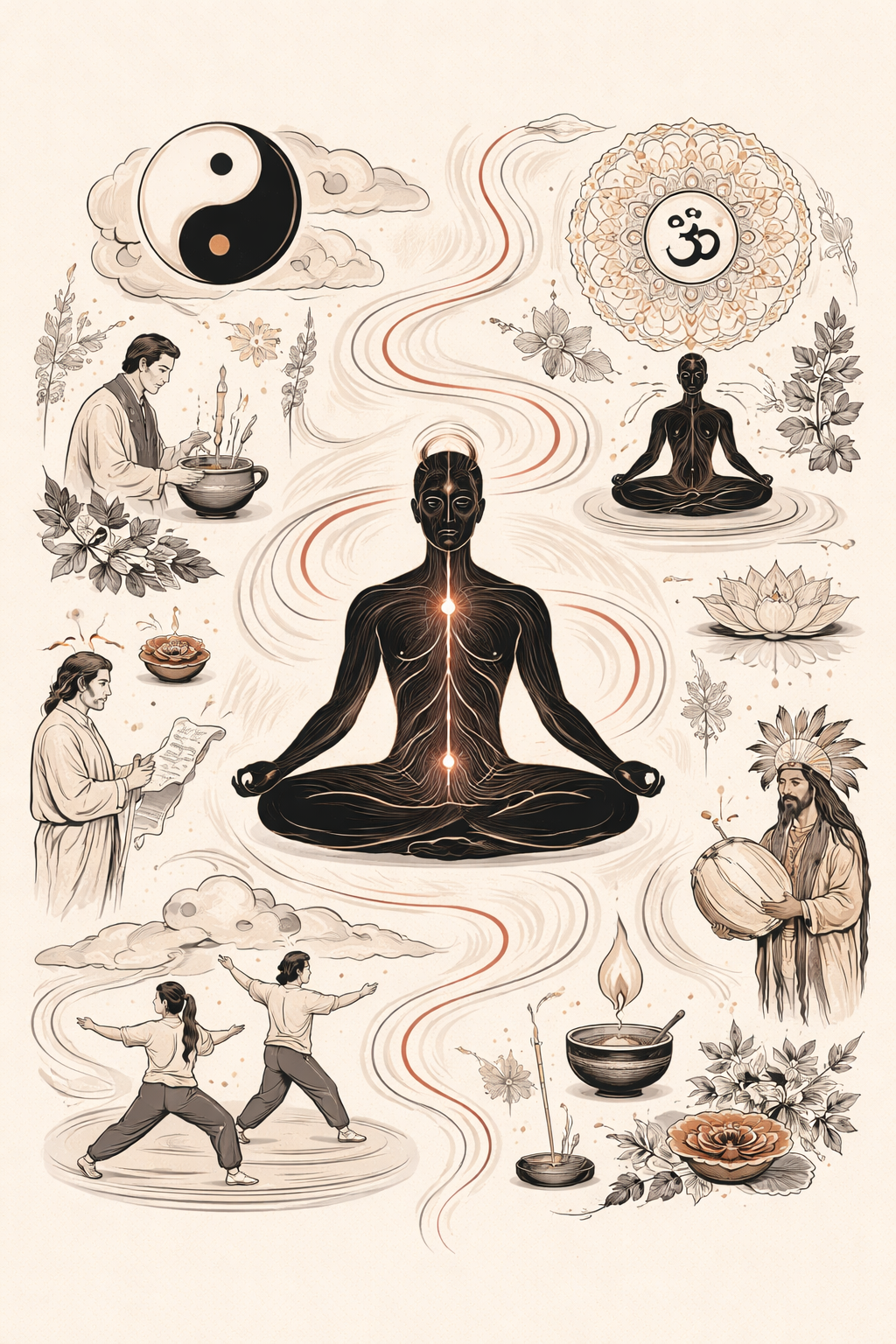
Vital energy and healing traditions examine health through concepts of life force, breath, circulation, balance, and subtle or invisible dimensions of embodiment. Across civilizations, healing has often been understood not only in mechanical or anatomical terms, but through ideas of animating force: qi in Chinese traditions, prāṇa in Indian thought, pneuma in Greek and later Mediterranean medicine, and a wider range of ritual, cosmological, and embodied systems in which vitality is treated as formative of health, disorder, and restoration. These traditions do not all mean the same thing, nor do they belong to a single doctrine. But they share a broad civilizational insight: that life is experienced as movement, relation, flow, breath, and balance, and that healing often concerns the restoration of disrupted vitality rather than only the repair of isolated parts.
This content pillar treats vital energy and healing traditions as a serious comparative field of inquiry rather than as a loose wellness category. It approaches these traditions historically, philosophically, anthropologically, and cautiously in relation to contemporary evidence. That caution is essential. The World Health Organization’s Global Traditional Medicine Strategy 2025–2034 explicitly recognizes the global importance of traditional, complementary, and integrative medicine while emphasizing evidence, safety, regulation, cultural respect, and appropriate health-system integration. UNESCO’s intangible cultural heritage framework likewise places traditional healing knowledge within wider worlds of ritual, cosmology, transmission, and community practice. The result is a field that must be studied with both openness and discipline: respectful of civilizational knowledge, yet clear about the difference between cultural significance, philosophical depth, and modern clinical validation.
Why This Pillar Matters
Vital energy traditions matter because they preserve a major strand of human reflection on health that is often obscured by modern biomedical reductionism. In these traditions, illness may be interpreted as blockage, depletion, excess, disharmony, stagnation, spiritual disturbance, or broken relation between the person and a wider order of life. Such views are not merely pre-scientific curiosities. They are part of enduring attempts to understand embodiment as dynamic, ecological, and relational. Even where modern readers do not accept every metaphysical claim, these traditions remain important for intellectual history, comparative medicine, cultural anthropology, and the study of how societies have connected healing to breath, movement, ritual, diet, attention, and moral or cosmological balance.
They also matter because many contemporary practices associated with health, rehabilitation, contemplative wellbeing, and integrative care still emerge from these older frameworks. NCCIH’s overviews of traditional Chinese medicine, tai chi, qigong, and Ayurveda each show that long-standing traditions remain influential in contemporary health cultures, while also stressing the need for careful evidence review, product safety, practitioner competence, and informed use. This makes vital energy traditions a uniquely important bridge category: one that links intellectual history and civilizational knowledge to present-day questions of evidence, embodiment, plural healing systems, and responsible interpretation.
Comparative Method and Scholarly Approach
This pillar adopts a comparative method, but comparison here is heuristic rather than homogenizing. It does not assume that qi, prāṇa, pneuma, subtle body theories, ritual transmission, or later vitalist concepts are historically identical. They arise from distinct metaphysical, linguistic, religious, and medical worlds. Chinese concepts of qi are embedded in correlative cosmology, yin-yang theory, and traditions of medicine and self-cultivation. Indian concepts of prāṇa emerge within Vedic, Upanishadic, yogic, and Ayurvedic contexts. Greek pneuma develops within philosophical and medical debates about soul, body, vitality, and natural process. To compare these ideas responsibly is not to flatten them into sameness, but to ask what they reveal about shared human efforts to think life, animation, disorder, and healing.
The pillar therefore distinguishes among four levels of analysis. First is the historical and textual level: what traditions say, how concepts developed, and how practices were transmitted. Second is the philosophical and anthropological level: what models of body, self, cosmos, and relation these traditions presuppose. Third is the practical level: how healing methods such as breathing disciplines, movement, touch, ritual, or meditative attention are enacted. Fourth is the evidence and governance level: how modern research, public health institutions, and regulators evaluate safety, efficacy, and appropriate integration into health systems. A PhD-level treatment of this field requires keeping these levels distinct rather than allowing cultural meaning, philosophical coherence, and clinical proof to blur into one another.
Qi, Prāṇa, Pneuma, and the History of Vitality
One of the most important themes in this pillar is the long history of attempts to understand what animates life. In Chinese thought, qi is not merely a vague “energy” but a foundational concept woven into cosmology, physiology, medicine, and self-cultivation. Stanford’s work on Chinese philosophy and medicine shows how Chinese medical reasoning cannot be separated neatly from larger philosophical frameworks, while its work on Chinese metaphysics and mind also highlights the centrality of qi, yin-yang, and correlative thought in classical and later traditions. In this context, healing involves not only fixing damaged tissue but restoring patterned relation, balance, and appropriate movement within the person and the wider world.
In Indian traditions, prāṇa is likewise more than a modern wellness slogan. Britannica identifies it as one of the body’s vital “airs” in Indian philosophy, especially in early Hindu thought, while NCCIH’s overview of Ayurveda emphasizes that Ayurveda is one of the world’s oldest medical systems, organized around holistic theories of physical and mental health that integrate body, mind, and spirit. Here breath, vitality, and regulation can be linked to diet, conduct, discipline, and broader theories of health and illness. The philosophical and medical worlds are intertwined rather than segregated.
Greek and later Mediterranean traditions developed related but distinct concepts through pneuma, often translated as breath, spirit, or vital air. Britannica’s treatment of pneuma and broader histories of ancient medicine indicate how classical thought explored the relationship between breath, soul, life, physiology, and natural process. Such ideas were later received and transformed across Hellenistic, Roman, and Islamic medical worlds. The point of comparison is not to claim identity among these traditions, but to note that many civilizations have treated breath, vitality, and animation as central to the intelligibility of health.
Vital Energy and Traditional Medical Systems
Vital energy traditions are not always free-standing spiritual doctrines. They are often embedded in organized medical systems. Traditional Chinese medicine, as NCCIH notes, evolved over thousands of years and includes acupuncture, movement practices, psychological and physical approaches, and herbal products. Stanford’s work further clarifies that Chinese medicine is intellectually connected to broader philosophical frameworks rather than merely a collection of isolated remedies. Theories of qi, yin-yang, and patterned correspondence have long informed diagnosis, prevention, and treatment.
Ayurveda likewise cannot be reduced to herbal products alone. NCCIH describes it as an ancient Indian medical system based on long-standing writings and a holistic approach to physical and mental health, integrating products, diet, exercise, and lifestyle. In many Ayurvedic and yogic contexts, the regulation of vitality is inseparable from digestion, constitution, balance, and disciplined living. This is why the pillar must engage not only “energy healing” narrowly defined, but the larger medical and philosophical ecologies within which vital concepts gain meaning.
The pillar will also remain attentive to the fact that some healing traditions preserve vital concepts without being formalized into large textual medical systems. UNESCO’s intangible cultural heritage framework explicitly includes traditional healing systems, ritual knowledge, cosmologies, and knowledge concerning nature and the universe. This widens the field beyond formal medicine and allows attention to living traditions in which healing is transmitted through apprenticeship, ritual authority, ecological knowledge, and communal practice.
Breath, Movement, and Cultivation
Many vital energy traditions treat breath and movement as core therapeutic and formative practices. Tai chi and qigong are among the most visible examples in contemporary health discourse. NCCIH notes that tai chi and qigong are mind-and-body practices with long histories, and current research explores their relevance to balance, pain, falls prevention, stress, and general wellbeing. The evidence is mixed across conditions, but sufficiently substantial to warrant careful attention rather than dismissal. These practices are especially important because they demonstrate that vitality traditions are often enacted through disciplined bodily cultivation rather than only verbal theory.
Indian traditions likewise give special importance to breath regulation, posture, attention, and disciplined practice. Britannica’s entry on prāṇa points toward the centrality of vital airs and breath, while broader philosophical and yogic traditions connect breath to concentration, vitality, and states of consciousness. A research-grade pillar must therefore examine how vitality is cultivated, not just how it is named. Healing in these traditions may involve training, alignment, restraint, and attentiveness as much as intervention.
Subtle Body and Invisible Physiology
Some traditions articulate models of the body that are neither purely anatomical nor merely metaphorical. They work instead through channels, centers, airs, winds, meridians, or layered conceptions of embodiment. These systems matter because they reveal that many cultures have understood health through invisible physiology: not invisible in the sense of being trivial or imaginary to practitioners, but invisible in the sense that the body is conceived as more than gross matter alone. The pillar will examine these systems comparatively while resisting the temptation to treat them as interchangeable maps of the same thing.
This theme also opens onto a larger intellectual question. Subtle physiology often sits at the boundary of medicine, ritual, philosophy, and spiritual discipline. To study it well requires attention to symbolism, practice, ontology, and cosmology all at once. It is precisely here that shallow contemporary “energy” language often fails. A serious account must recover the richness and specificity of the traditions themselves.
Ritual Healing, Presence, and Transmission
Vital energy traditions are frequently linked to ritual authority, prayer, touch, gesture, chanting, and forms of transmission that cannot be understood through mechanistic intervention alone. UNESCO’s heritage framework is especially useful here because it places healing knowledge within living constellations of ritual, memory, apprenticeship, and community life. In this broader field, healing is not only technical treatment. It is often relational, symbolic, and socially embedded.
This does not relieve the scholar of the duty of discrimination. Some ritual healing systems make claims that contemporary medicine does not validate; others may involve meaningful psychosocial, communal, or embodied effects even where metaphysical claims remain disputed. The pillar will therefore treat ritual healing neither as mere superstition nor as automatically verified therapy. Its goal is to understand how ritual presence, symbolic efficacy, and forms of transmission function within traditions of care.
Modern Evidence, Safety, and the Politics of Interpretation
A research-grade pillar on vital energy traditions must address the modern evidence question directly. WHO’s strategy is particularly important here because it states plainly that decisions concerning traditional, complementary, and integrative medicine should be based on the best available evidence of safety and effectiveness, and that appropriate regulation and integration matter. NCCIH’s overviews similarly stress that products can be contaminated or misidentified, that manufacturing and practitioner quality matter, and that evidence varies greatly across practices and conditions.
This means that the pillar must separate at least three different questions. First, does a tradition have historical, philosophical, or cultural significance? Second, does a practice have observed value for wellbeing, movement, stress reduction, or other outcomes under certain conditions? Third, do specific treatments or claims meet contemporary standards of safety and efficacy for defined clinical use? Conflating these questions weakens scholarship. Keeping them distinct allows the field to be treated both seriously and responsibly.
The pillar will also examine the politics of translation. Modern wellness culture often universalizes terms like “energy,” stripping them of context and repackaging them for consumption. At the same time, reductive skepticism can erase civilizational depth by dismissing whole traditions because they do not fit modern biomedical categories neatly. The ethical and scholarly task is to avoid both distortions.
Articles in This Series
- What Is Vital Energy in Healing Traditions?
- Qi, Cosmology, and the Foundations of Chinese Healing Thought
- Prāṇa, Breath, and Vitality in Indian Philosophy and Medicine
- Pneuma, Breath, and the Classical Medical Imagination
- Vitalism, Mechanism, and the Modern History of Life Force
- Yin-Yang, Balance, and the Logic of Disorder in Chinese Medicine
- Meridians, Channels, and the Mapping of Invisible Physiology
- Subtle Body Traditions and the Energetic Imagination
- Tai Chi, Qigong, and the Cultivation of Vital Energy
- Yoga, Breath Discipline, and the Regulation of Vitality
- Ritual Healing, Presence, and Energetic Transmission
- Vital Energy, Symbolism, and the Anthropology of Healing
- Traditional Healing as Intangible Cultural Heritage
- Vital Energy Traditions and the Question of Evidence
- Safety, Regulation, and the Governance of Traditional Healing
- The Future of Vital Energy Traditions in Integrative Health
How This Pillar Connects to the Wider Site
This pillar connects naturally to Healing Traditions, Chinese Medicine, Shamanism, Ritual & Spiritual Healing, Diet, Nourishment & Food as Medicine, and Tea, Ritual & Everyday Philosophy. It also intersects with wider inquiries into symbolism, philosophy, anthropology, embodiment, and ethics. The study of vitality traditions opens onto questions of knowledge architecture, ritual meaning, cosmology, and the relation between human flourishing and systems of care. It therefore strengthens both the healing cluster and the broader intellectual coherence of the site.
Conclusion
Vital energy traditions preserve one of the most enduring ways human societies have tried to understand health: as a matter of animation, circulation, relation, breath, and balance rather than only mechanism and repair. These traditions should neither be romanticized nor dismissed. They deserve serious study because they illuminate civilizational attempts to think through life, suffering, restoration, and the invisible dimensions of embodied existence. Approached carefully, they also offer a powerful comparative lens on what healing has meant across cultures and why the history of medicine cannot be reduced to one model of body or one account of evidence.
This pillar therefore treats vital energy and healing traditions as a field of real intellectual consequence: one that links medicine, ritual, philosophy, anthropology, and living heritage. Its aim is not to flatten difference or to treat every energetic claim as equally established. Its aim is to study seriously the many ways civilizations have understood vitality and to ask what these traditions still reveal about care, embodiment, balance, and the human search for healing.
Further Reading
- Stanford Encyclopedia of Philosophy, Chinese Philosophy and Chinese Medicine
- Stanford Encyclopedia of Philosophy, Metaphysics in Chinese Philosophy
- WHO, Global Traditional Medicine Strategy 2025–2034
- WHO, Traditional, Complementary and Integrative Medicine: Global Strategies
- NCCIH, Traditional Chinese Medicine: What You Need To Know
- NCCIH, Ayurvedic Medicine: In Depth
- NCCIH, Tai Chi: What You Need To Know
- NCCIH, Qigong: What You Need To Know
- UNESCO, Knowledge and Practices Concerning Nature and the Universe
- Britannica, Qi
- Britannica, Prana
- Britannica, Pneuma
References
- Encyclopaedia Britannica (2026) Qi. Available at: https://www.britannica.com/topic/qi-Chinese-philosophy (Accessed: 6 April 2026).
- Encyclopaedia Britannica (2026) Prana. Available at: https://www.britannica.com/topic/prana (Accessed: 6 April 2026).
- Encyclopaedia Britannica (2026) Pneuma. Available at: https://www.britannica.com/science/pneuma (Accessed: 6 April 2026).
- Encyclopaedia Britannica (2026) Vitalism. Available at: https://www.britannica.com/topic/vitalism (Accessed: 6 April 2026).
- National Center for Complementary and Integrative Health (NCCIH) (2025) Traditional Chinese Medicine: What You Need To Know. Available at: https://www.nccih.nih.gov/health/traditional-chinese-medicine-what-you-need-to-know (Accessed: 6 April 2026).
- National Center for Complementary and Integrative Health (NCCIH) (2025) Ayurvedic Medicine: In Depth. Available at: https://www.nccih.nih.gov/health/ayurvedic-medicine-in-depth (Accessed: 6 April 2026).
- National Center for Complementary and Integrative Health (NCCIH) (2025) Tai Chi: What You Need To Know. Available at: https://www.nccih.nih.gov/health/tai-chi-what-you-need-to-know (Accessed: 6 April 2026).
- National Center for Complementary and Integrative Health (NCCIH) (2025) Qigong: What You Need To Know. Available at: https://www.nccih.nih.gov/health/qigong-what-you-need-to-know (Accessed: 6 April 2026).
- Raphals, L. (2015) ‘Chinese Philosophy and Chinese Medicine’, Stanford Encyclopedia of Philosophy. Available at: https://plato.stanford.edu/entries/chinese-phil-medicine/ (Accessed: 6 April 2026).
- Perkins, F. (2015) ‘Metaphysics in Chinese Philosophy’, Stanford Encyclopedia of Philosophy. Available at: https://plato.stanford.edu/entries/chinese-metaphysics/ (Accessed: 6 April 2026).
- UNESCO (n.d.) Knowledge and Practices Concerning Nature and the Universe. Available at: https://ich.unesco.org/en/knowledge-concerning-nature-00056 (Accessed: 6 April 2026).
- UNESCO (n.d.) Intangible Cultural Heritage Domains. Available at: https://ich.unesco.org/doc/src/01857-EN.pdf (Accessed: 6 April 2026).
- World Health Organization (2025) Global Traditional Medicine Strategy 2025–2034. Geneva: WHO. Available at: https://www.who.int/publications/i/item/9789240113176 (Accessed: 6 April 2026).
- World Health Organization (2026) Traditional, Complementary and Integrative Medicine (TCI): Global Strategies. Available at: https://www.who.int/teams/integrated-health-services/traditional-complementary-and-integrative-medicine/global-strategies (Accessed: 6 April 2026).