
Last Updated April 6, 2026
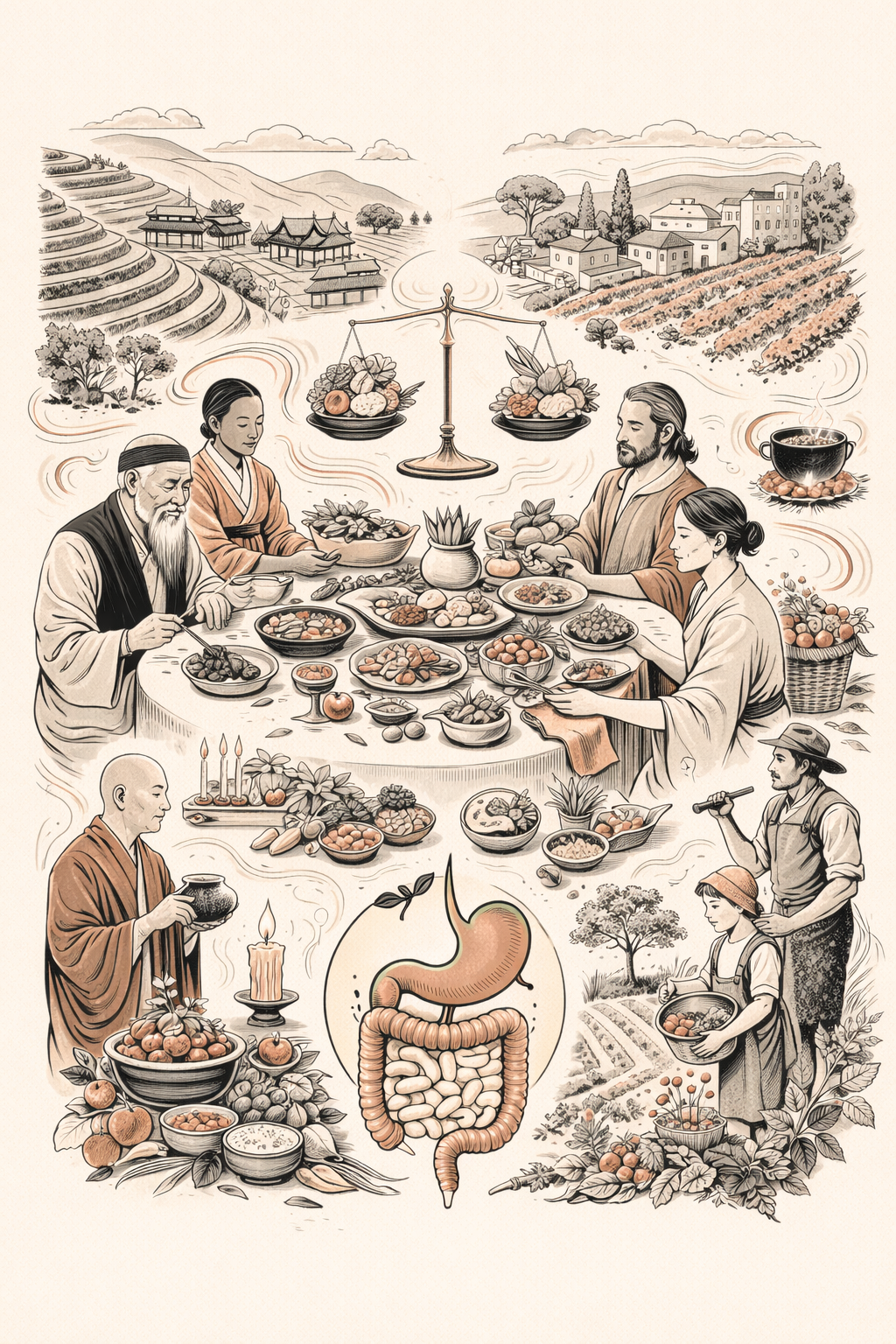
Before food became a category of nutrients, it was a category of life. It marked the rhythm of seasons, the order of the household, the obligations of hospitality, the discipline of appetite, the repair of weakness, the care of children, the recovery of the sick, and the moral shape of daily existence. Across civilizations, people have treated food not only as sustenance but as one of the primary means by which health is preserved, balance restored, and disorder either prevented or intensified. To eat has never been merely to consume. It has been to participate in a theory of the body, a relation to land and climate, a structure of social life, and an understanding of what it means to live well.
That is why nourishment belongs not only to nutrition, but to medicine, culture, ritual, ecology, and ethics. Diet has often been understood as a formative practice long before it was treated as a technical problem. In many traditions, food appears not at the edge of healing but at its center. It is tied to digestion, constitution, vitality, seasonality, restraint, and the repeated acts through which a body is strengthened or burdened over time. UNESCO’s heritage materials on the Mediterranean diet and washoku reinforce this wider view by presenting foodways as living constellations of knowledge, ritual, production, preparation, memory, and communal belonging rather than as mere lists of recommended ingredients.
Yet the present makes this field more demanding. The World Health Organization’s January 2026 healthy diet guidance stresses that healthy diets help prevent malnutrition in all its forms and reduce the risk of noncommunicable diseases, while also noting that rapid urbanization, changing lifestyles, and food-system transformation have driven people toward highly processed diets high in unhealthy fats, sugars, and salt. FAO and WHO’s sustainable healthy diets framework adds that dietary guidance must be attentive not only to health, but also to environmental cost and to social, cultural, and economic context. Meanwhile, WHO’s Global Traditional Medicine Strategy 2025–2034 recognizes the global importance of traditional, complementary, and integrative medicine while emphasizing evidence, safety, regulation, and culturally respectful integration. Taken together, these sources make clear that nourishment can no longer be treated as either private lifestyle choice or inherited custom alone. It is simultaneously civilizational, clinical, ecological, and political.
Why Food Has Always Belonged to Healing
Food belongs to healing because it occupies the threshold between ordinary life and bodily condition. Remedies may be exceptional, but eating is repeated. Drugs may be episodic, but nourishment is continuous. For this reason, many traditions have treated the daily table as one of the first sites of medicine. Health is not shaped only by interventions after disorder appears; it is also formed by the habits, patterns, balances, and excesses that precede visible illness. In this sense, nourishment is not merely a support to healing. It is one of healing’s most durable forms.
This insight remains powerful because it resists a narrow understanding of medicine as repair alone. It places emphasis on cultivation, prevention, adaptation, and resilience. It assumes that bodies are not static mechanisms into which substances are inserted, but living processes shaped by repetition, environment, constitution, and relation. A society that treats nourishment seriously therefore asks not only what can cure illness once it arrives, but what kinds of eating make strength, stability, and tolerable life more likely in the first place.
A Comparative Field, Not a Single Doctrine
There is no single doctrine of food as medicine. Chinese dietetics, Ayurvedic dietary theory, Mediterranean foodways, Japanese washoku, humoral traditions, monastic fasting, household herbal knowledge, and modern public-health nutrition do not emerge from one worldview. They differ in vocabulary, metaphysics, ritual setting, medical logic, and institutional form. Some interpret food through constitution, qualities, and balance. Others through seasonality, social order, or respect for nature. Others still through epidemiology, nutrient adequacy, affordability, and population health. To study them comparatively is not to force them into sameness, but to ask what they reveal about the recurring human attempt to connect eating with health, order, and flourishing.
A serious approach therefore keeps several levels distinct. One level is historical and textual: how dietary theories were articulated, transmitted, and debated. A second is anthropological and cultural: how foodways carry identity, memory, hierarchy, ritual, and inherited ecological knowledge. A third is physiological and practical: how traditions connect food to digestion, vitality, constitution, and recovery. A fourth is evidentiary and institutional: how modern public-health and medical bodies evaluate patterns of diet, safety, disease risk, and sustainability. These levels overlap, but they should not be collapsed. Cultural meaning is not identical to clinical proof; epidemiological validity is not identical to civilizational depth.
Foodways as Civilizational Memory
Foodways are among the most powerful carriers of civilizational continuity because they preserve knowledge in enacted rather than merely written form. They survive in kitchens, markets, harvests, rituals, family meals, seasonal observances, methods of preparation, and rules of hospitality. UNESCO’s description of the Mediterranean diet emphasizes not only crops, cooking, and consumption, but also sharing, social exchange, and the renewal of communal identity. Its description of washoku likewise frames Japanese dietary culture as a social practice grounded in respect for nature and the sustainable use of natural resources. In both cases, nourishment appears not as biochemical intake alone, but as a cultural order linking body, landscape, memory, and community.
This is one reason the erosion of foodways can be so consequential. What disappears is not only a menu. What disappears may be a theory of seasonality, a practice of restraint, a household ethic of care, a communal rhythm of eating together, or a form of ecological intelligence accumulated across generations. UNESCO’s recent material on foodways as intangible cultural heritage makes this especially clear: food traditions are forms of knowledge, skill, and social practice that define belonging and mediate continuity. A pillar on food as medicine must therefore be expansive enough to include not only dietary advice but the social and symbolic worlds in which nourishment becomes meaningful.
Dietetic Systems and the Ordering of the Body
Many healing traditions developed explicit dietetic systems in which food was understood as part of a larger ordering of the body. In Ayurveda, diet is inseparable from constitution, digestion, lifestyle, and balance. NCCIH describes Ayurveda as one of the world’s oldest medical systems and notes that it combines products, diet, exercise, and lifestyle practices within a holistic framework directed toward physical and mental health. In such a system, nourishment does not sit outside medicine; it belongs to the logic of medicine itself.
Comparable observations apply across other traditions even where the conceptual language differs. Food may be interpreted according to heating and cooling tendencies, dryness and moisture, heaviness and lightness, compatibility and incompatibility, strengthening and burdening effects, or relation to age, season, and labor. Whether expressed through humoral, constitutional, or ecological vocabularies, these frameworks reveal a common conviction: food acts differently in different bodies and circumstances. Nourishment is therefore relational rather than neutral. It cannot be understood only by naming the substance. It must also be understood through the conditions under which it is taken, transformed, and lived.
Digestion, Constitution, and the Problem of Assimilation
One of the deepest insights in traditions of food as medicine is that health depends not only on what is eaten, but on what can be digested, assimilated, and borne. A food may be excellent in abstract terms and yet unsuitable in a particular constitution, season, age, or state of illness. For this reason, many traditions place digestion at the center of nourishment. They ask not merely what enters the body, but what can be transformed into strength rather than disorder.
This concern remains intellectually important even where modern science uses different categories. Contemporary public health and nutrition research increasingly focus on dietary patterns, metabolic response, long-term risk, and the relation between food environments and chronic disease. That does not mean that older constitutional or digestive theories are simply validated whole by current science. It does mean that older traditions were often grappling with real questions about variability, tolerance, repetition, and the body’s uneven response to the same food. Their answers differ from modern biomedical frameworks, but the underlying problem they address remains recognizable and serious.
Fasting, Restraint, and the Government of Appetite
Food as medicine is not only about nourishment in the sense of provision. It is also about limits. Across religious, philosophical, and medical traditions, fasting and dietary restraint have been treated as practices of purification, preparation, self-command, digestive rest, and moral orientation. To eat well has often meant not only choosing properly, but abstaining deliberately, pacing consumption, and resisting forms of appetite judged excessive or disordered.
This theme matters because it shows that nourishment traditions are inseparable from ethics. They ask what should be desired, when intake should be limited, what counts as moderation, and how bodily life should be governed without collapsing into indulgence or deprivation. A serious treatment of food as medicine therefore cannot stop with ingredients or menus. It must also examine how traditions have understood self-discipline, ritual observance, and therapeutic restraint as part of the ordering of health.
The Household, the Table, and the Social Life of Care
Food heals socially as well as physiologically. Meals are among the most basic scenes in which care becomes visible: feeding children, tending the sick, honoring guests, marking grief, celebrating harvest, sustaining elders, and binding strangers into relation. A healing tradition that ignores the social life of the table misses one of the oldest truths about nourishment: people are not fed only by nutrients, but by ordered forms of belonging and repeated acts of provision.
This is one reason shared eating appears so prominently in heritage language. Eating together is not merely convivial; it is formative. It teaches pace, reciprocity, gratitude, hierarchy, and place. It reinforces memory and identity. It can also reveal exclusion, scarcity, or the unequal distribution of labor. A deeper account of food as medicine must therefore treat the table as a moral site. It is where health, care, identity, and power meet in ordinary life.
Modern Food Systems and the Crisis of Nourishment
The contemporary difficulty is that many food systems now operate at a scale and speed that disrupt older relations among nourishment, seasonality, locality, and care. WHO’s 2026 healthy diet guidance notes that changes in food production, urbanization, and lifestyles have shifted many populations toward heavily processed foods high in unhealthy fats, free sugars, and salt. At the same time, WHO highlights that many people do not consume enough fruit, vegetables, and dietary fibre. This is not merely a matter of poor individual judgment. It reflects a structural transformation in how food is produced, marketed, distributed, and normalized.
The 2025 State of Food Security and Nutrition in the World further sharpens the issue by emphasizing food price inflation and the affordability of healthy diets. When nourishing food becomes economically inaccessible, advice alone becomes inadequate. The question of food as medicine then becomes inseparable from inequality, wages, infrastructure, agricultural policy, and the political economy of supply chains. A serious pillar must therefore resist moralizing nourishment as though all households occupy the same position of choice. Healthy eating is not only a matter of will. It is also a matter of access.
Sustainable Diets and the Ecological Condition of Health
Food as medicine must now be considered under ecological conditions that earlier traditions did not confront in the same globalized form. WHO notes that healthy diets are associated not only with lower disease risk but also, in many cases, with lower greenhouse gas emissions and lower pressure on land and freshwater. FAO and WHO’s sustainable healthy diets guidance takes this further by insisting that dietary thinking must account for environmental cost as well as health, and must remain adaptable to local social, cultural, and economic context. The implication is profound: nourishment can no longer be understood solely as an individual matter because the ecological basis of nourishment is itself under strain.
This gives new relevance to traditional foodways shaped by seasonality, preservation, modesty, plant diversity, and adaptation to place. Not every traditional pattern is automatically sustainable, but many preserve forms of ecological intelligence that industrial food systems have weakened: respect for season, attention to waste, local adaptation, and the sense that food belongs to landscape rather than to endless abstraction. A future-oriented healing tradition will need to think nourishment together with ecology, not after it.
Evidence, Public Health, and the Boundaries of Claim
A research-grade pillar on diet and nourishment must address evidence directly. Modern public-health institutions evaluate diets in relation to malnutrition, chronic disease, life-course health, and structural affordability. These forms of evidence are indispensable. But they do not cancel the interpretive importance of ritual, heritage, or historical dietetic systems. They simply change the terms of responsible claim-making. A culturally meaningful foodway is not thereby clinically optimal in every respect. A traditional dietary rule may embody practical wisdom without functioning as universal therapeutic law. A public-health recommendation may be epidemiologically strong while remaining culturally shallow if severed from actual food practice.
The task, then, is not to force all nourishment traditions into one standard of proof, nor to exempt them from scrutiny. It is to distinguish clearly among types of claim: historical, cultural, philosophical, therapeutic, and epidemiological. That distinction is what allows food as medicine to be studied both honestly and seriously. Without it, the field collapses either into romantic nostalgia or into a thin technocracy unable to see why nourishment has mattered so deeply across civilizations.
Articles in This Series
- What Is Food as Medicine?
- Diet, Nourishment, and the History of Healing
- Ayurveda, Constitution, and Therapeutic Eating
- Chinese Dietetics and the Logic of Balance
- Humoral Diets, Temperament, and Classical Medicine
- Digestion, Assimilation, and the Meaning of Nourishment
- Seasonality, Climate, and Eating in Traditional Food Systems
- Fasting, Restraint, and the Ethics of Appetite
- Foodways, Ritual, and the Social Life of Healing
- The Mediterranean Diet as Cultural Heritage and Health Practice
- Washoku, Respect for Nature, and Dietary Culture in Japan
- Food, Identity, and the Transmission of Healing Knowledge
- Modern Nutrition Science and Traditional Dietary Wisdom
- Affordability, Inequality, and Access to Healthy Diets
- Sustainable Diets, Ecology, and the Future of Nourishment
- The Future of Food as Medicine
How This Pillar Connects to the Wider Site
This pillar connects naturally to Healing Traditions, Chinese Medicine, Vital Energy & Healing Traditions, Tea, Ritual & Everyday Philosophy, and Herbalism & Traditional Knowledge. It also intersects with wider inquiries into culture, symbolism, sustainability, ethics, and everyday philosophy. The study of diet and nourishment opens onto questions of embodiment, ritual, ecology, care, memory, and the civilizational ordering of daily life. It therefore strengthens both the healing cluster and the broader intellectual coherence of the site.
Conclusion
Diet, nourishment, and food as medicine preserve one of the oldest and most durable truths in the history of healing: that health is shaped in kitchens, fields, households, rituals, and shared tables as much as in formal medical encounters. These traditions deserve serious study because they reveal how civilizations have linked nourishment to vitality, digestion, moral order, hospitality, ecological adaptation, restraint, and the repeated practices through which people sustain life. They should neither be romanticized nor reduced to folk residue. They are part of the intellectual and practical history of how human beings have tried to live well.
This pillar therefore treats food as medicine as a field of real intellectual consequence: one that links nutrition, medicine, ritual, heritage, ecology, and ethics. Its aim is not to collapse all traditions into one diet doctrine or to treat every inherited practice as clinically established. Its aim is to study seriously the many ways societies have understood nourishment and to ask what those traditions still reveal about care, balance, resilience, and the ordinary civilizational practices of healing.
Further Reading
- WHO, Healthy diet
- WHO, The State of Food Security and Nutrition in the World 2025
- FAO, Dietary guidelines and sustainability
- FAO/WHO, Sustainable Healthy Diets: Guiding Principles
- FAO, Food-based dietary guidelines
- NCCIH, Ayurvedic Medicine: In Depth
- UNESCO, Mediterranean diet
- UNESCO, Washoku
- UNESCO, Foodways: growing recognition and reinforced safeguarding measures
References
- Food and Agriculture Organization of the United Nations (FAO) (2026) Dietary guidelines and sustainability. Available at: https://www.fao.org/nutrition/education/dietary-guidelines/background/sustainable-dietary-guidelines/en/ (Accessed: 6 April 2026).
- Food and Agriculture Organization of the United Nations (FAO) (2026) Food-based dietary guidelines. Available at: https://www.fao.org/nutrition/nutrition-education/food-dietary-guidelines/en/ (Accessed: 6 April 2026).
- Food and Agriculture Organization of the United Nations and World Health Organization (2019) Sustainable Healthy Diets: Guiding Principles. Rome: FAO and WHO. Available at: https://www.who.int/publications/i/item/9789241516648 (Accessed: 6 April 2026).
- National Center for Complementary and Integrative Health (NCCIH) (2025) Ayurvedic Medicine: In Depth. Available at: https://www.nccih.nih.gov/health/ayurvedic-medicine-in-depth (Accessed: 6 April 2026).
- UNESCO Intangible Cultural Heritage (2026) Mediterranean diet. Available at: https://ich.unesco.org/en/RL/mediterranean-diet-00884 (Accessed: 6 April 2026).
- UNESCO Intangible Cultural Heritage (2026) Washoku, traditional dietary cultures of the Japanese, notably for the celebration of New Year. Available at: https://ich.unesco.org/en/RL/washoku-traditional-dietary-cultures-of-the-japanese-notably-for-the-celebration-of-new-year-00869 (Accessed: 6 April 2026).
- UNESCO Intangible Cultural Heritage (2025) Foodways: growing recognition and reinforced safeguarding measures. Available at: https://ich.unesco.org/doc/src/68477-EN.pdf (Accessed: 6 April 2026).
- World Health Organization (WHO) (2026) Healthy diet. Available at: https://www.who.int/news-room/fact-sheets/detail/healthy-diet (Accessed: 6 April 2026).
- World Health Organization (WHO) (2025) The State of Food Security and Nutrition in the World 2025. Available at: https://www.who.int/publications/m/item/the-state-of-food-security-and-nutrition-in-the-world-2025 (Accessed: 6 April 2026).