Author name: Tariq Ahmad

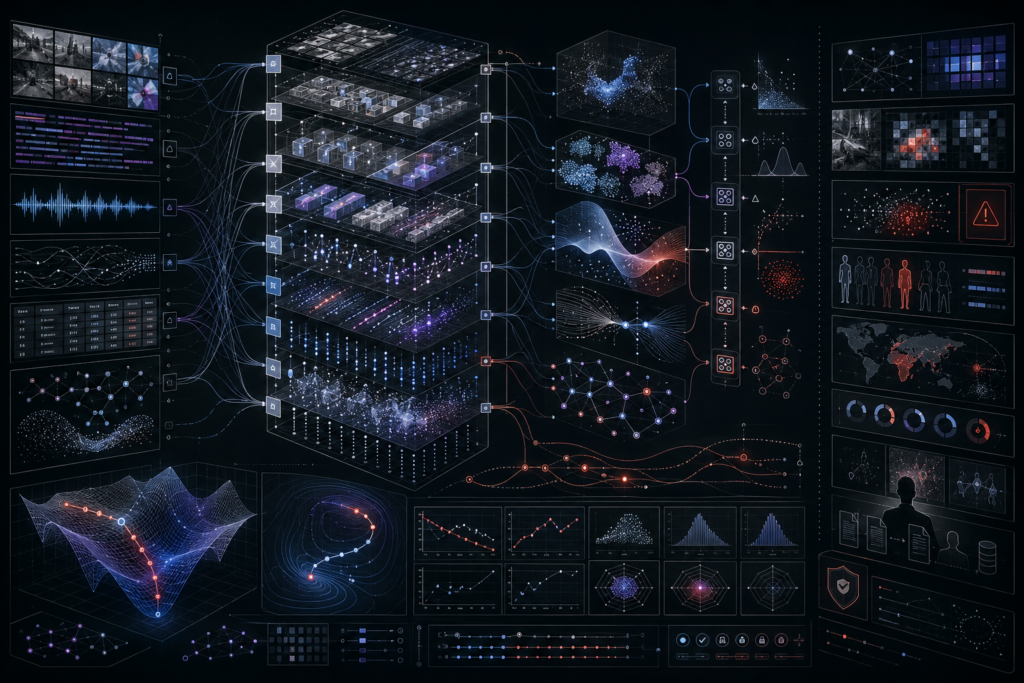
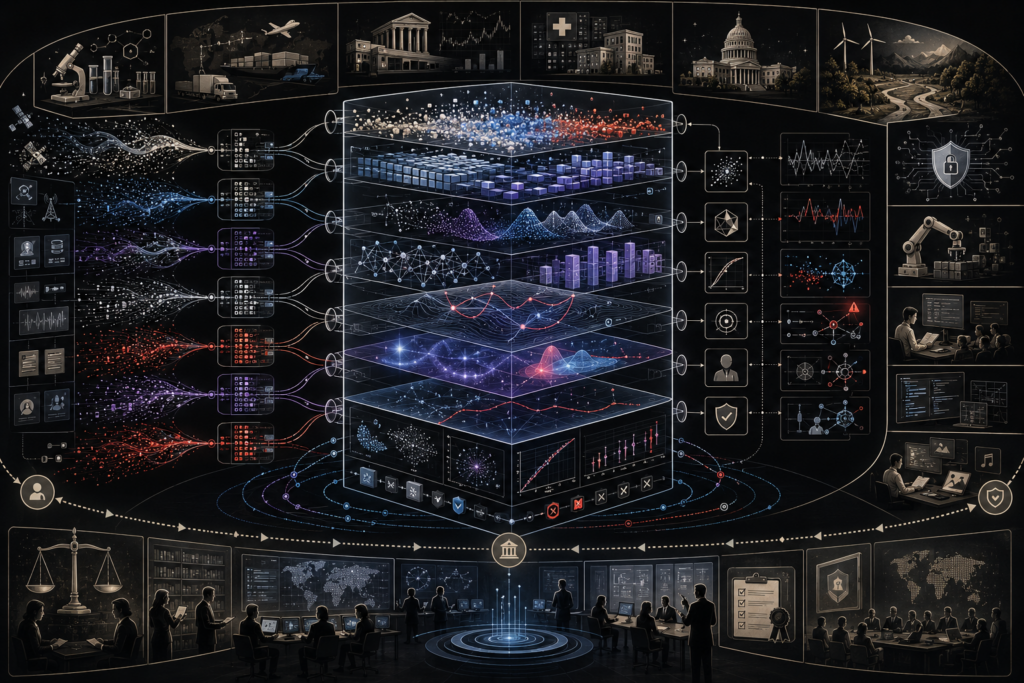
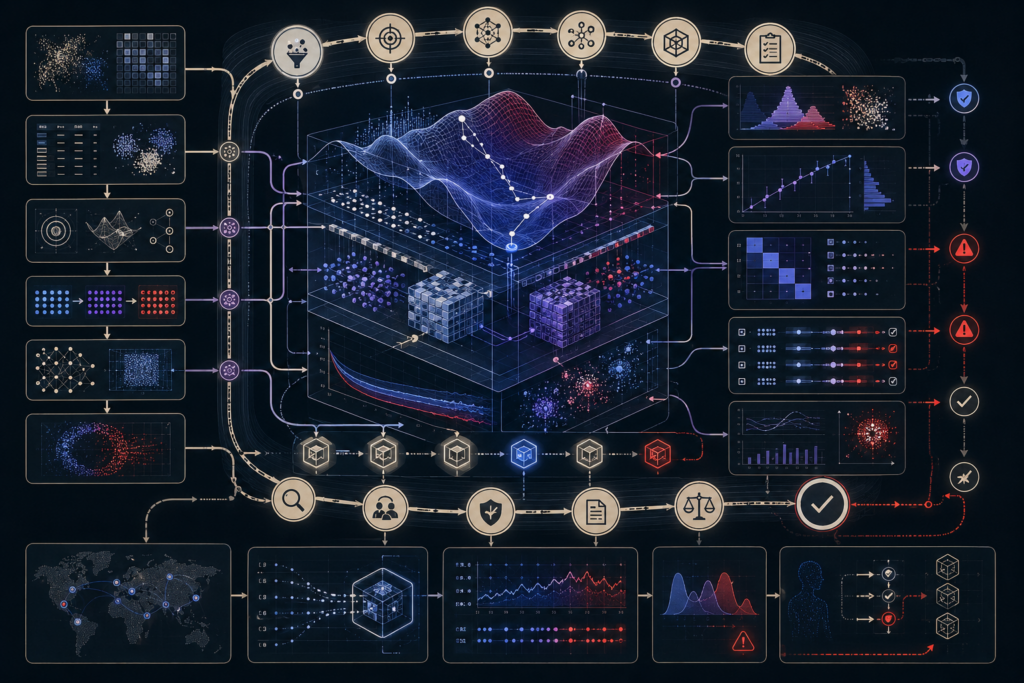
Machine learning training and evaluation system showing datasets, loss surfaces, gradient descent paths, optimizer trajectories, validation and testing splits, calibration review, learning curves, robustness diagnostics, distribution-shift monitoring, governance checkpoints, human oversight, and audit controls.

Model Training, Optimization, and Evaluation

Model training, optimization, and evaluation form the operational core of machine learning systems, determining how models learn, what they optimize, and whether their outputs can be trusted beyond development data. This article explains empirical risk minimization, loss functions, objective design, gradient descent, mini-batch optimization, adaptive methods, loss landscapes, validation, testing, calibration, generalization, regularization, robustness, distribution shift, monitoring, and failure analysis. It also introduces mathematical lenses for training data, empirical risk, expected risk, gradient updates, cross-entropy, calibration error, generalization gaps, and drift, alongside Python and R workflows for model fitting, evaluation metrics, calibration tables, grouped diagnostics, and deployment-condition analysis. By connecting optimization practice to evidence, uncertainty, infrastructure, auditability, and governance, it frames model development as a disciplined systems process for trustworthy AI.
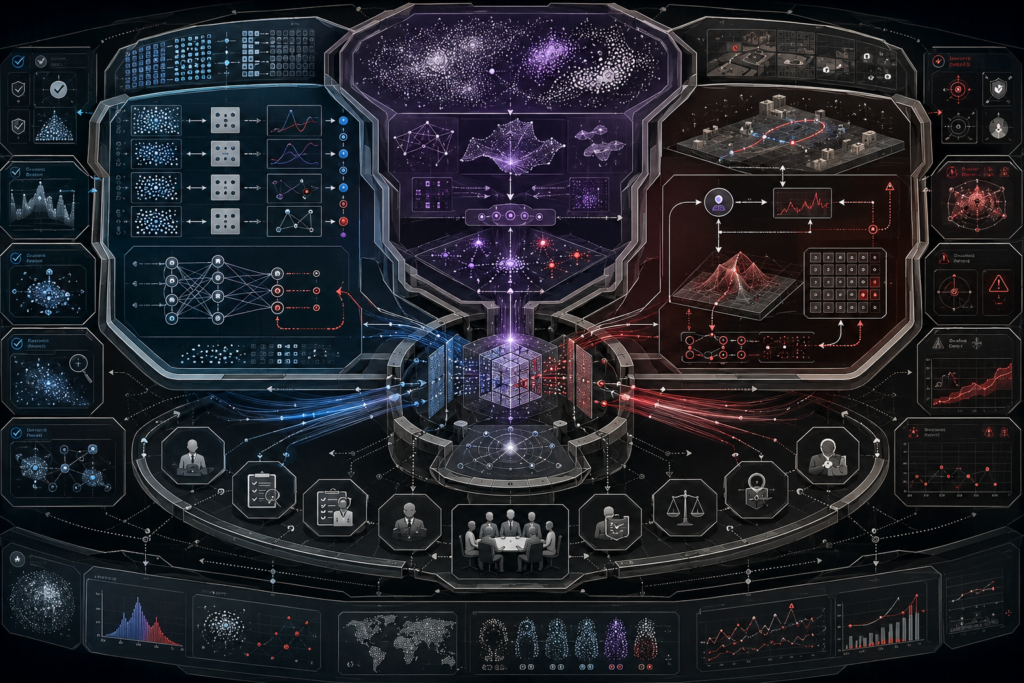
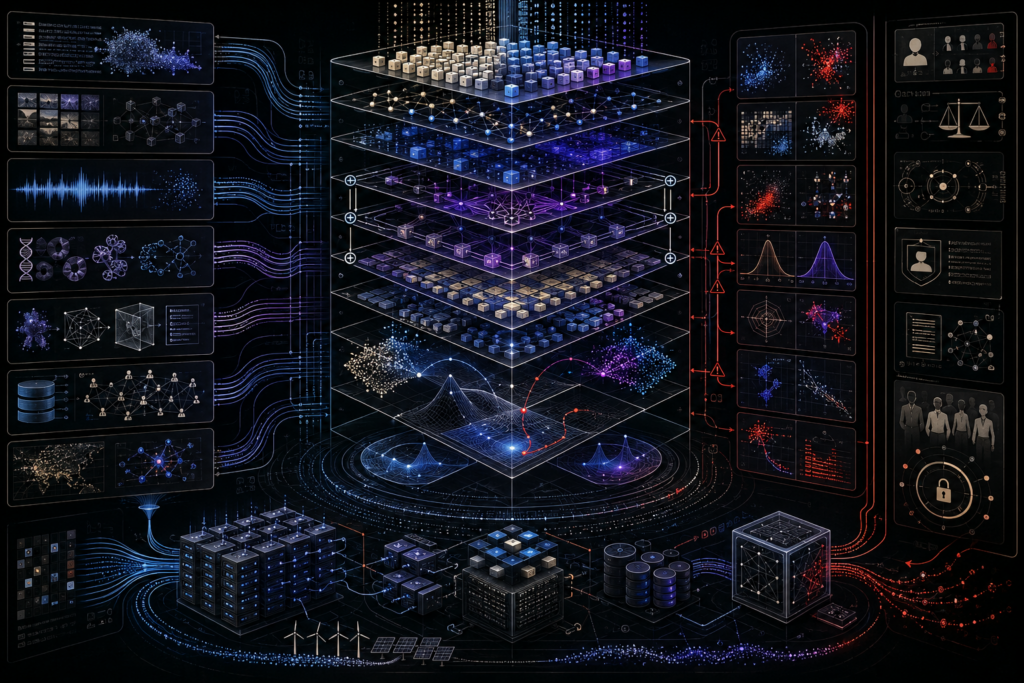
Machine learning paradigms system showing supervised learning from labeled examples, unsupervised learning from latent patterns and clusters, reinforcement learning through agent-environment reward loops, hybrid representation learning, evaluation diagnostics, human oversight, and audit controls.

Supervised, Unsupervised, and Reinforcement Learning

Supervised, unsupervised, and reinforcement learning describe three distinct ways AI systems acquire structure from data, feedback, and experience. This article explains supervised learning as conditional estimation from labeled examples, unsupervised learning as structure discovery within unlabeled data, and reinforcement learning as sequential decision-making through rewards and environmental interaction. It covers signal structure, objectives, feedback timing, labels, latent variables, clustering, Markov Decision Processes, policies, value functions, Q-learning, generalization, self-supervised learning, hybrid systems, and governance risks. The article also introduces mathematical lenses for empirical loss, distribution modeling, latent structure, expected return, value estimation, and action-value updates, alongside Python and R workflows for classification, clustering, Q-learning, and learning-paradigm diagnostics. By connecting learning regimes to auditability, it frames machine learning paradigms as systems of evidence, optimization, and accountability.

Deep learning systems architecture showing hierarchical representations, neural layers, transformers, attention pathways, embedding spaces, scaling dynamics, optimization geometry, generalization diagnostics, distributed compute, robustness checks, human oversight, and audit controls.

Deep Learning Systems: Representation, Scale, and Generalization

Deep learning systems use large-scale neural architectures to learn hierarchical representations from data, enabling AI models to generalize across complex domains such as language, vision, speech, biology, multimodal reasoning, and scientific discovery. This article explains representation learning, the manifold hypothesis, depth, compositionality, expressive power, scaling laws, transformers, attention, overparameterization, double descent, emergent capabilities, optimization geometry, infrastructure, robustness, and governance. It also introduces mathematical lenses for composed neural functions, layer transformations, residual connections, empirical risk, attention, scaling behavior, generalization gaps, and distribution shift, alongside Python and R workflows for representation geometry, scaling-law simulation, and generalization diagnostics. By connecting neural representation to compute, data, architecture, deployment, and institutional power, it frames deep learning as an auditable systems regime rather than a model class alone.

Neural network architecture showing raw data transformed through layered representations, activation maps, weighted connections, latent embeddings, decision surfaces, gradient paths, pattern-recognition outputs, robustness checks, human oversight, and audit controls.

Neural Networks and Pattern Recognition

Neural networks and pattern recognition explain how AI systems transform raw data into layered representations that make complex structure detectable, learnable, and usable. This article explains neural networks as parameterized function approximators, showing how inputs pass through weights, biases, activation functions, hidden layers, loss functions, gradients, and backpropagation to produce learned representations and predictions. It covers nonlinear architecture, representation hierarchies, latent-space geometry, inductive bias, convolution, attention, generalization, overparameterization, double descent, interpretability, distribution shift, adversarial inputs, and governance. The article also introduces mathematical lenses for neural functions, layer transformations, empirical loss, gradient descent, backpropagation, softmax classification, representation similarity, and generalization gaps, alongside Python and R workflows for multilayer perceptrons, representation projection, and grouped error diagnostics. By connecting pattern recognition to auditability, it frames neural networks as systems-level components of trustworthy AI.

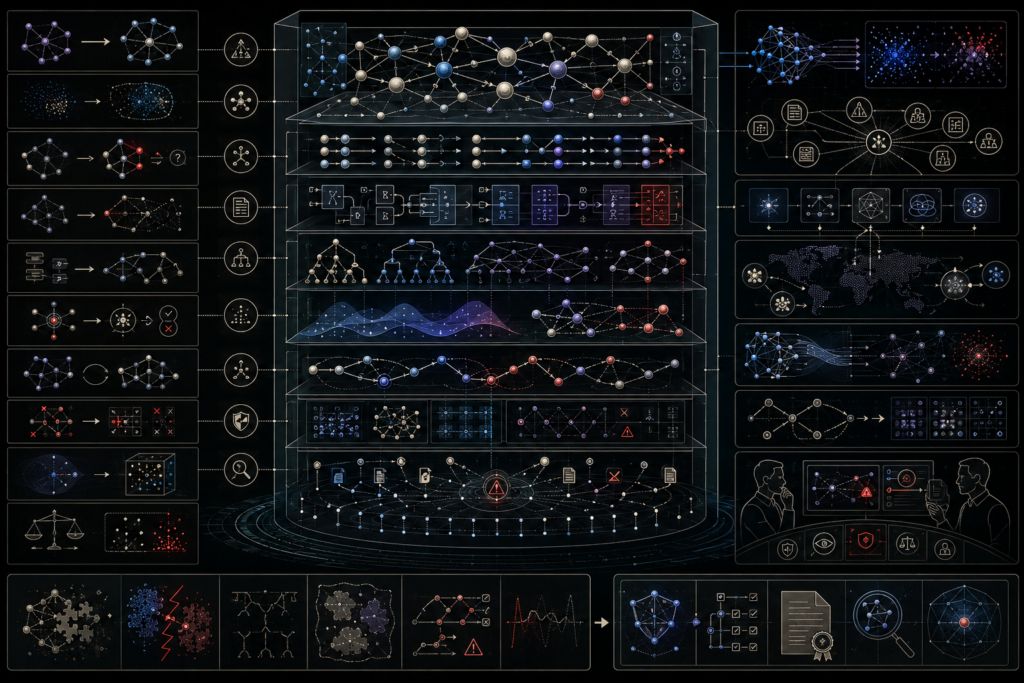
Knowledge representation and artificial reasoning system showing entities, relations, semantic triples, ontology hierarchies, logic rules, inference pathways, uncertainty modeling, knowledge graphs, hybrid neural-symbolic links, explanation trails, human oversight, and audit controls.

Knowledge Representation and Artificial Reasoning

Knowledge representation and artificial reasoning examine how AI systems encode facts, concepts, relations, constraints, uncertainty, and causal structure so they can support inference, explanation, planning, diagnosis, and accountable action. This article explains symbolic AI, formal logic, predicates, semantic networks, frames, ontologies, knowledge graphs, inference engines, deduction, induction, abduction, search, uncertainty, Bayesian reasoning, non-monotonic logic, hybrid AI, and neuro-symbolic systems. It also introduces mathematical lenses for knowledge bases, predicate assertions, rules, entailment, semantic triples, knowledge graphs, Bayesian updating, and hybrid reasoning architectures, alongside Python and R workflows for forward chaining, symbolic facts, inference traces, rule coverage, and reasoning diagnostics. By connecting representation to meaning, interoperability, governance, and institutional trust, it frames artificial reasoning as a foundation for auditable AI systems.

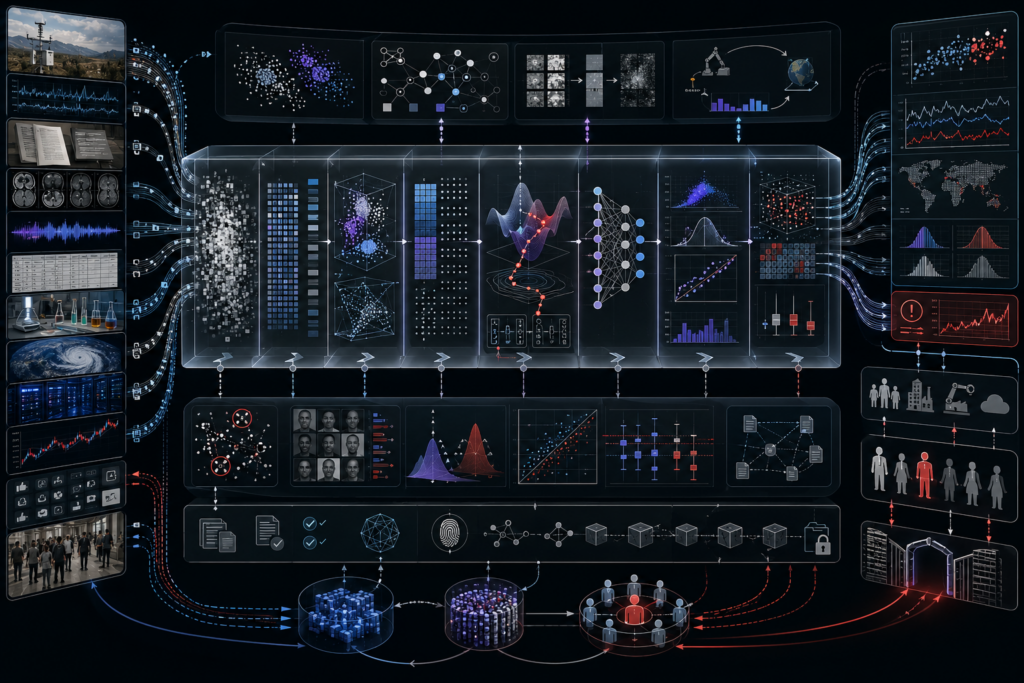
Machine learning foundations system showing data inputs, feature representation, embeddings, model training, loss functions, optimization, inference, evaluation, calibration, monitoring, distribution-shift detection, feedback loops, human oversight, and audit controls.

Machine Learning Foundations: How Systems Learn from Data

Machine learning foundations explain how computational systems learn from data by estimating structure, updating internal parameters, and improving performance on defined tasks under uncertainty. This article explains machine learning as adaptive computation, statistical inference, empirical risk minimization, representation learning, optimization, generalization, validation, deployment, monitoring, and governance. It covers supervised, unsupervised, reinforcement, self-supervised, and semi-supervised learning; features and embeddings; loss functions; gradient descent; overfitting; model capacity; uncertainty; distribution shift; calibration; error analysis; feedback loops; and responsible deployment. The article also introduces mathematical lenses for datasets, predictions, empirical risk, expected risk, gradient updates, generalization gaps, distribution shift, and calibration, alongside Python and R workflows for supervised learning, evaluation metrics, calibration diagnostics, grouped error analysis, and monitoring. By connecting learning from data to auditability, it frames machine learning as a systems discipline.

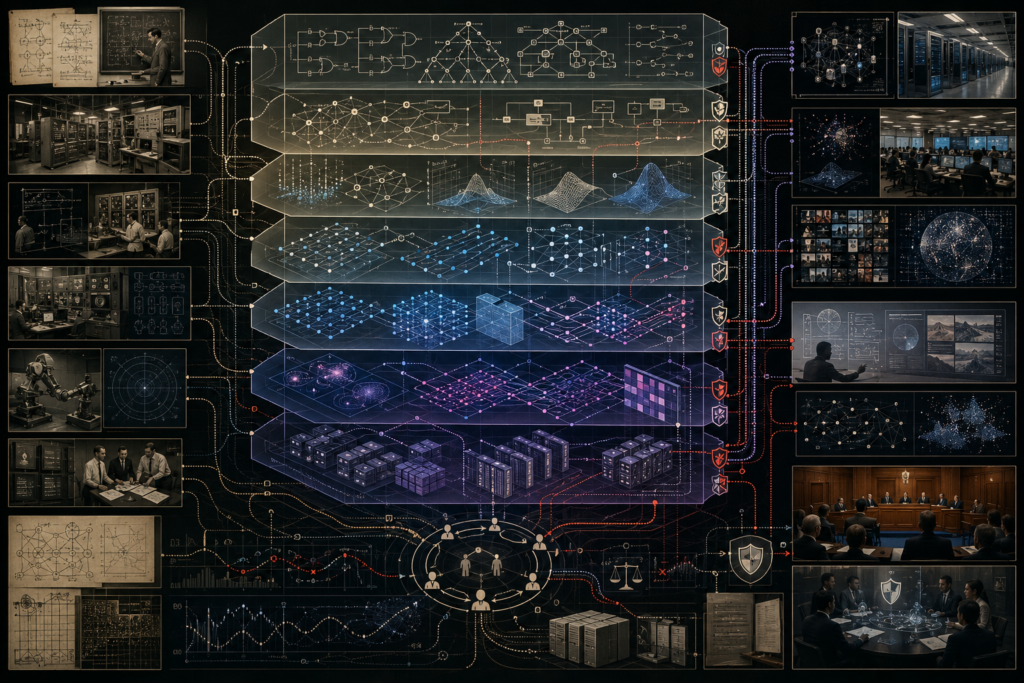
History of artificial intelligence system showing symbolic logic, early computation, cybernetics, expert systems, statistical learning, machine learning, neural networks, deep learning, transformers, foundation models, generative AI, hybrid systems, governance checkpoints, and audit controls.

The History of Artificial Intelligence: From Symbolic Logic to Machine Learning

The history of artificial intelligence is a story of changing assumptions about intelligence, knowledge, learning, and computation. This article traces AI from its roots in formal logic, computability, cybernetics, and symbolic reasoning through expert systems, AI winters, statistical learning, machine learning, neural networks, deep learning, transformers, foundation models, and generative AI. It shows why AI history is not a simple replacement of old methods by new ones, but a layered evolution in which symbolic reasoning, data-driven learning, neural representation, infrastructure, and governance continue to interact. The article also introduces mathematical lenses for understanding knowledge bases, inference, empirical loss, regularization, attention, and systems-scale AI, alongside Python and R workflows for modeling paradigm transitions. By connecting technical history to institutional accountability, it frames modern AI as an auditable systems field shaped by data, compute, evaluation, and governance.

Artificial intelligence systems architecture showing data inputs, representation layers, model training, optimization, inference outputs, validation, monitoring, feedback loops, uncertainty signals, human oversight, governance controls, and audit trails across real-world applications.

What Is Artificial Intelligence? Computational Intelligence and Learning Systems

Artificial intelligence is the study and design of computational systems that represent information, learn from data, identify patterns, generate predictions, support decisions, and operate within real-world infrastructures. This article introduces AI as a systems field rather than a single model, product, or tool. It explains the relationship among artificial intelligence, machine learning, and deep learning; examines data acquisition, representation, training, inference, evaluation, deployment, and monitoring; and shows why uncertainty, error, generalization, and drift are central to responsible use. The article also introduces mathematical foundations such as loss functions, optimization, thresholds, and generalization error, alongside Python and R workflows for validation and grouped diagnostics. By connecting technical architecture to governance, accountability, and institutional consequences, it frames AI as an auditable infrastructure for modern knowledge, automation, and decision-making across complex domains.

A diverse multigenerational group discusses future pathways amid images of ecological crisis, collective imagination, community repair, and long-term social transformation.

Future Directions in Strategic Foresight: Systems Integration, Decision Architectures, and the Evolution of Long-Term Strategy

Future Directions in Strategic Foresight examines how foresight is moving beyond periodic planning exercises and becoming an integrated component of continuous decision systems. The article argues that in environments shaped by nonlinear change, deep uncertainty, rapid feedback, and global interdependence, strategic foresight must evolve from isolated scenario work into a system-level capability linked to analytics, governance, institutional learning, and adaptive strategy. It explores the role of data, real-time monitoring, AI-assisted decision support, continuous scenario updating, institutionalization, global coordination, and ethical responsibility in shaping the next phase of foresight practice. The article emphasizes that the future of foresight is not prediction in a narrow sense, but the design of institutions capable of sensing change, updating assumptions, and preserving strategic options under uncertainty.

Scroll to Top