
Last Updated May 10, 2026
Artificial intelligence is the study and design of computational systems that can represent information, learn from data, identify patterns, update internal parameters, generate predictions, support decisions, and produce outputs that resemble reasoning, perception, language use, planning, search, optimization, or adaptive action. In practice, artificial intelligence is not a single tool, model type, product category, chatbot, automation feature, or software layer. It is a broad systems field that joins computer science, statistics, optimization, logic, data engineering, cognitive modeling, human-computer interaction, institutional design, and governance in order to build machines that act on information under conditions of complexity, uncertainty, and scale.
The central argument of this article is that artificial intelligence should be understood as computational decision and representation infrastructure. An AI system does not simply “think,” “learn,” or “generate” in isolation. It depends on data collection, representation, model architecture, training objectives, optimization procedures, inference pipelines, validation protocols, deployment environments, user interfaces, monitoring systems, feedback loops, institutional incentives, and governance controls. What appears to the user as a prediction, recommendation, generated answer, risk score, classification, detection, or automated action is the visible surface of a deeper technical and institutional system.
Main Library
Publications
Article Map
Artificial Intelligence Systems
Related Topic
Data Systems & Analytics
Related Topic
Institutions & Governance
Related Topic
Intelligent Infrastructure Systems
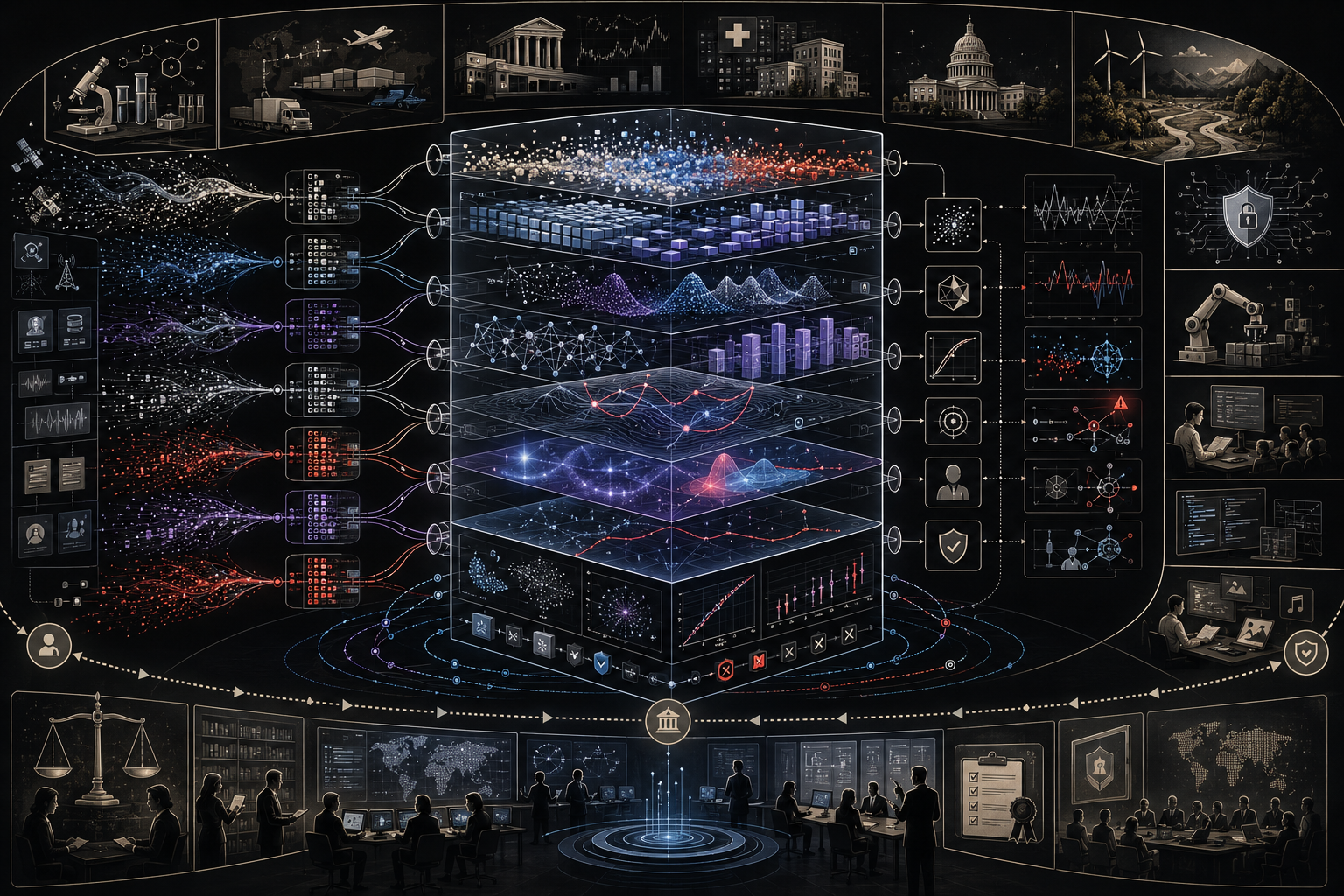
Artificial intelligence systems now shape scientific research, digital platforms, logistics, finance, health systems, public administration, environmental monitoring, cybersecurity, robotics, education, software development, creative production, and knowledge work. Yet much popular discussion still treats AI either as a magical technological breakthrough or as a singular threat detached from the infrastructures that make it possible. Both views are incomplete. Artificial intelligence is better understood as a layered computational system: data is collected, represented, and transformed; models are trained through optimization; outputs are produced at inference time; and those outputs are embedded in real-world workflows, institutions, and feedback loops.
This article develops What Is Artificial Intelligence? as a foundation article within the Artificial Intelligence Systems knowledge series. It explains AI as a field of representation, learning, reasoning, prediction, optimization, uncertainty, generalization, infrastructure, deployment, evaluation, and governance. Selected Python and R examples appear here, while the full GitHub repository contains expanded computational scaffolding for supervised-learning baselines, grouped error diagnostics, model validation, drift monitoring, data provenance, AI metadata, SQL governance tables, model-card templates, risk registers, and reproducible audit workflows.
What Is Artificial Intelligence?
Artificial intelligence can be defined as the field concerned with building computational systems capable of performing tasks that require adaptive information processing. These tasks may include classification, pattern recognition, forecasting, optimization, language generation, strategic action, anomaly detection, planning, recommendation, perception, search, control, or decision support. The field includes systems that rely on explicit representations of rules and systems that infer patterns from data through statistical learning.
At a deeper level, artificial intelligence studies how aspects of intelligence can be made computational. That involves at least five recurring questions. First, how can information about the world be represented in machine-readable form? Second, how can a system update its internal state in light of data, feedback, or interaction? Third, how can a model map inputs to useful outputs under uncertainty? Fourth, how should performance be evaluated across changing environments? Fifth, how should these systems be constrained when their outputs affect human lives, institutions, public goods, or critical infrastructure?
The term “artificial intelligence” historically carried a broad and ambitious meaning. It referred not only to automation, but to the attempt to formalize cognition itself: reasoning, learning, memory, language, perception, planning, and problem solving. Contemporary usage is narrower in some contexts and broader in others. It is narrower because many deployed AI systems perform specific tasks rather than exhibiting general intelligence. It is broader because the field now includes massive engineering systems for training, scaling, monitoring, and governing models in production environments. The modern reality is that artificial intelligence is simultaneously a scientific field, an engineering discipline, an infrastructure layer, and a governance problem.
AI should therefore not be described as an isolated capability. It belongs alongside systems modeling, decision science, data governance, software engineering, human-computer interaction, risk management, and institutional analysis as a way of understanding how complex systems process information, adapt to feedback, and produce consequences across time.
Artificial\ Intelligence = Representation + Learning + Inference + Evaluation + Governance
\]
Interpretation: AI systems combine ways of representing information, learning from evidence, producing outputs, evaluating performance, and governing consequences.
| AI Dimension | Core Question | Technical Form | Governance Concern |
|---|---|---|---|
| Representation | How is information encoded? | Features, embeddings, rules, graphs, schemas, tokens, states. | Representation choices determine what is visible, learnable, and actionable. |
| Learning | How does the system adapt from evidence? | Parameter updates, optimization, reward signals, self-supervision. | Learning inherits data quality, measurement bias, and objective design. |
| Inference | How are outputs produced? | Prediction, classification, ranking, generation, planning, control. | Outputs can be misused when uncertainty and scope are hidden. |
| Evaluation | How is performance tested? | Metrics, validation, calibration, robustness checks, error analysis. | Weak evaluation creates false confidence. |
| Governance | How are consequences constrained? | Documentation, monitoring, human review, risk registers, audits. | Accountability must follow deployment scale and social consequence. |
Note: Artificial intelligence is best understood as a full system of representation, learning, inference, evaluation, deployment, and accountability—not as a model alone.
Computational Intelligence and the Problem of Learning
Computational intelligence refers to the capacity of a machine system to transform inputs into adaptive outputs through formal procedures. In plain terms, a computationally intelligent system does not merely execute a fixed script. It processes data, updates parameters or internal representations, and improves performance relative to a task, objective, or feedback signal. In some cases, the improvement comes from learning statistical regularities. In others, it comes from search, rule refinement, reinforcement, probabilistic inference, memory retrieval, or structured reasoning.
Learning is central to this account. A system learns when experience produces a durable change in its ability to perform a task. In machine learning, that change is often formalized as parameter adjustment. A model is exposed to examples, a loss function measures the difference between predicted and actual outcomes, and an optimization procedure alters parameters to reduce future error. This process may be simple in a linear model or highly complex in a large neural network, but the general logic is the same: the system uses data to alter its internal configuration.
A computational learning process can be represented as:
Experience \rightarrow Parameter\ Update \rightarrow Changed\ Future\ Behavior
\]
Interpretation: A learning system changes its internal configuration after exposure to data, feedback, or interaction.
This definition of learning is narrower than human learning in some respects and broader in others. It is narrower because machine systems do not automatically possess consciousness, meaning, embodied understanding, moral judgment, or lived experience. It is broader because computational systems can identify patterns in high-dimensional data at scales impossible for unaided human cognition. The important analytical point is that machine learning does not replicate human intelligence in any straightforward way. It constitutes a distinct form of computational adaptation, one that can complement, amplify, or distort human judgment depending on how it is designed and deployed.
The phrase “computational intelligence” is therefore useful because it emphasizes process rather than mythology. It directs attention to representations, training data, objective functions, architectures, optimization procedures, feedback conditions, and performance environments. Instead of asking only whether a machine is “really intelligent” in an abstract metaphysical sense, it asks what kind of information processing the system performs, how it updates, how robustly it generalizes, and how its outputs function inside larger systems of action.
| Learning Mechanism | How It Works | Example | Risk |
|---|---|---|---|
| Rule refinement | System changes explicit rules or decision procedures. | Expert systems, policy engines, adaptive workflows. | Rules may become inconsistent, stale, or overfit to local practice. |
| Parameter updating | Model adjusts weights or coefficients to reduce loss. | Regression, neural networks, classifiers. | Parameters may learn noise, bias, or proxy patterns. |
| Representation learning | System learns internal features or embeddings. | Vision models, language models, recommender systems. | Representations may be opaque or difficult to interpret. |
| Reward learning | Agent adapts behavior through reward signals. | Reinforcement learning, robotics, game agents. | Reward proxies may produce unintended strategies. |
| Feedback adaptation | System changes behavior based on user or environmental response. | Recommendation systems, monitoring systems, RLHF. | Feedback loops may amplify error or manipulation. |
Note: Computational intelligence is not the same as human intelligence. It is adaptive information processing implemented through formal systems.
Machine\ Learning \neq Human\ Understanding
\]
Interpretation: A system can adapt from data and perform useful tasks without possessing consciousness, lived experience, moral judgment, or human-like understanding.
Artificial Intelligence, Machine Learning, and Deep Learning
One of the most persistent sources of confusion in contemporary discussion is the relationship between artificial intelligence, machine learning, and deep learning. These terms are related but not interchangeable.
Artificial intelligence is the broadest category. It includes computational approaches aimed at producing intelligent behavior, whether through symbolic reasoning, probabilistic models, search, planning, machine learning, neural networks, or hybrid systems.
Machine learning is a subset of artificial intelligence focused on systems that improve performance through data-driven learning rather than relying solely on explicit hand-coded rules. The model learns from examples, signals, interaction histories, or feedback.
Deep learning is a subset of machine learning that uses multi-layer neural network architectures to learn hierarchical representations from large volumes of data. These systems have driven major advances in language, vision, speech, generative modeling, scientific prediction, and representation learning.
This hierarchy matters because it prevents conceptual collapse. Not all AI is machine learning. Expert systems, symbolic planners, theorem provers, logic-based systems, and knowledge graphs belong to AI without necessarily relying on modern statistical learning. Not all machine learning is deep learning. Regression, decision trees, support vector machines, clustering methods, probabilistic classifiers, Gaussian processes, and ensemble methods remain foundational. Deep learning has become highly influential because of its ability to discover representations automatically at scale, but that influence should not obscure the broader field.
It is also useful to distinguish models by their learning regime. Supervised, unsupervised, self-supervised, semi-supervised, and reinforcement learning describe different ways systems learn from signals. In supervised learning, models learn from labeled examples. In unsupervised learning, they identify structure without explicit target labels. In self-supervised learning, systems construct training signals from the data itself. In reinforcement learning, agents adapt through reward signals tied to sequential action. These distinctions imply different risks, data requirements, evaluation methods, and deployment contexts.
| Term | Scope | Examples | Common Misunderstanding |
|---|---|---|---|
| Artificial intelligence | Broad field of computational systems that perform tasks associated with intelligence. | Search, planning, symbolic reasoning, machine learning, robotics, generative AI. | AI is often reduced incorrectly to chatbots or neural networks. |
| Machine learning | Subset of AI focused on learning from data or feedback. | Regression, decision trees, ensembles, classifiers, recommenders. | Machine learning is often treated as all of AI. |
| Deep learning | Subset of machine learning using multi-layer neural networks. | Transformers, CNNs, RNNs, diffusion models, large language models. | Deep learning is often treated as synonymous with machine learning. |
| Foundation models | Large pretrained models adapted to many tasks. | Language models, multimodal models, code models, generative models. | Foundation models are often mistaken for general intelligence. |
| Hybrid AI | Systems combining learning with symbolic, retrieval, causal, or rule-based structure. | RAG, knowledge-graph grounding, neural-symbolic reasoning, tool-using agents. | Hybrid systems are often ignored in simplified AI narratives. |
Note: AI is the broad field. Machine learning is one major approach within AI. Deep learning is one influential approach within machine learning.
Deep\ Learning \subset Machine\ Learning \subset Artificial\ Intelligence
\]
Interpretation: Deep learning is a subset of machine learning, and machine learning is a subset of the broader field of artificial intelligence.
Why AI Should Be Understood as a System
Artificial intelligence is often described as if the model were the whole system. In reality, the model is only one component. An AI system includes data collection, preprocessing, representation, model training, validation, deployment, monitoring, human oversight, and downstream integration into workflows or institutions. The intelligence of the overall system therefore depends on many layers outside the model itself.
This systems perspective is essential for at least four reasons. First, performance depends heavily on input quality. A sophisticated model trained on noisy, biased, incomplete, or unrepresentative data will produce unreliable outputs. Second, deployment context shapes meaning. A prediction that is technically accurate in a benchmark environment may fail when embedded in a hospital, public agency, logistics platform, classroom, financial institution, or legal setting. Third, feedback loops matter. AI outputs can alter the very systems that generate future data, creating recursive dynamics, drift, and self-reinforcing error. Fourth, accountability cannot be attached only to code. It also belongs to institutions, operators, governance frameworks, infrastructure providers, and decision-makers.
This is why AI belongs naturally in dialogue with systems thinking. Like other complex systems, AI systems exhibit interdependence, path dependence, sensitivity to data conditions, nonlinear effects, and emergent consequences. A recommendation model changes user behavior, which changes platform data, which changes future recommendations. A predictive model changes institutional attention, which changes what gets measured, which changes future training data. A diagnostic model changes triage flows, which changes what cases clinicians see and how outcomes are recorded. In each case, the model is one node in a larger adaptive network.
Seen this way, artificial intelligence is not merely a question of computational performance. It is a question of system design, institutional fit, recursive consequence, and operational accountability.
S_{\mathrm{AI}}
=
(D,R,M,E,U,G)
\]
Interpretation: An AI system includes data \(D\), representation \(R\), model \(M\), environment \(E\), users \(U\), and governance \(G\).
| System Layer | Role | Failure Mode | Governance Need |
|---|---|---|---|
| Data layer | Collects and structures evidence. | Biased, stale, incomplete, unlawful, or unrepresentative data. | Provenance, quality review, consent, licensing, documentation. |
| Representation layer | Transforms information into model-usable form. | Important context is lost, compressed, or distorted. | Schema review, feature documentation, embedding inspection. |
| Model layer | Learns mappings, patterns, distributions, or policies. | Overfitting, opacity, brittleness, hallucination, poor calibration. | Validation, robustness testing, interpretability, model cards. |
| Deployment layer | Places outputs into workflows. | Outputs are used beyond validated scope. | Use-case boundaries, human review, escalation paths. |
| Feedback layer | Connects outputs to future data and behavior. | Self-reinforcing error, drift, manipulation, feedback bias. | Monitoring, incident response, retraining governance. |
| Governance layer | Defines accountability, oversight, and constraints. | Responsibility diffuses behind technical complexity. | Risk registers, audits, ownership, documentation, review boards. |
Note: The model is not the system. AI reliability depends on the full architecture connecting data, representation, model behavior, deployment context, monitoring, and governance.
The Architecture of Learning Systems
Most learning systems can be understood through a common architecture, even when the model families differ. This architecture includes input acquisition, representation, training, inference, evaluation, deployment, monitoring, and iterative refinement.
1. Data Acquisition
Learning begins with data: text, images, numerical records, sensor streams, transactions, user interactions, geographic data, audio, logs, documents, code, biological sequences, physical measurements, or multimodal combinations. At this stage, the central issues are measurement quality, sampling, completeness, provenance, licensing, privacy, and relevance. Data is never neutral raw material. It reflects collection methods, institutional priorities, measurement constraints, and historical conditions.
2. Representation
Raw inputs must be transformed into forms models can process. In classical systems this may involve feature engineering. In neural systems it may involve embeddings or learned latent representations. Representation is foundational because what the system can learn depends partly on how reality has been encoded.
3. Training
During training, the model updates parameters by minimizing a loss function or maximizing some measure of expected reward or fit. In gradient-based systems, the model computes error, propagates that error backward, and adjusts parameters iteratively. Model performance depends not only on architecture, but also on learning rate, regularization, dataset structure, objective design, initialization, optimization stability, and training conditions.
4. Inference
Once trained, the model receives new inputs and produces outputs: classifications, forecasts, recommendations, probabilities, embeddings, generated text, detected anomalies, control actions, ranked alternatives, or suggested decisions. Inference is often what users see, but it rests on all the upstream design decisions made during data preparation and training.
5. Evaluation
No system can be trusted without evaluation. Metrics vary by task: accuracy, precision, recall, F1 score, calibration, log loss, AUC, mean squared error, robustness, latency, cost sensitivity, subgroup performance, and human usefulness. In real systems, evaluation also includes fairness analysis, stress testing, domain shift detection, interpretability review, error decomposition, and domain-specific risk assessment.
6. Deployment and Monitoring
Deployed systems must be monitored for drift, degradation, misuse, security vulnerabilities, changing environmental conditions, and downstream consequences. A model that performs well at launch may deteriorate as user behavior changes, underlying conditions shift, adversarial behavior emerges, or the system begins influencing the environment from which it learns.
This pipeline makes clear why artificial intelligence is inseparable from infrastructure. AI requires storage, compute, data governance, observability, reproducibility, operational controls, documentation, and institutional review.
| Stage | Technical Work | Evidence Produced | Review Question |
|---|---|---|---|
| Data acquisition | Collects observations, labels, documents, signals, or interactions. | Dataset manifest, data source records, collection notes. | Is the data lawful, relevant, representative, and documented? |
| Representation | Transforms raw data into features, tokens, embeddings, or states. | Feature definitions, schema files, preprocessing logs. | What information was compressed, excluded, or transformed? |
| Training | Updates model parameters using objective functions. | Training logs, model artifacts, hyperparameter records. | What objective was optimized, and under what assumptions? |
| Inference | Produces predictions, recommendations, rankings, or generated outputs. | Inference logs, output records, confidence scores. | How should outputs be interpreted and limited? |
| Evaluation | Tests performance, calibration, robustness, and errors. | Validation reports, metrics, subgroup diagnostics. | Does evidence support deployment in the intended context? |
| Monitoring | Tracks drift, degradation, incidents, and feedback loops. | Drift reports, incident logs, retraining records. | Does the system remain valid after release? |
Note: AI development should produce reviewable evidence across the full lifecycle, not only final model outputs.
Representation, Reasoning, and Prediction
Artificial intelligence systems differ not only by architecture but by the kind of intelligence they attempt to formalize. Some systems emphasize reasoning through explicit symbols, rules, and logical relationships. Others emphasize prediction through pattern extraction in high-dimensional data. Still others combine search, memory, planning, retrieval, and learned representations. The intellectual history of AI has often turned on the relationship between these approaches.
Symbolic systems treat intelligence as structured manipulation of represented knowledge. Facts, categories, relations, and inference rules are explicitly defined, allowing systems to reason transparently in constrained domains. These methods were foundational in early AI and remain important in planning, formal verification, theorem proving, knowledge graphs, expert systems, and rule-governed environments.
Statistical learning systems treat intelligence as the ability to infer patterns from data. Instead of requiring complete hand-coded representations, these systems estimate functional relationships between inputs and outputs, often using probabilities, weights, decision boundaries, latent features, or embeddings. This makes them powerful in domains where explicit rules are insufficient or impossible to enumerate, such as image classification, speech recognition, natural language processing, anomaly detection, and large-scale recommendation.
The tension between reasoning and prediction is often overstated. In practice, many powerful systems combine them. Real-world intelligence requires representation, inference, adaptation, memory, and context-sensitive action. A mature AI field therefore cannot be reduced either to rule-following logic or to opaque statistical fitting. It must ask what form of information processing is appropriate to the task, what degree of interpretability is required, what evidence supports the system’s output, and how that output will be used by decision-makers.
| AI Mode | Primary Object | Strength | Limitation |
|---|---|---|---|
| Symbolic reasoning | Rules, facts, predicates, constraints. | Transparent inference and explicit logic. | Brittle in open, ambiguous, noisy domains. |
| Statistical prediction | Data distributions, probabilities, learned parameters. | Flexible learning from examples. | Can learn spurious correlations and hidden bias. |
| Representation learning | Embeddings, latent spaces, hidden states. | Discovers useful features at scale. | Internal representations can be opaque. |
| Search and planning | States, actions, goals, heuristics. | Supports structured problem solving and strategy. | Search spaces can become computationally explosive. |
| Hybrid AI | Learned models plus structured knowledge. | Combines flexibility with constraints and grounding. | Integration can be complex and difficult to validate. |
Note: AI systems often require multiple modes of intelligence: representation, reasoning, prediction, search, memory, and governance.
Prediction \neq Explanation,\qquad Reasoning \neq Learning
\]
Interpretation: Prediction, explanation, reasoning, and learning are related but distinct capabilities. Reliable AI systems require clarity about which capability is being used and evaluated.
Uncertainty, Error, and Generalization
No discussion of artificial intelligence is complete without addressing uncertainty. Learning systems do not absorb truth directly from data. They infer structure from finite samples under imperfect measurement, limited coverage, and model assumptions. As a result, AI outputs should be interpreted probabilistically or conditionally, even when systems present answers in definitive language.
Three concepts are especially important: error, generalization, and drift. Error refers to the gap between predicted and actual outcomes, but error is never a single phenomenon. It may arise from noise, misspecification, poor representation, class imbalance, bad labels, confounding, data leakage, adversarial behavior, or deployment mismatch. Generalization refers to the model’s ability to perform well on unseen data rather than merely memorizing the training set. Drift occurs when the environment changes so the statistical relationships the model learned no longer hold reliably.
These issues are not minor technical details. They are the boundary between useful intelligence and false confidence. A model that appears effective in development may fail in production because the world is dynamic, adversarial, and institutionally uneven. This is why robust evaluation matters, why uncertainty should be communicated rather than concealed, and why AI systems must be treated as provisional tools rather than infallible authorities.
These questions also connect AI to decision science. In uncertain environments, the value of a model is not just whether it predicts well in aggregate, but whether it improves decisions under real constraints. An AI system can be technically impressive and still strategically poor if it encourages overconfidence, reduces resilience, hides uncertainty, or obscures responsibility.
| Concept | Meaning | Example | Governance Response |
|---|---|---|---|
| Error | Difference between model output and observed or desired outcome. | False positive, false negative, hallucinated claim, wrong forecast. | Error analysis, threshold review, incident logging. |
| Generalization | Performance on unseen data or future cases. | Model works beyond training examples. | Held-out tests, external validation, scenario testing. |
| Calibration | Whether predicted probabilities match observed frequencies. | A 70% score corresponds to roughly 70% observed outcomes. | Reliability diagrams, calibration metrics, threshold policy. |
| Distribution shift | Deployment data differs from training data. | New users, sensors, dialects, regions, policies, or market conditions. | Drift monitoring, recalibration, retraining review. |
| Uncertainty | Limits of what the model can know from available evidence. | Ambiguous input, rare case, incomplete record, sparse data. | Uncertainty communication, abstention, human escalation. |
Note: Reliable AI requires more than accuracy. It requires understanding error, uncertainty, generalization, calibration, and drift.
Confidence \neq Correctness
\]
Interpretation: An AI system can present an output confidently while still being wrong, incomplete, poorly grounded, or outside its validated scope.
Evaluation, Validation, and Monitoring
Evaluation is the discipline that turns AI capability claims into evidence. A model may appear impressive in a demo, benchmark, or controlled test, but serious AI systems require evaluation that matches the intended use context. Metrics must be chosen based on the task, the consequences of error, the structure of the data, the deployment environment, and the people or systems affected by the output.
Validation should ask more than whether the model performs well on average. It should ask whether the model performs consistently across subgroups, domains, time periods, devices, languages, locations, and operating conditions where those distinctions are relevant and ethically appropriate. It should ask whether probabilities are calibrated, whether thresholds are justified, whether errors are explainable, whether rare cases are handled responsibly, and whether the model remains valid after deployment.
Monitoring extends evaluation into time. AI systems are not static. Data pipelines change. Users adapt. Adversaries respond. Environments drift. Institutional practices shift. Source documents become outdated. Sensors fail. Legal rules change. A model that was valid at launch may degrade silently if monitoring is weak.
| Evaluation Layer | Question | Evidence | Risk if Missing |
|---|---|---|---|
| Performance | Does the model perform the task? | Accuracy, precision, recall, F1, AUC, RMSE, task metrics. | Basic functionality may be assumed rather than proven. |
| Calibration | Do scores or probabilities behave as probabilities? | Calibration curves, reliability tables, expected calibration error. | Users may overtrust confidence scores. |
| Robustness | Does the model hold under stress, noise, or shift? | Stress tests, adversarial tests, external validation. | The model may fail outside benchmark conditions. |
| Grouped diagnostics | Are errors unevenly distributed? | Subgroup metrics, site-level metrics, condition-level diagnostics. | Aggregate performance may hide unequal error burdens. |
| Monitoring | Does performance remain valid after deployment? | Drift reports, incident logs, monitoring dashboards, retraining records. | Model degradation may remain invisible. |
| Human review | Can outputs be challenged, corrected, or escalated? | Review workflows, appeal mechanisms, override logs. | Automation may become unaccountable authority. |
Note: Evaluation is not a one-time benchmark. It is a lifecycle practice that connects model performance to deployment conditions and institutional responsibility.
AI\ Reliability = Validation + Monitoring + Human\ Review + Correction
\]
Interpretation: AI reliability depends on evidence before deployment, monitoring after deployment, and mechanisms for correction when systems fail.
Artificial Intelligence in Real-World Systems
Artificial intelligence now operates across a wide range of practical domains, but its role varies substantially depending on the structure of the system it enters. In some cases AI automates repetitive tasks. In others it augments expert judgment, identifies latent patterns, supports strategic planning, or accelerates discovery. The significance of AI lies not in a single universal use case but in the diversity of functions it can perform when embedded in domain-specific infrastructures.
In scientific research, AI systems accelerate pattern discovery, protein structure prediction, simulation analysis, literature synthesis, experimental optimization, and hypothesis generation. In health systems, they support diagnostic imaging, triage assistance, risk scoring, and operational forecasting, though these uses raise major concerns around bias, accountability, clinical oversight, and error interpretation. In finance, AI is used for fraud detection, risk modeling, credit scoring, forecasting, and algorithmic trading, often under conditions where opacity and reflexivity create systemic risk. In logistics and infrastructure, AI supports route optimization, maintenance forecasting, network balancing, anomaly detection, and resource allocation. In environmental monitoring, it helps interpret remote sensing data, sensor streams, ecological signals, and climate-related indicators at scales that exceed manual analysis.
These deployments are analytically important because they demonstrate that AI is most powerful when it functions as part of a broader information system. It rarely acts alone. It depends on measurement networks, storage systems, data pipelines, human review processes, institutions, legal constraints, operational goals, and failure protocols.
| Domain | AI Function | System Value | Governance Concern |
|---|---|---|---|
| Scientific research | Pattern discovery, simulation, literature synthesis, hypothesis generation. | Accelerates analysis and discovery across complex data. | Prediction may be mistaken for causal or mechanistic explanation. |
| Health systems | Diagnostic imaging, triage, risk scoring, resource forecasting. | Supports clinical and operational decision-making. | Bias, safety, oversight, liability, and unequal error rates. |
| Finance | Fraud detection, credit scoring, risk modeling, trading, forecasting. | Improves detection, speed, and quantitative analysis. | Opacity, discrimination, systemic risk, and feedback effects. |
| Infrastructure and logistics | Route optimization, maintenance forecasting, anomaly detection. | Improves efficiency, reliability, and situational awareness. | Brittle automation can create cascading failure. |
| Environmental monitoring | Remote sensing, sensor interpretation, ecological classification. | Expands capacity to observe complex environmental change. | Measurement uncertainty, missing ground truth, and policy misuse. |
| Knowledge work | Search, summarization, drafting, coding, translation, retrieval. | Reduces cognitive load and expands analytic capacity. | Hallucination, provenance, authorship, and overreliance. |
Note: AI’s social meaning depends on the system it enters. The same technical capability can support public value or institutional harm depending on context, incentives, and governance.
Intelligence, Power, and Governance
Because artificial intelligence systems influence decisions, resource allocation, attention, visibility, and institutional action, they are never merely technical artifacts. They are instruments of power. They shape what becomes legible, what is prioritized, what is optimized, and what forms of error are tolerated. This is why AI governance cannot be treated as an optional afterthought added after innovation. Governance is internal to system design.
Several questions follow from this claim. Who defines the objective function? What outcomes count as success? What tradeoffs are accepted between speed, cost, accuracy, interpretability, and accountability? Who bears the harms of misclassification or omission? What forms of oversight exist when a model is deployed in a high-stakes setting? What recourse is available when the system fails? These are not external political questions imposed on a neutral technology. They are constitutive questions about what the system is for and how it should operate.
Governance also matters because intelligence at scale can generate asymmetry. Large AI systems can centralize epistemic authority, automate surveillance, reinforce institutional bias, or magnify concentrated control over information infrastructures. At the same time, well-designed systems can improve transparency, broaden analytic capacity, reduce burdensome routine tasks, and support better decisions under complexity. The challenge is therefore not to choose between blind enthusiasm and blanket rejection. It is to design institutions capable of aligning computational power with accountability, auditability, and public legitimacy.
This is one of the central reasons an AI knowledge series must culminate in governance rather than stopping at technical explanation. A mature treatment of AI must move from capability to consequence. It must address AI safety, system reliability, bias, fairness, accountability, governance, regulation, systemic risk, and institutional legitimacy as integral parts of the field rather than auxiliary concerns.
| Governance Question | Technical Location | Institutional Consequence | Needed Control |
|---|---|---|---|
| Who defines success? | Objective functions, metrics, reward models, thresholds. | Optimized systems may encode narrow institutional priorities. | Metric review, stakeholder analysis, public-interest assessment. |
| Who is represented? | Training data, labels, sampling, feature design. | Excluded or mismeasured groups may experience unequal error. | Dataset documentation, subgroup diagnostics, representation review. |
| Who can contest outputs? | User interface, workflow, appeals, escalation paths. | Automated outputs may become difficult to challenge. | Human review, explanation, appeal, correction mechanisms. |
| Who benefits? | Deployment model, business incentives, access controls. | AI may concentrate power or distribute capability. | Access governance, transparency, accountability requirements. |
| Who is accountable? | Ownership, logs, approvals, monitoring, incident response. | Responsibility may diffuse across vendors, users, and institutions. | Risk registers, audit trails, model cards, governance ownership. |
Note: AI governance is not external to technical design. It determines how objectives, evidence, outputs, responsibility, and correction are organized.
Computational\ Power + Institutional\ Deployment \Rightarrow Public\ Responsibility
\]
Interpretation: When AI systems shape decisions, resources, knowledge, safety, or rights, governance becomes part of the system itself.
Mathematical Lens: Representation, Learning, Inference, Drift, and Risk
A mathematics-first view begins with a model that maps inputs to outputs:
f_\theta:X\rightarrow Y
\]
Interpretation: A model \(f_\theta\) maps an input space \(X\) to an output space \(Y\), with \(\theta\) representing trainable parameters.
For supervised learning, training data can be written as:
D=\{(x_i,y_i)\}_{i=1}^{n}
\]
Interpretation: A supervised dataset contains input-output examples used to fit the model.
A common training objective is empirical risk minimization with regularization:
\theta^{*}
=
\arg\min_{\theta}
\left[
\frac{1}{n}
\sum_{i=1}^{n}
\ell(f_{\theta}(x_i),y_i)
+
\lambda \Omega(\theta)
\right]
\]
Interpretation: Training selects parameters that minimize prediction loss while controlling complexity through regularization.
For a binary classifier, a probabilistic prediction can be written as:
\hat{p}_i=P_\theta(y_i=1 \mid x_i)
\]
Interpretation: The model estimates the probability that an input belongs to the positive class.
A decision threshold converts probabilities into classifications:
\hat{y}_i=
\begin{cases}
1, & \hat{p}_i \geq \tau \\
0, & \hat{p}_i < \tau
\end{cases}
\]
Interpretation: A threshold \(\tau\) turns model scores into discrete decisions, which means thresholds are part of system design.
Generalization error can be described as expected loss on new data:
R(\theta)=E_{(x,y)\sim P_{\mathrm{test}}}
\left[
\ell(f_\theta(x),y)
\right]
\]
Interpretation: Generalization concerns performance on unseen data drawn from the environment where the model will be used.
A drift signal can be described as a divergence between training and deployment distributions:
\Delta =
d(P_{\mathrm{train}}(X),P_{\mathrm{deploy}}(X))
\]
Interpretation: Drift occurs when the deployment input distribution differs from the distribution seen during training.
Calibration can be written as:
P(Y=1\mid \hat{p}=p)=p
\]
Interpretation: A calibrated model’s predicted probability \(p\) corresponds to the observed frequency of the outcome.
A systems-level AI reliability score can combine performance, calibration, drift, interpretability, and governance maturity:
Reliability_i =
\alpha M_i
–
\beta C_i
–
\gamma \Delta_i
–
\lambda O_i
+
\rho G_i
\]
Interpretation: Reliability for AI system \(i\) may combine model performance \(M_i\), calibration error \(C_i\), distribution shift \(\Delta_i\), opacity \(O_i\), and governance maturity \(G_i\). The weights should be documented and tied to the deployment context.
A risk-aware system view can be written as:
Risk_i =
Impact_i \times Likelihood_i \times Exposure_i
\]
Interpretation: AI risk depends not only on technical error, but on impact, probability, and the number or vulnerability of people, systems, or institutions exposed.
This mathematical lens shows why artificial intelligence is not merely a set of applications. It is a formal discipline of representation, optimization, inference, evaluation, decision-making under uncertainty, and system-level governance.
Variables and System Interpretation
| Symbol or Term | Meaning | Typical Dimension or Type | System Interpretation |
|---|---|---|---|
| \(x\) | Input | Vector, text, image, signal, graph, document, or observation | Information provided to the system. |
| \(y\) | Target or label | Class, value, sequence, action, or outcome | Observed output used for training or evaluation. |
| \(\hat{y}\) | Prediction | Model output | Estimated class, value, recommendation, ranking, or decision. |
| \(f_\theta\) | Parameterized model | Function | Computational mapping from inputs to outputs. |
| \(\theta\) | Model parameters | Weights, coefficients, rules, embeddings, or internal states | Trainable structure adjusted during learning. |
| \(\ell\) | Loss function | Scalar | Penalty for mismatch between model output and target. |
| \(\Omega(\theta)\) | Regularization term | Scalar | Penalty controlling complexity or instability. |
| \(\lambda\) | Regularization strength | Scalar | Controls the tradeoff between fit and complexity. |
| \(\tau\) | Decision threshold | Scalar | Converts probabilities or scores into actions. |
| \(P_{\mathrm{train}}\) | Training distribution | Probability distribution | Data environment used to fit the model. |
| \(P_{\mathrm{deploy}}\) | Deployment distribution | Probability distribution | Data environment encountered after release. |
| \(\Delta\) | Distribution shift | Distance or divergence | Difference between training and deployment environments. |
| \(G_i\) | Governance maturity | Composite review measure | Documentation, monitoring, accountability, and oversight capacity. |
Note: These symbols describe the simplified mathematical structure of many AI systems. Real-world systems also require metadata, provenance, governance controls, user interfaces, monitoring infrastructure, and domain-specific evaluation.
Worked Example: Supervised Learning as Parameter Updating
A simple supervised-learning problem begins with labeled data:
D=\{(x_i,y_i)\}_{i=1}^{n}
\]
Interpretation: The model learns from examples containing inputs and observed targets.
A model generates predictions:
\hat{y}_i=f_\theta(x_i)
\]
Interpretation: The model transforms each input into an estimated output.
A loss function measures error:
\mathcal{L}_{\mathrm{data}}
=
\frac{1}{n}
\sum_{i=1}^{n}
\ell(\hat{y}_i,y_i)
\]
Interpretation: Data loss summarizes how far model predictions are from observed outcomes.
An optimizer updates parameters:
\theta_{t+1}
=
\theta_t
–
\eta \nabla_\theta \mathcal{L}(\theta_t)
\]
Interpretation: Gradient descent adjusts parameters in the direction that reduces loss, with learning rate \(\eta\).
The model is then evaluated on held-out data:
\mathcal{L}_{\mathrm{test}}
=
\frac{1}{m}
\sum_{j=1}^{m}
\ell(f_{\theta^*}(x_j^{\mathrm{test}}),y_j^{\mathrm{test}})
\]
Interpretation: Test loss estimates how well the trained model performs on examples not used during training.
A deployment monitor then asks whether current inputs still resemble the training environment:
d(P_{\mathrm{train}},P_{\mathrm{current}})>\tau_{\mathrm{drift}}
\]
Interpretation: A drift alert may be triggered when current inputs differ from training inputs beyond a defined threshold.
This example is simple, but it contains much of the logic of modern AI: representation, parameterization, loss, optimization, evaluation, generalization, monitoring, and governance. More advanced systems may use transformers, embeddings, reinforcement learning, diffusion models, retrieval, human feedback, or multimodal architectures, but the central question remains: how does the system transform information into output, and how do we know whether that transformation is valid, reliable, and appropriate?
| Workflow Stage | Technical Question | Governance Question | Evidence Needed |
|---|---|---|---|
| Data | What examples were used? | Are they representative, lawful, documented, and fit for purpose? | Dataset manifest, provenance, sampling notes. |
| Target | What outcome is learned? | Does the label measure the intended concept? | Label documentation, target rationale, domain review. |
| Training | What objective was optimized? | Does the objective match the real-world purpose? | Loss function, metrics, hyperparameters, training logs. |
| Evaluation | How was generalization tested? | Does testing match deployment conditions? | Validation design, test reports, subgroup diagnostics. |
| Deployment | How are outputs used? | Are outputs advisory, automated, reviewable, and contestable? | Workflow notes, human review policies, escalation paths. |
| Monitoring | Does the system remain valid? | Can drift, degradation, and incidents be detected? | Monitoring dashboard, drift reports, incident records. |
Note: Supervised learning is not complete when a model trains successfully. It becomes trustworthy only when the full evidence chain is documented and monitored.
Computational Modeling
Computational modeling makes artificial intelligence auditable. A validation workflow can evaluate whether a model performs well overall and whether its errors are distributed unevenly across groups. A drift-monitoring workflow can compare training and deployment distributions. A model-card workflow can document intended use, limitations, evaluation data, and human oversight. A SQL metadata schema can record datasets, model versions, evaluation runs, subgroup diagnostics, monitoring events, and risk-register entries. A reproducible repository can connect conceptual explanation to runnable examples.
The selected examples below focus on model validation and grouped error diagnostics because they are foundational, readable, and directly reusable. The GitHub repository extends the same logic into richer computational scaffolding: synthetic datasets, Python validation workflows, R grouped diagnostics, SQL governance schema, model-card templates, AI metadata schemas, risk-register templates, drift monitoring, reproducible outputs, and documentation.
| Artifact | Purpose | Governance Value |
|---|---|---|
| Validation report | Documents performance metrics and test design. | Supports evidence-based deployment decisions. |
| Grouped diagnostics | Compares error rates across groups, conditions, sites, or contexts. | Reveals hidden failure patterns behind aggregate metrics. |
| Drift monitor | Compares current data with training data. | Detects performance threats after release. |
| Model card | Documents intended use, limitations, evaluation, and caveats. | Supports transparency and responsible reuse. |
| Risk register | Tracks known risks, mitigations, owners, and status. | Supports governance, accountability, and review. |
| Audit trail | Records versions, approvals, incidents, and changes. | Supports reconstruction and accountability after deployment. |
Note: AI systems should generate durable evidence for inspection, not only final predictions or generated outputs.
Python Workflow: Model Validation and Grouped Diagnostics
Python is useful for machine-learning pipelines, model validation, grouped diagnostics, reproducible reporting, and audit-ready outputs. The following simplified workflow demonstrates a model-evaluation pattern for a binary classifier.
"""
What Is Artificial Intelligence?
Python workflow: model validation and grouped diagnostics.

This educational workflow demonstrates the logic of an AI validation process:
1. Generate a synthetic evaluation dataset.
2. Compute overall performance metrics.
3. Compute grouped error diagnostics.
4. Write audit-ready outputs.
5. Create a short governance memo.

Real AI audits require domain review, privacy safeguards, stakeholder analysis,
security review, monitoring, documentation, and institutional accountability.
"""

from __future__ import annotations

from pathlib import Path

import numpy as np
import pandas as pd

from sklearn.metrics import accuracy_score, precision_score, recall_score, f1_score


RANDOM_SEED = 42
OUTPUT_DIR = Path("outputs")
OUTPUT_DIR.mkdir(exist_ok=True)


def create_synthetic_audit_data(n: int = 3000) -> pd.DataFrame:
    """Create synthetic model-output records for validation."""
    rng = np.random.default_rng(RANDOM_SEED)

    groups = rng.choice(
        ["A", "B", "C"],
        size=n,
        p=[0.50, 0.30, 0.20],
    )

    condition = rng.choice(
        ["training_like", "moderate_shift", "high_shift"],
        size=n,
        p=[0.55, 0.30, 0.15],
    )

    target = rng.binomial(1, 0.35, size=n)

    base_score = rng.beta(2.3, 3.1, size=n)

    shift_adjustment = np.where(
        condition == "training_like",
        0.00,
        np.where(condition == "moderate_shift", 0.08, 0.15),
    )

    group_adjustment = np.where(groups == "A", 0.00, np.where(groups == "B", 0.03, 0.07))

    score = np.clip(base_score + shift_adjustment + group_adjustment, 0.0, 1.0)
    prediction = (score >= 0.50).astype(int)

    return pd.DataFrame(
        {
            "record_id": [f"AI-{i:05d}" for i in range(1, n + 1)],
            "group": groups,
            "condition": condition,
            "target": target,
            "score": score,
            "prediction": prediction,
        }
    )


def evaluate_predictions(y_true: pd.Series, y_pred: pd.Series) -> pd.DataFrame:
    """Compute basic performance metrics for a classification model."""
    return pd.DataFrame(
        [
            {
                "accuracy": accuracy_score(y_true, y_pred),
                "precision": precision_score(y_true, y_pred, zero_division=0),
                "recall": recall_score(y_true, y_pred, zero_division=0),
                "f1": f1_score(y_true, y_pred, zero_division=0),
                "records": len(y_true),
            }
        ]
    )


def grouped_error_diagnostics(frame: pd.DataFrame) -> pd.DataFrame:
    """
    Compute group-level selection and error rates.

    Required columns:
    - group
    - condition
    - target
    - prediction
    """
    rows: list[dict[str, object]] = []

    for (group_name, condition_name), group_frame in frame.groupby(
        ["group", "condition"],
        observed=True,
    ):
        true_positive = (
            (group_frame["target"] == 1) & (group_frame["prediction"] == 1)
        ).sum()

        true_negative = (
            (group_frame["target"] == 0) & (group_frame["prediction"] == 0)
        ).sum()

        false_positive = (
            (group_frame["target"] == 0) & (group_frame["prediction"] == 1)
        ).sum()

        false_negative = (
            (group_frame["target"] == 1) & (group_frame["prediction"] == 0)
        ).sum()

        false_positive_rate = false_positive / max(false_positive + true_negative, 1)
        false_negative_rate = false_negative / max(false_negative + true_positive, 1)
        selection_rate = group_frame["prediction"].mean()
        error_rate = (group_frame["target"] != group_frame["prediction"]).mean()

        rows.append(
            {
                "group": group_name,
                "condition": condition_name,
                "n": len(group_frame),
                "selection_rate": selection_rate,
                "error_rate": error_rate,
                "false_positive_rate": false_positive_rate,
                "false_negative_rate": false_negative_rate,
            }
        )

    return pd.DataFrame(rows)


def create_governance_memo(metrics: pd.DataFrame, diagnostics: pd.DataFrame) -> str:
    """Create a short governance memo from validation outputs."""
    m = metrics.iloc[0]
    max_error = diagnostics["error_rate"].max()
    min_error = diagnostics["error_rate"].min()
    diagnostic_gap = max_error - min_error

    flagged = diagnostics[
        diagnostics["error_rate"] > diagnostics["error_rate"].mean() + 0.05
    ]

    return f"""# AI Validation and Grouped Diagnostics Memo

## Summary

Records evaluated: {int(m["records"])}
Accuracy: {m["accuracy"]:.3f}
Precision: {m["precision"]:.3f}
Recall: {m["recall"]:.3f}
F1: {m["f1"]:.3f}
Maximum group-condition error rate: {max_error:.3f}
Minimum group-condition error rate: {min_error:.3f}
Diagnostic gap: {diagnostic_gap:.3f}
Review flags: {len(flagged)}

## Interpretation

- Aggregate metrics provide only a partial view of AI performance.
- Grouped diagnostics can reveal uneven error burdens across groups and conditions.
- Shifted conditions should trigger monitoring, robustness review, and possible recalibration.
- Real systems should add privacy review, domain validation, model cards,
  risk registers, human oversight, incident logging, and deployment monitoring.
- Model outputs should not be treated as authoritative without documented scope,
  limitations, and accountability.
"""


def main() -> None:
    """Run the AI validation workflow."""
    audit_data = create_synthetic_audit_data()

    metrics = evaluate_predictions(
        y_true=audit_data["target"],
        y_pred=audit_data["prediction"],
    )

    diagnostics = grouped_error_diagnostics(audit_data)
    memo = create_governance_memo(metrics, diagnostics)

    audit_data.to_csv(OUTPUT_DIR / "python_ai_audit_records.csv", index=False)
    metrics.to_csv(OUTPUT_DIR / "python_ai_validation_metrics.csv", index=False)
    diagnostics.to_csv(OUTPUT_DIR / "python_ai_grouped_diagnostics.csv", index=False)
    (OUTPUT_DIR / "python_ai_validation_governance_memo.md").write_text(memo)

    print("Validation metrics")
    print(metrics)

    print("\nGrouped diagnostics")
    print(diagnostics)

    print("\nGovernance memo")
    print(memo)


if __name__ == "__main__":
    main()
This workflow is deliberately modest. Its purpose is not to claim that simple metrics solve AI governance. Rather, it shows how validation becomes more serious when model outputs are decomposed into performance, threshold behavior, group-level diagnostics, deployment conditions, and reproducible reporting.
R Workflow: Grouped Error Audit
R is useful for statistical diagnostics, tabular summaries, uncertainty analysis, and reproducible reporting. The following workflow demonstrates a grouped audit pattern using synthetic predictions.
# What Is Artificial Intelligence?
# R workflow: grouped error audit.
#
# This simplified workflow evaluates whether model error rates differ
# across groups and deployment conditions. In real systems, group definitions,
# sensitive attributes, privacy, legality, and fairness interpretation require
# careful review.

set.seed(42)

if (!dir.exists("outputs")) {
  dir.create("outputs")
}

n <- 3000

audit_data <- data.frame(
  record_id = paste0("AI-", sprintf("%05d", 1:n)),
  group = sample(
    c("A", "B", "C"),
    size = n,
    replace = TRUE,
    prob = c(0.50, 0.30, 0.20)
  ),
  condition = sample(
    c("training_like", "moderate_shift", "high_shift"),
    size = n,
    replace = TRUE,
    prob = c(0.55, 0.30, 0.15)
  ),
  target = rbinom(n, size = 1, prob = 0.35),
  score = pmin(pmax(rbeta(n, shape1 = 2.3, shape2 = 3.1), 0), 1)
)

condition_adjustment <- ifelse(
  audit_data$condition == "training_like",
  0.00,
  ifelse(audit_data$condition == "moderate_shift", 0.08, 0.15)
)

group_adjustment <- ifelse(
  audit_data$group == "A",
  0.00,
  ifelse(audit_data$group == "B", 0.03, 0.07)
)

audit_data$score <- pmin(
  pmax(audit_data$score + condition_adjustment + group_adjustment, 0),
  1
)

audit_data$prediction <- ifelse(audit_data$score >= 0.50, 1, 0)
audit_data$error <- audit_data$prediction != audit_data$target

false_positive_rate <- function(df) {
  negatives <- df[df$target == 0, ]
  if (nrow(negatives) == 0) {
    return(NA_real_)
  }
  mean(negatives$prediction == 1)
}

false_negative_rate <- function(df) {
  positives <- df[df$target == 1, ]
  if (nrow(positives) == 0) {
    return(NA_real_)
  }
  mean(positives$prediction == 0)
}

split_groups <- split(
  audit_data,
  list(audit_data$group, audit_data$condition),
  drop = TRUE
)

error_rates <- data.frame(
  segment = names(split_groups),
  n = sapply(split_groups, nrow),
  error_rate = sapply(split_groups, function(df) mean(df$error)),
  false_positive_rate = sapply(split_groups, false_positive_rate),
  false_negative_rate = sapply(split_groups, false_negative_rate),
  selection_rate = sapply(split_groups, function(df) mean(df$prediction == 1)),
  row.names = NULL
)

overall_summary <- data.frame(
  records = nrow(audit_data),
  accuracy = mean(audit_data$prediction == audit_data$target),
  error_rate = mean(audit_data$error),
  max_segment_error = max(error_rates$error_rate, na.rm = TRUE),
  min_segment_error = min(error_rates$error_rate, na.rm = TRUE),
  diagnostic_gap = max(error_rates$error_rate, na.rm = TRUE) -
    min(error_rates$error_rate, na.rm = TRUE)
)

review_flags <- error_rates[
  error_rates$error_rate > overall_summary$error_rate + 0.05,
]

write.csv(audit_data, "outputs/r_ai_audit_records.csv", row.names = FALSE)
write.csv(error_rates, "outputs/r_ai_grouped_error_rates.csv", row.names = FALSE)
write.csv(overall_summary, "outputs/r_ai_overall_summary.csv", row.names = FALSE)
write.csv(review_flags, "outputs/r_ai_review_flags.csv", row.names = FALSE)

memo <- paste0(
  "# AI Grouped Error Audit Memo\n\n",
  "Records reviewed: ", nrow(audit_data), "\n",
  "Accuracy: ", round(overall_summary$accuracy, 3), "\n",
  "Overall error rate: ", round(overall_summary$error_rate, 3), "\n",
  "Maximum segment error: ", round(overall_summary$max_segment_error, 3), "\n",
  "Minimum segment error: ", round(overall_summary$min_segment_error, 3), "\n",
  "Diagnostic gap: ", round(overall_summary$diagnostic_gap, 3), "\n",
  "Review flags: ", nrow(review_flags), "\n\n",
  "Interpretation:\n",
  "- Aggregate accuracy can hide uneven error burdens.\n",
  "- Group and condition diagnostics help identify where the system needs review.\n",
  "- Shifted conditions should trigger robustness and drift-monitoring checks.\n",
  "- Real AI governance should add privacy review, domain expertise, human oversight,\n",
  "  model documentation, incident logging, and risk-register ownership.\n"
)

writeLines(memo, "outputs/r_ai_grouped_error_audit_memo.md")

print("Grouped error rates")
print(error_rates)

print("Overall summary")
print(overall_summary)

print("Review flags")
print(review_flags)

cat(memo)
Grouped diagnostics help reveal whether aggregate performance hides uneven error burdens. They do not automatically settle fairness questions, because fairness depends on domain context, measurement validity, historical conditions, legal requirements, and stakeholder judgment. But they provide an essential quantitative layer for responsible AI evaluation.
GitHub Repository
The article body includes selected computational examples so the conceptual and mathematical argument remains readable. The full repository contains expanded computational infrastructure: Python validation workflows, R grouped diagnostics, SQL metadata schemas, model cards, risk registers, drift monitoring examples, synthetic data generators, governance documentation, and reproducible audit scaffolding.
Complete Code Repository
The full code distribution for this article includes Python, R, SQL, Julia, Rust, Go, TypeScript, C++, model-validation workflows, grouped diagnostics, drift monitoring, synthetic data generation, metadata schemas, model-card templates, risk-register scaffolding, governance documentation, reproducible outputs, and audit workflows for studying artificial intelligence as a layered system of representation, learning, inference, deployment, and accountability.
From Machine Intelligence to Auditable Systems
Artificial intelligence is not valuable merely because it allows machines to imitate isolated cognitive tasks. It is valuable when it expands the capacity to represent complex information, detect meaningful patterns, support better decisions, automate appropriate work, and reveal relationships that would otherwise remain invisible. Its strongest forms do not replace human judgment with opaque automation. They create structured relationships among data, models, evidence, interpretation, and responsible action.
The central lesson is that artificial intelligence must be treated as a systems field. AI systems begin with representation and data. They learn through objectives and optimization. They produce outputs through inference. They enter the world through interfaces, workflows, institutions, and infrastructure. They change behavior through feedback loops. They remain trustworthy only when evaluation, monitoring, documentation, and governance are strong enough to match their consequences.
Within the Artificial Intelligence Systems knowledge series, this article belongs near The History of Artificial Intelligence: From Symbolic Logic to Machine Learning, Machine Learning Foundations: How Systems Learn from Data, Knowledge Representation and Artificial Reasoning, Neural Networks and Pattern Recognition, Supervised, Unsupervised, and Reinforcement Learning, Model Validation, Benchmarking, and Generalization Theory, Data Quality, Bias, and Measurement in Machine Learning, Data Governance, Provenance, and Lineage in AI Systems, Explainable AI and Model Interpretability, AI Safety and System Reliability, Bias, Fairness, and Accountability in Artificial Intelligence, and AI Governance and Regulatory Systems. It provides the foundation for understanding artificial intelligence as a technical, mathematical, organizational, and ethical systems field.
The next conceptual steps are natural. Machine learning foundations explain how systems learn from examples. Knowledge representation explains symbolic and structured reasoning. Model validation explains how claims about performance are tested. Data governance explains how provenance and lineage shape trust. Explainable AI explains how systems become interpretable. AI safety explains how systems remain reliable under stress, uncertainty, adversarial pressure, and deployment risk. AI governance explains how computational power becomes accountable.
The final point is practical. AI systems should not be trusted because they are automated, fluent, adaptive, or impressive. They should be trusted only to the extent that their evidence, limits, assumptions, performance, failure modes, monitoring, and accountability structures are visible enough to inspect. The future of artificial intelligence must therefore move from machine intelligence toward auditable systems.
Related Articles
- The History of Artificial Intelligence: From Symbolic Logic to Machine Learning
- Machine Learning Foundations: How Systems Learn from Data
- Knowledge Representation and Artificial Reasoning
- Neural Networks and Pattern Recognition
- Supervised, Unsupervised, and Reinforcement Learning
- Model Validation, Benchmarking, and Generalization Theory
- Data Quality, Bias, and Measurement in Machine Learning
- Data Governance, Provenance, and Lineage in AI Systems
- Explainable AI and Model Interpretability
- Artificial Intelligence in Decision Support Systems
- AI Safety and System Reliability
- Bias, Fairness, and Accountability in Artificial Intelligence
- AI Governance and Regulatory Systems
Further Reading
- Russell, S. and Norvig, P. (2021) Artificial Intelligence: A Modern Approach. 4th edn. Harlow: Pearson. Available at: https://aima.cs.berkeley.edu/
- Goodfellow, I., Bengio, Y. and Courville, A. (2016) Deep Learning. Cambridge, MA: MIT Press. Available at: https://www.deeplearningbook.org/
- Bishop, C.M. and Bishop, H. (2024) Deep Learning: Foundations and Concepts. Cham: Springer. Available at: https://link.springer.com/book/10.1007/978-3-031-45468-4
- Mitchell, T.M. (1997) Machine Learning. New York: McGraw-Hill. Available at: https://www.cs.cmu.edu/~tom/mlbook.html
- Hastie, T., Tibshirani, R. and Friedman, J. (2009) The Elements of Statistical Learning. 2nd edn. New York: Springer. Available at: https://hastie.su.domains/ElemStatLearn/
- Bishop, C.M. (2006) Pattern Recognition and Machine Learning. New York: Springer. Available at: https://www.microsoft.com/en-us/research/people/cmbishop/prml-book/
- National Institute of Standards and Technology (2023) Artificial Intelligence Risk Management Framework (AI RMF 1.0). Available at: https://nvlpubs.nist.gov/nistpubs/ai/nist.ai.100-1.pdf
- National Institute of Standards and Technology (2024) Artificial Intelligence Risk Management Framework: Generative Artificial Intelligence Profile. Available at: https://nvlpubs.nist.gov/nistpubs/ai/NIST.AI.600-1.pdf
- OECD (2019, updated 2024) OECD AI Principles. Available at: https://www.oecd.org/en/topics/sub-issues/ai-principles.html
- Bringsjord, S. and Govindarajulu, N.S. (2018) Artificial Intelligence, Stanford Encyclopedia of Philosophy. Available at: https://plato.stanford.edu/entries/artificial-intelligence/
- Müller, V.C. (2020) Ethics of Artificial Intelligence and Robotics, Stanford Encyclopedia of Philosophy. Available at: https://plato.stanford.edu/entries/ethics-ai/
References
- Bishop, C.M. (2006) Pattern Recognition and Machine Learning. New York: Springer. Available at: https://www.microsoft.com/en-us/research/people/cmbishop/prml-book/
- Bishop, C.M. and Bishop, H. (2024) Deep Learning: Foundations and Concepts. Cham: Springer. Available at: https://link.springer.com/book/10.1007/978-3-031-45468-4
- Bringsjord, S. and Govindarajulu, N.S. (2018) Artificial Intelligence, Stanford Encyclopedia of Philosophy. Available at: https://plato.stanford.edu/entries/artificial-intelligence/
- European Union (2024) Regulation (EU) 2024/1689 laying down harmonised rules on artificial intelligence. Available at: https://eur-lex.europa.eu/eli/reg/2024/1689/oj/eng
- Goodfellow, I., Bengio, Y. and Courville, A. (2016) Deep Learning. Cambridge, MA: MIT Press. Available at: https://www.deeplearningbook.org/
- Hastie, T., Tibshirani, R. and Friedman, J. (2009) The Elements of Statistical Learning. 2nd edn. New York: Springer. Available at: https://hastie.su.domains/ElemStatLearn/
- Mitchell, T.M. (1997) Machine Learning. New York: McGraw-Hill. Available at: https://www.cs.cmu.edu/~tom/mlbook.html
- Müller, V.C. (2020) Ethics of Artificial Intelligence and Robotics, Stanford Encyclopedia of Philosophy. Available at: https://plato.stanford.edu/entries/ethics-ai/
- National Institute of Standards and Technology (2023) Artificial Intelligence Risk Management Framework (AI RMF 1.0). Gaithersburg, MD: National Institute of Standards and Technology. Available at: https://nvlpubs.nist.gov/nistpubs/ai/nist.ai.100-1.pdf
- National Institute of Standards and Technology (2024) Artificial Intelligence Risk Management Framework: Generative Artificial Intelligence Profile. Gaithersburg, MD: National Institute of Standards and Technology. Available at: https://nvlpubs.nist.gov/nistpubs/ai/NIST.AI.600-1.pdf
- OECD (2019, updated 2024) OECD AI Principles. Paris: Organisation for Economic Co-operation and Development. Available at: https://www.oecd.org/en/topics/sub-issues/ai-principles.html
- Russell, S. and Norvig, P. (2021) Artificial Intelligence: A Modern Approach. 4th edn. Harlow: Pearson. Available at: https://aima.cs.berkeley.edu/