
Last Updated May 10, 2026
Knowledge representation and artificial reasoning sit near the philosophical, logical, and architectural core of artificial intelligence because they ask how machines can encode facts, concepts, relations, constraints, uncertainty, causality, evidence, and rules in forms that support inference, explanation, planning, diagnosis, decision support, and accountable action. Before contemporary AI became associated primarily with statistical learning, neural computation, and large-scale optimization, researchers confronted a prior question: what does it mean for a machine to know something? Knowledge representation emerged as the discipline concerned with how aspects of the world can be formalized so they are not merely stored, but used. Artificial reasoning developed alongside it as the study of how those representations can support deduction, induction, abduction, search, belief revision, planning, and decision-making.
The central argument of this article is that knowledge representation should be understood as governed semantic infrastructure. A system that stores information is not necessarily a system that understands how information is structured, related, constrained, qualified, or revised. A system that generates fluent text is not necessarily a system that can explain what entities it recognizes, what relations it assumes, what rules it applies, what evidence supports a claim, or what uncertainty remains. Knowledge representation gives AI systems explicit conceptual structure. Artificial reasoning gives those structures operational force.
Main Library
Publications
Article Map
Artificial Intelligence Systems
Related Topic
Data Systems & Analytics
Related Topic
Institutions & Governance
Related Topic
Intelligent Infrastructure Systems
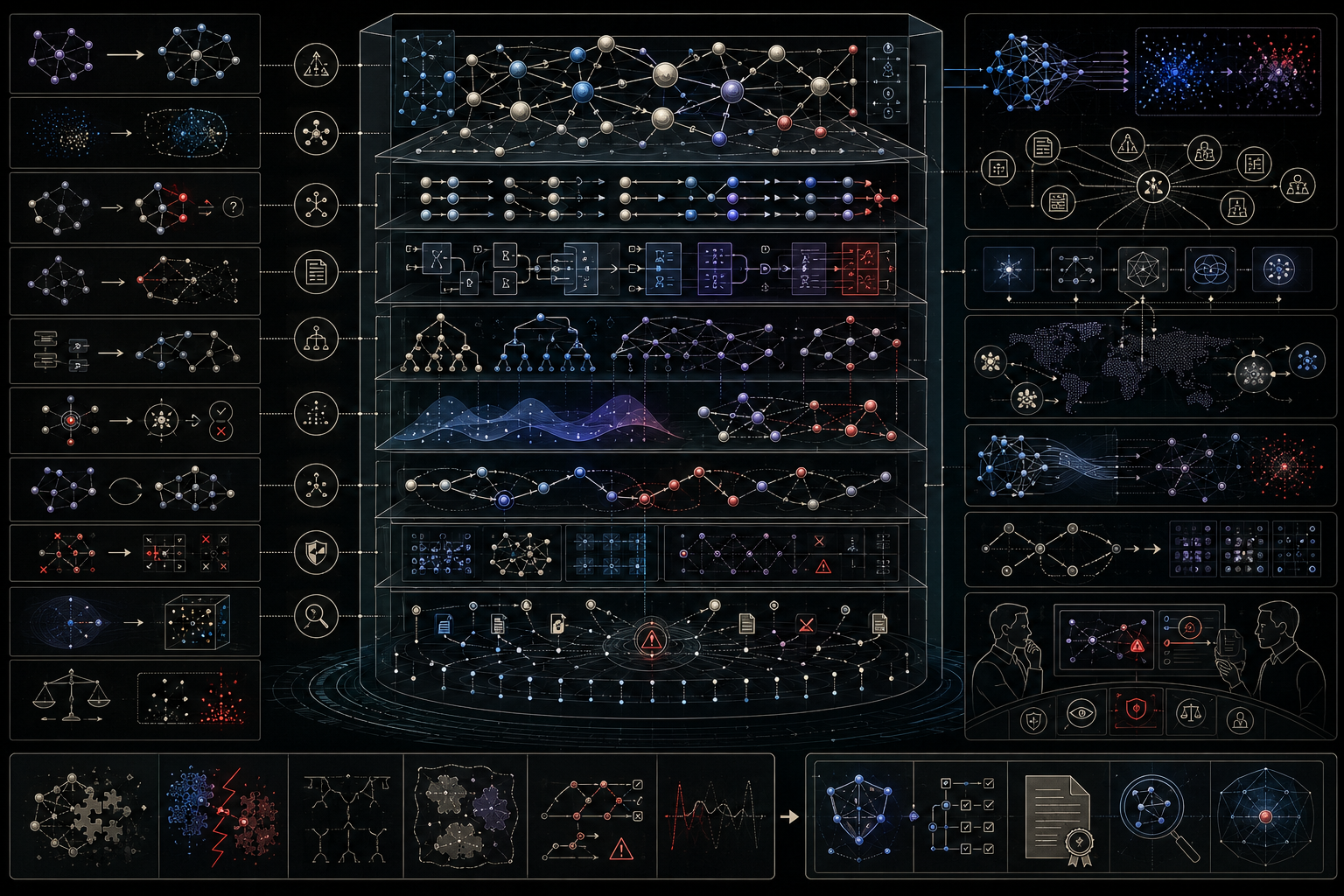
Although machine learning now dominates much of the AI landscape, knowledge representation has not become obsolete. It remains indispensable wherever systems must preserve semantic consistency, reason over structured domains, integrate heterogeneous information, justify conclusions, enforce constraints, document assumptions, or operate under governance requirements that demand transparency and auditability. In domains such as law, medicine, engineering, logistics, scientific knowledge management, public administration, environmental monitoring, infrastructure, and safety-critical decision support, representation is inseparable from trust.
This article develops Knowledge Representation and Artificial Reasoning as an advanced article within the Artificial Intelligence Systems knowledge series. It explains symbolic AI, formal logic, semantic networks, frames, ontologies, knowledge graphs, inference engines, search, deduction, induction, abduction, uncertainty, probabilistic reasoning, non-monotonic reasoning, hybrid AI, neuro-symbolic systems, semantic interoperability, explainability, and governance. Selected Python and R examples appear here, while the full GitHub repository contains expanded computational scaffolding for symbolic triples, rule-based inference, transitive closure, ontology-style schemas, uncertainty scoring, reasoning diagnostics, SQL metadata, governance notes, and advanced Jupyter notebooks.
Why Knowledge Representation Matters
Knowledge representation matters because intelligent behavior depends on more than pattern recognition. A system may detect correlations, classify inputs, retrieve documents, or generate fluent text, yet still lack explicit concepts, stable relations, causal assumptions, logical constraints, provenance structures, or traceable inference paths. In many settings, those missing structures are exactly what make reasoning meaningful. A medical system must distinguish symptoms, diagnoses, treatments, contraindications, uncertainty, evidence quality, and patient context. A legal system must distinguish statutes, precedents, obligations, exceptions, parties, jurisdictions, and interpretive authority. An infrastructure system must distinguish assets, dependencies, risks, thresholds, events, interventions, ownership, and cascading failure paths.
This makes knowledge representation one of the enduring pillars of artificial intelligence. Machine learning asks how systems can learn from data. Knowledge representation asks how systems can organize what is learned, assumed, asserted, inferred, or contested. Artificial reasoning asks how systems can move from represented knowledge to conclusions, plans, explanations, or decisions. Together, representation and reasoning provide the conceptual architecture for AI systems that must do more than predict.
The issue is especially important in an era of large language models and multimodal AI. Neural systems can encode vast statistical patterns, but their internal representations are often opaque, distributed, and difficult to inspect. Structured representations—rules, ontologies, knowledge graphs, constraints, taxonomies, provenance models, and causal diagrams—remain essential for grounding, interoperability, traceability, verification, and governance. The future of AI is unlikely to be purely symbolic or purely statistical. It will increasingly depend on systems that can combine learned representations with explicit structures for reasoning and accountability.
Knowledge\ Representation = Concepts + Relations + Rules + Constraints + Provenance
\]
Interpretation: Knowledge representation gives AI systems explicit structures for organizing meaning, not merely storing data.
| System Need | Representation Function | Reasoning Function | Governance Concern |
|---|---|---|---|
| Semantic clarity | Defines entities, categories, relations, and meanings. | Allows conclusions to be expressed in domain terms. | Without semantic clarity, outputs become hard to interpret or contest. |
| Consistency | Encodes constraints, axioms, taxonomies, and rules. | Detects contradictions and supports valid inference. | Inconsistent systems may produce incompatible recommendations. |
| Interoperability | Aligns concepts across databases, institutions, and systems. | Supports reasoning across heterogeneous evidence sources. | Misaligned categories can create false equivalence or data misuse. |
| Explanation | Preserves explicit structures behind conclusions. | Produces traceable inference paths. | Opaque conclusions cannot be meaningfully audited. |
| Accountability | Links claims to provenance, assumptions, and rules. | Supports review, challenge, and correction. | Responsibility diffuses when reasoning paths are invisible. |
Note: Knowledge representation becomes especially important when AI systems are expected to justify, constrain, explain, or govern their outputs.
Knowledge Representation as a Foundational Problem
At the heart of artificial intelligence lies a deceptively difficult challenge: how can aspects of the world be encoded in forms that a computational system can meaningfully manipulate? Data alone is insufficient. Intelligent action depends on distinctions among entities, categories, events, properties, relations, constraints, causes, evidence, temporal sequences, and context-sensitive interpretations. Knowledge representation concerns the formal design of these structures.
A basic knowledge representation system can be viewed as a pair of represented facts and inference procedures:
\mathcal{K}=(F,R)
\]
Interpretation: A knowledge base \(\mathcal{K}\) may contain facts \(F\) and rules or reasoning procedures \(R\) used to derive conclusions.
This challenge is foundational because representation and reasoning are inseparable. Every reasoning system presupposes a world model, whether explicit or implicit. A system cannot infer over categories it does not possess, apply constraints it cannot encode, or explain conclusions in terms it cannot represent. Representation determines the space of possible inference. It shapes what counts as evidence, what relationships can be modeled, what abstractions are available, and what conclusions are computationally reachable.
In this sense, knowledge representation is not merely a storage problem. It is an architectural and epistemic problem. To represent knowledge is to make commitments about ontology, granularity, and relevance. A system designer must decide what kinds of things exist in the domain, how they are distinguished, how they are related, what assumptions are acceptable, and what kinds of operations the system must perform over them. These are not neutral technical decisions. They embed assumptions about reality, categorization, authority, and intelligibility.
This has deep implications for contemporary AI systems. Even in statistical and neural pipelines, representational choices persist: label schemas, feature spaces, embedding geometries, metadata standards, taxonomies, entity types, relational databases, prompt templates, retrieval indices, and evaluation categories all instantiate representational commitments. The difference is often not whether representation exists, but whether it is explicit, inspectable, and semantically grounded.
| Foundational Question | Representation Choice | Reasoning Consequence | Risk |
|---|---|---|---|
| What exists? | Entities, categories, events, properties, processes. | Determines what the system can reason about. | Important realities may be excluded from the ontology. |
| How are things related? | Relations, edges, predicates, dependencies. | Enables inference across connected facts. | False or missing relations distort conclusions. |
| What rules apply? | Logic rules, constraints, policies, defaults, exceptions. | Guides inference, classification, and decision support. | Rules may be incomplete, outdated, or institutionally biased. |
| What is uncertain? | Probabilities, confidence, evidence quality, belief states. | Supports reasoning under incomplete information. | Uncertainty may be hidden behind crisp outputs. |
| What can be explained? | Provenance, inference traces, evidence links, rule paths. | Makes conclusions reviewable and auditable. | Outputs may be operational but not accountable. |
Note: Representation determines the boundary between what an AI system can reason about and what it cannot even name.
Representation\ Determines\ Inference
\]
Interpretation: A reasoning system can only derive conclusions from the concepts, relations, constraints, and evidence structures made available to it.
Philosophical and Epistemological Foundations
Knowledge representation sits at the intersection of computer science, logic, linguistics, philosophy of mind, and epistemology. The field inherits long-standing questions: What is knowledge? What is the relation between symbols and meanings? Can reasoning be reduced to formal manipulation? How do categories relate to the world? What is required for a proposition to count as justified, true, useful, or actionable within a computational setting?
Classical AI was deeply influenced by the view that cognition could be understood as symbolic information processing. On this account, intelligent behavior results from the manipulation of internal representations according to formal rules. This perspective aligned naturally with developments in mathematical logic and analytic philosophy, especially traditions that emphasized formal languages, propositions, inference rules, compositional semantics, and validity-preserving operations.
Yet knowledge representation also confronts the limits of abstraction. Human knowledge is not exhausted by formal propositions. It often includes tacit understanding, embodied know-how, contextual judgment, analogical transfer, probabilistic expectation, practical skill, contested meaning, and socially constructed categories. Representational systems must constantly negotiate a tension between formal precision and real-world complexity. Highly formal systems gain rigor and consistency but may lose flexibility. Looser representations gain breadth but may sacrifice inferential discipline.
This epistemic tension helps explain why knowledge representation remains so important in AI governance. Systems that make consequential decisions are often required not merely to predict, but to justify, document, and explain. That demand reintroduces classical epistemic questions into applied computational systems: what exactly does the system “know,” how is that knowledge structured, and on what grounds does it act?
| Question | AI Translation | System Design Issue | Governance Implication |
|---|---|---|---|
| What is knowledge? | What is stored, inferred, asserted, or justified? | Facts, rules, probabilities, provenance, and evidence quality. | Institutions must distinguish assertion, inference, and verified knowledge. |
| What do symbols mean? | How do tokens, predicates, and categories connect to real domains? | Ontology design, grounding, semantic alignment. | Misgrounded symbols produce misleading outputs. |
| What counts as reasoning? | What transformations from premises to conclusions are valid? | Inference rules, search, belief revision, planning. | Reasoning paths must be reviewable in consequential systems. |
| How are categories formed? | How does the system classify entities and cases? | Taxonomies, frames, classes, embeddings, graph schemas. | Categories can encode power, exclusion, or institutional bias. |
| How is uncertainty handled? | How does the system reason with incomplete or conflicting evidence? | Probabilities, defaults, defeasible rules, confidence scores. | Uncertainty must be visible, not hidden behind artificial certainty. |
Note: Knowledge representation is not only a technical discipline. It is an applied theory of meaning, evidence, inference, and accountability.
Symbolic AI and the Logicist Tradition
Symbolic AI, often called classical AI or Good Old-Fashioned AI, approached intelligence as the explicit manipulation of symbols according to formal rules. In this tradition, symbols stand for entities, properties, relations, or propositions, while reasoning consists of transformations over those symbols that preserve logical validity or domain-specific consistency.
Two major representational frameworks dominated early symbolic AI. The first was propositional logic, in which statements are represented as truth-valued propositions connected by logical operators. The second was predicate logic, which introduced quantification, variables, relations, and more expressive ways of describing structure in the world. Predicate logic was especially important because it allowed systems to represent not just isolated facts, but general rules about classes of entities and their relationships.
A simple predicate assertion can be written as:
\mathrm{Human}(\mathrm{Socrates})
\]
Interpretation: Predicate logic represents a claim by applying a predicate, such as \(\mathrm{Human}\), to an entity, such as \(\mathrm{Socrates}\).
A general rule can be written as:
\forall x\;(\mathrm{Human}(x)\rightarrow \mathrm{Mortal}(x))
\]
Interpretation: This rule states that for every entity \(x\), if \(x\) is human, then \(x\) is mortal.
This symbolic tradition gave rise to expert systems, theorem provers, rule engines, planning systems, diagnostic systems, and constraint-based architectures. Expert systems encoded specialist knowledge through rules of the form “if condition, then conclusion,” often supported by inference engines that chained deductions to reach recommendations or diagnoses. The appeal was obvious: knowledge could be made explicit, audited, revised, and explained.
Symbolic AI also aligned with human intuitions about reasoning. When people justify conclusions, they often cite rules, categories, exceptions, and relations. This made symbolic systems especially useful in structured domains where concepts were stable, logic mattered, and explanation was essential. At the same time, the logicist tradition represented a broader claim about intelligence itself: that at least some forms of cognition can be captured through formal symbol systems. Whether that claim holds universally remains debated, but its influence on AI is profound.
| Symbolic Approach | Core Idea | Strength | Limitation |
|---|---|---|---|
| Propositional logic | Represents statements as true or false propositions. | Clear syntax, semantics, and inference rules. | Limited ability to represent objects, relations, and quantification. |
| Predicate logic | Represents entities, properties, relations, variables, and quantifiers. | More expressive representation of structured domains. | Reasoning can become computationally expensive. |
| Rule systems | Encode expert knowledge as conditional rules. | Transparent and operationally direct. | Large rule sets can become brittle and hard to maintain. |
| Expert systems | Apply domain rules to make recommendations or diagnoses. | Useful in structured domains with explicit expertise. | Knowledge acquisition is slow and incomplete. |
| Theorem proving | Derives conclusions from formal axioms and inference rules. | Strong correctness guarantees where formalization is possible. | Real-world ambiguity often exceeds formal assumptions. |
Note: Symbolic AI remains valuable where meaning, rules, constraints, explanation, and formal consistency matter.
Symbolic\ Clarity \neq Real\ World\ Completeness
\]
Interpretation: Symbolic systems can make reasoning explicit, but real-world domains often contain ambiguity, uncertainty, exceptions, and tacit knowledge that are difficult to encode completely.
Rules, Frames, Semantic Networks, Ontologies, and Knowledge Graphs
Knowledge representation developed a diverse set of structures for organizing machine-usable knowledge. Each structure reflects different assumptions about what knowledge consists of and how it should be processed.
Rule-based representations encode domain knowledge as conditional statements. Their strength lies in clarity and operational directness. They are effective when expertise can be articulated as explicit heuristics or decision criteria. However, large rule sets can become brittle, difficult to maintain, and vulnerable to combinatorial explosion.
Semantic networks represent knowledge as graphs of nodes and edges, where nodes correspond to concepts or entities and edges correspond to relations. These were early attempts to model conceptual structure in a way that resembled associative meaning. Graph representations remain highly influential today in modern knowledge graphs.
A knowledge graph can be represented as:
G=(V,E)
\]
Interpretation: A knowledge graph contains vertices \(V\), representing entities or concepts, and edges \(E\), representing relations.
A triple representation can be written as:
(s,p,o)
\]
Interpretation: A semantic triple represents a subject \(s\), predicate \(p\), and object \(o\), such as \((\mathrm{Socrates},\mathrm{isA},\mathrm{Human})\).
Frames represent concepts through structured templates with slots and values. A “restaurant” frame, for example, might include roles such as customer, menu, server, bill, and payment. Frames support inheritance, defaults, and contextual reasoning, making them useful for representing organized world knowledge rather than isolated facts.
Ontologies move further toward formal semantic engineering. An ontology specifies entities, categories, properties, relations, constraints, and axioms that structure a domain. Ontologies are central to semantic interoperability because they help systems share meaning across databases, institutions, and applications. In medicine, biology, engineering, environmental governance, and enterprise information systems, ontologies enable standardized vocabulary, consistent classification, and cross-system integration.
Knowledge graphs extend these ideas at scale. By linking entities and relations across heterogeneous datasets, they provide infrastructure for semantic retrieval, question answering, recommendation, data integration, and reasoning over relationships. Their importance in modern AI lies not only in knowledge storage, but in preserving relational structure that would otherwise be flattened in purely tabular or vectorized forms.
Taken together, these structures reveal an important truth: knowledge is multidimensional. Some aspects are best represented propositionally, others taxonomically, others relationally, others probabilistically, others temporally, and still others causally. Sophisticated AI systems increasingly require combinations of representational forms rather than allegiance to a single formalism.
| Structure | Represents | Useful For | Governance Concern |
|---|---|---|---|
| Rules | Conditional logic, policies, expert heuristics. | Decision support, compliance, diagnosis, control. | Rules may be incomplete, outdated, or inconsistent. |
| Frames | Structured concepts with slots, roles, and defaults. | Contextual reasoning and organized domain knowledge. | Default assumptions may encode hidden bias. |
| Semantic networks | Concepts connected by relations. | Associative meaning, inheritance, conceptual structure. | Edges may imply more certainty than evidence supports. |
| Ontologies | Formal classes, properties, axioms, and constraints. | Interoperability, classification, consistency checking. | Ontological choices can standardize contested categories. |
| Knowledge graphs | Entities and relations at scale. | Semantic search, retrieval, integration, question answering. | Graph incompleteness and provenance gaps can distort inference. |
Note: Different domains require different representational structures. In many serious AI systems, multiple structures must work together.
Formal Logic, Predicates, and Inference
Formal logic gives knowledge representation a rigorous foundation. It defines syntax, semantics, inference rules, and validity. In propositional logic, statements are represented as propositions connected by logical operators. In predicate logic, statements can involve variables, quantifiers, predicates, and relations. Description logics, which underpin many ontology languages, provide decidable fragments of first-order logic useful for classification, subsumption, and consistency checking.
A rule of inference such as modus ponens can be written as:
P,\quad P\rightarrow Q \;\vdash\; Q
\]
Interpretation: If \(P\) is true and \(P\) implies \(Q\), then \(Q\) can be inferred.
A knowledge base may entail a conclusion:
\mathcal{K}\models q
\]
Interpretation: A knowledge base \(\mathcal{K}\) entails query \(q\) if \(q\) follows from the represented facts and rules under the chosen semantics.
This distinction between representation and entailment is central. A fact may be explicitly stored, or it may be derivable from stored facts and rules. Reasoning systems therefore extend the usable content of a knowledge base beyond what is directly written.
However, expressiveness and tractability are in tension. More expressive logical languages can represent richer domains, but reasoning may become computationally expensive or undecidable. Less expressive languages may be tractable but insufficient for complex domains. Knowledge representation therefore requires choosing formal systems appropriate to domain complexity, inference requirements, and operational constraints.
| Logical Tool | Function | Reasoning Value | Tradeoff |
|---|---|---|---|
| Propositions | Represent truth-valued statements. | Supports basic logical inference. | Limited expressiveness for structured domains. |
| Predicates | Represent properties or relations over entities. | Supports richer claims about objects and relations. | Requires careful ontology and variable design. |
| Quantifiers | Express rules over all or some entities. | Supports generalization within formal systems. | Can increase reasoning complexity. |
| Entailment | Defines what follows from a knowledge base. | Connects facts and rules to conclusions. | Depends on chosen semantics and assumptions. |
| Description logics | Represent classes, relations, and constraints in decidable fragments. | Useful for ontologies and consistency checking. | Less expressive than full first-order logic. |
Note: Formal logic gives AI systems powerful tools for explicit reasoning, but language choice determines what can be represented and what can be computed efficiently.
Expressiveness \leftrightarrow Tractability
\]
Interpretation: More expressive representation languages can encode richer knowledge, but may make reasoning more computationally difficult.
Deduction, Induction, Abduction, and Search
Artificial reasoning is the process by which a system derives conclusions, recommendations, diagnoses, or plans from represented knowledge. The quality of such reasoning depends not only on representational adequacy, but on inference mechanisms, control strategies, and computational tractability.
Deductive reasoning derives conclusions that follow necessarily from premises. It provides strong guarantees of validity and is foundational to theorem proving, constraint solving, and formal verification. Deduction is especially valuable where correctness matters more than flexibility, such as safety-critical systems, compliance checking, and formal verification.
Inductive reasoning generalizes from observations. Although more closely associated with statistical learning, induction also appears in classical AI in the formation of rules, hypotheses, or conceptual generalizations from experience. It is epistemically powerful but inherently uncertain, since conclusions extend beyond observed data.
Abductive reasoning seeks the most plausible explanation for observed evidence. It is central to diagnosis, troubleshooting, intelligence analysis, scientific hypothesis generation, and incident investigation. In practical reasoning, abduction is often more relevant than deduction because real-world agents frequently work backward from symptoms to possible causes.
Abduction can be represented abstractly as:
h^*
=
\arg\max_h P(h\mid e)
\]
Interpretation: Abductive reasoning selects the hypothesis \(h\) that best explains evidence \(e\).
Reasoning systems also depend on search. In many AI problems, the challenge is not merely whether a conclusion follows, but how to navigate an enormous space of possibilities efficiently. Planning, game playing, theorem proving, and constraint satisfaction all rely on search procedures guided by heuristics, pruning strategies, and representations of state transitions.
This matters for broader decision architectures as well. Artificial reasoning is closely connected to decision science, where structured inference supports strategic judgment under constraints. It also connects to systems modeling, where causal structure, feedback, and state relationships shape what decisions are intelligible and what interventions are likely to have downstream effects.
| Reasoning Type | Core Pattern | Useful For | Risk |
|---|---|---|---|
| Deduction | Derives necessary conclusions from premises. | Formal verification, compliance, constraints, theorem proving. | Only as valid as premises, rules, and formalization. |
| Induction | Generalizes from observations. | Learning rules, identifying patterns, hypothesis formation. | Conclusions may fail outside observed evidence. |
| Abduction | Selects plausible explanations for evidence. | Diagnosis, troubleshooting, investigation, causal hypothesis generation. | Plausible explanations may be incomplete or wrong. |
| Search | Navigates possible states, proofs, plans, or solutions. | Planning, games, theorem proving, scheduling, optimization. | Search spaces can become computationally explosive. |
| Belief revision | Updates conclusions when evidence changes. | Dynamic domains, monitoring, uncertain environments. | Systems may preserve outdated assumptions if revision is weak. |
Note: Reasoning is not one operation. Serious AI systems often require several forms of inference operating together.
Reasoning = Representation + Inference + Search + Revision
\]
Interpretation: Artificial reasoning depends on what is represented, how conclusions are derived, how possible paths are searched, and how beliefs change when evidence changes.
Reasoning Under Uncertainty, Incompleteness, and Ambiguity
One of the enduring challenges for classical knowledge representation is that real-world reasoning rarely occurs under conditions of complete information and crisp truth values. Human agents reason amid uncertainty, ambiguity, missing data, shifting concepts, noisy signals, conflicting evidence, and incomplete causal knowledge. Formal AI systems had to address the fact that logic alone is often too rigid for open-world environments.
This gave rise to approaches for representing uncertain belief, probabilistic dependence, defeasible reasoning, non-monotonic logic, fuzzy categories, default assumptions, and belief revision. Bayesian networks, probabilistic graphical models, and belief revision frameworks provided ways to model uncertainty explicitly. Non-monotonic reasoning allowed systems to withdraw conclusions when new evidence invalidated previous assumptions. Default reasoning enabled systems to operate with plausible assumptions in the absence of complete information.
A Bayesian update can be written as:
P(H\mid E)
=
\frac{P(E\mid H)P(H)}{P(E)}
\]
Interpretation: Bayesian reasoning updates belief in hypothesis \(H\) after observing evidence \(E\).
A simple probabilistic graphical model factorization can be written as:
P(X_1,\ldots,X_n)
=
\prod_{i=1}^{n}
P(X_i\mid \mathrm{Pa}(X_i))
\]
Interpretation: A Bayesian network represents joint probability through local conditional dependencies, where \(\mathrm{Pa}(X_i)\) denotes the parents of variable \(X_i\).
These developments are critical because intelligence is not simply the manipulation of certain truths. It often involves navigating what is likely, plausible, revisable, contested, or contextually warranted. In many decision environments, the most important capability is not proving a theorem but updating beliefs responsibly when evidence changes.
This issue remains central today. Contemporary AI systems often operate in domains where ambiguity and uncertainty are structural features rather than anomalies. Climate modeling, legal interpretation, infrastructure planning, supply-chain risk, public-health decision support, and environmental governance all require systems that can represent contested knowledge, partial observability, and uncertain causal relations.
| Approach | What It Handles | Example Use | Governance Concern |
|---|---|---|---|
| Bayesian reasoning | Belief revision under evidence. | Diagnosis, risk assessment, forecasting, sensor fusion. | Priors and likelihoods must be documented and justified. |
| Probabilistic graphical models | Dependencies among uncertain variables. | Causal-like modeling, monitoring, fault diagnosis. | Graph structure can imply unsupported dependencies. |
| Default reasoning | Plausible assumptions in incomplete settings. | Commonsense reasoning and decision support. | Defaults may encode hidden cultural or institutional assumptions. |
| Non-monotonic reasoning | Conclusions that can be withdrawn when evidence changes. | Legal reasoning, exception handling, dynamic domains. | Revision rules must be transparent and consistent. |
| Fuzzy reasoning | Gradual category membership and vague boundaries. | Control systems, qualitative classifications, human-centered domains. | Membership functions can appear objective while reflecting design choices. |
Note: Uncertainty is not a weakness of reasoning systems. It is a condition of real-world intelligence and should be represented explicitly.
Certain\ Logic \neq Complete\ Reasoning
\]
Interpretation: Real-world reasoning often requires uncertainty, defeasibility, revision, and evidence quality—not only strict deduction.
Why Purely Symbolic Systems Reached Their Limits
Despite their conceptual elegance, purely symbolic systems encountered major practical and theoretical limitations. First, they depended heavily on manual knowledge encoding. This made knowledge acquisition expensive, slow, and difficult to scale. Expert knowledge is often tacit, incomplete, inconsistent, or domain-fragmented, and translating it into formal rules proved more difficult than early optimism suggested.
Second, symbolic systems struggled in domains characterized by perceptual complexity, statistical regularity, or high-dimensional pattern recognition. Tasks such as image recognition, speech processing, natural language variation, sensor interpretation, and large-scale prediction exposed the limits of handcrafted symbolic representations. In such settings, the world presented too much noise, ambiguity, and variability for rigid logical encoding alone.
Third, symbolic systems often lacked robustness in open environments. They worked best when the ontology was stable, the rules were known, and domain boundaries were relatively closed. Real-world settings are messier: categories shift, exceptions proliferate, and edge cases dominate.
The rise of machine learning, especially connectionist and later deep learning approaches, was partly a response to these limitations. Instead of requiring explicit symbolic encoding, learning-based systems infer patterns from large datasets. This allowed AI to make dramatic advances in perception, classification, generation, and prediction. Yet these successes did not eliminate representational concerns; they transformed them. Learned representations became powerful, but often opaque, distributed, and difficult to interpret semantically.
The result is not a simple victory of one paradigm over another, but a reframing of the central problem. Statistical systems solved some scaling problems that symbolic AI could not, while reintroducing challenges around explanation, abstraction, reliability, conceptual grounding, and governance.
| Limit | Description | Why It Matters | Contemporary Response |
|---|---|---|---|
| Knowledge acquisition bottleneck | Expert knowledge must be manually encoded. | Scaling large domains becomes slow and expensive. | Use machine learning, extraction, and human-in-the-loop curation. |
| Brittleness | Rules fail under exceptions, ambiguity, or unanticipated cases. | Open-world environments resist complete formalization. | Use probabilistic, defeasible, and hybrid reasoning. |
| Perceptual weakness | Symbolic systems struggle with raw images, audio, text variation, and sensor data. | Many real-world inputs are noisy and high-dimensional. | Use neural representation learning for perception. |
| Maintenance complexity | Large rule sets become hard to update and test. | Contradictions and obsolete rules accumulate. | Use modular ontologies, versioning, validation, and governance workflows. |
| Closed-world assumptions | Systems often assume domains are complete and stable. | Real environments change and contain unknowns. | Use monitoring, belief revision, and uncertainty-aware inference. |
Note: Symbolic AI’s limits do not make representation obsolete. They show why representation must be combined with learning, uncertainty, and adaptive system design.
Hybrid AI and Neuro-Symbolic Reasoning
One of the most important contemporary developments in AI is the return of interest in hybrid systems that combine learning-based methods with structured representation and reasoning. The motivation is straightforward: statistical learning excels at pattern extraction from data, while symbolic methods excel at structure, constraints, compositionality, traceability, and explanation. Many real-world systems need both.
Hybrid AI can take many forms. Knowledge graphs may enrich retrieval and disambiguation for language systems. Logical constraints may be imposed on learned outputs to preserve consistency. Ontologies may organize domain knowledge for downstream reasoning. Neural models may generate candidate interpretations that symbolic systems verify against rules or domain constraints. Differentiable approximations of symbolic operations may attempt to integrate reasoning directly into learning architectures.
A hybrid system can be represented abstractly as:
S_{\mathrm{hybrid}}
=
(M_{\mathrm{neural}},K_{\mathrm{symbolic}},R_{\mathrm{reason}})
\]
Interpretation: A hybrid AI system combines a neural model, structured symbolic knowledge, and reasoning procedures.
This renewed interest reflects a deeper recognition: intelligence in complex environments often requires both subsymbolic adaptation and explicit semantic structure. A system that can predict but not justify may be operationally useful yet institutionally fragile. A system that can reason but not perceive may be transparent yet impractical. Hybrid architectures attempt to bridge this divide.
This is especially relevant for large-scale language systems. Contemporary models exhibit powerful pattern-based capabilities, but they do not automatically possess stable ontology management, explicit causal reasoning, or formal world models. Integrating structured knowledge, retrieval mechanisms, and reasoning components can improve factual grounding, controllability, consistency, and auditability.
| Hybrid Pattern | Neural Role | Symbolic Role | Governance Value |
|---|---|---|---|
| Retrieval-augmented reasoning | Generates queries, summaries, or candidate answers. | Provides structured evidence and source-grounded context. | Improves provenance and reduces unsupported claims. |
| Knowledge-graph grounding | Embeds language, images, or records. | Links outputs to entities, relations, and ontologies. | Supports semantic consistency and entity-level audit. |
| Constraint-guided generation | Produces flexible outputs. | Applies rules, policies, schemas, or validity constraints. | Prevents outputs from violating domain rules. |
| Neural perception plus symbolic planning | Interprets raw sensory input. | Plans actions over explicit states and constraints. | Connects perception to explainable decision logic. |
| Neuro-symbolic verification | Generates candidate conclusions or programs. | Checks consistency, proofs, or constraints. | Improves safety and reliability in formal domains. |
Note: Hybrid AI is not a return to old symbolic systems. It is an attempt to combine learned representation with explicit semantic structure and traceable inference.
Learning + Structure + Reasoning \Rightarrow Auditable\ Intelligence
\]
Interpretation: Trustworthy AI increasingly requires systems that learn from data while preserving explicit structures for meaning, constraints, evidence, and explanation.
Knowledge Representation in Complex Socio-Technical Systems
Knowledge representation becomes even more important when AI operates inside complex socio-technical systems rather than isolated benchmarks. In such environments, systems must coordinate across institutions, datasets, standards, legal frameworks, human users, and evolving operational contexts. Representation is no longer just about internal cognition; it becomes part of information infrastructure.
Consider environmental monitoring, public administration, supply-chain intelligence, or infrastructure resilience. These domains involve multi-scale relationships, temporal dependencies, interacting subsystems, heterogeneous forms of evidence, and contested institutional categories. Effective AI in such contexts depends on semantically coherent representations of entities, measurements, events, jurisdictions, thresholds, causal pathways, policy categories, and operational constraints.
This is where knowledge representation intersects directly with infrastructure systems, feedback-rich system behavior, and AI in environmental monitoring. Systems that support strategic analysis or sustainability governance must reconcile sensor data, institutional categories, scientific indicators, legal obligations, and human interpretation. Without robust representational frameworks, those layers remain fragmented.
In this broader sense, knowledge representation is a condition for interoperability. It enables different actors and systems to refer to the same entities, align on shared concepts, compare states across time, and reason over consequences. It supports continuity between data pipelines, analytical models, institutional rules, and human decision processes.
| Domain | Representation Need | Reasoning Need | Risk if Weak |
|---|---|---|---|
| Environmental monitoring | Sensors, indicators, locations, species, thresholds, time periods. | Infer risk, trends, anomalies, and intervention priorities. | Disconnected evidence produces weak or misleading environmental claims. |
| Infrastructure resilience | Assets, dependencies, hazards, capacities, failure modes. | Reason over cascading risk and recovery pathways. | Hidden dependencies amplify system failure. |
| Public administration | Programs, eligibility, obligations, jurisdictions, service records. | Apply rules consistently while preserving review and exception handling. | Rigid categories can deny context and accountability. |
| Scientific knowledge systems | Concepts, methods, datasets, instruments, findings, uncertainty. | Integrate evidence across studies and models. | Knowledge claims become difficult to reproduce or compare. |
| Supply-chain intelligence | Firms, materials, routes, contracts, risks, jurisdictions. | Infer exposure, dependency, vulnerability, and disruption pathways. | Fragmented data hides systemic vulnerability. |
Note: In complex systems, knowledge representation is not only internal AI design. It is the semantic infrastructure that allows institutions to coordinate action.
Explainability, Governance, and Institutional Trust
The contemporary importance of knowledge representation extends well beyond technical elegance. It is central to AI governance. As AI systems enter domains involving rights, safety, compliance, public accountability, and institutional legitimacy, explainability becomes not a decorative feature but often a structural requirement.
Symbolic and structured representational approaches are valuable because they make semantic commitments explicit. Rules can be inspected. Ontologies can be documented. Inference paths can be traced. Constraints can be reviewed. Provenance can be attached to claims. This does not guarantee correctness, fairness, or wisdom, but it creates the conditions for auditability and contestability.
By contrast, purely opaque systems may produce highly accurate outputs while remaining difficult to interrogate. In low-stakes settings this may be acceptable. In high-stakes settings it becomes problematic. Institutions often need to know not only what a system concluded, but why, under what assumptions, and with what evidentiary structure.
This is why knowledge representation matters for trustworthy AI. Trust is not merely a psychological response; it is a governance achievement. It depends on documentation, semantic clarity, procedural accountability, evidence lineage, and the ability to connect outputs back to intelligible world models. Systems that cannot articulate their conceptual structure risk becoming operational black boxes even when their outputs appear useful.
| Governance Requirement | Representation Mechanism | Reasoning Mechanism | Review Question |
|---|---|---|---|
| Explainability | Rules, ontologies, triples, evidence links. | Inference traces and explanation paths. | Can the system show why a conclusion was reached? |
| Accountability | Provenance, ownership, versioning, approval status. | Decision logs and reviewable rule application. | Who is responsible for the representation and inference? |
| Consistency | Constraints, axioms, schemas, validation rules. | Consistency checking and contradiction detection. | Do system conclusions remain coherent across cases? |
| Contestability | Explicit claims, assumptions, exceptions, and evidence. | Alternative inference paths and belief revision. | Can users challenge a claim or provide new evidence? |
| Auditability | Versioned knowledge base and evidence records. | Reproducible reasoning runs and inference logs. | Can conclusions be reconstructed after the fact? |
Note: Trustworthy AI requires more than accurate outputs. It requires semantic structures that make conclusions inspectable, explainable, and correctable.
Trust = Evidence + Semantics + Traceability + Accountability
\]
Interpretation: Institutional trust depends on whether claims can be connected to evidence, meaning, inference, and responsibility.
Future Directions in Representation and Reasoning
The future of knowledge representation is unlikely to involve a return to purely hand-crafted expert systems, nor a complete surrender to uninterpretable statistical representations. More plausibly, the field is moving toward layered architectures that combine relational structure, probabilistic reasoning, learned representations, retrieval systems, ontological grounding, causal modeling, and human-in-the-loop oversight.
Several directions are especially important. One is the development of richer causal and temporal representations that allow systems not merely to associate patterns but to model interventions, sequences, and counterfactual structure. Another is the integration of semantic frameworks with foundation models so that language generation is constrained by domain knowledge and institutional context. A third is the expansion of machine-readable knowledge infrastructures that support interoperability across policy, science, operations, and public accountability.
There is also a deeper conceptual future for the field. As AI systems increasingly participate in knowledge production itself, the boundary between representation and governance will continue to blur. How knowledge is classified, standardized, linked, justified, and revised will shape not only machine performance but the epistemic quality of institutions that rely on those systems.
For that reason, knowledge representation should be understood not as a narrow subfield but as a bridge discipline connecting logic, semantics, institutional design, and computational intelligence. It remains one of the central places where AI confronts the problem of meaning.
| Direction | What It Adds | Why It Matters | Governance Challenge |
|---|---|---|---|
| Causal representation | Models interventions, mechanisms, and counterfactuals. | Supports decision-making beyond correlation. | Causal claims require evidence and humility. |
| Temporal reasoning | Represents events, sequences, change, and persistence. | Supports planning, monitoring, and dynamic systems. | Time-dependent assumptions must be updated. |
| Foundation-model grounding | Connects generative systems to structured knowledge. | Improves factuality, consistency, and domain control. | Grounding evidence must remain current and traceable. |
| Semantic interoperability | Aligns meaning across institutions and systems. | Supports data integration and coordinated governance. | Standardization can hide contested categories. |
| Human-in-the-loop reasoning | Combines automated inference with human review. | Supports accountability in uncertain domains. | Human oversight must be substantive, not ceremonial. |
Note: The future of representation and reasoning will likely be hybrid, causal, temporal, probabilistic, and governance-aware.
Mathematical Lens: Facts, Rules, Graphs, Entailment, Belief, and Hybrid Systems
A mathematics-first view begins with a knowledge base:
\mathcal{K}=(F,R)
\]
Interpretation: A knowledge base contains facts \(F\) and rules \(R\) that support inference.
A fact may be represented as a predicate:
P(a)
\]
Interpretation: Predicate \(P\) is asserted of entity \(a\).
A rule can express implication:
\forall x\;(P(x)\rightarrow Q(x))
\]
Interpretation: For every entity \(x\), if \(P(x)\) holds, then \(Q(x)\) follows.
Modus ponens derives conclusions:
P,\quad P\rightarrow Q \;\vdash\; Q
\]
Interpretation: If \(P\) is asserted and \(P\) implies \(Q\), the system may infer \(Q\).
A query follows from a knowledge base when it is entailed:
\mathcal{K}\models q
\]
Interpretation: Query \(q\) is entailed by knowledge base \(\mathcal{K}\) under the relevant semantics.
A knowledge graph stores entities and relations:
G=(V,E)
\]
Interpretation: Vertices \(V\) represent entities or concepts, while edges \(E\) represent relations.
Semantic triples represent relational claims:
(s,p,o)
\]
Interpretation: A subject \(s\), predicate \(p\), and object \(o\) encode a structured assertion.
Bayesian reasoning updates belief:
P(H\mid E)
=
\frac{P(E\mid H)P(H)}{P(E)}
\]
Interpretation: Belief in hypothesis \(H\) is revised after observing evidence \(E\).
A probabilistic graphical model can factor a joint distribution:
P(X_1,\ldots,X_n)
=
\prod_{i=1}^{n}
P(X_i\mid \mathrm{Pa}(X_i))
\]
Interpretation: A Bayesian network represents a joint probability distribution through local conditional dependencies.
A hybrid system combines learned and symbolic components:
S_{\mathrm{hybrid}}
=
(M_{\mathrm{neural}},K_{\mathrm{symbolic}},R_{\mathrm{reason}})
\]
Interpretation: Hybrid AI combines neural models, symbolic knowledge, and reasoning procedures.
A governance-aware reasoning reliability score can combine consistency, provenance, uncertainty, coverage, and risk:
ReasoningReliability_i =
\alpha C_i
+
\beta P_i
–
\gamma U_i
+
\lambda V_i
–
\rho R_i
\]
Interpretation: Reliability for reasoning system \(i\) may combine consistency \(C_i\), provenance quality \(P_i\), uncertainty \(U_i\), validation coverage \(V_i\), and downstream risk \(R_i\). The weights should be documented and tied to domain consequences.
This mathematical lens shows that knowledge representation and artificial reasoning are formal systems of entities, predicates, relations, rules, graphs, probabilities, entailment, evidence, and governance-relevant inference.
Variables and System Interpretation
| Symbol or Term | Meaning | Typical Type | System Interpretation |
|---|---|---|---|
| \(\mathcal{K}\) | Knowledge base | Facts and rules | Structured body of machine-usable knowledge. |
| \(F\) | Facts | Assertions | Explicit claims stored in the system. |
| \(R\) | Rules | Inference procedures or implications | Mechanisms for deriving new conclusions. |
| \(P(a)\) | Predicate assertion | Logical statement | Claim that property or relation \(P\) applies to entity \(a\). |
| \(\forall\) | Universal quantifier | Logical operator | Expresses a rule applying to all relevant entities. |
| \(\vdash\) | Syntactic derivation | Proof relation | Indicates that a conclusion can be derived by inference rules. |
| \(\models\) | Semantic entailment | Semantic relation | Indicates that a conclusion follows from a knowledge base under a model-theoretic interpretation. |
| \(G=(V,E)\) | Knowledge graph | Graph | Entity-relation structure for semantic knowledge. |
| \((s,p,o)\) | Triple | Subject-predicate-object assertion | Atomic relational claim in semantic systems. |
| \(P(H\mid E)\) | Posterior belief | Probability | Updated belief in hypothesis after evidence. |
| \(h^*\) | Best explanation | Hypothesis | Abductive explanation selected from possible causes. |
| \(S_{\mathrm{hybrid}}\) | Hybrid AI system | Neural, symbolic, and reasoning components | System combining learned representation with explicit knowledge and inference. |
Note: Knowledge representation systems are shaped by ontology, formalism, domain assumptions, uncertainty, provenance, and governance requirements. The same facts can support different conclusions under different representational choices.
Worked Example: From Facts to Inference
A simple knowledge base begins with facts:
\mathrm{Human}(\mathrm{Socrates})
\]
Interpretation: The system stores the fact that Socrates is human.
It also includes a rule:
\forall x\;(\mathrm{Human}(x)\rightarrow \mathrm{Mortal}(x))
\]
Interpretation: Every human is mortal.
Using modus ponens, the system infers:
\mathrm{Mortal}(\mathrm{Socrates})
\]
Interpretation: Because Socrates is human and all humans are mortal, Socrates is inferred to be mortal.
In graph form, this might be represented as triples:
(\mathrm{Socrates},\mathrm{isA},\mathrm{Human}),
\quad
(\mathrm{Human},\mathrm{subClassOf},\mathrm{Mortal})
\]
Interpretation: Relational triples allow inheritance-style reasoning from class membership to broader categories.
This example is simple, but it captures the central idea: artificial reasoning extends explicit knowledge by applying rules, relations, constraints, or probabilistic updates to derive additional conclusions.
| Inference Stage | Technical Question | Governance Question | Evidence Needed |
|---|---|---|---|
| Fact assertion | What facts are stored? | Who asserted them, and from what source? | Provenance, evidence link, timestamp, confidence. |
| Rule definition | What rule is applied? | Is the rule valid, current, and appropriate? | Rule documentation, domain review, version history. |
| Inference path | Which facts and rules produced the conclusion? | Can the conclusion be reconstructed and challenged? | Inference trace and explanation record. |
| Uncertainty | Is the conclusion certain, probabilistic, or defeasible? | Should the system communicate confidence or conditions? | Uncertainty model and exception handling. |
| Use context | How will the conclusion be used? | Does the conclusion affect rights, resources, safety, or accountability? | Decision record, review process, appeal path. |
Note: Even simple reasoning systems require provenance, rule review, inference tracing, and context-sensitive governance when conclusions matter.
Computational Modeling
Computational modeling makes knowledge representation and artificial reasoning more auditable. A rule-based workflow can show which facts triggered which conclusions. A graph workflow can show how entities are connected. A reasoning workflow can compute transitive closure or inheritance. A probabilistic workflow can show how evidence changes belief. A governance workflow can document provenance, uncertainty, assumptions, and inference paths. A SQL metadata schema can document knowledge bases, ontologies, rules, triples, inference runs, evidence sources, and review status.
The selected examples below focus on symbolic triples, rule-based inference, and reasoning diagnostics because they are foundational, readable, and directly reusable. The GitHub repository extends the same logic into advanced Jupyter notebooks, ontology-style schemas, forward chaining, transitive closure, uncertainty scoring, explanation traces, SQL metadata, model-card notes, and governance documentation.
| Artifact | Purpose | Governance Value |
|---|---|---|
| Knowledge-base manifest | Documents facts, rules, schemas, sources, and versions. | Supports provenance and lifecycle review. |
| Triple store export | Stores subject-predicate-object assertions. | Supports semantic inspection and graph reasoning. |
| Inference trace | Records which rules produced which conclusions. | Supports explainability and auditability. |
| Rule coverage report | Measures which rules are used and where. | Identifies unused, overused, or fragile reasoning patterns. |
| Uncertainty report | Documents confidence, evidence quality, and ambiguous cases. | Prevents false certainty in incomplete domains. |
| Governance memo | Summarizes assumptions, constraints, limits, and review needs. | Supports responsible deployment and institutional accountability. |
Note: Reasoning systems should preserve the evidence needed to reconstruct conclusions, not merely output final answers.
Python Workflow: Symbolic Facts, Rules, and Forward Chaining
Python is useful for prototyping symbolic facts, graph structures, rule engines, and explanation traces. The following lightweight example implements facts, rules, forward chaining, transitive subclass inference, and governance-ready outputs without requiring external libraries.
"""
Knowledge Representation and Artificial Reasoning
Python workflow: symbolic facts, rules, and forward chaining.

This educational workflow demonstrates:
1. symbolic facts as triples
2. simple forward-chaining rules
3. subclass inheritance
4. transitive subclass inference
5. explanation traces
6. governance-ready output records

It does not use private data.
"""

from __future__ import annotations

from dataclasses import dataclass
from pathlib import Path
from typing import Callable

import csv


Fact = tuple[str, str, str]

OUTPUT_DIR = Path("outputs")
OUTPUT_DIR.mkdir(exist_ok=True)


@dataclass(frozen=True)
class Rule:
    """A simple forward-chaining rule."""
    name: str
    apply: Callable[[set[Fact]], set[Fact]]


def subclass_inheritance(facts: set[Fact]) -> set[Fact]:
    """Infer class membership through subclass relations."""
    inferred: set[Fact] = set()

    memberships = [
        (entity, parent_class)
        for entity, predicate, parent_class in facts
        if predicate == "isA"
    ]

    subclass_edges = [
        (child_class, parent_class)
        for child_class, predicate, parent_class in facts
        if predicate == "subClassOf"
    ]

    for entity, entity_class in memberships:
        for child_class, parent_class in subclass_edges:
            if entity_class == child_class:
                inferred.add((entity, "isA", parent_class))

    return inferred


def transitive_subclass(facts: set[Fact]) -> set[Fact]:
    """Infer transitive subclass relationships."""
    inferred: set[Fact] = set()

    subclass_edges = [
        (child_class, parent_class)
        for child_class, predicate, parent_class in facts
        if predicate == "subClassOf"
    ]

    for child, middle in subclass_edges:
        for possible_middle, parent in subclass_edges:
            if middle == possible_middle:
                inferred.add((child, "subClassOf", parent))

    return inferred


def forward_chain(
    initial_facts: set[Fact],
    rules: list[Rule],
    max_steps: int = 20,
) -> tuple[set[Fact], list[dict[str, object]]]:
    """Apply rules until no new facts are inferred."""
    facts = set(initial_facts)
    trace: list[dict[str, object]] = []

    for step in range(max_steps):
        new_facts: set[Fact] = set()

        for rule in rules:
            inferred = rule.apply(facts) - facts

            for fact in sorted(inferred):
                trace.append(
                    {
                        "step": step,
                        "rule": rule.name,
                        "subject": fact[0],
                        "predicate": fact[1],
                        "object": fact[2],
                    }
                )

            new_facts.update(inferred)

        if not new_facts:
            break

        facts.update(new_facts)

    return facts, trace


def write_facts(path: Path, facts: set[Fact]) -> None:
    """Write facts to a CSV file."""
    with path.open("w", newline="") as file:
        writer = csv.DictWriter(file, fieldnames=["subject", "predicate", "object"])
        writer.writeheader()

        for subject, predicate, object_value in sorted(facts):
            writer.writerow(
                {
                    "subject": subject,
                    "predicate": predicate,
                    "object": object_value,
                }
            )


def write_trace(path: Path, trace: list[dict[str, object]]) -> None:
    """Write explanation trace records to a CSV file."""
    with path.open("w", newline="") as file:
        writer = csv.DictWriter(
            file,
            fieldnames=["step", "rule", "subject", "predicate", "object"],
        )
        writer.writeheader()
        writer.writerows(trace)


def create_governance_memo(
    initial_facts: set[Fact],
    all_facts: set[Fact],
    trace: list[dict[str, object]],
) -> str:
    """Create a governance memo for the reasoning workflow."""
    inferred_count = len(all_facts) - len(initial_facts)

    return f"""# Knowledge Representation and Reasoning Governance Memo

## Summary

Initial facts: {len(initial_facts)}
Final facts: {len(all_facts)}
Inferred facts: {inferred_count}
Inference trace records: {len(trace)}

## Interpretation

- Facts are represented as subject-predicate-object triples.
- Rules produce new facts through forward chaining.
- Explanation traces record which rule produced each inferred conclusion.
- Real systems should add provenance, confidence, evidence links, rule ownership,
  versioning, exception handling, and human review.
- Reasoning outputs should not be deployed in consequential settings unless
  facts, rules, and inference paths are auditable.
"""


def main() -> None:
    """Run the symbolic reasoning workflow."""
    initial_facts: set[Fact] = {
        ("Socrates", "isA", "Human"),
        ("Human", "subClassOf", "Mortal"),
        ("Mortal", "subClassOf", "Entity"),
        ("InfrastructureAsset", "subClassOf", "ManagedObject"),
        ("BridgeA", "isA", "InfrastructureAsset"),
    }

    rules = [
        Rule("subclass_inheritance", subclass_inheritance),
        Rule("transitive_subclass", transitive_subclass),
    ]

    all_facts, explanation_trace = forward_chain(initial_facts, rules)

    write_facts(OUTPUT_DIR / "python_initial_facts.csv", initial_facts)
    write_facts(OUTPUT_DIR / "python_all_inferred_facts.csv", all_facts)
    write_trace(OUTPUT_DIR / "python_inference_trace.csv", explanation_trace)

    memo = create_governance_memo(initial_facts, all_facts, explanation_trace)
    (OUTPUT_DIR / "python_reasoning_governance_memo.md").write_text(memo)

    print("All inferred facts:")
    for fact in sorted(all_facts):
        print(fact)

    print("\nExplanation trace:")
    for item in explanation_trace:
        print(item)

    print("\nGovernance memo:")
    print(memo)


if __name__ == "__main__":
    main()
This example demonstrates why symbolic systems are valuable for auditability. The system can show not only what it concluded, but which rule generated each conclusion.
R Workflow: Reasoning Coverage and Rule Diagnostics
R is useful for diagnostics, coverage summaries, and governance-oriented reporting. The following workflow simulates a rule-based reasoning system and summarizes which rules are producing conclusions across synthetic domains, rule types, and evidence-quality conditions.
# Knowledge Representation and Artificial Reasoning
# R workflow: reasoning coverage and rule diagnostics.
#
# This educational workflow simulates rule coverage,
# inference success, and evidence-quality diagnostics.

set.seed(42)

if (!dir.exists("outputs")) {
  dir.create("outputs")
}

n <- 1000

reasoning_log <- data.frame(
  record_id = paste0("KR", sprintf("%04d", 1:n)),
  domain = sample(
    c("medicine", "law", "infrastructure", "environment"),
    n,
    replace = TRUE,
    prob = c(0.25, 0.25, 0.25, 0.25)
  ),
  rule_type = sample(
    c("deductive", "default", "probabilistic", "constraint"),
    n,
    replace = TRUE,
    prob = c(0.35, 0.25, 0.25, 0.15)
  ),
  evidence_quality = sample(
    c("high", "medium", "low"),
    n,
    replace = TRUE,
    prob = c(0.45, 0.35, 0.20)
  )
)

base_success <- ifelse(
  reasoning_log$rule_type == "deductive", 0.92,
  ifelse(
    reasoning_log$rule_type == "constraint", 0.86,
    ifelse(reasoning_log$rule_type == "probabilistic", 0.78, 0.72)
  )
)

evidence_modifier <- ifelse(
  reasoning_log$evidence_quality == "high", 1.00,
  ifelse(reasoning_log$evidence_quality == "medium", 0.88, 0.70)
)

reasoning_log$successful_inference <- rbinom(
  n,
  size = 1,
  prob = pmin(base_success * evidence_modifier, 0.99)
)

summary_table <- aggregate(
  successful_inference ~ domain + rule_type + evidence_quality,
  data = reasoning_log,
  FUN = mean
)

names(summary_table)[4] <- "simulated_success_rate"

coverage_table <- aggregate(
  successful_inference ~ rule_type,
  data = reasoning_log,
  FUN = length
)

names(coverage_table)[2] <- "rule_applications"

domain_summary <- aggregate(
  successful_inference ~ domain,
  data = reasoning_log,
  FUN = mean
)

names(domain_summary)[2] <- "mean_success_rate"

evidence_summary <- aggregate(
  successful_inference ~ evidence_quality,
  data = reasoning_log,
  FUN = mean
)

names(evidence_summary)[2] <- "mean_success_rate"

overall_summary <- data.frame(
  reasoning_records = nrow(reasoning_log),
  overall_success_rate = mean(reasoning_log$successful_inference),
  minimum_group_success = min(summary_table$simulated_success_rate),
  maximum_group_success = max(summary_table$simulated_success_rate),
  diagnostic_gap = max(summary_table$simulated_success_rate) -
    min(summary_table$simulated_success_rate)
)

review_flags <- summary_table[
  summary_table$simulated_success_rate <
    overall_summary$overall_success_rate - 0.10,
]

write.csv(reasoning_log, "outputs/r_reasoning_log.csv", row.names = FALSE)
write.csv(summary_table, "outputs/r_reasoning_success_diagnostics.csv", row.names = FALSE)
write.csv(coverage_table, "outputs/r_rule_coverage_diagnostics.csv", row.names = FALSE)
write.csv(domain_summary, "outputs/r_reasoning_domain_summary.csv", row.names = FALSE)
write.csv(evidence_summary, "outputs/r_reasoning_evidence_summary.csv", row.names = FALSE)
write.csv(overall_summary, "outputs/r_reasoning_overall_summary.csv", row.names = FALSE)
write.csv(review_flags, "outputs/r_reasoning_review_flags.csv", row.names = FALSE)

memo <- paste0(
  "# Knowledge Representation and Reasoning Diagnostics Memo\n\n",
  "Reasoning records reviewed: ", nrow(reasoning_log), "\n",
  "Overall simulated success rate: ",
  round(overall_summary$overall_success_rate, 3), "\n",
  "Minimum group success rate: ",
  round(overall_summary$minimum_group_success, 3), "\n",
  "Maximum group success rate: ",
  round(overall_summary$maximum_group_success, 3), "\n",
  "Diagnostic gap: ",
  round(overall_summary$diagnostic_gap, 3), "\n",
  "Review-flag rows: ", nrow(review_flags), "\n\n",
  "Interpretation:\n",
  "- Reasoning systems should be evaluated by rule coverage, evidence quality, and domain fit.\n",
  "- Low-quality evidence should trigger review before conclusions are treated as reliable.\n",
  "- Deductive, default, probabilistic, and constraint rules require different validation strategies.\n",
  "- Real systems should add provenance, versioning, exception handling, inference traces, and human review.\n"
)

writeLines(memo, "outputs/r_reasoning_diagnostics_memo.md")

print("Reasoning success diagnostics")
print(summary_table)

print("Rule coverage diagnostics")
print(coverage_table)

print("Domain summary")
print(domain_summary)

print("Evidence summary")
print(evidence_summary)

print("Overall summary")
print(overall_summary)

print("Review flags")
print(review_flags)

cat(memo)
This workflow is synthetic, but the diagnostic logic is real. Reasoning systems should be evaluated not only for final conclusions, but for rule coverage, evidence quality, uncertainty, domain fit, explanation traces, and governance review.
GitHub Repository
The article body includes selected computational examples so the conceptual and mathematical argument remains readable. The full repository contains expanded computational infrastructure: advanced Jupyter notebooks, symbolic fact systems, forward chaining, transitive closure, ontology-style schemas, uncertainty scoring, abductive reasoning simulations, reasoning diagnostics, SQL metadata schemas, model-card notes, governance documentation, and reproducible outputs.
Complete Code Repository
The full code distribution for this article includes Python, R, SQL, Julia, Rust, Go, TypeScript, C++, symbolic reasoning labs, fact-triple workflows, forward chaining, transitive closure, ontology-style schemas, uncertainty scoring, abductive reasoning simulations, knowledge-graph diagnostics, SQL metadata, model-card notes, advanced notebooks, reproducible outputs, and audit scaffolding for studying knowledge representation and artificial reasoning.
From Representation to Auditable Reasoning Systems
Knowledge representation and artificial reasoning show that artificial intelligence is not only a matter of learning patterns. It is also a matter of structuring meaning. A system must know what entities exist, how they relate, what rules apply, what assumptions are being made, what evidence supports a claim, what uncertainty remains, and how conclusions follow. Without representation, reasoning has no stable objects. Without reasoning, representation remains inert.
The central lesson is that meaning must be architected. Rules, ontologies, graphs, constraints, probabilities, causal structures, and inference procedures define what a system can know and how it can act. Statistical learning can discover patterns, but structured representation helps make those patterns interoperable, explainable, and governable. Symbolic systems can reason explicitly, but learned systems can scale across messy data. The strongest AI architectures will increasingly need both.
The future of trustworthy AI will depend on systems that combine learned representation with explicit semantic structure, evidence provenance, uncertainty modeling, causal and temporal reasoning, and traceable inference. Knowledge representation must therefore be treated not as an old symbolic artifact, but as a living discipline for making AI systems auditable, interoperable, and institutionally accountable.
Within the Artificial Intelligence Systems knowledge series, this article belongs near What Is Artificial Intelligence?, The History of Artificial Intelligence: From Symbolic Logic to Machine Learning, Machine Learning Foundations: How Systems Learn from Data, Natural Language Processing and Computational Language Systems, Explainable AI and Model Interpretability, Artificial Intelligence in Decision Support Systems, Data Governance, Provenance, and Lineage in AI Systems, and AI Governance and Regulatory Systems. It provides the conceptual bridge between symbolic representation, structured reasoning, hybrid AI, and responsible AI governance.
The final point is institutional. AI systems that cannot explain what they represent, how they infer, and what evidence supports their conclusions remain difficult to govern. Representation is not merely a technical substrate. It is one of the foundations of accountability.
Related Articles
- What Is Artificial Intelligence?
- The History of Artificial Intelligence: From Symbolic Logic to Machine Learning
- Machine Learning Foundations: How Systems Learn from Data
- Natural Language Processing and Computational Language Systems
- Explainable AI and Model Interpretability
- Artificial Intelligence in Decision Support Systems
- Model Validation, Benchmarking, and Generalization Theory
- Data Governance, Provenance, and Lineage in AI Systems
- AI Risk Registers, Model Cards, and Audit Documentation
- AI Governance and Regulatory Systems
Further Reading
- Brachman, R.J. and Levesque, H.J. (2004) Knowledge Representation and Reasoning. San Francisco: Morgan Kaufmann. Available at: https://www.sciencedirect.com/book/9781558609327/knowledge-representation-and-reasoning
- Genesereth, M.R. and Nilsson, N.J. (1987) Logical Foundations of Artificial Intelligence. Los Altos, CA: Morgan Kaufmann. Available at: https://dl.acm.org/doi/book/10.5555/28802
- Sowa, J.F. (2000) Knowledge Representation: Logical, Philosophical, and Computational Foundations. Pacific Grove, CA: Brooks/Cole. Available at: http://www.jfsowa.com/krbook/
- Russell, S. and Norvig, P. (2021) Artificial Intelligence: A Modern Approach. 4th edn. Harlow: Pearson. Available at: https://aima.cs.berkeley.edu/
- Pearl, J. (1988) Probabilistic Reasoning in Intelligent Systems: Networks of Plausible Inference. San Mateo, CA: Morgan Kaufmann. Available at: https://bayes.cs.ucla.edu/BOOK-2K/
- McCarthy, J. and Hayes, P.J. (1969) ‘Some philosophical problems from the standpoint of artificial intelligence’, in Meltzer, B. and Michie, D. (eds.) Machine Intelligence 4. Edinburgh: Edinburgh University Press, pp. 463–502. Available at: http://www-formal.stanford.edu/jmc/mcchay69.pdf
- Minsky, M. (1975) ‘A framework for representing knowledge’, in Winston, P.H. (ed.) The Psychology of Computer Vision. New York: McGraw-Hill. Available at: https://web.media.mit.edu/~minsky/papers/Frames/frames.html
- Gruber, T.R. (1993) ‘A translation approach to portable ontology specifications’, Knowledge Acquisition, 5(2), pp. 199–220. Available at: https://doi.org/10.1006/knac.1993.1008
- World Wide Web Consortium (2012) OWL 2 Web Ontology Language Document Overview. Available at: https://www.w3.org/TR/owl2-overview/
- World Wide Web Consortium (2014) RDF 1.1 Concepts and Abstract Syntax. Available at: https://www.w3.org/TR/rdf11-concepts/
- World Wide Web Consortium (2013) SPARQL 1.1 Query Language. Available at: https://www.w3.org/TR/sparql11-query/
References
- Brachman, R.J. and Levesque, H.J. (2004) Knowledge Representation and Reasoning. San Francisco: Morgan Kaufmann. Available at: https://www.sciencedirect.com/book/9781558609327/knowledge-representation-and-reasoning
- Genesereth, M.R. and Nilsson, N.J. (1987) Logical Foundations of Artificial Intelligence. Los Altos, CA: Morgan Kaufmann. Available at: https://dl.acm.org/doi/book/10.5555/28802
- Gruber, T.R. (1993) ‘A translation approach to portable ontology specifications’, Knowledge Acquisition, 5(2), pp. 199–220. Available at: https://doi.org/10.1006/knac.1993.1008
- Levesque, H.J. and Lakemeyer, G. (2001) The Logic of Knowledge Bases. Cambridge, MA: MIT Press. Available at: https://mitpress.mit.edu/9780262621359/the-logic-of-knowledge-bases/
- McCarthy, J. and Hayes, P.J. (1969) ‘Some philosophical problems from the standpoint of artificial intelligence’, in Meltzer, B. and Michie, D. (eds.) Machine Intelligence 4. Edinburgh: Edinburgh University Press, pp. 463–502. Available at: http://www-formal.stanford.edu/jmc/mcchay69.pdf
- Minsky, M. (1975) ‘A framework for representing knowledge’, in Winston, P.H. (ed.) The Psychology of Computer Vision. New York: McGraw-Hill. Available at: https://web.media.mit.edu/~minsky/papers/Frames/frames.html
- Newell, A. and Simon, H.A. (1976) ‘Computer science as empirical inquiry: Symbols and search’, Communications of the ACM, 19(3), pp. 113–126. Available at: https://doi.org/10.1145/360018.360022
- Pearl, J. (1988) Probabilistic Reasoning in Intelligent Systems: Networks of Plausible Inference. San Mateo, CA: Morgan Kaufmann. Available at: https://bayes.cs.ucla.edu/BOOK-2K/
- Russell, S. and Norvig, P. (2021) Artificial Intelligence: A Modern Approach. 4th edn. Harlow: Pearson. Available at: https://aima.cs.berkeley.edu/
- Sowa, J.F. (2000) Knowledge Representation: Logical, Philosophical, and Computational Foundations. Pacific Grove, CA: Brooks/Cole. Available at: http://www.jfsowa.com/krbook/
- World Wide Web Consortium (2012) OWL 2 Web Ontology Language Document Overview. Available at: https://www.w3.org/TR/owl2-overview/
- World Wide Web Consortium (2014) RDF 1.1 Concepts and Abstract Syntax. Available at: https://www.w3.org/TR/rdf11-concepts/
- World Wide Web Consortium (2013) SPARQL 1.1 Query Language. Available at: https://www.w3.org/TR/sparql11-query/