
Last Updated August 5, 2026
Neural networks and pattern recognition sit at the center of modern artificial intelligence because they describe how computational systems transform raw data into layered representations that make complex structure detectable, learnable, and usable for prediction, classification, generation, retrieval, anomaly detection, and decision support. Although neural networks are often introduced through loose analogies to biological neurons, contemporary neural networks are best understood as high-capacity parameterized function approximators trained through optimization over data. Their power comes from representation learning: the ability to transform inputs such as images, text, audio, sensor signals, tabular records, graphs, and multimodal data into internal spaces where patterns become easier to separate, compare, classify, retrieve, or generate.
The central argument of this article is that neural networks should be understood as governed pattern-recognition infrastructure. A neural network does not simply identify patterns that already exist in a transparent form. It constructs internal representations through architecture, data, objectives, optimization, and evaluation. Those representations can reveal useful structure, but they can also encode spurious correlations, biased labels, dataset artifacts, shortcut features, overconfident predictions, or brittle decision boundaries. Pattern recognition is therefore not only a technical capability. It is an evidentiary and governance problem.
Main Library
Publications
Article Map
Artificial Intelligence Systems
Related Topic
Data Systems & Analytics
Related Topic
Embedded & Edge Systems
Related Topic
Intelligent Infrastructure Systems
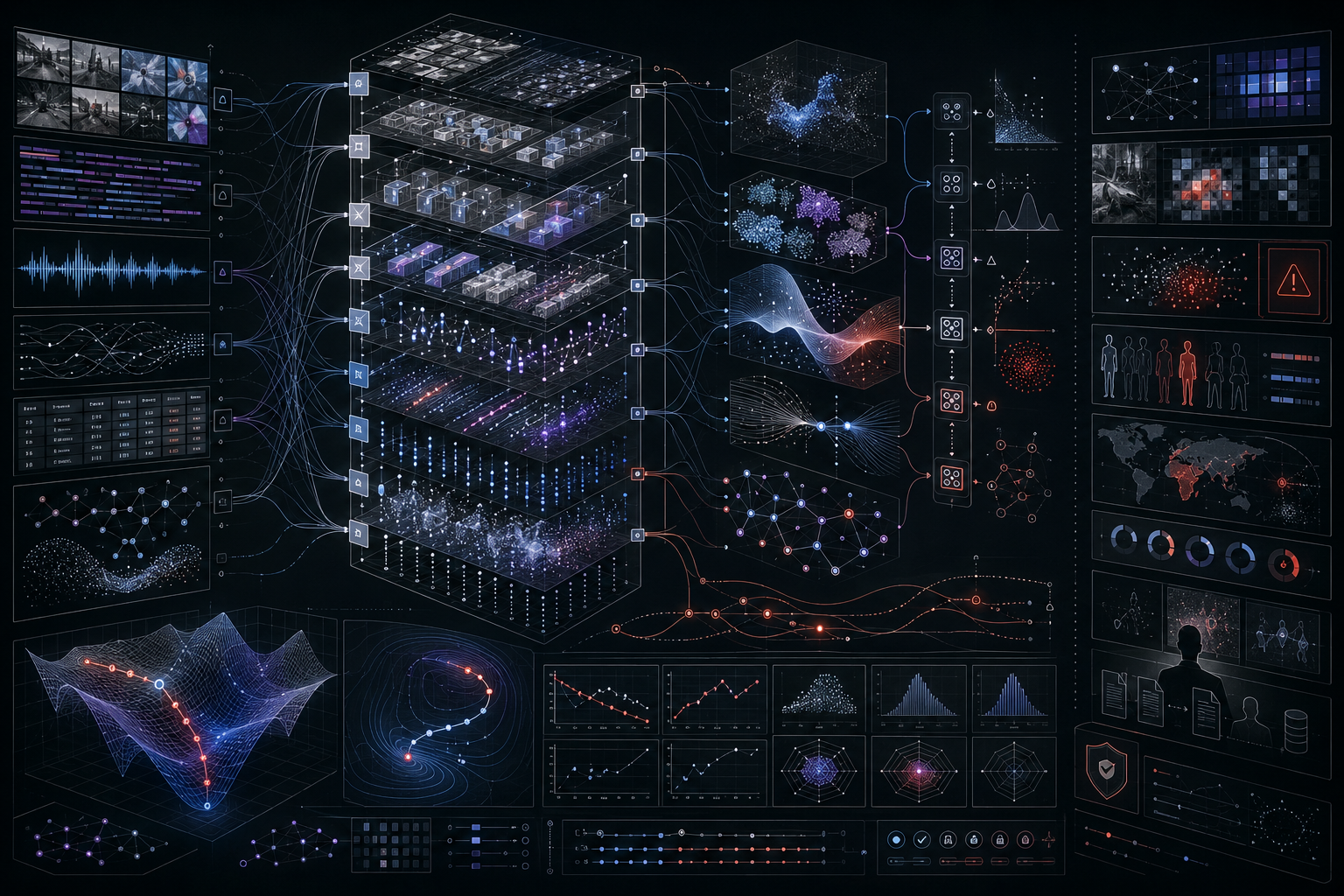
Pattern recognition is not simply the act of identifying a visible feature. In neural systems, pattern recognition emerges through layered transformations, learned weights, nonlinear activations, optimization objectives, architectural assumptions, and evaluation feedback. A network does not begin with explicit human-written rules for every pattern it may encounter. Instead, it learns statistical structure from examples. Early layers may detect local signals; intermediate layers may compose those signals into motifs; deeper layers may encode abstract features, classes, semantic relationships, or latent concepts. This layered construction is why neural networks have become central to computer vision, natural language processing, speech recognition, recommender systems, anomaly detection, scientific machine learning, and generative AI.
This article develops Neural Networks and Pattern Recognition as an advanced article within the Artificial Intelligence Systems knowledge series. It explains neural networks as function approximators, layered representation systems, optimization-driven models, pattern-recognition engines, and components of larger AI infrastructures. It covers activations, weights, biases, loss functions, backpropagation, gradient descent, representation geometry, inductive bias, generalization, overparameterization, double descent, interpretability, robustness, distribution shift, adversarial examples, and governance. Selected Python and R examples appear here, while the full GitHub repository contains expanded computational scaffolding for multilayer perceptrons, representation geometry, backpropagation intuition, neural-network diagnostics, grouped error analysis, SQL metadata, model-card notes, and advanced Jupyter notebooks.
Why Neural Networks Matter
Neural networks matter because they provide one of the most powerful general-purpose mechanisms for learning patterns from data. Earlier AI systems often required explicit rules, hand-designed features, domain-specific heuristics, and symbolic representations. Neural networks shifted much of the burden of feature discovery into the model itself. Instead of requiring engineers to specify every relevant feature, the system learns representations through training.
This shift transformed artificial intelligence. In computer vision, neural networks learn edges, textures, object parts, objects, and scenes. In natural language processing, they learn token embeddings, syntactic patterns, semantic relationships, contextual representations, and generative distributions. In speech recognition, they transform acoustic signals into phonetic, subword, and linguistic representations. In recommender systems, they learn latent patterns of preference and behavior. In scientific machine learning, they detect structure in high-dimensional biological, physical, chemical, and environmental data.
The significance of neural networks is therefore not simply that they can make predictions. It is that they create internal representational systems. These representations can support classification, generation, retrieval, anomaly detection, optimization, and decision support. But this power also creates challenges. Neural networks can be difficult to interpret, sensitive to distribution shift, vulnerable to adversarial perturbations, dependent on training data quality, and opaque in high-stakes institutional contexts. Their strengths and risks arise from the same source: they learn complex internal structure from data.
Pattern\ Recognition = Data + Representation + Objective + Evaluation
\]
Interpretation: Neural pattern recognition depends on the data used for learning, the representations created by the network, the objective being optimized, and the evaluation process used to judge performance.
| Use Context | Neural Capability | System Value | Governance Concern |
|---|---|---|---|
| Computer vision | Feature hierarchies, object recognition, detection, segmentation. | Supports medical imaging, robotics, inspection, accessibility, and environmental monitoring. | Domain shift, visual overconfidence, surveillance risk, subgroup error. |
| Language systems | Embeddings, contextual representation, sequence modeling, generation. | Supports search, summarization, translation, writing, and knowledge interfaces. | Hallucination, bias, source misrepresentation, authorship ambiguity. |
| Speech and audio systems | Acoustic feature learning and sequence recognition. | Supports transcription, accessibility, voice interfaces, and monitoring. | Unequal error rates across accents, languages, recording conditions, or environments. |
| Scientific machine learning | Pattern detection in biological, physical, chemical, and environmental data. | Supports discovery, simulation, prediction, and hypothesis generation. | Weak causal grounding, extrapolation error, and false confidence. |
| Decision support | Classification, ranking, scoring, anomaly detection, and forecasting. | Supports triage, allocation, monitoring, and operational intelligence. | Opaque patterns can affect rights, resources, access, or institutional decisions. |
Note: Neural networks become most consequential when their outputs are used as evidence, recommendation, classification, or automated action inside real systems.
Neural Networks as Function Approximators
At a fundamental level, a neural network defines a parameterized function:
f_\theta:X\rightarrow Y
\]
Interpretation: A neural network maps inputs from a domain \(X\) to outputs in a domain \(Y\), using learned parameters \(\theta\).
Given input \(x\), the network produces a prediction:
\hat{y}=f_\theta(x)
\]
Interpretation: The model produces output \(\hat{y}\) by applying the learned function \(f_\theta\) to input \(x\).
This places neural networks within the broader theory of function approximation and statistical learning. The network is trained to approximate an unknown relationship between inputs and outputs. That relationship may be a class label, a probability distribution, a continuous value, a sequence, an image, an action, or a latent representation.
Unlike linear models, neural networks introduce nonlinear transformations through activation functions. This allows them to approximate complex relationships that would be difficult or impossible to capture with a single linear mapping. The universal approximation theorem shows that sufficiently wide neural networks can approximate broad classes of functions under certain conditions. However, theoretical expressiveness does not guarantee practical success. A model must still be trainable, data must contain learnable structure, the objective must be meaningful, and evaluation must test generalization rather than memorization.
This distinction is essential. Neural networks do not “understand” in the human sense merely because they produce impressive outputs. They learn mappings from data. Their apparent intelligence emerges from the structure of those mappings, the representations created during training, and the contexts in which outputs are interpreted.
| Concept | Meaning | System Role | Risk if Misunderstood |
|---|---|---|---|
| Parameterized function | A mapping controlled by learned parameters. | Defines model behavior. | Outputs may appear intentional when they are fitted mappings. |
| Approximation | Model estimates an unknown relationship. | Supports prediction and pattern recognition. | Approximation may fail outside training conditions. |
| Nonlinearity | Activation functions create complex decision boundaries. | Allows flexible modeling of difficult patterns. | Complexity can reduce interpretability. |
| Training objective | Loss function defines what the model tries to reduce. | Guides parameter updates. | Objective may not match real-world purpose. |
| Generalization | Performance beyond the training data. | Determines practical usefulness. | Training success may not transfer to deployment. |
Note: Function approximation is powerful, but approximation should not be confused with explanation, causality, or institutional legitimacy.
Approximation \neq Understanding
\]
Interpretation: A neural network can approximate useful mappings without possessing human-like understanding, causal knowledge, or contextual judgment.
Layered Architecture and Representation Hierarchies
A neural network is composed of layers. Each layer transforms an input representation into a new representation. A simple fully connected layer can be written as:
h_{\ell+1}=\sigma(W_\ell h_\ell+b_\ell)
\]
Interpretation: Layer \(\ell\) applies weights \(W_\ell\), bias \(b_\ell\), and nonlinear activation \(\sigma\) to produce the next representation.
A deep network composes many such transformations:
f_\theta(x)
=
f_L\circ f_{L-1}\circ \cdots \circ f_1(x)
\]
Interpretation: A deep neural network builds complex mappings by composing multiple simpler transformations.
This compositional structure enables hierarchical representation learning. Early layers may capture simple features such as edges, frequencies, token co-occurrences, or local signal changes. Intermediate layers may combine these features into motifs, textures, phrases, object parts, acoustic patterns, or structural regularities. Deeper layers may encode abstract categories, semantic relationships, latent concepts, or task-specific decision boundaries.
The important point is that neural networks do not merely pass data through a pipeline. They progressively reshape the data. Each layer changes the geometry of the representation space. A pattern that is difficult to separate in raw input space may become easier to distinguish after several learned transformations. This is why neural networks are central to modern pattern recognition.
| Layer Level | Typical Structure Learned | Example Domain | System Concern |
|---|---|---|---|
| Input layer | Raw numerical representation of data. | Pixels, tokens, acoustic frames, features, sensor readings. | Input preprocessing can remove or distort important context. |
| Early hidden layers | Low-level local patterns. | Edges, local frequencies, lexical fragments, signal changes. | Artifacts may be learned as meaningful features. |
| Intermediate layers | Composed motifs and reusable features. | Textures, object parts, phrases, acoustic units, behavioral patterns. | Spurious correlations can become embedded in representation. |
| Deep layers | Abstract concepts or task-oriented structure. | Objects, categories, semantic relationships, risk scores. | High-level abstractions can hide uncertainty and bias. |
| Output layer | Task-specific prediction or distribution. | Class, score, token, ranking, action, or embedding. | Users may overtrust clean outputs from opaque internal processes. |
Note: Neural-network layers are best understood as transformations of representation, not as transparent symbolic reasoning steps.
Activation Functions and Nonlinear Representation
Activation functions make neural networks nonlinear. Without nonlinear activations, a stack of linear layers would collapse into a single linear transformation. Nonlinear activations allow networks to model curved decision boundaries, complex interactions, and compositional structure.
Common activation functions include sigmoid, hyperbolic tangent, rectified linear unit, GELU, and softmax. A rectified linear unit can be written as:
\mathrm{ReLU}(z)=\max(0,z)
\]
Interpretation: ReLU passes positive values forward and suppresses negative values, introducing nonlinearity into the network.
Softmax is often used to transform output scores into class probabilities:
\mathrm{softmax}(z_i)
=
\frac{e^{z_i}}{\sum_{j=1}^{C}e^{z_j}}
\]
Interpretation: Softmax converts raw class scores into probabilities that sum to one.
Activation functions affect optimization, expressiveness, gradient flow, and model behavior. A poor activation choice can make training unstable or inefficient. A strong activation function can help preserve useful gradients and support deeper architectures. In large neural systems, activations are part of the architecture’s inductive bias.
| Activation | Purpose | Strength | Potential Issue |
|---|---|---|---|
| Sigmoid | Squashes values into a bounded interval. | Useful for probabilities and gates. | Can saturate and weaken gradients. |
| Tanh | Maps values to a centered bounded range. | Useful in some recurrent and older architectures. | Can also suffer from saturation. |
| ReLU | Passes positive values and suppresses negative values. | Simple, efficient, and widely used. | Can produce inactive units under some training conditions. |
| GELU | Smooth nonlinear activation common in transformer systems. | Supports high-performance deep architectures. | Less intuitive than simpler activations. |
| Softmax | Converts scores into normalized probabilities. | Useful for classification and token prediction. | Probabilities may be poorly calibrated. |
Note: Activation functions shape representation, optimization, and probability interpretation. They are part of model design, not cosmetic implementation details.
Nonlinearity \Rightarrow Expressive\ Representation
\]
Interpretation: Nonlinear activations allow neural networks to model complex patterns that cannot be represented by stacked linear transformations alone.
Learning Dynamics: Loss, Gradients, and Backpropagation
Learning in neural networks is driven by optimization. A loss function measures the discrepancy between the model’s prediction and the target output:
\mathcal{L}(y,f_\theta(x))
\]
Interpretation: The loss function measures how far the model’s prediction is from the target.
Training usually minimizes empirical risk over a dataset:
\theta^*
=
\arg\min_\theta
\frac{1}{n}
\sum_{i=1}^{n}
\mathcal{L}(y_i,f_\theta(x_i))
\]
Interpretation: Training selects parameters that reduce average loss over observed examples.
Gradient descent updates parameters by moving against the gradient of the loss:
\theta_{t+1}
=
\theta_t
–
\eta\nabla_\theta\mathcal{L}(\theta_t)
\]
Interpretation: The learning rate \(\eta\) controls how far the model moves in the direction that reduces loss.
Backpropagation computes gradients efficiently using the chain rule. Because a neural network is a composition of functions, the derivative of the loss with respect to early parameters depends on the derivatives of later layers. Backpropagation propagates error information backward through the network so that each parameter can be updated.
This process is often presented mechanically: forward pass, loss computation, backward pass, parameter update. But the deeper interpretation is more important. Training is a trajectory through high-dimensional parameter space. The final model depends on architecture, initialization, data order, optimizer choice, learning rate, regularization, batch size, and stopping criteria. Neural networks are therefore not just trained; they are shaped by learning dynamics.
| Training Element | Function | Why It Matters | Governance Concern |
|---|---|---|---|
| Loss function | Defines what error means. | Directs learning toward a formal objective. | The objective may not match the real-world purpose. |
| Gradient | Indicates how parameters affect loss. | Enables efficient learning through optimization. | Gradient behavior can be unstable or hard to reproduce. |
| Backpropagation | Computes parameter gradients through layers. | Makes multilayer training practical. | Internal updates remain opaque to most users. |
| Optimizer | Controls parameter update rule. | Shapes training trajectory and convergence. | Different optimizers can produce different model behavior. |
| Stopping criteria | Defines when training ends. | Affects overfitting, cost, and performance. | Poor stopping can undertrain or overfit the model. |
Note: Training records should document loss, optimizer, learning rate, data split, seed, schedule, and evaluation evidence when neural-network behavior matters.
Training\ Path \Rightarrow Model\ Behavior
\]
Interpretation: The final neural network reflects not only data and architecture, but also the path taken through parameter space during optimization.
Pattern Recognition as Learned Representation
Pattern recognition is the process of identifying structure in data. In neural networks, this structure is not usually encoded as explicit rules. It is learned through representation. A model trained on images may learn visual patterns. A model trained on language may learn grammatical, semantic, and contextual patterns. A model trained on time series may learn periodicity, anomaly signatures, or regime changes.
A classifier can be written as:
\hat{y}
=
\arg\max_c P_\theta(y=c\mid x)
\]
Interpretation: Pattern recognition often involves selecting the class with the highest predicted probability for input \(x\).
The key point is that the model’s ability to recognize a pattern depends on how it represents the input. A raw input may be noisy, high-dimensional, and difficult to separate. A learned representation may make relevant differences more visible. Pattern recognition therefore depends on representation geometry.
This is why neural networks often outperform hand-engineered systems in domains where explicit rules are difficult to define. They can learn statistical structure from examples. However, they may also learn spurious patterns, dataset artifacts, or biased correlations. Pattern recognition is powerful, but not automatically reliable.
| Pattern Type | How Neural Networks Learn It | Example | Failure Risk |
|---|---|---|---|
| Visual pattern | Hierarchical image features across layers. | Edges, textures, object parts, objects, scenes. | Model learns background shortcuts or visual artifacts. |
| Linguistic pattern | Token embeddings and contextual representations. | Syntax, semantic association, discourse context. | Model learns stereotype, style, or plausibility instead of truth. |
| Temporal pattern | Sequence representations and recurrence or attention. | Trend, periodicity, anomaly, event sequence. | Model fails when regimes shift over time. |
| Behavioral pattern | Latent representation of user or system behavior. | Recommendation, fraud detection, demand prediction. | Model reinforces feedback loops or proxies. |
| Scientific pattern | Representation of biological, physical, chemical, or environmental structure. | Protein motifs, materials properties, climate signals. | Correlation is mistaken for causal or mechanistic explanation. |
Note: Neural networks recognize patterns through learned representation. The quality of recognition depends on what structure the model actually learned.
Recognized\ Pattern \neq Causal\ Explanation
\]
Interpretation: A neural network may detect a predictive pattern without identifying the causal mechanism behind it.
Representation Learning and Latent Space Geometry
One of the most important ways to understand neural networks is geometrically. A network maps raw inputs into latent spaces where meaningful structure may become more organized. Similar examples may cluster together. Decision boundaries may become simpler. Semantic relationships may appear as distances, directions, or neighborhoods.
A learned representation can be written as:
z=f_{\theta}^{\mathrm{enc}}(x)
\]
Interpretation: An encoder maps input \(x\) into latent representation \(z\).
Similarity in representation space is often measured with cosine similarity:
\mathrm{sim}(u,v)
=
\frac{u\cdot v}{\|u\|\|v\|}
\]
Interpretation: Cosine similarity measures angular closeness between two representation vectors.
This geometric view connects neural networks to embeddings, manifolds, clustering, retrieval, anomaly detection, and metric learning. In language systems, embeddings can encode semantic similarity. In vision systems, latent representations can organize objects by visual or conceptual structure. In biological models, representations may capture sequence or molecular relationships.
But representation geometry must be interpreted carefully. A cluster in latent space does not automatically correspond to a meaningful real-world category. A direction in embedding space does not automatically imply causal meaning. Learned representations are useful but also shaped by training data, objectives, architecture, and preprocessing.
| Geometric Concept | Meaning | Use | Interpretive Caution |
|---|---|---|---|
| Embedding | Vector representation of an input. | Search, retrieval, clustering, classification. | Embedding similarity may reflect shallow association or bias. |
| Cluster | Group of nearby representations. | Segmentation, anomaly review, exploratory analysis. | Clusters may not be natural or meaningful categories. |
| Decision boundary | Surface separating predicted classes. | Classification and pattern recognition. | Boundary may be brittle under shift or perturbation. |
| Latent direction | Vector direction associated with variation. | Representation editing, interpretation, probing. | Direction may not map cleanly to causal meaning. |
| Neighborhood | Local region around an embedding. | Nearest-neighbor retrieval and similarity search. | Local similarity can hide missing context or source quality. |
Note: Latent space is useful for analysis, but representation geometry requires domain interpretation and evaluation.
Embedding\ Similarity \neq Semantic\ Truth
\]
Interpretation: Two representations may be geometrically close without being equivalent in meaning, evidence, context, or consequence.
Inductive Bias and Architectural Design
Neural networks do not learn from data alone. Their behavior is shaped by inductive bias: the assumptions built into architecture, training procedure, and data representation. These biases make learning possible by constraining the space of functions the model is likely to learn.
Examples include:
- Convolutional neural networks: assume local spatial structure and translation-related patterns.
- Recurrent neural networks: assume sequential dependency and temporal order.
- Transformers: model global relationships through attention over tokens, patches, frames, or modalities.
- Graph neural networks: assume relational structure among nodes and edges.
- Autoencoders: assume useful structure can be compressed and reconstructed.
A convolutional layer can be written as:
h_{\ell+1}=\sigma(W_\ell * h_\ell+b_\ell)
\]
Interpretation: A convolutional layer applies learned local filters across positions, encoding spatial inductive bias.
Attention can be written as:
\mathrm{Attention}(Q,K,V)
=
\mathrm{softmax}
\left(
\frac{QK^T}{\sqrt{d_k}}
\right)V
\]
Interpretation: Attention allows elements of a sequence or representation to dynamically relate to one another.
Neural networks succeed not because they are entirely general, but because their architectures encode assumptions that fit certain kinds of data. Architecture is therefore a form of theory. It expresses beliefs about structure: locality, sequence, hierarchy, relation, compression, or global dependency.
| Architecture | Inductive Bias | Useful For | Risk |
|---|---|---|---|
| Fully connected networks | Flexible dense interaction among features. | Tabular, synthetic, or general nonlinear mapping tasks. | Weak structure assumptions may require more data. |
| Convolutional networks | Locality and translation-related structure. | Images, spatial grids, signals, some scientific data. | May underrepresent long-range context without added mechanisms. |
| Recurrent networks | Sequential order and temporal dependency. | Time series, speech, language, sequence modeling. | Long-range dependency can be hard to preserve. |
| Transformers | Relational attention across tokens or patches. | Language, vision, code, multimodal data, long-context tasks. | Requires data, compute, positional design, and careful evaluation. |
| Graph neural networks | Node-edge relational structure. | Molecules, networks, infrastructure, knowledge graphs. | Graph construction choices can dominate results. |
Note: Architecture is not neutral. It encodes assumptions about what structure the model should find easy to learn.
Generalization, Overparameterization, and Double Descent
Generalization is the ability of a model to perform well on data it did not see during training. A model that memorizes training examples but fails on new cases has not learned a useful pattern. A model that captures durable structure can generalize.
A generalization gap can be written as:
\mathrm{Gap}
=
R_{\mathrm{test}}(\theta)
–
R_{\mathrm{train}}(\theta)
\]
Interpretation: The generalization gap compares test risk with training risk.
Modern neural networks complicate classical assumptions about generalization. Many neural networks are overparameterized, meaning they contain more parameters than might seem necessary. Classical intuition suggests that such models should overfit. Yet deep neural networks often generalize well, especially when architecture, optimization, data scale, regularization, and implicit bias align.
Double descent describes a modern pattern in which test error can initially worsen as model capacity increases, then improve again after the interpolation threshold. This challenges the simple view that larger models always overfit after a certain point. It does not mean overfitting is impossible. It means generalization depends on more than parameter count alone.
Neural-network generalization remains an active area of research. It depends on data structure, optimization dynamics, representation geometry, architectural bias, regularization, scaling, and evaluation design. For practical AI systems, the lesson is straightforward: training performance is never enough. Generalization must be evaluated directly.
| Concept | Meaning | Development Signal | Governance Concern |
|---|---|---|---|
| Training fit | How well the model performs on training data. | Training loss or accuracy. | Strong training fit can hide memorization. |
| Held-out performance | How well the model performs on unseen evaluation data. | Validation and test metrics. | Test design may not reflect deployment context. |
| Overparameterization | Model has many more parameters than simple theory might require. | High capacity and flexible representation. | Can create opacity, memorization, and weak interpretability. |
| Double descent | Non-monotonic relationship between capacity and test error. | Risk curve changes across interpolation threshold. | Capacity cannot be interpreted through old bias-variance intuition alone. |
| Distribution transfer | Performance under new settings or shifted environments. | External validation, stress tests, drift monitoring. | Benchmark generalization may not equal deployment reliability. |
Note: Neural-network generalization is an empirical claim. It requires evidence from held-out testing, external validation, robustness checks, subgroup diagnostics, and monitoring.
Training\ Accuracy \neq Generalization
\]
Interpretation: A model that performs well on training data may still fail on new cases, shifted environments, rare examples, or underrepresented groups.
Interpretability, Feature Attribution, and Explanation Limits
Neural networks are often difficult to interpret because their internal representations are distributed across many parameters and layers. Unlike rule-based systems, they do not usually provide a simple chain of symbolic reasoning. This creates challenges for explanation, accountability, debugging, safety, and trust.
Interpretability methods attempt to make neural networks more understandable. These include feature attribution, saliency maps, activation analysis, representation probing, concept activation vectors, counterfactual examples, attention analysis, mechanistic interpretability, and surrogate models. Each method reveals something, but none provides a complete explanation in all settings.
A local explanation can be abstractly represented as:
E(x,f_\theta)
\approx
\text{local behavior of } f_\theta \text{ near } x
\]
Interpretation: Interpretability methods often approximate how a model behaves around a particular input rather than fully explaining the entire system.
This distinction matters. An explanation method may be useful without being complete. A saliency map may highlight sensitive pixels without proving causal reasoning. An attention pattern may show relational weights without fully explaining a model’s decision. A surrogate model may approximate behavior locally while missing global complexity.
Interpretability is therefore part of governance, but it is not a substitute for evaluation. A responsible neural-network system requires both explanation tools and empirical testing.
| Method | What It Shows | Useful For | Limit |
|---|---|---|---|
| Feature attribution | Inputs associated with output sensitivity. | Debugging, review, model explanation. | Attribution may not prove causality. |
| Saliency maps | Image or signal regions influencing output. | Computer vision review. | Can be unstable or visually misleading. |
| Representation probing | What information is present in hidden states. | Understanding learned features. | Presence of information does not prove model use. |
| Counterfactual examples | How output changes when input changes. | Boundary testing and recourse analysis. | Counterfactuals may be unrealistic or incomplete. |
| Surrogate models | Simpler approximation of model behavior. | Local explanation and communication. | Approximation may fail globally. |
Note: Interpretability methods should be used as evidence aids, not as proof that a model is reliable, fair, causal, or safe.
Explanation\ Tool \neq Accountability
\]
Interpretation: Explanation tools can support review, but accountability also requires evaluation, documentation, monitoring, contestability, and human responsibility.
Failure Modes, Distribution Shift, and Adversarial Inputs
Neural networks can fail in ways that are difficult to anticipate. They may rely on spurious correlations, perform poorly under distribution shift, misclassify rare cases, overfit benchmark artifacts, or produce overconfident predictions. They may also be vulnerable to adversarial perturbations: small input changes that alter model behavior.
Distribution shift can be written as:
\Delta
=
d(P_{\mathrm{train}},P_{\mathrm{deploy}})
\]
Interpretation: Deployment risk increases when the deployment distribution differs from the training distribution.
An adversarial perturbation can be written as:
x’=x+\delta,
\qquad
\|\delta\|\leq\epsilon
\]
Interpretation: A small perturbation \(\delta\) can sometimes change model predictions even when the input appears similar to humans.
These failure modes show why neural networks should not be evaluated only on average accuracy. Robustness, calibration, subgroup performance, out-of-distribution testing, stress testing, and monitoring matter. A model that performs well in a benchmark may fail in deployment if the environment changes.
| Failure Mode | Description | Example | Mitigation |
|---|---|---|---|
| Shortcut learning | Model relies on spurious predictive cues. | Image model uses background instead of object; clinical model uses hospital artifact. | Counterfactual testing, dataset review, stress tests. |
| Distribution shift | Deployment data differs from training data. | Model fails in new region, device, hospital, dialect, or time period. | External validation, drift monitoring, domain adaptation. |
| Adversarial vulnerability | Small perturbations change output. | Image, prompt, audio, or sensor perturbation alters prediction. | Threat modeling, robust training, uncertainty checks. |
| Overconfident error | Model assigns high confidence to wrong output. | High-confidence classification under ambiguity or shift. | Calibration, abstention, escalation workflows. |
| Subgroup failure | Error rates vary across people, places, conditions, or devices. | Speech, vision, or text model performs unevenly across groups. | Grouped diagnostics and inclusive evaluation. |
| Benchmark overfitting | Model performs well on benchmark but poorly in realistic use. | Public leaderboard success fails in field deployment. | External validation, scenario testing, deployment monitoring. |
Note: Neural-network failures become especially serious when high-confidence outputs are used in consequential decisions without review or contestability.
Accuracy \neq Robustness
\]
Interpretation: A model can be accurate on average while remaining fragile under shift, stress, rare cases, adversarial input, or underrepresented conditions.
Neural Networks in Complex AI Systems
Neural networks rarely operate alone. They are embedded within larger systems that include data pipelines, preprocessing, feature stores, training infrastructure, model serving layers, user interfaces, monitoring dashboards, feedback loops, human review processes, and governance controls.
A deployed neural-network system can be represented as:
S_{\mathrm{NN}}
=
(D,A,\Theta,O,E,G)
\]
Interpretation: A neural-network system includes data \(D\), architecture \(A\), parameters \(\Theta\), optimization \(O\), environment \(E\), and governance \(G\).
Once deployed, neural networks may influence the environments that generate future data. A recommendation model changes user behavior. A fraud model changes adversary behavior. A language model changes how people write. A medical decision-support model changes clinical workflow. A perception system changes how autonomous agents act.
These feedback loops make neural networks components of adaptive systems. Their behavior cannot be fully understood by looking only at architecture or training loss. Deployment context matters. Monitoring matters. Governance matters.
| System Layer | Function | Why It Matters | Failure Mode |
|---|---|---|---|
| Data pipeline | Collects, labels, filters, and versions training data. | Defines the evidence base. | Data errors become model behavior. |
| Architecture layer | Defines representational structure. | Shapes what patterns the model can learn efficiently. | Architecture assumptions may not match the domain. |
| Training layer | Optimizes parameters using data and loss. | Creates the learned model. | Training choices are undocumented or unreproducible. |
| Inference layer | Serves predictions, scores, rankings, or generated outputs. | Connects model behavior to users and workflows. | Outputs may be used outside validated scope. |
| Monitoring layer | Tracks drift, errors, incidents, and performance. | Maintains reliability after deployment. | Model degradation remains invisible. |
| Governance layer | Documents responsibility, review, limits, and correction. | Supports accountability and contestability. | Responsibility diffuses behind technical complexity. |
Note: A neural network should be evaluated as part of a full system, not as a detached model artifact.
Governance, Accountability, and Responsible Deployment
The opacity and power of neural networks raise governance questions. What data shaped the model? What labels defined the target? What objective was optimized? How does the model perform across groups, conditions, and environments? What are the known failure modes? Can users contest or correct outputs? How is performance monitored after deployment? What human oversight is required?
These questions are especially important in high-stakes settings: health care, finance, employment, education, criminal justice, infrastructure, public administration, and scientific decision support. In such domains, model performance must be interpreted through risk, consequence, and accountability.
Neural-network governance requires documentation across the full lifecycle: data provenance, model architecture, training runs, evaluation results, calibration, robustness tests, subgroup diagnostics, monitoring, incident response, and update history. The goal is not to make every neural network perfectly transparent. The goal is to make system behavior testable, documented, contestable, and accountable.
| Governance Area | Question | Evidence Needed | Risk if Ignored |
|---|---|---|---|
| Data provenance | What data and labels shaped the model? | Dataset documentation, label rules, source records, lineage. | Hidden bias or measurement error becomes model behavior. |
| Objective alignment | What loss or reward was optimized? | Loss function, metric rationale, threshold policy. | Model optimizes a proxy instead of the real purpose. |
| Evaluation coverage | Where was model behavior tested? | Held-out tests, external validation, stress tests, subgroup reports. | Performance claims are too narrow. |
| Interpretability | Can behavior be inspected or challenged? | Attribution, counterfactuals, representation probes, review notes. | Users cannot understand or contest consequential outputs. |
| Monitoring | Does performance remain valid after deployment? | Drift reports, calibration checks, incident logs, retraining records. | Model degradation remains invisible. |
| Accountability | Who is responsible for use and correction? | Approval records, model cards, risk registers, escalation paths. | Responsibility diffuses behind model complexity. |
Note: Responsible neural-network deployment requires auditable evidence, not only model performance claims.
Current assurance work reinforces this lifecycle view. NIST’s AI test, evaluation, validation, and verification program develops measurements for accuracy, robustness, bias, interpretability, transparency, privacy, reliability, safety, and security. NIST AI 800-3, published in 2026, formalizes evaluation assumptions and measurement targets using statistical models. Current PyTorch 2.13 documentation also reflects the implementation importance of initialization, modules, normalization, attention, and transformer components.
Neural\ Prediction + Institutional\ Use \Rightarrow Institutional\ Responsibility
\]
Interpretation: When institutions use neural-network outputs in real decisions, responsibility remains with the institution, not with the model alone.
The Modern Neural-Architecture Landscape
Neural networks are not one architecture. They are a family of representation systems whose structure encodes assumptions about locality, sequence, relation, hierarchy, invariance, memory, and computation. Fully connected networks remain useful for small tabular and synthetic problems. Convolutional networks exploit spatial locality and weight sharing. Recurrent and state-space models represent ordered signals. Transformers use attention to construct context-dependent interactions. Graph neural networks propagate information through relational structure. Autoencoders and diffusion models learn latent or generative representations. Mixture-of-experts systems route examples or tokens through specialized subnetworks.
Architecture choice is an evidentiary decision because it determines what patterns are easy to learn and which failure modes are likely. A convolutional architecture may privilege textures over global shape. A transformer may learn broad contextual dependencies while remaining sensitive to tokenization, position, prompt framing, and context composition. A graph model may inherit errors from the graph construction process.
| Architecture family | Primary inductive bias | Typical use | Validation concern |
|---|---|---|---|
| Multilayer perceptron | Dense nonlinear interaction. | Tabular data and compact function approximation. | Scaling, feature leakage, and weak structural assumptions. |
| Convolutional network | Locality and weight sharing. | Images, grids, audio, and signals. | Texture shortcuts, resolution shift, and sensor artifacts. |
| Transformer | Content-dependent global interaction. | Language, vision, code, multimodal, and long-context tasks. | Context sensitivity, positional assumptions, contamination, and compute. |
| Graph neural network | Message passing over relations. | Molecules, infrastructure, networks, and knowledge graphs. | Graph construction, oversmoothing, topology shift, and leakage. |
| Generative latent model | Compressed or iterative representation of a data distribution. | Generation, denoising, simulation, and anomaly detection. | Memorization, mode failure, latent ambiguity, and evaluation gaps. |
No architecture is universally superior. The responsible design question is whether the architecture’s assumptions, resource demands, and failure modes match the intended task and environment.
Initialization, Normalization, and Gradient Flow
Training begins before the first gradient update. Parameter initialization determines the scale and symmetry of signals entering each layer. Poor initialization can cause activations and gradients to vanish, explode, saturate, or become identical across units. Initialization methods therefore account for fan-in, fan-out, and activation properties.
Normalization changes the geometry and conditioning of optimization. Batch normalization uses batch statistics, layer normalization uses feature statistics within an example, and other methods normalize weights, groups, or activations. Normalization can stabilize training, support larger learning rates, and reduce sensitivity to initialization, but it also introduces assumptions about batch composition, deployment mode, and numerical behavior.
Var(W_{ij})\propto \frac{1}{fan\_in}
\]
Interpretation: Variance-aware initialization scales parameters to preserve useful signal magnitude across layers.
Gradient-flow diagnostics include activation distributions, gradient norms, dead units, saturation, update-to-weight ratios, and layerwise sensitivity. A loss curve can decline while early layers receive weak gradients or a few layers dominate learning.
Training and inference normalization must remain consistent. Batch-statistic mismatch, small serving batches, precision changes, or stale running statistics can degrade a model that appeared stable in development.
Residual Connections, Attention, and Information Paths
Deep networks must preserve and transform information across many operations. Residual connections create direct paths that allow a layer to learn a modification to an existing representation rather than reconstructing the entire mapping. This can improve gradient flow and make very deep networks trainable.
h_{\ell+1}=h_\ell+F_\ell(h_\ell)
\]
Interpretation: A residual block adds a learned transformation to the current representation.
Attention creates dynamic information paths. Queries select from keys and aggregate values, allowing representations to depend on other tokens, patches, nodes, or modalities. Multi-head attention learns several relation subspaces, but the resulting weights are not automatically faithful explanations of the final decision.
Information-path analysis asks which components, tokens, layers, heads, residual streams, and tools materially affect an output. Ablation, activation patching, causal tracing, and controlled interventions can test contribution more directly than visual inspection alone.
Residual and attention architectures can also create correlated failure. A misleading feature or prompt token can propagate globally, while a shared residual stream can mix useful and harmful representations. Architecture diagrams should therefore be connected to empirical interventions.
Optimization Landscapes, Learning Rates, and Training Pathologies
Neural training is a path-dependent search through a high-dimensional, nonconvex parameter space. Stochastic gradient descent and adaptive optimizers use noisy local information to choose updates. The final solution depends on initialization, sample order, optimizer state, precision, regularization, data curriculum, and stopping criteria.
Learning-rate schedules can determine whether a model escapes unstable regions, converges smoothly, or destroys useful representations. Warm-up, decay, cosine schedules, restarts, gradient clipping, momentum, and adaptive preconditioning each alter the path.
Training pathologies include exploding or vanishing gradients, loss spikes, collapse, unstable normalization, catastrophic forgetting, dead activations, sharp sensitivity to seeds, and validation degradation after continued optimization. Large-scale systems may exhibit numerical overflow, distributed desynchronization, stale gradients, or optimizer-state corruption.
UpdateRatio_\ell=\frac{\|\Delta W_\ell\|}{\|W_\ell\|+\epsilon}
\]
Interpretation: The update-to-weight ratio helps reveal layers that are barely learning or changing too aggressively.
Training governance should preserve curves, checkpoints, optimizer state, seeds, hardware, precision, data order, and exceptions. Reproducing the architecture without reproducing the training path may produce materially different behavior.
Regularization, Implicit Bias, and Capacity Control
Regularization shapes which solutions are preferred among many that fit the data. Explicit techniques include weight decay, dropout, data augmentation, label smoothing, early stopping, sparsity penalties, margin objectives, and consistency losses. Architectural constraints and optimizer dynamics create implicit regularization even when no penalty appears in the loss.
Dropout trains subnetworks under random masking, encouraging distributed representations. Weight decay discourages large parameter norms. Data augmentation encodes invariances by presenting transformed examples. Early stopping limits adaptation to the training sample. Each technique assumes that the imposed constraint is compatible with the task.
Regularization can also conceal underfitting or unequal performance. Aggressive augmentation may alter label meaning. Label smoothing can weaken calibration interpretation. Weight decay can suppress rare but important features. Early stopping based on aggregate loss can freeze subgroup failure.
Capacity should be evaluated through behavior rather than parameter count alone. Effective rank, margins, representation compression, interpolation, stability, and sensitivity can provide additional evidence. A large model may generalize well while a smaller model memorizes shortcuts.
Regularization is therefore not a generic safeguard. It is an intervention whose assumptions and distributional consequences require validation.
Shortcut Learning, Spurious Correlation, and Counterfactual Data
Shortcut learning occurs when a network uses a predictive cue that performs well in the development environment but does not represent the intended structure. Background, watermark, scanner type, hospital identifier, writing style, metadata, annotation artifact, or historical policy can become easier to learn than the target concept.
A shortcut is often invisible in aggregate benchmark performance because the cue is present in both training and test data. External validation, counterfactual editing, environment variation, subgroup analysis, and representation probing are needed to expose it.
P(Y\mid Shortcut)_{train}\neq P(Y\mid Shortcut)_{deploy}
\]
Interpretation: A shortcut fails when its training association does not persist in deployment.
Counterfactual datasets alter the suspected shortcut while preserving the intended label. Background-swapped images, style-controlled text, metadata removal, site-held-out testing, and simulated sensor changes can reveal dependence. The intervention must remain realistic; an unnatural edit may test artifact sensitivity rather than meaningful robustness.
Mitigation can involve data redesign, stratified sampling, environment-aware objectives, feature removal, adversarial training, concept supervision, causal reasoning, or restricting use. Removing one shortcut does not prove that the network learned the intended mechanism.
Representation Diagnostics, Probes, and Geometry Audits
Representation diagnostics examine what information is encoded in hidden states and how examples are organized. Linear probes test whether a property can be decoded from a representation. Clustering, neighborhood analysis, centered-kernel alignment, representational similarity, effective rank, and class-separation measures characterize geometry.
A successful probe shows that information is available to the probe, not that the original network uses it causally. Probe capacity, dataset size, regularization, and control tasks matter. A powerful probe can learn a property that was not readily accessible to the network’s downstream layers.
Geometry audits should examine class, subgroup, site, nuisance, and uncertainty structure. If a protected attribute or acquisition site forms a strong latent direction, the model may rely on it directly or indirectly. If out-of-distribution examples fall inside dense in-domain regions, distance-based detection may fail.
Representation drift can be monitored after deployment, but a changing latent distribution is not automatically harmful. Drift should be linked to task performance, data provenance, calibration, and incidents.
Hidden representations are evidence objects. Their interpretation should combine quantitative diagnostics, controlled interventions, domain expertise, and known limits.
Interpretability Taxonomy, Concepts, and Mechanistic Analysis
Interpretability methods answer different questions. Feature attribution estimates sensitivity or contribution of inputs. Example-based methods identify influential or similar cases. Concept methods connect predictions to human-defined abstractions. Representation probes test encoded information. Mechanistic methods attempt to identify computational circuits and causal pathways inside the network.
Concept bottleneck models insert a human-interpretable concept layer between input and prediction. They can support interventions when a reviewer corrects a concept, but the concepts themselves can be incomplete, correlated, mislabeled, or bypassed through residual information. Recent work continues to develop intervenable, editable, probabilistic, and data-efficient concept systems.
Mechanistic interpretability uses ablation, activation patching, causal tracing, sparse representations, and circuit analysis. These methods can reveal useful structure, but claims should remain proportional to the fraction of behavior explained and the stability of the mechanism across inputs.
| Method family | Question | Limit |
|---|---|---|
| Attribution | Which inputs affect this output? | Sensitivity may be unstable or noncausal. |
| Concept-based | Which human concepts mediate prediction? | Concept vocabulary may be incomplete or bypassed. |
| Example-based | Which cases resemble or influenced this result? | Similarity may reflect nuisance structure. |
| Mechanistic | Which internal components implement behavior? | Coverage and scalability remain limited. |
Interpretability evidence should be validated for faithfulness, stability, completeness, usability, and decision value. A persuasive visualization is not sufficient.
Uncertainty, Calibration, and Abstention in Neural Systems
Softmax output is not a complete uncertainty estimate. Neural networks can assign high probability to incorrect, ambiguous, or unfamiliar inputs. Calibration evaluates the relationship between probability and empirical correctness, while uncertainty methods attempt to represent data noise, model uncertainty, ensemble disagreement, or distribution novelty.
Approaches include temperature scaling, ensembles, Bayesian approximations, Monte Carlo dropout, evidential methods, conformal prediction, and density or distance signals. Each captures different assumptions and can fail under shift.
RiskCoverage(\tau)=E[Loss\mid Confidence\geq \tau]
\]
Interpretation: Selective prediction evaluates error among cases retained above a confidence threshold.
Abstention should route a case to more evidence, a validated fallback, human review, or service refusal. The system must measure who is rejected, how long review takes, and whether uncertainty burdens particular groups.
Calibration should be tested by subgroup, site, time, severity, and shift condition. Recalibration can align probabilities without improving representation quality or discrimination. A neural system is uncertainty-aware only when uncertainty changes operation.
Adversarial Robustness, Threat Models, and Certified Bounds
Adversarial robustness depends on a threat model: what an attacker can observe, modify, query, or control; what perturbations are allowed; and what success means. Small norm-bounded image perturbations are one threat model, not a universal definition of adversarial behavior.
Threats can target inputs, prompts, training data, labels, model weights, retrieval indexes, tools, interfaces, or decision workflows. Physical attacks must survive sensing and environmental variation. Language attacks can exploit instruction hierarchy, context, encoding, or tool access rather than continuous vector norms.
Adversarial training can improve robustness within a specified perturbation set while reducing clean accuracy or failing outside that set. Randomized smoothing and formal verification can provide certified guarantees under narrow assumptions and bounded regions.
\forall \delta\in\Delta,\quad f(x+\delta)=f(x)
\]
Interpretation: A robustness claim states that model behavior remains stable for every perturbation in a defined set \(\Delta\).
Robustness evidence should identify the threat model, attack budget, adaptive attacker, implementation, restarts, transfer tests, and limitations. Passing one attack is not proof of security.
Out-of-Distribution Detection and Open-World Recognition
Closed-set classification assumes every input belongs to a known class. Real systems encounter new classes, corrupted data, unfamiliar environments, unsupported languages, novel devices, and nonsensical inputs. Open-world recognition requires detecting or safely handling this novelty.
Out-of-distribution methods use confidence, energy scores, ensembles, density estimates, distances, reconstruction error, or learned detectors. A method that separates one synthetic outlier dataset may fail on semantically near novelty. Likelihood can be high for unfamiliar examples when models focus on low-level statistics.
Evaluation should distinguish near-OOD, far-OOD, covariate shift, label shift, concept drift, and adversarial novelty. The negative datasets should be representative of realistic deployment boundaries rather than convenient benchmarks alone.
OOD detection should connect to the action policy. A high novelty signal may trigger abstention, quarantine, source review, or a specialized model. False alarms can overload review and create unequal service.
No scalar score establishes that an input is safe. Open-world operation requires layered evidence, bounded scope, and monitoring for forms of novelty the detector was not designed to recognize.
Multimodal Foundation Models and Representation Alignment
Multimodal models align text, images, audio, video, sensor streams, actions, or structured data in shared or interacting representation spaces. Contrastive learning can bring paired modalities closer while separating unrelated examples. Generative objectives can reconstruct or predict one modality from another.
Alignment in latent space does not guarantee alignment in meaning, truth, or social interpretation. Paired web data can contain weak captions, stereotypes, missing context, copyright restrictions, and uneven cultural coverage. A model may associate modalities through superficial co-occurrence.
Cross-modal evaluation should test retrieval, grounding, temporal consistency, compositionality, ambiguity, missing modalities, conflicting evidence, and subgroup performance. A model that names objects correctly may still misinterpret relationships or provenance.
Foundation models also create reuse risk. A representation trained for broad transfer can be deployed in tasks with different consequences and data rights. Fine-tuning, adapters, prompts, and retrieval change behavior without erasing base-model limitations.
Governed multimodal systems should preserve source lineage, modality-specific quality, alignment objectives, safety filters, evaluation tasks, and the exact configuration used for deployment.
Graph, Scientific, and Physics-Informed Neural Networks
Graph neural networks learn from entities and relations. Message passing aggregates neighboring information, making graph construction part of the model. Missing edges, false relations, direction, temporal order, and sampling can dominate performance. Repeated aggregation can oversmooth representations until nodes become difficult to distinguish.
Scientific neural networks can learn surrogate models, operators, differential-equation solutions, molecular properties, and latent physical structure. Physics-informed objectives add residuals, conservation laws, boundary conditions, symmetries, or mechanistic constraints.
\mathcal{L}_{total}=\mathcal{L}_{data}+\lambda\mathcal{L}_{physics}
\]
Interpretation: A scientific model can combine empirical fit with penalties for violating known structure.
Physical constraints improve plausibility only when the equations, parameters, and boundary conditions are appropriate. An incorrect mechanism can make a model confidently wrong. Scientific evaluation should include extrapolation, dimensional consistency, conservation, uncertainty, sensitivity, and comparison with mechanistic baselines.
Mechanistic neural networks and neural operators illustrate efforts to learn structured dynamics rather than correlations alone. Their scientific value depends on whether the learned representation supports reliable prediction, interpretation, and discovery outside the calibration range.
Compression, Quantization, Distillation, and Edge Deployment
Deployment constraints can require smaller, faster, and lower-power models. Pruning removes parameters or structures. Quantization reduces numerical precision. Knowledge distillation trains a compact student to reproduce a larger teacher. Low-rank methods compress matrices, while early-exit architectures adapt computation to case difficulty.
Compression changes behavior. Quantization error can affect rare classes, calibration, numerical stability, and adversarial sensitivity. Distillation can transfer the teacher’s bias and overconfidence. Unstructured pruning may reduce parameter count without producing real hardware speedup.
Edge deployment introduces sensor variation, intermittent connectivity, thermal throttling, memory limits, battery constraints, model-update risk, and physical security. The deployed binary, preprocessing, runtime, and hardware should be validated together.
CompressionUtility=\frac{Quality\times Robustness}{Latency\times Energy\times Memory}
\]
Interpretation: Compression should be evaluated across quality, robustness, resource use, and actual hardware behavior.
A compact model is not automatically more sustainable or accessible if it enables much higher total demand or requires frequent hardware replacement. Absolute workload and lifecycle impact remain relevant.
Privacy, Memorization, and Model Extraction
Neural networks can memorize training examples, rare strings, faces, records, code, or copyrighted material. Memorization risk depends on duplication, rarity, model capacity, training duration, objective, access, and extraction strategy. Strong generalization does not imply absence of memorization.
Privacy attacks include membership inference, attribute inference, model inversion, prompt extraction, data reconstruction, and gradient leakage. Model-extraction attacks approximate functionality through queries, potentially transferring private behavior or intellectual property.
Differential privacy can bound the influence of individual records under stated parameters, but privacy budgets, clipping, accounting, utility, and group effects require interpretation. Data minimization, deduplication, access control, redaction, secure training, output filtering, rate limits, and monitoring provide additional layers.
Privacy testing should use realistic attackers and sensitive canaries. A failure to extract data with one method is not proof that memorization is absent. Models and checkpoints should be classified and protected as data-bearing artifacts.
Deletion is difficult after training. Organizations should document whether a record affected a model, whether unlearning or retraining is required, and which residual risks remain.
Data Curation, Labels, and Governance of Neural Representations
Neural representations reflect the data and objectives that produced them. Dataset governance should record source, collection, sampling, deduplication, filtering, labeling, consent, license, geography, time, preprocessing, and exclusions. Large scale does not correct systematic omission or measurement bias.
Labels can encode policy and human judgment. Classification categories may be unstable, contested, or context dependent. Weak supervision, synthetic labels, model-generated labels, and consensus annotation should remain distinguishable from direct measurement.
Data curation should test whether filters remove valuable minority examples, whether deduplication disproportionately affects repeated cultural material, whether quality scoring privileges dominant language styles, and whether balancing changes real prevalence.
Representation governance extends beyond raw data. Embeddings, activation stores, feature caches, probes, checkpoints, and distilled models can preserve sensitive or restricted information. Their retention and access should follow the strongest applicable obligation.
A dataset card or model card should be linked to the exact version used. Documentation becomes operational evidence when it can block an incompatible or unauthorized training run.
Compute, Energy, and Lifecycle Resource Governance
Neural-network development consumes accelerator time, electricity, cooling, water, storage, network transfer, hardware, and labor. Training receives attention, but repeated experiments, hyperparameter searches, evaluation, inference, retrieval, logging, and model updates can dominate lifecycle use.
Efficiency metrics should connect resource consumption to valid work. Floating-point operations and device utilization do not reveal whether experiments were duplicated, outputs were useful, or the service produced responsible outcomes.
EnergyPerValidOutcome=\frac{Training+Evaluation+Inference+Storage}{Valid\ governed\ outcomes}
\]
Interpretation: Lifecycle efficiency should account for the full system and exclude invalid or discarded work.
Resource governance includes experiment budgets, checkpoint retention, early termination, mixed precision, batching, efficient architectures, carbon-aware scheduling, hardware reuse, and demand management. Reliability headroom and safety testing should not be removed solely to reduce cost.
Efficiency can create rebound when lower cost increases total use. Reports should include absolute energy and compute, not only per-request improvements. Distribution also matters: whose needs justify the resource expenditure and who bears environmental burdens?
Production Monitoring, Representation Drift, and Incidents
Production monitoring should connect input quality, feature or representation drift, confidence, calibration, errors, subgroup behavior, latency, fallback, human review, decisions, and outcomes. A stable service metric can coexist with a degraded model, and stable input distributions can coexist with changed label relationships.
Representation monitoring can compare activation statistics, embedding geometry, class centroids, effective rank, novelty scores, and nearest-neighbor composition. These signals require baselines and should be interpreted with task performance. A latent shift can be benign adaptation or a warning of changed evidence.
Incidents can originate in data, labels, preprocessing, model weights, quantization, runtime, hardware, prompts, retrieval, or policy. The response should identify the active version, affected cases, failure mechanism, containment, rollback, human correction, and revalidation requirement.
Monitoring thresholds should have owners and runbooks. Unlabeled production data can support drift and uncertainty signals, but true performance may remain unknown until outcomes arrive. Delayed or selectively observed outcomes require explicit handling.
A neural system should be suspended or restricted when evidence no longer supports its validation claim. Continuous monitoring is an assurance process, not permission for uncontrolled deployment.
Current Evaluation and Assurance Context
NIST’s current AI test, evaluation, validation, and verification work treats measurement as broader than accuracy, including robustness, bias, interpretability, transparency, privacy, reliability, safety, and security. In 2026 NIST also published AI 800-3, which formalizes evaluation assumptions and measurement targets using statistical models and describes the work as an expansion of the AI-evaluation toolbox.
Current framework documentation matters because software and evaluation practices evolve. PyTorch 2.13 documentation, for example, describes parameter initialization, neural modules, attention, normalization, and transformer components in the current library surface. Production evidence should identify the library and implementation version used rather than relying on generic architecture names.
Research on shortcut learning continues to emphasize that neural networks can exploit decision rules that perform well on standard benchmarks yet fail under more challenging conditions. Concept-bottleneck research continues to develop models that expose and permit intervention on human-understandable concepts, while also showing that interpretability requires validation of the concept layer itself.
Assurance therefore combines architecture knowledge, empirical evaluation, statistical measurement, interpretability, security, governance, and institutional response. No single explanation or benchmark can establish that a neural system is safe or legitimate.
Worked Diagnostic: A Vision Network Learns the Wrong Pattern
Consider a vision model trained to detect equipment damage. It achieves high internal accuracy, but performance collapses at a new site. Investigation suggests that the model learned camera overlays and background color rather than the damaged component.
Step 1: Restate the intended recognition claim
The team defines the target condition, supported cameras, environments, severity range, decision role, minimum subgroup performance, and human-review requirement.
Step 2: Audit the data and split structure
Near duplicates, site identity, camera model, timestamp, overlays, background, label source, and preprocessing are checked across train and test partitions.
Step 3: Test shortcut dependence
Overlays are removed, backgrounds are swapped, site-held-out evaluation is run, and suspected nuisance variables are measured against predictions.
Step 4: Inspect representations and explanations
Attribution, activation analysis, concept probes, nearest neighbors, and controlled ablations test whether the network uses the component or the environmental shortcut.
Step 5: Evaluate robustness and uncertainty
Lighting, blur, resolution, sensor noise, unseen sites, adversarial perturbations, calibration, and abstention behavior are assessed.
Step 6: Compare mitigation pathways
Data redesign, counterfactual augmentation, feature masking, concept supervision, architecture changes, domain adaptation, and restricted use are evaluated.
Step 7: Retrain and validate independently
A new model is tested on untouched sites and equipment, with subgroup confidence intervals and predeclared release floors.
Step 8: Deploy with monitoring and correction
Camera and representation drift, uncertainty, human overrides, incidents, and new-site performance trigger review, rollback, or suspension.
| Response pattern | Immediate result | Assurance limitation |
|---|---|---|
| Add more random training images | May improve average fit. | The same shortcut can remain dominant if environments are unchanged. |
| Publish a saliency map | Provides a visual explanation. | One attribution method does not prove causal feature use or external robustness. |
| Governed representation diagnosis | Connects data, counterfactuals, latent analysis, intervention, external testing, uncertainty, and monitoring. | May require narrowing the claim or declining deployment where evidence remains weak. |
The diagnostic demonstrates that high accuracy can validate the wrong pattern. The purpose of neural assurance is to test what the model learned, where that representation transfers, and how failure is controlled.
Mathematical Lens: Layers, Gradients, Representations, and Risk
A mathematics-first view begins with a neural network as a parameterized function:
f_\theta:X\rightarrow Y
\]
Interpretation: A neural network maps inputs to outputs using learned parameters.
A layer transforms one representation into another:
h_{\ell+1}=\sigma(W_\ell h_\ell+b_\ell)
\]
Interpretation: Neural networks build representations through repeated affine transformations and nonlinear activations.
The full network is a composition:
f_\theta(x)
=
f_L\circ f_{L-1}\circ \cdots \circ f_1(x)
\]
Interpretation: Depth allows the network to compose multiple transformations into a complex function.
Training minimizes empirical loss:
\theta^*
=
\arg\min_\theta
\frac{1}{n}
\sum_{i=1}^{n}
\mathcal{L}(y_i,f_\theta(x_i))
\]
Interpretation: Learning selects parameters that reduce average error on training data.
Backpropagation applies the chain rule:
\frac{\partial \mathcal{L}}{\partial W_\ell}
=
\frac{\partial \mathcal{L}}{\partial h_L}
\prod_{k=\ell+1}^{L}
\frac{\partial h_k}{\partial h_{k-1}}
\frac{\partial h_\ell}{\partial W_\ell}
\]
Interpretation: Gradients flow backward through the composed layers so each parameter can be updated.
Gradient descent updates parameters:
\theta_{t+1}
=
\theta_t-\eta\nabla_\theta\mathcal{L}(\theta_t)
\]
Interpretation: Optimization adjusts parameters in the direction that reduces loss.
A latent representation maps inputs into feature space:
z=f_{\theta}^{\mathrm{enc}}(x)
\]
Interpretation: Representation learning transforms raw inputs into latent vectors.
Softmax converts scores into class probabilities:
\hat{p}_c
=
\frac{e^{z_c}}{\sum_{j=1}^{C}e^{z_j}}
\]
Interpretation: Softmax normalizes output scores into a probability distribution over classes.
Generalization compares test and training risk:
\mathrm{Gap}
=
R_{\mathrm{test}}(\theta)-R_{\mathrm{train}}(\theta)
\]
Interpretation: A model generalizes when performance remains strong beyond training data.
Distribution shift compares training and deployment environments:
\Delta
=
d(P_{\mathrm{train}},P_{\mathrm{deploy}})
\]
Interpretation: Neural-network reliability can degrade when deployment data differs from training data.
A governance-aware neural-network reliability score can combine performance, calibration, shift exposure, opacity, and downstream risk:
Reliability_i =
\alpha M_i
–
\beta C_i
–
\gamma \Delta_i
–
\lambda O_i
–
\rho R_i
\]
Interpretation: Reliability for system \(i\) may combine model performance \(M_i\), calibration error \(C_i\), distribution shift \(\Delta_i\), opacity \(O_i\), and downstream risk \(R_i\). The weights should be documented and tied to deployment context.
This mathematical lens shows that neural networks combine function approximation, representation learning, optimization, pattern recognition, generalization, and deployment risk into one modeling framework.
Variables and System Interpretation
| Symbol or Term | Meaning | Typical Type | System Interpretation |
|---|---|---|---|
| \(x\) | Input | Image, text, signal, vector, sequence, graph, or record | Observed data provided to the neural network. |
| \(y\) | Target or output | Label, value, token, class, or structure | Observed or desired output used for training or evaluation. |
| \(\hat{y}\) | Prediction | Model output | Estimated output produced by the neural network. |
| \(h_\ell\) | Hidden representation | Vector, matrix, tensor, or activation map | Intermediate representation at layer \(\ell\). |
| \(W_\ell\) | Weight matrix or tensor | Trainable parameter | Controls the transformation performed by layer \(\ell\). |
| \(b_\ell\) | Bias term | Trainable parameter | Offsets the layer transformation. |
| \(\sigma\) | Activation function | Nonlinear function | Introduces nonlinear representation capacity. |
| \(\theta\) | All model parameters | Collection of weights and biases | Learned structure of the neural network. |
| \(\mathcal{L}\) | Loss function | Scalar objective | Measures prediction error during training. |
| \(\eta\) | Learning rate | Positive scalar | Controls optimization step size. |
| \(z\) | Latent representation | Embedding vector or feature tensor | Learned representation used for pattern recognition. |
| \(\Delta\) | Distribution shift | Distance or divergence | Difference between training and deployment environments. |
| \(S_{\mathrm{NN}}\) | Neural-network system | Data, architecture, parameters, optimization, environment, governance | Systems-level view of neural networks beyond model weights alone. |
Note: Neural-network behavior depends on architecture, data, optimization, representation geometry, evaluation setting, and deployment environment. The same architecture can behave differently under different training and governance conditions.
Supporting Example: From Input to Hidden Representation
For a two-feature input \(x=[0.8,-0.3]\), a hidden layer with two units applies weights, bias, and a nonlinear activation. Suppose the preactivation is \(z=[1.10,-0.45]\). Applying the hyperbolic tangent produces a hidden representation of approximately \(h=[0.80,-0.42]\).
h=\tanh(Wx+b)\approx[0.80,-0.42]
\]
Interpretation: The network transforms raw features into a learned coordinate system used by later layers.
| Stage | Value | Meaning |
|---|---|---|
| Input | \([0.8,-0.3]\) | Measured or engineered features. |
| Affine transformation | \([1.10,-0.45]\) | Weighted combination before nonlinearity. |
| Hidden representation | \([0.80,-0.42]\) | Learned internal coordinates. |
| Output probability | \(0.73\) | Task-specific score requiring calibration and threshold policy. |
The calculation explains a forward pass, but it does not establish what real-world concept the hidden units encode, whether the probability is calibrated, or whether the representation will transfer to a new environment.
Computational Modeling
Computational modeling makes neural-network concepts more auditable. A small multilayer perceptron can demonstrate nonlinear classification. A representation workflow can show how hidden activations separate data. A backpropagation lab can show how gradients flow through layers. A generalization workflow can compare training and test performance. A grouped diagnostics workflow can reveal whether error rates differ across synthetic conditions. A SQL metadata schema can document architectures, datasets, training runs, evaluation results, monitoring events, and governance reviews.
The selected examples below focus on representation learning and grouped diagnostics because they are foundational, readable, and directly reusable. The GitHub repository extends the same logic into advanced Jupyter notebooks, backpropagation intuition, activation-function comparisons, hidden-layer visualization, overparameterization diagnostics, adversarial perturbation demos, SQL metadata, model-card notes, and governance documentation.
| Artifact | Purpose | Governance Value |
|---|---|---|
| Model training report | Documents architecture, optimizer, training settings, and metrics. | Supports reproducibility and auditability. |
| Representation projection | Visualizes or exports latent representation structure. | Supports inspection of learned patterns. |
| Held-out evaluation report | Measures performance beyond training data. | Supports generalization claims. |
| Grouped diagnostics | Compares error across groups, domains, or conditions. | Reveals hidden failure patterns. |
| Robustness tests | Assesses performance under shift, noise, perturbation, or stress. | Supports deployment safety review. |
| Governance memo | Summarizes assumptions, limits, and review needs. | Supports responsible release and monitoring. |
Note: Neural-network workflows should preserve evidence for review, not only final model outputs.
Python Workflow: Neural Network Representation and Diagnostics
Python is useful for neural-network prototyping, representation analysis, and diagnostic workflows. The following example trains a small neural network on synthetic data, evaluates performance, extracts a two-dimensional representation proxy for inspection, and writes governance-ready outputs.
from __future__ import annotations

import csv
import math
import random
from collections import defaultdict
from pathlib import Path
from statistics import mean

ROOT = Path(__file__).resolve().parents[1]
PROFILE_FILE = ROOT / "data" / "neural_system_profiles.csv"
TABLES = ROOT / "outputs" / "tables"

SEED = 20260806
EPOCHS = 120
HIDDEN = 6

CONTROL_COLUMNS = [
    "interpretability_evidence",
    "provenance_score",
    "monitoring_readiness",
    "compression_integrity",
    "privacy_score",
    "energy_efficiency",
]

def clamp(value: float, low: float = 0.0, high: float = 1.0) -> float:
    return max(low, min(high, value))

def sigmoid(value: float) -> float:
    if value >= 0:
        z = math.exp(-value)
        return 1.0 / (1.0 + z)
    z = math.exp(value)
    return z / (1.0 + z)

def dot(left: list[float], right: list[float]) -> float:
    return sum(a * b for a, b in zip(left, right))

def generate_dataset(
    n: int,
    seed: int,
    shortcut_mode: str,
) -> list[dict[str, object]]:
    rng = random.Random(seed)
    rows = []
    for index in range(n):
        group = "B" if index % 3 == 0 else "A"
        x1 = rng.uniform(-1.0, 1.0)
        x2 = rng.uniform(-1.0, 1.0)
        nonlinear_signal = x1 * x2 + 0.35 * x1 - 0.20 * x2
        if group == "B":
            nonlinear_signal -= 0.08
        label = int(nonlinear_signal + rng.gauss(0.0, 0.12) > 0.0)
        if shortcut_mode == "correlated":
            shortcut = label if rng.random() < 0.90 else 1 - label
        elif shortcut_mode == "reversed":
            shortcut = 1 - label if rng.random() < 0.80 else label
        elif shortcut_mode == "neutral":
            shortcut = int(rng.random() < 0.50)
        else:
            raise ValueError(shortcut_mode)
        rows.append({
            "case_id": f"{seed}-{index:04d}",
            "group": group,
            "x": [x1, x2, float(shortcut)],
            "label": label,
        })
    return rows

class TinyMLP:
    def __init__(self, seed: int = SEED) -> None:
        rng = random.Random(seed)
        scale = math.sqrt(2.0 / 3.0)
        self.w1 = [
            [rng.uniform(-scale, scale) for _ in range(3)]
            for _ in range(HIDDEN)
        ]
        self.b1 = [0.0 for _ in range(HIDDEN)]
        self.w2 = [rng.uniform(-0.35, 0.35) for _ in range(HIDDEN)]
        self.b2 = 0.0

    def forward(self, x: list[float]) -> tuple[list[float], float]:
        hidden = [
            math.tanh(dot(weights, x) + bias)
            for weights, bias in zip(self.w1, self.b1)
        ]
        probability = sigmoid(dot(self.w2, hidden) + self.b2)
        return hidden, probability

    def train(
        self,
        rows: list[dict[str, object]],
        epochs: int = EPOCHS,
        learning_rate: float = 0.035,
    ) -> list[dict[str, object]]:
        history = []
        rng = random.Random(SEED + 1)
        checkpoints = {1, *range(10, epochs + 1, 10)}
        for epoch in range(1, epochs + 1):
            order = list(range(len(rows)))
            rng.shuffle(order)
            epoch_loss = 0.0
            for index in order:
                row = rows[index]
                x = list(row["x"])
                y = float(row["label"])
                hidden, probability = self.forward(x)
                probability = clamp(probability, 1e-8, 1.0 - 1e-8)
                epoch_loss += -(
                    y * math.log(probability)
                    + (1.0 - y) * math.log(1.0 - probability)
                )

                dlogit = probability - y
                old_w2 = list(self.w2)
                for j in range(HIDDEN):
                    self.w2[j] -= learning_rate * dlogit * hidden[j]
                self.b2 -= learning_rate * dlogit

                for j in range(HIDDEN):
                    dh = dlogit * old_w2[j] * (1.0 - hidden[j] ** 2)
                    for k in range(3):
                        self.w1[j][k] -= learning_rate * dh * x[k]
                    self.b1[j] -= learning_rate * dh

            if epoch in checkpoints:
                metrics = evaluate(self, rows)
                history.append({
                    "epoch": epoch,
                    "mean_log_loss": round(epoch_loss / len(rows), 6),
                    "accuracy": metrics["accuracy"],
                    "brier_score": metrics["brier_score"],
                    "ece": metrics["ece"],
                })
        return history

def expected_calibration_error(
    probabilities: list[float],
    labels: list[int],
    bins: int = 10,
) -> float:
    total = len(labels)
    error = 0.0
    for bin_index in range(bins):
        lower = bin_index / bins
        upper = (bin_index + 1) / bins
        indices = [
            i for i, p in enumerate(probabilities)
            if lower <= p < upper or (bin_index == bins - 1 and p == 1.0)
        ]
        if not indices:
            continue
        confidence = mean(probabilities[i] for i in indices)
        accuracy = mean(
            float((probabilities[i] >= 0.5) == bool(labels[i]))
            for i in indices
        )
        error += len(indices) / total * abs(confidence - accuracy)
    return error

def evaluate(
    model: TinyMLP,
    rows: list[dict[str, object]],
) -> dict[str, float]:
    probabilities = [model.forward(list(row["x"]))[1] for row in rows]
    labels = [int(row["label"]) for row in rows]
    predictions = [int(p >= 0.5) for p in probabilities]
    return {
        "accuracy": round(
            mean(float(pred == label) for pred, label in zip(predictions, labels)),
            4,
        ),
        "brier_score": round(
            mean((p - label) ** 2 for p, label in zip(probabilities, labels)),
            4,
        ),
        "ece": round(expected_calibration_error(probabilities, labels), 4),
        "mean_confidence": round(
            mean(max(p, 1.0 - p) for p in probabilities), 4
        ),
    }

def group_diagnostics(
    model: TinyMLP,
    datasets: dict[str, list[dict[str, object]]],
) -> list[dict[str, object]]:
    output = []
    for dataset_name, rows in datasets.items():
        for group in ("A", "B"):
            subset = [row for row in rows if row["group"] == group]
            metrics = evaluate(model, subset)
            output.append({
                "dataset": dataset_name,
                "group": group,
                "cases": len(subset),
                **metrics,
            })
    return output

def representation_summary(
    model: TinyMLP,
    datasets: dict[str, list[dict[str, object]]],
) -> list[dict[str, object]]:
    output = []
    for dataset_name, rows in datasets.items():
        by_label: dict[int, list[list[float]]] = defaultdict(list)
        for row in rows:
            hidden, _ = model.forward(list(row["x"]))
            by_label[int(row["label"])].append(hidden)

        centroids = {}
        for label, vectors in by_label.items():
            centroids[label] = [
                mean(vector[j] for vector in vectors)
                for j in range(HIDDEN)
            ]
        separation = math.sqrt(
            sum(
                (centroids[1][j] - centroids[0][j]) ** 2
                for j in range(HIDDEN)
            )
        )
        shortcut_weights = [abs(row[2]) for row in model.w1]
        semantic_weights = [
            math.sqrt(row[0] ** 2 + row[1] ** 2)
            for row in model.w1
        ]
        output.append({
            "dataset": dataset_name,
            "hidden_dimensions": HIDDEN,
            "class_centroid_separation": round(separation, 4),
            "mean_semantic_input_weight": round(mean(semantic_weights), 4),
            "mean_shortcut_input_weight": round(mean(shortcut_weights), 4),
            "shortcut_to_semantic_weight_ratio": round(
                mean(shortcut_weights) / max(mean(semantic_weights), 1e-8),
                4,
            ),
        })
    return output

def robustness_scenarios(
    model: TinyMLP,
    base: list[dict[str, object]],
) -> list[dict[str, object]]:
    scenarios = []
    definitions = {
        "Baseline external": lambda x: list(x),
        "Shortcut removed": lambda x: [x[0], x[1], 0.5],
        "Semantic noise": lambda x: [clamp(x[0] + 0.18, -1, 1), clamp(x[1] - 0.18, -1, 1), x[2]],
        "Shortcut flipped": lambda x: [x[0], x[1], 1.0 - x[2]],
        "Combined stress": lambda x: [clamp(x[0] - 0.22, -1, 1), clamp(x[1] + 0.22, -1, 1), 1.0 - x[2]],
    }
    for name, transform in definitions.items():
        transformed = [
            {**row, "x": transform(list(row["x"]))}
            for row in base
        ]
        metrics = evaluate(model, transformed)
        scenarios.append({
            "scenario": name,
            "cases": len(transformed),
            **metrics,
        })
    return scenarios

def load_profiles(path: Path = PROFILE_FILE) -> list[dict[str, object]]:
    with path.open(newline="", encoding="utf-8") as handle:
        rows = list(csv.DictReader(handle))
    numeric = [
        "in_domain_accuracy",
        "external_accuracy",
        "worst_group_accuracy",
        "ece",
        "shortcut_risk",
        "adversarial_robustness",
        "ood_detection",
        "interpretability_evidence",
        "provenance_score",
        "monitoring_readiness",
        "compression_integrity",
        "privacy_score",
        "energy_efficiency",
        "consequence",
    ]
    for row in rows:
        for column in numeric:
            row[column] = float(row[column])
    return rows

def score_profile(row: dict[str, object]) -> dict[str, object]:
    external_gap = max(
        0.0,
        float(row["in_domain_accuracy"]) - float(row["external_accuracy"]),
    )
    subgroup_gap = max(
        0.0,
        float(row["external_accuracy"]) - float(row["worst_group_accuracy"]),
    )
    control_strength = mean(float(row[column]) for column in CONTROL_COLUMNS)
    validation_risk = clamp(
        (
            0.18 * min(external_gap / 0.22, 1.0)
            + 0.15 * min(subgroup_gap / 0.18, 1.0)
            + 0.13 * min(float(row["ece"]) / 0.20, 1.0)
            + 0.14 * float(row["shortcut_risk"])
            + 0.11 * (1.0 - float(row["adversarial_robustness"]))
            + 0.09 * (1.0 - float(row["ood_detection"]))
            + 0.08 * (1.0 - float(row["interpretability_evidence"]))
            + 0.05 * (1.0 - float(row["privacy_score"]))
            + 0.04 * (1.0 - float(row["compression_integrity"]))
            + 0.03 * (1.0 - control_strength)
        )
        * (0.72 + 0.38 * float(row["consequence"]))
    )
    release_allowed = (
        validation_risk < 0.48
        and float(row["external_accuracy"]) >= 0.78
        and float(row["worst_group_accuracy"]) >= 0.72
        and float(row["ece"]) <= 0.10
        and float(row["shortcut_risk"]) <= 0.30
        and float(row["monitoring_readiness"]) >= 0.70
        and float(row["provenance_score"]) >= 0.70
    )
    if validation_risk >= 0.66:
        risk_band = "severe"
    elif validation_risk >= 0.48:
        risk_band = "high"
    elif validation_risk >= 0.29:
        risk_band = "moderate"
    else:
        risk_band = "lower"

    priorities = {
        "external validation": min(external_gap / 0.22, 1.0),
        "subgroup performance": min(subgroup_gap / 0.18, 1.0),
        "calibration": min(float(row["ece"]) / 0.20, 1.0),
        "shortcut mitigation": float(row["shortcut_risk"]),
        "adversarial robustness": 1.0 - float(row["adversarial_robustness"]),
        "OOD detection": 1.0 - float(row["ood_detection"]),
        "interpretability evidence": 1.0 - float(row["interpretability_evidence"]),
        "monitoring and provenance": max(
            1.0 - float(row["monitoring_readiness"]),
            1.0 - float(row["provenance_score"]),
        ),
    }

    return {
        **row,
        "external_gap": round(external_gap, 4),
        "subgroup_gap": round(subgroup_gap, 4),
        "control_strength": round(control_strength, 4),
        "neural_system_risk": round(validation_risk, 4),
        "release_allowed": int(release_allowed),
        "risk_band": risk_band,
        "priority": max(priorities, key=priorities.get),
    }

def write_csv(path: Path, rows: list[dict[str, object]]) -> None:
    path.parent.mkdir(parents=True, exist_ok=True)
    if not rows:
        raise ValueError(f"No rows for {path}")
    with path.open("w", newline="", encoding="utf-8") as handle:
        writer = csv.DictWriter(handle, fieldnames=list(rows[0].keys()))
        writer.writeheader()
        writer.writerows(rows)

def main() -> None:
    train = generate_dataset(540, SEED, "correlated")
    internal = generate_dataset(240, SEED + 10, "correlated")
    external = generate_dataset(240, SEED + 20, "reversed")
    datasets = {"train": train, "internal": internal, "external": external}

    model = TinyMLP()
    history = model.train(train)

    dataset_records = []
    for name, rows in datasets.items():
        dataset_records.append({
            "dataset": name,
            "cases": len(rows),
            **evaluate(model, rows),
        })

    profiles = [score_profile(row) for row in load_profiles()]
    profiles.sort(key=lambda row: float(row["neural_system_risk"]), reverse=True)

    write_csv(TABLES / "neural_training_history.csv", history)
    write_csv(TABLES / "neural_dataset_diagnostics.csv", dataset_records)
    write_csv(TABLES / "neural_group_diagnostics.csv", group_diagnostics(model, datasets))
    write_csv(TABLES / "neural_representation_summary.csv", representation_summary(model, datasets))
    write_csv(TABLES / "neural_robustness_scenarios.csv", robustness_scenarios(model, external))
    write_csv(TABLES / "neural_model_profiles.csv", profiles)

    print("Neural-network diagnostics complete.")
    print(TABLES / "neural_dataset_diagnostics.csv")

if __name__ == "__main__":
    main()
This workflow uses a small neural network rather than a deep production architecture. Its purpose is to expose the core logic of pattern recognition: fit a nonlinear function, evaluate held-out behavior, inspect representation geometry, and preserve evidence for review.
R Workflow: Neural Network Error Diagnostics by Group
R is useful for evaluation summaries, grouped diagnostics, and reporting. The following workflow simulates neural-network classification errors across synthetic groups and deployment conditions, then writes governance-ready summaries.
# Base R neural-system assurance cross-check.
args <- commandArgs(trailingOnly = FALSE)
file_arg <- grep("^--file=", args, value = TRUE)

if (length(file_arg) > 0) {
  script_path <- normalizePath(sub("^--file=", "", file_arg[1]), mustWork = TRUE)
  article_root <- normalizePath(file.path(dirname(script_path), ".."), mustWork = TRUE)
} else {
  article_root <- getwd()
}

input_file <- file.path(article_root, "data", "neural_system_profiles.csv")
output_file <- file.path(article_root, "outputs", "tables", "neural_diagnostics_r.csv")

models <- read.csv(input_file, stringsAsFactors = FALSE)

models$external_gap <- pmax(
  0,
  models$in_domain_accuracy - models$external_accuracy
)
models$subgroup_gap <- pmax(
  0,
  models$external_accuracy - models$worst_group_accuracy
)
models$control_strength <- rowMeans(
  models[, c(
    "interpretability_evidence",
    "provenance_score",
    "monitoring_readiness",
    "compression_integrity",
    "privacy_score",
    "energy_efficiency"
  )]
)
models$neural_system_risk <- pmin(
  1,
  pmax(
    0,
    (
      0.20 * pmin(models$external_gap / 0.22, 1) +
      0.16 * pmin(models$subgroup_gap / 0.18, 1) +
      0.15 * pmin(models$ece / 0.20, 1) +
      0.15 * models$shortcut_risk +
      0.12 * (1 - models$adversarial_robustness) +
      0.10 * (1 - models$ood_detection) +
      0.07 * (1 - models$interpretability_evidence) +
      0.05 * (1 - models$control_strength)
    ) *
    (0.72 + 0.38 * models$consequence)
  )
)
models$release_allowed <- as.integer(
  models$neural_system_risk < 0.48 &
  models$external_accuracy >= 0.78 &
  models$worst_group_accuracy >= 0.72 &
  models$ece <= 0.10 &
  models$shortcut_risk <= 0.30 &
  models$monitoring_readiness >= 0.70
)

dir.create(dirname(output_file), recursive = TRUE, showWarnings = FALSE)
write.csv(models, output_file, row.names = FALSE)

cat("Base R neural-system diagnostics complete.\n")
cat(output_file, "\n")
This workflow is synthetic, but the diagnostic logic is real. Neural-network systems should not be evaluated only by aggregate accuracy. Error rates should be inspected across groups, domains, time periods, deployment conditions, and operational contexts where those categories are relevant, privacy-preserving, and ethically appropriate.
Go Workflow: Lightweight Neural-System Assurance Gate
The Go workflow provides a dependency-free scoring service for external accuracy, worst-group performance, calibration, shortcut exposure, adversarial robustness, out-of-distribution detection, interpretability evidence, provenance, monitoring, privacy, compression integrity, and release control.
package main

import (
	"encoding/csv"
	"fmt"
	"math"
	"os"
	"path/filepath"
	"strconv"
)

func parse(record map[string]string, key string) float64 {
	value, err := strconv.ParseFloat(record[key], 64)
	if err != nil {
		panic(fmt.Errorf("%s: %w", key, err))
	}
	return value
}

func clamp(value float64) float64 {
	return math.Max(0, math.Min(1, value))
}

func average(values ...float64) float64 {
	total := 0.0
	for _, value := range values {
		total += value
	}
	return total / float64(len(values))
}

func main() {
	input := filepath.Join("..", "data", "neural_system_profiles.csv")
	output := filepath.Join("..", "outputs", "tables", "neural_scores_go.csv")

	file, err := os.Open(input)
	if err != nil {
		panic(err)
	}
	defer file.Close()

	reader := csv.NewReader(file)
	rows, err := reader.ReadAll()
	if err != nil {
		panic(err)
	}
	headers := rows[0]

	out, err := os.Create(output)
	if err != nil {
		panic(err)
	}
	defer out.Close()

	writer := csv.NewWriter(out)
	defer writer.Flush()
	writer.Write([]string{
		"model_id", "external_gap", "subgroup_gap", "control_strength",
		"neural_system_risk", "release_allowed",
	})

	for _, row := range rows[1:] {
		record := map[string]string{}
		for index, header := range headers {
			record[header] = row[index]
		}

		externalGap := math.Max(
			0,
			parse(record, "in_domain_accuracy")-parse(record, "external_accuracy"),
		)
		subgroupGap := math.Max(
			0,
			parse(record, "external_accuracy")-parse(record, "worst_group_accuracy"),
		)
		controlStrength := average(
			parse(record, "interpretability_evidence"),
			parse(record, "provenance_score"),
			parse(record, "monitoring_readiness"),
			parse(record, "compression_integrity"),
			parse(record, "privacy_score"),
			parse(record, "energy_efficiency"),
		)
		baseRisk := 0.20*clamp(externalGap/0.22) +
			0.16*clamp(subgroupGap/0.18) +
			0.15*clamp(parse(record, "ece")/0.20) +
			0.15*parse(record, "shortcut_risk") +
			0.12*(1-parse(record, "adversarial_robustness")) +
			0.10*(1-parse(record, "ood_detection")) +
			0.07*(1-parse(record, "interpretability_evidence")) +
			0.05*(1-controlStrength)
		risk := clamp(
			baseRisk * (0.72 + 0.38*parse(record, "consequence")),
		)
		releaseAllowed := risk < 0.48 &&
			parse(record, "external_accuracy") >= 0.78 &&
			parse(record, "worst_group_accuracy") >= 0.72 &&
			parse(record, "ece") <= 0.10 &&
			parse(record, "shortcut_risk") <= 0.30 &&
			parse(record, "monitoring_readiness") >= 0.70

		writer.Write([]string{
			record["model_id"],
			fmt.Sprintf("%.4f", externalGap),
			fmt.Sprintf("%.4f", subgroupGap),
			fmt.Sprintf("%.4f", controlStrength),
			fmt.Sprintf("%.4f", risk),
			strconv.FormatBool(releaseAllowed),
		})
	}

	fmt.Println("Go neural-system scoring complete.")
	fmt.Println(output)
}
GitHub Repository
The article body includes selected computational examples so the conceptual and mathematical argument remains readable. The full repository contains expanded computational infrastructure: advanced Jupyter notebooks, neural-network classification labs, backpropagation intuition, activation-function demonstrations, representation geometry, hidden-layer diagnostics, overparameterization examples, adversarial perturbation intuition, grouped diagnostics, SQL metadata schemas, model-card notes, governance documentation, and reproducible outputs.
From Neural Networks to Auditable AI Systems
Neural networks show how artificial intelligence moves from explicit rules toward learned representation. Their power comes from layered function approximation, nonlinear transformations, optimization, and representation geometry. They can detect patterns that are difficult to specify manually, generalize across complex data environments, and support modern AI systems across vision, language, speech, science, infrastructure, and decision support.
But neural networks also make AI governance more difficult. Their internal representations are often distributed and opaque. Their performance depends on training data, labels, architecture, optimization, and deployment context. They may learn spurious correlations, fail under distribution shift, or produce overconfident outputs. Their outputs can appear authoritative even when the evidence is fragile.
The future of trustworthy neural-network systems will require stronger evaluation, clearer documentation, better interpretability tools, robustness testing, subgroup diagnostics, monitoring, human oversight, and lifecycle governance. Training records, dataset documentation, model cards, calibration reports, grouped diagnostics, incident logs, and drift monitors should become normal parts of neural-network practice rather than afterthoughts. Neural networks must be treated not only as models, but as components of auditable AI systems.
Within the Artificial Intelligence Systems knowledge series, this article belongs near Machine Learning Foundations: How Systems Learn from Data, Supervised, Unsupervised, and Reinforcement Learning, Model Training, Optimization, and Evaluation, Deep Learning Systems: Representation, Scale, and Generalization, Computer Vision and Machine Perception, Natural Language Processing and Computational Language Systems, Speech Recognition and Multimodal AI Systems, Model Validation, Benchmarking, and Generalization Theory, Explainable AI and Model Interpretability, and AI Governance and Regulatory Systems. It provides the conceptual bridge between representation learning, pattern recognition, neural architecture, and responsible AI governance.
The final point is institutional. Neural networks do not merely recognize patterns. They help decide which patterns become visible, operational, automated, and trusted. Responsible neural-network systems must make pattern recognition testable, documented, monitored, contestable, and accountable.
A Practical Method for Engineering and Governing Neural Networks
1. Define the recognition task and decision role
Specify target, population, environment, consequence, threshold, uncertainty, human authority, and unsupported uses.
2. Document data generation and labels
Record source, sampling, annotation, measurement, deduplication, rights, missingness, sites, time, and suspected nuisance variables.
3. Select architecture through explicit inductive bias
Connect locality, sequence, relation, context, compression, and resource assumptions to the domain.
4. Establish reproducible training controls
Version initialization, optimizer, schedule, precision, augmentation, regularization, checkpoints, seeds, and hardware.
5. Diagnose optimization and representation formation
Inspect losses, gradients, activation distributions, update ratios, dead units, geometry, and seed stability.
6. Test for shortcuts and leakage
Use group-aware splits, counterfactual data, nuisance ablation, environment holdouts, and representation probes.
7. Evaluate accuracy, calibration, robustness, and OOD behavior
Report confidence intervals, subgroup floors, stress tests, adversarial threat models, novelty detection, and abstention.
8. Validate interpretability evidence
Test explanation faithfulness, stability, concept completeness, intervention behavior, and user understanding.
9. Assess privacy, security, and supply-chain integrity
Evaluate memorization, extraction, poisoning, artifact signatures, dependencies, access, and incident pathways.
10. Validate compressed and deployed artifacts
Test quantization, pruning, distillation, preprocessing, runtime, hardware, latency, energy, and fallback together.
11. Connect the model to human and institutional outcomes
Evaluate review, override, contestability, workload, downstream action, equity, and causal impact.
12. Monitor, revalidate, restrict, or retire
Use data, representation, calibration, subgroup, incident, resource, and outcome evidence to revise the validation claim.
Common Pitfalls in Neural-Network Development
- Explaining neural networks only through biological analogy: The operational system is a parameterized function shaped by data and optimization.
- Choosing architecture by popularity: Inductive bias and deployment constraints should drive design.
- Watching loss without diagnosing gradients and activations: A declining objective can hide weak or unstable learning.
- Assuming more parameters cause or prevent overfitting: Generalization depends on data, optimization, architecture, regularization, and evaluation.
- Using random tests that preserve shortcuts: Internal accuracy can validate spurious cues shared across partitions.
- Treating a probe as proof of causal model use: Decodable information may not drive the network’s decision.
- Publishing an explanation without validating faithfulness: Saliency, attention, and concepts can be unstable or incomplete.
- Equating softmax confidence with uncertainty: Neural networks can be confidently wrong under ambiguity and novelty.
- Claiming adversarial robustness without a threat model: Guarantees apply only to defined perturbations and attackers.
- Compressing without revalidating groups and calibration: Quantization and distillation can change rare-case behavior.
- Ignoring memorization because test accuracy is strong: Generalization and privacy are distinct properties.
- Monitoring inputs but not representations, decisions, and outcomes: Neural-system failure can emerge after apparently stable data.
The central mistake is to treat a neural network as a detached pattern-recognition engine rather than a governed representation system whose data, architecture, training path, latent geometry, deployment, and institutional use must remain connected.
Related Articles
- Machine Learning Foundations: How Systems Learn from Data
- Supervised, Unsupervised, and Reinforcement Learning
- Model Training, Optimization, and Evaluation
- Deep Learning Systems: Representation, Scale, and Generalization
- Computer Vision and Machine Perception
- Natural Language Processing and Computational Language Systems
- Speech Recognition and Multimodal AI Systems
- Model Validation, Benchmarking, and Generalization Theory
- Explainable AI and Model Interpretability
- AI Governance and Regulatory Systems
Further Reading
- Pervez, A., Locatello, F. and Gavves, S. (2024) Mechanistic Neural Networks for Scientific Machine Learning. Available at: https://proceedings.mlr.press/v235/pervez24a.html
- Prasse, K. et al. (2025) Data-Efficient Visual Concept Bottleneck Models. Available at: https://proceedings.mlr.press/v267/prasse25a.html
- Steinmann, D. et al. (2024) Learning to Intervene on Concept Bottlenecks. Available at: https://proceedings.mlr.press/v235/steinmann24a.html
- Koh, P.W. et al. (2020) Concept Bottleneck Models. Available at: https://proceedings.mlr.press/v119/koh20a.html
- Geirhos, R. et al. (2020) Shortcut Learning in Deep Neural Networks. Available at: https://arxiv.org/abs/2004.07780
- PyTorch (2026) Neural Network Parameter Initialization. Available at: https://docs.pytorch.org/docs/stable/nn.init.html
- PyTorch (2026) PyTorch 2.13 Neural Network Documentation. Available at: https://docs.pytorch.org/docs/stable/nn.html
- National Institute of Standards and Technology (2026) Expanding the AI Evaluation Toolbox with Statistical Models. Available at: https://www.nist.gov/publications/expanding-ai-evaluation-toolbox-statistical-models
- National Institute of Standards and Technology (2026) AI Test, Evaluation, Validation and Verification (TEVV). Available at: https://www.nist.gov/ai-test-evaluation-validation-and-verification-tevv
- Goodfellow, I., Bengio, Y. and Courville, A. (2016) Deep Learning. Cambridge, MA: MIT Press. Available at: https://www.deeplearningbook.org/
- Bishop, C.M. (2006) Pattern Recognition and Machine Learning. New York: Springer. Available at: https://www.microsoft.com/en-us/research/people/cmbishop/prml-book/
- Murphy, K.P. (2022) Probabilistic Machine Learning: An Introduction. Cambridge, MA: MIT Press. Available at: https://probml.github.io/pml-book/book1.html
- Hornik, K., Stinchcombe, M. and White, H. (1989) ‘Multilayer feedforward networks are universal approximators’, Neural Networks, 2(5), pp. 359–366. Available at: https://doi.org/10.1016/0893-6080(89)90020-8
- LeCun, Y., Bengio, Y. and Hinton, G. (2015) ‘Deep learning’, Nature, 521, pp. 436–444. Available at: https://www.nature.com/articles/nature14539
- Rumelhart, D.E., Hinton, G.E. and Williams, R.J. (1986) ‘Learning representations by back-propagating errors’, Nature, 323, pp. 533–536. Available at: https://www.nature.com/articles/323533a0
- Belkin, M., Hsu, D., Ma, S. and Mandal, S. (2019) ‘Reconciling modern machine-learning practice and the classical bias–variance trade-off’, Proceedings of the National Academy of Sciences, 116(32), pp. 15849–15854. Available at: https://www.pnas.org/doi/10.1073/pnas.1903070116
- Molnar, C. (2025) Interpretable Machine Learning. Available at: https://christophm.github.io/interpretable-ml-book/
- Shalev-Shwartz, S. and Ben-David, S. (2014) Understanding Machine Learning: From Theory to Algorithms. Cambridge: Cambridge University Press. Available at: https://www.cs.huji.ac.il/~shais/UnderstandingMachineLearning/copy.html
- Prince, S.J.D. (2023) Understanding Deep Learning. Cambridge, MA: MIT Press. Available at: https://udlbook.github.io/udlbook/
References
- Pervez, A., Locatello, F. and Gavves, S. (2024) Mechanistic Neural Networks for Scientific Machine Learning. Available at: https://proceedings.mlr.press/v235/pervez24a.html
- Prasse, K. et al. (2025) Data-Efficient Visual Concept Bottleneck Models. Available at: https://proceedings.mlr.press/v267/prasse25a.html
- Steinmann, D. et al. (2024) Learning to Intervene on Concept Bottlenecks. Available at: https://proceedings.mlr.press/v235/steinmann24a.html
- Koh, P.W. et al. (2020) Concept Bottleneck Models. Available at: https://proceedings.mlr.press/v119/koh20a.html
- Geirhos, R. et al. (2020) Shortcut Learning in Deep Neural Networks. Available at: https://arxiv.org/abs/2004.07780
- PyTorch (2026) Neural Network Parameter Initialization. Available at: https://docs.pytorch.org/docs/stable/nn.init.html
- PyTorch (2026) PyTorch 2.13 Neural Network Documentation. Available at: https://docs.pytorch.org/docs/stable/nn.html
- National Institute of Standards and Technology (2026) Expanding the AI Evaluation Toolbox with Statistical Models. Available at: https://www.nist.gov/publications/expanding-ai-evaluation-toolbox-statistical-models
- National Institute of Standards and Technology (2026) AI Test, Evaluation, Validation and Verification (TEVV). Available at: https://www.nist.gov/ai-test-evaluation-validation-and-verification-tevv
- Belkin, M., Hsu, D., Ma, S. and Mandal, S. (2019) ‘Reconciling modern machine-learning practice and the classical bias–variance trade-off’, Proceedings of the National Academy of Sciences, 116(32), pp. 15849–15854. Available at: https://www.pnas.org/doi/10.1073/pnas.1903070116
- Bishop, C.M. (2006) Pattern Recognition and Machine Learning. New York: Springer. Available at: https://www.microsoft.com/en-us/research/people/cmbishop/prml-book/
- Goodfellow, I., Bengio, Y. and Courville, A. (2016) Deep Learning. Cambridge, MA: MIT Press. Available at: https://www.deeplearningbook.org/
- Hornik, K., Stinchcombe, M. and White, H. (1989) ‘Multilayer feedforward networks are universal approximators’, Neural Networks, 2(5), pp. 359–366. Available at: https://doi.org/10.1016/0893-6080(89)90020-8
- LeCun, Y., Bengio, Y. and Hinton, G. (2015) ‘Deep learning’, Nature, 521, pp. 436–444. Available at: https://www.nature.com/articles/nature14539
- Molnar, C. (2025) Interpretable Machine Learning. Available at: https://christophm.github.io/interpretable-ml-book/
- Murphy, K.P. (2022) Probabilistic Machine Learning: An Introduction. Cambridge, MA: MIT Press. Available at: https://probml.github.io/pml-book/book1.html
- Prince, S.J.D. (2023) Understanding Deep Learning. Cambridge, MA: MIT Press. Available at: https://udlbook.github.io/udlbook/
- Rumelhart, D.E., Hinton, G.E. and Williams, R.J. (1986) ‘Learning representations by back-propagating errors’, Nature, 323, pp. 533–536. Available at: https://www.nature.com/articles/323533a0
- Shalev-Shwartz, S. and Ben-David, S. (2014) Understanding Machine Learning: From Theory to Algorithms. Cambridge: Cambridge University Press. Available at: https://www.cs.huji.ac.il/~shais/UnderstandingMachineLearning/copy.html