Author name: Tariq Ahmad

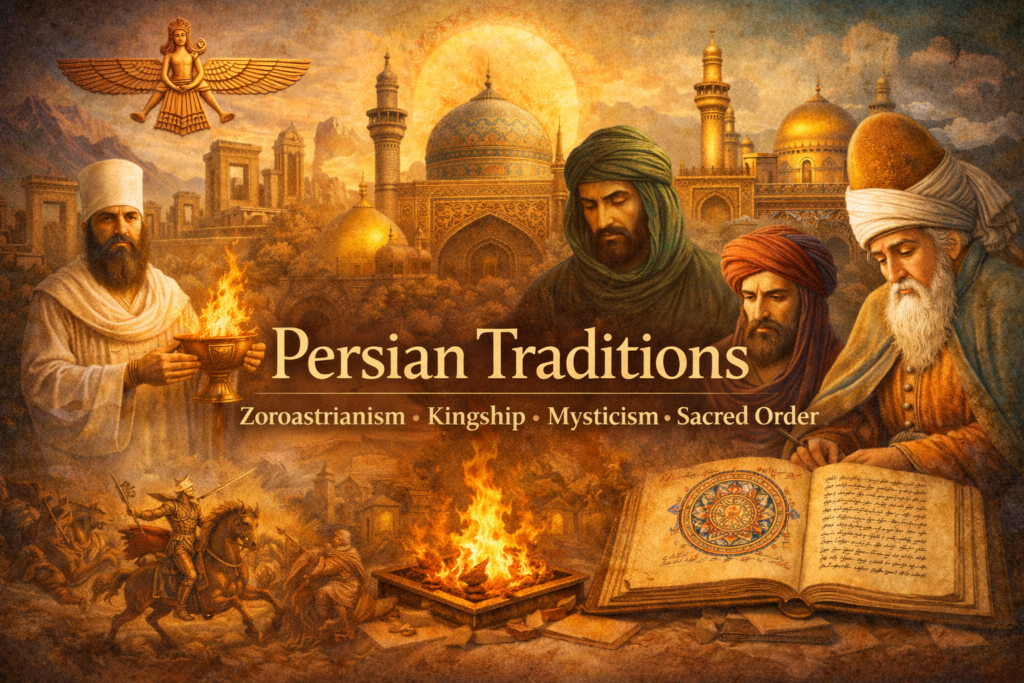
Symbolic Persian scene with sacred fire, manuscript, classical architecture, and figures representing Zoroastrian, mystical, and Persianate religious traditions.

Persian Traditions: Zoroastrianism, Kingship, Mysticism, and Sacred Order

Persian Traditions examines the religious, philosophical, literary, mystical, and civilizational worlds that emerged from Iranian and Persian history through sacred texts, imperial institutions, metaphysical speculation, ethical reflection, ritual practice, and enduring struggles over truth, justice, kingship, cosmic order, and the destiny of the soul. This pillar explores the Avesta and Gathas, Zoroastrianism, sacred kingship, apocalyptic expectation, Manichaeism, Mazdakism, the Shahnameh, Persianate Islam, Shi‘i devotion, Sufi poetry, illuminationist philosophy, and the long transition from pre-Islamic Iran to later Persian spiritual and intellectual life. By treating Persian traditions as a major civilizational stream rather than a narrow national archive, this category provides a serious framework for understanding one of the deepest religious and symbolic worlds in Eurasian history.
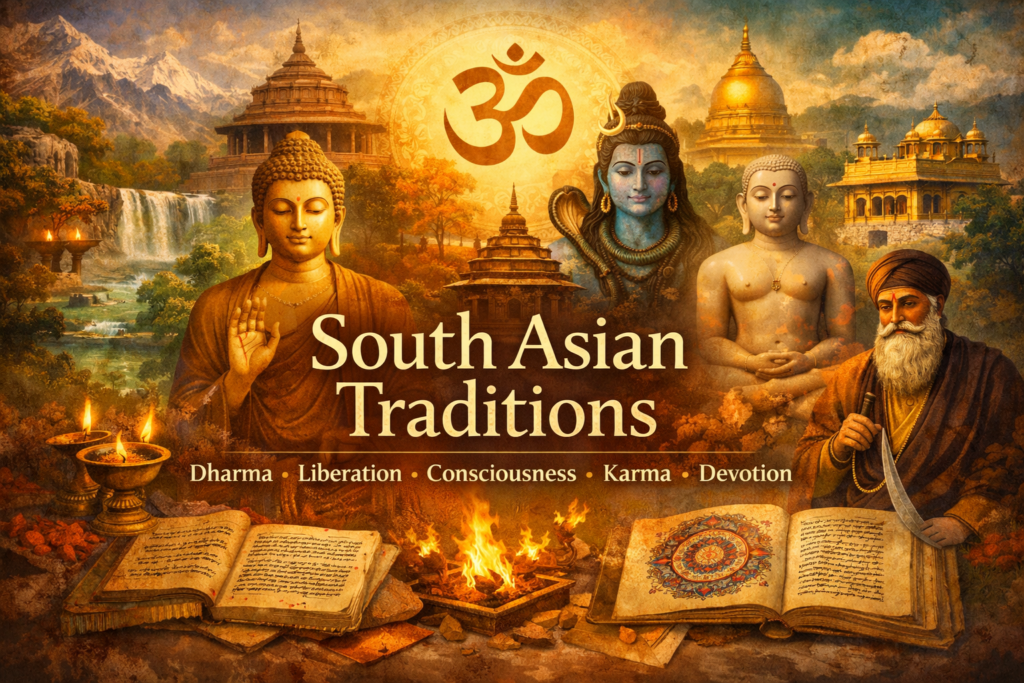
Symbolic scene featuring sacred architecture, manuscripts, ritual fire, and representative figures from South Asian religious traditions.

South Asian Traditions: Dharma, Liberation, Consciousness, and Sacred Order

South Asian Traditions examines the religious, philosophical, ritual, and civilizational worlds that emerged from the Indian subcontinent through sacred texts, oral traditions, contemplative disciplines, legal systems, devotional movements, and enduring reflections on selfhood, suffering, duty, liberation, and cosmic order. This pillar explores Vedic religion, Upanishadic speculation, epic traditions, Buddhism, Jainism, Sikhism, and the broader religious questions that connect them, including karma, dharma, rebirth, consciousness, ritual power, devotion, renunciation, and the disciplined transformation of the self. By treating these traditions as internally rich and historically layered worlds rather than as a vague spirituality, the category provides a serious framework for understanding one of the deepest civilizational archives of religion, metaphysics, contemplation, and moral thought.

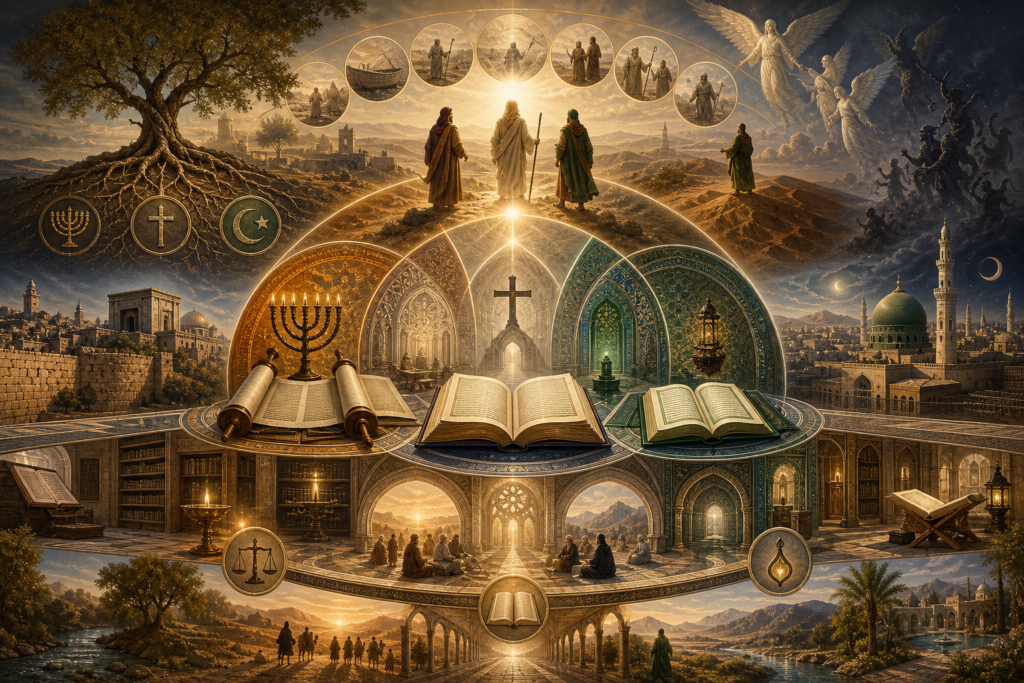
Symbolic religious-studies illustration showing Judaism, Christianity, and Islam through sacred books, architectural forms, desert landscapes, prophetic figures, angelic and demonic imagery, law, prayer, and shared Abrahamic sacred history.

Abrahamic Traditions: Prophecy, Revelation, Law, and Sacred History

Abrahamic Traditions examines the scriptural, prophetic, theological, legal, ritual, spiritual, philosophical, and historical worlds associated with Judaism, Christianity, and Islam through the primary texts, interpretive traditions, and civilizational forms by which these religions have understood God, revelation, covenant, prophecy, law, mercy, worship, judgment, knowledge, and the destiny of human communities. This pillar traces the prophetic arc from Adam to Jesus and culminates in Muhammad and the finality of Qur’anic revelation, while also exploring the interpretive traditions, legal structures, devotional worlds, and intellectual cultures that shaped Abrahamic civilization. With particular emphasis on Islam, the category connects revelation not only to worship and law, but also to philosophy, natural science, medicine, and the wider history of knowledge.

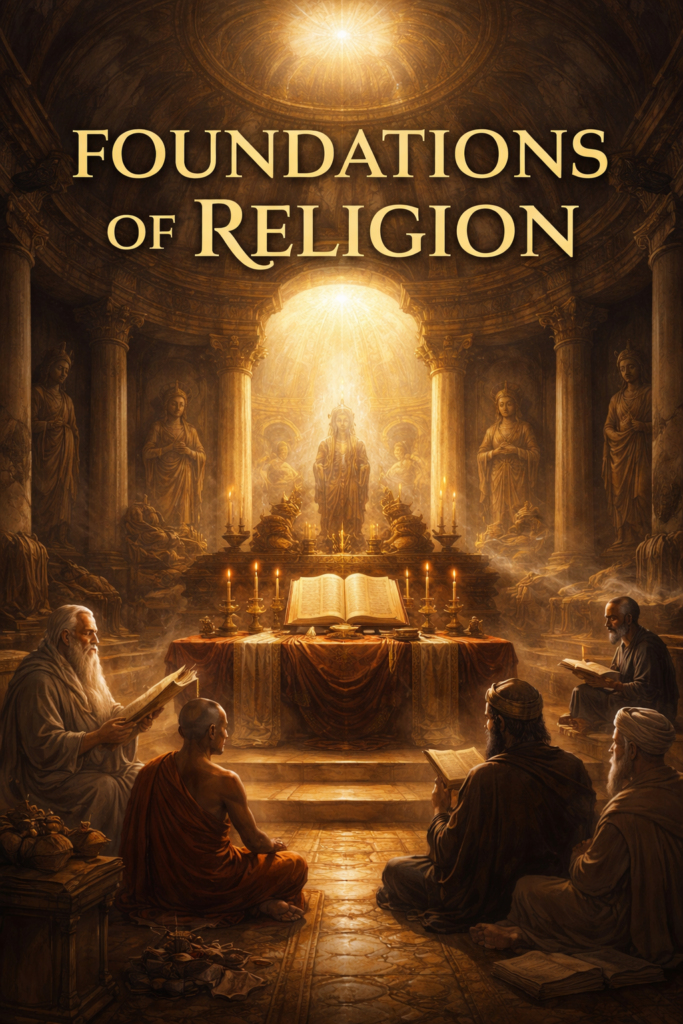
Illuminated sacred interior with scholars and religious figures gathered around an altar and open manuscript beneath a domed ceiling.

Foundations of Religion

Foundations of Religion examines the conceptual, historical, textual, ritual, and institutional structures through which religious traditions have interpreted reality, organized communal life, and articulated humanity’s relation to the sacred. This pillar explores the problem of defining religion, the distinction between sacred and ordinary orders, the role of myth and ritual, the formation of scripture and canon, the politics of interpretation and authority, and the importance of oral, embodied, and place-based traditions that cannot be reduced to text alone. By grounding the study of religion in history, comparison, sacred transmission, and civilizational analysis, this category provides the framework for understanding how religious worlds shape meaning, law, memory, identity, and the structure of social order across time and place.

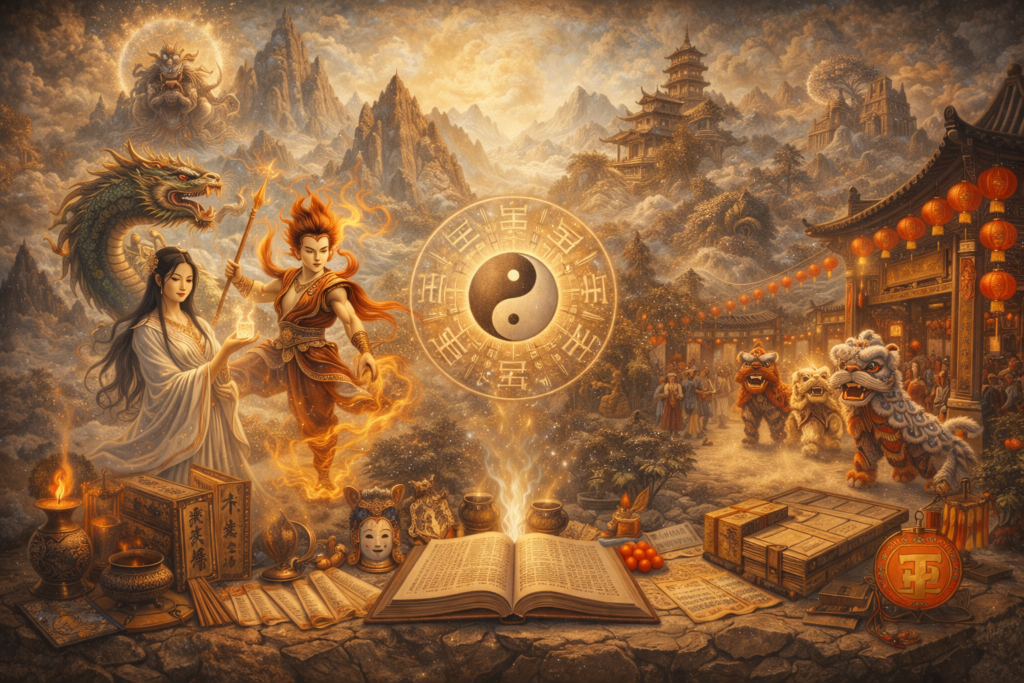
Symbolic Chinese mythic landscape with legendary figures, dragon, sacred mountains, ritual objects, festival lanterns, lion dancers, and cosmological imagery.

Why Chinese Myth, Folklore & Legend Still Matter

Chinese myth, folklore, and legend still matter because they preserve one of the world’s richest symbolic archives for thinking about cosmos, society, landscape, memory, and moral order. This article explores why these traditions remain intellectually, culturally, and socially significant, showing how they survived not through a single canon, but through a distributed field of texts, rituals, festivals, regional traditions, sacred geographies, performances, and modern media reinventions. Far from being relics of a vanished world, they continue to shape how communities remember, inherit, imagine, and reinterpret meaning across generations. In their persistence, adaptability, and symbolic depth, Chinese mythic traditions reveal how old stories remain alive by continuing to speak to questions of order, danger, belonging, transformation, and cultural continuity.

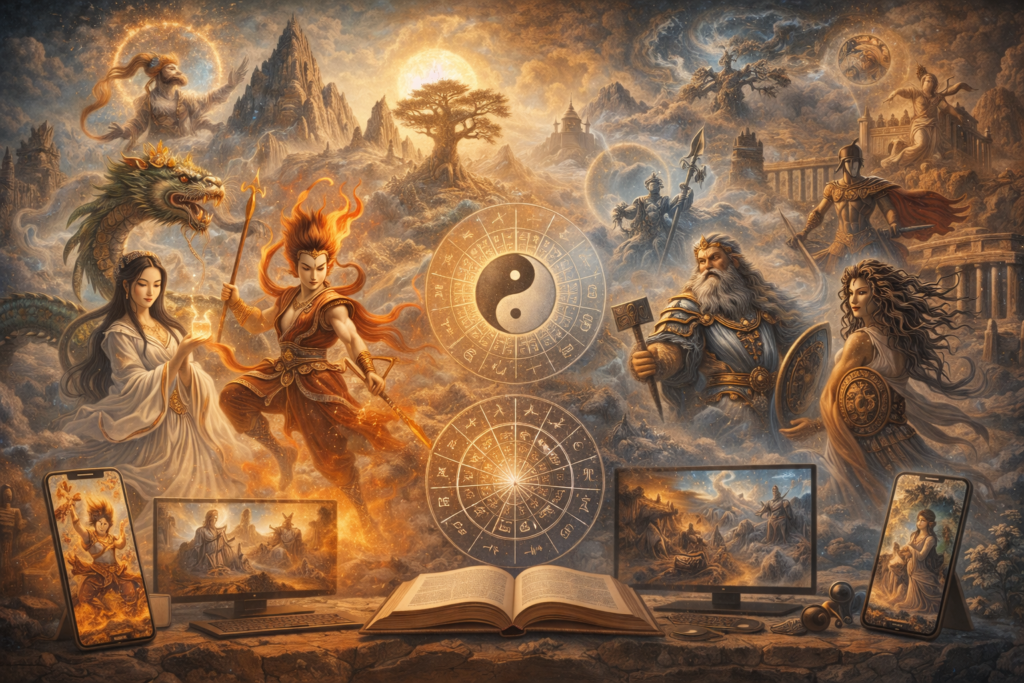
Comparative mythology scene juxtaposing Chinese mythic figures, sacred landscapes, and cosmological symbols with figures and motifs from other world myth traditions.

Chinese Myth in Comparative Perspective

Chinese myth becomes especially illuminating when placed in comparative perspective, but only if comparison avoids forcing it into models shaped by Greece, India, Mesopotamia, or the Norse world. This article explores how Chinese myth differs in formal structure, cosmological imagination, sacred geography, political order, and modes of transmission, showing that it survives less as a single epic canon than as a layered archive carried through classics, ritual, folklore, landscape, performance, and reinvention. By comparing themes such as creation, flood, divine authority, heroism, and mythic place, it argues that Chinese mythology is not an incomplete version of some more familiar pattern, but a distinct civilizational formation whose fragmentary, correlative, and distributed character expands what comparative mythology itself can mean.

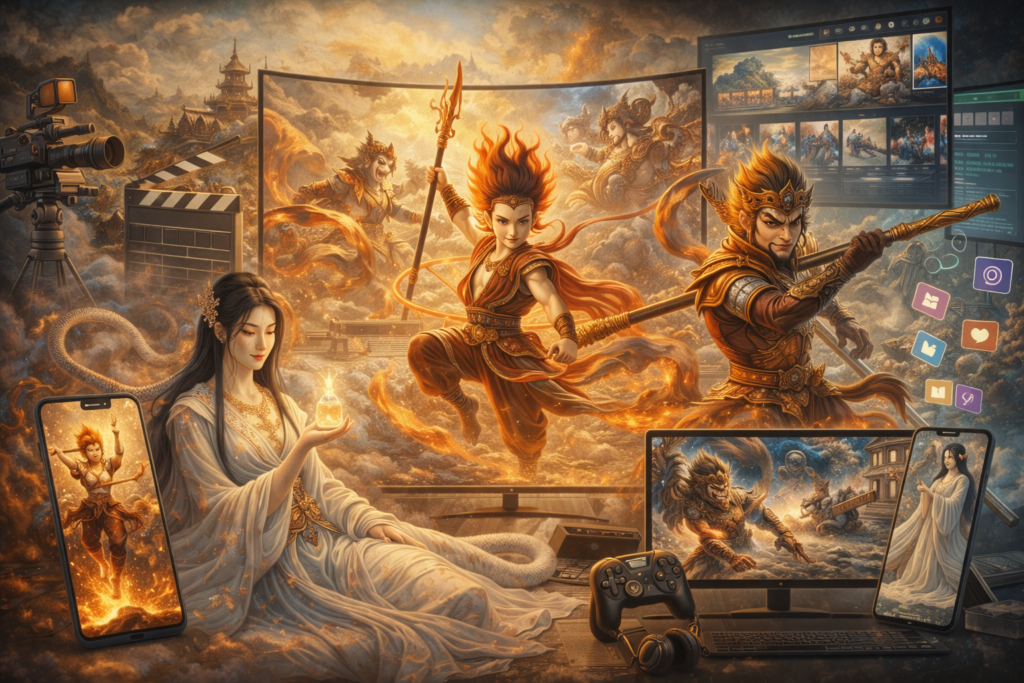
Modern media collage featuring Chinese mythic figures like Nezha, Sun Wukong, and White Snake across screens, gaming devices, and cinematic imagery.

Modern China and the Reinvention of Myth in Film, Television, and Digital Media

Chinese myth survives in modern China not by remaining fixed, but by being reinvented. This article explores how film, television, animation, streaming platforms, and digital media have transformed legendary figures such as Nezha, White Snake, Sun Wukong, and Yang Jian into contemporary icons shaped by spectacle, psychology, serial storytelling, and franchise logic. Rather than treating modern media as a break from tradition, it shows how they extend a much older pattern of adaptation through which myth has always moved across performance, text, image, and audience. In the process, Chinese legend becomes newly visible as a living field of cultural memory, commercial reinvention, national symbolism, and digitally accelerated afterlife.

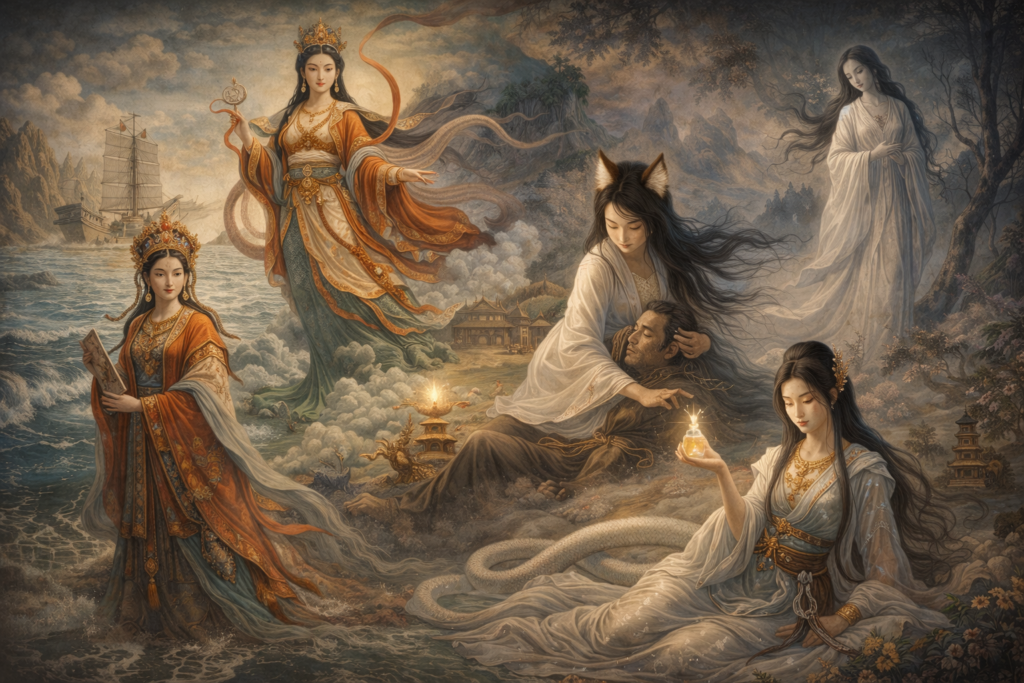
Mythic Chinese scene featuring goddess figures, a fox spirit, a ghostly woman, and White Snake imagery in a symbolic landscape of sacred power, desire, and supernatural presence.

Women, Spirits, and Gendered Power in Chinese Legend

Chinese legend is filled with women whose power exceeds ordinary social boundaries. This article explores how goddesses, fox spirits, ghost-women, supernatural wives, divine mothers, and sea-protectors became central figures in the Chinese mythic imagination, not as marginal curiosities, but as forces through which desire, protection, transgression, virtue, grief, and sovereignty were imagined. Moving across traditions associated with Nüwa, Mazu, White Snake, and female spirit lore, it shows how gendered power in Chinese legend often appears at unstable thresholds between household and wilderness, morality and enchantment, devotion and danger, human and nonhuman worlds. These figures reveal that feminine power in Chinese myth is not singular, but multiple: nurturing, disruptive, erotic, sacred, maternal, haunted, and cosmologically charged.

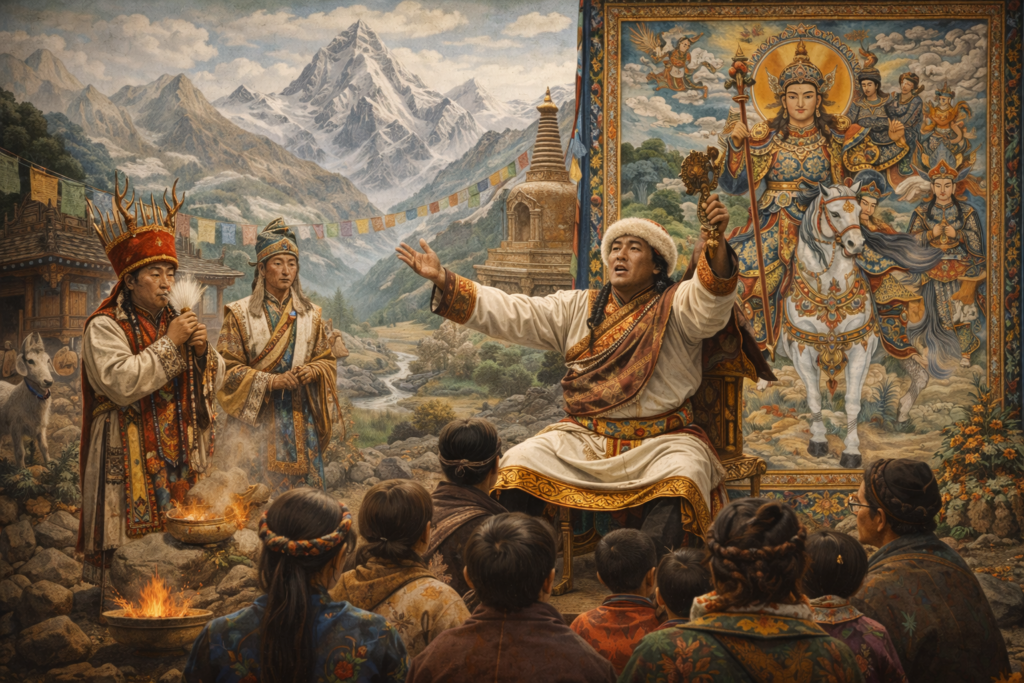
Mountain ritual scene inspired by Qiang and Tibetan traditions, with ceremonial figures, bardic performance, sacred thangka imagery, prayer flags, and gathered community.

Qiang, Tibetan, and Other Regional Mythic Traditions

The mythic traditions of China cannot be reduced to a single literary canon or a uniform civilizational voice. This article explores Qiang, Tibetan, and other regional mythic traditions as vital parts of a wider narrative field shaped by ritual specialists, sacred landscapes, oral performance, festival life, visual art, and community memory. Drawing on traditions such as the Qiang New Year festival, Tibetan opera, Regong arts, and the Gesar epic, it shows how regional worlds preserve distinct understandings of nature, divinity, protection, ancestry, and communal identity. In doing so, these traditions reveal Chinese mythology not as a single closed archive, but as a plural and layered constellation of symbolic worlds.

Scroll to Top