Author name: Tariq Ahmad

Abstract metaphysical image of a human figure standing between two diverging luminous paths, with radiant and mechanical cosmic structures symbolizing freedom, agency, and determinism

Freedom, Agency, and Determinism: Free Will, Action, and Responsibility in a Causally Ordered World

Freedom, agency, and determinism form one of the central constellations of metaphysics. The problem is not merely whether human beings act, choose, and deliberate, but whether those acts, choices, and deliberations can be genuinely free in a world shaped by causal order, natural law, character, history, and circumstance. To ask whether we are free is to ask whether agency is real, whether responsibility is justified, whether persons are authors of what they do in any meaningful sense, and whether action can be more than the unfolding of forces whose deeper sources lie beyond conscious control. This content pillar explores those questions across classical, medieval, modern, and contemporary philosophy, while also connecting metaphysical debates to action theory, law, politics, psychology, neuroscience, coercion, social structure, and the conditions under which human beings can meaningfully be held answerable for what they do.

Abstract metaphysical image showing a luminous human profile, radiant neural patterns, a central human figure, and a technological cosmic landscape representing mind, matter, and consciousness

Mind, Matter, and Consciousness: Mental Life, Physical Reality, and the Problem of Experience

Mind, matter, and consciousness form one of the most enduring and difficult constellations in metaphysics. The problem is not simply whether minds exist, but how mental life relates to physical reality, whether consciousness can be explained in material terms, how thought is possible in a world of matter, and whether subjective experience discloses a dimension of reality that resists reduction to physical description. At its core lies a defining philosophical question: how does subjective life fit into the structure of reality? This content pillar explores dualism, materialism, physicalism, idealism, consciousness, qualia, intentionality, mental representation, mental causation, embodiment, personal identity, cognitive science, and artificial intelligence, showing why the relation between mind and world remains one of the deepest fault lines in metaphysics.

Abstract cosmic landscape with a flowing luminous path, celestial spheres, human figures, and radiant structures representing time, change, and causation

Time, Change, and Causation: Temporality, Becoming, and the Order of Events

Time, change, and causation form one of the central constellations of metaphysics. Time concerns succession, duration, persistence, and the ordering of past, present, and future. Change concerns alteration, motion, development, and transformation. Causation concerns the relations through which events, processes, states, and actions bring about further events, processes, states, and actions. Taken together, these concepts shape some of the deepest philosophical questions about reality: whether the world genuinely unfolds, whether becoming is real, whether the present is metaphysically privileged, whether causes must precede their effects, and how explanation is possible in a changing world. This content pillar explores those questions across classical, medieval, modern, and contemporary philosophy, while also connecting metaphysical debates to physics, agency, law, history, and systems thinking.

Abstract metaphysical landscape with layered circular platforms, glowing spheres, geometric forms, and human silhouettes representing being, categories, and the structure of reality

Ontology: Being, Existence, and the Structure of Reality

Ontology is the branch of metaphysics concerned with being, existence, and the most general structure of reality. It asks what there is, what kinds of things exist, how those things are organized into categories, whether some entities are more fundamental than others, and how relations of dependence, composition, identity, and modality shape any serious account of the real. From Aristotle’s investigations into substance and category to contemporary debates over grounding, mereology, abstract objects, possible worlds, and social ontology, the history of ontology is the history of philosophy’s attempt to clarify what reality contains and how reality is structured. This content pillar explores ontology historically, systematically, and critically, providing a foundation for future work on being, essence, universals, particulars, truthmakers, fundamentality, and the layered architecture of the world.

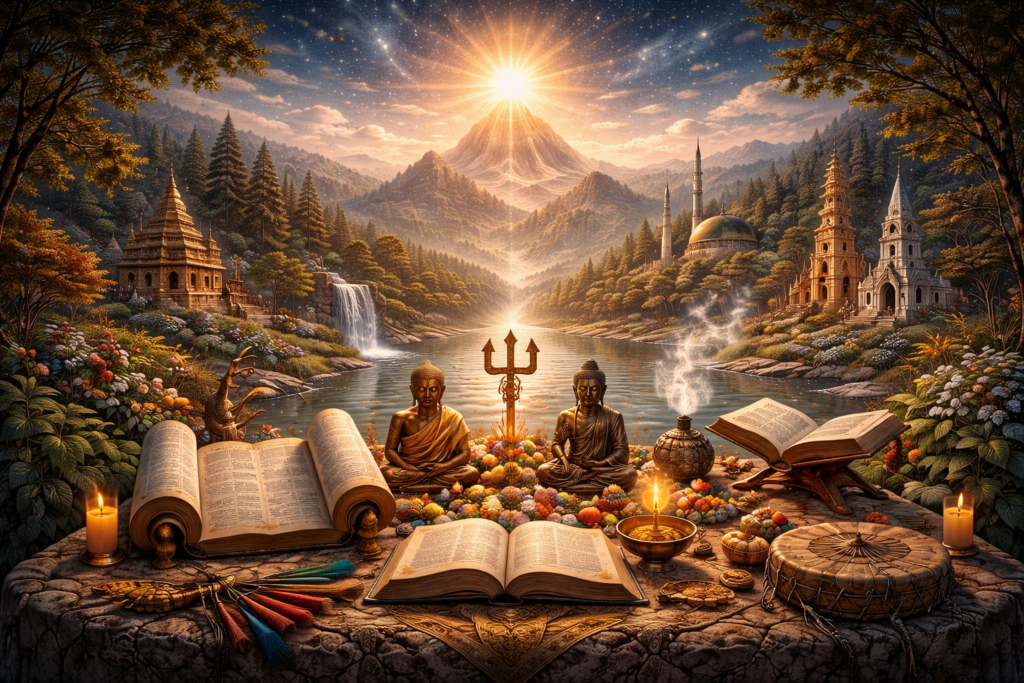
Symbolic sacred landscape with religious texts, ritual objects, temples, water, mountains, and celestial light representing shared sacred themes across traditions.

Comparative Sacred Themes: Creation, Sacrifice, Justice, Death, and Sacred Order

Comparative Sacred Themes examines the recurring moral, symbolic, ritual, metaphysical, and civilizational patterns through which religious traditions have addressed creation, death, sacrifice, purity, justice, suffering, salvation, revelation, wisdom, time, community, law, transcendence, and the meaning of human life. This pillar explores origin and cosmic order, sacred obligation, sacrifice and exchange, purity and pollution, suffering and evil, death and afterlife, wisdom and revelation, pilgrimage and sacred geography, apocalypse and renewal, compassion and justice, ascetic discipline, personhood, and sacred belonging across religious worlds. By treating comparison as a disciplined method rather than a flattening exercise, the category provides a serious framework for understanding both the recurring sacred questions human beings ask and the radically different ways religious traditions answer them.

Sacred natural landscape with lake, forest, mountains, ritual objects, shrine structures, and people in prayer and contemplation representing religion and ecology.

Religion and Ecology: Sacred Earth, Stewardship, Justice, and Ecological Responsibility

Religion and Ecology examines the ethical, cosmological, ritual, theological, civilizational, and practical worlds through which religious traditions understand the natural world, human responsibility toward land and life, the meaning of creation, the moral status of nonhuman beings, and the ecological consequences of human power. This pillar explores creation and kinship, stewardship and dominion, Indigenous sacred reciprocity, ritual purity and pollution, animals and food ethics, climate crisis, biodiversity loss, ecological grief, and environmental justice across religious traditions. By treating ecological breakdown as not only a technical problem but also a crisis of worldview, moral order, and unequal power, the category provides a serious framework for understanding how religions shape both extractive systems and the ethical resources for restraint, repair, and ecological responsibility.

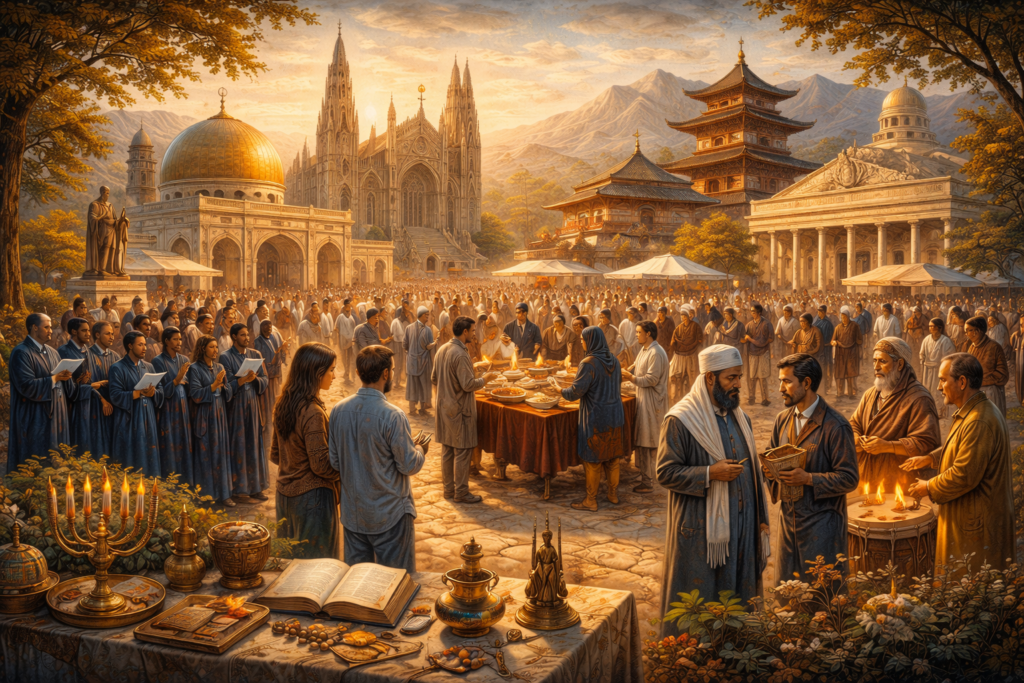
Symbolic public scene with diverse religious communities, sacred buildings, civic space, ritual objects, and social gathering representing religion’s role in public life.

Religion and Society: Power, Identity, Pluralism, and Social Order

Religion and Society examines the social, ethical, political, institutional, cultural, and civilizational worlds through which religion shapes collective life, public order, identity, moral imagination, ritual belonging, social hierarchy, solidarity, conflict, education, family life, and the long negotiation between sacred authority and social change. This pillar explores religion as social institution; the role of ritual, family, and education in forming communities; the entanglement of religion with class, race, ethnicity, gender, and nationalism; and the ways pluralism, conflict, media, migration, and globalization reshape religious life in modern societies. By treating religion as lived social power rather than private belief alone, the category provides a serious framework for understanding how sacred worlds move through institutions, public life, inequality, and struggles over belonging.

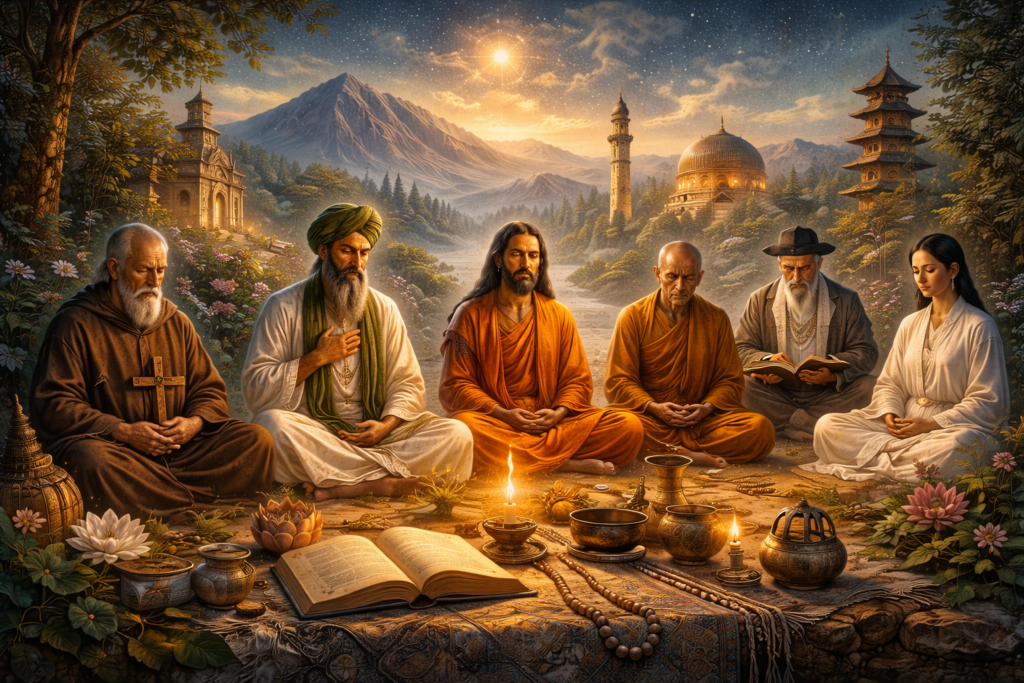
Symbolic contemplative scene with figures from multiple traditions in meditation and prayer among sacred texts, candles, mountains, and religious architecture.

Mysticism and Contemplative Traditions: Silence, Union, Discipline, and Awakening

Mysticism and Contemplative Traditions examines the religious, philosophical, devotional, ascetic, and experiential worlds through which human beings have sought direct transformation of perception, deeper union with ultimate reality, disciplined purification of the self, contemplative insight, sacred presence, interior stillness, and the reordering of life around what is held to be highest, truest, or most real. This pillar explores Christian mysticism, Sufism, Jewish mysticism, South Asian contemplative paths, Buddhist meditation traditions, Daoist interior cultivation, and the symbolic languages of silence, love, emptiness, illumination, and detachment. By treating contemplation and mysticism as rigorously formed paths of transformation rather than vague spirituality or private feeling, the category provides a serious framework for understanding how religious civilizations have pursued inward discipline, sacred knowledge, and the remaking of consciousness.

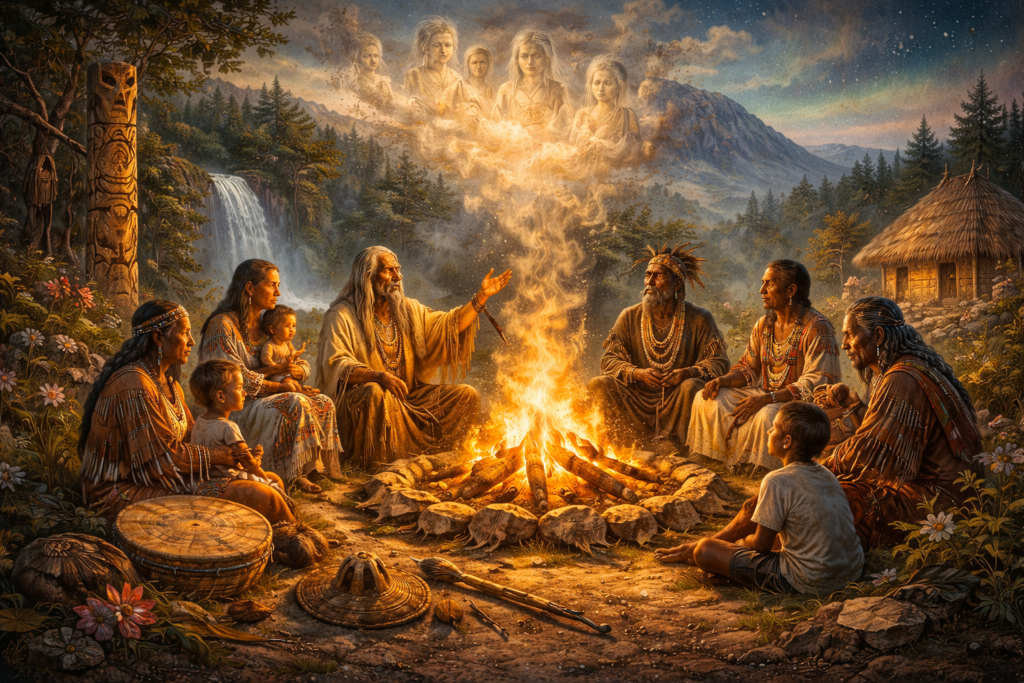
Symbolic scene of Indigenous oral storytelling around a fire with elders, children, ceremonial objects, sacred landscape, and ancestral presence.

Indigenous and Oral Traditions: Land, Memory, Ceremony, and Sacred Continuity

Indigenous and Oral Traditions examine the religious, ethical, cosmological, ceremonial, ecological, and civilizational worlds preserved through oral transmission, ancestral memory, land-based practice, sacred performance, kinship structures, and enduring relationships among people, place, spirit, animal life, and the more-than-human world. This pillar explores oral tradition as a disciplined archive of law, memory, and cosmology; the sacred significance of land and ancestry; healing, ritual, and ecological relation; and the global range of Indigenous religious worlds across North America, Mesoamerica, the Andes, Amazonia, Africa, Aboriginal Australia, the Pacific, the Arctic, and Indigenous Asia. By treating these traditions as intellectually rigorous and historically enduring worlds rather than as marginal folklore or vague spirituality, the category provides a serious framework for understanding some of humanity’s oldest and most profound religious inheritances.

Scroll to Top