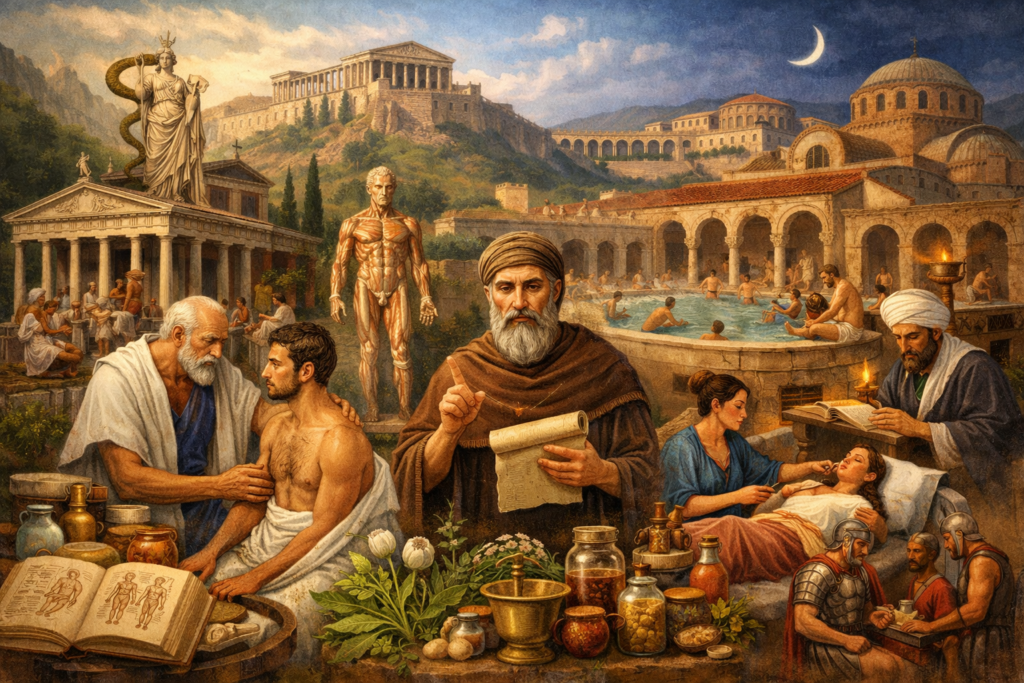
Composite illustration of Greek and Roman medicine showing physicians treating patients, medicinal herbs and jars, an anatomical figure, temple healing, Roman baths, and military care within a classical Mediterranean setting.

Greek & Roman Medicine: Healing, Balance, and the Classical Traditions of Care

Greek and Roman medicine examines one of the foundational healing traditions of the ancient world through theories of balance, regimen, environment, diagnosis, prognosis, anatomy, pharmacology, ethics, and care. This content pillar explores Hippocratic medicine, Galenic systematization, Alexandrian anatomy, surgery, women’s medicine, public health, military care, temple healing, and the transmission of classical medicine into Byzantine, Islamic, and later European traditions. By bringing together intellectual history, practical healing, social life, and material culture, it reveals how the classical Mediterranean understood the body, suffering, and the disciplined art of restoring health within a larger order of nature and life.
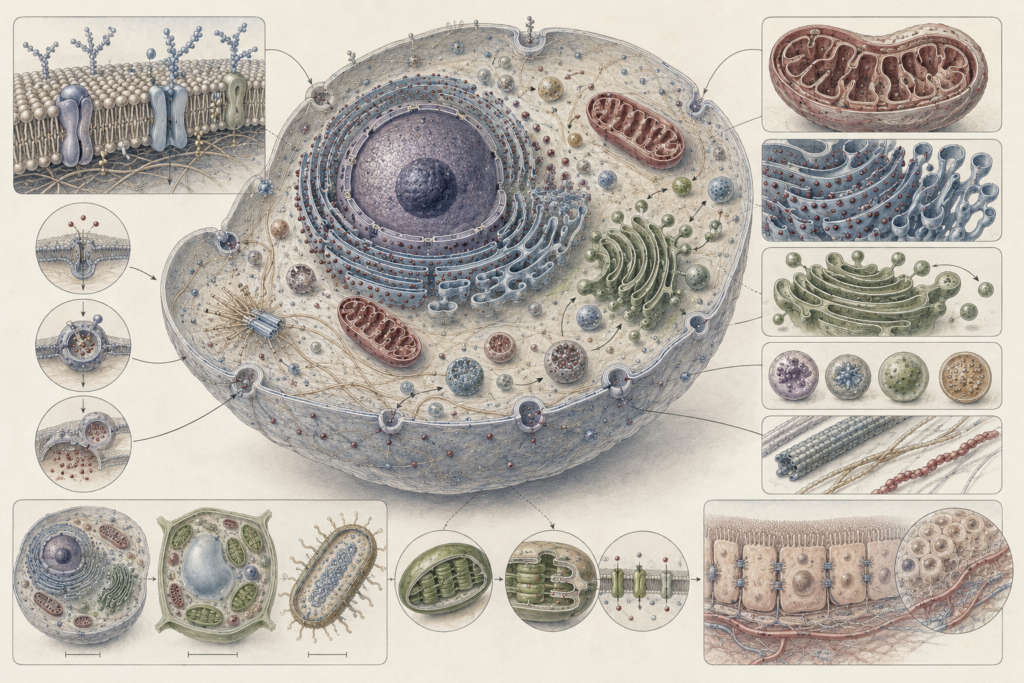
Research-grade cell biology illustration showing a eukaryotic cell with plasma membrane, nucleus, mitochondria, endoplasmic reticulum, Golgi apparatus, vesicles, lysosomes, cytoskeleton, membrane transport, plant cells, bacterial cells, and tissue context.

Cell Structure, Membranes, and Organelles

Cell structure, membranes, and organelles examine how cells are organized internally and how that organization makes living function possible. This article explores the structural logic of the cell, with particular attention to membranes as selective boundaries, organelles as specialized compartments, and the coordinated architecture through which cells regulate transport, metabolism, signaling, information flow, and energetic transformation. It shows why cellular structure is never merely anatomical description: the arrangement of membranes, cytoskeleton, nucleus, mitochondria, endoplasmic reticulum, Golgi apparatus, lysosomes, and other compartments is inseparable from the work cells perform. It also explains why this topic matters not only to cell biology, but also to ecology, marine biology, medicine, biotechnology, and quantitative life science, since environmental stress, disease, development, and engineered biological systems all depend on how cells are physically organized and functionally compartmentalized.

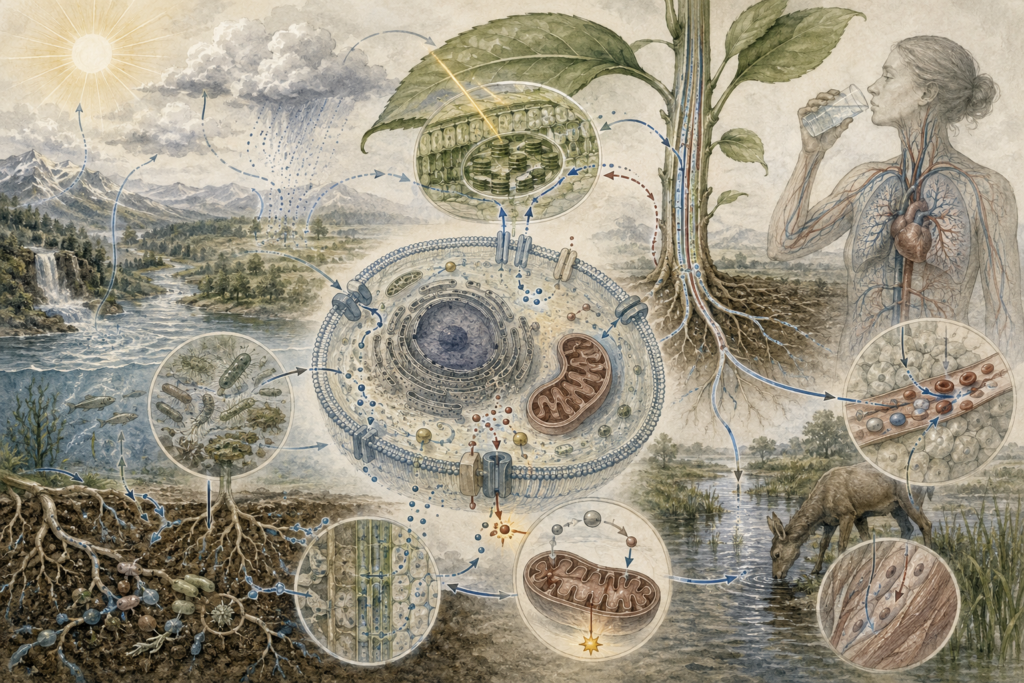
Research-grade systems biology illustration showing water cycles, sunlight, rivers, soil, plant roots, cells, membranes, mitochondria, chloroplasts, microbes, animals, and human physiology connected through water and energy flows.

Water, Energy, and the Material Conditions of Life

Water, energy, and the material conditions of life examine the physical and chemical conditions that make living systems possible, including the role of water as the medium of biological organization, the role of energy in sustaining ordered process, and the material constraints under which cells, organisms, and ecosystems persist. This article explores why life depends on water not only as a substance but as a solvent, transport medium, thermal buffer, and participant in chemical reaction; why living systems require continuous energy throughput rather than static stores alone; and how gradients, metabolism, and regulation connect the chemistry of life to physiology, ecology, marine systems, medicine, and biotechnology. It shows that life is not merely made of molecules, but maintained under material conditions that permit exchange, regulation, growth, and repair.

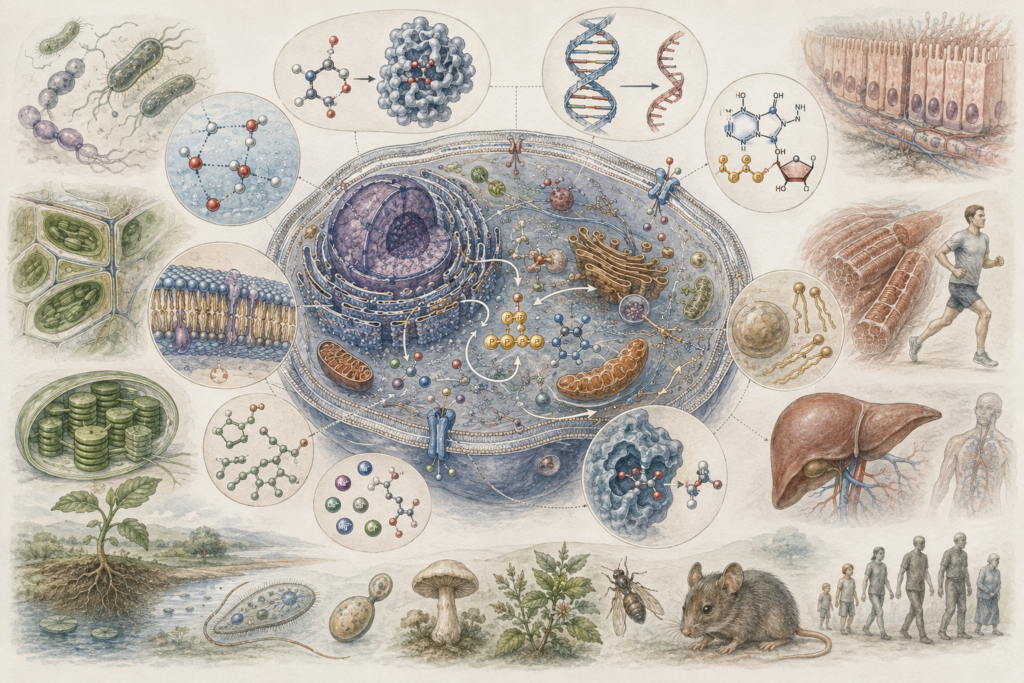
Research-grade systems biology illustration showing biomolecules, proteins, lipids, carbohydrates, nucleic acids, membranes, organelles, enzymes, ions, cells, tissues, plants, fungi, microbes, animals, and human physiology connected across biological scales.

Biomolecules and the Chemical Basis of Life

Biomolecules and the chemical basis of life examine how living systems are built from a distinctive chemical architecture of carbohydrates, lipids, proteins, nucleic acids, water, ions, and smaller metabolites whose interactions make cellular organization, metabolism, heredity, and regulation possible. This article explores how biology explains life at the chemical level without reducing it to chemistry alone. It considers the four major classes of biological macromolecules—carbohydrates, lipids, proteins, and nucleic acids—and shows how their structures support energy storage, membrane formation, catalysis, signaling, information transfer, and the maintenance of living order. It also shows why the chemical basis of life matters not only for core biology, but also for ecology, marine biology, medicine, biotechnology, and quantitative life science.

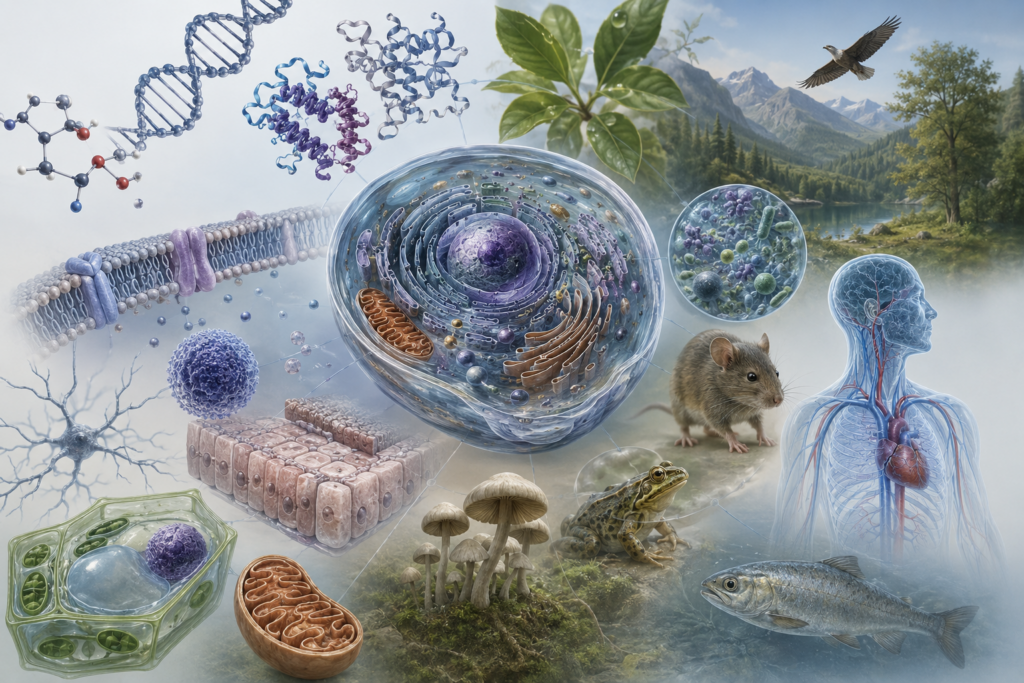
Research-grade biology illustration showing molecular structures, DNA, proteins, cell membranes, organelles, plant cells, tissues, microbes, fungi, animals, human physiology, and ecosystems connected across biological scales with no text.

Biology and the Scientific Understanding of Living Order

Biology and the scientific understanding of living order examine how the life sciences explain the organization, regulation, persistence, and transformation of living systems across scales. This article explores one of biology’s deepest concerns: how life maintains order in the midst of flux, how cells and organisms preserve internal stability while exchanging matter and energy with their surroundings, and how living systems generate structure, coordination, development, and adaptation without ceasing to change. It considers the scientific importance of organization, homeostasis, metabolism, self-regulation, heredity, and evolutionary continuity, and it shows how biology came to understand living order not as a static perfection but as a dynamic, process-based achievement sustained through interaction, feedback, and historically evolved structure.

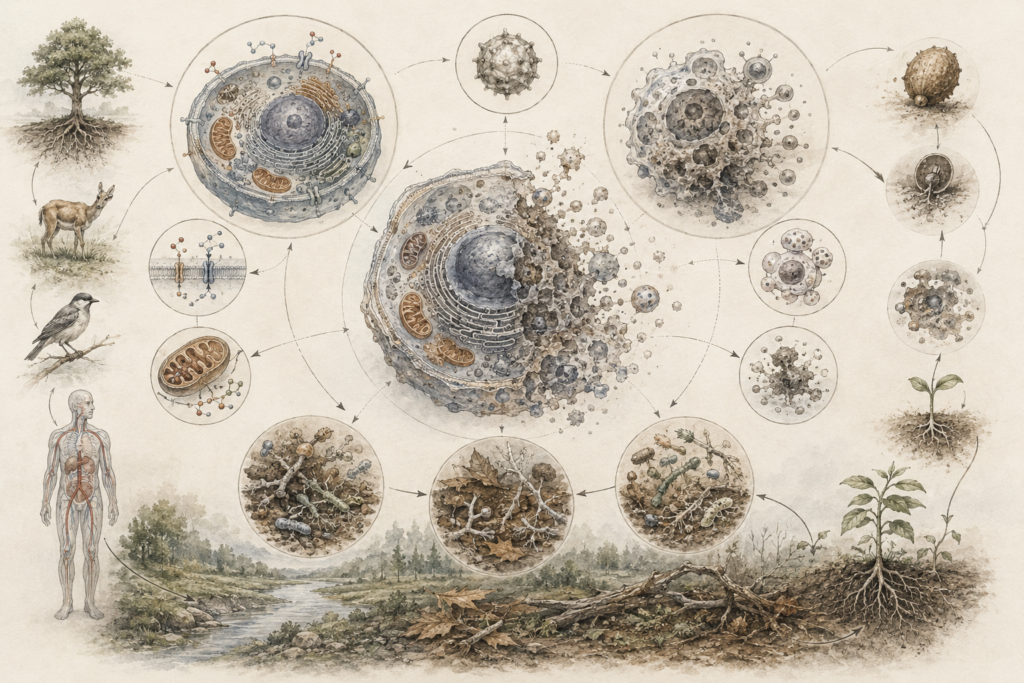
Research-grade biology illustration showing living cells, cellular breakdown, viruses, seeds, seedlings, decomposition, soil microbes, fungi, plants, animals, and human physiology connected through cycles of life, death, decay, and renewal.

Life, Death, and the Problem of Biological Definition

Life, death, and the problem of biological definition examine one of the most difficult questions in biology: what distinguishes living systems from nonliving matter, what counts as death in organisms and cells, and why biological definition becomes unstable at the margins of viruses, dormancy, reproduction, and evolutionary change. This article explores how biology has tried to define life through organization, metabolism, responsiveness, reproduction, heredity, and the capacity for evolution, while also showing why no single checklist fully resolves the problem. It also considers the scientific significance of borderline cases such as viruses, dormant seeds, spores, and metabolically reduced organisms, showing why the meaning of life matters for biology, medicine, bioethics, origin-of-life research, and astrobiology.

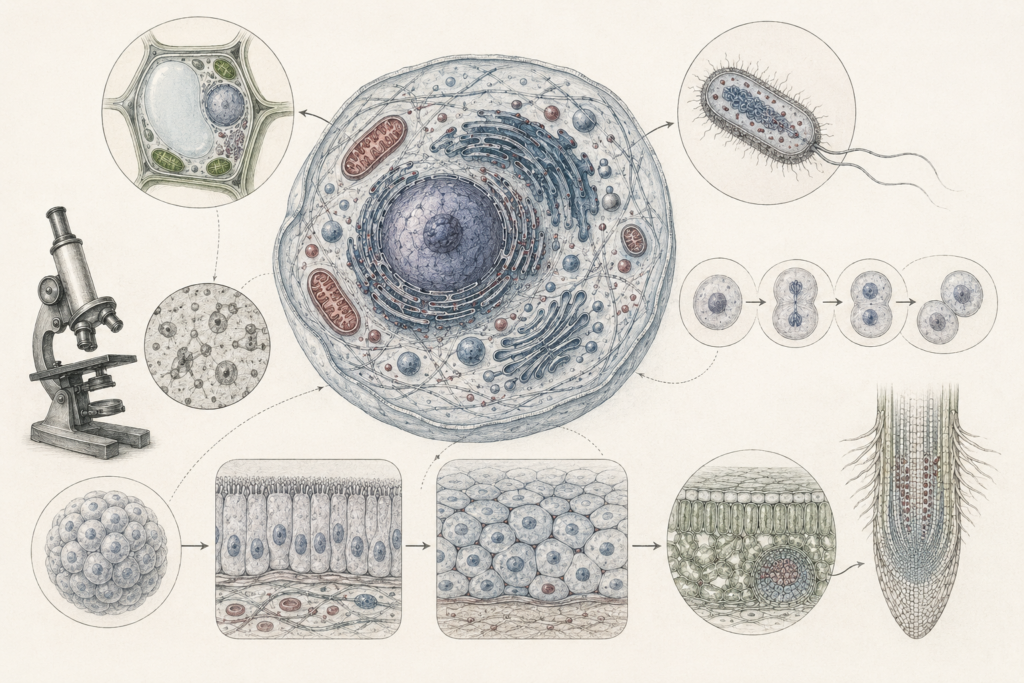
Research-grade cell biology illustration showing a eukaryotic cell, plant cell, bacterial cell, cell division, microscope, tissues, root tip, membranes, organelles, and multicellular organization.

Cell Theory and the Basic Unit of Life

Cell theory and the basic unit of life examine one of the foundational principles of modern biology: that the cell is the basic structural, functional, and organizational unit of living systems. This article explores how cell theory emerged from microscopy, anatomy, and early modern biological thought, and how it became one of the core frameworks through which biology understands living order, development, heredity, physiology, and disease. It also extends classical cell theory into quantitative cell biology through growth models, diffusion equations, and practical R and Python workflows, showing how modern cell biology treats the cell not only as a structural unit but also as a measurable, modelable, and experimentally tractable system.

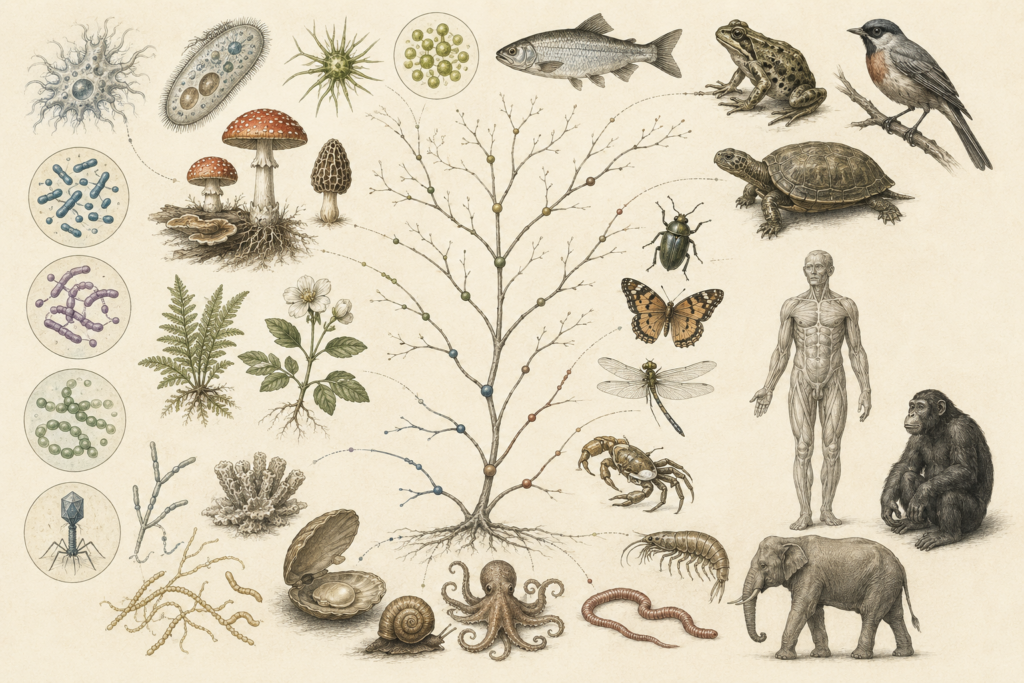
Research-grade taxonomy illustration showing a branching tree of life with microbes, protists, fungi, plants, invertebrates, fish, amphibians, reptiles, birds, mammals, humans, and subtle classification pathways.

Classification, Taxonomy, and the Ordering of Life

Classification, taxonomy, and the ordering of life examine how biology identifies, names, compares, and organizes living beings into meaningful frameworks of relation, distinction, and descent. This article explores the development and significance of taxonomy, from early descriptive systems and the Linnaean tradition to modern phylogenetics, molecular systematics, and evolutionary classification. It also shows why taxonomy remains foundational to biology by making biodiversity scientifically intelligible through naming, comparison, ancestry, and the continuing refinement of biological order through morphology, genetics, ecology, and deep time.

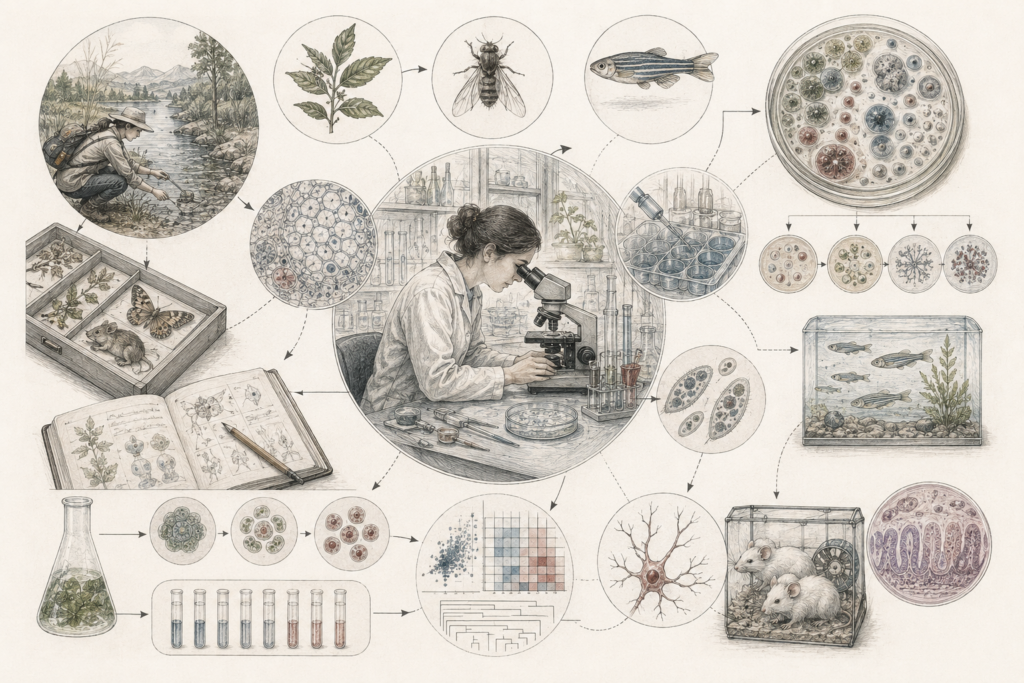
Research-grade biology illustration showing field observation, laboratory microscopy, specimen study, controlled experiments, cell cultures, model organisms, aquatic systems, notebooks, test tubes, data matrices, and biological analysis.

Observation, Experiment, and the Methods of Biological Inquiry

Observation, experiment, and the methods of biological inquiry explore how biology builds knowledge about living systems through careful description, comparison, measurement, hypothesis testing, fieldwork, laboratory investigation, historical reconstruction, and increasingly quantitative and computational analysis. This article examines the principal methods through which biologists study life across scales, from cells and genes to organisms, populations, ecosystems, and evolutionary history. It also shows why biological inquiry is methodologically plural, requiring observation, experiment, statistical inference, modeling, and computational workflows to understand living systems under real conditions of variation, complexity, and change.

Scroll to Top