Editorial illustration of interconnected hospitals, utilities, data centers, cloud systems, logistics networks, public agencies, and households showing cyber risk, digital dependency, and resilient infrastructure under stress.

Cyber Risk, Digital Dependency, and System Resilience

Cyber risk, digital dependency, and system resilience belong together because digital systems now sit inside nearly every essential function of modern life. Energy grids, water utilities, hospitals, banks, schools, ports, emergency services, logistics networks, public benefits, communications systems, local governments, cloud platforms, identity systems, industrial control systems, and supply chains all depend on software, data, networks, vendors, credentials, sensors, and automated processes. This article explains how cyber incidents can become service-continuity, public-health, financial-stability, infrastructure, governance, and social-trust crises. It examines ransomware, identity and access risk, cloud concentration, vendor dependency, operational technology, data integrity, AI decision risk, secure design, and accountable governance. Durable cyber resilience requires protecting essential functions, not merely defending networks.

Editorial illustration showing global supply chain disruption and resilience across ports, ships, trucks, rail, warehouses, factories, workers, digital monitoring, and logistics networks.

Supply Chain Risk and Resilience

Supply chain risk and resilience belong together because modern societies depend on production, logistics, trade, storage, labor, energy, digital systems, ports, roads, rail, warehouses, suppliers, and public institutions that are distributed across many places yet tightly connected in time. This article explains how supply-chain disruption can become a food-price shock, hospital shortage, infrastructure delay, industrial bottleneck, inflationary pressure, energy-security concern, public-health risk, or geopolitical vulnerability. It examines supplier concentration, dependency intensity, logistics chokepoints, inventory buffers, strategic reserves, trade exposure, industrial policy, labor conditions, cyber-digital risk, climate hazards, and public governance. Durable supply-chain resilience requires visibility, supplier diversity, substitutability, strategic buffers, worker protection, logistics flexibility, accountable procurement, and the protection of essential flows before private efficiency becomes public fragility.

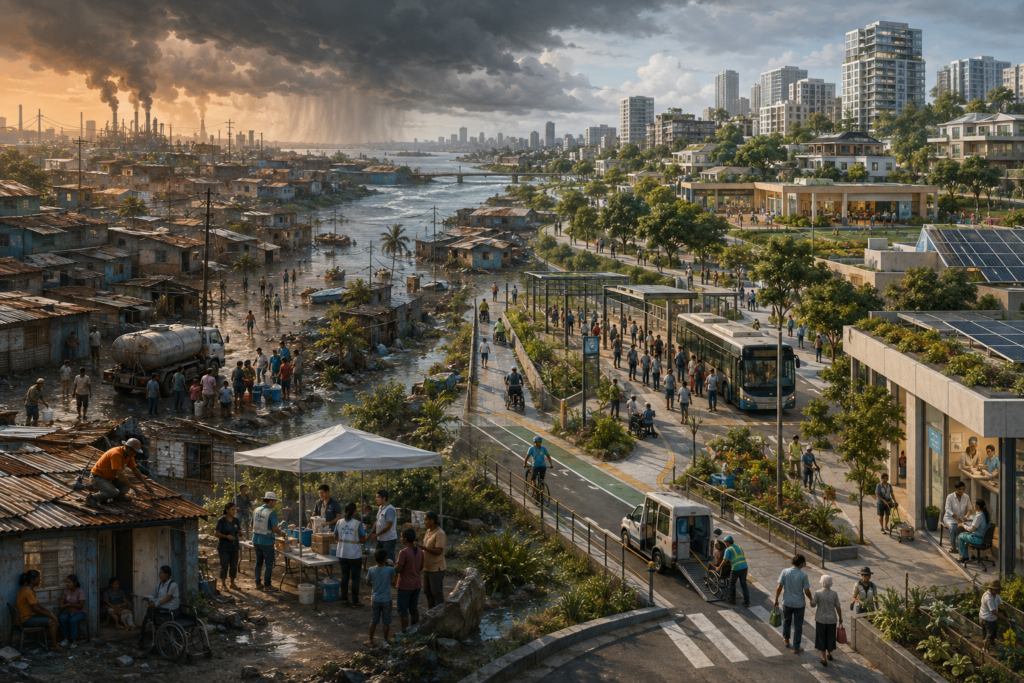
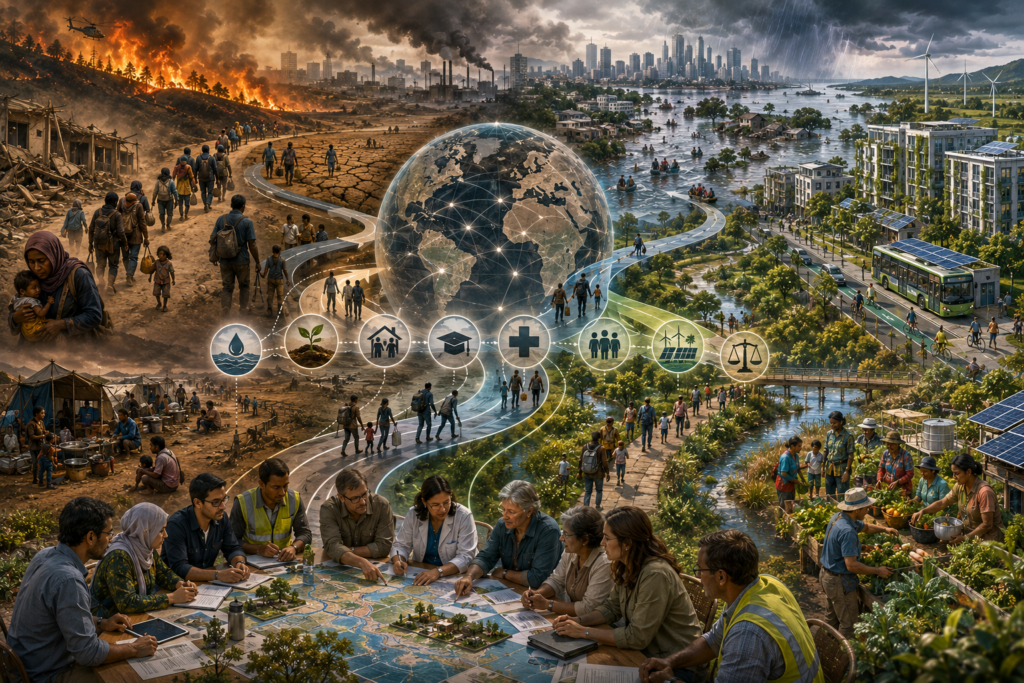
Editorial illustration showing communities under climate and displacement stress alongside resilient public infrastructure, ecological buffers, planning teams, and social protection systems.

Debt, Austerity, and the Erosion of Public Resilience

Debt, austerity, and the erosion of public resilience belong together because resilience depends on public capacity. Health systems, schools, water systems, infrastructure, social protection, climate adaptation, disaster-risk reduction, local governments, and emergency services all require durable financing before crisis arrives. This article explains how debt service, fiscal pressure, austerity, deferred maintenance, underinvestment, service cuts, public workforce stress, climate vulnerability, inequality, and weak revenue systems can shrink resilience margins over time. Debt is not inherently harmful when it finances long-term public capacity, but it becomes dangerous when repayment burdens crowd out essential services and prevention. Durable resilience requires fiscal systems that protect public investment, essential services, social protection, adaptation, maintenance, and democratic accountability.

Editorial sustainability illustration showing a divided urban landscape where flood-prone, under-resourced neighborhoods contrast with better-protected districts connected by transit, public services, and recovery infrastructure.

Social Vulnerability and Risk Distribution

Social vulnerability and risk distribution are central to resilience because hazards do not become disasters evenly. Floods, heatwaves, droughts, storms, fires, disease outbreaks, infrastructure failures, food shocks, and economic disruptions move through societies already structured by unequal housing, income, health, mobility, political power, public services, exposure, recovery capacity, environmental burdens, and historical injustice. This article explains why vulnerability is not weakness in people, but a condition produced by systems that distribute harm and protection unequally. It examines exposure, capacity, poverty, housing, disability, language access, legal status, environmental justice, recovery inequality, vulnerability measurement, and justice-centered resilience. True resilience requires reducing unequal harm, repairing cumulative vulnerability, and ensuring that recovery systems protect those most often asked to absorb risk.

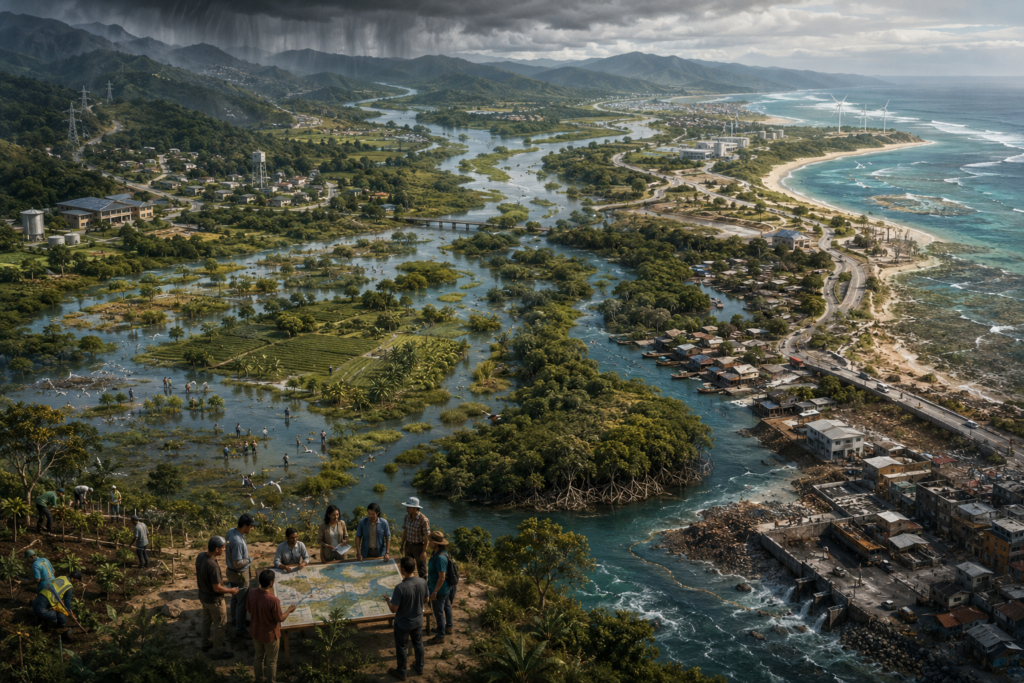
Editorial sustainability illustration showing wetlands, floodplains, mangroves, reefs, restored landscapes, community planning, and vulnerable coastal settlements within a connected resilience landscape.

Nature-Based Solutions, Ecosystem Buffers, and Resilience

Nature-based solutions, ecosystem buffers, and resilience belong together because living systems can reduce risk while supporting biodiversity, livelihoods, water security, food systems, public health, climate adaptation, and social wellbeing. Wetlands, floodplains, forests, mangroves, reefs, dunes, soils, watersheds, riparian corridors, grasslands, peatlands, urban tree canopy, and restored habitats can absorb floodwater, reduce heat, stabilize slopes, buffer storm surge, filter water, store carbon, support pollination, and create adaptive capacity. This article explains how credible nature-based solutions differ from superficial greening, why ecosystem buffers must be governed and maintained as serious resilience infrastructure, and how ecological integrity, community rights, public accountability, social legitimacy, biodiversity, and long-term stewardship determine whether nature-based approaches actually reduce vulnerability.

Editorial sustainability illustration showing wetlands, floodplains, forests, mangroves, reefs, soils, rivers, and urban green space protecting nearby communities and infrastructure through connected natural-buffer systems.

Ecosystem Resilience and Natural Buffers

Ecosystem resilience and natural buffers are foundational to sustainable risk reduction. Wetlands, floodplains, forests, mangroves, reefs, soils, watersheds, urban tree canopy, and coastal ecosystems reduce flood peaks, buffer storm surge, stabilize slopes, moderate heat, filter water, support biodiversity, and protect food and water systems. This article explains why ecological systems should be understood as living resilience infrastructure, while also recognizing that they are more than infrastructure. It examines wetlands, floodplains, watersheds, forests, soils, mangroves, reefs, biodiversity, governance, justice, ecological maintenance, and the limits of nature-based approaches. Resilience depends not only on restoration, but on protecting intact ecosystems, reconnecting habitats, maintaining ecological function, respecting community rights, and integrating natural buffers with public institutions, engineered systems, social protection, and long-term stewardship.

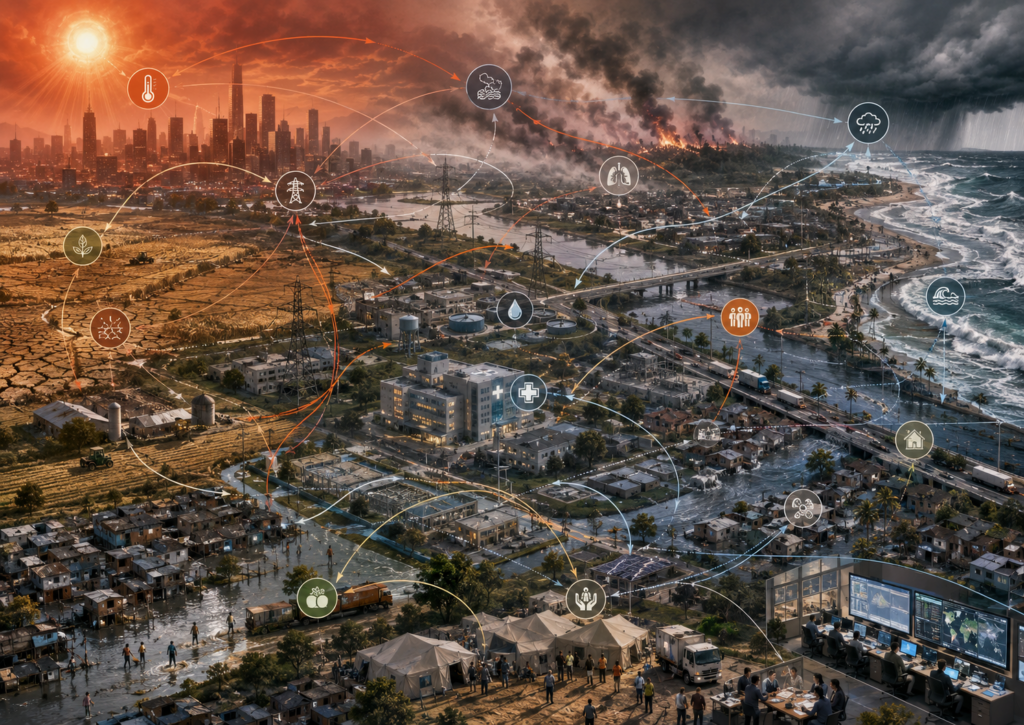
Editorial illustration of overlapping climate hazards, infrastructure systems, vulnerable communities, emergency response, and ecological buffers connected by cascading risk pathways.

Compound Climate Events and Cascading Social Risk

Compound climate events reveal why climate risk cannot be understood one hazard at a time. Heat, drought, flood, wildfire, storm surge, smoke, food stress, water scarcity, power instability, and disease risk often overlap or occur in close sequence, creating pressures that move through infrastructure, health systems, households, ecosystems, public agencies, and local economies. This article explains how compound events become cascading social risk when hazards interact with exposure, vulnerability, infrastructure fragility, food-water-energy stress, weak governance, recovery deficits, inequality, degraded ecological buffers, and unreliable communication. It also examines why single-hazard planning is inadequate, how social harm spreads beyond direct physical damage, and why resilience requires multi-hazard preparedness, cross-sector dependency mapping, public-health capacity, social protection, ecological restoration, and justice-centered climate governance.

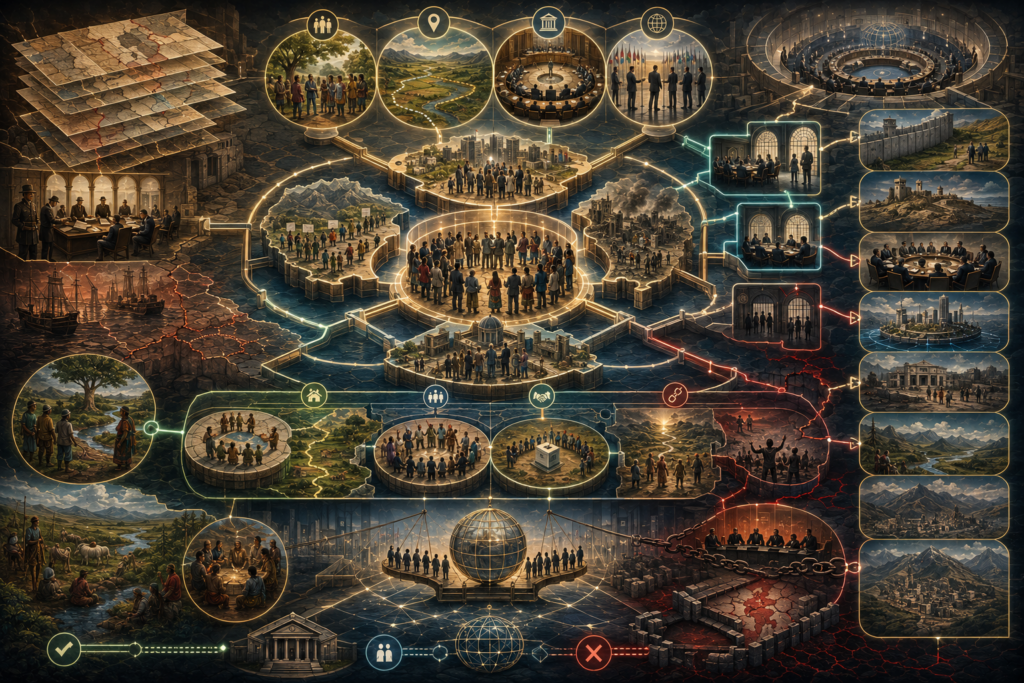
Abstract legal-studies illustration of secession, recognition, and contested statehood in international law, showing statehood criteria, recognition pathways, territorial integrity, self-determination, non-recognition, institutional exclusion, and selective legitimacy.

Secession, Recognition, and Contested Statehood

Secession, recognition, and contested statehood expose one of international law’s deepest tensions: peoples may claim the right to determine their political future, but the international system is organized around the stability of existing states. This article examines the Montevideo criteria, declaratory and constitutive theories of recognition, territorial integrity, self-determination, remedial secession, unilateral declarations of independence, UN membership, non-recognition, foreign intervention, proxy statehood, minority rights, autonomy, and contested examples. It treats statehood not as a purely technical checklist, but as a contested legal and political status shaped by effectiveness, consent, legitimacy, coercion, recognition practice, great-power politics, and the unresolved struggle over whose peoplehood international law is willing to recognize.

Abstract legal-studies illustration of treaty law and the Vienna Convention, showing treaty formation, consent, ratification, entry into force, interpretation, reservations, invalidity, amendment, termination, institutional governance, and unequal consent.

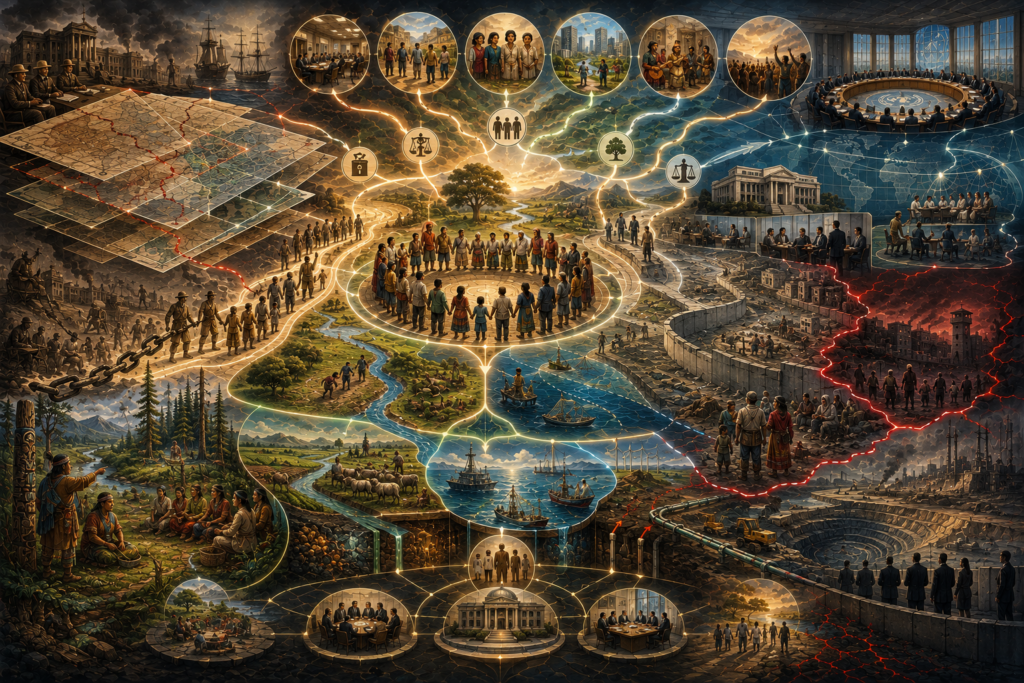
Self-Determination, Decolonization, and the Rights of Peoples

Self-determination is one of international law’s most powerful and unfinished principles. It affirms that peoples are not merely objects of empire, occupation, racial domination, resource extraction, or great-power negotiation, but legal and moral subjects with the right to determine their political status and pursue economic, social, and cultural development. This article examines the UN Charter, Resolution 1514, common Article 1 of the ICCPR and ICESCR, permanent sovereignty over natural resources, internal and external self-determination, territorial integrity, Indigenous peoples, Palestine, Western Sahara, Chagos, Namibia, East Timor, Kashmir, Kosovo, secession, and decolonization’s unfinished legal legacy. It treats self-determination as both a legal doctrine and a morally serious anti-colonial claim rooted in human dignity, consent, land, resources, and collective freedom.

Scroll to Top