Restrained institutional illustration of people interacting across a layered organizational campus with meeting rooms, courtyards, bridges, offices, libraries, and network pathways.

Human Behavior in Organizations

Human behavior in organizations is shaped by the interaction between people, roles, teams, leadership, culture, incentives, power, technology, and institutional design. Organizational psychology studies this interaction because behavior at work is never purely individual. People bring abilities, motives, values, emotions, identities, expectations, and habits into organizations, but those characteristics are filtered through job demands, authority structures, communication systems, reward systems, social norms, workload pressures, and the practical conditions of organized work. A systems view helps explain why people cooperate, resist, disengage, speak up, remain silent, innovate, burn out, or adapt under different organizational conditions. By connecting individual psychology with team dynamics and institutional systems, this article examines how work environments shape behavior and how organizations can create conditions that support clarity, trust, voice, learning, dignity, and sustainable performance.


Restrained institutional illustration showing the historical evolution of organizational psychology from industrial-era workplaces to modern collaborative, research-based organizational systems.

The Evolution of Organizational Psychology

The evolution of organizational psychology traces how the study of work moved from early concerns with efficiency, selection, testing, and performance measurement toward a broader science of motivation, leadership, teams, culture, fairness, well-being, technology, and institutional responsibility. What began as an applied effort to fit people to jobs and improve productivity gradually expanded into a deeper study of how organizations shape human behavior and how people shape institutions in return. The field’s history reveals an ongoing tension between administrative utility and human consequence: psychological knowledge can support better selection, training, and performance systems, but it can also be used to classify, monitor, exclude, or intensify work. At its strongest, organizational psychology connects evidence, ethics, systems thinking, and human dignity to help institutions become more effective without becoming less humane.

Detailed institutional illustration of organizational psychology, showing people collaborating, researching, mentoring, and meeting across a university-like organizational environment.

What Is Organizational Psychology?

Organizational psychology is the scientific study of how people think, feel, behave, coordinate, lead, decide, and adapt inside formal organizations. It examines work not simply as a collection of tasks, roles, procedures, or performance targets, but as a human system shaped by motivation, leadership, culture, communication, trust, fairness, psychological safety, conflict, decision-making, power, and institutional design. The field connects individual psychology with team dynamics and organizational systems, asking how work environments influence engagement, learning, cooperation, well-being, and performance. It also studies how institutions can become more effective without becoming less humane. By examining job design, leadership behavior, team coordination, culture, change, incentives, and employee experience together, organizational psychology offers a disciplined way to understand how people and organizations shape one another.

Editorial sustainability illustration showing a degraded landscape being restored into wetlands, flowing water, healthy soil, biodiversity corridors, community stewardship, Indigenous knowledge sharing, and ecological repair.

Regenerative Resilience and the Repair of Living Systems

Regenerative resilience and the repair of living systems begin from a deeper understanding of resilience: the goal is not only to withstand disturbance, recover after harm, or preserve existing systems under stress. In living systems, resilience also depends on the capacity to regenerate the ecological, social, and institutional foundations that make recovery, adaptation, health, livelihood, and long-term flourishing possible. This article examines regenerative resilience as the repair of soil, water, forests, wetlands, biodiversity, food systems, urban ecosystems, community stewardship, and public institutions. It connects restoration science, climate adaptation, Indigenous and local knowledge, justice, governance, and accountability, showing that regeneration is not simply an environmental practice but a social and ethical one. Resilience remains incomplete when damaged systems are stabilized without being healed. Long-term wellbeing requires societies to restore the living conditions that sustain people, places, and future generations.

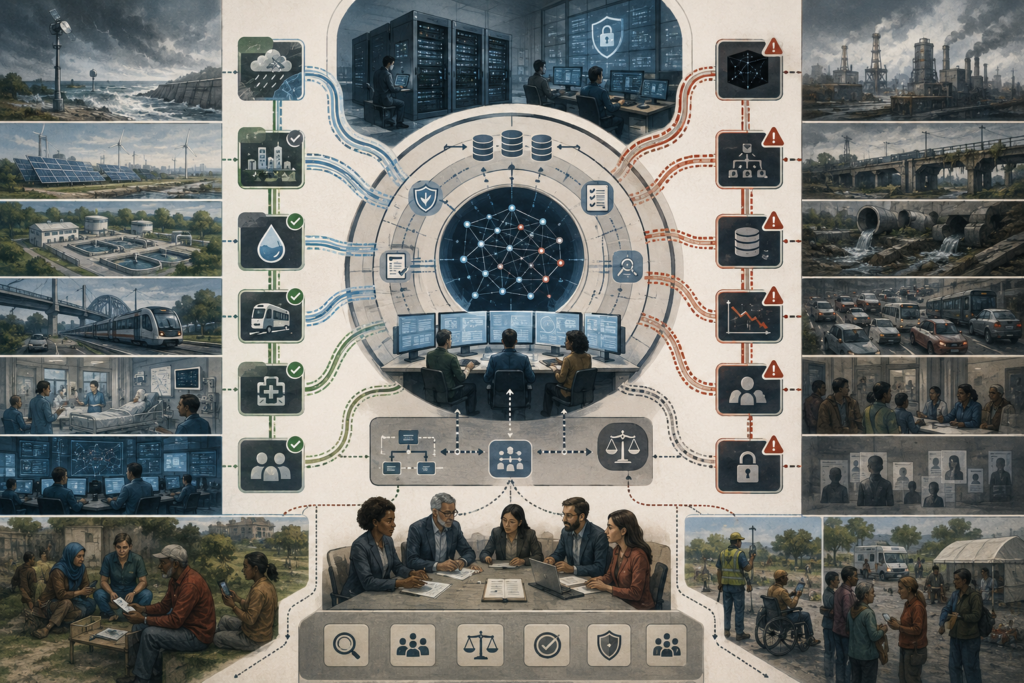
Editorial systems illustration showing AI governance infrastructure connecting public institutions, critical services, data centers, human oversight, audit trails, cyber risk, community review, and automated decision systems.

AI, Automation, and Resilience Under Algorithmic Governance

AI, automation, and resilience under algorithmic governance belong together because societies increasingly rely on automated systems to sense risk, allocate resources, prioritize response, classify vulnerability, monitor infrastructure, detect cyber threats, and shape decisions that affect human lives. This article examines AI as both a resilience capability and a systemic-risk source. It explains how algorithmic systems can strengthen early warning, forecasting, logistics, cyber defense, infrastructure monitoring, and public-service coordination, while also creating new fragilities through opaque decisions, automation dependency, model drift, cyber exposure, vendor concentration, bias, automated exclusion, and accountability gaps. It argues that resilient algorithmic governance requires human oversight, contestability, auditability, data provenance, fallback capacity, public legitimacy, and institutions capable of correcting automated harm.

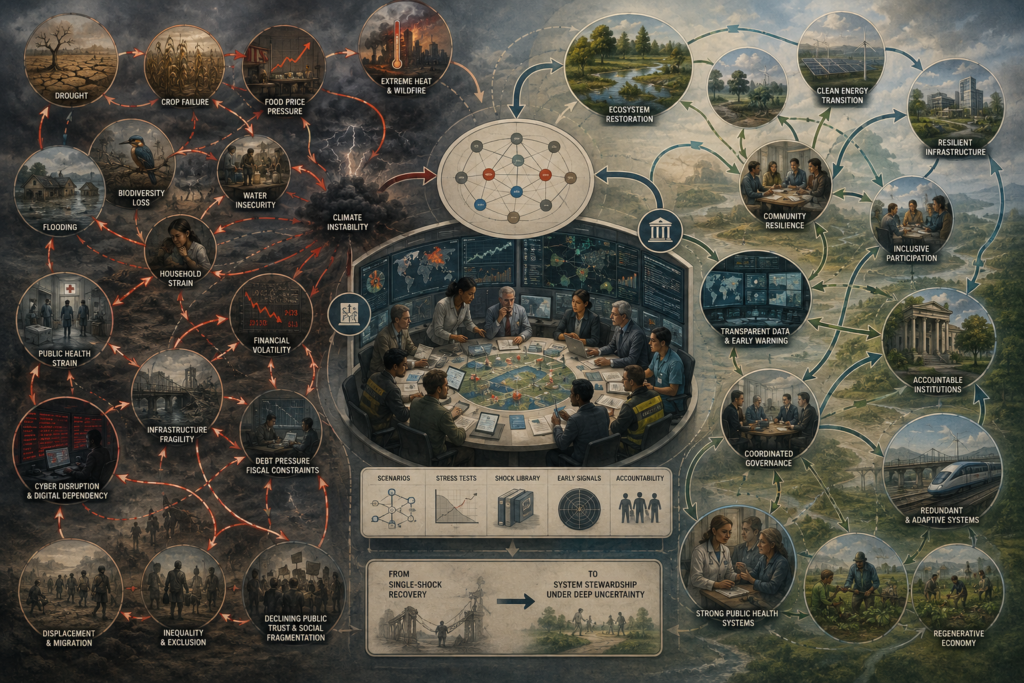
Editorial systems illustration showing interacting crises, climate stress, cyber disruption, debt pressure, public-health strain, infrastructure fragility, ecological thresholds, and adaptive resilience governance pathways.

Polycrisis, Systemic Risk, and the Future of Resilience Thinking

Polycrisis, systemic risk, and the future of resilience thinking belong together because modern disruption increasingly emerges from interacting crises rather than isolated shocks. Climate instability, biodiversity loss, debt stress, food insecurity, cyber dependency, geopolitical fragmentation, public-health risk, infrastructure fragility, technological disruption, inequality, democratic strain, and declining public trust do not unfold in separate compartments. They overlap, compound, amplify, and redirect one another. This article explains polycrisis as interacting systemic risk rather than a loose bundle of crises, examining cascading shocks, feedback loops, planetary boundaries, institutional overload, financial fragility, digital common-mode failure, legitimacy, maladaptation, and transformative resilience. It argues that resilience thinking must move beyond single-shock recovery toward system stewardship, justice, ecological renewal, data accountability, and governance capable of learning under uncertainty.

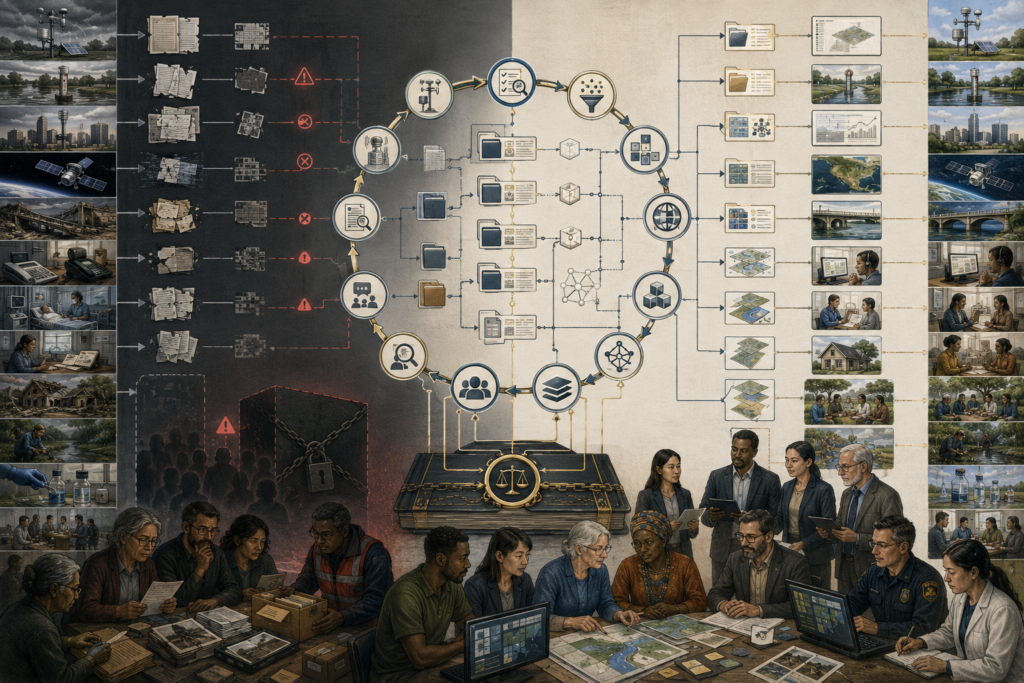
Editorial illustration showing interconnected agents, infrastructure systems, financial institutions, supply chains, hospitals, data centers, households, and public officials using network models to analyze systemic risk, contagion, and cascading failure.

Agent-Based Models, Network Models, and Systemic Risk

Agent-based models, network models, and systemic risk belong together because modern crises often emerge from interaction, interdependence, adaptation, and contagion rather than from one isolated failure. This article explains how heterogeneous agents, network topology, feedback loops, cascading failure, behavioral amplification, infrastructure dependencies, financial contagion, cyber common-mode failure, supply-chain fragility, and public-health dynamics shape systemic risk. It shows why aggregate models can miss hidden fragility and why agent-based and network approaches help analysts examine how local behavior becomes systemwide disruption. The article also explores resilience interventions such as redundancy, buffers, modularity, diversity, governance, stress testing, and model validation, arguing that systemic resilience requires understanding how connected systems behave under stress.

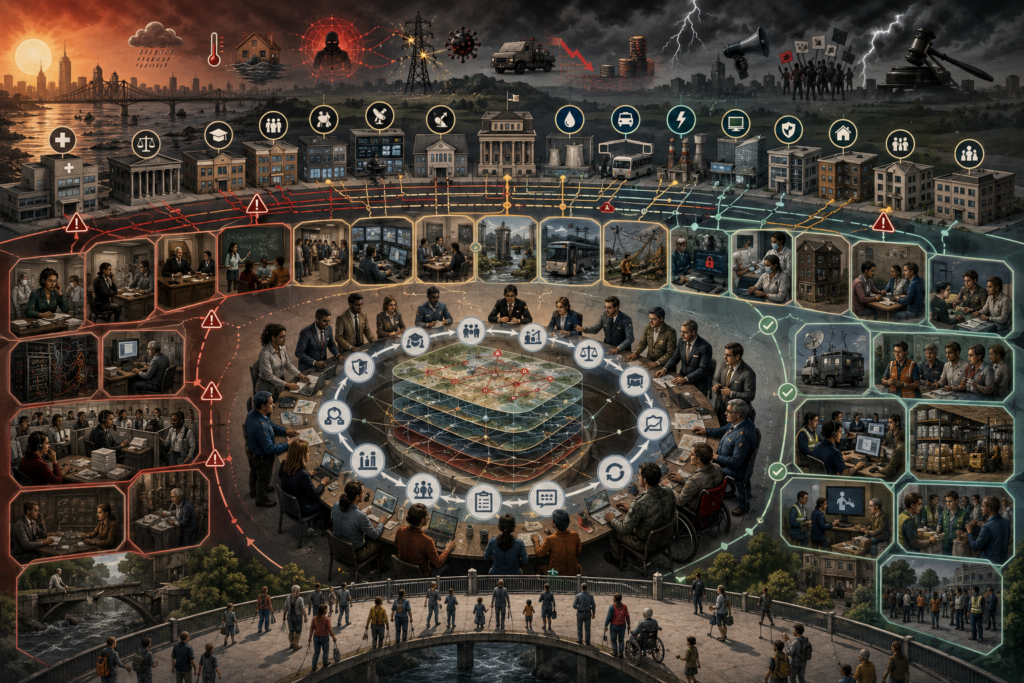
Editorial illustration of public institutions under compound stress, showing hospitals, courts, schools, utilities, digital systems, emergency managers, and community actors connected through a central stress-testing and service-continuity process.

Stress Testing Public Institutions

Stress testing public institutions means asking whether the systems people rely on can still perform essential functions when conditions become severe, simultaneous, uncertain, and politically difficult. This article examines stress testing as a governance practice for public resilience, connecting essential-function clarity, capacity margins, hidden dependencies, workforce resilience, digital infrastructure, legal authority, coordination, equity protection, and public trust. It shows why normal performance is not the same as resilience, and why public institutions must be tested against compound hazards, cyber disruption, staffing shortages, infrastructure failure, fiscal pressure, and cascading service breakdown. Stress testing does not predict the future; it reveals where public systems are fragile before crisis exposes those weaknesses through avoidable harm.

Scroll to Top