
Last Updated May 9, 2026
Regenerative resilience and the repair of living systems begin from a deeper understanding of resilience: the goal is not only to withstand disturbance, recover after harm, or preserve existing systems under stress. In living systems, resilience also depends on the capacity to regenerate the ecological, social, and institutional foundations that make recovery, adaptation, health, livelihood, and long-term flourishing possible. Soil must be able to rebuild fertility. Watersheds must be able to regulate flow. Forests must be able to renew structure and diversity. Wetlands must be able to buffer flood and filter water. Fisheries must be able to reproduce. Pollinators must be able to move through landscapes. Communities must be able to repair the relationships between land, water, biodiversity, livelihood, culture, public institutions, and future generations.
The older language of risk management often asks how systems can survive shocks. Regenerative resilience asks a more demanding question: what must be repaired so that systems do not merely survive repeated damage, but recover the living capacity to support life under changing conditions? This article builds from ecological resilience, biodiversity, restoration science, climate adaptation, Indigenous and local knowledge, and systems governance toward a broader theory of living-systems repair.
Main Library
Publications
Article Map
Risk & Resilience
Related Topic
Biodiversity
Related Topic
Regenerative Capacity
Related Topic
Polycrisis
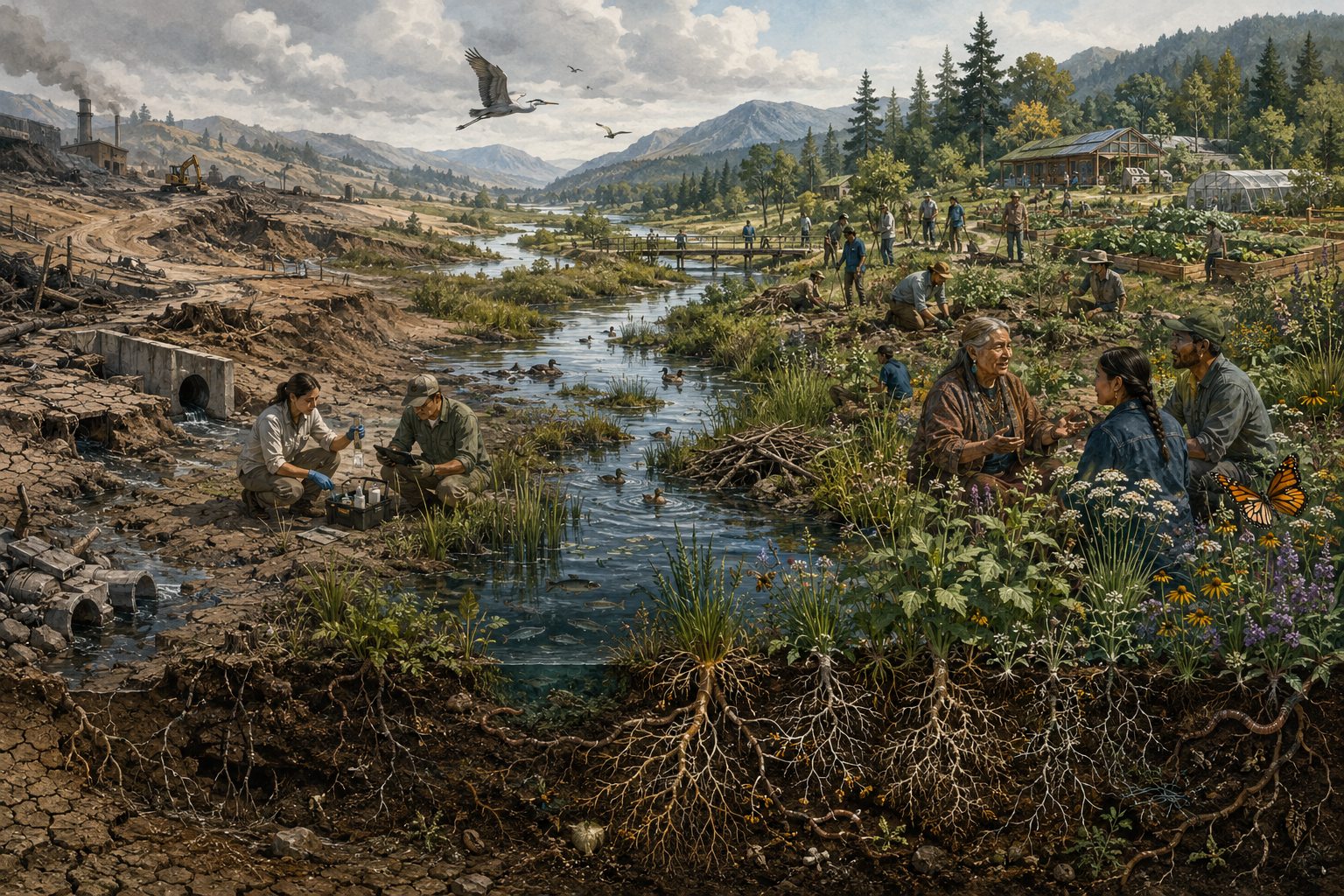
Regenerative resilience is not a vague green ideal. It is a systems concept. It asks how damaged ecological and social-ecological systems can regain the capacity to produce life-supporting functions. It asks how restoration can move beyond isolated projects into landscape-scale repair. It asks how public institutions, communities, Indigenous and local knowledge systems, farmers, scientists, conservation practitioners, engineers, planners, and policymakers can rebuild the conditions that reduce long-term systemic risk. It asks whether resilience is merely defensive—or whether it can become reparative, restorative, and transformative.
Why This Topic Matters
Regenerative resilience matters because many modern systems are trying to manage risk while the living foundations of resilience are being depleted. Climate adaptation plans may protect infrastructure while watersheds degrade. Food-security strategies may increase short-term production while soil organic matter, pollinators, genetic diversity, and water systems decline. Flood defenses may harden riverbanks while wetlands disappear. Urban resilience plans may add cooling centers while tree canopy, housing quality, and neighborhood ecological health remain unequal. Disaster-recovery systems may rebuild after damage while recreating the same exposure, the same land-use patterns, the same inequities, and the same ecological fragility.
This matters because resilience is not only a property of organizations, infrastructure, finance, or emergency systems. It is also a property of living relationships. Forests, soils, rivers, wetlands, grasslands, coral reefs, mangroves, fisheries, agricultural landscapes, and urban ecosystems all contain regenerative processes. They cycle nutrients, store carbon, filter water, buffer heat, hold soil, support pollination, regulate disease dynamics, and provide habitat. When these processes weaken, human systems become more exposed to shock.
A society can appear technologically sophisticated while becoming ecologically fragile. It can build stronger infrastructure while losing the living systems that reduce flood, drought, heat, disease, and food-system risk. It can measure resilience through dashboards while failing to measure soil decline, ecological fragmentation, watershed degradation, biodiversity loss, and community disconnection from land. It can finance recovery after disasters while underfunding the ecological repair that would reduce future disasters.
Regenerative resilience changes the frame. It asks not only how to protect assets from hazards, but how to repair the systems that make hazards less damaging. It asks not only how fast a community can recover, but whether recovery restores the living relationships needed for long-term adaptation. It asks not only what was lost, but what must be regenerated.
This is especially important in a period of polycrisis. Climate instability, biodiversity decline, water stress, food-system fragility, public-health vulnerability, migration pressure, infrastructure risk, and inequality increasingly interact. Living-systems degradation does not remain inside an environmental category. It moves through food, water, health, housing, public finance, insurance, livelihoods, migration, conflict, and public legitimacy.
Regenerative resilience is therefore not optional environmentalism. It is part of systemic resilience. It recognizes that societies cannot become resilient by armoring themselves against the collapse of the living systems that sustain them.
From Risk Management to Regeneration
Risk management often begins with hazards: flood, heat, drought, wildfire, storm, disease outbreak, supply-chain disruption, or infrastructure failure. It asks how likely these events are, what they may damage, and what protective measures can reduce loss. This is necessary. But it is incomplete when the underlying system is degrading.
A flood-risk strategy that ignores wetland loss remains partial. A drought strategy that ignores soil health and groundwater depletion remains partial. A heat strategy that ignores tree canopy, housing quality, labor protections, and public health remains partial. A food-security strategy that ignores pollinators, soil organisms, seed diversity, water systems, and farmer livelihoods remains partial. Defensive risk management can reduce immediate exposure while leaving the deeper sources of vulnerability untouched.
Regeneration begins from a different premise. It asks what living capacities must be restored so that the system becomes less fragile over time. In a watershed, this may mean reconnecting floodplains, restoring wetlands, rebuilding riparian vegetation, reducing pollution, improving soil infiltration, and changing land-use practices. In a food system, it may mean improving soil organic matter, diversifying crops, restoring pollinator habitat, protecting water, supporting agroecological practices, and strengthening local and regional food networks. In a city, it may mean expanding tree canopy, restoring urban streams, improving housing, reducing heat islands, protecting wetlands, and building community stewardship.
Regeneration is not the opposite of protection. Protective resilience and regenerative resilience can work together. A community may need flood barriers, early warning, evacuation routes, insurance, emergency services, and recovery funds. But if those measures are not paired with ecological repair, each future shock may become harder to manage. Regenerative resilience asks how protection can be joined to renewal.
The key shift is from defending against disturbance to rebuilding the capacities that allow systems to live with disturbance. Living systems are not machines. They cannot be maintained only by replacing parts. They require cycles, relationships, diversity, adaptation, and memory. When those conditions degrade, repair must be ecological, social, and institutional at the same time.
Regenerative resilience therefore expands the meaning of preparedness. Preparedness is not only an emergency plan. It is healthy soil before drought, wetlands before flood, tree canopy before heat, biodiversity before pest outbreak, public trust before crisis, community knowledge before evacuation, and governance capacity before thresholds are crossed.
What Living Systems Mean
Living systems are dynamic systems composed of organisms, relationships, processes, feedbacks, habitats, flows, and histories. They include forests, wetlands, grasslands, rivers, soils, reefs, farms, fisheries, watersheds, coastal systems, urban ecosystems, and the human communities embedded within them. They are not static backgrounds for human activity. They are active systems that produce conditions for life.
A living system has structure: species, habitats, soils, water pathways, canopy layers, roots, microbes, food webs, corridors, and physical forms. It has function: nutrient cycling, pollination, decomposition, water regulation, carbon storage, temperature moderation, flood buffering, seed dispersal, habitat creation, and energy flow. It has memory: seed banks, genetic variation, soil organisms, old trees, cultural practices, migration routes, hydrological patterns, and surviving ecological relationships. It has adaptive capacity: the ability to respond to changing conditions through variation, movement, reorganization, and learning.
Living systems are also social-ecological. Human communities shape and are shaped by ecological systems. Farming, fishing, forestry, grazing, fire management, settlement, water management, restoration, conservation, extraction, pollution, infrastructure, law, culture, and spirituality all influence living systems. The idea that nature exists outside society is often misleading. Many landscapes have been shaped by Indigenous and local stewardship over long periods. Many degraded landscapes have been shaped by colonial extraction, industrial land use, forced displacement, and unequal development.
This matters because repair cannot be purely technical. A river is not repaired only by engineering channels. A forest is not repaired only by planting trees. A food system is not repaired only by increasing yield. A wetland is not repaired only by drawing a boundary on a map. Living-systems repair must attend to hydrology, species, soil, land rights, community knowledge, governance, maintenance, monitoring, and long-term stewardship.
Living systems also do not respond instantly. Soil formation takes time. Forest structure takes time. Coral recovery takes time. Trust takes time. Ecological memory takes time. Regenerative resilience therefore requires longer time horizons than conventional project cycles. It asks institutions to govern across decades rather than only budgets, elections, or grant periods.
To repair living systems is to repair relationships: between water and land, species and habitat, people and place, knowledge and governance, present needs and future life.
Biodiversity as Regenerative Capacity
Biodiversity is one of the foundations of regenerative resilience because it gives living systems more ways to respond. Genetic diversity supports adaptation within species. Species diversity supports ecological richness and food-web complexity. Functional diversity supports multiple ecological roles. Response diversity allows organisms performing similar functions to respond differently to stress. Habitat diversity creates spaces for movement, reproduction, recovery, and reorganization.
In the companion article Biodiversity Loss and Ecological Resilience, biodiversity is treated as a direct foundation of ecological resilience. Here, the emphasis is slightly different: biodiversity is also regenerative capacity. It is part of the living repertoire through which damaged systems recover, reorganize, and renew function.
A degraded forest may recover if seed sources remain, soil biota persist, pollinators survive, and species can recolonize. A wetland may recover if hydrology is restored and plant, microbial, bird, fish, and invertebrate communities can reassemble. A farm landscape may regain resilience if crop diversity, soil organisms, beneficial insects, hedgerows, water retention, and habitat corridors are restored. A reef may recover from disturbance if coral diversity, fish communities, water quality, larval sources, and thermal refugia remain sufficient.
When biodiversity is deeply depleted, regeneration becomes harder. The system loses ecological options. Recovery pathways narrow. Functions become concentrated in fewer organisms. Disturbance can push the system toward simplified states. Restoration then requires more intervention because the living sources of recovery have been weakened.
Biodiversity also supports redundancy. Redundancy is often misunderstood as inefficiency, but in living systems it is a form of resilience. Multiple species that pollinate, decompose, disperse seeds, stabilize soil, filter water, or regulate pests provide backup under changing conditions. Species that seem redundant under normal conditions may respond differently under stress. That difference can preserve function when conditions change.
Regenerative resilience therefore requires more than protecting charismatic species or maximizing species counts. It requires protecting and restoring the living diversity that supports function, adaptation, recovery, and ecological memory. Biodiversity is not only what regeneration protects. It is one of the means by which regeneration happens.
Soil, Water, and Ecological Memory
Soil and water are among the deepest foundations of living-systems repair. Without healthy soil, ecosystems lose fertility, structure, infiltration, carbon storage, microbial life, and plant support. Without functioning water systems, landscapes lose flow regulation, habitat, groundwater recharge, flood buffering, drought resilience, and ecological continuity. Regenerative resilience begins by treating soil and water as living infrastructure.
Soil is not inert material. It contains organisms, organic matter, minerals, roots, fungi, bacteria, invertebrates, pores, aggregates, and histories of land use. Healthy soils can hold water, cycle nutrients, store carbon, support plants, reduce erosion, and buffer drought. Degraded soils lose structure, organic matter, biodiversity, and water-holding capacity. This can intensify flood runoff, drought stress, crop vulnerability, and ecosystem decline.
Water systems are also relational. Rivers, floodplains, wetlands, aquifers, forests, soils, rainfall, snowpack, vegetation, and human infrastructure interact. When wetlands are drained, rivers channelized, floodplains developed, forests cleared, and soils compacted, water moves differently. Floods may become more damaging. Droughts may become more severe. Water quality may decline. Ecosystem recovery may weaken.
Ecological memory connects soil and water to regeneration. It includes seed banks, surviving roots, microbial communities, old trees, hydrological patterns, habitat structure, species pools, genetic variation, cultural practices, and local knowledge. After disturbance, ecological memory helps guide recovery. When ecological memory remains, a system may regenerate from within. When it is lost, recovery becomes slower, more expensive, and more uncertain.
Restoration projects often fail when they ignore these foundations. Planting trees without restoring soil, water, species diversity, maintenance, and local governance may produce low survival. Restoring a stream channel without reconnecting floodplains or changing upstream land use may produce limited resilience. Building green infrastructure without maintaining it or involving communities may create short-lived benefits.
Regenerative resilience asks what the system remembers and what memory has been erased. Are seed sources present? Are soils alive? Are water flows functional? Are species able to return? Are local knowledge systems respected? Are communities connected to stewardship? Repair begins by rebuilding the conditions under which living systems can remember how to recover.
Restoration, Regeneration, and Repair
Restoration, regeneration, and repair are related but not identical. Restoration often refers to assisting the recovery of degraded ecosystems. Regeneration emphasizes the renewal of living processes and capacities. Repair adds a moral and political dimension: harm has been done, and responsibility exists to address it. Regenerative resilience brings these ideas together.
Restoration can be technical, ecological, and social. It may involve rewetting wetlands, removing invasive species, restoring native vegetation, reconnecting rivers to floodplains, rebuilding oyster reefs, restoring mangroves, improving soil health, reintroducing species, reducing pollution, changing grazing practices, restoring fire regimes, or protecting habitat corridors. But restoration is not only a list of interventions. It is a long-term process of recovery, monitoring, learning, and stewardship.
Regeneration asks whether the restored system can continue renewing itself. A planted forest that requires constant replacement because seedlings fail is not fully regenerative. A wetland that looks green but lacks hydrological function is not fully regenerative. A farm that increases soil cover but remains dependent on degraded water systems, chemical inputs, and biodiversity loss may not yet be regenerative. Regeneration means that living processes begin to sustain recovery.
Repair asks who was harmed, who benefits, who decides, and who is responsible. Ecological degradation is often tied to unequal power: land dispossession, extractive economies, pollution, colonial land management, forced displacement, industrial agriculture, poorly planned infrastructure, and environmental racism. Repair cannot be credible if it ignores these histories.
This is why regenerative resilience must avoid superficial “green” language. Tree planting is not automatically repair. Carbon offsets are not automatically repair. Nature-based solutions are not automatically repair. A project may look ecological while reproducing land injustice, excluding local communities, simplifying ecosystems, or protecting high-value assets while shifting risk elsewhere.
Real repair requires ecological integrity, community legitimacy, long-term maintenance, monitoring, and accountability. It asks whether the system is recovering function, whether vulnerable groups are protected, whether rights are respected, whether knowledge systems are included, whether harm is reduced rather than displaced, and whether the project will persist beyond the funding cycle.
Regenerative resilience is therefore not an aesthetic of greenness. It is a disciplined practice of restoring living capacity in ways that are ecologically functional and socially legitimate.
Climate Risk and Living Systems
Climate risk is inseparable from living systems. Climate change alters heat, rainfall, drought, fire, storms, sea level, ocean temperature, acidification, pest pressure, disease dynamics, and species ranges. Living systems shape how those changes are experienced. Forests, soils, wetlands, reefs, grasslands, mangroves, urban tree canopy, rivers, and agricultural landscapes can buffer climate impacts—or amplify them when degraded.
Healthy ecosystems reduce climate vulnerability in multiple ways. Wetlands store water and reduce flood peaks. Mangroves and reefs reduce coastal storm impacts. Forests moderate temperature, stabilize slopes, regulate water, and store carbon. Soils hold moisture and carbon. Grasslands support infiltration and biodiversity. Urban trees reduce heat. Diverse agricultural systems can support pest regulation, pollination, and drought resilience.
Degraded ecosystems reduce these buffers. A drained wetland cannot absorb floodwater in the same way. A compacted soil cannot hold rainfall in the same way. A fragmented forest cannot support species movement in the same way. A dead reef cannot buffer waves or sustain fisheries in the same way. A city without tree canopy exposes residents to more heat, especially in neighborhoods already burdened by poverty, poor housing, and pollution.
Climate adaptation can therefore be regenerative or maladaptive. It is regenerative when it strengthens ecological function, reduces exposure, supports justice, and builds long-term capacity. It becomes maladaptive when it protects one asset while degrading ecosystems, displacing communities, increasing emissions, or locking systems into fragile pathways.
For example, a hard coastal wall may protect infrastructure in the short term but accelerate erosion elsewhere if poorly designed. Air conditioning can reduce heat risk but increase energy demand and emissions if not paired with clean power, housing improvements, and urban cooling. Irrigation can support crops but deplete groundwater if not governed. A monoculture tree plantation may store carbon but reduce biodiversity, water availability, and fire resilience.
Regenerative climate resilience asks how adaptation can restore the living systems that reduce climate risk. It links climate action with biodiversity, water, soil, public health, land rights, food systems, infrastructure, and community stewardship.
The future of climate resilience will depend not only on emissions reduction and engineered protection, but on whether living systems retain the capacity to regulate, buffer, recover, and adapt.
Thresholds, Degradation, and Regime Shifts
Living systems can absorb disturbance up to a point. Beyond certain thresholds, they may reorganize into degraded states that are difficult to reverse. A lake may shift to persistent algal dominance. A forest may shift toward shrubland or grassland after repeated fire, drought, pests, and regeneration failure. A grassland may shift toward desertification. A coral reef may shift toward algal dominance after bleaching, pollution, and overfishing. A wetland may lose hydrological function and become less able to recover.
Regenerative resilience matters because degradation can become self-reinforcing. Vegetation loss increases erosion. Erosion reduces soil fertility. Reduced fertility limits plant recovery. Reduced plant cover increases runoff. Runoff worsens water quality. Water-quality decline affects species and human use. The system moves farther from recovery.
Thresholds are dangerous because visible change can lag behind functional decline. A forest may still appear forested while losing seedlings, soil moisture, species diversity, and fire resilience. A watershed may still supply water while losing ecological buffering. A farm may still produce yields while drawing down soil, groundwater, and biodiversity. A city may still function while heat, flood, housing, and public-health vulnerabilities accumulate.
Regenerative resilience is partly a threshold strategy. It seeks to restore ecological capacity before degradation becomes irreversible or extremely costly. It asks which functions are declining, which feedbacks are turning harmful, which thresholds are approaching, and which interventions can restore stabilizing feedbacks.
This requires monitoring. Without ecological indicators, thresholds may remain invisible until crisis. Soil organic matter, groundwater levels, species diversity, seedling recruitment, wetland hydrology, pollinator abundance, water quality, canopy cover, fire regime, invasive species pressure, and habitat connectivity can all serve as early-warning indicators.
Threshold thinking also changes governance. Institutions should not wait for collapse before acting. They need precautionary triggers, adaptive management, restoration finance, community monitoring, and legal authority to intervene before systems cross critical boundaries. Prevention is often cheaper, more humane, and more ecologically realistic than late-stage repair.
Regenerative resilience does not assume that every damaged system can be fully restored to a prior state. Some systems will transform under climate change and long-term human pressure. But repair can still increase function, diversity, connectivity, and adaptive capacity. The goal is not nostalgia. It is renewed viability.
Food Systems and Regenerative Landscapes
Food systems are one of the most important domains for regenerative resilience. Agriculture, fisheries, pastoral systems, forests, water systems, soils, pollinators, markets, labor, public health, and culture all intersect in food. A food system can appear productive while becoming fragile if it degrades the living systems on which future production depends.
Regenerative resilience in food systems begins with soil. Soil organic matter, microbial diversity, structure, water-holding capacity, nutrient cycling, and biological activity all shape resilience to drought, flood, heat, pests, and erosion. Practices that protect soil cover, diversify plantings, reduce erosion, improve organic matter, manage grazing carefully, and reduce harmful inputs can support long-term resilience when adapted to place and context.
Biodiversity also matters. Crop diversity, livestock diversity, pollinator habitat, beneficial insects, hedgerows, agroforestry, seed diversity, crop wild relatives, and landscape mosaics can reduce vulnerability. Highly simplified systems may produce efficiently under stable conditions but become brittle under disturbance.
Water is equally central. Irrigation, rainfall, groundwater, wetlands, rivers, soil moisture, and watershed health shape food-system resilience. Regenerative landscapes aim to slow, store, infiltrate, and clean water rather than simply move it away as fast as possible.
Food-system regeneration also has a justice dimension. Farmers, farmworkers, Indigenous food systems, small-scale fishers, pastoralists, rural communities, and consumers experience food-system risk differently. A regenerative strategy that ignores labor, land tenure, debt, market power, pesticide exposure, food access, and cultural foodways remains incomplete.
Regenerative agriculture is sometimes used loosely, and the term can be captured by marketing. The resilience question should be concrete: Are soils improving? Is biodiversity increasing? Is water use sustainable? Are livelihoods more secure? Are workers protected? Are emissions reduced? Is resilience increasing across the landscape, or only on a single farm? Are benefits distributed fairly?
Food systems also connect local and global risk. A drought in one region, fertilizer-price shock, conflict, trade disruption, disease outbreak, or energy-price spike can affect food availability and affordability elsewhere. Regenerative landscapes cannot eliminate global food-system risk, but they can increase local and regional buffers.
Regenerative resilience in food systems means producing food while repairing the ecological and social conditions that make food production possible over time.
Cities, Infrastructure, and Nature-Based Resilience
Cities are living systems too. They contain watersheds, trees, soils, parks, vacant lots, gardens, streams, wetlands, birds, insects, microbes, people, buildings, roads, pipes, power systems, public institutions, and histories of unequal development. Urban resilience cannot be achieved only through concrete, steel, sensors, and emergency plans. It also depends on ecological repair.
Nature-based resilience in cities can reduce heat, flood, air pollution, stormwater burden, mental-health stress, and biodiversity loss. Urban tree canopy can reduce heat exposure. Restored streams and wetlands can absorb stormwater. Green roofs and rain gardens can slow runoff. Parks and ecological corridors can support habitat and social wellbeing. Healthy soils can absorb water. Coastal wetlands and dunes can buffer storm surge.
But urban nature-based solutions must be designed carefully. A green project can cause displacement if it raises land values without housing protections. Tree planting can fail if maintenance is underfunded. Green infrastructure can perform poorly if placed without hydrological analysis. Parks can reproduce inequality if wealthy neighborhoods receive high-quality green space while marginalized neighborhoods remain exposed to heat, flood, and pollution.
Regenerative urban resilience must therefore connect ecological design with housing justice, public health, infrastructure planning, maintenance budgets, community governance, and climate adaptation. It must ask where ecological benefits are needed most, who controls the land, who maintains the project, who benefits, and who may be displaced.
Infrastructure systems can also be redesigned to work with living systems. Roads, drainage, water supply, wastewater, energy, housing, and public spaces can be planned in relation to watersheds, floodplains, heat, soils, tree canopy, and habitat connectivity. This does not mean replacing all engineered infrastructure with ecological infrastructure. It means combining engineered and living systems in ways that reduce risk and restore ecological function.
Nature-based resilience should also be measured. Does the project reduce flood peak? Does it lower neighborhood heat? Does it improve water quality? Does it increase biodiversity? Does it reduce combined sewer overflow? Does it support community use? Does it require maintenance? Does it protect vulnerable residents?
Cities will be central to the future of resilience. Regenerative urbanism asks whether cities can become places that repair living systems rather than merely consume them.
Justice, Indigenous Knowledge, and Repair
Regenerative resilience cannot be separated from justice. Living-systems degradation is often tied to histories of land dispossession, colonial extraction, pollution, forced displacement, racialized planning, unequal infrastructure, labor exploitation, and exclusion from decision-making. Repair must therefore address both ecological harm and unequal power.
Indigenous Peoples and local communities have stewarded many landscapes and seascapes for generations. Their knowledge systems often include careful observation of seasonal cycles, fire, water, species behavior, soil, fisheries, forests, grazing, medicinal plants, and reciprocal obligations to land. These knowledge systems are not simply “local color” added to technical projects. They are forms of governance, science, ethics, and long-term ecological memory.
Regenerative resilience should respect Indigenous sovereignty, land rights, consent, cultural relationships, and knowledge authority. It should not extract knowledge without power-sharing. It should not use conservation or restoration as a justification for displacement. It should not treat communities as obstacles to nature when many landscapes now called “natural” have long histories of human stewardship.
Justice also requires attention to who experiences ecological degradation first. Low-income neighborhoods often have less tree canopy, more heat exposure, more flood risk, more pollution, poorer housing, and weaker public services. Rural communities may face soil degradation, water contamination, extractive land use, and economic vulnerability. Coastal and island communities may face sea-level rise, fisheries decline, storm risk, and cultural loss. Workers may face heat, pesticide exposure, unstable employment, and disaster risk.
Repair must be participatory. Communities should help define what restoration means, which harms matter, which indicators are valid, which interventions are legitimate, and how benefits are distributed. This is not only ethical; it improves resilience. People who live in a place often know failure pathways that official systems miss.
Regenerative resilience also requires protecting environmental defenders, community stewards, and frontline knowledge holders. Where people are punished for defending land, water, forests, or community health, resilience governance is already failing.
Justice-centered repair asks: who was harmed, who decides, who benefits, who bears risk, whose knowledge counts, and what obligations remain after damage has been done? Without these questions, regeneration can become another language of extraction.
Measurement, Governance, and Accountability
Regenerative resilience requires measurement, but measurement must be aligned with living systems. A project should not be judged only by acres planted, funds spent, or carbon stored. It should be judged by whether ecological function, biodiversity, water regulation, soil health, community stewardship, justice, and adaptive capacity are improving over time.
Useful indicators may include soil organic matter, infiltration, erosion rates, groundwater recharge, water quality, wetland extent, habitat connectivity, native species recovery, pollinator abundance, canopy cover, temperature reduction, flood attenuation, carbon storage, seedling recruitment, invasive species pressure, restoration survival, community access, land tenure security, public-health co-benefits, and governance participation.
Measurement should also distinguish between outputs and outcomes. Planting trees is an output. Surviving, diverse, climate-appropriate, community-supported tree canopy that reduces heat and supports habitat is an outcome. Building a wetland is an output. Restored hydrology, improved water quality, habitat recovery, and flood buffering are outcomes. Holding a public meeting is an output. Shared decision-making and changed project design are outcomes.
Accountability matters because regenerative language can be misused. A project can claim regeneration while delivering monoculture plantations, displacement, weak biodiversity, low survival, poor maintenance, or carbon accounting without ecological repair. Strong governance should require transparency, monitoring, independent review, community participation, and correction when projects fail.
Regenerative resilience also requires long-term finance. Living-systems repair often takes decades. Short grant cycles can encourage superficial projects. Maintenance, monitoring, adaptive management, community stewardship, and institutional capacity must be funded. Otherwise, restoration becomes event-based rather than regenerative.
Data governance is also important. Ecological data should have provenance, quality notes, uncertainty, and public accessibility where appropriate. Community data should be protected and governed ethically. Indigenous and local knowledge should not be reduced to extractive datasets. Measurement systems must make missingness visible rather than hiding uncertainty behind dashboards.
Governance should connect measurement to action. If soil is declining, land management should change. If wetlands are not recovering, hydrology should be reassessed. If tree mortality is high, planting methods and maintenance should change. If benefits are inequitable, distribution should change.
Regenerative resilience is not proven by intention. It must be demonstrated through accountable repair.
Toward Regenerative Resilience
Regenerative resilience asks societies to move beyond survival. It asks whether recovery can repair the foundations of life. It asks whether adaptation can reduce future vulnerability rather than merely manage present damage. It asks whether infrastructure can work with living systems. It asks whether food systems can produce without degrading soil, water, biodiversity, and labor. It asks whether climate resilience can restore ecosystems rather than only defend assets. It asks whether governance can honor justice, local knowledge, and public accountability.
The first principle is to protect what still functions. High-integrity ecosystems, old-growth forests, wetlands, peatlands, mangroves, reefs, native grasslands, healthy soils, intact watersheds, and biodiversity-rich habitats cannot be casually sacrificed on the assumption that restoration can replace them. Protection is often the most effective form of resilience.
The second principle is to restore degraded systems where repair is possible. Restoration should be functional, place-based, monitored, and socially legitimate. It should rebuild hydrology, soil, biodiversity, connectivity, ecological memory, and stewardship.
The third principle is to reconnect systems. Habitat corridors, river-floodplain connections, urban ecological networks, regional food systems, and community stewardship all support resilience by restoring relationships.
The fourth principle is to reduce the drivers of degradation. Regeneration cannot succeed if pollution, extraction, land conversion, overharvest, climate stress, and unjust governance continue unchecked.
The fifth principle is to center justice. Repair must include communities harmed by degradation and by past forms of development. It must respect Indigenous and local knowledge, land rights, and cultural relationships to place.
The sixth principle is to build institutions capable of learning. Living systems change. Restoration outcomes vary. Climate conditions shift. Governance must be adaptive, transparent, and accountable.
Regenerative resilience is not a substitute for emissions reduction, disaster preparedness, infrastructure investment, public health, social protection, or risk finance. It is a necessary complement to them. It reminds us that the deepest resilience does not come from controlling nature, but from repairing the living relationships that make human futures possible.
The future of resilience will be regenerative or it will remain incomplete.
Mathematical Lens
A regenerative resilience score can be represented as a function of ecological integrity, biodiversity, soil health, water-system function, connectivity, stewardship, governance, and justice, reduced by degradation pressure, fragmentation, extraction, pollution, and maladaptation risk. Let \(R_g\) represent regenerative resilience:
R_g = \alpha E_i + \beta B_d + \gamma S_h + \delta W_f + \epsilon C_n + \zeta L_s + \eta G_a + \theta J_r – \lambda D_p – \mu F_g – \nu X_c – \xi M_a
\]
Interpretation: Regenerative resilience rises when ecosystem integrity, biodiversity, soil health, water function, connectivity, stewardship, governance, and justice are strong. It declines when degradation pressure, fragmentation, extraction, and maladaptation risk intensify.
A living-systems repair gap can be represented as:
G_l = P_d – R_g
\]
Interpretation: The living-systems repair gap grows when degradation pressure \(P_d\) exceeds regenerative resilience \(R_g\). A large positive gap suggests that repair efforts are not yet sufficient to overcome ecological and social-ecological stress.
A restoration integrity score can be represented as:
I_r = \frac{F_r + B_r + H_r + C_r + J_r}{5}
\]
Interpretation: Restoration integrity increases when functional recovery, biodiversity recovery, hydrological repair, community stewardship, and justice outcomes improve together.
| Term | Meaning | Interpretive role |
|---|---|---|
| \(R_g\) | Regenerative resilience | Represents the living system’s capacity to repair, regenerate, and sustain function under stress. |
| \(E_i\) | Ecosystem integrity | Represents ecological condition, structure, function, and continuity. |
| \(B_d\) | Biodiversity | Represents genetic, species, functional, and habitat diversity. |
| \(S_h\) | Soil health | Represents organic matter, soil structure, biological activity, fertility, and water-holding capacity. |
| \(W_f\) | Water-system function | Represents hydrology, infiltration, water quality, flood buffering, and drought resilience. |
| \(C_n\) | Connectivity | Represents habitat corridors, watershed connections, species movement, and landscape continuity. |
| \(L_s\) | Local stewardship | Represents community, Indigenous, local, farmer, fisher, and practitioner stewardship capacity. |
| \(G_a\) | Governance accountability | Represents institutional capacity, monitoring, transparency, and adaptive management. |
| \(J_r\) | Justice and repair | Represents rights, participation, equitable benefit, consent, and repair of historical harm. |
| \(D_p\) | Degradation pressure | Represents chronic ecological stress, land-use pressure, and cumulative system damage. |
| \(M_a\) | Maladaptation risk | Represents the risk that resilience measures shift harm, simplify ecosystems, or deepen inequity. |
| \(G_l\) | Living-systems repair gap | Represents the gap between degradation pressure and regenerative capacity. |
The equations are conceptual rather than predictive. Their value is to make the systems logic explicit: regenerative resilience is not a single ecological variable, and it cannot be measured only by project outputs. It depends on ecological function, social legitimacy, governance capacity, and the repair of living relationships.
Advanced Python Workflow: Regenerative Resilience Scoring
This Python workflow evaluates regenerative resilience by combining ecosystem integrity, biodiversity, soil health, water function, connectivity, local stewardship, governance accountability, justice, and monitoring quality against degradation pressure, fragmentation, extraction pressure, pollution pressure, climate stress, and maladaptation risk.
from __future__ import annotations

import pandas as pd
import numpy as np

INPUT_FILE = "regenerative_resilience_panel.csv"
OUTPUT_FILE = "regenerative_resilience_scores.csv"


def load_data(path: str) -> pd.DataFrame:
    """
    Load a regenerative resilience dataset.

    All *_index columns should be normalized to [0, 1].
    Higher values should mean more of the named property.

    Examples:
      - ecosystem_integrity_index: higher = stronger ecosystem condition and function
      - soil_health_index: higher = stronger soil regenerative capacity
      - degradation_pressure_index: higher = greater chronic ecological stress
      - maladaptation_risk_index: higher = greater risk of harmful or superficial interventions
    """
    df = pd.read_csv(path)

    required_columns = [
        "system_name",
        "jurisdiction",
        "system_type",
        "ecosystem_integrity_index",
        "biodiversity_index",
        "soil_health_index",
        "water_function_index",
        "connectivity_index",
        "local_stewardship_index",
        "governance_accountability_index",
        "justice_repair_index",
        "monitoring_quality_index",
        "degradation_pressure_index",
        "fragmentation_pressure_index",
        "extraction_pressure_index",
        "pollution_pressure_index",
        "climate_stress_index",
        "maladaptation_risk_index",
    ]

    missing = [col for col in required_columns if col not in df.columns]

    if missing:
        raise ValueError(f"Missing required columns: {missing}")

    return df


def validate_indices(df: pd.DataFrame) -> pd.DataFrame:
    """Validate that all *_index fields are complete and normalized to [0, 1]."""
    index_columns = [col for col in df.columns if col.endswith("_index")]

    for col in index_columns:
        if df[col].isna().any():
            raise ValueError(f"Column '{col}' contains missing values.")

        if ((df[col] < 0) | (df[col] > 1)).any():
            raise ValueError(f"Column '{col}' contains values outside [0, 1].")

    return df


def compute_scores(df: pd.DataFrame) -> pd.DataFrame:
    """
    Compute regenerative capacity, degradation pressure,
    and the living-systems repair gap.
    """
    df = df.copy()

    df["regenerative_capacity_score"] = (
        0.15 * df["ecosystem_integrity_index"] +
        0.14 * df["biodiversity_index"] +
        0.14 * df["soil_health_index"] +
        0.13 * df["water_function_index"] +
        0.12 * df["connectivity_index"] +
        0.10 * df["local_stewardship_index"] +
        0.10 * df["governance_accountability_index"] +
        0.08 * df["justice_repair_index"] +
        0.04 * df["monitoring_quality_index"]
    ).clip(lower=0, upper=1)

    df["degradation_pressure_score"] = (
        0.20 * df["degradation_pressure_index"] +
        0.17 * df["fragmentation_pressure_index"] +
        0.16 * df["extraction_pressure_index"] +
        0.15 * df["pollution_pressure_index"] +
        0.18 * df["climate_stress_index"] +
        0.14 * df["maladaptation_risk_index"]
    ).clip(lower=0, upper=1)

    df["living_systems_repair_gap"] = (
        df["regenerative_capacity_score"] -
        df["degradation_pressure_score"]
    )

    df["regenerative_resilience_band"] = np.select(
        [
            df["regenerative_capacity_score"] >= 0.80,
            df["regenerative_capacity_score"] >= 0.60,
            df["regenerative_capacity_score"] >= 0.40,
        ],
        [
            "Strong regenerative resilience",
            "Moderate regenerative resilience",
            "Limited regenerative resilience",
        ],
        default="Weak regenerative resilience",
    )

    df["repair_warning"] = np.select(
        [
            df["degradation_pressure_score"] - df["regenerative_capacity_score"] >= 0.35,
            df["degradation_pressure_score"] - df["regenerative_capacity_score"] >= 0.20,
            df["degradation_pressure_score"] - df["regenerative_capacity_score"] >= 0.05,
        ],
        [
            "Severe living-systems repair gap",
            "High living-systems repair gap",
            "Moderate living-systems repair gap",
        ],
        default="Lower repair gap or stronger regenerative capacity",
    )

    return df


def build_summary(df: pd.DataFrame) -> pd.DataFrame:
    """Return a ranked summary table for regenerative resilience review."""
    columns = [
        "system_name",
        "jurisdiction",
        "system_type",
        "regenerative_capacity_score",
        "degradation_pressure_score",
        "living_systems_repair_gap",
        "regenerative_resilience_band",
        "repair_warning",
    ]

    summary = df[columns].copy()

    summary = summary.sort_values(
        by=[
            "living_systems_repair_gap",
            "regenerative_capacity_score",
            "degradation_pressure_score",
        ],
        ascending=[False, False, True],
    ).reset_index(drop=True)

    return summary


def main() -> None:
    df = load_data(INPUT_FILE)
    df = validate_indices(df)
    scored = compute_scores(df)
    summary = build_summary(scored)

    summary.to_csv(OUTPUT_FILE, index=False)

    print("Regenerative resilience scoring complete.")
    print(summary.to_string(index=False))


if __name__ == "__main__":
    main()
This workflow is diagnostic rather than definitive. It does not claim that living-systems repair can be reduced to one universal score. It helps analysts distinguish systems where regenerative capacity is growing from systems where degradation pressure still exceeds the capacity of soil, water, biodiversity, governance, and stewardship to recover.
Advanced R Workflow: Living-Systems Repair Diagnostics
This R workflow summarizes regenerative capacity and degradation pressure by jurisdiction and system type. It is useful for comparing watersheds, forests, wetlands, urban ecosystems, agricultural landscapes, coastal systems, and restoration areas.
library(readr)
library(dplyr)

input_file <- "regenerative_resilience_panel.csv"
jurisdiction_output_file <- "regenerative_resilience_jurisdiction_summary.csv"
system_output_file <- "regenerative_resilience_system_type_summary.csv"

regen_df <- read_csv(input_file, show_col_types = FALSE)

required_cols <- c(
  "system_name",
  "jurisdiction",
  "system_type",
  "ecosystem_integrity_index",
  "biodiversity_index",
  "soil_health_index",
  "water_function_index",
  "connectivity_index",
  "local_stewardship_index",
  "governance_accountability_index",
  "justice_repair_index",
  "monitoring_quality_index",
  "degradation_pressure_index",
  "fragmentation_pressure_index",
  "extraction_pressure_index",
  "pollution_pressure_index",
  "climate_stress_index",
  "maladaptation_risk_index"
)

missing_cols <- setdiff(required_cols, names(regen_df))

if (length(missing_cols) > 0) {
  stop(paste("Missing required columns:", paste(missing_cols, collapse = ", ")))
}

index_cols <- names(regen_df)[grepl("_index$", names(regen_df))]

invalid_index_cols <- index_cols[
  vapply(
    regen_df[index_cols],
    function(x) any(is.na(x) | x < 0 | x > 1),
    logical(1)
  )
]

if (length(invalid_index_cols) > 0) {
  stop(
    paste(
      "Index columns must be complete and normalized to [0, 1]:",
      paste(invalid_index_cols, collapse = ", ")
    )
  )
}

regen_df <- regen_df %>%
  mutate(
    regenerative_capacity_proxy = (
      ecosystem_integrity_index +
        biodiversity_index +
        soil_health_index +
        water_function_index +
        connectivity_index +
        local_stewardship_index +
        governance_accountability_index +
        justice_repair_index +
        monitoring_quality_index
    ) / 9,
    degradation_pressure_proxy = (
      degradation_pressure_index +
        fragmentation_pressure_index +
        extraction_pressure_index +
        pollution_pressure_index +
        climate_stress_index +
        maladaptation_risk_index
    ) / 6,
    living_systems_repair_gap = regenerative_capacity_proxy -
      degradation_pressure_proxy,
    regenerative_resilience_band = case_when(
      regenerative_capacity_proxy >= 0.75 ~ "Strong regenerative resilience",
      regenerative_capacity_proxy >= 0.55 ~ "Moderate regenerative resilience",
      regenerative_capacity_proxy >= 0.35 ~ "Limited regenerative resilience",
      TRUE ~ "Weak regenerative resilience"
    )
  )

jurisdiction_summary <- regen_df %>%
  group_by(jurisdiction) %>%
  summarise(
    avg_regenerative_capacity = mean(regenerative_capacity_proxy, na.rm = TRUE),
    avg_degradation_pressure = mean(degradation_pressure_proxy, na.rm = TRUE),
    avg_living_systems_repair_gap = mean(living_systems_repair_gap, na.rm = TRUE),
    avg_ecosystem_integrity = mean(ecosystem_integrity_index, na.rm = TRUE),
    avg_biodiversity = mean(biodiversity_index, na.rm = TRUE),
    avg_soil_health = mean(soil_health_index, na.rm = TRUE),
    avg_water_function = mean(water_function_index, na.rm = TRUE),
    avg_connectivity = mean(connectivity_index, na.rm = TRUE),
    avg_local_stewardship = mean(local_stewardship_index, na.rm = TRUE),
    avg_governance_accountability = mean(governance_accountability_index, na.rm = TRUE),
    avg_justice_repair = mean(justice_repair_index, na.rm = TRUE),
    avg_degradation_pressure_index = mean(degradation_pressure_index, na.rm = TRUE),
    avg_fragmentation_pressure = mean(fragmentation_pressure_index, na.rm = TRUE),
    avg_extraction_pressure = mean(extraction_pressure_index, na.rm = TRUE),
    avg_pollution_pressure = mean(pollution_pressure_index, na.rm = TRUE),
    avg_climate_stress = mean(climate_stress_index, na.rm = TRUE),
    avg_maladaptation_risk = mean(maladaptation_risk_index, na.rm = TRUE),
    observations = n(),
    .groups = "drop"
  ) %>%
  arrange(desc(avg_living_systems_repair_gap))

system_summary <- regen_df %>%
  group_by(system_type) %>%
  summarise(
    avg_regenerative_capacity = mean(regenerative_capacity_proxy, na.rm = TRUE),
    avg_degradation_pressure = mean(degradation_pressure_proxy, na.rm = TRUE),
    avg_living_systems_repair_gap = mean(living_systems_repair_gap, na.rm = TRUE),
    avg_ecosystem_integrity = mean(ecosystem_integrity_index, na.rm = TRUE),
    avg_biodiversity = mean(biodiversity_index, na.rm = TRUE),
    avg_soil_health = mean(soil_health_index, na.rm = TRUE),
    avg_water_function = mean(water_function_index, na.rm = TRUE),
    avg_connectivity = mean(connectivity_index, na.rm = TRUE),
    avg_local_stewardship = mean(local_stewardship_index, na.rm = TRUE),
    avg_governance_accountability = mean(governance_accountability_index, na.rm = TRUE),
    avg_justice_repair = mean(justice_repair_index, na.rm = TRUE),
    avg_degradation_pressure_index = mean(degradation_pressure_index, na.rm = TRUE),
    avg_fragmentation_pressure = mean(fragmentation_pressure_index, na.rm = TRUE),
    avg_extraction_pressure = mean(extraction_pressure_index, na.rm = TRUE),
    avg_pollution_pressure = mean(pollution_pressure_index, na.rm = TRUE),
    avg_climate_stress = mean(climate_stress_index, na.rm = TRUE),
    avg_maladaptation_risk = mean(maladaptation_risk_index, na.rm = TRUE),
    observations = n(),
    .groups = "drop"
  ) %>%
  arrange(desc(avg_degradation_pressure))

write_csv(jurisdiction_summary, jurisdiction_output_file)
write_csv(system_summary, system_output_file)

cat("Regenerative resilience jurisdiction summary exported to:", jurisdiction_output_file, "\n")
print(jurisdiction_summary)

cat("\nRegenerative resilience system-type summary exported to:", system_output_file, "\n")
print(system_summary)
This workflow helps distinguish systems where repair is becoming functional from systems where ecological degradation continues to exceed regenerative capacity. It can support restoration prioritization, climate adaptation, watershed planning, biodiversity governance, regenerative agriculture review, urban ecological infrastructure, and community stewardship evaluation.
GitHub Repository
Complete Code Repository
The full code distribution for this article, including regenerative resilience scoring, living-systems repair diagnostics, SQL materials, optional governance-support tools, and supporting documentation, is available on GitHub.
Related Articles
- Biodiversity Loss and Ecological Resilience
- From Risk Management to Regenerative Capacity
- Nature-Based Solutions, Ecosystem Buffers, and Resilience
- Planetary Boundaries and Earth System Resilience
- Climate Risk and Systemic Vulnerability
- Water Security, Drought, Flood, and Resilience
- Food System Fragility and Resilience
- Polycrisis, Systemic Risk, and the Future of Resilience Thinking
Further Reading
- Convention on Biological Diversity (CBD) (2022) Kunming-Montreal Global Biodiversity Framework. Available at: https://www.cbd.int/gbf
- Convention on Biological Diversity (CBD) (n.d.) 2030 Targets with Guidance Notes. Available at: https://www.cbd.int/gbf/targets
- Food and Agriculture Organization of the United Nations (FAO) (2019) The State of the World’s Biodiversity for Food and Agriculture. Available at: https://www.fao.org/3/CA3129EN/CA3129EN.pdf
- Intergovernmental Panel on Climate Change (IPCC) (2022) Climate Change 2022: Impacts, Adaptation and Vulnerability. Available at: https://www.ipcc.ch/report/ar6/wg2/
- Intergovernmental Panel on Climate Change (IPCC) (2022) Chapter 18: Climate Resilient Development Pathways. In: Climate Change 2022: Impacts, Adaptation and Vulnerability. Available at: https://www.ipcc.ch/report/ar6/wg2/chapter/chapter-18/
- Intergovernmental Science-Policy Platform on Biodiversity and Ecosystem Services (IPBES) (2019) Global Assessment Report on Biodiversity and Ecosystem Services: Summary for Policymakers. Available at: https://files.ipbes.net/ipbes-web-prod-public-files/inline/files/ipbes_global_assessment_report_summary_for_policymakers.pdf
- International Union for Conservation of Nature (IUCN) (2020) Global Standard for Nature-Based Solutions. Available at: https://portals.iucn.org/library/node/49070
- United Nations Environment Programme (UNEP) and Food and Agriculture Organization of the United Nations (FAO) (2021) Becoming #GenerationRestoration: Ecosystem Restoration for People, Nature and Climate. Available at: https://www.decadeonrestoration.org/publications/becoming-generationrestoration-ecosystem-restoration-people-nature-and-climate
References
- Convention on Biological Diversity (CBD) (2022) Kunming-Montreal Global Biodiversity Framework. Available at: https://www.cbd.int/gbf
- Convention on Biological Diversity (CBD) (n.d.) 2030 Targets with Guidance Notes. Available at: https://www.cbd.int/gbf/targets
- Food and Agriculture Organization of the United Nations (FAO) (2019) The State of the World’s Biodiversity for Food and Agriculture. Available at: https://www.fao.org/3/CA3129EN/CA3129EN.pdf
- Intergovernmental Panel on Climate Change (IPCC) (2022) Climate Change 2022: Impacts, Adaptation and Vulnerability. Available at: https://www.ipcc.ch/report/ar6/wg2/
- Intergovernmental Panel on Climate Change (IPCC) (2022) Chapter 18: Climate Resilient Development Pathways. In: Climate Change 2022: Impacts, Adaptation and Vulnerability. Available at: https://www.ipcc.ch/report/ar6/wg2/chapter/chapter-18/
- Intergovernmental Panel on Climate Change (IPCC) (2023) AR6 Synthesis Report: Summary for Policymakers. Available at: https://www.ipcc.ch/report/ar6/syr/downloads/report/IPCC_AR6_SYR_SPM.pdf
- Intergovernmental Science-Policy Platform on Biodiversity and Ecosystem Services (IPBES) (2019) Global Assessment Report on Biodiversity and Ecosystem Services: Summary for Policymakers. Available at: https://files.ipbes.net/ipbes-web-prod-public-files/inline/files/ipbes_global_assessment_report_summary_for_policymakers.pdf
- International Union for Conservation of Nature (IUCN) (2020) Global Standard for Nature-Based Solutions. Available at: https://portals.iucn.org/library/node/49070
- United Nations Environment Programme (UNEP) and Food and Agriculture Organization of the United Nations (FAO) (2021) Becoming #GenerationRestoration: Ecosystem Restoration for People, Nature and Climate. Available at: https://www.decadeonrestoration.org/publications/becoming-generationrestoration-ecosystem-restoration-people-nature-and-climate