
Last Updated May 23, 2026
The evolution of organizational psychology is the story of how the study of work moved from efficiency, selection, and measurement toward a broader science of motivation, leadership, teams, culture, fairness, well-being, technology, and institutional responsibility. What began as an applied effort to fit people to jobs, design training systems, improve productivity, and measure performance gradually became a much wider inquiry into how people experience organizations and how organizations shape human behavior. The field expanded because work itself changed: factories became corporations, corporations became knowledge systems, stable hierarchies became networked institutions, and modern organizations increasingly became sites of identity, conflict, learning, surveillance, adaptation, and ethical concern.
Organizational psychology did not emerge fully formed. It developed through overlapping traditions: industrial psychology, psychometrics, personnel selection, scientific management, human relations, organizational behavior, social psychology, occupational health, leadership studies, organizational development, decision science, systems theory, and contemporary people analytics. Each period added new questions. Early researchers asked how to select and train workers more efficiently. Later researchers asked how leadership, morale, job satisfaction, motivation, group norms, and work design affected performance. More recent scholarship asks how organizations distribute voice, opportunity, stress, trust, power, and dignity under conditions of technological and institutional complexity.
Main Library
Publications
Article Map
Organizational Psychology
Related Topic
Cognitive Psychology
Related Topic
Social Psychology
Related Topic
Institutional Psychology
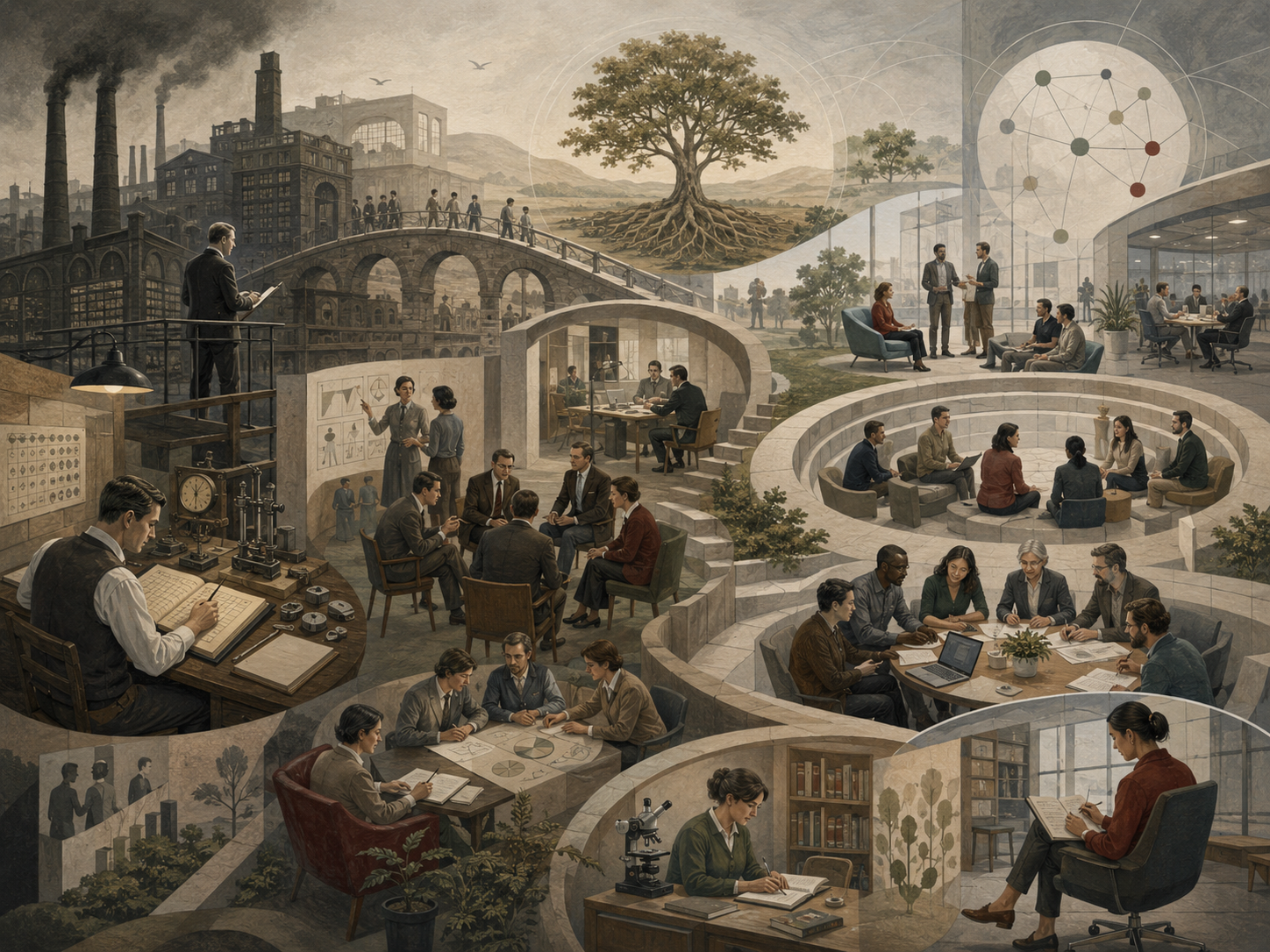
This history matters because organizational psychology has always contained a tension. On one side, the field has been used to improve organizational performance, predict job success, and support administrative decision-making. On the other side, it has increasingly examined worker well-being, fairness, voice, psychological safety, burnout, inclusion, ethical leadership, and the human consequences of organizational systems. The most serious version of the field does not choose one side simplistically. It studies effectiveness and human experience together, recognizing that organizations are not only production systems, but social institutions that shape life chances, identity, health, dignity, and collective possibility.
The evolution of organizational psychology therefore reflects a widening lens. The field moved from the worker as a measurable unit of labor, to the worker as a motivated and social person, to the team as an interdependent system, to the organization as a cultural and institutional environment, to the contemporary workplace as a data-rich, ethically contested, technologically mediated, and globally embedded human system.
Why the History of Organizational Psychology Matters
The history of organizational psychology matters because the field has never been merely academic. It developed in direct relationship to industrialization, labor management, military selection, bureaucratic administration, legal regulation, technological change, organizational growth, and shifting expectations about work. Its concepts were shaped by real institutional problems: how to select people for roles, how to train large workforces, how to measure performance, how to reduce fatigue, how to improve morale, how to design jobs, how to lead teams, how to manage change, and how to build organizations that can learn under uncertainty.
This history also matters because organizational psychology has always been ethically charged. Psychological knowledge can be used to improve work systems, protect workers, support learning, and strengthen fairness. It can also be used to rank, classify, monitor, manipulate, exclude, or intensify work. The evolution of the field is therefore not simply a story of scientific progress. It is also a story about the uses of expertise inside institutions of power.
Organizational psychology’s development can be understood as a series of widening questions. The earliest applied questions were often about efficiency and selection: who should be hired, where should workers be placed, how should training be designed, and how can output be improved? Later questions focused on morale, motivation, leadership, job satisfaction, and group life. Still later questions addressed culture, organizational change, psychological safety, justice, identity, diversity, well-being, decision-making, and resilience. The field’s current questions increasingly concern data, algorithms, hybrid work, worker voice, institutional legitimacy, and ethical governance.
| Historical lens | Early question | Later development | Contemporary implication |
|---|---|---|---|
| Efficiency | How can work be organized to increase output? | Job design, workflow analysis, performance systems | Efficiency must be evaluated alongside dignity, safety, fairness, and sustainability. |
| Selection | How can organizations identify people suited to particular roles? | Psychometrics, validation, structured assessment, adverse impact analysis | Selection must be job-relevant, fair, transparent, and evidence-based. |
| Motivation | Why do people exert effort? | Goal-setting, self-determination, expectancy, equity, engagement | Motivation depends on meaning, autonomy, fairness, trust, and work design. |
| Human relations | How do social conditions shape work experience? | Morale, leadership, groups, communication, culture | Organizations are social systems, not only technical systems. |
| Systems | How do structure, culture, power, and incentives interact? | Organizational development, change, resilience, institutional psychology | Individual behavior must be interpreted in institutional context. |
| Ethics and data | How should organizations use psychological evidence responsibly? | People analytics, algorithmic management, privacy, worker voice | Measurement must not become surveillance or automated control. |
The evolution of organizational psychology therefore reveals a field moving from narrow administrative utility toward a deeper study of organized human life. Its best work helps institutions understand how work systems shape people, and how people shape institutions in return.
Origins: Industrialization, Measurement, and Scientific Management
Organizational psychology emerged from the conditions created by industrialization. As factories, bureaucracies, railroads, manufacturing systems, military organizations, and large corporations expanded, work became more formalized, standardized, measured, and coordinated at scale. Organizations needed ways to allocate labor, train workers, improve output, reduce errors, manage fatigue, and design jobs. These pressures created a demand for applied knowledge about human performance.
One early influence was scientific management, associated most famously with Frederick Winslow Taylor. Scientific management treated work as a system that could be analyzed, decomposed, timed, standardized, and optimized. It helped establish the idea that work behavior could be studied systematically. But it also carried a narrow view of workers as instruments of production, often underemphasizing autonomy, dignity, social meaning, and the experience of labor. This tension remains important: organizational psychology inherited some of its early applied energy from efficiency movements, but later developed broader human and institutional concerns.
Early industrial psychology also drew from psychophysics, psychometrics, experimental psychology, and individual differences research. Psychologists began asking how abilities, attention, fatigue, perception, habit, and training affected performance. This marked the beginning of a more scientific approach to work behavior. Instead of relying entirely on intuition, employers and researchers increasingly sought methods for measuring capacity, predicting performance, and designing work more systematically.
However, the earliest phase of the field was not yet “organizational psychology” in the modern sense. It focused more heavily on individual performance, job efficiency, worker selection, and task design than on culture, leadership, group dynamics, psychological safety, or institutional power. The organizational lens would develop gradually as researchers recognized that work behavior could not be explained adequately by individual ability alone.
| Early influence | Core contribution | Limitation | Long-term legacy |
|---|---|---|---|
| Industrialization | Created large-scale work systems requiring coordination and measurement | Often treated labor as an input to production | Made work behavior a major applied scientific problem. |
| Scientific management | Emphasized systematic study of tasks, time, workflow, and output | Could reduce workers to efficiency variables | Influenced job analysis, work design, productivity measurement, and operations research. |
| Experimental psychology | Provided methods for studying attention, perception, fatigue, learning, and performance | Laboratory methods did not always capture institutional complexity | Supported evidence-based study of human performance at work. |
| Psychometrics | Developed measurement tools for abilities and individual differences | Raised fairness, validity, and classification concerns | Became central to selection, assessment, and personnel psychology. |
| Early personnel systems | Connected measurement to hiring, placement, and training | Often prioritized organizational utility over worker voice | Established the industrial side of I-O psychology. |
The origins of organizational psychology therefore lie in a practical problem: modern institutions needed to understand work scientifically. But the field’s later development required moving beyond efficiency and measurement toward social systems, motivation, fairness, and institutional life.
Early Applied Psychology and the Problem of Person-Job Fit
Early applied psychologists helped establish the idea that psychological science could be used to understand work. Hugo Münsterberg’s early work, especially Psychology and Industrial Efficiency, is often associated with the development of industrial psychology because it asked how psychological principles could improve selection, training, and performance. The central concern was person-job fit: how to place individuals into roles where their abilities, temperaments, and capacities matched task demands.
This emphasis on fit helped create a foundation for job analysis, vocational guidance, aptitude testing, training design, and personnel selection. The field began to develop tools for linking human characteristics to work requirements. This was a major step because it moved employment decisions away from purely informal judgment and toward evidence-informed assessment.
At the same time, person-job fit created enduring ethical questions. Who defines the requirements of the job? What counts as relevant ability? Are assessments valid? Do selection systems exclude unfairly? Are workers being fitted to poorly designed jobs instead of jobs being redesigned to support human capability? Does measurement reflect actual work or institutional bias? These questions would become increasingly important as industrial psychology matured.
The early focus on person-job fit also helped establish one of the field’s recurring dilemmas. Should psychology primarily help organizations choose and manage workers, or should it also help redesign organizations so people can work more effectively and humanely? The evolution of organizational psychology can be read as the gradual expansion from the first question toward the second.
| Person-job fit question | Early applied concern | Later organizational psychology expansion | Ethical issue |
|---|---|---|---|
| Who is suited to a role? | Assess ability, aptitude, attention, or skill | Examine whether role design itself is clear, fair, and supportive | Selection should not hide poor job design. |
| How should workers be trained? | Improve task learning and efficiency | Support development, identity, autonomy, and transfer of learning | Training should not shift all responsibility onto individuals. |
| How should performance be measured? | Identify output and task success | Include quality, collaboration, learning, hidden labor, and context | Measurement can distort behavior if too narrow. |
| How should work be assigned? | Match capacity to requirements | Consider team systems, fairness, workload, support, and opportunity | Assignment systems can reproduce inequality. |
Early applied psychology gave the field tools of measurement and prediction. Organizational psychology later had to ask whether those tools were being used in ways that made work more intelligent, fair, and humane—or merely more administratively efficient.
War, Selection, Testing, and Large-Scale Personnel Systems
The First and Second World Wars accelerated the development of applied psychology because military organizations needed large-scale systems for classification, selection, placement, training, morale, fatigue management, and performance. War created urgent problems of scale. Institutions had to assess large numbers of people quickly and place them into roles where they could be effective. This reinforced the importance of testing, psychometrics, and personnel classification.
The war periods helped establish psychology as a practical administrative science. Ability testing, aptitude assessment, training research, job classification, leadership studies, morale research, and human factors all gained institutional relevance. Psychologists demonstrated that systematic methods could support large organizations facing complex personnel problems.
These developments were scientifically important, but also ethically complicated. Large-scale testing can improve placement and reduce arbitrary decision-making, but it can also classify people in ways that reproduce inequality, overstate measurement precision, or treat institutional needs as more important than human development. The military roots of some applied methods also remind us that organizational psychology has always operated close to systems of authority.
After the wars, many methods developed in military settings moved into business, government, education, and public administration. Personnel selection, training evaluation, leadership assessment, job analysis, and human factors research became more prominent in civilian organizations. The field’s industrial side strengthened, but the organizational side also began to expand as researchers examined morale, group dynamics, leadership, and motivation.
| Wartime problem | Psychological contribution | Postwar influence | Continuing concern |
|---|---|---|---|
| Large-scale classification | Testing and placement systems | Personnel selection, assessment centers, job matching | Validity, fairness, and overclassification |
| Training at scale | Training design and evaluation | Workforce development, instructional systems, skill assessment | Training cannot fix every system problem |
| Morale and fatigue | Studies of motivation, strain, and group functioning | Work attitudes, occupational health, engagement research | Morale should not be used to mask harmful conditions |
| Human-machine performance | Human factors and ergonomics | Safety, interface design, cognitive workload, systems engineering | Technology must be designed around human limits |
| Leadership and coordination | Leadership assessment and group performance research | Leadership development, team science, organizational behavior | Authority must be distinguished from legitimacy |
War accelerated organizational psychology’s technical development. But it also left the field with enduring responsibilities: measurement must be valid, authority must be examined, and human beings must not be reduced to administrative categories.
The Human Relations Turn
The human relations movement marked a major shift in the study of work. Rather than treating employees primarily as isolated units of labor, researchers increasingly examined morale, supervision, informal groups, communication, recognition, and the social meaning of work. The Hawthorne studies, despite later methodological criticism, became symbolically important because they drew attention to the social and psychological dimensions of workplace behavior.
The human relations turn suggested that productivity could not be explained only by physical conditions, individual ability, or monetary incentive. Workers were embedded in groups. They responded to supervision, attention, norms, informal status, belonging, recognition, and perceptions of management. This helped open the door to organizational psychology as a field concerned with social systems rather than individual performance alone.
This shift also changed the meaning of management. Supervisors and leaders were no longer seen only as controllers of tasks. They became interpreters of meaning, managers of relationships, builders or destroyers of trust, and important sources of morale. Work became a social experience, not merely a technical assignment.
However, the human relations tradition also carried risks. Organizations could use the language of morale and belonging to encourage cooperation without addressing pay, power, workload, safety, or structural inequality. Human relations approaches sometimes softened management rhetoric without changing institutional conditions. This is why later organizational psychology had to integrate social understanding with stronger attention to justice, work design, power, and institutional accountability.
| Human relations insight | Contribution to organizational psychology | Risk if superficial | Contemporary extension |
|---|---|---|---|
| Workers are social beings | Work behavior is shaped by groups, norms, recognition, and belonging | Belonging language can hide unequal power | Study psychological safety, inclusion, voice, and social identity. |
| Supervision matters | Leadership style affects morale and performance | Managerial kindness can substitute rhetorically for structural repair | Examine leadership trust, fairness, accountability, and role clarity. |
| Informal groups matter | Norms and peer relationships shape behavior | Informal systems can exclude or silence lower-status workers | Study networks, culture, identity, and hidden power. |
| Attention affects behavior | Employees respond to being seen and valued | Attention can become performative rather than substantive | Connect recognition with real participation and institutional support. |
The human relations turn was essential because it made the social life of work visible. But organizational psychology had to move beyond morale as a managerial tool toward a more serious account of trust, dignity, participation, and institutional design.
Motivation, Job Attitudes, and the Psychology of Work Experience
Mid-century organizational psychology increasingly examined motivation, job satisfaction, morale, leadership, and work attitudes. This period helped establish the idea that employee experience was not peripheral to organizational performance. Motivation theories explored how needs, expectations, rewards, fairness, goals, autonomy, achievement, recognition, and meaning shape work behavior. Job satisfaction and organizational commitment became important research areas because they linked subjective experience with absenteeism, turnover, performance, and institutional stability.
The field’s motivation research moved beyond simple assumptions that money alone explains work behavior. Incentives matter, but they are interpreted through fairness, identity, autonomy, role clarity, opportunity, trust, and the meaning of the work. Employees may comply when rewarded, but commitment, learning, creativity, and citizenship behavior often require deeper psychological and social conditions.
This period also strengthened the connection between organizational psychology and organizational behavior. Researchers examined not only individual attitudes but the social and institutional conditions that shape those attitudes. Motivation became linked to job design, leadership, equity, goal-setting, feedback, and work climate. The field increasingly recognized that attitudes are not merely private feelings; they are indicators of how workers experience institutional conditions.
This development remains central to the field today. Engagement, burnout, commitment, satisfaction, psychological safety, and trust are not soft concerns. They are evidence about whether an organization’s systems support sustainable human contribution.
| Research area | Historical contribution | Modern significance | Responsible interpretation |
|---|---|---|---|
| Motivation | Explained why people invest effort beyond simple compliance | Connects work design, autonomy, fairness, purpose, and performance | Low motivation may reflect poor systems, not personal deficiency. |
| Job satisfaction | Made employee experience measurable and organizationally relevant | Supports retention, well-being, and organizational learning | Satisfaction scores require context and qualitative interpretation. |
| Commitment | Linked attachment to organization with stability and contribution | Informs retention, identity, belonging, and change readiness | Commitment should not be confused with coerced loyalty. |
| Goal-setting | Showed how specific goals and feedback shape performance | Influences performance systems and leadership practice | Goals can distort behavior if too narrow or punitive. |
| Job design | Connected task structure with motivation and well-being | Supports autonomy, skill use, meaning, and role clarity | Redesign should address real conditions, not only attitudes. |
The motivation and job-attitudes tradition helped organizational psychology become a field concerned with lived work experience. It showed that organizations cannot understand performance without understanding the psychological conditions under which work is performed.
The Organizational Turn: Culture, Systems, Leadership, and Change
As the field matured, organizational psychology expanded from individuals and jobs toward organizations as complex social systems. Researchers increasingly studied culture, leadership, communication, power, decision-making, organizational development, institutional change, group dynamics, and systems of influence. This organizational turn was essential because many workplace outcomes could not be explained by individual ability or motivation alone.
Culture became a major topic because organizations were recognized as meaning systems. Shared norms, assumptions, stories, rituals, incentives, and values shape how people behave. Culture determines what is safe to say, what kinds of performance are rewarded, how conflict is handled, whether rules are applied consistently, and how people interpret authority. Culture also explains why formal policies often fail: what is written may matter less than what is repeatedly modeled, rewarded, tolerated, and ignored.
Leadership research also widened. Instead of focusing only on traits or authority, researchers examined behaviors, styles, leader-member exchange, transformational leadership, ethical leadership, shared leadership, and the relationship between leadership and culture. Leadership became a social influence process that shapes meaning, trust, motivation, psychological safety, and institutional direction.
Organizational change became another central concern. Institutions must adapt to technology, markets, regulation, crises, social expectations, and internal growth. Organizational psychology contributed insight into change readiness, resistance, communication, participation, identity threat, leadership credibility, fatigue, and learning. It became increasingly clear that change fails not only because plans are weak, but because people do not trust the process, understand the purpose, or experience enough support to adapt.
| Organizational topic | Why it emerged | Key insight | Contemporary relevance |
|---|---|---|---|
| Culture | Formal rules did not fully explain behavior | Norms and assumptions shape what people actually do | Culture affects ethics, voice, belonging, and legitimacy. |
| Leadership | Authority alone did not explain motivation or coordination | Influence works through trust, meaning, behavior, and legitimacy | Leadership shapes psychological safety, change, and performance. |
| Communication | Organizations struggled with ambiguity and coordination | Information flow shapes interpretation and action | Communication quality is central to hybrid work and complex systems. |
| Organizational change | Institutions had to adapt to unstable environments | Change depends on trust, participation, meaning, and support | Change fatigue and resilience are now major concerns. |
| Systems thinking | Individual-level explanations were insufficient | Behavior emerges from interacting roles, incentives, culture, and structure | Supports more responsible diagnosis and intervention. |
The organizational turn made the field more powerful and more ethically serious. It showed that behavior at work is not simply the result of individual character. It is produced through systems of meaning, authority, incentives, relationships, and institutional design.
Professionalization and the Emergence of I-O Psychology
The professional identity of industrial-organizational psychology developed through academic programs, professional societies, applied research, consulting practice, legal standards, journals, conferences, and the growth of specialized expertise. The Society for Industrial and Organizational Psychology became a central professional organization, and SIOP’s own history materials trace the field’s evolution across the twentieth century. SIOP’s current public materials describe the society as founded in 1982 and representing Division 14 of the American Psychological Association. The older Division 14 history also reflects the field’s shift from industrial psychology toward industrial and organizational psychology.
This professionalization mattered because it consolidated the field around standards of evidence, training, ethics, and practice. I-O psychologists became identified with areas such as job analysis, personnel selection, training, organizational development, leadership assessment, performance appraisal, employee attitudes, work motivation, team effectiveness, and organizational change. The profession also became increasingly connected to legal and institutional questions about fairness, validity, adverse impact, and accountability.
The shift from “industrial psychology” to “industrial and organizational psychology” was not merely a naming change. It reflected a conceptual expansion. Industrial psychology had focused heavily on individual workers, tasks, performance, and personnel systems. Organizational psychology emphasized the broader context in which those systems operate: leadership, culture, groups, motivation, communication, decision-making, change, and institutional life.
| Professional development | Field significance | Institutional implication |
|---|---|---|
| Academic specialization | Created formal training pathways and research communities | Strengthened methodological rigor and professional identity. |
| Professional societies | Provided standards, conferences, publications, and field representation | Helped define the scope and legitimacy of I-O psychology. |
| Applied consulting | Connected research to organizational practice | Made evidence-based work design, selection, and development more available. |
| Legal and regulatory pressures | Increased attention to validity, fairness, and documentation | Made employment systems more accountable to evidence and law. |
| Organizational expansion | Added leadership, culture, change, and teams to the field’s core | Moved the field beyond selection and performance measurement alone. |
Professionalization gave organizational psychology a durable institutional home. But it also deepened the field’s responsibilities: if psychologists help organizations measure, select, evaluate, and change people, they must also help ensure that such practices are valid, fair, humane, and accountable.
Fairness, Validity, Law, and Institutional Accountability
As employment systems became more formal, the field’s concern with fairness and validity intensified. Selection tests, interviews, performance ratings, promotion systems, assessment centers, and training evaluations all raised questions about evidence, bias, job relevance, documentation, and legal defensibility. Organizational psychology became increasingly tied to the question of whether institutional decisions about people could be justified with valid and fair methods.
This was a major development. Earlier personnel systems often emphasized administrative efficiency. Later I-O psychology had to demonstrate that assessments were related to job requirements, that performance criteria were meaningful, that selection procedures were valid, and that adverse impact and unfair exclusion were taken seriously. The field increasingly recognized that measurement is never neutral when it affects hiring, promotion, compensation, development, or termination.
Fairness also broadened beyond selection. Organizational justice research examined distributive fairness, procedural fairness, interpersonal fairness, and informational fairness. Employees care not only about outcomes, but about how decisions are made, how they are treated, whether explanations are given, and whether rules are applied consistently. This connected organizational psychology to trust, legitimacy, leadership, culture, and institutional ethics.
| Fairness domain | Core concern | Organizational psychology contribution | Continuing risk |
|---|---|---|---|
| Selection validity | Are assessments job-relevant and predictive? | Job analysis, criterion validation, structured assessment | Invalid tools can exclude unfairly while appearing scientific. |
| Adverse impact | Do procedures produce unequal outcomes across groups? | Fairness analysis, documentation, alternative methods | Technically valid systems can still reproduce structural inequality. |
| Performance appraisal | Are employees evaluated accurately and consistently? | Rating design, rater training, behaviorally anchored scales | Ratings may reflect bias, visibility, politics, or role inequality. |
| Organizational justice | Are decisions and processes experienced as fair? | Procedural, distributive, interpersonal, and informational justice research | Fairness language can become symbolic without power accountability. |
| People analytics | Are data-driven systems transparent, valid, and rights-preserving? | Measurement design, validation, governance, ethical review | Analytics can become surveillance or automated exclusion. |
The fairness and validity tradition is one of organizational psychology’s most important contributions. It reminds institutions that decisions about people must be evidence-based, reviewable, and accountable—not merely efficient or convenient.
Teams, Complexity, and Knowledge Work
As organizations became more complex, the field increasingly focused on teams, collaboration, communication, distributed expertise, and knowledge work. Many modern tasks cannot be performed effectively by isolated individuals. They require coordination across roles, disciplines, technologies, locations, and knowledge systems. This made team science central to organizational psychology.
Team research examines shared mental models, role clarity, trust, cohesion, conflict, communication, psychological safety, leadership, and collective learning. It also studies how teams perform under stress, how they adapt to changing conditions, how they coordinate in high-risk environments, and how distributed or hybrid teams maintain connection and accountability.
This team-centered turn expanded the field beyond individual performance measurement. A high-performing individual may struggle in a poorly coordinated team. A team with strong individual talent may fail if roles are unclear, conflict is unmanaged, psychological safety is low, or leadership suppresses information. Organizational outcomes increasingly depend on the quality of interaction, not only the quality of individual contributors.
| Team concept | Why it became important | Organizational psychology insight | Risk if ignored |
|---|---|---|---|
| Shared mental models | Complex work requires common understanding | Teams coordinate better when members understand goals, roles, and interdependencies | Misalignment produces errors, duplication, and delay. |
| Psychological safety | Learning depends on honest voice | People must be able to raise concerns, admit uncertainty, and challenge assumptions | Silence hides problems until they become failures. |
| Team conflict | Interdependent work generates disagreement | Conflict can support learning if managed constructively | Unmanaged conflict becomes blame, avoidance, or fragmentation. |
| Distributed expertise | No single leader or worker holds all relevant knowledge | Organizations must create systems for expertise to circulate | Formal hierarchy may suppress necessary knowledge. |
| Hybrid coordination | Work increasingly occurs across locations and platforms | Communication routines, inclusion, and visibility must be designed deliberately | Remote or lower-visibility workers may be excluded from influence. |
The growth of team science made organizational psychology more relational and systems-oriented. It showed that performance often emerges from coordination, trust, and communication—not from individual ability alone.
Well-Being, Stress, Burnout, and the Human Cost of Work
Organizational psychology also evolved through growing attention to stress, burnout, occupational health, safety, recovery, and well-being. This development expanded the field beyond performance and satisfaction toward the human costs of organizational systems. Work can support meaning, mastery, identity, and social contribution, but it can also produce exhaustion, alienation, anxiety, injury, moral distress, and chronic strain.
Research on job demands, job resources, burnout, work-family conflict, emotional labor, safety climate, and occupational stress showed that work design has psychological and health consequences. Burnout is not merely an individual weakness; it can reflect sustained mismatch between demands and resources, workload and recovery, responsibility and control, effort and recognition, or values and institutional behavior.
This shift made organizational psychology more ethically significant. If organizations can design systems that intensify strain, they can also redesign systems to reduce harm. Well-being interventions that focus only on individual resilience are insufficient if workload, staffing, scheduling, leadership, role ambiguity, and culture remain unchanged. Organizational psychology’s strongest contribution is not teaching people to cope with harmful systems, but helping institutions see and repair the systems producing harm.
| Well-being concern | System-level source | Organizational psychology response | Misuse to avoid |
|---|---|---|---|
| Burnout | Chronic overload, low control, weak support, value conflict | Assess job demands, resources, leadership, recovery, and workload design | Reducing burnout to individual resilience failure |
| Work stress | Ambiguity, time pressure, role conflict, insecurity, unfairness | Improve role clarity, support, communication, staffing, and fairness | Offering wellness programs while preserving harmful conditions |
| Emotional labor | Demand to regulate emotion for service or organizational image | Recognize hidden labor, support recovery, and design humane expectations | Treating emotional control as limitless professionalism |
| Psychological safety | Leadership response to voice, error, dissent, and vulnerability | Protect candor, learning, and lower-power voice | Using safety language without changing power dynamics |
| Work-life conflict | Scheduling, workload, availability expectations, role pressure | Design boundaries, flexibility, staffing, and recovery norms | Framing conflict as poor individual time management |
The well-being turn marks one of the field’s most important ethical expansions. Organizational psychology increasingly asks whether work systems are sustainable for the human beings who carry them.
People Analytics, Digital Work, and Algorithmic Management
The contemporary phase of organizational psychology is shaped by data-intensive work, digital platforms, remote and hybrid coordination, people analytics, algorithmic management, artificial intelligence, and new forms of workplace monitoring. Organizations now collect far more data about communication, productivity, collaboration, engagement, learning, mobility, performance, and sentiment than earlier generations could have imagined. This creates both scientific opportunity and ethical risk.
People analytics can help organizations detect systemic problems, evaluate interventions, improve selection systems, monitor workload, analyze turnover, and understand patterns of opportunity or exclusion. But analytics can also become surveillance. Data can be used to rank workers, infer attitudes, identify dissenters, monitor productivity, automate decisions, or intensify control without transparency. Organizational psychology must therefore bring measurement expertise together with ethical governance.
Digital work also changes organizational experience. Hybrid teams must manage visibility bias, isolation, communication overload, asynchronous coordination, digital fatigue, informal exclusion, and changing boundaries between work and life. Leadership, culture, and psychological safety must be maintained across mediated environments. The organization is no longer only a physical workplace; it is also a communication architecture, platform ecology, data system, and algorithmic environment.
| Contemporary development | Opportunity | Risk | Organizational psychology responsibility |
|---|---|---|---|
| People analytics | Identify patterns in work systems and evaluate interventions | Surveillance, false precision, opaque inference | Use data for institutional learning, not hidden control. |
| Algorithmic management | Coordinate work at scale and support decision-making | Automated discipline, opacity, bias, loss of worker voice | Require validation, transparency, appeal, and human oversight. |
| Hybrid work | Increase flexibility and broaden participation | Visibility bias, isolation, communication overload | Design inclusive communication and fair evaluation systems. |
| AI-supported HR | Assist screening, training, analytics, and workforce planning | Bias, explainability problems, overreliance on prediction | Apply validity, fairness, privacy, and governance standards. |
| Digital collaboration | Enable distributed teams and knowledge sharing | Fragmentation, burnout, notification overload | Study work rhythms, attention, coordination, and recovery. |
The data era makes organizational psychology more necessary. The field understands measurement, validity, behavior, motivation, culture, and systems. It is therefore well positioned to ask whether new technologies are making organizations more intelligent and humane—or merely more capable of measuring and controlling people.
Mathematical Lens: Modeling the Evolution of the Field
The evolution of organizational psychology can be modeled as a shift in the field’s center of gravity. Early industrial psychology emphasized selection, efficiency, and measurement. Later organizational psychology added motivation, morale, social systems, leadership, culture, well-being, fairness, and institutional change. A mathematical lens can represent this widening field as a weighted combination of research emphases over time.
F_t = w_1S_t + w_2E_t + w_3M_t + w_4G_t + w_5C_t + w_6W_t + w_7J_t + w_8D_t
\]
Interpretation: The field orientation \(F_t\) at time \(t\) can be represented as a weighted combination of selection, efficiency, motivation, group dynamics, culture, well-being, justice, and digital work. As organizational psychology evolved, the weights shifted from a narrow emphasis on selection and efficiency toward a broader systems view of work, institutions, and human experience.
where:
- \(S_t\) = selection, testing, assessment, and person-job fit;
- \(E_t\) = efficiency, task design, workflow, and performance optimization;
- \(M_t\) = motivation, job attitudes, engagement, and commitment;
- \(G_t\) = group dynamics, team coordination, and social behavior;
- \(C_t\) = culture, leadership, communication, and organizational systems;
- \(W_t\) = worker well-being, stress, burnout, and occupational health;
- \(J_t\) = justice, fairness, validity, ethics, and institutional accountability;
- \(D_t\) = digital work, analytics, algorithms, and technology-mediated organization.
A second model can represent the field’s historical expansion as a movement from individual-level analysis toward multilevel systems analysis:
O_t = \alpha I_t + \beta T_t + \gamma U_t + \delta X_t
\]
Interpretation: Organizational psychology at time \(t\) can be understood as a changing balance among individual, team, organizational, and external-system levels of analysis. The field became more sophisticated as it learned to examine how individual behavior is nested within teams, institutions, technologies, labor markets, and social conditions.
where:
- \(I_t\) = individual-level behavior, ability, attitudes, and motivation;
- \(T_t\) = team-level coordination, trust, conflict, and psychological safety;
- \(U_t\) = organizational-level culture, structure, leadership, and change;
- \(X_t\) = external context such as law, technology, labor markets, social inequality, and public accountability.
A final model can represent responsible progress in the field:
RP = \frac{(V \cdot H \cdot J \cdot L)}{(B + S + P)}
\]
Interpretation: Responsible progress in organizational psychology increases when validity, human well-being, justice, and institutional learning reinforce one another. It declines when bias, surveillance, and power imbalance shape how psychological knowledge is used.
where \(RP\) is responsible progress, \(V\) is validity, \(H\) is human well-being, \(J\) is justice, \(L\) is learning, \(B\) is bias, \(S\) is surveillance risk, and \(P\) is unchecked power imbalance.
These models are not historical laws. They are interpretive tools. They make explicit that organizational psychology did not simply add topics over time; it changed its assumptions about what work is, what organizations are, and what responsible psychological science should do inside institutions.
R Workflow: Mapping Historical Phases of Organizational Psychology
The following R workflow creates a synthetic historical dataset representing shifts in organizational psychology’s research emphasis across periods. It is designed to show how the field’s center of gravity can be modeled descriptively—from selection and efficiency toward motivation, teams, culture, well-being, justice, and digital work. This is a synthetic educational workflow, not a bibliometric claim about actual publication counts.
# R Workflow: Mapping Historical Phases of Organizational Psychology
# Synthetic history-of-the-field demonstration.
#
# Responsible-use scope:
# This workflow is for synthetic-data research, methods demonstration,
# institutional learning, and organizational psychology education.
# It is not a tool for ranking scholars, departments, journals, workers,
# employees, or institutions.

suppressPackageStartupMessages({
  library(dplyr)
  library(tidyr)
  library(ggplot2)
  library(scales)
})

history_data <- tibble::tribble(
  ~period, ~selection_testing, ~efficiency_work_design, ~motivation_attitudes,
  ~groups_teams, ~culture_leadership_change, ~wellbeing_stress,
  ~justice_validity_ethics, ~digital_analytics,
  "1900-1919", 78, 86, 22, 18, 12, 14, 18, 0,
  "1920-1939", 72, 74, 42, 45, 24, 24, 26, 0,
  "1940-1959", 84, 70, 52, 48, 32, 36, 38, 0,
  "1960-1979", 70, 58, 74, 68, 66, 52, 62, 2,
  "1980-1999", 66, 54, 78, 76, 82, 64, 72, 18,
  "2000-2019", 68, 60, 80, 84, 86, 76, 82, 62,
  "2020-2035", 70, 66, 82, 86, 88, 84, 90, 86
)

weighted_history <- history_data %>%
  mutate(
    industrial_orientation =
      0.48 * selection_testing +
      0.42 * efficiency_work_design +
      0.10 * motivation_attitudes,
    organizational_orientation =
      0.18 * motivation_attitudes +
      0.18 * groups_teams +
      0.22 * culture_leadership_change +
      0.16 * wellbeing_stress +
      0.16 * justice_validity_ethics +
      0.10 * digital_analytics,
    responsible_progress_index =
      rescale(
        0.25 * justice_validity_ethics +
          0.22 * wellbeing_stress +
          0.18 * culture_leadership_change +
          0.14 * groups_teams +
          0.11 * motivation_attitudes +
          0.10 * digital_analytics,
        to = c(0, 100)
      )
  )

print(weighted_history)

long_history <- history_data %>%
  pivot_longer(
    cols = -period,
    names_to = "research_emphasis",
    values_to = "emphasis_score"
  )

ggplot(long_history, aes(x = period, y = emphasis_score, group = research_emphasis)) +
  geom_line() +
  geom_point() +
  facet_wrap(~ research_emphasis, ncol = 2) +
  labs(
    title = "Synthetic Evolution of Organizational Psychology Research Emphases",
    x = "Historical period",
    y = "Synthetic emphasis score"
  ) +
  theme_minimal() +
  theme(axis.text.x = element_text(angle = 45, hjust = 1))

ggplot(weighted_history, aes(x = period)) +
  geom_line(aes(y = industrial_orientation, group = 1), linewidth = 1) +
  geom_line(aes(y = organizational_orientation, group = 1), linewidth = 1, linetype = "dashed") +
  geom_point(aes(y = industrial_orientation)) +
  geom_point(aes(y = organizational_orientation)) +
  labs(
    title = "Synthetic Shift from Industrial to Organizational Orientation",
    x = "Historical period",
    y = "Orientation score"
  ) +
  theme_minimal() +
  theme(axis.text.x = element_text(angle = 45, hjust = 1))

ggplot(weighted_history, aes(x = period, y = responsible_progress_index, group = 1)) +
  geom_line(linewidth = 1) +
  geom_point() +
  labs(
    title = "Synthetic Responsible Progress Index",
    subtitle = "Validity, well-being, justice, learning, and digital governance",
    x = "Historical period",
    y = "Responsible progress index"
  ) +
  theme_minimal() +
  theme(axis.text.x = element_text(angle = 45, hjust = 1))
This workflow is useful because it treats the history of organizational psychology as a shift in emphasis rather than a simple replacement of old ideas by new ones. Selection, measurement, and efficiency did not disappear. They remain part of the field. What changed is that organizational psychology increasingly placed those concerns inside a broader framework that includes motivation, groups, culture, leadership, well-being, justice, technology, and institutional systems.
Python Workflow: Simulating Field Evolution Across Research Emphases
The following Python workflow simulates the evolution of organizational psychology as a changing distribution of research emphases over time. It creates synthetic period-level scores, calculates field-orientation indices, and compares historical phases. This is a conceptual demonstration, not a claim about actual publication frequencies or professional membership data.
"""
Python Workflow: Simulating Field Evolution Across Research Emphases

Responsible-use scope:
This workflow is for synthetic-data research, methods demonstration,
institutional learning, and organizational psychology education.
It is not a tool for ranking scholars, departments, journals, workers,
employees, or institutions.
"""

import numpy as np
import pandas as pd
from sklearn.preprocessing import MinMaxScaler
from sklearn.decomposition import PCA
from sklearn.cluster import KMeans

history = pd.DataFrame({
    "period": [
        "1900-1919",
        "1920-1939",
        "1940-1959",
        "1960-1979",
        "1980-1999",
        "2000-2019",
        "2020-2035"
    ],
    "selection_testing": [78, 72, 84, 70, 66, 68, 70],
    "efficiency_work_design": [86, 74, 70, 58, 54, 60, 66],
    "motivation_attitudes": [22, 42, 52, 74, 78, 80, 82],
    "groups_teams": [18, 45, 48, 68, 76, 84, 86],
    "culture_leadership_change": [12, 24, 32, 66, 82, 86, 88],
    "wellbeing_stress": [14, 24, 36, 52, 64, 76, 84],
    "justice_validity_ethics": [18, 26, 38, 62, 72, 82, 90],
    "digital_analytics": [0, 0, 0, 2, 18, 62, 86]
})

features = [
    "selection_testing",
    "efficiency_work_design",
    "motivation_attitudes",
    "groups_teams",
    "culture_leadership_change",
    "wellbeing_stress",
    "justice_validity_ethics",
    "digital_analytics"
]

history["industrial_orientation"] = (
    0.48 * history["selection_testing"] +
    0.42 * history["efficiency_work_design"] +
    0.10 * history["motivation_attitudes"]
)

history["organizational_orientation"] = (
    0.18 * history["motivation_attitudes"] +
    0.18 * history["groups_teams"] +
    0.22 * history["culture_leadership_change"] +
    0.16 * history["wellbeing_stress"] +
    0.16 * history["justice_validity_ethics"] +
    0.10 * history["digital_analytics"]
)

history["systems_ethics_orientation"] = (
    0.22 * history["culture_leadership_change"] +
    0.20 * history["wellbeing_stress"] +
    0.24 * history["justice_validity_ethics"] +
    0.18 * history["digital_analytics"] +
    0.16 * history["groups_teams"]
)

history["field_expansion_index"] = (
    history["organizational_orientation"] -
    history["industrial_orientation"]
)

print(history[[
    "period",
    "industrial_orientation",
    "organizational_orientation",
    "systems_ethics_orientation",
    "field_expansion_index"
]])

scaler = MinMaxScaler()
scaled = scaler.fit_transform(history[features])

pca = PCA(n_components=2)
components = pca.fit_transform(scaled)

history["pc1_field_breadth"] = components[:, 0]
history["pc2_measurement_to_systems"] = components[:, 1]

clusters = KMeans(n_clusters=3, random_state=42, n_init=10)
history["synthetic_phase_cluster"] = clusters.fit_predict(scaled)

phase_labels = {
    0: "Measurement and efficiency phase",
    1: "Organizational systems expansion phase",
    2: "Digital, justice, and well-being phase"
}

history["interpreted_phase"] = history["synthetic_phase_cluster"].map(phase_labels)

print(history[[
    "period",
    "pc1_field_breadth",
    "pc2_measurement_to_systems",
    "interpreted_phase"
]])

scenario = pd.DataFrame([
    {
        "scenario": "Narrow administrative use of psychology",
        "selection_testing": 86,
        "efficiency_work_design": 84,
        "motivation_attitudes": 28,
        "groups_teams": 24,
        "culture_leadership_change": 18,
        "wellbeing_stress": 18,
        "justice_validity_ethics": 26,
        "digital_analytics": 10
    },
    {
        "scenario": "Broad responsible organizational psychology",
        "selection_testing": 72,
        "efficiency_work_design": 66,
        "motivation_attitudes": 84,
        "groups_teams": 86,
        "culture_leadership_change": 88,
        "wellbeing_stress": 86,
        "justice_validity_ethics": 92,
        "digital_analytics": 84
    }
])

scenario["responsible_progress_index"] = (
    0.18 * scenario["selection_testing"] +
    0.10 * scenario["efficiency_work_design"] +
    0.13 * scenario["motivation_attitudes"] +
    0.13 * scenario["groups_teams"] +
    0.15 * scenario["culture_leadership_change"] +
    0.15 * scenario["wellbeing_stress"] +
    0.18 * scenario["justice_validity_ethics"] +
    0.08 * scenario["digital_analytics"]
)

print(scenario[["scenario", "responsible_progress_index"]])
This simulation helps clarify the article’s central argument: organizational psychology did not abandon measurement or performance. It placed measurement and performance inside a wider ethical and systems-oriented field. The contemporary challenge is not to reject analytics, selection, or performance science, but to govern them with validity, fairness, worker voice, privacy, human well-being, and institutional responsibility.
GitHub Repository
The companion repository for this article organizes the computational materials for this topic, including synthetic datasets, reproducible workflows, documentation, validation notes, and responsible-use guidance for organizational psychology research.
Complete Code Repository
Access the full companion repository for this article, including reproducible analysis materials, synthetic datasets, R and Python workflows, multi-language examples, documentation, validation notes, and responsible interpretation materials.
The Future of Organizational Psychology
The future of organizational psychology will likely be shaped by several converging pressures: artificial intelligence, hybrid work, global labor systems, demographic change, climate disruption, mental health concerns, institutional distrust, algorithmic management, and rising demands for transparency and fairness. These pressures will require the field to integrate its historical strengths—measurement, validity, job analysis, motivation, leadership, teams, and organizational change—with stronger attention to ethics, power, worker voice, and institutional accountability.
AI and people analytics will be especially important. Organizational psychology has the tools to ask whether AI-assisted systems are valid, fair, explainable, and appropriate for the decisions they influence. But technical validation alone will not be enough. The field will need to ask whether workers understand how data are used, whether systems permit challenge or appeal, whether analytics increase surveillance, and whether prediction is being confused with justice.
Hybrid work will also reshape the field. Organizational psychologists will need to study how trust, coordination, visibility, inclusion, mentorship, informal learning, and psychological safety operate when work is distributed across digital platforms and physical spaces. The old assumption that culture lives primarily in offices is no longer adequate. Culture also lives in communication systems, meeting norms, documentation practices, platform design, availability expectations, and algorithmic visibility.
The future field must also become more serious about inequality. Work is not experienced the same way across class, race, gender, disability, immigration status, caregiving responsibility, employment arrangement, geography, or organizational rank. If organizational psychology is to remain credible, it must examine how institutions distribute opportunity, risk, recognition, voice, surveillance, and strain.
| Future pressure | Research challenge | Organizational psychology contribution |
|---|---|---|
| Artificial intelligence | How should algorithmic tools influence work decisions? | Validity, fairness, transparency, human oversight, and governance. |
| Hybrid work | How do distributed workers maintain trust, learning, and coordination? | Communication design, inclusion, visibility bias review, team science. |
| Worker well-being | How can organizations address burnout without individualizing harm? | Work design, demands-resources analysis, leadership, recovery, staffing. |
| Institutional trust | How do organizations rebuild legitimacy? | Justice, voice, ethical leadership, procedural fairness, transparency. |
| People analytics | How can data support learning without becoming surveillance? | Responsible measurement, privacy, validation, participatory governance. |
| Inequality | How are opportunity, voice, and strain distributed unequally? | Fairness analysis, inclusion research, structural diagnosis, institutional accountability. |
The future of organizational psychology should not be a more sophisticated science of control. It should be a more responsible science of work systems: one that helps institutions become more effective, fair, adaptive, transparent, and humane.
Conclusion
The evolution of organizational psychology reveals a field that began with practical concerns about efficiency, selection, and measurement, but gradually expanded into a broader science of work, motivation, leadership, teams, culture, fairness, well-being, technology, and institutional life. This expansion was not accidental. It occurred because organizations themselves became more complex and because narrow explanations of work behavior proved inadequate.
The field’s history shows that individual performance cannot be understood apart from job design, leadership, team coordination, communication, culture, incentives, workload, fairness, and institutional trust. It also shows that measurement is powerful but ethically dangerous when separated from validity, transparency, accountability, and human consequence. Organizational psychology’s greatest strength lies in its ability to connect evidence with systems thinking.
At its best, organizational psychology helps institutions understand how people and organizations shape one another. It can improve performance, but it can also expose harm. It can support selection and training, but it can also challenge unfair systems. It can use data, but it must resist surveillance. It can study leadership, but it must also study power. The evolution of the field is therefore not only a history of methods and theories. It is a continuing argument about what work should become and how psychological science should be used inside institutions.
Return to the Organizational Psychology knowledge series
Related Articles
- What Is Organizational Psychology?
- Leadership in Organizational Psychology
- Employee Motivation in Organizations
- Team Dynamics in Organizations
- Organizational Culture and Shared Norms
- Psychological Safety in High-Performing Teams
- Decision-Making in Organizations
- Information Flow and Organizational Communication
- Adaptive Organizations and Institutional Transformation
- Organizational Resilience in Complex Systems
Further Reading
- American Psychological Association (n.d.) ‘Industrial and Organizational Psychology’. Available at: https://www.apa.org/education-career/guide/subfields/organizational.
- Highhouse, S., Zickar, M.J. and Yankelevich, M. (2020) Historical Perspectives in Industrial and Organizational Psychology. New York: Routledge. Available at: https://www.routledge.com/Historical-Perspectives-in-Industrial-and-Organizational-Psychology/Highhouse-Zickar-Yankelevich/p/book/9781138182585.
- Koppes, L.L. (ed.) (2007) Historical Perspectives in Industrial and Organizational Psychology. Mahwah, NJ: Lawrence Erlbaum Associates. Available at: https://psycnet.apa.org/record/2007-01652-000.
- Münsterberg, H. (1913) Psychology and Industrial Efficiency. Boston: Houghton Mifflin. Available at: https://archive.org/details/psychologyandind00mn.
- O*NET OnLine (2026) ‘Industrial-Organizational Psychologists’. Available at: https://www.onetonline.org/link/summary/19-3032.00.
- Society for Industrial and Organizational Psychology (n.d.) ‘Early History’. Available at: https://www.siop.org/about-siop/siop-history/early-history/.
- Society for Industrial and Organizational Psychology (n.d.) ‘Koppes’ History of SIOP and the APA’. Available at: https://www.siop.org/about-siop/siop-history/koppes-history-of-siop-and-the-apa/.
- U.S. Bureau of Labor Statistics (2025) ‘Psychologists: Occupational Outlook Handbook’. Available at: https://www.bls.gov/ooh/life-physical-and-social-science/psychologists.htm.
References
- American Psychological Association (n.d.) ‘Industrial and Organizational Psychology’. Available at: https://www.apa.org/education-career/guide/subfields/organizational.
- Baritz, L. (1960) The Servants of Power: A History of the Use of Social Science in American Industry. Middletown, CT: Wesleyan University Press. Available at: https://archive.org/details/servantsofpowerh0000bari.
- Borman, W.C., Ilgen, D.R. and Klimoski, R.J. (eds.) (2003) Handbook of Psychology, Volume 12: Industrial and Organizational Psychology. Hoboken, NJ: Wiley. Available at: https://onlinelibrary.wiley.com/doi/book/10.1002/0471264385.
- Highhouse, S., Zickar, M.J. and Yankelevich, M. (2020) Historical Perspectives in Industrial and Organizational Psychology. New York: Routledge. Available at: https://www.routledge.com/Historical-Perspectives-in-Industrial-and-Organizational-Psychology/Highhouse-Zickar-Yankelevich/p/book/9781138182585.
- Koppes, L.L. (ed.) (2007) Historical Perspectives in Industrial and Organizational Psychology. Mahwah, NJ: Lawrence Erlbaum Associates. Available at: https://psycnet.apa.org/record/2007-01652-000.
- Kozlowski, S.W.J. (ed.) (2012) The Oxford Handbook of Organizational Psychology. Oxford: Oxford University Press. Available at: https://academic.oup.com/edited-volume/28377.
- Münsterberg, H. (1913) Psychology and Industrial Efficiency. Boston: Houghton Mifflin. Available at: https://archive.org/details/psychologyandind00mn.
- O*NET OnLine (2026) ‘Industrial-Organizational Psychologists’. Available at: https://www.onetonline.org/link/summary/19-3032.00.
- Society for Industrial and Organizational Psychology (n.d.) ‘Early History’. Available at: https://www.siop.org/about-siop/siop-history/early-history/.
- Society for Industrial and Organizational Psychology (n.d.) ‘Koppes’ History of SIOP and the APA’. Available at: https://www.siop.org/about-siop/siop-history/koppes-history-of-siop-and-the-apa/.
- Taylor, F.W. (1911) The Principles of Scientific Management. New York: Harper & Brothers. Available at: https://archive.org/details/principlesofscie00taylrich.
- U.S. Bureau of Labor Statistics (2025) ‘Psychologists: Occupational Outlook Handbook’. Available at: https://www.bls.gov/ooh/life-physical-and-social-science/psychologists.htm.