Finnish public school campus surrounded by trees illustrating the Finland education system and its learning environment

The Institutional Logic of the Finland Education System

The institutional logic of the Finland education system reveals how public education can function as a deeply designed institution rather than a competitive sorting mechanism. This article examines Finland’s schools through the lens of Institutions & Governance, focusing on public funding, comprehensive schooling, equity, teacher professionalism, assessment restraint, student well-being, local autonomy, and public trust. It argues that Finland’s visible education practices rest on deeper institutional foundations: strong teacher preparation, national purpose, municipal implementation, welfare-state support, and a commitment to reducing disparities between schools and communities. Rather than treating Finland as a simple model to copy, the article explores what other systems can learn from its governance architecture: education works best when society treats learning as a public good, teachers as trusted professionals, and equity as a design obligation.

China green energy transition illustrated by large-scale solar and wind power infrastructure

China Green Energy Transition: Industrial Policy, Infrastructure, and Global Climate Leadership

China’s green energy transition is not only an energy story, but an institutional story about state capacity, industrial policy, infrastructure planning, regulatory coordination, and long-term climate governance. As the world’s largest energy consumer and greenhouse gas emitter, China occupies a decisive position in global decarbonization. This article examines how China has expanded solar, wind, storage, electric vehicles, transmission infrastructure, and clean-technology manufacturing through coordinated public investment and national planning. It argues that decarbonization requires more than cleaner technology; it requires institutions capable of financing infrastructure, integrating renewable power, managing coal dependence, coordinating regional development, and shaping global supply chains. China’s transition remains incomplete and contested, but it demonstrates how climate leadership increasingly depends on industrial capacity, infrastructure governance, and the ability to align national development with planetary responsibility.

Urban farming infrastructure including rooftop gardens and distributed city food production

Urban Farming Infrastructure: Distributed Food Systems and Urban Resilience

Urban farming infrastructure reframes local food production as a question of resilience, not lifestyle. Community gardens, rooftop greenhouses, hydroponic systems, vacant-lot farms, and peri-urban production cannot replace industrial agriculture or global trade, but they can add distributed capacity to fragile food systems. In an era of climate volatility, supply-chain disruption, food-price instability, and unequal food access, cities need more than efficient long-distance logistics; they need redundancy, proximity, visibility, and neighborhood-level adaptive capacity. This article examines urban farming as civic infrastructure: a measurable layer of food-system resilience connected to land use, water, energy, waste cycling, public health, equity, and governance. It argues that local production is most valuable when designed honestly—not as romantic self-sufficiency, but as practical distributed infrastructure that helps cities absorb shocks.

American classroom illustrating structural challenges in the American education system

The Structural Failures of the American Education System

The structural failures of the American education system are not mainly failures of teachers, students, families, or individual schools. They are failures of institutional design: how public education is funded, governed, measured, staffed, segregated, disciplined, professionalized, and connected to housing, public finance, higher education, debt, and social inequality. This article examines American education as an Institutions & Governance problem, showing how local property-tax dependence, district boundaries, residential segregation, unequal facilities, teacher workforce pressure, test-driven accountability, curriculum stratification, civil-rights disparities, and debt-financed higher education distribute opportunity unevenly. It argues that educational inequality is not accidental or marginal, but built into the public architecture of the system. A more democratic education system would require equitable finance, professional trust, strong facilities, broad curriculum access, civil-rights enforcement, affordable higher education, and public accountability for the conditions of learning.

Rising sea levels increasing coastal flood risk and threatening low-elevation coastal infrastructure

Measuring the Ocean: Why Coastal Flood Risk May Be Higher Than We Think

Coastal flood risk is often framed as a future consequence of sea-level rise, but present-day exposure may already be underestimated when baseline sea-level assumptions are inaccurate. Flood models depend on the relationship between water levels, land elevation, tides, storm surge, vertical datums, infrastructure protection, and local subsidence. When those baselines are wrong, the map of risk changes. This article examines how small measurement errors can produce large differences in flood exposure, especially in low-elevation coastal zones, deltas, ports, island communities, and infrastructure corridors. It connects sea-level measurement to risk governance, environmental monitoring, infrastructure resilience, and planetary-boundaries thinking. The central argument is that coastal adaptation depends not only on projecting future sea-level rise, but on accurately measuring present risk before planning systems, insurance models, and infrastructure investments lock in avoidable vulnerability.

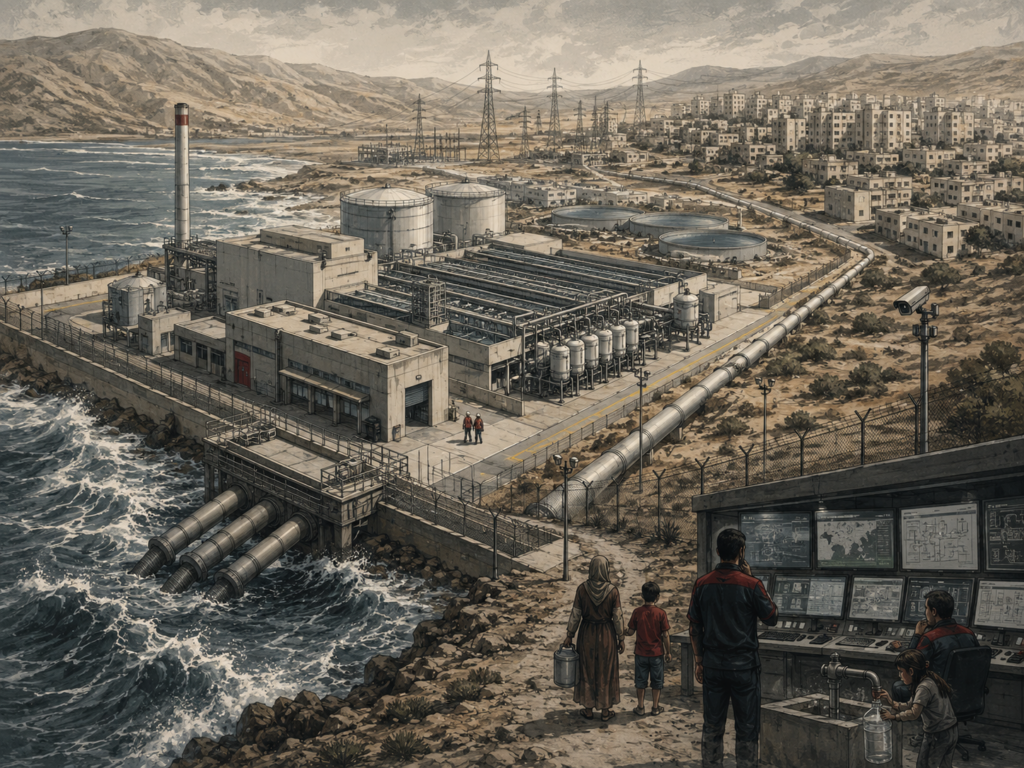
Editorial illustration of a coastal desalination plant with seawater intakes, pipelines, treatment tanks, power lines, security fencing, monitoring systems, nearby communities, and workers overseeing critical water infrastructure.

Water Infrastructure at Risk: The Security Challenge of Desalination Plants

Desalination plant security is becoming a central question for water security, urban resilience, and sustainable development. In arid coastal regions, desalination facilities are no longer secondary infrastructure; they are strategic lifelines that convert seawater into drinking water for millions of people. Yet these systems also concentrate risk. Large plants depend on coastal siting, energy supply, specialized membranes, pumps, digital controls, chemical inputs, skilled operators, and global supply chains. Disruption can cascade through public health, sanitation, hospitals, food systems, and urban stability. This article examines desalination as critical infrastructure, connecting water scarcity, climate stress, energy dependency, cyber and physical security, environmental monitoring, and resilience planning. It argues that desalination can strengthen water security only when cities design for redundancy, storage, accountability, and continuity under disruption.

Landscape associated with Indigenous stewardship traditions and long-term land management practices

Indigenous Stewardship and Relational Land Governance: Lessons for Modern Environmental Systems

Indigenous stewardship and relational land governance challenge modern environmental systems to move beyond ownership, extraction, and technocratic control. This article examines how many Indigenous traditions understand land, water, animals, plants, ancestors, seasons, and future generations through relationships of reciprocity, obligation, memory, law, and care. It argues that sustainability becomes stronger when ecological governance recognizes place-based knowledge, Indigenous sovereignty, biocultural diversity, and long-standing practices of relational responsibility rather than treating land as a passive resource base. Modern environmental systems can learn from these traditions, but only if they avoid romanticization, appropriation, or symbolic inclusion without authority. Indigenous stewardship offers not a nostalgic alternative to science, but a deeper ethical framework for governing living systems through respect, reciprocity, consent, ecological accountability, and responsibility across generations.

Deep learning for biodiversity illustrated as AI-assisted monitoring of wildlife and ecosystems

Deep Learning for Biodiversity: Monitoring, Prediction, and the Governance Challenge

Deep learning for biodiversity can transform ecological monitoring by helping researchers classify species, detect habitat change, analyze acoustic recordings, process satellite imagery, and identify early warning signals across complex ecosystems. But its conservation value depends on more than model performance. Biodiversity loss is driven by land-use change, extraction, climate stress, pollution, weak enforcement, and institutional failure, not simply by a lack of data. This article examines deep learning as one layer within a broader environmental monitoring system: data collection, validation, uncertainty reporting, governance, policy translation, and ecological stewardship. It argues that AI-assisted biodiversity monitoring is most valuable when it is transparent, auditable, scientifically validated, ethically governed, and connected to institutions capable of turning prediction into preservation.

Stockholm skyline representing inclusive growth and Nordic welfare governance

Inclusive Growth: The Institutional Foundations of Shared Prosperity

Inclusive growth is not simply about whether an economy expands, but whether institutions convert growth into shared security, opportunity, dignity, and long-term social stability. Aggregate output can rise while wages stagnate, housing becomes unaffordable, healthcare remains inaccessible, education becomes stratified, and households carry greater exposure to debt and economic shock. This article examines inclusive growth as an Institutions & Governance question, arguing that prosperity is shaped by public architecture: taxation, labor protections, healthcare systems, education, housing policy, social insurance, public goods, and state capacity. It contrasts market dynamism with the institutional need for risk-sharing, social investment, and democratic legitimacy. Growth becomes genuinely inclusive only when it expands human capability, reduces preventable insecurity, protects basic dignity, and ensures that economic prosperity strengthens the public foundations of collective wellbeing.

Scroll to Top