Restrained academic illustration of a seated figure facing a central flow pathway between chaotic complexity and under-stimulating flatness, with skill, attention, feedback, and mastery diagrams.

Flow and Optimal Experience: Attention, Skill, and the Architecture of Human Engagement

Flow and optimal experience describe a state of deep engagement in which attention, challenge, skill, and intrinsic motivation become tightly aligned. This article examines Mihaly Csikszentmihalyi’s theory of flow as a framework for understanding why some of the most rewarding moments in human life arise not from comfort, but from absorbed involvement in meaningful activity. It explores the role of attention, the challenge-skill balance, the links between flow and expertise, creativity, and intrinsic motivation, and the institutional conditions that support or disrupt deep engagement. The result is a stronger account of flow as a core dimension of flourishing, especially in a culture increasingly shaped by distraction and fragmented attention.


Restrained academic illustration of a central human figure surrounded by six interconnected virtue domains, symbolic scenes, civic structures, botanical motifs, and character-strength networks.

Character Strengths and Virtues in Positive Psychology

Character strengths and virtues form one of the central moral-psychological frameworks in positive psychology because they provide a systematic way to study what is best in human beings rather than only what is disordered. This article examines the VIA classification of six virtues and twenty-four character strengths, the measurement of strengths through the VIA Survey, the role of signature strengths in flourishing, and the broader relationship between character, moral life, and institutional context. It also addresses key debates about universality, psychometric structure, and the limits of self-report. The result is a stronger account of character strengths as psychological capacities that matter for meaning, resilience, ethical action, and human flourishing.

Restrained academic illustration of a central figure, storm event, branching interpretive pathways, blocked routes, regrowth, social connection, and cognitive reappraisal diagrams representing explanatory style and optimism.

Explanatory Style and Optimism in Positive Psychology

Explanatory style is one of the most important concepts in positive psychology because it explains how habitual interpretations of success and failure shape resilience, motivation, and persistence. This article examines the origins of explanatory style in learned helplessness research, the three core dimensions of permanence, pervasiveness, and personalization, and the difference between optimistic and pessimistic attributional patterns. It also explores explanatory style’s role in learned optimism, performance, and resilience, while addressing the conceptual and contextual limits of the framework. The result is a stronger account of explanatory style as a bridge between the psychology of discouragement and the science of human flourishing.

Restrained academic illustration of a central figure between blocked pathways, storm imagery, enclosed spaces, tangled networks, and emerging routes of agency and regrowth.

Learned Helplessness and Depression: The Psychological Roots of Positive Psychology

Learned helplessness is one of the most important theories in modern psychology because it explains how repeated exposure to uncontrollable adversity can weaken motivation, alter expectations about agency, and contribute to patterns associated with depression. This article examines the origins of the theory, its role in depression research, the attributional reformulation, and its importance for optimism, resilience, and prevention. It also adds a related articles section linking learned helplessness to explanatory style, hope, post-traumatic growth, strengths, flourishing measurement, public health, and the future of well-being science. The result is a stronger account of learned helplessness as both a theory of suffering and a foundational precursor to positive psychology.

Restrained academic illustration of a central human figure surrounded by five interconnected well-being domains representing positive emotion, engagement, relationships, meaning, and accomplishment.

The PERMA Model of Well-Being: A Framework for Human Flourishing

The PERMA model of well-being is one of the central frameworks in positive psychology because it reconceives flourishing as a multidimensional structure rather than a single emotional state. This article examines Martin Seligman’s five-part model of positive emotion, engagement, relationships, meaning, and accomplishment, while also exploring its measurement, institutional applications, and relationship to subjective well-being and eudaimonic traditions. It adds a related articles section linking PERMA to flourishing measurement, meaning, flow, self-determination, education, public health, sustainability, and the future of well-being science. The result is a stronger account of PERMA as a serious framework for understanding how flourishing is built across personal, social, and institutional life.

Editorial illustration of international law shown as a layered global legal system with a central institutional core, circular legal frameworks, treaty-like structures, maritime pathways, human figures, and interconnected chambers representing sovereignty, accountability, and global legal coordination.

International Law: Foundations of the Global Legal Order

International law examines the legal rules, institutions, doctrines, and disputes that organize relations among states, peoples, international organizations, courts, and other global actors. This content pillar introduces the foundations of public international law, including sources of law, treaty law, customary international law, general principles, statehood, recognition, sovereignty, jurisdiction, non-intervention, state responsibility, international courts, human rights, diplomatic and state immunity, the law of the sea, collective security, peremptory norms, and the legal consequences of war, occupation, inequality, and global governance. It treats international law not as a neutral rulebook detached from power, but as a contested legal order shaped by empire, decolonization, sovereign equality, institutional authority, selective enforcement, and the continuing struggle over whose rights, territory, security, and self-determination are protected.

Abstract legal-studies illustration of human rights in international law, showing individual dignity, treaty systems, monitoring bodies, regional courts, customary norms, state accountability, and global challenges.

Human Rights in International Law

International human rights law places individual dignity at the center of the international legal order. Developed in the aftermath of the Second World War, it transformed international law from a system concerned primarily with relations among sovereign states into one that also recognizes individuals as subjects of legal protection. Through the UN Charter, the Universal Declaration of Human Rights, the International Bill of Human Rights, treaty bodies, regional courts, customary norms, and peremptory protections, human rights law establishes standards for civil, political, economic, social, and cultural rights. This article explains how the modern human rights system emerged, how treaties and institutions monitor compliance, how regional systems strengthen protection, and how contemporary challenges such as climate change, digital surveillance, migration, limited enforcement, and political selectivity continue to test the promise of universal human dignity.

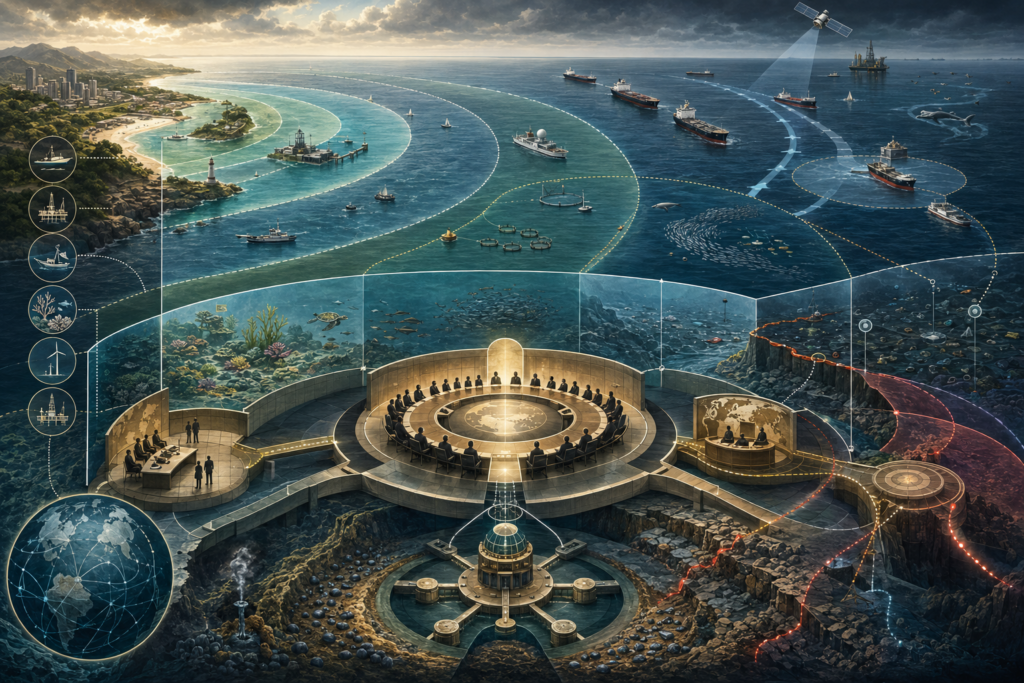
Abstract legal-studies illustration of the law of the sea under UNCLOS, showing maritime zones, coastal jurisdiction, high seas, navigation rights, seabed resources, marine protection, dispute settlement, and ocean governance.

The Law of the Sea and the United Nations Convention on the Law of the Sea (UNCLOS)

The law of the sea establishes the legal architecture for governing the world’s oceans. Largely codified in the United Nations Convention on the Law of the Sea, UNCLOS defines maritime zones, coastal-state jurisdiction, navigation rights, high-seas freedoms, continental shelf claims, deep seabed resources, marine environmental protection, and dispute settlement. This article explains how modern ocean law emerged from earlier debates over freedom of the seas and coastal sovereignty, how UNCLOS structures territorial seas, contiguous zones, exclusive economic zones, continental shelves, and the high seas, and why the deep seabed is treated as part of the common heritage of mankind. It also examines contemporary challenges in ocean governance, including fisheries, biodiversity protection, maritime boundary disputes, seabed mining, pollution, and sustainable stewardship of marine ecosystems.

Abstract legal-studies illustration of the United Nations collective security system, showing Security Council authority, peaceful settlement, enforcement powers, self-defense, peacekeeping, veto paralysis, General Assembly workarounds, and unequal enforcement.

The United Nations and Collective Security

The United Nations collective security system is the central legal framework through which the contemporary international order seeks to prevent conflict, respond to threats to peace, and authorize collective action under international law. Created in the aftermath of the Second World War, the Charter established a system in which the Security Council bears primary responsibility for maintaining international peace and security through peaceful settlement, sanctions, enforcement powers, and evolving peacekeeping practice. This article examines the structure of that system through Chapters VI and VII of the UN Charter, Article 51 self-defense, Security Council practice, the veto, Palestine, Gaza, South Africa’s legal activism, and the unequal political conditions that often determine whether collective security operates as a universal legal mechanism or a selectively enforced instrument of power.

Scroll to Top