
Last Updated June 24, 2026
The modern law of the sea is largely codified in the United Nations Convention on the Law of the Sea, adopted in 1982 and entering into force in 1994. UNCLOS is often described as a constitutional framework for the oceans because it organizes nearly every major dimension of maritime law: territorial seas, straits, archipelagic waters, exclusive economic zones, continental shelves, high seas freedoms, deep seabed resources, marine scientific research, environmental protection, navigation, fisheries, technology transfer, and dispute settlement.
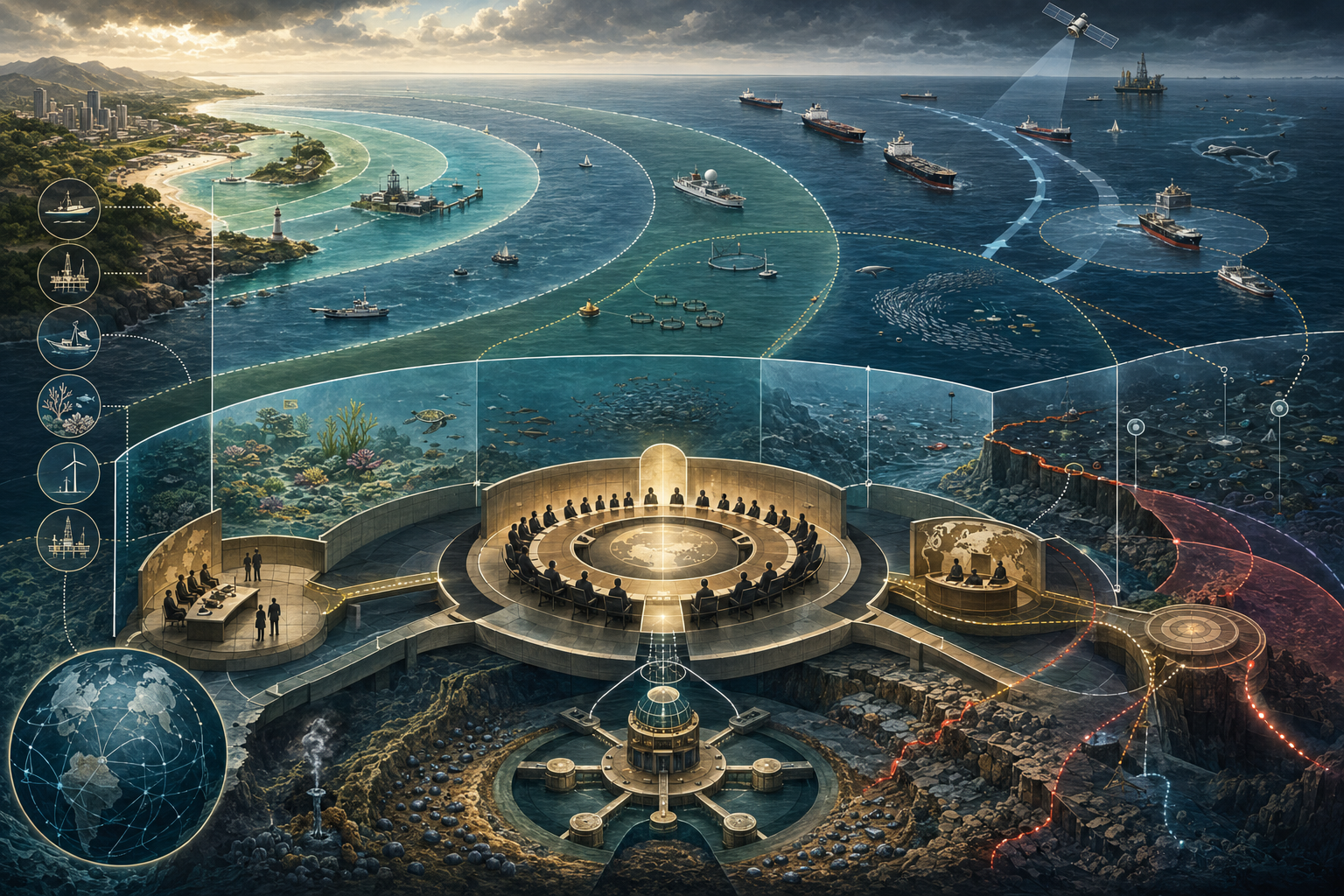
UNCLOS represents a grand legal bargain. Coastal states gained extended maritime entitlements, especially through the exclusive economic zone and continental shelf. Maritime powers preserved navigation and overflight freedoms. Developing states secured recognition of the deep seabed as the common heritage of humankind. Landlocked and geographically disadvantaged states received limited access and benefit-sharing protections. Environmental obligations were built into the legal regime. Dispute-settlement procedures were created to reduce the risk that maritime conflict would be resolved by unilateral force.
Yet the law of the sea is not only a technical regime of nautical miles and maritime zones. It is also one of the most important legal fields for the twenty-first century. Ocean warming, acidification, sea-level rise, collapsing fisheries, plastic pollution, deep seabed mining, biodiversity loss, submarine cables, naval competition, offshore energy, marine genetic resources, and the governance of areas beyond national jurisdiction have made ocean law central to global sustainability, security, and equity. The ocean is not empty space. It is a living planetary system and a legal commons under pressure.
This article explains the historical foundations of the law of the sea, the structure of UNCLOS, maritime zones, navigation rights, the deep seabed, the common heritage principle, marine environmental protection, the BBNJ Agreement, dispute settlement, the International Tribunal for the Law of the Sea, the International Seabed Authority, the Commission on the Limits of the Continental Shelf, the South China Sea Arbitration, and contemporary challenges in ocean governance. It treats UNCLOS as both a legal achievement and an unfinished project: a sophisticated framework that must now operate under conditions of ecological crisis, technological acceleration, geopolitical rivalry, and unequal capacity among states.
Why the Law of the Sea Matters
The law of the sea matters because oceans are not merely physical spaces between states. They are routes of navigation, sources of food, sites of military movement, zones of energy extraction, habitats of immense biodiversity, reservoirs of genetic resources, pathways for submarine cables, arenas of geopolitical rivalry, and regulators of the planetary climate system. Ocean governance therefore sits at the intersection of sovereignty, commerce, security, ecology, science, technology, and global justice.
For coastal states, the law of the sea defines where sovereignty ends, where sovereign rights begin, and where international freedoms remain. For landlocked states, it helps guarantee access to the sea and participation in ocean benefits. For maritime powers, it protects navigation and overflight. For developing states, it provides legal tools for resource control and benefit sharing. For small island developing states, it is tied to survival, sea-level rise, fisheries, maritime entitlements, and climate vulnerability. For humanity as a whole, it governs the high seas, the deep seabed, and marine biodiversity beyond national jurisdiction.
Treaty excerpt
“all issues relating to the law of the sea”
United Nations Convention on the Law of the Sea, Preamble.
UNCLOS presents itself as a comprehensive settlement: a legal framework intended to organize the major uses, rights, duties, and institutions of ocean governance.
The law of the sea also matters because ocean disputes can easily become security crises. Maritime boundary disputes, naval operations, fishing conflicts, offshore oil and gas exploration, island-building, resource claims, and freedom-of-navigation disputes can escalate into diplomatic confrontation or armed conflict. UNCLOS does not eliminate maritime rivalry, but it gives states a shared legal vocabulary for managing it.
Finally, the law of the sea matters because the ocean is under ecological stress. Marine pollution, overfishing, biodiversity loss, warming, acidification, oxygen depletion, coral bleaching, sea-level rise, and potential deep seabed mining all test whether a legal regime designed in the twentieth century can respond to twenty-first-century planetary risks. The future of ocean law will depend on whether maritime governance can move beyond resource allocation toward genuine ecological stewardship.
A Lawyer’s Law-of-the-Sea Analysis Checklist
For lawyers, ocean governance analysis should not begin with a broad claim that a state has “maritime rights.” It should begin with classification. The legal consequences differ depending on whether the dispute concerns internal waters, the territorial sea, a strait, archipelagic waters, the contiguous zone, the exclusive economic zone, the continental shelf, the high seas, the Area, or a treaty-specific environmental or fisheries regime.
1. Identify the maritime space
Determine whether the conduct occurs in internal waters, territorial sea, contiguous zone, EEZ, continental shelf, high seas, the Area, or an overlapping zone.
2. Classify the actor
Identify whether the relevant actor is a coastal state, flag state, port state, landlocked state, international organization, private contractor, vessel owner, research entity, fisher, or naval actor.
3. State the source of authority
Locate the controlling UNCLOS provisions, treaty supplements, customary rules, regional agreements, institutional decisions, and domestic implementing law.
4. Separate sovereignty from sovereign rights
Do not treat the EEZ or continental shelf as territorial sea. Sovereignty, sovereign rights, jurisdiction, freedoms, and due-regard obligations have different legal consequences.
5. Check navigation and passage rights
Assess innocent passage, transit passage, archipelagic sea lanes passage, high-seas freedoms, and rights to lay submarine cables or conduct other internationally lawful uses.
6. Test environmental duties
Identify whether the duty to protect and preserve the marine environment, pollution rules, environmental impact assessment, biodiversity obligations, or precautionary standards apply.
7. Map dispute-settlement limits
Analyze Part XV jurisdiction, Article 287 choices, Article 298 declarations, military-activity exclusions, maritime-delimitation limits, and available provisional measures.
8. Address equity and capacity
Consider landlocked states, geographically disadvantaged states, small island developing states, developing-state capacity, common heritage, benefit sharing, and technology transfer.
Maritime-Zone Authority Table for Legal Practice
The following table translates UNCLOS’s zonal architecture into a practical research framework. It is designed for legal memos, advisory notes, pleadings, policy analysis, and institutional research.
| Maritime space | Core legal authority | Main legal function | Lawyer-facing question |
|---|---|---|---|
| Internal waters | UNCLOS baseline and internal-waters rules | Strong coastal-state authority landward of the baseline, subject to specific treaty limits. | Was the baseline lawfully drawn, and does any right of access or port-related obligation apply? |
| Territorial sea | UNCLOS Articles 2–32 | Coastal-state sovereignty subject to innocent passage and other treaty obligations. | Is the conduct protected passage, non-innocent passage, enforcement, or unlawful interference? |
| Contiguous zone | UNCLOS Article 33 | Limited enforcement for customs, fiscal, immigration, and sanitary laws. | Is the state using this zone for the specified purposes, or trying to convert it into general sovereignty? |
| Exclusive economic zone | UNCLOS Articles 55–75 | Sovereign rights over resources and functional jurisdiction, while preserving navigation and overflight freedoms. | Does the dispute concern resource control, environmental regulation, military activity, research, fisheries, cables, or installations? |
| Continental shelf | UNCLOS Articles 76–85 | Seabed and subsoil resource rights, including potential outer shelf beyond 200 nautical miles. | Is the claim about the seabed, the water column, Article 76 evidence, or delimitation with another state? |
| High seas | UNCLOS Articles 86–120 | Open access for all states, structured by due regard, flag-state duties, conservation, and cooperation. | Which flag state has jurisdiction, and what cooperative or environmental obligations constrain freedom? |
| The Area | UNCLOS Part XI and 1994 Implementation Agreement | Deep seabed resources beyond national jurisdiction governed as common heritage of humankind. | Does the activity require ISA authorization, benefit sharing, environmental assessment, or precautionary restraint? |
| Areas beyond national jurisdiction | UNCLOS and BBNJ Agreement | Biodiversity, marine genetic resources, high-seas protected areas, environmental assessment, and capacity building. | Does the conduct implicate BBNJ obligations, existing sectoral bodies, or high-seas biodiversity protection? |
Leading Cases and Institutional Authorities for Ocean Governance
Law-of-the-sea analysis often depends on treaty text, technical institutions, arbitral awards, advisory opinions, and specialized tribunals. The table below identifies recurring authorities and their practical use.
| Authority | Legal significance | Practical use |
|---|---|---|
| UNCLOS | Comprehensive treaty framework for maritime zones, navigation, resources, environment, institutions, and dispute settlement. | Start with the relevant Part, Article, and Annex before turning to custom, institutional practice, or case law. |
| ITLOS | Specialized tribunal for disputes concerning UNCLOS interpretation and application, including provisional measures and advisory work. | Use for prompt release, environmental duties, provisional measures, seabed issues, and specialized ocean-law reasoning. |
| CLCS | Technical body reviewing submissions on outer continental shelf limits beyond 200 nautical miles. | Use where entitlement depends on Article 76 scientific evidence and outer-shelf recommendations. |
| ISA | Institution organizing and controlling mineral-resource activities in the Area. | Use for deep seabed mining, common heritage, environmental regulation, sponsoring-state obligations, and benefit sharing. |
| North Sea Continental Shelf | Foundational ICJ authority on continental shelf delimitation and equitable principles. | Use for historical development of shelf doctrine, equitable delimitation, and the relationship between treaty and custom. |
| South China Sea Arbitration | Major Annex VII award on maritime entitlements, historic-rights claims, features, and environmental harm. | Use for expansive maritime claims, island/rock analysis, environmental obligations, and limits of adjudication under geopolitical pressure. |
| BBNJ Agreement | New treaty framework for biodiversity beyond national jurisdiction, marine genetic resources, protected areas, environmental assessment, and capacity building. | Use for high-seas biodiversity, marine protected areas, benefit sharing, and governance of areas beyond national jurisdiction. |
Historical Foundations of Ocean Law
The legal principles governing the oceans developed gradually through custom, imperial practice, commerce, naval power, fisheries conflict, and the growth of international legal doctrine. Early ocean law was shaped by the tension between two competing ideas: the sea as an open space available to all and the sea as a zone subject to coastal-state control. This tension remains visible in UNCLOS, which balances coastal-state rights with navigation freedoms and shared interests in areas beyond national jurisdiction.
In the early modern period, maritime powers fought over trade routes, fisheries, colonial access, and naval dominance. The ocean was never a neutral commons in practice. It was a space of commerce, empire, violence, piracy, slavery, extraction, and strategic mobility. Legal doctrines about freedom of the seas and maritime sovereignty therefore developed alongside European expansion and global inequality. A serious history of the law of the sea must acknowledge both the legal sophistication of maritime doctrine and the imperial world in which much of that doctrine developed.
For several centuries, state practice evolved toward a compromise. Coastal states asserted authority over waters adjacent to their coasts, while the high seas were treated as open to navigation, fishing, and communication by all states. This compromise reflected both practical geography and political power. States needed control near their shores for defense, customs, sanitation, and resource use. Maritime powers wanted open routes for trade and naval mobility. The law developed around the management of that tension.
The twentieth century transformed these older arrangements. New technologies made offshore oil, gas, minerals, and distant-water fisheries more valuable. Decolonization brought many new states into the international legal order. Developing states demanded a fairer distribution of ocean resources. Environmental concern grew. The old freedom-of-the-seas framework could no longer manage the scale of claims being made over ocean space. UNCLOS emerged from this transformation.
Mare Liberum, Mare Clausum, and the Ocean Sovereignty Debate
Two classical phrases still symbolize the historical debate over ocean governance: mare liberum, the free sea, and mare clausum, the closed sea. The Dutch jurist Hugo Grotius defended the idea of open seas in Mare Liberum in 1609, arguing that the ocean could not be subject to exclusive appropriation in the way land could. John Selden, writing from an English perspective, defended the possibility of maritime dominion in Mare Clausum. These arguments were never purely philosophical. They reflected commercial rivalry, imperial ambition, and the strategic interests of maritime states.
The Grotian idea of open seas became foundational to the freedom of navigation and high-seas freedoms. It helped support the claim that no state could close the ocean to others merely by assertion of power. But the freedom-of-the-seas tradition also served maritime empires by protecting global mobility, trade, naval reach, and colonial access. Freedom could therefore operate both as a principle of shared access and as a legal language supporting the most powerful maritime actors.
The closed-sea tradition, by contrast, reflected the intuition that coastal states have legitimate security, economic, and regulatory interests in waters near their coasts. States needed some authority over coastal waters to protect ports, enforce customs, prevent smuggling, manage fisheries, and secure their territory. Modern territorial seas, contiguous zones, exclusive economic zones, and continental shelves all reflect the persistence of coastal-state claims, though within legal limits.
UNCLOS can be understood as a mature settlement of this old debate. It does not treat the ocean as entirely free or entirely subject to coastal sovereignty. Instead, it organizes ocean space into zones. Sovereignty is strongest in internal waters and the territorial sea. Sovereign rights are functional in the exclusive economic zone and continental shelf. Freedoms remain central on the high seas. The deep seabed is governed through the common heritage principle. The law of the sea is therefore a zonal architecture balancing freedom, sovereignty, resource control, and common interest.
The Emergence of Modern Maritime Law
Modern maritime law accelerated in the twentieth century. In 1945, the United States issued the Truman Proclamation asserting jurisdiction over the natural resources of the continental shelf adjacent to its coastline. This declaration helped trigger a wave of offshore resource claims. Coastal states increasingly sought legal control over seabed resources, fisheries, and nearby marine space. Technology made previously inaccessible resources commercially significant, and law followed technology outward from the coast.
The 1958 Geneva Conferences on the Law of the Sea produced several conventions concerning the territorial sea, contiguous zone, high seas, fishing, conservation of living resources, and continental shelf. These instruments were important, but they did not fully resolve major disputes, including the breadth of the territorial sea, fisheries jurisdiction, seabed mineral governance, and maritime zones beyond traditional coastal waters.
Decolonization also changed the politics of ocean law. Newly independent states were not content to inherit a maritime order largely shaped by older naval and colonial powers. They sought broader coastal rights, equitable sharing of seabed resources, recognition of developing-state interests, and legal limits on unilateral appropriation. The famous intervention of Arvid Pardo of Malta before the UN General Assembly in 1967 helped catalyze the idea that the deep seabed beyond national jurisdiction should be treated as the common heritage of humankind rather than as an open field for technologically advanced states and corporations.
The Third United Nations Conference on the Law of the Sea began in 1973 and lasted nearly a decade. The result was UNCLOS, adopted in 1982 at Montego Bay, Jamaica. The Convention represented a vast legal compromise among coastal states, maritime powers, developing states, landlocked states, archipelagic states, fishing states, and states concerned with seabed minerals and environmental protection. Its breadth reflects the political complexity of the ocean itself.
The Structure and Legal Architecture of UNCLOS
UNCLOS is a comprehensive treaty containing 320 articles and multiple annexes. It is organized around maritime zones, navigation regimes, resource rights, environmental duties, marine scientific research, technology transfer, institutional mechanisms, and dispute settlement. Its scale is one reason it is often described as a constitution for the oceans. It does not merely regulate one activity; it establishes a legal order for ocean space as a whole.
The Convention covers internal waters, the territorial sea, the contiguous zone, straits used for international navigation, archipelagic waters, the exclusive economic zone, the continental shelf, the high seas, islands, enclosed and semi-enclosed seas, landlocked states, the deep seabed, protection of the marine environment, marine scientific research, development and transfer of marine technology, and dispute settlement. It also establishes or supports key institutions such as ITLOS, the International Seabed Authority, and the Commission on the Limits of the Continental Shelf.
UNCLOS is best understood as a treaty of allocation and restraint. It allocates jurisdiction and rights, but it also limits them. Coastal states receive extensive rights, but those rights are tied to duties and to the rights of other states. Maritime powers retain freedoms, but those freedoms are not unlimited. Deep seabed resources are not left to unilateral appropriation. Environmental protection is not optional. Disputes are not meant to be settled by force.
The Convention’s legal architecture also reflects functional differentiation. Sovereignty is not the same in every zone. A coastal state’s sovereignty in the territorial sea differs from its sovereign rights in the EEZ. Rights over the continental shelf differ from rights over the water column above it. The high seas are governed by freedom, but not lawlessness. The Area is governed by common heritage, not national appropriation. This layered structure is the genius of UNCLOS.
Baselines and the Measurement of Maritime Space
Maritime zones are measured from baselines. For that reason, baselines are not a technical afterthought. They are foundational to maritime entitlement. A state’s territorial sea, contiguous zone, exclusive economic zone, and continental shelf are all measured from the baseline, usually the low-water line along the coast, though straight baselines and archipelagic baselines may apply in specific circumstances under UNCLOS.
Baseline rules matter because small changes in coastal geography can have large legal consequences. Coastlines are irregular. Deltas shift. Islands erode. Sea levels rise. Reefs may be submerged. Artificial islands may be constructed. These facts raise difficult questions about how stable maritime entitlements should be when coastlines change, especially for low-lying and small island states facing sea-level rise.
Straight baselines are permitted only under specific conditions, such as deeply indented coastlines or fringes of islands along the coast. They cannot be used simply to expand maritime claims beyond what the Convention permits. Archipelagic baselines are available to archipelagic states under defined conditions and reflect the special geography of states composed of island groups. The baseline system therefore balances geographical reality with legal restraint.
In the climate era, baseline stability has become one of the most urgent questions in ocean law. If sea-level rise physically alters coastlines, should maritime zones move landward, or should entitlements remain fixed to protect vulnerable states from losing maritime rights because of climate change they did not primarily cause? The answer will shape the future of ocean equity and the survival of some island-state legal entitlements.
Maritime Zones Under UNCLOS
One of UNCLOS’s central achievements is the establishment of clearly defined maritime zones. These zones determine the rights and responsibilities of coastal states, flag states, landlocked states, and the international community. They allow the ocean to be governed not as a single undifferentiated space but as a structured legal geography.
The major zones include internal waters, the territorial sea, the contiguous zone, the exclusive economic zone, the continental shelf, the high seas, and the Area. Each zone reflects a different balance between coastal-state authority and international freedom. The closer the zone is to land, the stronger coastal-state authority generally becomes. Farther from land, common access and international freedoms play a larger role. But the pattern is not purely spatial. The continental shelf concerns seabed rights even where the water column above may have a different legal status. The Area concerns the seabed beyond national jurisdiction, governed by common heritage rather than high-seas freedom alone.
This zonal structure reduces conflict by clarifying legal entitlement. It tells states where they may regulate fishing, where vessels enjoy passage rights, where offshore resources may be exploited, where navigation freedoms remain, and where common institutional governance applies. But it also creates new disputes: where baselines are drawn, how islands are classified, how shelves are delimited, how overlapping EEZs are divided, and how rights are balanced where military, environmental, fishing, and scientific activities overlap.
UNCLOS therefore provides the map, but not always the final answer. Maritime delimitation, entitlement, and use still require interpretation, negotiation, adjudication, and restraint.
Territorial Sea and Innocent Passage
The territorial sea extends up to 12 nautical miles from the baseline. Within this zone, the coastal state exercises sovereignty over the waters, the airspace above them, and the seabed and subsoil below them. This sovereignty is similar to territorial sovereignty on land, but it is subject to an important qualification: foreign ships enjoy the right of innocent passage.
Treaty excerpt
“sovereignty of a coastal State extends, beyond its land territory and internal waters”
United Nations Convention on the Law of the Sea, Article 2.
Article 2 anchors coastal-state sovereignty over the territorial sea, while UNCLOS immediately qualifies that sovereignty through passage rights and other treaty rules.
Treaty excerpt
“ships of all States, whether coastal or land-locked, enjoy the right of innocent passage”
United Nations Convention on the Law of the Sea, Article 17.
Innocent passage is one of UNCLOS’s central compromises: coastal states have sovereignty in the territorial sea, but foreign ships retain a legally protected passage right.
Passage is innocent so long as it is not prejudicial to the peace, good order, or security of the coastal state. UNCLOS lists activities that would render passage non-innocent, including threats or use of force, weapons exercises, intelligence collection, propaganda affecting defense or security, launching aircraft, loading or unloading contrary to laws, willful pollution, fishing, research, and interference with communications. This structure protects coastal security while preserving navigation.
The territorial sea therefore reflects the classic balance of the law of the sea. Coastal states are not powerless near their coasts, but they cannot close their waters to ordinary passage. Navigation is protected because the ocean remains a shared medium of movement. Sovereignty is preserved because the coast is not legally defenseless.
The right of innocent passage also matters for landlocked states. UNCLOS does not treat access to the sea as a privilege enjoyed only by coastal powers. The law recognizes that navigation rights must be available to all states, whether coastal or landlocked. This is one of the ways the Convention tries to prevent geography from becoming total exclusion.
Contiguous Zone
The contiguous zone extends beyond the territorial sea and may reach up to 24 nautical miles from the baseline. It does not grant the coastal state full sovereignty. Instead, it gives the coastal state limited enforcement powers to prevent and punish infringement of customs, fiscal, immigration, and sanitary laws and regulations within its territory or territorial sea.
Treaty excerpt
“contiguous to its territorial sea, described as the contiguous zone”
United Nations Convention on the Law of the Sea, Article 33.
The contiguous zone provides limited enforcement authority beyond the territorial sea, especially for border-related regulatory interests.
The contiguous zone is therefore a functional enforcement zone. It reflects the practical reality that violations involving customs, immigration, sanitation, or fiscal rules may occur just beyond the territorial sea but still threaten the coastal state’s regulatory order. The zone gives coastal states a buffer without converting the area into sovereign waters.
This limited character matters. The contiguous zone should not be treated as a second territorial sea. Coastal states do not receive general legislative or enforcement authority over all activities within it. The zone exists for specified purposes. That specificity is part of UNCLOS’s broader legal method: rights and jurisdiction are allocated functionally rather than through blanket assertions of power.
In modern practice, the contiguous zone may intersect with migration enforcement, smuggling, public health, trafficking, and maritime policing. These issues can be sensitive because enforcement at sea may affect migrants, refugees, fishers, small vessels, and people in distress. Coastal-state authority must therefore be exercised consistently with other obligations, including search and rescue, non-refoulement where applicable, human rights, and maritime safety.
Exclusive Economic Zone
The exclusive economic zone, or EEZ, is one of UNCLOS’s most important innovations. It extends up to 200 nautical miles from the baseline. Within the EEZ, the coastal state does not possess full sovereignty, but it does possess sovereign rights for the purpose of exploring, exploiting, conserving, and managing natural resources, whether living or non-living, of the waters, seabed, and subsoil. It also has jurisdiction over artificial islands, installations, marine scientific research, and protection and preservation of the marine environment.
Treaty excerpt
“sovereign rights for the purpose of exploring and exploiting, conserving and managing the natural resources”
United Nations Convention on the Law of the Sea, Article 56.
Article 56 defines the EEZ as a functional resource-rights zone: the coastal state receives powerful economic rights without full sovereignty over the water column.
The EEZ transformed ocean governance by giving coastal states legal control over vast offshore resource zones. Fisheries, offshore wind, oil and gas, seabed minerals within national jurisdiction, and marine scientific research all became subject to a more structured legal regime. For many developing coastal states, the EEZ created an important legal basis for resource sovereignty and economic development.
But the EEZ is also a zone of shared use. Other states retain freedoms of navigation, overflight, and the laying of submarine cables and pipelines, as well as other internationally lawful uses related to those freedoms. This creates recurring disputes, especially over military activities, marine scientific research, surveillance, fisheries enforcement, and installations.
The EEZ also illustrates a broader challenge in international law: resource rights and environmental duties are inseparable. Coastal states receive rights to exploit living resources, but they also have duties to conserve and manage them. Overfishing, illegal, unreported, and unregulated fishing, bycatch, ecosystem collapse, and climate-driven fish migration all test whether EEZ governance can operate sustainably.
The EEZ is therefore one of UNCLOS’s greatest achievements and one of its most contested zones. It expands coastal-state authority, preserves key international freedoms, and forces states to negotiate the relationship between economic use and ecological responsibility.
Continental Shelf and the CLCS
The continental shelf regime concerns the seabed and subsoil of submarine areas extending beyond the territorial sea. Under UNCLOS, every coastal state has rights over the continental shelf to at least 200 nautical miles, where the continental margin does not extend that far. In some cases, a state may establish an outer continental shelf beyond 200 nautical miles if it satisfies the geological and geomorphological criteria of Article 76.
Treaty excerpt
“continental shelf of a coastal State comprises the seabed and subsoil”
United Nations Convention on the Law of the Sea, Article 76.
The continental shelf regime concerns seabed and subsoil entitlement, not general sovereignty over the water column.
Continental shelf rights are sovereign rights for the purpose of exploring and exploiting natural resources of the seabed and subsoil. These rights exist by virtue of the coastal state’s entitlement and do not depend on occupation or proclamation. They cover mineral and other non-living resources as well as sedentary species. The water column above the shelf may be governed by a different regime, especially beyond the EEZ.
The Commission on the Limits of the Continental Shelf plays a crucial role for shelves extending beyond 200 nautical miles. Coastal states submit information to the Commission, which makes recommendations concerning the outer limits of the continental shelf. The Commission does not delimit boundaries between states, but its recommendations are central to establishing outer limits in accordance with Article 76.
The extended continental shelf regime shows how law and science interact. Geological data, bathymetry, sediment thickness, foot-of-slope analysis, and technical mapping become legally relevant. Maritime entitlement is no longer only a matter of distance from the coast; it is also tied to the physical structure of the continental margin.
The continental shelf regime also raises equity questions. Advanced coastal states often have greater technical capacity to prepare complex submissions. Developing states may need support to document claims. Landlocked states do not possess continental shelves but may have interests in benefit sharing where exploitation occurs beyond 200 nautical miles under Article 82. Thus, even a technical seabed regime carries distributive consequences.
Navigation, Straits, Archipelagic Waters, and Maritime Mobility
Navigation is one of the oldest and most important concerns in the law of the sea. UNCLOS protects several forms of maritime mobility, including innocent passage through the territorial sea, transit passage through straits used for international navigation, archipelagic sea lanes passage, and high-seas freedom of navigation. These regimes reflect the central role of the ocean in global commerce, communication, naval movement, and human mobility.
Straits used for international navigation are especially important because they connect one part of the high seas or EEZ with another. If coastal states bordering straits could close them unilaterally, global navigation would be vulnerable to strategic choke points. UNCLOS therefore establishes transit passage, a regime stronger than ordinary innocent passage in many respects. It protects continuous and expeditious transit through such straits while preserving certain regulatory interests of bordering states.
Archipelagic states are treated through a special regime. States made up wholly of one or more archipelagos may draw archipelagic baselines under specified conditions, enclosing archipelagic waters. But the regime also protects archipelagic sea lanes passage and other navigational interests. This reflects another UNCLOS compromise: the unity and security of archipelagic states are recognized, but international navigation is not extinguished.
Navigation is also militarily sensitive. Naval powers emphasize freedom of navigation and overflight. Coastal states emphasize security, environmental protection, surveillance concerns, and resource rights. Disputes over military activities in EEZs, intelligence collection, marine scientific research, hydrographic surveys, and freedom-of-navigation operations remain major sources of tension. UNCLOS provides a framework, but state practice and interpretation still diverge.
Navigation law therefore reveals the ocean’s dual character. It is a space of connection and commerce, but also a space of military strategy. It is a common route, but not a lawless one. The durability of UNCLOS depends in part on whether states can preserve navigational freedoms without turning them into instruments of coercive power projection.
High Seas Freedoms and Responsibilities
The high seas are ocean areas beyond national jurisdiction. Under UNCLOS, they are open to all states, whether coastal or landlocked. The traditional freedoms include navigation, overflight, laying submarine cables and pipelines, constructing artificial islands and installations permitted under international law, fishing, and scientific research. These freedoms are not unlimited; they must be exercised with due regard for the interests of other states and in accordance with the Convention and other rules of international law.
Treaty excerpt
“The high seas are open to all States”
United Nations Convention on the Law of the Sea, Article 87.
High-seas freedom is central to ocean law, but UNCLOS frames that freedom as legally structured rather than anarchic.
High-seas freedom historically served commerce, navigation, and communication. Today it also raises major governance challenges. The high seas are vast, difficult to monitor, and ecologically vulnerable. Fishing fleets, shipping, submarine cables, scientific research, pollution, marine genetic resource collection, and emerging technologies all operate in areas where no state has territorial sovereignty. Governance therefore depends on flag-state responsibility, port-state control, regional fisheries bodies, environmental agreements, inspection regimes, and cooperation among states.
Flag-state jurisdiction is especially important. Ships on the high seas generally fall under the jurisdiction of the state whose flag they fly. But flags of convenience, weak enforcement, illegal fishing, labor abuse, unsafe vessels, pollution, and maritime crime have exposed the limits of flag-state control. Where flag states fail to regulate effectively, high-seas freedom can become a cover for exploitation.
The high seas also raise a moral and ecological question: should freedom be understood primarily as freedom to use, or also as responsibility to preserve? The BBNJ Agreement reflects the growing view that high-seas governance must move beyond open access toward biodiversity protection, environmental impact assessment, benefit sharing, and scientific cooperation. The high seas are not empty; they are part of Earth’s life-support system.
The Deep Seabed and the Common Heritage of Humankind
One of UNCLOS’s most distinctive features is its treatment of the deep seabed beyond national jurisdiction, known as “the Area.” UNCLOS declares that the Area and its resources are the common heritage of humankind. This principle rejects unilateral appropriation by states or corporations and requires that mineral-resource activities in the Area be organized and controlled through an international institutional framework.
Treaty excerpt
“The Area and its resources are the common heritage of mankind.”
United Nations Convention on the Law of the Sea, Article 136.
The common-heritage principle is one of UNCLOS’s most important distributive innovations. It treats deep seabed mineral resources beyond national jurisdiction as belonging to humankind as a whole, not to the first technologically capable extractor.
The common heritage principle emerged from concerns that technologically advanced states and corporations would dominate the deep seabed before developing states could participate. It is therefore not only a property rule. It is a distributive justice principle. It says that some global resources should not be allocated solely through power, technology, capital, or first possession.
The deep seabed is now at the center of intense debate. Polymetallic nodules, cobalt-rich crusts, and massive sulfides contain minerals that may be valuable for batteries, electronics, and energy technologies. Proponents of deep seabed mining argue that these resources could support energy transition and development. Critics warn that mining could cause severe and poorly understood damage to deep-ocean ecosystems, many of which are fragile, slow-growing, and scientifically underexplored.
This debate tests the meaning of common heritage. If common heritage becomes merely a revenue-sharing formula for extraction, it may fail to protect the ocean itself. If it includes stewardship, precaution, intergenerational equity, scientific knowledge, and environmental protection, then it becomes a broader principle of planetary responsibility. The future of deep seabed governance will depend on which interpretation prevails.
The International Seabed Authority
The International Seabed Authority is the institution through which states parties to UNCLOS organize and control mineral-resource-related activities in the Area. It is headquartered in Kingston, Jamaica, and is responsible for ensuring that activities in the Area are carried out for the benefit of humankind as a whole while protecting the marine environment from harmful effects arising from deep seabed activities.
ISA’s role is legally significant because it converts the common heritage principle into institutional governance. Rather than leaving deep seabed resources to unilateral exploitation, UNCLOS establishes an organization with authority to issue regulations, approve plans of work, administer exploration contracts, develop benefit-sharing mechanisms, and protect the marine environment. ISA therefore sits at the center of one of the most contested questions in contemporary ocean law: whether deep seabed mining should proceed, under what conditions, and with what environmental safeguards.
The Authority’s work has become increasingly controversial because the ecological risks of deep seabed mining remain uncertain and potentially severe. The deep ocean contains ecosystems that are poorly understood, slow to recover, and potentially vulnerable to sediment plumes, noise, habitat destruction, toxic disturbance, and biodiversity loss. The legal challenge is not merely to regulate mining efficiently; it is to determine whether the precautionary principle, scientific uncertainty, and common heritage require restraint.
ISA also raises questions of representation and equity. Developing states, landlocked states, small island developing states, technologically advanced sponsoring states, mining contractors, environmental organizations, scientists, and Indigenous and coastal communities may have sharply different interests. If the Area belongs to humankind as a whole, then decision-making must not be captured by the states and companies most eager to mine. Common heritage requires procedural legitimacy as well as benefit sharing.
Article 140 of UNCLOS provides that activities in the Area shall be carried out for the benefit of humankind as a whole, taking into particular consideration the interests and needs of developing states. That language should remain central. Deep seabed governance cannot be evaluated only by production value. It must be evaluated by equity, environmental protection, intergenerational justice, and the integrity of the global commons.
Marine Environmental Protection
UNCLOS imposes a general obligation on states to protect and preserve the marine environment. This duty is one of the Convention’s most important features because it integrates environmental protection into the basic structure of ocean law. The marine environment is not treated merely as a resource pool. It is a legal object of protection.
Treaty excerpt
“States have the obligation to protect and preserve the marine environment.”
United Nations Convention on the Law of the Sea, Article 192.
Article 192 is one of UNCLOS’s most important environmental provisions. It states the general duty from which more specific marine environmental obligations flow.
UNCLOS requires states to prevent, reduce, and control pollution of the marine environment from land-based sources, seabed activities, dumping, vessels, and the atmosphere. It also requires cooperation, monitoring, environmental assessment in certain circumstances, and special care for fragile ecosystems and the habitat of depleted, threatened, or endangered species. These provisions have influenced subsequent treaties, regional agreements, institutional practice, and judicial interpretation.
Marine environmental protection is now one of the most urgent areas of ocean law. Plastic pollution, chemical runoff, oil spills, shipping emissions, ballast-water transfer, underwater noise, ocean warming, acidification, coral bleaching, dead zones, overfishing, and habitat destruction all place pressure on the legal regime. The ocean is vast, but it is not infinitely resilient.
The environmental provisions of UNCLOS also connect ocean law to climate law. Greenhouse-gas emissions contribute to ocean warming, sea-level rise, acidification, deoxygenation, and ecosystem disruption. This raises legal questions about whether states’ duties to protect and preserve the marine environment include obligations related to climate mitigation and adaptation. Recent advisory proceedings before international courts and tribunals have made this connection increasingly important.
Environmental protection also requires attention to inequality. Coastal communities, small island developing states, fishers, Indigenous peoples, and low-income populations often suffer most from ocean degradation while contributing least to its causes. The legal duty to protect the marine environment must therefore be understood not only ecologically, but also socially and distributively.
BBNJ, the High Seas Treaty, and Biodiversity Beyond National Jurisdiction
The Agreement under UNCLOS on the Conservation and Sustainable Use of Marine Biological Diversity of Areas beyond National Jurisdiction, commonly known as the BBNJ Agreement or High Seas Treaty, is one of the most important recent developments in ocean governance. It addresses areas beyond national jurisdiction, including high-seas biodiversity and marine genetic resources, and seeks to fill gaps left by the original UNCLOS framework.
Treaty excerpt
“to ensure the conservation and sustainable use of marine biological diversity of areas beyond national jurisdiction”
Agreement under UNCLOS on Marine Biological Diversity of Areas beyond National Jurisdiction, Article 2.
The BBNJ Agreement extends the UNCLOS architecture by creating a dedicated legal framework for biodiversity beyond national jurisdiction.
The BBNJ Agreement addresses four major areas: marine genetic resources and benefit sharing; area-based management tools, including marine protected areas; environmental impact assessments; and capacity-building and marine technology transfer. These issues are central because the high seas and deep ocean beyond national jurisdiction contain rich biodiversity but remain difficult to govern through traditional state jurisdiction.
Marine genetic resources are especially important. Organisms from the deep ocean may have scientific, pharmaceutical, industrial, and technological value. Without a benefit-sharing framework, states and corporations with advanced research capacity could capture benefits while developing states and the broader international community remain excluded. The BBNJ Agreement therefore extends the distributive logic of ocean governance into the biological and informational dimensions of marine resources.
Marine protected areas beyond national jurisdiction are another major innovation. The ability to create protected areas on the high seas is essential if the world is to conserve biodiversity at the scale required by ecological science. But implementation will be difficult. High-seas protection must coordinate with shipping, fisheries, seabed activities, scientific research, military uses, and existing regional and sectoral bodies.
The BBNJ Agreement shows that UNCLOS remains a living framework. The original Convention created the constitutional architecture, but new agreements are needed to respond to emerging ecological and technological pressures. The law of the sea is therefore not fixed in 1982. It is evolving toward a more biodiversity-centered and precautionary understanding of ocean governance.
Fisheries, Food Security, and Ocean Equity
Fisheries are among the most socially important uses of the ocean. They support food security, livelihoods, culture, trade, and coastal economies. UNCLOS gives coastal states significant rights over living resources in the EEZ, but it also imposes conservation and management obligations. States must determine allowable catches, prevent overexploitation, cooperate over shared and migratory stocks, and consider the interests of other states in certain circumstances.
Fisheries governance is legally difficult because fish move. Stocks cross EEZs, migrate into high seas areas, and respond to climate-driven changes in temperature, oxygen, currents, and habitat. A coastal state may manage its EEZ carefully, but the same stock may be affected by high-seas fishing or by another state’s practices. This makes cooperation essential.
Illegal, unreported, and unregulated fishing remains a major challenge. It undermines conservation, harms coastal communities, deprives developing states of revenue, contributes to labor abuse, and weakens trust in fisheries governance. Flag-state responsibility, port-state measures, regional fisheries management organizations, vessel monitoring, catch documentation, and market controls are all part of the response.
Fisheries also raise equity questions. Distant-water fishing fleets from wealthy or technologically advanced states may operate near the waters of developing states, sometimes under access agreements that do not adequately protect local communities or ecosystems. Small-scale fishers may be displaced by industrial fleets. Conservation measures may burden communities that depend on fish for survival unless designed with justice and participation in mind.
The law of the sea must therefore treat fisheries as more than an economic sector. Fisheries connect marine ecology to human rights, food systems, labor rights, Indigenous and coastal cultures, development, and intergenerational sustainability. A sustainable fisheries regime must protect both fish populations and the communities whose lives depend on them.
Climate Change, Sea-Level Rise, and the Future of Maritime Boundaries
Climate change is transforming the law of the sea. Ocean warming, sea-level rise, acidification, deoxygenation, glacier melt, storm intensification, coral bleaching, and changing fish migration patterns all affect maritime governance. The legal framework of UNCLOS was not drafted for a world in which coastlines, baselines, ecosystems, and maritime entitlements are destabilized by global climate change.
Sea-level rise is particularly urgent. Maritime zones are measured from baselines, and baselines are tied to coastal geography. If coastlines retreat, reefs disappear, or low-lying islands become uninhabitable or submerged, questions arise about whether maritime entitlements should also shift. For small island developing states, this is existential. Maritime zones may represent not only economic rights but also national identity, food security, and international legal continuity.
Many states and scholars now argue for stability of maritime entitlements in the face of sea-level rise. The legal and moral logic is strong: states least responsible for climate change should not lose maritime zones because rising seas alter coastlines. If maritime boundaries shift automatically with climate harm, climate-vulnerable states may suffer a double injury: physical loss of land and legal loss of ocean rights.
Climate change also affects fisheries and marine ecosystems. Fish stocks move poleward or deeper. Coral reef systems collapse. Ocean acidification affects shell-forming organisms. Warmer waters contribute to harmful algal blooms and oxygen depletion. These ecological changes will make fixed fisheries allocations and management regimes harder to maintain. Ocean law will need adaptive governance.
The marine environment provisions of UNCLOS are increasingly relevant to climate obligations. If states have a duty to protect and preserve the marine environment, and greenhouse-gas emissions damage that environment, then climate law and ocean law cannot be separated. Future litigation and advisory opinions will likely deepen this connection.
Dispute Settlement Under UNCLOS
UNCLOS includes one of the most developed dispute-settlement systems in international law. Part XV requires states to settle disputes concerning the interpretation or application of the Convention by peaceful means. If parties cannot resolve a dispute through negotiation or other chosen procedures, UNCLOS provides for compulsory dispute settlement, subject to limitations and optional exceptions.
Treaty excerpt
“choose, by means of a written declaration, one or more of the following means”
United Nations Convention on the Law of the Sea, Article 287.
Article 287 allows states to choose among ITLOS, the International Court of Justice, Annex VII arbitration, or Annex VIII special arbitration for certain categories of UNCLOS disputes.
The major dispute-settlement options include the International Tribunal for the Law of the Sea, the International Court of Justice, Annex VII arbitration, and Annex VIII special arbitration. If states have not accepted the same procedure, Annex VII arbitration generally operates as the default. This structure makes UNCLOS unusually judicialized compared with many other multilateral treaties.
The dispute-settlement system is important because maritime disputes can otherwise become coercive. Boundary disputes, navigation conflicts, detention of vessels, fisheries enforcement, environmental harm, and resource claims all have the potential to escalate. Legal procedures create a channel for resolution through argument and evidence rather than unilateral action.
But UNCLOS dispute settlement also has limits. Certain disputes may be excluded or limited, including some disputes concerning maritime delimitation, historic bays or titles, military activities, law-enforcement activities in some contexts, and matters before the Security Council. Some states have made Article 298 declarations excluding specified categories of disputes. Jurisdiction must therefore be carefully analyzed in each case.
Even where jurisdiction exists and an award is binding, compliance may remain politically contested. The South China Sea Arbitration illustrates this challenge. The legal decision was significant, but enforcement depended on state practice, diplomatic pressure, and broader regional politics. As in other fields of international law, adjudication clarifies law but does not automatically eliminate power.
The International Tribunal for the Law of the Sea
The International Tribunal for the Law of the Sea is an independent judicial body established by UNCLOS to adjudicate disputes arising out of the interpretation and application of the Convention. It is located in Hamburg and is composed of independent judges with recognized competence in the law of the sea.
ITLOS has jurisdiction over disputes submitted in accordance with UNCLOS and over matters specifically provided for in other agreements conferring jurisdiction on the Tribunal. It can hear contentious cases and, in certain contexts, advisory proceedings. Its Seabed Disputes Chamber has special competence concerning activities in the Area, including legal questions arising within the scope of ISA activities.
ITLOS is important because it provides specialized judicial capacity for a specialized legal regime. Ocean law involves technical, scientific, environmental, navigational, and resource questions that benefit from institutional expertise. Cases may involve prompt release of vessels, provisional measures, maritime delimitation, fisheries, environmental protection, deep seabed activities, or interpretation of UNCLOS obligations.
The Tribunal also illustrates the plural nature of international adjudication. It does not replace the ICJ, arbitration, or other specialized mechanisms. Instead, it forms part of a broader dispute-settlement ecosystem. States may choose among procedures under Article 287, and specific agreements may confer additional jurisdiction. The law of the sea is therefore judicialized but not centralized in a single court.
ITLOS’s advisory and environmental work is likely to become increasingly important as climate change, marine biodiversity, fisheries, and deep seabed mining generate new legal questions. The Tribunal’s role may expand as states and international organizations seek authoritative interpretation of ocean obligations in a changing ecological order.
The South China Sea Arbitration
The South China Sea Arbitration between the Philippines and China is one of the most significant modern UNCLOS disputes. The arbitration was constituted under Annex VII of UNCLOS, with the Permanent Court of Arbitration serving as registry. The tribunal issued its award in 2016. China did not participate in the merits proceedings and rejected the award, but the tribunal proceeded under UNCLOS rules.
The award addressed several issues, including maritime entitlements, the status of features, historic rights claims, environmental obligations, and the lawfulness of certain activities in the South China Sea. It held that UNCLOS comprehensively allocates maritime entitlements and that claims exceeding those entitlements cannot be maintained merely by reference to historic rights. The tribunal also addressed whether certain maritime features were islands, rocks, or low-tide elevations for purposes of generating maritime zones.
The case is important because it shows how UNCLOS can discipline expansive maritime claims. It also shows the limits of adjudication where a powerful state rejects the outcome. The award clarified law, but compliance and implementation remain political. That tension is not unique to ocean law; it is a general feature of international adjudication.
The South China Sea Arbitration also highlights the ecological dimension of maritime disputes. The tribunal addressed harm to coral reefs and marine environments connected to large-scale construction and land reclamation activities. This part of the award is especially important because it treats marine environmental protection as a legal obligation, not simply a policy preference.
The case therefore belongs at the center of any article on the law of the sea. It demonstrates the importance of UNCLOS dispute settlement, the legal limits of historic claims, the significance of feature classification, the environmental obligations of states, and the continuing problem of enforcement where law confronts geopolitical power.
Equity, Developing States, and the Distribution of Ocean Benefits
The law of the sea is often presented as a technical system of zones and rights, but equity is built into its structure. UNCLOS contains provisions addressing landlocked states, geographically disadvantaged states, developing states, technology transfer, marine scientific research, benefit sharing, and the common heritage of humankind. These provisions reflect the demand that ocean governance not simply reproduce the advantages of states with long coastlines, large navies, advanced fleets, offshore technology, and scientific infrastructure.
Equity appears most clearly in the deep seabed regime. Activities in the Area are to be carried out for the benefit of humankind as a whole, with particular consideration for developing states. ISA’s role in benefit sharing and environmental protection is therefore not peripheral. It is part of the distributive design of UNCLOS.
Equity also appears in relation to landlocked states. Landlocked states have no coast, but UNCLOS recognizes their interest in access to and from the sea and, in some cases, participation in the exploitation of living resources of EEZs in a region. These provisions do not eliminate geographical disadvantage, but they acknowledge that ocean governance cannot be built solely around coastal privilege.
Small island developing states raise another dimension of equity. They may have vast maritime zones but limited enforcement capacity, high climate vulnerability, and dependence on fisheries and marine ecosystems. Sea-level rise threatens not only territory but also maritime entitlement, food systems, culture, and state continuity. Ocean law must therefore integrate climate justice into maritime governance.
The BBNJ Agreement deepens the equity dimension through benefit sharing, capacity building, and technology transfer. Marine genetic resources and high-seas science should not become another domain where wealthy states and private actors capture value while poorer states remain data sources, biodiversity reservoirs, or passive observers. Ocean law’s legitimacy depends on whether its common-interest language produces material inclusion.
A Practical Method for Maritime Legal Analysis
This method turns the article’s doctrinal framework into a usable workflow for maritime disputes, advisory memoranda, NGO submissions, policy briefs, and institutional research.
1. Locate the conduct
Plot the relevant conduct, vessel, resource, feature, installation, cable, research activity, pollution source, or enforcement action against baselines and maritime zones.
2. Identify the legal status of the feature
Determine whether the feature is mainland coast, island, rock, low-tide elevation, artificial island, reef, archipelagic baseline point, or submerged feature.
3. Separate entitlement from delimitation
Ask first what zones a state may claim, then separately ask how overlapping entitlements should be delimited with another state.
4. Classify the right asserted
Distinguish sovereignty, sovereign rights, jurisdiction, high-seas freedom, common heritage, environmental obligation, navigation right, or institutional authorization.
5. Identify competing rights
Map coastal-state authority against flag-state rights, navigation freedoms, due regard, environmental duties, fisheries conservation, and rights of other states.
6. Check institutional pathways
Determine whether the matter belongs before ITLOS, ICJ, Annex VII arbitration, ISA, CLCS, IMO, a regional fisheries body, or domestic courts.
7. Build the evidence record
Collect charts, coordinates, baseline claims, treaty status, notices to mariners, official statements, environmental data, vessel tracks, licenses, maps, and expert reports.
8. State the consequence
Identify whether the legal consequence is invalid claim, breach, compensation, provisional measures, release, environmental remediation, non-recognition, or negotiated settlement.
Common Pitfalls in Law-of-the-Sea Analysis
Treating the EEZ as sovereignty
The EEZ gives coastal states powerful resource rights, but it does not convert the water column into territorial sea.
Ignoring baselines
Every maritime entitlement analysis depends on the baseline. A weak baseline claim can distort every zone measured from it.
Conflating islands and rocks
Article 121 classification can determine whether a feature generates an EEZ or continental shelf, so factual and legal analysis must be disciplined.
Skipping due regard
Rights at sea often coexist. Coastal states, flag states, fishers, researchers, cable operators, and naval actors may all have duties to accommodate competing lawful uses.
Overstating historic rights
Historic narratives cannot automatically override UNCLOS’s entitlement structure. Claims must be tested against treaty text, state practice, and adjudication.
Forgetting environmental duties
Ocean-law disputes are not only boundary or navigation disputes. UNCLOS includes general and specific marine environmental obligations.
Treating common heritage as extraction license
The Area’s common-heritage regime includes benefit sharing, institutional control, environmental protection, and intergenerational concerns.
Assuming adjudication ensures compliance
ITLOS, ICJ, and arbitral decisions can clarify law, but compliance still depends on state behavior, institutions, politics, and enforcement pressure.
The central pitfall is treating ocean law as a map exercise alone. Maritime zones matter, but they operate within a legal order concerned with navigation, environment, equity, scientific uncertainty, geopolitical restraint, and common interests.
Contemporary Challenges in Ocean Governance
The law of the sea now faces a set of challenges that are more complex than the core problems UNCLOS was originally designed to solve. Maritime boundary disputes, naval rivalry, deep seabed mining, biodiversity loss, climate change, fisheries collapse, plastic pollution, offshore energy, migration by sea, submarine cables, cyber vulnerability, and marine scientific research all place pressure on the legal regime.
Deep seabed mining may become one of the defining tests of UNCLOS. If mining proceeds without sufficient scientific understanding, robust environmental safeguards, transparent decision-making, and fair benefit sharing, the common heritage principle may be undermined. If mining is delayed or regulated through precaution, the regime may evolve toward a more ecologically grounded interpretation of common heritage.
High-seas biodiversity is another test. The BBNJ Agreement creates a framework, but implementation will require institutions, funding, scientific capacity, monitoring, compliance, and coordination with existing bodies. Creating marine protected areas on paper will not be enough. Protection must be ecologically meaningful and enforceable.
Maritime security is also changing. Naval competition, gray-zone operations, coast guard encounters, militarized artificial islands, cable vulnerability, autonomous vessels, maritime surveillance, and strategic choke points are making ocean space increasingly contested. UNCLOS can regulate many aspects of these disputes, but some military and security questions remain interpretively contested.
Migration by sea raises another set of obligations. Search and rescue, refugee protection, non-refoulement, port access, human smuggling, trafficking, and border enforcement all intersect with maritime law and human rights. The ocean cannot be treated as a legal void where vulnerable people disappear from protection.
The future of ocean governance will require a more integrated legal imagination. The law of the sea can no longer be treated separately from climate law, biodiversity law, human rights, development, Indigenous rights, labor, technology, and global political economy. UNCLOS remains the central framework, but its future depends on whether it can support a just and ecologically durable ocean order.
GitHub Repository
The companion repository supports this article with structured research materials, source metadata, maritime-zone tables, treaty notes, institutional references, and reproducible outputs for studying the law of the sea and UNCLOS within the International Law series.
Complete Code Repository
Use the companion repository for structured source tracking, UNCLOS metadata, maritime-zone comparison, institutional references, environmental-governance notes, dispute-settlement materials, and lightweight research utilities for the International Law series.
Related Articles
- International Law Foundations
- Sources of International Law
- Treaty Law
- Customary International Law
- Sovereignty, Jurisdiction, and Non-Intervention in International Law
- Jurisdiction in International Law
- International Courts and Tribunals
- State Responsibility in International Law
- Human Rights in International Law
- United Nations Collective Security
Primary Authorities
- United Nations (1982) United Nations Convention on the Law of the Sea. Available at: https://www.un.org/depts/los/convention_agreements/texts/unclos/unclos_e.pdf.
- United Nations Treaty Collection (n.d.) United Nations Convention on the Law of the Sea: Status. Available at: https://treaties.un.org/pages/ViewDetailsIII.aspx?src=TREATY&mtdsg_no=XXI-6&chapter=21&Temp=mtdsg3&clang=_en.
- United Nations Division for Ocean Affairs and the Law of the Sea (n.d.) Oceans and Law of the Sea. Available at: https://www.un.org/depts/los/index.htm.
- International Tribunal for the Law of the Sea (n.d.) UNCLOS. Available at: https://www.itlos.org/en/main/the-tribunal/unclos/.
- International Tribunal for the Law of the Sea (n.d.) The Tribunal. Available at: https://www.itlos.org/en/main/the-tribunal/the-tribunal/.
- International Tribunal for the Law of the Sea (n.d.) Jurisdiction. Available at: https://www.itlos.org/en/main/jurisdiction/.
- International Seabed Authority (2026) About ISA. Available at: https://isa.org.jm/about-isa/.
- International Seabed Authority (n.d.) Equitable Sharing of Benefits. Available at: https://isa.org.jm/equitable-sharing-of-benefits/.
- United Nations (2026) Commission on the Limits of the Continental Shelf. Available at: https://www.un.org/depts/los/clcs_new/clcs_home.htm.
- United Nations (n.d.) Commission on the Limits of the Continental Shelf: Purpose. Available at: https://www.un.org/depts/los/clcs_new/commission_purpose.htm.
- Permanent Court of Arbitration (2016) The South China Sea Arbitration. Available at: https://pca-cpa.org/en/cases/7/.
- United Nations Reports of International Arbitral Awards (2016) The South China Sea Arbitration between the Republic of the Philippines and the People’s Republic of China. Available at: https://legal.un.org/riaa/cases/vol_XXXIII/153-617.pdf.
- International Court of Justice (1969) North Sea Continental Shelf. Available at: https://www.icj-cij.org/case/52.
- International Court of Justice (1969) North Sea Continental Shelf: Judgments. Available at: https://www.icj-cij.org/case/52/judgments.
- United Nations (2026) Agreement under UNCLOS on Marine Biological Diversity of Areas beyond National Jurisdiction. Available at: https://www.un.org/bbnjagreement/en.
- United Nations (2023) Agreement under UNCLOS on Marine Biological Diversity of Areas beyond National Jurisdiction: Text of the Agreement. Available at: https://www.un.org/bbnjagreement/sites/default/files/2024-08/Text%20of%20the%20Agreement%20in%20English.pdf.
- United Nations Environment Programme (2025) Agreement on Marine Biological Diversity of Areas beyond National Jurisdiction. Available at: https://www.unep.org/resources/agreement-marine-biological-diversity-areas-beyond-national-jurisdiction-bbnj-agreement.
- International Maritime Organization (n.d.) International Convention for the Prevention of Pollution from Ships (MARPOL). Available at: https://www.imo.org/en/about/Conventions/Pages/International-Convention-for-the-Prevention-of-Pollution-from-Ships-%28MARPOL%29.aspx.
Further Reading
- Attard, D.J., Fitzmaurice, M. and Martínez Gutiérrez, N.A. (eds.) (2014–2016) The IMLI Manual on International Maritime Law. Oxford: Oxford University Press. Available at: https://global.oup.com/academic/product/the-imli-manual-on-international-maritime-law-volume-i-9780199683925.
- Churchill, R., Lowe, V. and Sander, A. (2022) The Law of the Sea. 4th edn. Manchester: Manchester University Press. Available at: https://manchesteruniversitypress.co.uk/9781526116281/.
- Freestone, D., Barnes, R. and Ong, D.M. (eds.) (2006) The Law of the Sea: Progress and Prospects. Oxford: Oxford University Press. Available at: https://global.oup.com/academic/product/the-law-of-the-sea-9780199299614.
- Harrison, J. (2017) Saving the Oceans through Law: The International Legal Framework for the Protection of the Marine Environment. Oxford: Oxford University Press. Available at: https://global.oup.com/academic/product/saving-the-oceans-through-law-9780198707325.
- Klein, N. (2005) Dispute Settlement in the UN Convention on the Law of the Sea. Cambridge: Cambridge University Press. Available at: https://www.cambridge.org/core/books/dispute-settlement-in-the-un-convention-on-the-law-of-the-sea/.
- Klein, N. (2011) Maritime Security and the Law of the Sea. Oxford: Oxford University Press. Available at: https://global.oup.com/academic/product/maritime-security-and-the-law-of-the-sea-9780199566532.
- Nordquist, M.H. (ed.) (1985–2012) United Nations Convention on the Law of the Sea 1982: A Commentary. Leiden: Brill/Nijhoff. Available at: https://brill.com/display/serial/UNCLOS.
- Rothwell, D.R. and Stephens, T. (2023) The International Law of the Sea. 3rd edn. Oxford: Hart Publishing. Available at: https://www.bloomsbury.com/us/international-law-of-the-sea-9781509958399/.
- Serdy, A. (2016) The New Entrants Problem in International Fisheries Law. Cambridge: Cambridge University Press. Available at: https://www.cambridge.org/core/books/new-entrants-problem-in-international-fisheries-law/.
- Shaw, M.N. (2021) International Law. 9th edn. Cambridge: Cambridge University Press. Available at: https://www.cambridge.org/highereducation/books/international-law/2AB3E3A1B863D0F1D9B22F7862B1F0F1.
- Tanaka, Y. (2023) The International Law of the Sea. 4th edn. Cambridge: Cambridge University Press. Available at: https://www.cambridge.org/core/books/international-law-of-the-sea/0DE2FDC78EAA0C48B27E0D96FD6F6504.
- Treves, T., Pineschi, L., Tanzi, A., Pitea, C., Ragni, C. and Romanin Jacur, F. (eds.) (2011) Non-Compliance Procedures and Mechanisms and the Effectiveness of International Environmental Agreements. The Hague: T.M.C. Asser Press. Available at: https://link.springer.com/book/10.1007/978-90-6704-557-5.
- United Nations Division for Ocean Affairs and the Law of the Sea (n.d.) The United Nations Convention on the Law of the Sea: A Historical Perspective. New York: United Nations. Available at: https://www.un.org/depts/los/convention_agreements/convention_historical_perspective.htm.
- United Nations Division for Ocean Affairs and the Law of the Sea (n.d.) Oceans and Law of the Sea. New York: United Nations. Available at: https://www.un.org/depts/los/index.htm.
- Warner, R. (2009) Protecting the Oceans Beyond National Jurisdiction: Strengthening the International Law Framework. Leiden: Brill/Nijhoff. Available at: https://brill.com/display/title/13905.
References
- International Court of Justice (1969) North Sea Continental Shelf. Available at: https://www.icj-cij.org/case/52.
- International Seabed Authority (2026) About ISA. Available at: https://isa.org.jm/about-isa/.
- International Seabed Authority (n.d.) Equitable Sharing of Benefits. Available at: https://isa.org.jm/equitable-sharing-of-benefits/.
- International Tribunal for the Law of the Sea (n.d.) Jurisdiction. Available at: https://www.itlos.org/en/main/jurisdiction/.
- International Tribunal for the Law of the Sea (n.d.) The Tribunal. Available at: https://www.itlos.org/en/main/the-tribunal/the-tribunal/.
- International Tribunal for the Law of the Sea (n.d.) UNCLOS. Available at: https://www.itlos.org/en/main/the-tribunal/unclos/.
- Permanent Court of Arbitration (2016) The South China Sea Arbitration. Available at: https://pca-cpa.org/en/cases/7/.
- United Nations (1982) United Nations Convention on the Law of the Sea. Available at: https://www.un.org/depts/los/convention_agreements/texts/unclos/unclos_e.pdf.
- United Nations (2023) Agreement under UNCLOS on Marine Biological Diversity of Areas beyond National Jurisdiction: Text of the Agreement. Available at: https://www.un.org/bbnjagreement/sites/default/files/2024-08/Text%20of%20the%20Agreement%20in%20English.pdf.
- United Nations (2026) Agreement under UNCLOS on Marine Biological Diversity of Areas beyond National Jurisdiction. Available at: https://www.un.org/bbnjagreement/en.
- United Nations (2026) Commission on the Limits of the Continental Shelf. Available at: https://www.un.org/depts/los/clcs_new/clcs_home.htm.
- United Nations Division for Ocean Affairs and the Law of the Sea (n.d.) Oceans and Law of the Sea. Available at: https://www.un.org/depts/los/index.htm.
- United Nations Reports of International Arbitral Awards (2016) The South China Sea Arbitration between the Republic of the Philippines and the People’s Republic of China. Available at: https://legal.un.org/riaa/cases/vol_XXXIII/153-617.pdf.