Editorial illustration of a design research table covered with field sketches, community observations, systems maps, clustered insights, boundary diagrams, and prototype models.

Problem Framing in Design Thinking

Problem Framing in Design Thinking examines how teams define, interpret, and repeatedly reframe challenges before attempting to solve them. The article argues that many innovation failures begin not with weak execution, but with a misdiagnosed problem: one framed too narrowly, too conveniently, or too early around visible symptoms rather than deeper causes. It explores the importance of defining the right problem, wicked problems, design challenges, reframing through human-centered research, the role of insight generation, and the strategic consequences of framing in organizations and institutions. It also addresses bias, power, stakeholder coverage, and the political dimensions of framing. The article includes a mathematical lens for modeling frame quality, along with advanced R and Python workflows for comparing alternative frames and analyzing uncertainty in problem-definition decisions.


Editorial illustration of a collaborative research table covered with human-centered sketches, interview scenes, journey maps, systems diagrams, and paper prototypes.

Human-Centered Problem Solving

Human-Centered Problem Solving examines how design begins from lived experience rather than institutional assumption. The article argues that many failures in products, services, policies, and organizational systems arise not because technical solutions are impossible, but because designers misunderstand how people actually navigate constraints, interpret processes, and absorb hidden burdens. It explores the shift from technology-centered to human-centered design, empathy as a research method, people within systems, underlying needs, applications across disciplines, and critiques related to power, access, and structural inequality. It also emphasizes that human-centered design must be paired with systems awareness and methodological rigor rather than reduced to sentiment or surface usability. The article includes a mathematical lens for modeling human-centered value, along with advanced R and Python workflows for comparing design options and analyzing uncertainty in stakeholder-centered priorities.

Editorial illustration of a design research studio table covered with sketches, diagrams, field notes, paper prototypes, and feedback loops, with two focused practitioners working through an iterative design process.

What Is Design Thinking?

What Is Design Thinking? introduces design thinking as a human-centered, iterative, and interdisciplinary approach to problem solving for situations where challenges are ambiguous, evolving, and shaped by multiple stakeholders. The article argues that design thinking is not simply a toolkit for creativity workshops, but a serious methodology for learning under uncertainty through observation, insight generation, reframing, ideation, prototyping, testing, and implementation. It traces the intellectual origins of the field, explains its relationship to human-centered innovation and wicked problems, and examines its use across business, public policy, healthcare, education, and sustainability. It also addresses critiques concerning superficiality, structural blindness, and the limits of user-centeredness. The article includes a mathematical lens for modeling design value, along with advanced R and Python workflows for comparing design pathways and analyzing uncertainty in strategic design choices.

Editorial scientific illustration of design thinking as a human-centered problem-solving systems architecture, showing empathy research, problem framing, ideation, prototyping, testing, implementation, inclusion, systems feedback, sustainability, and responsible revision.

Design Thinking: Human-Centered Innovation for Complex Problem Solving

Design Thinking examines the field as a rigorous method for inquiry and intervention under uncertainty rather than a simplified creativity framework. The article argues that design thinking is strongest when understood as a linked process of human-centered research, interpretive synthesis, problem framing, ideation, prototyping, testing, and implementation, all shaped by systems, institutions, and real-world constraints. It explains why the method matters for ambiguous and multi-stakeholder problems, maps the logic of the series from foundations to advanced applications, and expands the pillar with planned articles on co-design, service design, behavioral design, strategy, and ethics, power, and inclusion. It also includes an evergreen mathematical lens, along with advanced R and Python workflows for comparing design pathways and analyzing uncertainty in strategic design choices.

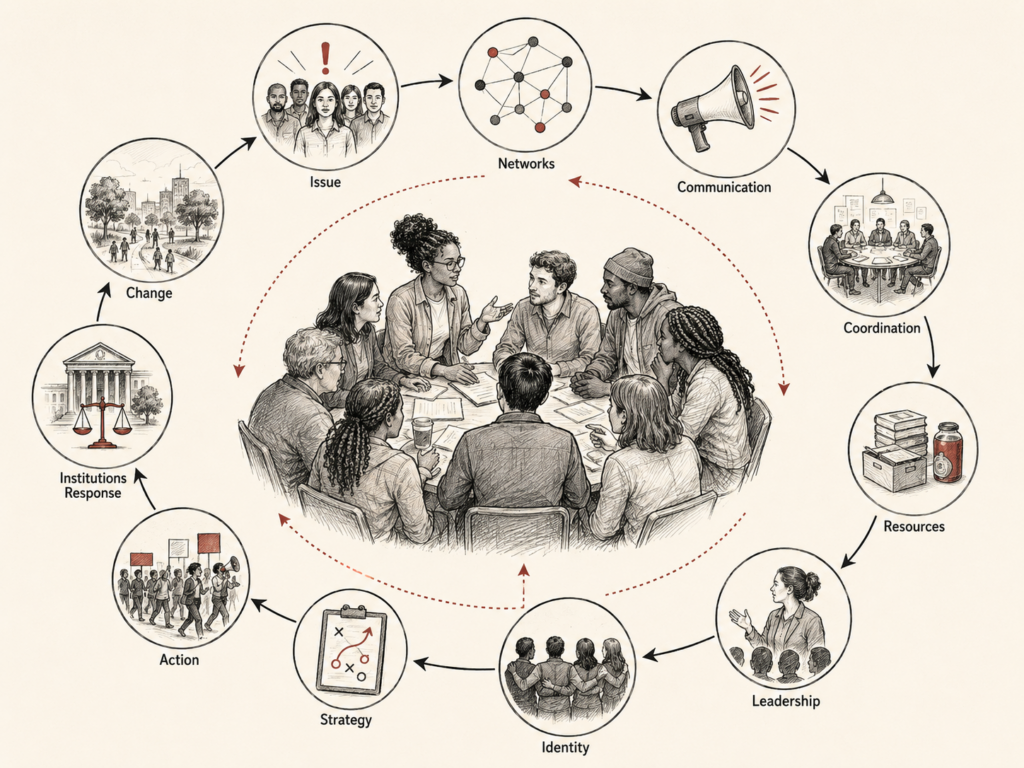
Restrained institutional research illustration showing collective action as a cycle of issue recognition, social networks, communication, coordination, resources, leadership, identity, strategy, action, institutional response, and social change.

Collective Action: How Groups Mobilize to Produce Social Change

Collective action refers to coordinated efforts by individuals or groups to achieve shared goals, especially when those goals involve changing social conditions, institutions, or systems of power. In social psychology, it is one of the most consequential forms of social behavior because it transforms private grievance into public demand. People may experience inequality, exclusion, or dissatisfaction in isolation, but social change rarely emerges from isolated discontent alone. It becomes possible when individuals recognize shared interests, develop collective identities, perceive injustice as morally significant, and mobilize together in ways that make coordinated action feel both necessary and effective. This is what gives collective action its distinctive importance: it links individual psychology to structural transformation. It shows how anger, identity, efficacy, networks, and norms can be organized into public force, and how groups acting together can pressure institutions, challenge entrenched arrangements of power, and reshape the very systems that structure their lives.

Restrained institutional research illustration showing the contact hypothesis as structured intergroup contact, with communication, cooperation, equal status, common goals, empathy, reduced anxiety, stereotype revision, trust building, and improved intergroup attitudes.

Contact Hypothesis: How Intergroup Contact Reduces Prejudice

The contact hypothesis proposes that, under specific social conditions, direct interaction between members of different groups can reduce prejudice, weaken stereotypes, and improve intergroup relations. Its importance lies in its challenge to a pessimistic view of group conflict. If prejudice were simply the product of fixed hostility, intergroup relations would appear resistant to change. Contact theory instead argues that bias is often sustained by distance, ignorance, anxiety, segregation, and distorted expectations, and that under the right institutional and relational conditions, interaction can interrupt those dynamics. This makes the contact hypothesis one of the most important frameworks in social psychology because it explains how social experience itself, not just abstract belief change, can soften group boundaries. It also carries a deeper institutional lesson: not all contact is beneficial, and exposure alone is not enough. Contact works best when it occurs under conditions of equal status, common goals, cooperation, and institutional support. For that reason, the theory is not simply about tolerance. It is a framework for understanding how social environments can be structured so that trust becomes more likely, anxiety declines, and people encounter one another as collaborators rather than abstractions.

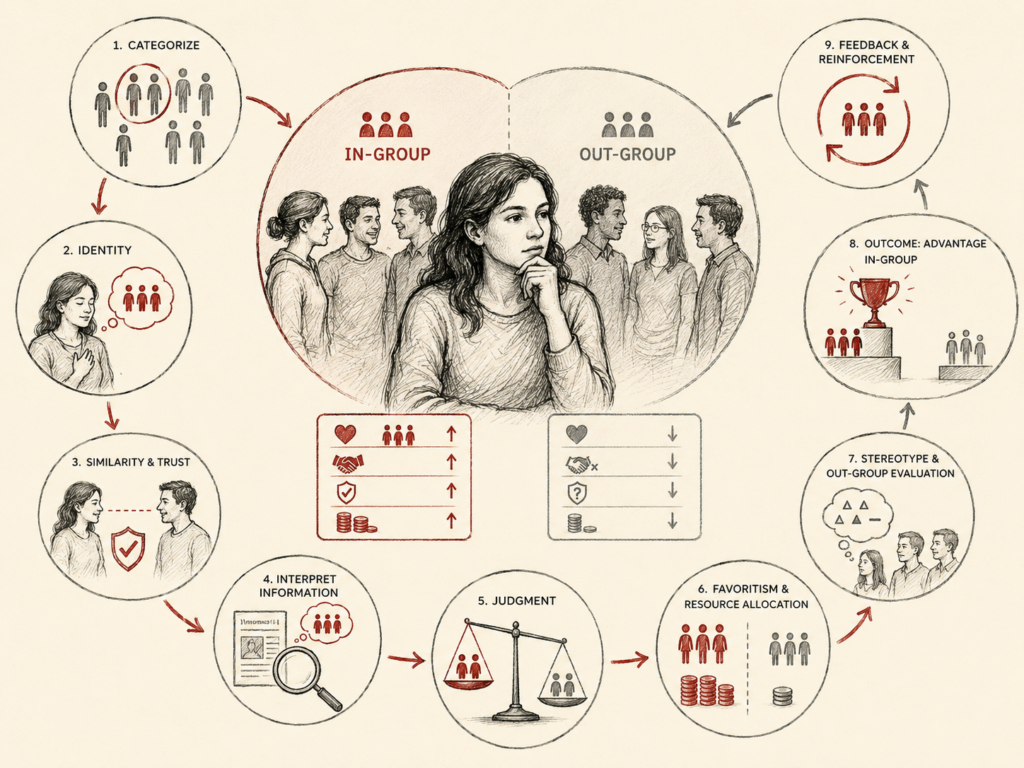
Restrained institutional research illustration showing in-group bias as a social-cognitive process involving categorization, identity, similarity, trust, information interpretation, judgment, favoritism, resource allocation, stereotype formation, outcomes, and reinforcement.

In-Group Bias: Why People Favor Their Own Groups

In-group bias refers to the tendency for individuals to evaluate, trust, and favor members of their own group more positively than members of other groups. Within social psychology, it is one of the foundational mechanisms through which identity becomes socially consequential. Its importance lies in its ordinariness. It does not require hatred, explicit prejudice, or ideological extremism to operate. People may display preferential treatment toward their own group even in the absence of overt hostility toward outsiders, which is precisely why the concept is so powerful. It helps explain how seemingly minor preferences can accumulate into durable patterns of exclusion, favoritism, and asymmetrical opportunity. In-group bias therefore reveals that social inequality does not always begin with explicit animus. Often it begins with quieter forms of loyalty, trust asymmetry, selective generosity, and the presumption that “our people” are more familiar, more deserving, or more trustworthy. For that reason, the concept is essential for understanding intergroup relations, political polarization, organizational inequality, and the everyday psychology through which social boundaries become moral boundaries.

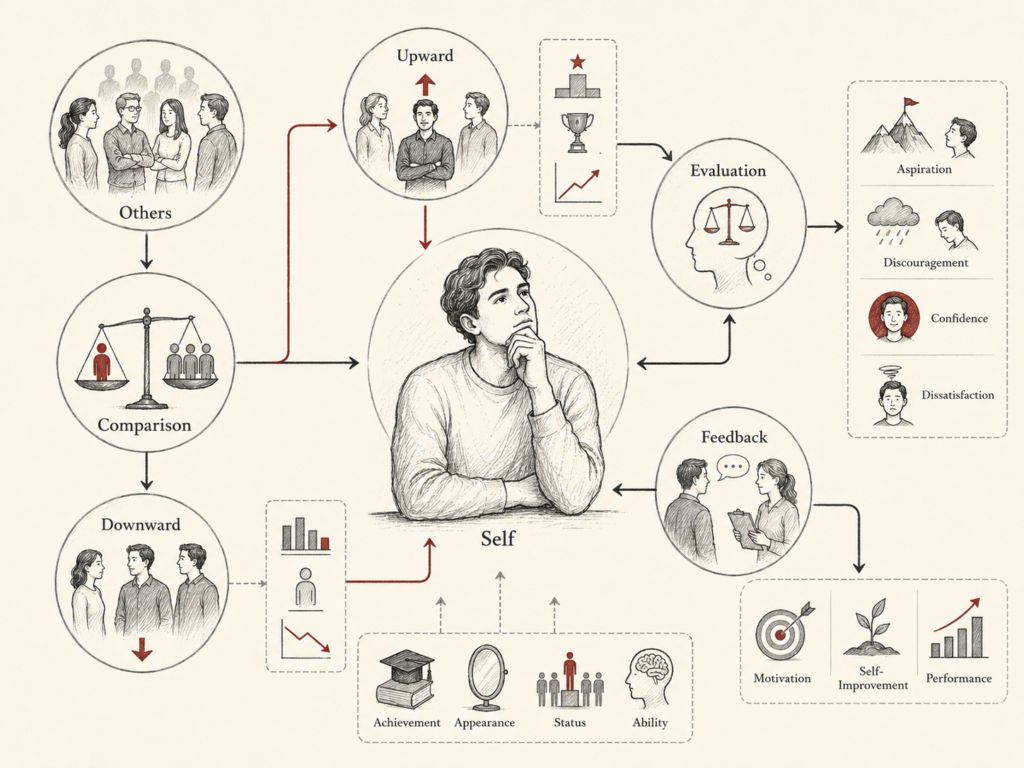
Restrained institutional research illustration showing social comparison theory as a process of self-evaluation through others, upward and downward comparison, feedback, achievement, appearance, status, ability, motivation, self-improvement, and performance.

Social Comparison Theory: How Individuals Evaluate Themselves Through Others

Social comparison theory describes the process through which individuals evaluate their abilities, opinions, and social standing by comparing themselves to other people. First articulated by Leon Festinger, the theory begins from a simple but powerful premise: many of the qualities that matter most in human life do not come with clear objective measures. People often cannot determine in absolute terms whether they are successful, competent, attractive, moral, or respected, so they turn instead to relevant others as social reference points. Through these comparisons, individuals construct implicit benchmarks for achievement, status, belonging, and self-worth. This makes self-evaluation inherently relational rather than isolated. Social comparison is therefore central not only to identity formation and motivation, but also to self-esteem, emotional experience, organizational life, digital media behavior, and institutional competition. By showing that people understand themselves through comparison with others, the theory provides one of the clearest accounts of how self-knowledge, aspiration, hierarchy, and social order become psychologically linked.

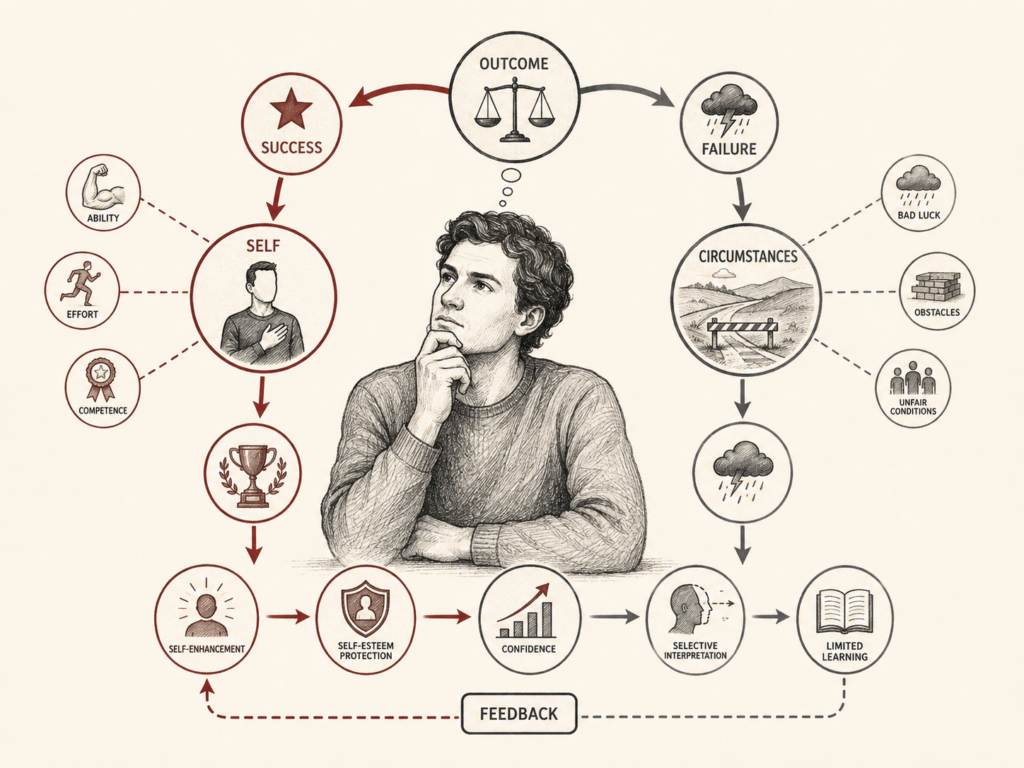
Restrained institutional research illustration showing self-serving bias as a social-cognitive process in which success is attributed to the self, ability, effort, and competence, while failure is attributed to circumstances, bad luck, obstacles, and unfair conditions.

Self-Serving Bias: Why People Take Credit for Success and Blame Circumstances for Failure

The self-serving bias refers to the tendency for individuals to attribute positive outcomes to their own abilities, effort, or character while attributing negative outcomes to external circumstances. Within social psychology, it remains one of the clearest demonstrations that attribution is not a neutral process of causal analysis, but one often shaped by the need to preserve a valued self-concept. When success occurs, people are inclined to read it as evidence of competence, merit, or virtue; when failure occurs, they are more likely to explain it through bad luck, unfair conditions, or forces outside their control. This pattern helps protect dignity, coherence, and self-esteem, but it also distorts responsibility, limits learning from failure, and complicates accountability in relationships, organizations, and public life. For that reason, the self-serving bias is important not only as a bias in judgment, but as a window into the deeper interaction among social cognition, motivation, moral evaluation, and the psychological need to sustain a workable image of the self.

Scroll to Top