
Last Updated May 28, 2026
Human-centered problem solving refers to an approach to innovation and decision-making that begins with the people affected by a system rather than with the preferences of the institution designing it. In its strongest sense, this does not mean simply asking users what they want, adding empathy language to a conventional planning process, or treating user experience as a surface-level design concern. It means treating lived experience as a serious source of knowledge. It means studying how people interpret systems, navigate constraints, improvise workarounds, absorb burdens, and make decisions under real conditions rather than idealized ones.
This matters because many organizational and institutional failures do not originate in weak technology alone. They originate in a mismatch between formal design and actual use. A process may appear efficient on paper while remaining confusing, stressful, exclusionary, or practically unusable in everyday life. A policy may satisfy administrative requirements while imposing hidden burdens on those expected to comply with it. A digital tool may improve internal reporting while making the user’s path more fragmented. Human-centered problem solving attempts to correct this distortion by shifting inquiry toward the realities of use, interpretation, and experience before solutions are designed.
At its best, human-centered problem solving provides the conceptual foundation for the broader methodology of design thinking. It grounds later stages such as empathy and stakeholder research, problem framing, insight generation, ideation, and prototyping in something more rigorous than institutional assumption. It is not a decorative ethical gesture. It is a method for improving the quality of understanding before intervention begins.
Main Library
Publications
Article Map
Design Thinking
Related Topic
Behavioral Economics
Related Topic
Knowledge Architecture
Related Topic
AI Systems
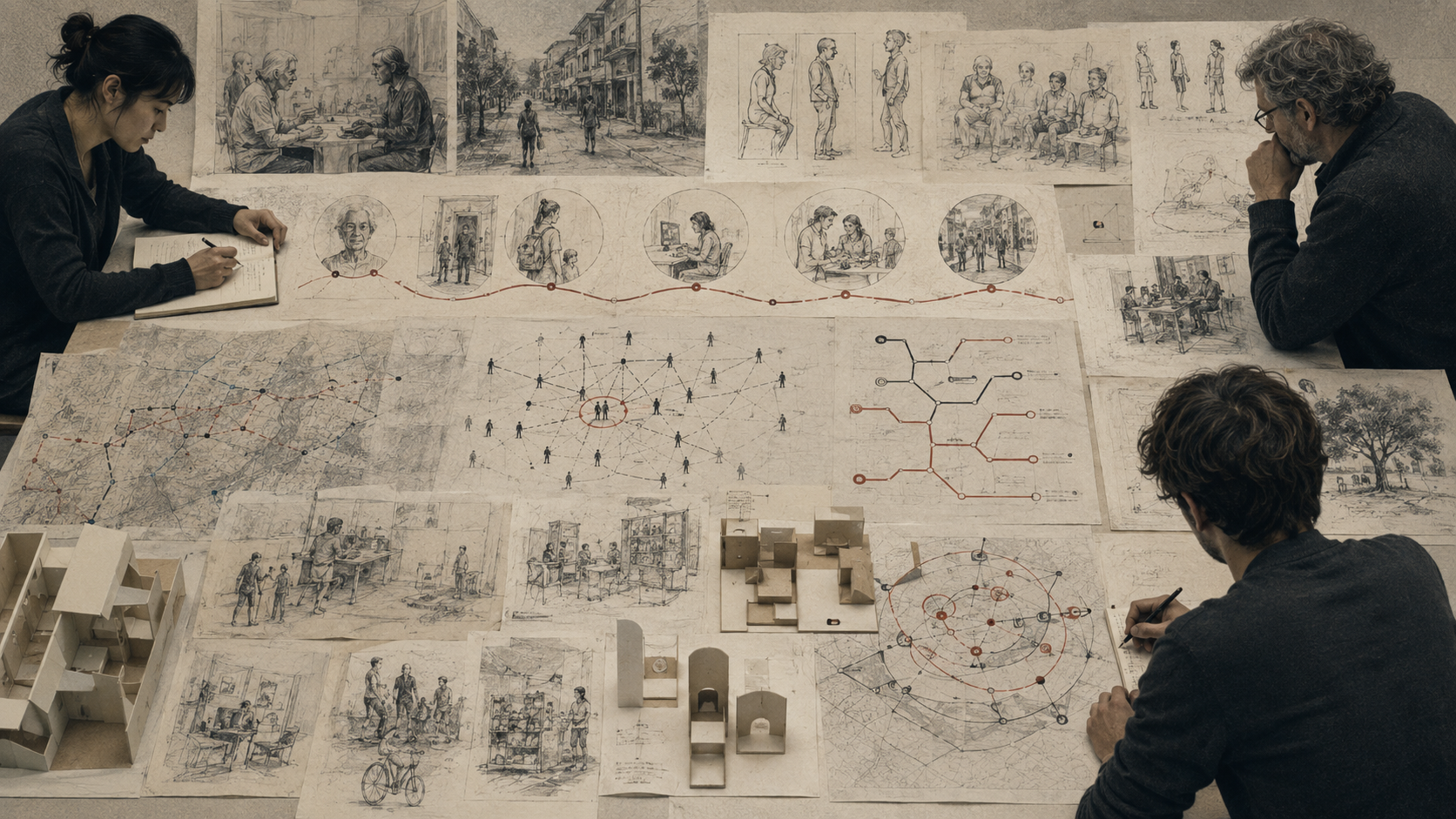
Human-centered problem solving begins with a simple but demanding claim: systems should be understood from the standpoint of those who must live with them. This does not make institutional knowledge irrelevant. Engineers, clinicians, educators, administrators, policymakers, designers, and domain experts all possess forms of knowledge that matter. But their knowledge is incomplete if it does not encounter the reality of use. Human-centered problem solving therefore asks institutions to place formal expertise in conversation with lived experience, behavioral evidence, contextual observation, and the practical intelligence of people navigating the system every day.
What Human-Centered Problem Solving Means
Human-centered problem solving means beginning with the realities of lived experience rather than with the convenience of existing systems. It asks how people encounter a product, service, workflow, institution, or policy in practice, not merely how its designers intended it to function. That distinction is central. The same system may look coherent to its creators while feeling fragmented, confusing, inaccessible, intimidating, or punitive to those who must live within it.
In this sense, human-centered problem solving is not just about kindness or attentiveness. It is a mode of inquiry. It treats behavior, frustration, interpretation, hesitation, adaptation, avoidance, and improvisation as evidence. It assumes that real users, patients, citizens, students, workers, families, community members, or frontline staff often know something essential about a system precisely because they must bear its consequences. The design challenge is to make that knowledge visible enough to influence decisions.
A human-centered approach therefore changes the first question. Instead of beginning with “What do we want to build?” it begins with “What is actually happening to people?” Instead of asking only “How can we make this process more efficient?” it asks “Efficient for whom, and at whose cost?” Instead of assuming that failure means users need more instruction, it asks whether the system itself is producing confusion, exclusion, mistrust, or unnecessary burden.
This shift has methodological consequences. Human-centered problem solving requires observation, listening, interpretation, field evidence, and iterative testing. It also requires humility. Institutions often overestimate how well they understand the people they serve. A form, portal, intake process, policy rule, appointment system, benefits application, learning platform, or workplace workflow may appear reasonable from the administrative side while imposing substantial cognitive, emotional, financial, temporal, or social costs on users.
The goal is not to romanticize lived experience or assume that every stated preference should become a design requirement. People may misdiagnose the cause of their frustration. They may ask for a faster process when what they actually need is predictability. They may request more information when what they need is trust, translation, reassurance, or decision support. Human-centered problem solving treats lived experience as evidence that requires interpretation, not as a simple command to be followed uncritically.
Why Human-Centered Work Is Not Just Empathy Language
The language of empathy is now common in design, innovation, public service, healthcare, technology, and organizational strategy. That popularity has advantages: it reminds institutions that people are not abstractions. But it also creates a danger. Human-centered language can become a performance. Teams may say they are centering users while still designing around institutional convenience, leadership preference, technical feasibility, cost minimization, or legacy workflows.
Human-centered problem solving should therefore be distinguished from empathy as branding. A workshop with sticky notes is not automatically human-centered. A persona is not automatically evidence. A customer journey map is not automatically research. A listening session is not automatically participation. A prototype is not automatically inclusive. These tools matter only when they are connected to serious inquiry, careful interpretation, and real decision authority.
The deeper test is whether the process changes what the institution understands and does. Did stakeholder research alter the problem definition? Did field observation reveal hidden burdens? Did the team revise its assumptions? Did the prototype expose a flaw before scale? Did excluded users become visible? Did the design reduce actual friction rather than simply improve presentation? Did the institution change a rule, workflow, incentive, or governance structure because human experience revealed a deeper problem?
Human-centered work is strongest when empathy becomes disciplined attention. It requires asking who is affected, what burdens they carry, what constraints shape their behavior, what knowledge they possess, and what forms of institutional power determine whether their experience will matter. The goal is not merely to feel for people. The goal is to understand systems well enough to change them responsibly.
From Technology-Centered Design to Human-Centered Design
Historically, many technological and organizational systems were designed primarily from the perspective of engineers, managers, administrators, or institutional planners. Solutions were often developed according to what was technically possible, procedurally legible, financially measurable, or economically efficient rather than what was most beneficial for the individuals expected to use them. This produced systems that were often functionally impressive yet difficult to understand, burdensome to navigate, inaccessible to some users, or misaligned with everyday human behavior.
Human-centered design emerged in response to the limitations of these approaches. Researchers increasingly recognized that many failures occurred not because the technology itself was inadequate, but because it did not align with human cognition, perception, habit, context, motivation, trust, accessibility, or social environment. Early computer interfaces provide a familiar example. Systems designed around technical logic alone often proved difficult for ordinary users to understand or operate. By studying how people actually interacted with technology, designers were able to create interfaces that better reflected human attention, mental models, and decision-making.
This shift was strongly influenced by thinkers such as Herbert Simon and later usability researchers including Don Norman, who emphasized that design must account for the cognitive and behavioral realities of actual users. Human-centered problem solving therefore begins with a different question: not simply what can we build? but what do people actually need, and what does their experience reveal about how the system is working?
The distinction remains important in contemporary settings. A technologically advanced system can still be humanly poor. An AI assistant may generate accurate outputs while leaving users uncertain about accountability. A digital benefits portal may reduce paperwork for administrators while increasing burden for applicants without stable internet access. A healthcare app may improve data capture while overwhelming patients with alerts and unclear instructions. A learning platform may provide analytics while failing to support students who lack time, confidence, language access, or advising support.
Human-centered problem solving does not reject technology. It asks technology to justify itself in relation to human purpose, use, burden, dignity, agency, and consequence. Technology becomes stronger when it is designed around real contexts rather than around the assumptions of those who build or procure it.
Empathy as a Research Method
One of the central tools of human-centered problem solving is empathy, but empathy here should be understood as a research method rather than as a vague emotional disposition. In design thinking, empathy means a structured attempt to understand how people interpret their circumstances, what they are trying to accomplish, what frustrates them, what they value, what they fear, what they avoid, and how they adapt to systems under real constraints.
Design researchers often use qualitative methods such as observation, stakeholder interviews, ethnographic inquiry, contextual interviews, diary methods, participatory workshops, service safaris, journey mapping, usability testing, and frontline staff shadowing. These approaches help uncover behaviors, tensions, and unmet needs that may remain invisible in purely quantitative reporting or internal planning discussions. The goal is not simply to collect opinions. It is to develop a richer account of how experience is actually organized in practice.
Empathy as research also requires methodological discipline. Researchers must avoid leading questions, selective listening, confirmation bias, overgeneralization from small samples, and the temptation to turn vivid anecdotes into universal claims. They must distinguish between what people say, what people do, what the system requires, and what the surrounding context makes possible. They must document uncertainty rather than hide it.
This research logic leads directly into the more focused article on Empathy and Stakeholder Research in Design Thinking. Human-centered problem solving depends on this groundwork because solutions are only as good as the quality of understanding that precedes them.
Empathy is therefore not the opposite of rigor. Properly practiced, it is a form of rigor. It asks institutions to gather better evidence about human experience before defining the problem. It insists that interpretation be grounded in observation rather than assumption. It expands the evidence base to include what people endure, work around, misunderstand, resist, or quietly accept because they have no better option.
Understanding People Within Systems
Human-centered problem solving does not treat individuals as isolated actors. People do not experience systems in a vacuum. Their choices and experiences are shaped by infrastructures, rules, institutions, interfaces, norms, incentives, histories of access or exclusion, and uneven distributions of power. A healthcare experience, for example, may involve not only a patient and clinician, but insurance rules, appointment workflows, documentation systems, billing logic, transportation access, caregiving arrangements, language access, digital tools, and regulatory requirements.
For that reason, human-centered design must also be systemic. Designers need to understand not only what an individual prefers, but how that individual is positioned within a larger structure of constraints and relationships. This systemic perspective connects naturally to Design Thinking and Systems Thinking, where the question becomes not only how a person feels at one touchpoint, but how a broader system produces that experience in the first place.
This is especially important because many organizations mistake touchpoint improvement for system improvement. A website can become easier to use while the underlying policy remains burdensome. A form can be redesigned while the eligibility rule remains unjust. A call center script can become friendlier while staffing shortages continue to produce delays. A patient portal can look cleaner while the care system remains fragmented. Human-centered problem solving becomes more powerful when it traces experience back to the structures that generate it.
A systems-aware human-centered process asks several layered questions:
- Experience: What does the person encounter, feel, misunderstand, avoid, or struggle to complete?
- Behavior: What do people actually do in response to the system, including workarounds and informal adaptations?
- Structure: What rules, workflows, incentives, data systems, and resource constraints shape that experience?
- Power: Who has authority to define the problem, allocate resources, change the process, or ignore the burden?
- Consequence: Who benefits, who pays the hidden cost, and who is excluded?
These questions move human-centered problem solving beyond surface usability. They connect experience to structure, and they allow design teams to distinguish between symptoms and causes.
Human Needs, Behavior, and Design Insight
One of the primary goals of human-centered research is identifying needs that are deeper than stated preference. People often describe what they think would help, but their descriptions may not fully capture the underlying tension shaping the situation. A commuter may ask for faster transit, while closer study reveals that reliability, predictability, and clarity matter more than absolute speed. A patient may request more information, while deeper inquiry reveals a stronger need for reassurance, trust, and a sense of control. A student may ask for reminders, while the real issue may be confusing course sequencing, advising gaps, financial pressure, or lack of belonging.
This is why human-centered problem solving depends on the move from observation to interpretation. It is not enough to record what people say. Teams have to understand what their behavior, frustrations, and adaptations reveal about the system. That interpretive process leads directly into Insight Generation in Design Thinking, where patterns in qualitative material become more structured explanations of need, friction, and opportunity.
Human needs can be functional, cognitive, emotional, social, cultural, ethical, and institutional. A user may need a process to be faster, but also more intelligible. A patient may need medical accuracy, but also dignity and continuity. A citizen may need access to benefits, but also a process that does not presume distrust. A worker may need a tool that improves productivity, but also autonomy and protection from surveillance. A community may need a service that is technically effective, but also legitimate and locally trusted.
The distinction between preference and need is critical. Preferences are important, but they are not always stable or sufficient. Needs often emerge from deeper patterns: what people repeatedly try to accomplish, where they experience friction, what they avoid, what they misunderstand, what causes harm, and what support would change the outcome. Human-centered problem solving seeks these deeper patterns because they are more likely to generate meaningful design insight.
| Observable signal | Possible interpretation | Design implication |
|---|---|---|
| Users repeatedly abandon a form midway through completion. | The process may be cognitively burdensome, poorly sequenced, mistrusted, or asking for information users cannot easily provide. | Test simplified sequencing, clearer explanation, save-and-return functionality, assistance pathways, and reduced documentation requirements. |
| People call support after using a digital tool. | The interface may appear usable but fail to provide confidence, confirmation, or contextual explanation. | Improve feedback, status visibility, plain-language guidance, and escalation pathways. |
| Frontline staff create unofficial workarounds. | The formal process may not match real conditions or may impose unrealistic administrative requirements. | Study the workaround as evidence; redesign the workflow rather than simply enforcing compliance. |
| Eligible users do not access a service. | The issue may involve trust, stigma, language, transportation, digital access, fear, or administrative burden. | Redesign outreach, eligibility communication, application support, and community partnership channels. |
Design insight is not a slogan. It is a disciplined interpretation that connects observed evidence to an actionable reframing of the problem.
Applications Across Disciplines
Human-centered problem solving has been applied across a wide range of disciplines because the core challenge it addresses appears almost everywhere: institutions and designers frequently misjudge the lived consequences of their own systems. In product development, user research improves usability, adoption, accessibility, customer experience, and product-market fit. In public policy, governments increasingly use human-centered methods to redesign services around citizen experience rather than administrative convenience. In healthcare, similar methods are used to improve patient pathways, clinical communication, discharge planning, care coordination, and staff workflows.
Human-centered approaches also matter in social innovation, education, sustainability, international development, organizational psychology, technology governance, and AI systems. Participatory design methods can help ensure that programs align more closely with the realities of the communities they are meant to support. Across these domains, the central insight remains consistent: solutions become more credible when they are designed with deeper understanding of the people they are meant to serve.
| Field | Human-centered focus | Typical failure when lived experience is ignored |
|---|---|---|
| Healthcare | Patient journeys, care transitions, communication, trust, access, staff burden | Technically correct processes become confusing, stressful, fragmented, or inaccessible. |
| Public policy | Administrative burden, benefits access, service delivery, eligibility, public trust | Policies satisfy formal rules while failing the people they are meant to serve. |
| Education | Student experience, advising, learning environments, persistence, belonging | Institutions misread nonparticipation as lack of motivation rather than system friction. |
| Technology | Usability, accessibility, mental models, trust, decision support, accountability | Tools optimize technical capability while creating confusion, dependency, or exclusion. |
| Sustainability | Community participation, behavior change, adaptation, local knowledge, legitimacy | Programs fail because they overlook local constraints, trust relationships, and lived priorities. |
| Organizations | Employee workflows, psychological safety, collaboration, leadership systems | Internal processes appear efficient but create hidden labor, burnout, and workaround cultures. |
In each domain, human-centered problem solving pushes against institutional abstraction. It asks decision-makers to study the system from the outside in, through the eyes and actions of those who experience it most directly.
Limitations and Critiques
Despite its strengths, human-centered design is not without limitations. Critics have argued that focusing too narrowly on user experience can obscure structural inequality, power asymmetries, historical context, and institutional constraint. A system may become easier to use without becoming more just. A service may become more intuitive while leaving deeper resource inequality or exclusion untouched. A product may feel better while continuing to extract data, reinforce dependency, or normalize harmful incentives.
For this reason, human-centered design works best when paired with broader analytical frames such as systems thinking, institutional analysis, equity-oriented critique, behavioral science, implementation research, and ethics. Understanding human experience is essential, but it is not sufficient by itself to resolve every kind of problem. Some issues are rooted not only in design friction, but in political economy, law, governance, resource allocation, and structural power.
There is also a risk of superficiality when empathy is treated as a slogan rather than a research discipline. Without careful methods, teams may imagine they understand people while actually projecting their own assumptions onto them. Personas may become stereotypes. Journey maps may become decorative artifacts. Interviews may become selective confirmation. Participation may become tokenistic. Human-centered problem solving is strongest when its human-centeredness is methodologically earned.
Another limitation concerns organizational willingness. Human-centered research may reveal problems that leadership does not want to address. It may show that the real issue is not the interface but the policy. Not the communication plan but the eligibility rule. Not the training material but the staffing model. Not the product feature but the business incentive. Institutions may welcome human-centered methods when they produce manageable improvements, but resist them when they expose deeper contradictions.
These limitations do not invalidate human-centered problem solving. They clarify what it requires. It is most effective when it is connected to authority, implementation capacity, ethical seriousness, and willingness to change systems rather than merely improve surfaces.
Power, Access, and Unequal Problem Experience
Another limitation concerns visibility. Not all people experience a system in equally legible ways, and not all stakeholders are equally easy for institutions to hear. Some have the time, language, confidence, mobility, digital access, and formal status to make their needs visible. Others are marginalized precisely because the system has made them hard to see. A research process that privileges the most accessible voices may therefore reproduce the same exclusions it hopes to address.
This is why human-centered problem solving must also ask whose experience is missing, who bears hidden costs, and whose burdens remain normalized because they are institutionally familiar. A system may work well for those with time, literacy, mobility, documentation, and digital access while quietly failing those without them. Human-centered design becomes more responsible when it moves beyond generic empathy toward a more explicit account of power, access, and unequal exposure to harm.
Power shapes problem definition. The institution often decides what counts as the problem before users are ever consulted. A public agency may define the problem as low completion rates, while applicants define it as fear, confusion, stigma, and documentation burden. A hospital may define the problem as missed appointments, while patients experience transportation, caregiving responsibilities, work schedules, and mistrust. A platform may define the problem as user engagement, while users experience distraction, manipulation, or loss of control.
Human-centered problem solving becomes more serious when it refuses to treat all stakeholder perspectives as equally powerful. Some stakeholders define the system. Others endure it. Some can opt out. Others cannot. Some can complain and be heard. Others face retaliation, shame, or silence. A responsible design process must account for these differences rather than flatten them into a generic category called “the user.”
This is particularly important in public systems, healthcare, education, social services, employment systems, AI decision tools, financial access, and sustainability transitions. In these domains, design decisions can distribute opportunity, burden, risk, and dignity unequally. Human-centered problem solving must therefore be more than user-friendly design. It must be attentive to justice, access, participation, and the institutional conditions that determine whose experience matters.
Administrative Burden, Friction, and Institutional Design
One of the most important contributions of human-centered problem solving is its ability to reveal burden. Burden is not always visible from the institution’s perspective. A form may take only ten minutes for a trained administrator to review but several hours for an applicant to understand, complete, document, and submit. A policy may appear neutral while requiring time, transportation, literacy, digital access, emotional resilience, and repeated follow-up from people who already face constraints.
Administrative burden includes learning costs, compliance costs, and psychological costs. Learning costs involve figuring out what a system requires. Compliance costs involve gathering documents, filling forms, attending appointments, waiting, traveling, calling, verifying, and correcting errors. Psychological costs include stigma, fear, frustration, shame, uncertainty, and exhaustion. Human-centered problem solving makes these costs visible by studying the process from the standpoint of the person navigating it.
This matters because friction is not always accidental. Sometimes it reflects legacy process design. Sometimes it reflects underinvestment. Sometimes it reflects distrust embedded in policy. Sometimes it reflects risk management shifted onto users. Sometimes it reflects a design culture that values institutional control over human usability. Human-centered inquiry asks whether a burden is necessary, proportional, ethical, and fairly distributed.
Design teams can use this lens to distinguish between helpful friction and harmful friction. Helpful friction may prevent error, create informed consent, protect privacy, or support careful decision-making. Harmful friction creates confusion, abandonment, inequity, delay, exclusion, or distrust without producing meaningful public value. Human-centered problem solving seeks to reduce harmful friction while preserving the safeguards that genuinely matter.
| Burden type | Human-centered question | Possible design response |
|---|---|---|
| Learning burden | Can people understand what is required without insider knowledge? | Plain-language guidance, progressive disclosure, examples, navigation support. |
| Compliance burden | How much work does the system shift onto the user? | Pre-filled fields, fewer documentation requirements, integrated records, assisted completion. |
| Psychological burden | Does the process create fear, shame, uncertainty, or mistrust? | Transparent status updates, respectful language, human support, trauma-informed design. |
| Access burden | Who is excluded by digital, language, mobility, time, or literacy requirements? | Multichannel access, translation, offline support, flexible timing, community partnerships. |
By making burden visible, human-centered problem solving helps institutions see that design is not only about creating new solutions. It is also about removing avoidable obstacles that the system itself has created.
Evidence, Interpretation, and Design Judgment
Human-centered problem solving depends on evidence, but the evidence is often mixed, qualitative, behavioral, and contextual. This can make it appear less rigorous to organizations that prefer dashboards, surveys, benchmarks, and performance indicators. Yet quantitative metrics alone often show only that a problem exists. They do not always explain how people experience it, why it occurs, or what design response would be meaningful.
A serious human-centered process combines multiple forms of evidence. Quantitative data can identify scale, frequency, disparities, drop-off points, completion rates, time delays, or service gaps. Qualitative research can reveal interpretation, motivation, frustration, trust, fear, workaround behavior, and contextual constraints. Prototype testing can examine whether a proposed response actually changes experience. Systems analysis can locate the institutional structures producing the pattern.
The movement from evidence to insight requires judgment. Teams must interpret what they observe, distinguish symptoms from causes, identify patterns without overgeneralizing, and decide what matters most. This judgment should be documented. Without documentation, design decisions can become memoryless and subjective. With documentation, teams can trace how research findings shaped problem framing, design criteria, prototype choices, and implementation priorities.
Human-centered evidence should also be contested. Stakeholders may disagree. Users may have conflicting needs. Frontline staff may see problems differently from leadership. Quantitative and qualitative signals may point in different directions. A design process is stronger when it treats disagreement as information rather than as a problem to suppress. Disagreement can reveal competing values, hidden constraints, and trade-offs that the design must confront honestly.
For professional use, human-centered problem solving should leave a trail: research protocols, interview guides, observation notes, synthesis memos, burden maps, journey maps, service blueprints, prototype logs, test results, decision records, and implementation lessons. These artifacts are not bureaucracy for its own sake. They help ensure that human-centered work remains accountable to evidence.
Mathematical Lens: Modeling Human-Centered Value, Burden, and Design Fit
Human-centered problem solving is not reducible to formal optimization, but mathematical framing can clarify the trade-offs that institutions are already making. One useful abstraction is to treat a candidate design intervention \(i\) as having composite value determined by human benefit, usability, stakeholder fit, and burden:
V_i = w_b B_i + w_u U_i + w_s S_i – w_c C_i
\]
where \(B_i\) represents human benefit, \(U_i\) usability or intelligibility, \(S_i\) stakeholder fit across relevant groups, and \(C_i\) user cost or burden such as time, confusion, emotional strain, documentation, travel, waiting, stigma, or access barriers. The weights \(w_b\), \(w_u\), \(w_s\), and \(w_c\) reflect institutional priorities. This kind of model does not capture the full meaning of human experience, but it does make visible what many organizations leave implicit: that every system distributes benefit and burden unevenly.
Human-centered fit can also be represented across stakeholder groups. If a design serves \(k\) of the \(n\) major stakeholder categories in a meaningful way, then a simple stakeholder-fit ratio can be expressed as:
\text{Stakeholder Fit} = \frac{k}{n}
\]
This is obviously incomplete as a measure, but it highlights a common problem: organizations often believe a design is human-centered when it fits only the most visible or institutionally convenient group.
Design opportunity can also be framed probabilistically. If a human-centered insight has probability \(p_i\) of yielding a durable downstream intervention, expected opportunity value may be expressed as:
E(O) = p_i \cdot V_i
\]
This matters because some human-centered findings are descriptive but not especially generative, while others open pathways toward problem reframing, better ideation, and more credible implementation.
Burden can also be modeled as a composite index. If a process imposes learning cost \(L\), compliance cost \(K\), psychological cost \(P\), and access cost \(A\), then a human-centered burden index might be written as:
C = \lambda_L L + \lambda_K K + \lambda_P P + \lambda_A A
\]
This model is not meant to imply that human experience can be reduced to a single number. Its value is diagnostic. It forces teams to ask whether they are measuring the full burden of a system or only the parts that are easiest for the institution to see.
Formal models should be used carefully. They can clarify assumptions, but they can also create false precision. A responsible team treats them as decision-support tools, not decision substitutes. They should be paired with fieldwork, stakeholder participation, domain expertise, ethics, and implementation judgment.
R Workflow: Human-Centered Design Option Assessment
The R workflow below evaluates a set of design options across human benefit, usability, stakeholder fit, and user burden. It then compares rankings under different strategic priorities, helping teams make explicit what they are really optimizing when they claim a design is human-centered.
# Install packages if needed.
# install.packages(c("tidyverse", "scales"))

library(tidyverse)
library(scales)

# -------------------------------------------------------------------
# Example human-centered design options.
# Higher burden means a larger penalty.
# -------------------------------------------------------------------

options <- tibble(
  option = c(
    "Guided Intake Redesign",
    "Simplified Mobile Access Flow",
    "Community Support Navigator",
    "AI Self-Service Assistant",
    "Hybrid Human-Digital Support Model"
  ),
  human_benefit   = c(8.7, 8.0, 8.9, 7.4, 8.6),
  usability       = c(8.2, 8.8, 7.6, 8.1, 8.4),
  stakeholder_fit = c(8.1, 7.7, 8.6, 6.9, 8.3),
  burden          = c(3.9, 3.5, 4.2, 5.0, 3.7),
  evidence_quality = c(0.78, 0.72, 0.76, 0.63, 0.80),
  implementation_complexity = c(5.8, 6.2, 6.8, 7.4, 6.5)
)

# -------------------------------------------------------------------
# Weighted human-centered value function.
# -------------------------------------------------------------------

score_options <- function(data, wb, wu, ws, wc) {
  data %>%
    mutate(
      hc_value = wb * human_benefit +
                 wu * usability +
                 ws * stakeholder_fit -
                 wc * burden,
      confidence_adjusted_value = hc_value * (0.75 + 0.25 * evidence_quality),
      burden_adjusted_fit = stakeholder_fit - 0.35 * burden
    ) %>%
    arrange(desc(hc_value))
}

# -------------------------------------------------------------------
# Scenario weights for different priorities.
# -------------------------------------------------------------------

scenarios <- tribble(
  ~scenario,             ~wb,  ~wu,  ~ws,  ~wc,
  "Balanced",            0.30, 0.25, 0.30, 0.15,
  "Benefit-first",       0.45, 0.20, 0.20, 0.15,
  "Usability-first",     0.20, 0.45, 0.20, 0.15,
  "Stakeholder-first",   0.20, 0.20, 0.45, 0.15,
  "Burden-sensitive",    0.25, 0.20, 0.20, 0.35,
  "Equity-sensitive",    0.35, 0.15, 0.35, 0.15
)

# -------------------------------------------------------------------
# Evaluate options across scenarios.
# -------------------------------------------------------------------

scenario_results <- scenarios %>%
  rowwise() %>%
  do(
    score_options(
      options,
      wb = .$wb,
      wu = .$wu,
      ws = .$ws,
      wc = .$wc
    ) %>%
      mutate(scenario = .$scenario)
  ) %>%
  ungroup()

# Rank within each scenario.
ranked_results <- scenario_results %>%
  group_by(scenario) %>%
  arrange(desc(hc_value), .by_group = TRUE) %>%
  mutate(rank = row_number()) %>%
  ungroup()

print(ranked_results)

# -------------------------------------------------------------------
# Visualize ranking shifts across human-centered priorities.
# -------------------------------------------------------------------

ggplot(ranked_results, aes(x = option, y = hc_value, group = scenario)) +
  geom_point(size = 3) +
  geom_line(aes(color = scenario), linewidth = 1) +
  coord_flip() +
  labs(
    title = "Human-Centered Design Value Across Strategic Priority Scenarios",
    x = "Design Option",
    y = "Weighted Human-Centered Value"
  ) +
  theme_minimal(base_size = 12)

# -------------------------------------------------------------------
# Summarize which options rank first most often.
# -------------------------------------------------------------------

top_rank_summary <- ranked_results %>%
  filter(rank == 1) %>%
  count(option, name = "times_ranked_first") %>%
  arrange(desc(times_ranked_first))

print(top_rank_summary)

# -------------------------------------------------------------------
# Sensitivity check: how much do rankings shift across scenarios?
# -------------------------------------------------------------------

rank_stability <- ranked_results %>%
  group_by(option) %>%
  summarize(
    mean_rank = mean(rank),
    best_rank = min(rank),
    worst_rank = max(rank),
    rank_range = worst_rank - best_rank,
    .groups = "drop"
  ) %>%
  arrange(mean_rank)

print(rank_stability)

# -------------------------------------------------------------------
# Export results for team review.
# -------------------------------------------------------------------

write_csv(ranked_results, "human_centered_design_option_assessment.csv")
write_csv(rank_stability, "human_centered_rank_stability.csv")
write_csv(top_rank_summary, "human_centered_top_rank_summary.csv")
This workflow is useful because teams often say they are optimizing for people while actually prioritizing one narrow dimension such as usability, adoption, speed, efficiency, or technical feasibility. Making those criteria explicit improves design judgment. It also helps teams see when a preferred option is robust across different priorities and when it depends heavily on a particular institutional value system.
Python Workflow: Uncertainty Analysis for Human-Centered Priorities
The Python workflow below extends the same logic with Monte Carlo simulation. Instead of assuming that each design option’s scores are known with certainty, it models uncertainty across human benefit, usability, stakeholder fit, and burden. This helps estimate which options remain strongest when the evidence is still provisional.
# Install packages if needed:
# pip install pandas numpy matplotlib scipy

import numpy as np
import pandas as pd
import matplotlib.pyplot as plt
from scipy.stats import entropy

# ---------------------------------------------------------------------
# Example human-centered design options.
# ---------------------------------------------------------------------

options = pd.DataFrame({
    "option": [
        "Guided Intake Redesign",
        "Simplified Mobile Access Flow",
        "Community Support Navigator",
        "AI Self-Service Assistant",
        "Hybrid Human-Digital Support Model"
    ],
    "human_benefit":   [8.7, 8.0, 8.9, 7.4, 8.6],
    "usability":       [8.2, 8.8, 7.6, 8.1, 8.4],
    "stakeholder_fit": [8.1, 7.7, 8.6, 6.9, 8.3],
    "burden":          [3.9, 3.5, 4.2, 5.0, 3.7],
    "evidence_quality": [0.78, 0.72, 0.76, 0.63, 0.80]
})

# ---------------------------------------------------------------------
# Baseline weights.
# ---------------------------------------------------------------------

weights = {
    "human_benefit": 0.30,
    "usability": 0.25,
    "stakeholder_fit": 0.30,
    "burden": 0.15
}

# ---------------------------------------------------------------------
# Weighted human-centered value function.
# ---------------------------------------------------------------------

def compute_hc_value(df, weights_dict):
    result = df.copy()
    result["hc_value"] = (
        weights_dict["human_benefit"]   * result["human_benefit"] +
        weights_dict["usability"]       * result["usability"] +
        weights_dict["stakeholder_fit"] * result["stakeholder_fit"] -
        weights_dict["burden"]          * result["burden"]
    )

    result["confidence_adjusted_value"] = (
        result["hc_value"] * (0.75 + 0.25 * result["evidence_quality"])
    )

    result["burden_adjusted_fit"] = (
        result["stakeholder_fit"] - 0.35 * result["burden"]
    )

    return result.sort_values("hc_value", ascending=False)

baseline_results = compute_hc_value(options, weights)
print("Baseline design ranking:")
print(baseline_results[["option", "hc_value", "confidence_adjusted_value"]])

# ---------------------------------------------------------------------
# Monte Carlo simulation.
# Allow scores to vary around current estimates.
# ---------------------------------------------------------------------

np.random.seed(42)
n_simulations = 10000
simulation_winners = []
simulation_records = []

for simulation_id in range(n_simulations):
    simulated = options.copy()

    for col in ["human_benefit", "usability", "stakeholder_fit", "burden"]:
        simulated[col] = np.random.normal(
            loc=options[col],
            scale=0.6
        )
        simulated[col] = simulated[col].clip(1, 10)

    simulated_results = compute_hc_value(simulated, weights)
    winner = simulated_results.iloc[0]["option"]
    simulation_winners.append(winner)

    for _, row in simulated_results.iterrows():
        simulation_records.append({
            "simulation_id": simulation_id,
            "option": row["option"],
            "hc_value": row["hc_value"],
            "rank": simulated_results.index.get_loc(row.name) + 1
        })

# ---------------------------------------------------------------------
# Estimate how often each option ranks first.
# ---------------------------------------------------------------------

winner_summary = (
    pd.Series(simulation_winners)
    .value_counts(normalize=True)
    .rename("probability_ranked_first")
    .reset_index()
)

winner_summary.columns = ["option", "probability_ranked_first"]
winner_summary["probability_ranked_first"] *= 100

print("\nProbability each option ranks first:")
print(winner_summary)

# ---------------------------------------------------------------------
# Rank stability summary.
# ---------------------------------------------------------------------

simulation_df = pd.DataFrame(simulation_records)

rank_stability = (
    simulation_df
    .groupby("option")
    .agg(
        mean_hc_value=("hc_value", "mean"),
        sd_hc_value=("hc_value", "std"),
        median_rank=("rank", "median"),
        mean_rank=("rank", "mean"),
        best_rank=("rank", "min"),
        worst_rank=("rank", "max")
    )
    .reset_index()
    .sort_values(["median_rank", "mean_rank"])
)

print("\nRank stability:")
print(rank_stability)

# ---------------------------------------------------------------------
# Priority uncertainty:
# Draw random weights from a Dirichlet distribution.
# ---------------------------------------------------------------------

n_weight_samples = 10000
criteria = ["human_benefit", "usability", "stakeholder_fit", "burden"]
random_weight_winners = []

for _ in range(n_weight_samples):
    random_weights = np.random.dirichlet(np.ones(len(criteria)))
    sampled_weights = dict(zip(criteria, random_weights))

    sampled_results = compute_hc_value(options, sampled_weights)
    random_weight_winners.append(sampled_results.iloc[0]["option"])

weight_sensitivity = (
    pd.Series(random_weight_winners)
    .value_counts(normalize=True)
    .rename("probability_winning_under_random_weights")
    .reset_index()
)

weight_sensitivity.columns = ["option", "probability_winning_under_random_weights"]
weight_sensitivity["probability_winning_under_random_weights"] *= 100

print("\nWeight sensitivity:")
print(weight_sensitivity)

# ---------------------------------------------------------------------
# Plot robustness under uncertainty.
# ---------------------------------------------------------------------

plt.figure(figsize=(10, 6))
plt.bar(winner_summary["option"], winner_summary["probability_ranked_first"])
plt.xticks(rotation=20, ha="right")
plt.ylabel("Probability of Ranking First (%)")
plt.title("Robustness of Human-Centered Design Choices Under Uncertainty")
plt.tight_layout()
plt.show()

# ---------------------------------------------------------------------
# Export summaries for reporting.
# ---------------------------------------------------------------------

winner_summary.to_csv("human_centered_priority_uncertainty_results.csv", index=False)
rank_stability.to_csv("human_centered_rank_stability_results.csv", index=False)
weight_sensitivity.to_csv("human_centered_weight_sensitivity_results.csv", index=False)
simulation_df.to_csv("human_centered_simulation_records.csv", index=False)
This workflow is especially useful because human-centered judgments often feel more settled than they really are. An option that appears strongest under one interpretation may be less robust once uncertainty, stakeholder variation, and competing priorities are made visible.
The simulation does not determine what should be built. It helps the team see where confidence is strong, where rankings are fragile, and where further research is warranted. A design option that performs well across uncertainty scenarios may deserve a larger prototype. A design option that wins only under narrow assumptions may require more evidence. A design option with high value but high burden may need redesign before implementation.
GitHub Repository
The companion repository provides a reproducible technical workspace for exploring the modeling, simulation, documentation, and implementation ideas associated with this article. The article folder is organized for multi-language design research and includes folders for Python, R, Julia, C++, Fortran, C, Rust, Go, SQL, notebooks, documentation, raw data, processed data, and outputs.
Complete Code Repository
This repository folder contains companion materials for modeling human-centered design value, comparing stakeholder-centered priorities, documenting design assumptions, working with synthetic design-research data, and extending the article’s analytical examples across multiple technical environments.
The repository structure is designed to support reproducible human-centered design research rather than isolated code examples. The language-specific folders allow the same conceptual model to be explored across statistical, scientific, systems, and database workflows. The documentation and data folders help preserve assumptions, provenance, intermediate outputs, and research artifacts so that design decisions remain traceable.
| Folder | Purpose |
|---|---|
python/ |
Uncertainty analysis, Monte Carlo simulation, burden modeling, rank stability, and reproducible design-strategy workflows. |
r/ |
Scenario comparison, statistical summaries, visualization, and human-centered design option ranking. |
julia/ |
Numerical modeling, optimization-style analysis, and high-performance exploratory workflows. |
cpp/, c/, rust/, go/ |
Systems-oriented examples, validation utilities, command-line tools, and reproducible processing components. |
fortran/ |
Scientific-computing examples for numerical modeling and legacy-compatible computational workflows. |
sql/ |
Structured design-research data schemas, stakeholder evidence tables, queries, and reproducible summaries. |
notebooks/ |
Exploratory analysis, teaching materials, and interactive demonstrations. |
docs/ |
Method notes, assumptions, research documentation, reproducibility guidance, validation protocol, and interpretation notes. |
data/raw/ |
Original or synthetic source data used for examples and reproducible analysis. |
data/processed/ |
Cleaned, transformed, or model-ready data outputs. |
outputs/ |
Generated figures, tables, reports, and model results. |
Conclusion
Human-centered problem solving matters because it shifts innovation away from designing for institutional convenience and toward designing for lived reality. It begins with the recognition that systems are encountered through experience, not just through formal logic, and that many failures become visible only when one studies what people are actually asked to do, endure, interpret, and navigate.
Seen clearly, this approach is not an argument against technology, efficiency, analytics, or strategy. It is an argument that these become stronger when grounded in a more accurate understanding of human need and system use. Human-centered problem solving does not guarantee justice, inclusion, or perfect fit on its own, but it creates conditions under which those questions can be asked more honestly and earlier in the design process.
The field is weakened when it is reduced to sentiment, surface usability, or a generic concern for the user. It is strongest when paired with methodological rigor, systems awareness, power analysis, implementation capacity, and attention to burden. In that sense, human-centered problem solving is not merely the beginning of design thinking. It is one of the clearest signs that good design starts by trying to understand the world as people actually live it before attempting to change it.
A system that is human-centered is not simply easier to use. It is more honest about the people it affects, more attentive to the burdens it creates, more willing to learn from experience, and more capable of revising itself in response to evidence. That is why human-centered problem solving remains foundational: it gives institutions a way to see the difference between what they intended and what people actually experience.
Related articles
- What Is Design Thinking?
- Empathy and Stakeholder Research in Design Thinking
- Insight Generation in Design Thinking
- Problem Framing in Design Thinking
- Ideation in Design Thinking
- Prototyping in Design Thinking
- Testing and Validation in Design Thinking
- Implementation and Scaling in Design Thinking
- Design Thinking and Systems Thinking
- Service Design in Design Thinking
Further reading
- Brown, T. (2008) ‘Design thinking’, Harvard Business Review. Available at: https://hbr.org/2008/06/design-thinking.
- Buchanan, R. (1992) ‘Wicked problems in design thinking’, Design Issues, 8(2), pp. 5–21. Available at: https://www.jstor.org/stable/1511637.
- IDEO.org (2015) The Field Guide to Human-Centered Design. Available at: https://www.designkit.org/resources/1.html.
- ISO (2019) ISO 9241-210:2019 Ergonomics of human-system interaction — Part 210: Human-centred design for interactive systems. Available at: https://www.iso.org/standard/77520.html.
- Liedtka, J. and Ogilvie, T. (2011) Designing for Growth: A Design Thinking Tool Kit for Managers. New York: Columbia University Press. Available at: https://cup.columbia.edu/book/designing-for-growth/9780231527965/.
- Norman, D.A. (2013) The Design of Everyday Things. Rev. and expanded edn. New York: Basic Books. Available at: https://jnd.org/the-design-of-everyday-things-revised-and-expanded-edition/.
- Schön, D.A. (1983) The Reflective Practitioner: How Professionals Think in Action. New York: Basic Books. Available at: https://www.routledge.com/The-Reflective-Practitioner-How-Professionals-Think-In-Action/Schon/p/book/9780465068784.
- Simon, H.A. (1996) The Sciences of the Artificial. 3rd edn. Cambridge, MA: MIT Press. Available at: https://mitpress.mit.edu/9780262691918/the-sciences-of-the-artificial/.
- Stanford d.school (no date) Design Thinking Bootleg. Available at: https://dschool.stanford.edu/tools/design-thinking-bootleg.
References
- Brown, T. (2008) ‘Design thinking’, Harvard Business Review. Available at: https://hbr.org/2008/06/design-thinking.
- Buchanan, R. (1992) ‘Wicked problems in design thinking’, Design Issues, 8(2), pp. 5–21. Available at: https://www.jstor.org/stable/1511637.
- IDEO.org (2015) The Field Guide to Human-Centered Design. Available at: https://www.designkit.org/resources/1.html.
- ISO (2019) ISO 9241-210:2019 Ergonomics of human-system interaction — Part 210: Human-centred design for interactive systems. Available at: https://www.iso.org/standard/77520.html.
- Liedtka, J. and Ogilvie, T. (2011) Designing for Growth: A Design Thinking Tool Kit for Managers. New York: Columbia University Press. Available at: https://cup.columbia.edu/book/designing-for-growth/9780231527965/.
- Norman, D.A. (2013) The Design of Everyday Things. Rev. and expanded edn. New York: Basic Books. Available at: https://jnd.org/the-design-of-everyday-things-revised-and-expanded-edition/.
- Schön, D.A. (1983) The Reflective Practitioner: How Professionals Think in Action. New York: Basic Books. Available at: https://www.routledge.com/The-Reflective-Practitioner-How-Professionals-Think-In-Action/Schon/p/book/9780465068784.
- Simon, H.A. (1996) The Sciences of the Artificial. 3rd edn. Cambridge, MA: MIT Press. Available at: https://mitpress.mit.edu/9780262691918/the-sciences-of-the-artificial/.
- Stanford d.school (no date) Design Thinking Bootleg. Available at: https://dschool.stanford.edu/tools/design-thinking-bootleg.