
Last Updated May 28, 2026
Design thinking is an interdisciplinary approach to problem solving that emphasizes human-centered understanding, interpretive rigor, iterative experimentation, and creative exploration. In its strongest sense, design thinking does not begin with predefined solutions, technical optimization, or institutional convenience. It begins by asking how people actually experience a problem, how that problem is shaped by systems and constraints, and how possible interventions can be explored through cycles of learning rather than assumed in advance.
This matters because many contemporary challenges do not yield easily to linear planning. Organizations, governments, communities, healthcare systems, schools, public agencies, and technology teams increasingly confront problems shaped by ambiguity, multiple stakeholders, incomplete information, institutional friction, ethical trade-offs, and changing conditions. In such environments, analytical planning remains important, but it is often insufficient on its own. Design thinking contributes something different: a disciplined way of moving from observation to insight, from insight to reframing, from reframing to ideation, and from ideation to prototype, test, implementation, and further revision.
Although design thinking emerged from industrial and product design, it has evolved into a broader approach to innovation across organizational strategy, public policy, healthcare, education, technology, sustainability, social impact, and institutional reform. Institutions such as the Stanford d.school, IDEO, and the University of Virginia Darden School of Business helped popularize it, but its deeper intellectual foundations lie in design methodology, wicked-problem theory, cognition, systems thinking, participatory design, and the sciences of the artificial. At its best, design thinking is not a fashionable synonym for creativity. It is a serious framework for learning what kind of change is actually possible before institutions overcommit to premature answers.
Main Library
Publications
Article Map
Design Thinking
Related Topic
Behavioral Economics
Related Topic
Knowledge Architecture
Related Topic
AI Systems
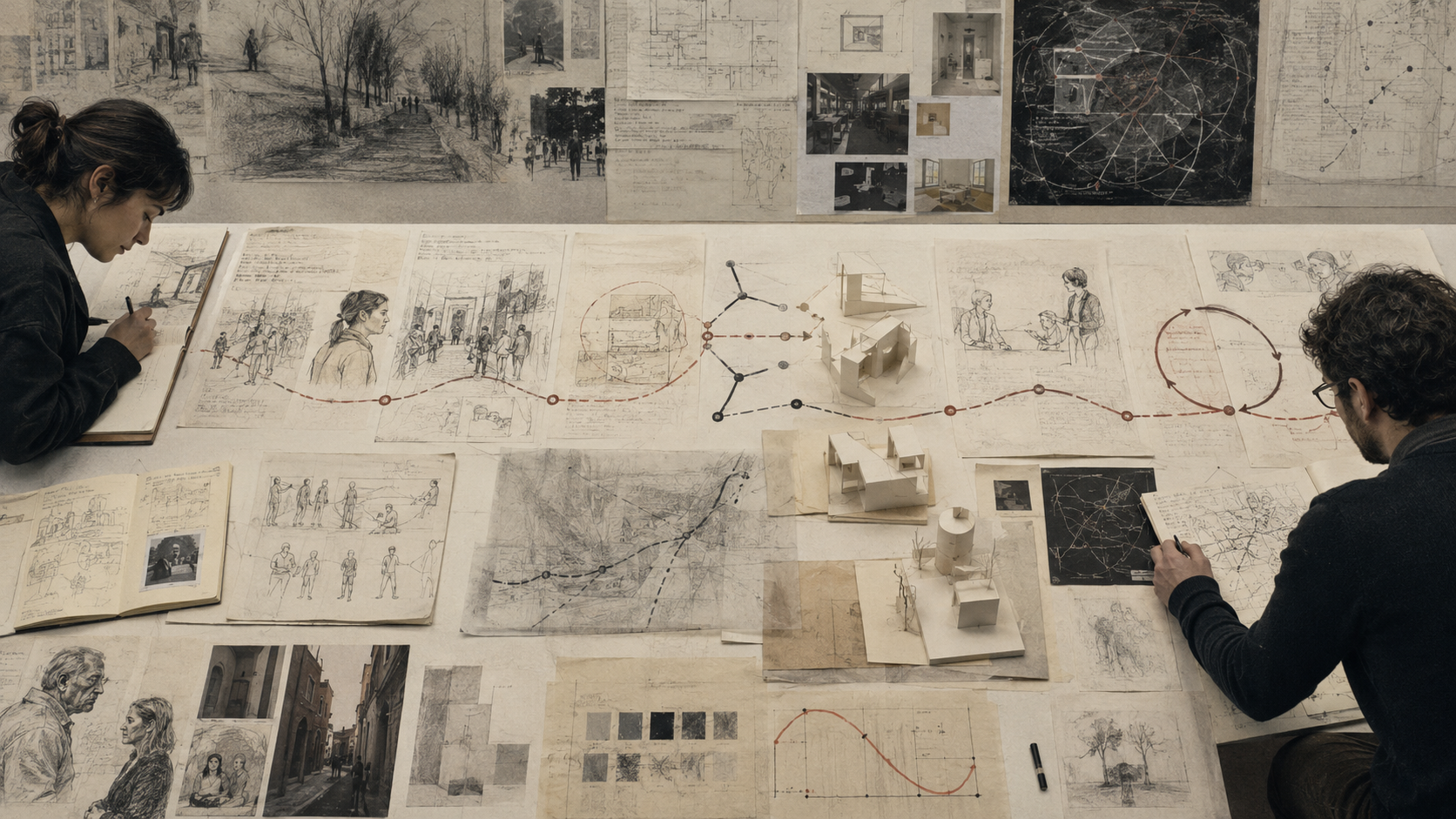
Design thinking is often introduced through a sequence of familiar activities: empathize, define, ideate, prototype, and test. That sequence is useful, but it can also be misleading when treated as a checklist. The deeper value of design thinking lies not in the memorization of stages, but in the disciplined movement between evidence and imagination, analysis and experimentation, lived experience and institutional action.
What Design Thinking Is
Design thinking is best understood as a methodology for inquiry and intervention in situations where the problem is not fully settled in advance. Rather than assuming that decision-makers already know what needs to be solved, design thinking begins by examining people, systems, environments, and constraints directly. It treats design as a mode of learning as much as a mode of making.
This distinguishes it from problem-solving traditions that prioritize prediction, optimization, and technical efficiency before they have adequately investigated lived experience. Design thinking assumes that effective solutions often emerge not from abstract reasoning alone, but from cycles of observation, interpretation, reframing, experimentation, and revision. In that sense, design thinking is less about discovering a perfect answer immediately than about creating better conditions for asking better questions and testing more credible responses.
The word design is important here. Design thinking is not merely brainstorming, visual facilitation, user interviews, sticky notes, or creativity exercises. Those may be useful tools, but the deeper practice concerns the transformation of unsatisfactory conditions into more desirable, usable, equitable, coherent, and sustainable arrangements. A designed intervention may take the form of a product, service, policy, workflow, institution, built environment, digital platform, public program, research process, or governance mechanism. What unites these varied applications is not a single artifact type, but a shared orientation toward purposeful change under uncertainty.
Design thinking therefore sits between several intellectual traditions. It draws from qualitative research because it treats human experience as evidence. It draws from systems thinking because it recognizes that individual experience is shaped by larger structures. It draws from behavioral science because people do not always act according to the assumptions embedded in institutional plans. It draws from strategy because choices must be made under constraint. It draws from ethics because every design process includes decisions about whose needs matter, whose burdens are visible, and whose participation is taken seriously.
Why Design Thinking Is Not a Five-Step Recipe
Design thinking is often taught through simplified diagrams. These diagrams can be helpful because they give teams a shared language for moving through research, synthesis, ideation, prototyping, testing, and implementation. Yet they can also create a false impression that design thinking is a neat sequence of steps that can be completed once and then checked off.
In practice, serious design work rarely moves in a straight line. Teams may begin with stakeholder research, define a problem, generate ideas, and build a prototype, only to discover that the original problem definition was incomplete. A pilot may reveal that the intended users are not the only stakeholders whose behavior matters. A usability test may expose institutional constraints that were invisible during interviews. A technically feasible solution may fail because it contradicts existing incentives, trust relationships, professional norms, legal requirements, or cultural expectations.
For this reason, design thinking should be understood as a learning architecture rather than a recipe. Its value comes from the way it structures uncertainty. It gives teams permission to investigate before deciding, to diverge before converging, to externalize assumptions through prototypes, to expose ideas to feedback before they harden into policy or product decisions, and to revise when evidence contradicts the initial plan.
The most mature versions of design thinking therefore resist theatrical innovation. They do not treat workshops as substitutes for field research. They do not treat empathy as sentimentality. They do not treat ideation as a performance of creativity. They do not treat prototyping as a decorative exercise. They treat design as a disciplined form of inquiry, judgment, and institutional learning.
Origins of Design Thinking
The intellectual foundations of design thinking can be traced to mid-twentieth-century research on design methodology, cognition, and creative problem solving. Herbert A. Simon helped establish one of the most influential early foundations by describing design as the effort to transform existing conditions into preferred ones. That formulation was significant because it distinguished design from pure analysis. Design is not only about describing the world. It is about imagining how the world might be otherwise and reasoning about how to move toward that alternative.
Later work in engineering, architecture, planning, and industrial design sought to formalize the cognitive processes underlying successful design practice. Researchers observed that designers dealing with ambiguity often moved back and forth between understanding the problem and exploring potential solutions, gradually refining both through interaction, feedback, and reinterpretation. Rather than beginning with a complete problem statement and then deriving the correct answer, designers often learned what the problem was by experimenting with possible responses.
This insight became especially important in discussions of wicked problems. Horst Rittel and Melvin Webber used the term to describe planning problems that could not be solved by conventional technical methods because they lacked stable boundaries, definitive formulations, and final solutions. Richard Buchanan later connected wicked problems to design thinking, arguing that design had become a liberal art of technological culture: a way of integrating knowledge across disciplines to address complex human situations.
Donald Schön’s work on reflective practice further deepened this understanding. Schön described practitioners as engaging in a “reflective conversation” with the situation. They act, observe the consequences, reinterpret what they are seeing, and act again. This model is highly relevant to design thinking because it explains why design judgment cannot be reduced to rules. Skilled designers learn through situated experimentation, not merely through the application of preexisting procedures.
By the early twenty-first century, design thinking had expanded beyond traditional design disciplines. Firms such as IDEO demonstrated that methods originally used for products could also be applied to services, institutions, strategy, and social innovation. Business schools, public-sector labs, and policy teams subsequently adapted these methods for broader organizational use. This diffusion increased design thinking’s visibility, but it also introduced the risk of simplification—something that still shapes debates about the field today.
Design Thinking and Human-Centered Innovation
One of the defining characteristics of design thinking is its emphasis on human-centered inquiry. Rather than assuming that designers, managers, or policymakers already understand the challenge, the framework prioritizes direct engagement with the people affected by it. This often involves qualitative methods such as interviews, observation, contextual inquiry, ethnographic research, journey mapping, service blueprinting, participatory workshops, diary studies, prototype testing, and stakeholder analysis.
Human-centered innovation matters because institutions often design from their own vantage point. They optimize for what they can measure, what their processes support, what appears efficient internally, or what aligns with existing authority structures. Yet a system can look coherent from the inside while remaining confusing, stressful, exclusionary, or unusable to those who must actually live with it. Design thinking tries to correct that distortion by grounding innovation in experience, behavior, and need.
This does not mean that every expressed preference should be treated as a final design requirement. People may not always know what solution they need. They may describe symptoms rather than causes. They may adapt to broken systems so thoroughly that the burden becomes normalized. The task of design research is therefore not simply to ask people what they want. It is to study what they do, what they experience, what frustrates them, what they work around, what they value, what they fear, and what the surrounding system makes possible or impossible.
This logic connects directly to Human-Centered Problem Solving and Empathy and Stakeholder Research in Design Thinking. These stages are not soft preliminaries. They are the empirical and interpretive foundation for everything that follows. Without them, ideation risks becoming projection: institutions imagining solutions for people they have not seriously tried to understand.
Human-centered design also requires inclusion. The most convenient users to interview are not always the most affected. The loudest stakeholders are not always the most burdened. The people with the greatest access to feedback channels are not always representative of those who experience exclusion, friction, or harm. A serious design process must therefore ask whose experience is being centered, whose experience is missing, and what structural conditions make some voices easier to hear than others.
The Iterative Design Process
Although institutions describe design thinking with slightly different vocabularies, most frameworks share a recognizable sequence of stages. These stages should not be interpreted as a rigid linear path. They form an iterative cycle in which learning at one stage may force reconsideration of earlier assumptions.
- Empathy and stakeholder research – understanding users, stakeholders, and contexts through observation, interviews, fieldwork, participatory inquiry, and direct engagement with lived experience.
- Insight generation – identifying patterns, tensions, unmet needs, contradictions, behavioral signals, institutional constraints, and opportunities emerging from research.
- Problem framing – defining or redefining the core challenge in light of what the evidence reveals, often shifting from a superficial symptom to a more meaningful underlying problem.
- Ideation – generating multiple possible responses before narrowing toward more promising directions, while separating creative divergence from premature evaluation.
- Prototyping – giving form to ideas so they can be explored, questioned, tested, and improved before major resources are committed.
- Testing and validation – examining how ideas perform in interaction with users, stakeholders, institutional conditions, technical constraints, and real-world contexts.
- Implementation and scaling – adapting, operationalizing, governing, maintaining, and extending solutions that prove credible, useful, and institutionally viable.
Because insights often emerge during testing and experimentation, teams frequently move backward as well as forward. A prototype may reveal that the problem was framed incorrectly. A pilot may uncover needs that earlier research missed. A stakeholder test may surface system constraints that require rethinking the entire intervention. Iteration is therefore not a sign of failure in design thinking. It is part of its epistemic logic.
The iterative process also changes the status of failure. In conventional planning cultures, failure often appears late, after large investments have already been made. In design thinking, small-scale failure can be a source of early learning. A rough prototype that fails quickly may save an organization from scaling a flawed program. A field test that exposes misunderstanding may prevent a costly technology deployment. A stakeholder review that surfaces ethical concerns may improve legitimacy before implementation.
Yet iteration must be disciplined. Repetition alone is not learning. Teams can run many workshops, tests, or pilots without improving if they do not document assumptions, define what evidence would change their judgment, include affected stakeholders, and connect learning back to decision-making. Design thinking is strongest when iteration is linked to explicit inquiry: What did we believe? What did we test? What changed? What remains uncertain? What should we do differently in the next cycle?
Design Thinking and Complex Problems
Design thinking is particularly well suited to complex problems—challenges characterized by uncertainty, conflicting stakeholder interests, incomplete information, evolving conditions, institutional fragmentation, and feedback effects. These are the kinds of problems often described as wicked: climate adaptation, healthcare delivery, urban mobility, educational access, technological governance, institutional trust, public benefits administration, workforce transitions, social services, and service fragmentation.
Traditional planning models often assume that such problems can be clearly defined and solved through technical optimization. Design thinking responds differently. It assumes that the problem itself may be unstable, contested, or partially misframed, and that understanding will emerge through cycles of inquiry and experimentation rather than prediction alone.
By developing multiple hypotheses, building prototypes, and testing them with stakeholders, organizations can explore possible directions without prematurely committing to a single strategy. This is one reason design thinking connects so productively to Design Thinking and Systems Thinking. In more complex environments, design is not only about what people want at a single touchpoint. It is about how broader structures, feedback loops, incentives, institutional arrangements, infrastructures, and power relations shape what people experience in the first place.
A complex problem also requires attention to scale. A solution that works for one user may fail across a population. A prototype that works in one office may break when applied across an entire agency. A service redesign that improves one stage of a journey may shift burdens elsewhere. A digital tool that improves speed may reduce accessibility, trust, privacy, or accountability. Design thinking must therefore ask not only whether a prototype works locally, but what happens when it enters a wider system.
In this sense, design thinking does not replace systems analysis. It makes systems analysis more grounded. Systems thinking helps teams see structures, feedback, interdependencies, and unintended consequences. Design thinking helps teams encounter how those structures are actually experienced. The strongest practice combines both: one lens for systemic pattern, another for lived reality, and an iterative process for moving between them.
Applications Across Disciplines
Over the past two decades, design thinking has been applied across a wide range of fields. In business settings, organizations use it to develop products, services, platforms, customer experiences, internal workflows, and strategic options. In public policy, governments and civic institutions apply design methods to citizen services, administrative processes, benefits delivery, public engagement, regulatory communication, and policy implementation. In healthcare, design thinking has been used to improve patient experiences, staff workflows, clinical coordination, digital health tools, and care transitions.
It has also become influential in education, sustainability, nonprofit strategy, organizational development, social innovation, and technology governance. In these settings, the appeal of design thinking lies partly in its adaptability. The tools used may differ by domain, but the underlying principles remain consistent: human-centered inquiry, interpretive synthesis, iterative experimentation, collaborative problem solving, and decision-making under uncertainty.
| Domain | Common design thinking focus | Key design questions |
|---|---|---|
| Healthcare | Patient journeys, clinical workflows, care coordination, staff burden | Where do patients and providers encounter friction, delay, confusion, or risk? |
| Public policy | Service delivery, administrative burden, public trust, implementation design | How do people actually experience the policy once it becomes a process? |
| Education | Learning environments, student support, curriculum design, advising systems | What barriers prevent learners from participating, persisting, or succeeding? |
| Technology | Product design, platform governance, user research, interface decisions | How do technical choices shape behavior, access, privacy, and accountability? |
| Sustainability | Behavior change, community engagement, adaptation planning, systems transition | How can interventions be usable, legitimate, equitable, and ecologically responsible? |
| Organizations | Strategy, culture, service design, internal processes, innovation capability | What institutional routines produce the current experience, and what must change? |
This breadth of application helps explain the field’s influence, but it also raises the stakes for precision. Design thinking becomes meaningful only when its principles are treated seriously rather than reduced to a generalized language of innovation. The more consequential the domain, the more important it becomes to distinguish serious design inquiry from aestheticized problem solving.
Systems, Institutions, and the Limits of User-Centeredness
One of the major developments in contemporary design thinking has been the recognition that user-centeredness alone is not enough. A product or service may be easier to use while leaving deeper institutional or political problems intact. A policy may become more legible while still distributing burdens unjustly. A digital interface may feel intuitive while deepening surveillance, dependency, exclusion, or administrative control.
For that reason, design thinking is strongest when its human-centered commitments are paired with broader structural analysis. It must ask not only what the user experiences, but how that experience is produced by institutions, rules, infrastructures, incentives, histories, and systems of power. This is why design thinking increasingly intersects with systems thinking, organizational analysis, public-sector design, sustainability work, ethics, governance, and critical social inquiry. In the strongest versions of the field, design does not merely optimize surfaces. It investigates the structures that make those surfaces what they are.
This distinction is especially important in institutional design. Many organizations want to improve experience without changing the deeper arrangements that produce the experience. A public agency may want a clearer form without reducing administrative burden. A hospital may want a better patient portal without addressing staffing, language access, insurance complexity, or care coordination. A company may want a more intuitive platform without questioning the incentives that shape user dependency. Design thinking becomes shallow when it treats the interface as the problem while leaving the system untouched.
Serious design thinking therefore requires institutional courage. It may reveal that the real problem is not the communication material, the app, the service counter, or the customer journey map. The real problem may be a rule, a workflow, a funding model, a governance structure, a culture of risk avoidance, or a distribution of authority that prevents the system from responding intelligently to the people it serves.
Evidence, Judgment, and Interpretation
Design thinking depends on evidence, but the evidence it uses is often interpretive, qualitative, provisional, and context-dependent. This can make the method appear less rigorous to organizations accustomed to quantitative metrics alone. Yet the rigor of design thinking lies in disciplined interpretation: careful observation, triangulation, pattern recognition, hypothesis formation, prototype testing, and revision.
Quantitative data can show where a system is failing at scale. Qualitative design research can help explain why. A dashboard may reveal that users abandon an application at a certain step. Interviews, observation, and prototype testing may reveal that the language is confusing, the documentation requirement is unrealistic, the process triggers fear, the interface assumes resources users do not have, or the institutional category does not match lived reality. Neither form of evidence is sufficient by itself. Design thinking is strongest when it integrates multiple forms of knowledge.
Judgment is also central. Design teams must decide which findings matter, which tensions are most important, which constraints are negotiable, which prototypes are worth testing, and which trade-offs are ethically acceptable. This means design thinking is never a purely technical method. It is a practice of situated judgment. Its quality depends on the depth of research, the inclusiveness of participation, the clarity of framing, the seriousness of testing, and the accountability of implementation.
Because of this, documentation matters. A mature design process should preserve research notes, assumptions, synthesis artifacts, prototype decisions, testing results, data dictionaries, model outputs, and implementation lessons. Without documentation, design thinking can become performative and memoryless. With documentation, it becomes institutional learning.
Critiques and Limitations
Despite its influence, design thinking has attracted criticism for good reason. Simplified versions of the framework can reduce complex design practice to a set of workshop rituals, brainstorming exercises, or inspirational slogans. In such cases, the term may be used to signal creativity without demanding the rigor of actual research, interpretation, experimentation, implementation, or accountability.
Critics have also argued that design thinking can sometimes overemphasize user experience while underemphasizing politics, inequality, institutional power, labor, history, and structural constraint. A human-centered process may still remain blind to who is excluded from the research, who bears hidden burdens, which harms are normalized, which trade-offs are being accepted, or which institution benefits from the redesign. These critiques do not invalidate design thinking. They clarify the conditions under which it becomes shallow.
Another limitation concerns scale. Design thinking is often strongest at the level of discovery, concept development, prototyping, and early implementation. It is weaker when teams assume that a successful prototype automatically resolves issues of governance, financing, maintenance, legal compliance, procurement, staffing, security, political legitimacy, long-term evaluation, or institutional adoption. A prototype can generate insight, but it is not the same thing as a durable public system, clinical intervention, educational program, or organizational capability.
There is also a risk of methodological overreach. Not every problem requires design thinking. Some problems are already well defined and require operational execution, technical expertise, regulatory enforcement, statistical analysis, historical interpretation, democratic deliberation, legal judgment, or political negotiation. Design thinking is valuable, but it is not a universal substitute for other forms of knowledge.
Design thinking therefore works best when treated as one part of a larger interdisciplinary practice. It is strengthened by systems thinking, behavioral science, sustainability analysis, ethics, institutional critique, implementation research, data science, and domain expertise. When paired with those complementary frameworks, it can be far more than a creativity method. It can become a disciplined way of navigating complexity.
Mathematical Lens: Modeling Design Value, Learning, and Iterative Improvement
Design thinking is not reducible to equations, but formal models can clarify the evaluative logic that teams often apply implicitly. One useful abstraction is to treat a candidate intervention \(i\) as having composite design value determined by human relevance, feasibility, generative learning, and residual risk:
V_i = w_h H_i + w_f F_i + w_l L_i – w_r R_i
\]
where \(H_i\) represents human-centered relevance, \(F_i\) feasibility, \(L_i\) learning value generated through experimentation, and \(R_i\) unresolved risk. The weights \(w_h\), \(w_f\), \(w_l\), and \(w_r\) reflect the priorities of the team or institution. This does not imply that design judgment is purely mathematical. It makes visible that design decisions often balance several forms of value at once, even when those trade-offs remain unstated.
The iterative logic of design can also be represented dynamically. Let solution quality at round \(t\) depend on insight gain \(I_t\), usability improvement \(U_t\), and new friction introduced through revision \(C_t\):
Q_{t+1} = Q_t + \alpha I_t + \beta U_t – \gamma C_t
\]
This expresses a familiar design principle: a solution improves over time only if each cycle produces real learning and reduces meaningful friction faster than new problems are introduced. Iteration, in other words, is not merely repetition. It is cumulative revision under evidence.
A portfolio perspective is useful as well. If each design pathway has probability \(p_i\) of producing durable downstream value, expected design portfolio value may be expressed as:
E(P) = \sum_{i=1}^{n} p_i V_i
\]
This matters because some prototypes or pathways are valuable not only because they succeed directly, but because they reveal constraints, disconfirm weak assumptions, or help the team refine its understanding before greater commitment is made. A failed prototype can still have positive learning value if it prevents a larger institutional failure.
These models should be used carefully. They are not meant to convert design into false precision. They are decision-support tools for making assumptions explicit. They can help teams ask which criteria they are prioritizing, how robust a preferred pathway is under uncertainty, and whether a design direction remains attractive when risk, feasibility, and learning value are considered together.
R Workflow: Comparing Design Pathways Across Innovation Priorities
The R workflow below evaluates a small portfolio of design pathways across human relevance, feasibility, learning value, and residual risk. It then compares how rankings shift under different strategic priorities, helping teams see what they are actually optimizing when they choose among design directions.
# Install packages if needed.
# install.packages(c("tidyverse", "scales"))

library(tidyverse)
library(scales)

# -------------------------------------------------------------------
# Example design pathways.
# Higher residual risk means a larger penalty.
# -------------------------------------------------------------------

pathways <- tibble(
  pathway = c(
    "Service Redesign Pathway",
    "Digital Platform Pathway",
    "Workflow Coordination Pathway",
    "Community Partnership Pathway"
  ),
  human_relevance = c(8.8, 7.9, 8.2, 8.6),
  feasibility     = c(7.4, 8.3, 7.8, 7.1),
  learning_value  = c(8.1, 7.7, 8.4, 8.5),
  residual_risk   = c(4.0, 4.3, 3.8, 4.2)
)

# -------------------------------------------------------------------
# Weighted design pathway value function.
# -------------------------------------------------------------------

score_pathways <- function(data, wh, wf, wl, wr) {
  data %>%
    mutate(
      design_value = wh * human_relevance +
                     wf * feasibility +
                     wl * learning_value -
                     wr * residual_risk
    ) %>%
    arrange(desc(design_value))
}

# -------------------------------------------------------------------
# Scenario weights for different innovation priorities.
# -------------------------------------------------------------------

scenarios <- tribble(
  ~scenario,              ~wh,  ~wf,  ~wl,  ~wr,
  "Balanced",             0.35, 0.25, 0.25, 0.15,
  "Human-first",          0.50, 0.20, 0.20, 0.10,
  "Feasibility-first",    0.20, 0.50, 0.20, 0.10,
  "Learning-first",       0.20, 0.20, 0.45, 0.15,
  "Risk-sensitive",       0.25, 0.20, 0.20, 0.35
)

# -------------------------------------------------------------------
# Evaluate design pathways across scenarios.
# -------------------------------------------------------------------

scenario_results <- scenarios %>%
  rowwise() %>%
  do(
    score_pathways(
      pathways,
      wh = .$wh,
      wf = .$wf,
      wl = .$wl,
      wr = .$wr
    ) %>%
      mutate(scenario = .$scenario)
  ) %>%
  ungroup()

# Rank within each scenario.
ranked_results <- scenario_results %>%
  group_by(scenario) %>%
  arrange(desc(design_value), .by_group = TRUE) %>%
  mutate(rank = row_number()) %>%
  ungroup()

print(ranked_results)

# -------------------------------------------------------------------
# Visualize ranking shifts across strategic priorities.
# -------------------------------------------------------------------

ggplot(ranked_results, aes(x = pathway, y = design_value, group = scenario)) +
  geom_point(size = 3) +
  geom_line(aes(color = scenario), linewidth = 1) +
  coord_flip() +
  labs(
    title = "Design Pathway Value Across Innovation Priority Scenarios",
    x = "Design Pathway",
    y = "Weighted Design Value"
  ) +
  theme_minimal(base_size = 12)

# -------------------------------------------------------------------
# Summarize which pathways rank first most often.
# -------------------------------------------------------------------

top_rank_summary <- ranked_results %>%
  filter(rank == 1) %>%
  count(pathway, name = "times_ranked_first") %>%
  arrange(desc(times_ranked_first))

print(top_rank_summary)

# -------------------------------------------------------------------
# Export results for team review.
# -------------------------------------------------------------------

write_csv(ranked_results, "design_thinking_pathway_comparison.csv")
This workflow is useful because different teams often use the same language of innovation while prioritizing very different things. Some prioritize feasibility, others human relevance, others learning value, and others risk containment. Making those criteria explicit improves collective judgment.
The workflow also provides a useful bridge between qualitative design research and strategic decision-making. It does not replace interviews, fieldwork, facilitation, or prototype testing. Instead, it helps translate design findings into a transparent comparison of possible pathways. Teams can adapt the variables, weights, and scenarios to fit public services, healthcare workflows, educational programs, digital products, organizational redesign, or sustainability interventions.
Python Workflow: Uncertainty Analysis for Design Strategy Choices
The Python workflow below extends the same logic with Monte Carlo simulation. Instead of assuming that each design pathway’s scores are known with certainty, it models uncertainty across human relevance, feasibility, learning value, and residual risk. This helps estimate which pathways remain strongest when the evidence is still incomplete and the design team is still learning.
# Install packages if needed:
# pip install pandas numpy matplotlib

import numpy as np
import pandas as pd
import matplotlib.pyplot as plt

# ---------------------------------------------------------------------
# Example design pathways.
# ---------------------------------------------------------------------

pathways = pd.DataFrame({
    "pathway": [
        "Service Redesign Pathway",
        "Digital Platform Pathway",
        "Workflow Coordination Pathway",
        "Community Partnership Pathway"
    ],
    "human_relevance": [8.8, 7.9, 8.2, 8.6],
    "feasibility":     [7.4, 8.3, 7.8, 7.1],
    "learning_value":  [8.1, 7.7, 8.4, 8.5],
    "residual_risk":   [4.0, 4.3, 3.8, 4.2]
})

# ---------------------------------------------------------------------
# Baseline weights.
# ---------------------------------------------------------------------

weights = {
    "human_relevance": 0.35,
    "feasibility": 0.25,
    "learning_value": 0.25,
    "residual_risk": 0.15
}

# ---------------------------------------------------------------------
# Weighted design value function.
# ---------------------------------------------------------------------

def compute_design_value(df, weights_dict):
    result = df.copy()
    result["design_value"] = (
        weights_dict["human_relevance"] * result["human_relevance"] +
        weights_dict["feasibility"]     * result["feasibility"] +
        weights_dict["learning_value"]  * result["learning_value"] -
        weights_dict["residual_risk"]   * result["residual_risk"]
    )
    return result.sort_values("design_value", ascending=False)

baseline_results = compute_design_value(pathways, weights)
print("Baseline design pathway ranking:")
print(baseline_results[["pathway", "design_value"]])

# ---------------------------------------------------------------------
# Monte Carlo simulation.
# Allow scores to vary around current estimates.
# ---------------------------------------------------------------------

np.random.seed(42)
n_simulations = 5000
simulation_winners = []

for _ in range(n_simulations):
    simulated = pathways.copy()

    for col in ["human_relevance", "feasibility", "learning_value", "residual_risk"]:
        simulated[col] = np.random.normal(
            loc=pathways[col],
            scale=0.6
        )
        simulated[col] = simulated[col].clip(1, 10)

    simulated_results = compute_design_value(simulated, weights)
    winner = simulated_results.iloc[0]["pathway"]
    simulation_winners.append(winner)

# ---------------------------------------------------------------------
# Estimate how often each pathway ranks first.
# ---------------------------------------------------------------------

winner_summary = (
    pd.Series(simulation_winners)
    .value_counts(normalize=True)
    .rename("probability_ranked_first")
    .reset_index()
)

winner_summary.columns = ["pathway", "probability_ranked_first"]
winner_summary["probability_ranked_first"] *= 100

print("\nProbability each pathway ranks first:")
print(winner_summary)

# ---------------------------------------------------------------------
# Plot robustness under uncertainty.
# ---------------------------------------------------------------------

plt.figure(figsize=(10, 6))
plt.bar(winner_summary["pathway"], winner_summary["probability_ranked_first"])
plt.xticks(rotation=20, ha="right")
plt.ylabel("Probability of Ranking First (%)")
plt.title("Robustness of Design Strategy Choices Under Uncertainty")
plt.tight_layout()
plt.show()

# ---------------------------------------------------------------------
# Export summary for reporting.
# ---------------------------------------------------------------------

winner_summary.to_csv("design_thinking_strategy_uncertainty_results.csv", index=False)
This workflow is especially useful because strategic design choices often feel more settled than they really are. A pathway that appears strongest under one interpretation may prove much less robust once uncertainty, alternative evidence, and contextual variation are introduced.
Monte Carlo analysis is especially appropriate for design contexts because early-stage research rarely provides complete certainty. Stakeholder interviews may be suggestive but limited. Prototype results may come from small samples. Feasibility estimates may depend on institutional constraints that change over time. Risk may be underestimated because some consequences are difficult to observe before implementation. By modeling uncertainty directly, design teams can avoid mistaking a single score for a stable conclusion.
The goal is not to turn design into a purely quantitative exercise. The goal is to make uncertainty visible enough that teams can reason about it. When a pathway wins across many simulations, it may be robust. When rankings fluctuate dramatically, the team may need more evidence before committing. When a high-value pathway also carries high uncertainty, the appropriate next step may be a focused prototype rather than immediate implementation.
GitHub Repository
The companion repository provides a reproducible technical workspace for exploring the modeling, simulation, documentation, and implementation ideas associated with this article. The article folder is organized for multi-language design research and includes folders for Python, R, Julia, C++, Fortran, C, Rust, Go, SQL, notebooks, documentation, raw data, processed data, and outputs.
Complete Code Repository
This repository folder contains companion materials for modeling design pathways, comparing innovation priorities, documenting assumptions, working with synthetic design-research data, and extending the article’s computational examples across multiple technical environments.
The repository structure is designed to support reproducible design research rather than one-off code snippets. The language-specific folders allow the same conceptual model to be explored across statistical, scientific, systems, and database workflows. The documentation and data folders help preserve assumptions, provenance, intermediate outputs, and research artifacts so that design decisions remain traceable.
| Folder | Purpose |
|---|---|
python/ |
Monte Carlo simulation, uncertainty analysis, data processing, and reproducible design strategy modeling. |
r/ |
Scenario comparison, statistical summaries, visualization, and design pathway ranking workflows. |
julia/ |
Numerical modeling, optimization experiments, and high-performance exploratory analysis. |
cpp/, c/, rust/, go/ |
Systems-oriented examples, validation utilities, command-line tools, and reproducible processing components. |
fortran/ |
Scientific-computing examples for numerical modeling and legacy-compatible computational workflows. |
sql/ |
Structured design-research data schemas, queries, and reproducible data summaries. |
notebooks/ |
Exploratory analysis, teaching materials, and interactive design-model demonstrations. |
docs/ |
Method notes, assumptions, research documentation, reproducibility guidance, and interpretation notes. |
data/raw/ |
Original or synthetic source data used for examples and reproducible analysis. |
data/processed/ |
Cleaned, transformed, or model-ready data outputs. |
outputs/ |
Generated figures, tables, reports, and model results. |
Why Design Thinking Matters
The growing influence of design thinking reflects a broader shift in how organizations approach innovation under complexity. In many domains, the challenge is no longer simply to optimize a known process. It is to understand what kind of problem is actually being faced, whose experience reveals its structure, what can be learned through experimentation, and how institutions can adapt without overcommitting to premature certainty.
Design thinking matters because it offers a structured methodology for navigating this uncertainty. By combining human-centered research with interpretive synthesis, creative divergence, prototyping, testing, and iterative learning, it gives organizations a way to explore new possibilities while remaining grounded in real-world contexts. It also matters because it changes the meaning of innovation itself. Innovation is no longer treated as a single moment of invention. It becomes a process of disciplined discovery.
It also matters because institutions often misdiagnose problems when they are too far removed from lived experience. A policy may fail because its designers never saw the administrative burden it created. A product may fail because the team optimized features rather than use. A service may fail because it solved the provider’s workflow while worsening the user’s journey. A technology may fail because the technical model was sound but the social context was misunderstood. Design thinking gives teams methods for encountering those realities earlier.
At the same time, design thinking must be practiced with humility. It cannot substitute for domain expertise, democratic accountability, technical rigor, historical understanding, or ethical judgment. Its value lies in helping teams learn before they decide, test before they scale, and revise before flawed assumptions become institutional commitments.
In that sense, design thinking is not merely a set of tools. It is a philosophy of problem solving grounded in curiosity, collaboration, humility, and revision under evidence. Its strongest contribution is not that it promises perfect solutions. It is that it helps institutions learn how to ask, test, and refine better responses to the complex problems they face.
Related articles
- Human-Centered Problem Solving
- Empathy and Stakeholder Research in Design Thinking
- Insight Generation in Design Thinking
- Problem Framing in Design Thinking
- Ideation in Design Thinking
- Prototyping in Design Thinking
- Testing and Validation in Design Thinking
- Implementation and Scaling in Design Thinking
- Design Thinking and Systems Thinking
- Service Design in Design Thinking
- Design Thinking in Public Policy
- Design Thinking and Organizational Innovation
- Design Thinking for Sustainability
Further reading
- Brown, T. (2008) ‘Design thinking’, Harvard Business Review. Available at: https://hbr.org/2008/06/design-thinking.
- Buchanan, R. (1992) ‘Wicked problems in design thinking’, Design Issues, 8(2), pp. 5–21. Available at: https://www.jstor.org/stable/1511637.
- Cross, N. (2006) Designerly Ways of Knowing. London: Springer. Available at: https://link.springer.com/book/10.1007/1-84628-301-9.
- Dorst, K. (2015) Frame Innovation: Create New Thinking by Design. Cambridge, MA: MIT Press. Available at: https://mitpress.mit.edu/9780262324311/frame-innovation/.
- IDEO.org (2015) The Field Guide to Human-Centered Design. Available at: https://www.designkit.org/resources/1.html.
- Kimbell, L. (2011) ‘Rethinking design thinking: Part I’, Design and Culture, 3(3), pp. 285–306. Available at: https://www.tandfonline.com/doi/abs/10.2752/175470811X13071166525216.
- Liedtka, J. and Ogilvie, T. (2011) Designing for Growth: A Design Thinking Tool Kit for Managers. New York: Columbia University Press. Available at: https://cup.columbia.edu/book/designing-for-growth/9780231527965/.
- Norman, D.A. (2013) The Design of Everyday Things. Rev. and expanded edn. New York: Basic Books. Available at: https://jnd.org/the-design-of-everyday-things-revised-and-expanded-edition/.
- Schön, D.A. (1983) The Reflective Practitioner: How Professionals Think in Action. New York: Basic Books. Available at: https://www.routledge.com/The-Reflective-Practitioner-How-Professionals-Think-In-Action/Schon/p/book/9780465068784.
- Simon, H.A. (1996) The Sciences of the Artificial. 3rd edn. Cambridge, MA: MIT Press. Available at: https://mitpress.mit.edu/9780262691918/the-sciences-of-the-artificial/.
References
- Brown, T. (2008) ‘Design thinking’, Harvard Business Review. Available at: https://hbr.org/2008/06/design-thinking.
- Buchanan, R. (1992) ‘Wicked problems in design thinking’, Design Issues, 8(2), pp. 5–21. Available at: https://www.jstor.org/stable/1511637.
- Cross, N. (2006) Designerly Ways of Knowing. London: Springer. Available at: https://link.springer.com/book/10.1007/1-84628-301-9.
- Dorst, K. (2015) Frame Innovation: Create New Thinking by Design. Cambridge, MA: MIT Press. Available at: https://mitpress.mit.edu/9780262324311/frame-innovation/.
- IDEO.org (2015) The Field Guide to Human-Centered Design. Available at: https://www.designkit.org/resources/1.html.
- Kimbell, L. (2011) ‘Rethinking design thinking: Part I’, Design and Culture, 3(3), pp. 285–306. Available at: https://www.tandfonline.com/doi/abs/10.2752/175470811X13071166525216.
- Liedtka, J. and Ogilvie, T. (2011) Designing for Growth: A Design Thinking Tool Kit for Managers. New York: Columbia University Press. Available at: https://cup.columbia.edu/book/designing-for-growth/9780231527965/.
- Norman, D.A. (2013) The Design of Everyday Things. Rev. and expanded edn. New York: Basic Books. Available at: https://jnd.org/the-design-of-everyday-things-revised-and-expanded-edition/.
- Rittel, H.W.J. and Webber, M.M. (1973) ‘Dilemmas in a general theory of planning’, Policy Sciences, 4, pp. 155–169. Available at: https://link.springer.com/article/10.1007/BF01405730.
- Schön, D.A. (1983) The Reflective Practitioner: How Professionals Think in Action. New York: Basic Books. Available at: https://www.routledge.com/The-Reflective-Practitioner-How-Professionals-Think-In-Action/Schon/p/book/9780465068784.
- Simon, H.A. (1996) The Sciences of the Artificial. 3rd edn. Cambridge, MA: MIT Press. Available at: https://mitpress.mit.edu/9780262691918/the-sciences-of-the-artificial/.
- Stanford d.school (no date) About the d.school. Available at: https://dschool.stanford.edu/.