Layered agent-based model on a research table with many tiny agents moving through mapped environments, interaction zones, network ties, clustered behaviors, and emergent patterns on translucent analytical planes.

Agent-Based Modeling: Simulating Complex Systems with Individual Agents

Agent-based modeling (ABM) is a computational approach for analyzing complex systems by simulating the behavior, interactions, and adaptation of individual agents operating within a defined environment. Rather than relying on aggregate averages alone, ABM studies how heterogeneous actors, local decision rules, bounded rationality, and decentralized interaction generate system-level outcomes over time. This article explains the intellectual origins of ABM, outlines its core components such as agents, rules, environments, and emergent outcomes, and shows why it is especially valuable for studying adaptation, path dependence, and complex adaptive systems. It also distinguishes ABM from aggregate modeling, emphasizes its generative rather than purely predictive role, and examines its use across economics, epidemiology, urban systems, ecology, and policy analysis. In systems modeling, ABM matters because it reveals how macro-level order can emerge from repeated micro-level interaction under conditions of heterogeneity and uncertainty.


Layered system dynamics model on a research table with translucent planes, reservoirs, flow paths, feedback loops, delay chains, maps, modular blocks, and small observational figures.

System Dynamics Modeling: Feedback Loops, Stocks, and Flows

System dynamics modeling is a formal method for analyzing complex systems by representing how stocks, flows, feedback loops, and time delays interact to generate behavior across time. Developed by Jay W. Forrester in the mid-twentieth century, the method emerged as a response to static and reductionist approaches that could not adequately explain recurring patterns such as growth, overshoot, oscillation, stagnation, and collapse. This article explains the origins of system dynamics, clarifies the role of causal loop diagrams and stock-and-flow structures, and shows how reinforcing and balancing feedback loops combine with delays to shape long-run system behavior. It also emphasizes the method’s importance for policy analysis, sustainability research, and strategic reasoning under complexity. In systems modeling, system dynamics matters because it reveals that many important patterns are generated endogenously by system structure rather than by external shocks alone.

Layered research-table model with translucent planes, maps, networks, feedback loops, boundary zones, modular blocks, waterways, infrastructure elements, and small observational figures.

Core Principles of Systems Modeling: Feedback, Emergence, and System Dynamics

Systems modeling seeks to represent complex systems through formal models that capture the relationships, structures, and dynamic processes that generate system behavior. Although modeling approaches differ in mathematical form and computational architecture, many share a core conceptual grammar: feedback loops, stocks and flows, time delays, nonlinear relationships, emergence, scenario exploration, and the causal importance of interconnected structure. This article explains those shared principles and shows why they matter for understanding how systems respond to shocks, policy interventions, and long-term feedback processes. Rather than treating variables in isolation, systems modeling asks how patterns arise from recursive relationships and accumulations across time. In policy, sustainability, economics, engineering, and governance, that perspective is essential because many of the most important dynamics of real-world systems are endogenous, delayed, nonlinear, and structurally produced rather than reducible to simple linear cause and effect.

Historical research workspace showing the evolution from early maps, instruments, and physical models to engineering schematics, analog systems, network diagrams, and layered computational models.

The History of Systems Modeling: From Cybernetics to Simulation

Systems modeling emerged during the twentieth century as researchers across multiple disciplines sought more rigorous ways to understand systems whose behavior arises from interaction, feedback, delay, and interdependence rather than from isolated variables alone. This article traces that historical development from cybernetics and general systems theory through system dynamics, computer simulation, and the rise of modern complexity research. It explains how figures such as Norbert Wiener, Ludwig von Bertalanffy, and Jay W. Forrester helped shift scientific reasoning toward feedback, regulation, accumulation, and dynamic structure, and how later advances in computation expanded modeling into agent-based simulation, network analysis, and global systems research. The history matters because it clarifies why systems modeling developed in the first place: to analyze phenomena that static, reductionist, and equilibrium-based approaches could not adequately explain.

A dense interconnected landscape of cities, waterways, infrastructure, people, industry, and ecology transitions into a layered research-table model with maps, networks, feedback loops, and modular structures.

Why Complex Systems Require Models: Systems Modeling Explained

Complex systems frequently behave in ways that cannot be understood through simple linear cause-and-effect reasoning. Their behavior emerges from interactions among many components linked through feedback loops, time delays, nonlinear relationships, and structural interdependence, making outcomes difficult to infer from intuition alone. This article explains why formal modeling is essential for analyzing such systems, showing how models make interaction, accumulation, delay, and threshold effects explicit and therefore open to systematic study. It examines the limits of intuitive reasoning, the importance of feedback and dynamic structure, the role of scenario exploration, and the value of models as tools for learning rather than perfect prediction. In systems characterized by recursive interaction and delayed consequence, modeling matters because it provides a disciplined way to understand structure, compare trajectories, and reason more effectively about long-term change under uncertainty.

Interconnected landscape of people, infrastructure, waterways, institutions, and ecology gradually transitions into a layered research-table model with network diagrams, maps, feedback loops, and modular blocks.

Systems Thinking vs Systems Modeling: Understanding the Difference

Systems thinking and systems modeling are closely related approaches for understanding complex systems, but they operate at different levels of analysis. Systems thinking provides the conceptual lens: it emphasizes interdependence, feedback, emergence, nonlinearity, and whole-system structure. Systems modeling extends that perspective by translating systemic insight into formal representations such as equations, simulations, and computational models that can be tested, compared, and explored across scenarios. This article explains the distinction between conceptual framing and analytical implementation, showing how systems thinking helps identify structure while systems modeling makes that structure explicit and measurable. Across sustainability, economics, infrastructure, and governance, the two approaches work best together. Systems thinking without modeling can remain too abstract, while modeling without systems thinking can become technically precise but conceptually shallow.

Layered systems model on a research table with maps, network diagrams, feedback loops, translucent planes, and small physical structures representing complex ecological, social, and infrastructure systems.

What Is Systems Modeling? Understanding Models of Complex Systems

Systems modeling is the formal study of how complex systems can be represented, analyzed, and simulated using mathematical, computational, or structured conceptual models. Rather than focusing on isolated variables, it examines how interactions among components generate dynamic patterns through feedback loops, nonlinear responses, delays, and structural interdependence. This article introduces the field as a whole, explains why formal models are necessary for understanding systems whose behavior cannot be grasped through intuition alone, and outlines the major modeling traditions that now shape research and policy analysis. It also emphasizes that systems modeling is not primarily about eliminating uncertainty, but about making assumptions explicit, exploring alternative futures, and improving judgment under complexity. Across climate, infrastructure, economics, public health, and sustainability, systems modeling matters because it turns dynamic interdependence into something that can be studied, compared, and used for more responsible decision-making.

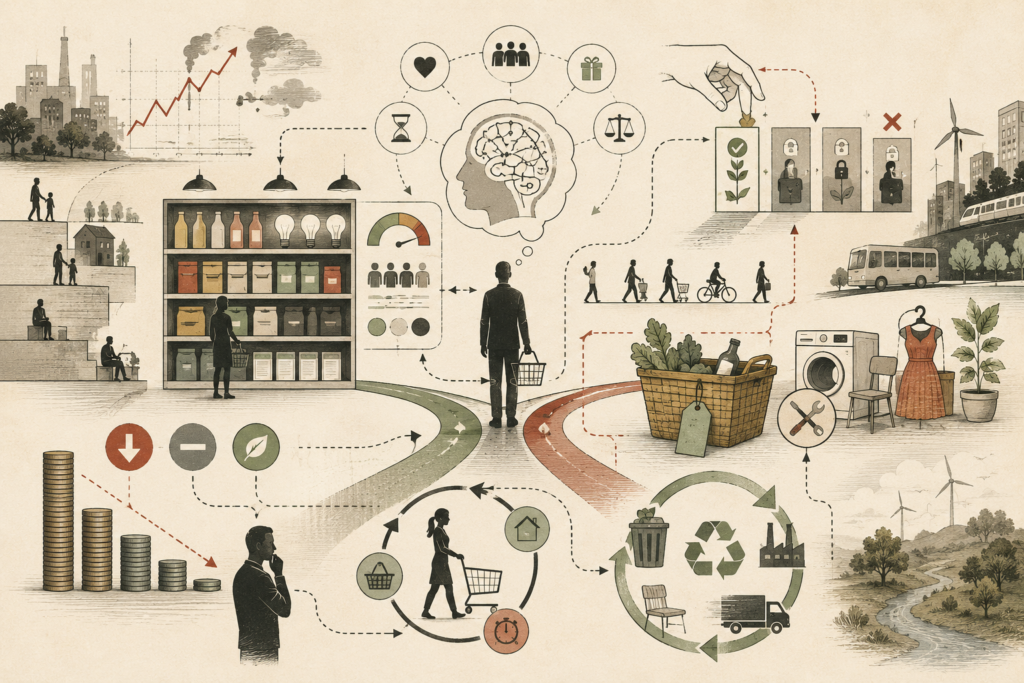
Editorial systems illustration showing sustainable consumption as a behavioral decision environment shaped by incentives, defaults, habits, social norms, pricing, infrastructure, reuse, and environmental feedback loops.

Behavioral Economics and Sustainable Consumption

Behavioral economics offers a stronger account of sustainable consumption than models that assume households respond cleanly to prices and information. Environmentally consequential decisions are made under conditions of limited attention, habit, present bias, uncertainty, status competition, and institutional constraint. This article examines the attitude-behavior gap, the role of norms and conditional cooperation, the power of defaults and choice architecture, and the limits of purely informational approaches. It also develops a formal analytical framework for sustainable choice and includes substantial R and Python sections for simulation and welfare analysis. The broader argument is that sustainable consumption is not simply a matter of individual virtue, but of governance, incentive design, and the architecture of feasible everyday action.

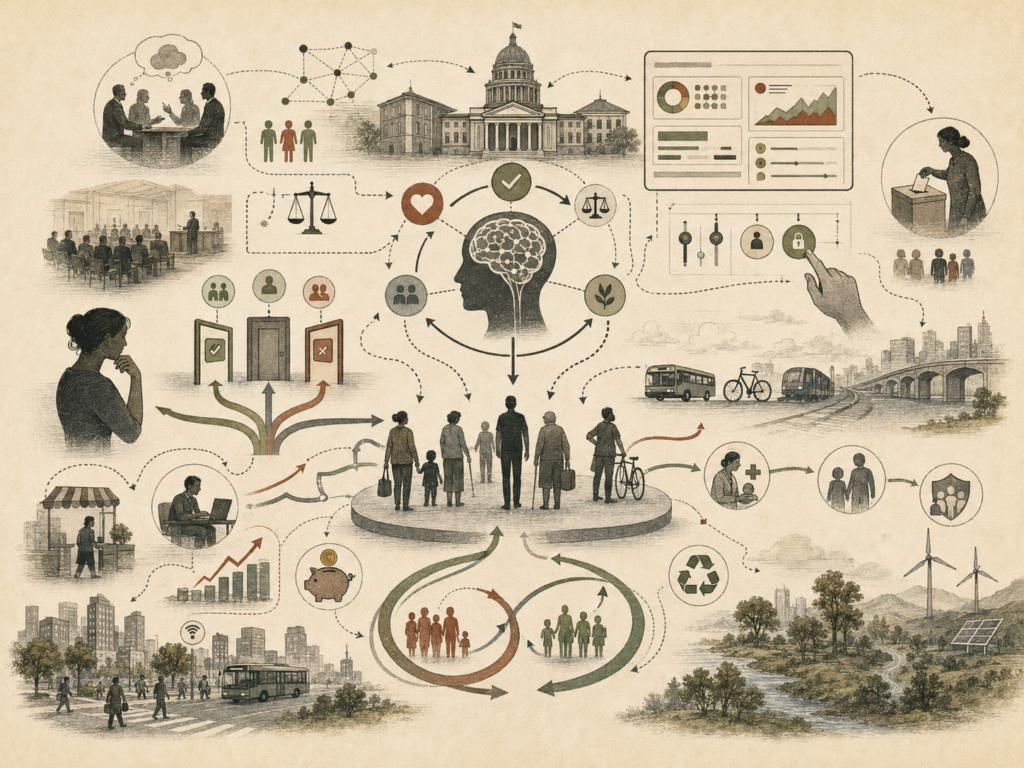
Editorial systems illustration showing behavioral economics applied to governance and public policy through decision pathways, civic institutions, social norms, public services, infrastructure, and feedback loops.

The Future of Behavioral Economics in Governance and Policy

Behavioral economics is becoming increasingly important to governance because institutions do not operate on idealized rational agents, but on people navigating friction, limited attention, social influence, and uneven trust. This article argues that the field’s future lies not only in nudges or bias correction, but in the design of psychologically realistic and ethically defensible institutions. It examines behavioral public policy, digital governance, sustainability transitions, administrative burden, and institutional legitimacy, while also developing a formal analytical framework for behaviorally informed governance. Substantial R and Python sections model compliance, trust, salience, and welfare across alternative governance regimes, showing how behavioral economics increasingly functions as a theory of institutional design rather than merely individual error.

Scroll to Top