Thinking

Thinking refers to the frameworks through which complexity is interpreted, uncertainty is framed, and change is understood across time. Contemporary thought increasingly recognizes that many real-world conditions are dynamic, adaptive, and interconnected, requiring approaches that move beyond linear analysis toward more relational and systems-oriented ways of understanding.

Modern approaches to thinking draw from multiple disciplines, including systems theory, design research, ecology, futures studies, and organizational learning. These frameworks help individuals and institutions make sense of patterns, feedback, resilience, emergence, and long-term change, while providing more structured ways to engage with uncertainty.

Effective thinking is central to research, governance, innovation, and strategy. In rapidly changing environments, organizations increasingly rely on interdisciplinary thinking frameworks to strengthen sense-making, support adaptive learning, and improve the quality of judgment in complex settings.

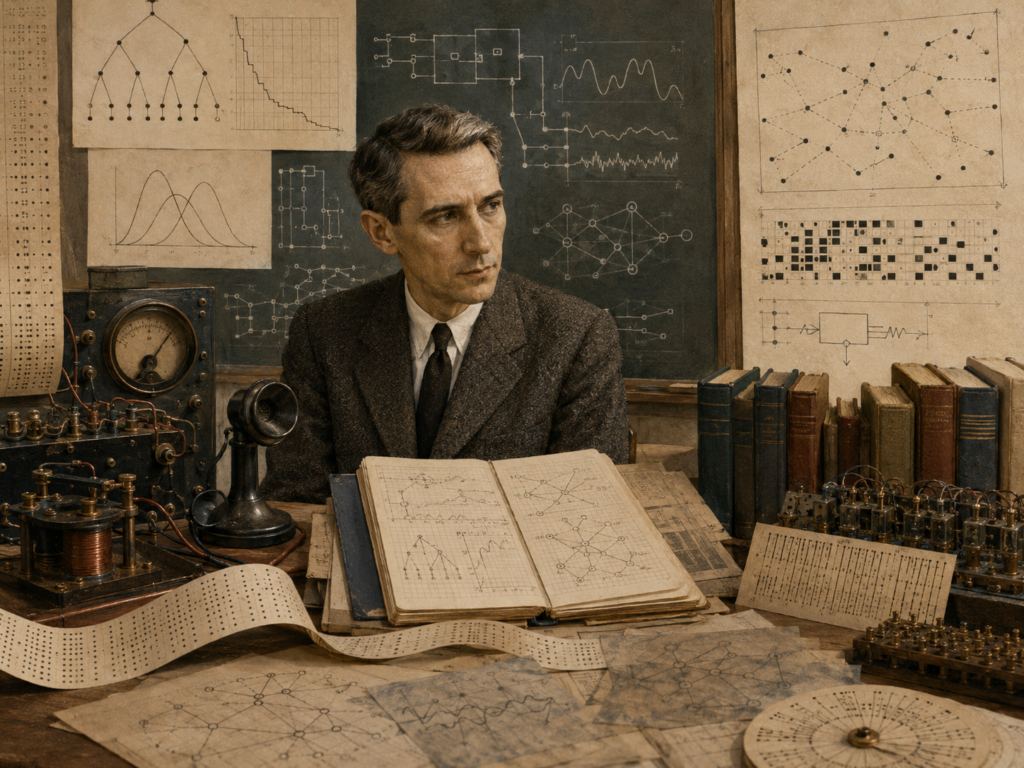
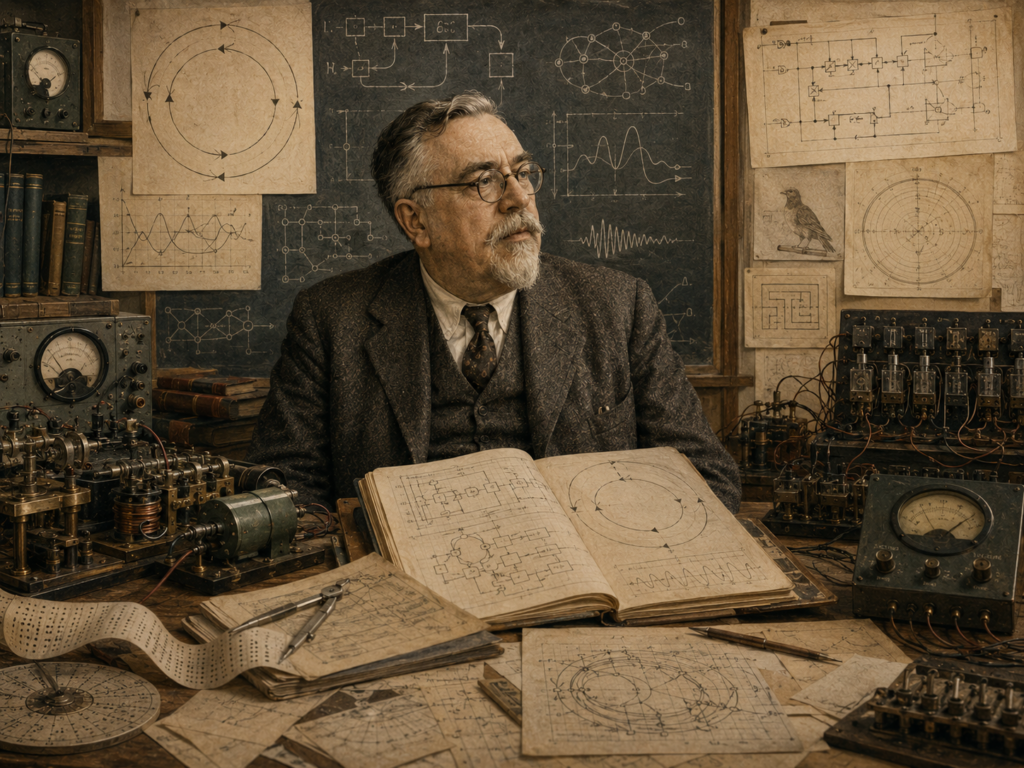
A restrained scholarly illustration of Claude Shannon in a mid-century research workspace with signal diagrams, entropy curves, communication channels, punched tape, circuit networks, books, notebooks, and chalkboard structures representing the mathematical theory of information.

Claude Shannon and the Mathematical Theory of Information: Entropy, Coding, and Communication

Claude Shannon and the Mathematical Theory of Information examines how Shannon transformed communication, uncertainty, and signal transmission into a general mathematical science. This article introduces Claude Shannon, information theory, mathematical communication theory, entropy, uncertainty, probability, bits, binary coding, source coding, channel coding, channel capacity, noisy channels, redundancy, compression, error correction, signal, noise, communication systems, semantic limits, cryptography, secrecy systems, digital circuits, Boolean algebra, telecommunications, data transmission, networks, machine learning, AI infrastructure, data governance, and responsible computational reasoning. It explains why Shannon’s legacy is foundational for modern algorithms: information can be encoded, compressed, transmitted, protected, measured, and transformed across technical systems. By connecting entropy, coding, capacity, redundancy, noise, and semantic caution, the article frames Shannon as central to computing, communications, cryptography, digital infrastructure, machine learning, and the responsible governance of data-rich systems today worldwide across science, policy, and public institutions.

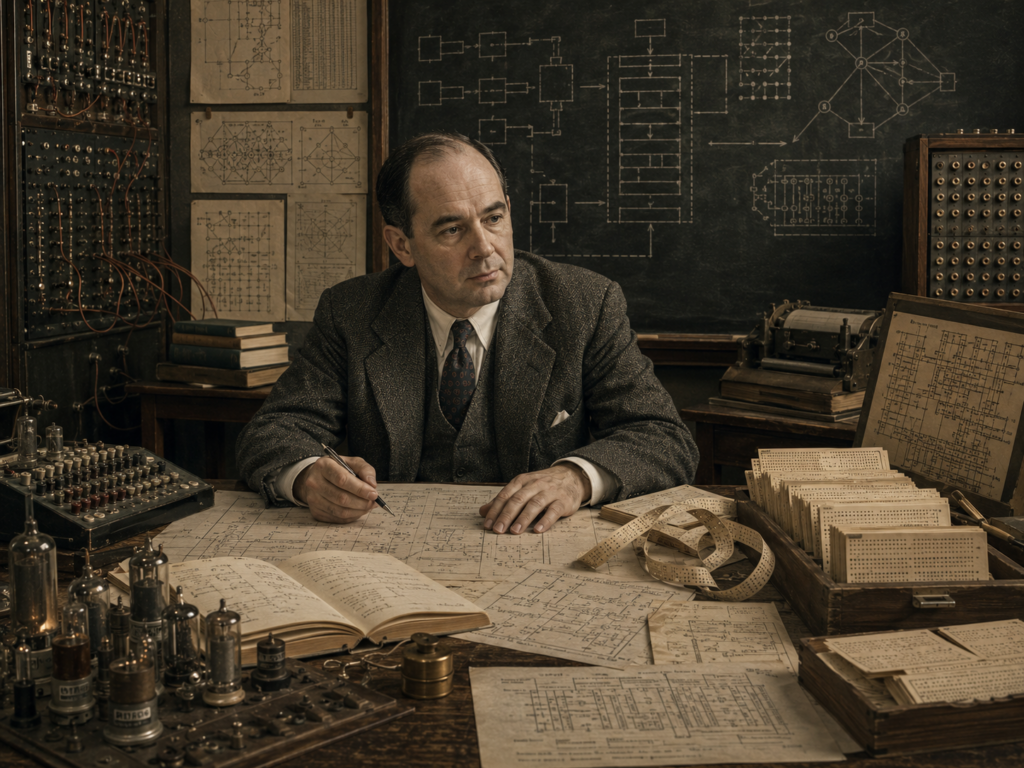
A restrained scholarly illustration of John von Neumann in a mid-century computing laboratory with stored-program architecture diagrams, punched cards, circuit panels, vacuum tubes, chalkboard schematics, books, and papers representing the architecture of modern computing.

John von Neumann and the Architecture of Modern Computing: Stored Programs, Memory, and AI Infrastructure

John von Neumann and the Architecture of Modern Computing examines how stored-program architecture helped turn electronic machines into general-purpose computational systems. This article introduces John von Neumann, EDVAC, ENIAC, IAS machine, stored programs, memory, instructions, data, control units, arithmetic units, input/output, shared memory, sequential execution, conditional branching, loops, self-modifying programs, program-as-data, software layers, compilers, operating systems, scientific computing, simulation, AI infrastructure, the von Neumann bottleneck, Harvard architecture, hardware implementation, credit disputes, institutional computing, and responsible architecture governance. It explains why von Neumann should be understood as an architectural synthesizer and disseminator rather than a lone inventor. By connecting memory, control, software, data movement, performance constraints, and institutional scale, the article frames von Neumann architecture as a foundational model for modern computation and a continuing guide for understanding infrastructure, automation, security, and AI systems across technical and public institutions today.

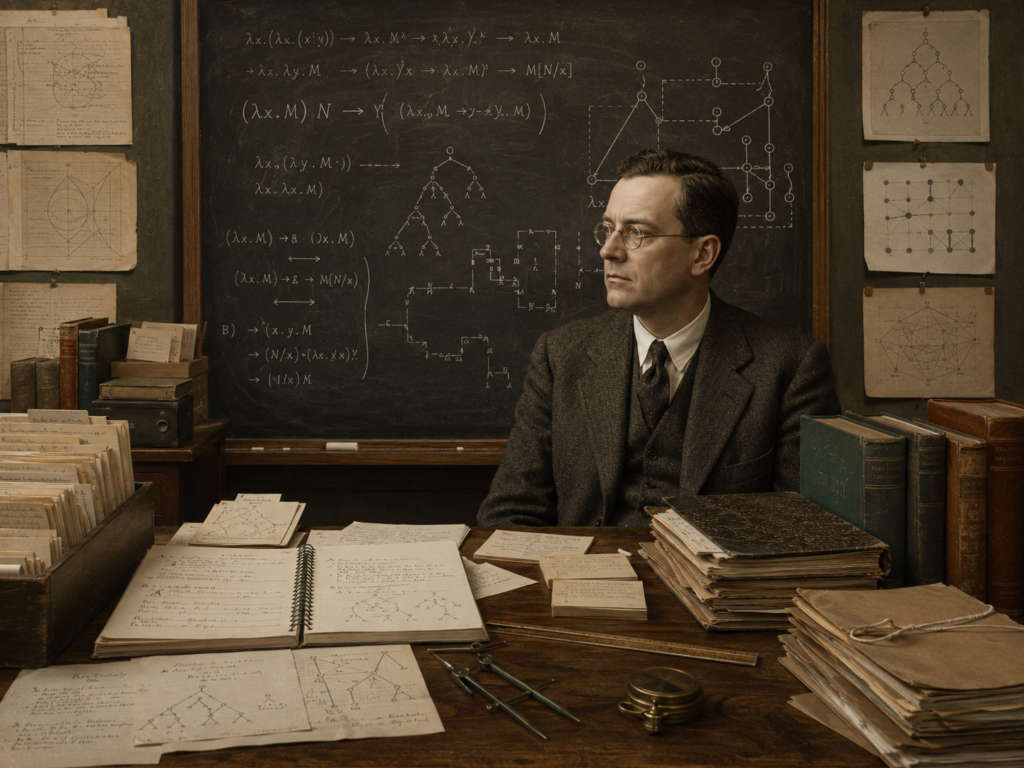
A restrained scholarly illustration of Alonzo Church in a mid-century academic study with lambda-calculus notation, formal computation diagrams, proof trees, notebooks, papers, books, and chalkboard structures representing formal computation.

Alonzo Church, Lambda Calculus, and Formal Computation: Functions, Computability, and Logic

Alonzo Church, Lambda Calculus, and Formal Computation examines how Church helped make computation precise without relying on machines, hardware, or physical motion. This article introduces Alonzo Church, lambda calculus, formal computation, functions, abstraction, application, variables, binding, scope, substitution, beta reduction, alpha conversion, eta conversion, normal forms, Church numerals, recursion, fixed points, effective calculability, recursive functions, the Entscheidungsproblem, Church’s theorem, Church-Turing thesis, type theory, functional programming, programming-language semantics, proof assistants, formal reasoning, and AI-era caution. It explains why Church’s legacy is essential beside Turing’s machine model: computation can be understood as symbolic transformation of expressions as well as mechanical execution of procedures. By connecting lambda calculus, undecidability, type systems, and functional programming, the article frames Church as central to modern computational reasoning, formal methods, software semantics, and responsible automation in artificial intelligence, science, and governance across contemporary technical institutions worldwide.

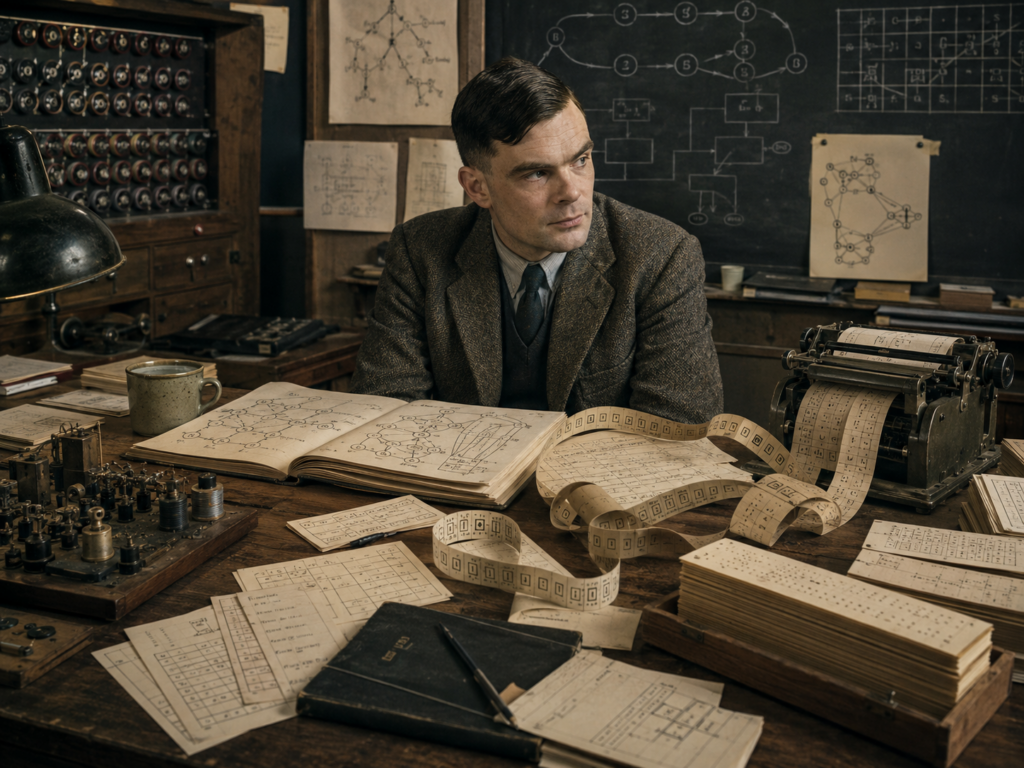
A restrained scholarly illustration of Alan Turing in a mid-century research workspace with machine-tape diagrams, computation tables, mechanical devices, chalkboard flow structures, notebooks, and papers representing the machine model of reasoning.

Alan Turing, Computation, and the Machine Model of Reasoning: Computability, Limits, and AI

Alan Turing, Computation, and the Machine Model of Reasoning examines how Turing transformed procedure into a formal model of computation. This article introduces Alan Turing, computable numbers, effective procedure, finite means, Turing machines, tape, symbols, states, transition rules, machine configurations, human computers, universal machines, program-as-description, decidability, undecidability, the Entscheidungsproblem, the halting problem, Church-Turing thesis, Alonzo Church, lambda calculus, symbolic reasoning, machine intelligence, imitation game, artificial intelligence, behavioral testing, automation limits, and responsible algorithmic reasoning. It explains why Turing’s legacy is not only the idea of a machine, but a disciplined way to define what can be computed, what cannot be decided, and how machine behavior should be interpreted. By connecting formal procedure, universal computation, logical limits, and AI caution, the article frames Turing as central to modern computational reasoning and responsible automation across software, governance, science, and policy today.

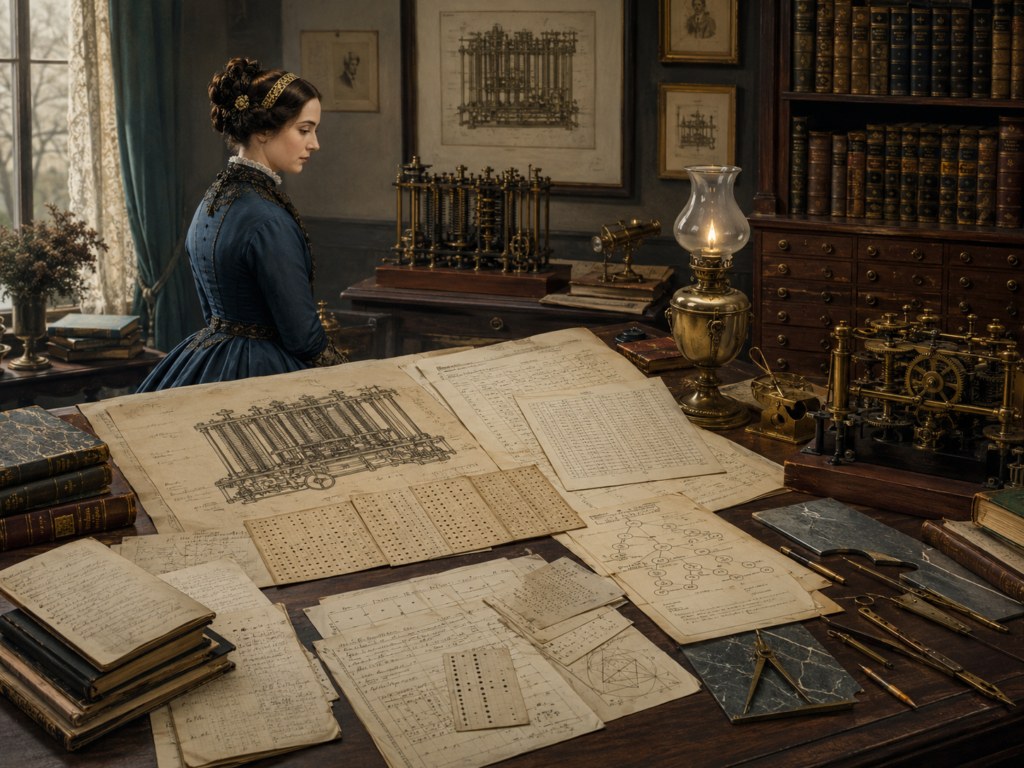
A restrained scholarly illustration of a Victorian study with Ada Lovelace, analytical engine diagrams, punched cards, mechanical computing devices, manuscripts, books, lamps, and drafting tools representing early programming and the imagination of computation.

Ada Lovelace, Programming, and the Imagination of Computation: From Analytical Engine to AI Caution

Ada Lovelace, Programming, and the Imagination of Computation examines how a nineteenth-century mathematical writer helped imagine computation before electronic computers, programming languages, or modern software existed. This article introduces Ada Lovelace, Charles Babbage, the Analytical Engine, Luigi Menabrea, Lovelace’s Notes, Note G, Bernoulli numbers, punched cards, programming, symbolic operations, machine procedure, computation beyond arithmetic, poetical science, music, pattern, collaboration, gendered recognition, authorship, machine limits, the Lovelace objection, and AI-era caution. It explains why Lovelace should not be reduced to either mythic first-programmer slogan or translator-only dismissal. By connecting ordered operations, symbolic generality, mathematical imagination, and disciplined caution, the article frames Lovelace as a decisive bridge between mechanical calculation and software imagination. Her legacy clarifies what computation can do, what machines depend on, and why human judgment remains essential for responsible algorithmic reasoning, programming history, and modern AI interpretation today.

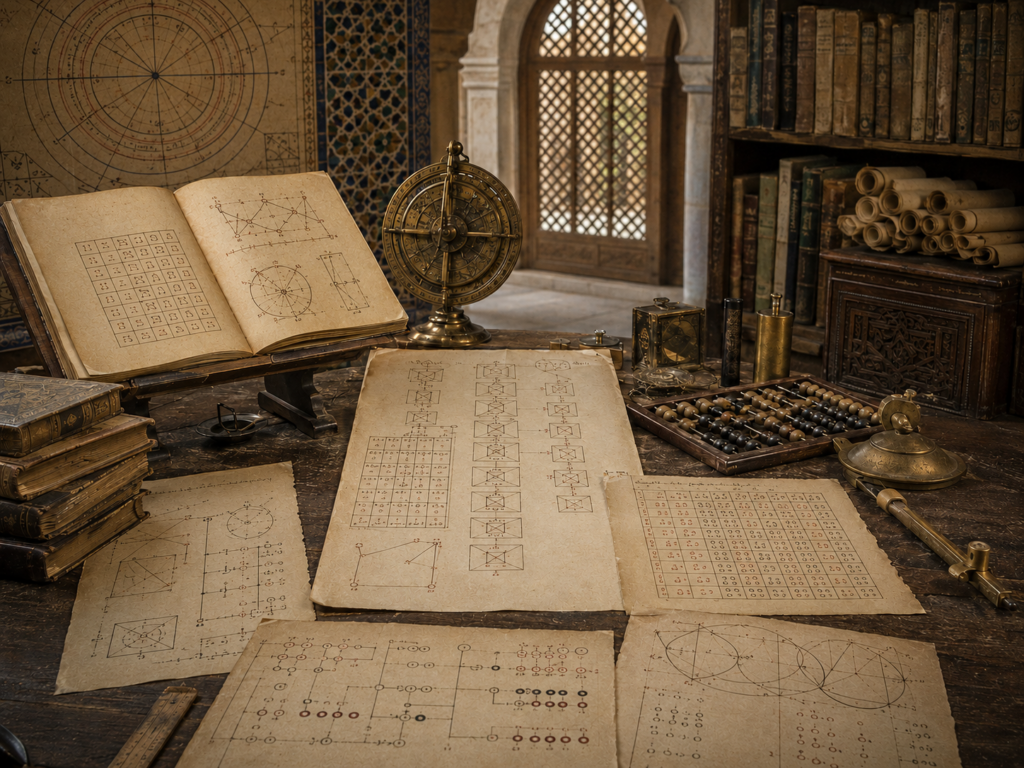
A restrained scholarly illustration of a medieval Islamic study with manuscripts, procedural diagrams, calculation tables, geometric constructions, an astrolabe-like instrument, books, and counting tools representing Al-Khwārizmī and the historical roots of algorithmic method.

Al-Khwārizmī and the Historical Roots of Algorithmic Method: Algorism, Algebra, and Computation

Al-Khwārizmī and the Historical Roots of Algorithmic Method examines how one of the most important figures in mathematical history helped shape the language, methods, and transmission of algorithmic reasoning without becoming a simplified mythic inventor of all algorithms. This article introduces al-Khwārizmī, algorithm, algorism, algebra, al-jabr, al-muqābalah, Hindu-Arabic numerals, place-value calculation, written arithmetic, equation cases, unknowns, roots, squares, numbers, geometric demonstration, astronomical tables, geography, Abbasid Baghdad, Arabic scientific culture, Latin reception, etymology, and procedural method. It explains why al-Khwārizmī’s legacy is strongest when framed precisely: his name is central to the word history of algorithm, while his arithmetic and algebraic works helped systematize teachable methods. By connecting algorism and algebra with algorithmic reasoning, the article frames him as a decisive historical bridge between practical procedure, mathematical abstraction, translation, and computation.

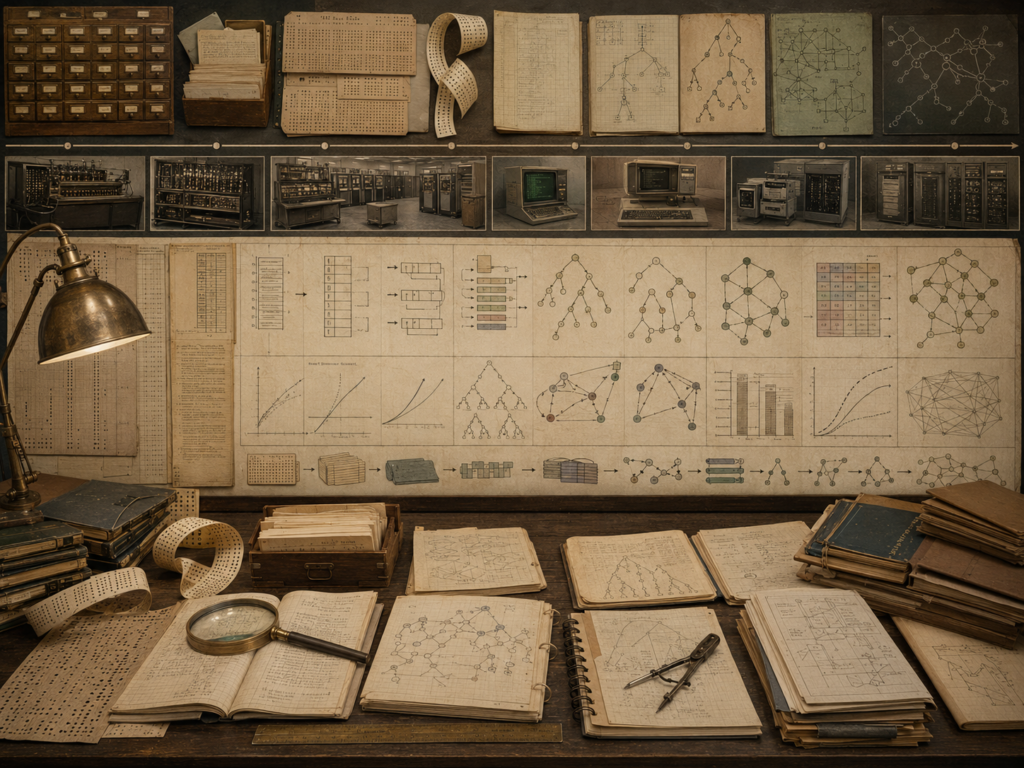
A restrained scholarly illustration of an archival workspace with manuscripts, calculation tables, mechanical devices, timeline pathways, punched cards, flowcharts, books, and instruments representing the history of algorithms from procedure to computation.

The History of Algorithms: From Procedure to Computation, Code, AI, and Responsible Systems

The History of Algorithms: From Procedure to Computation traces the development of algorithms from ancient worked procedures to modern computing, software, artificial intelligence, and governance. This article introduces Babylonian calculation, the Euclidean algorithm, Greek geometric demonstration, Indian numeration, zero, place value, Chinese procedural mathematics, Islamic-world algebra, al-Khwārizmī, algorism, Latin reception, merchant arithmetic, astronomical tables, mechanical calculators, symbolic notation, programmable machines, Boolean logic, Church, Turing, computability, electronic computers, programming languages, algorithm analysis, data structures, complexity, machine learning, platforms, and algorithmic accountability. It explains why algorithms should not be reduced to code, etymology, or one origin story, since rule-governed procedures have appeared in many forms across history. By connecting procedure with computation, the article frames algorithms as evolving infrastructures of representation, proof, execution, analysis, trust, and responsibility across technical institutions for scholars, educators, technologists, historians, policymakers, and public readers today worldwide.

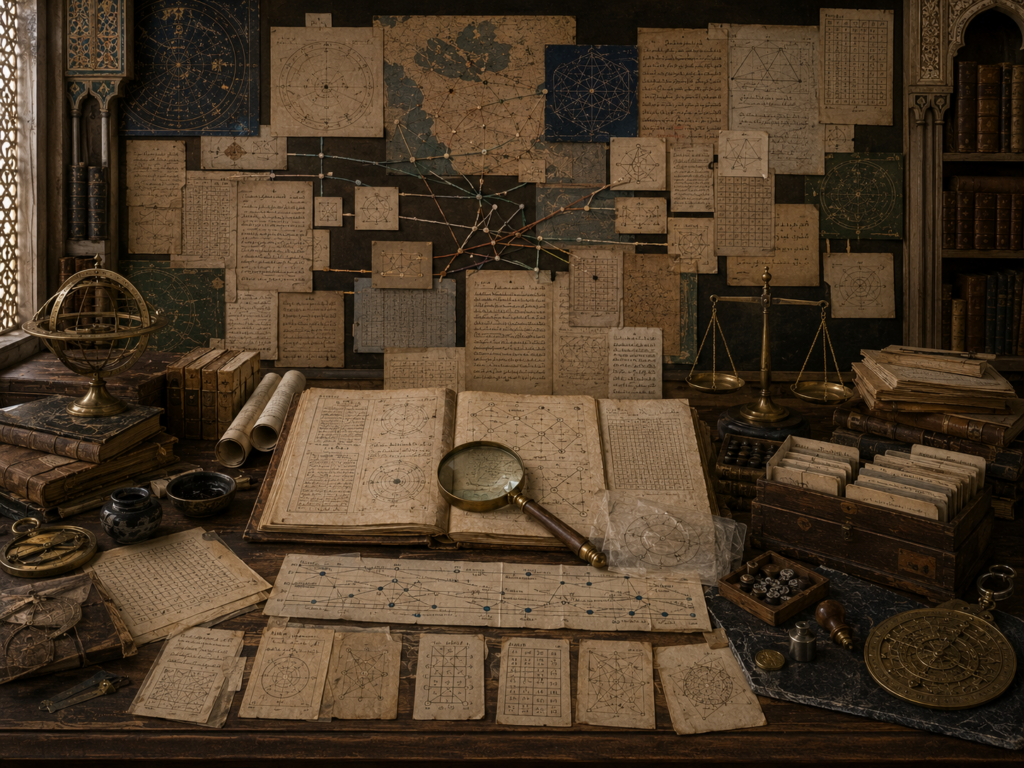
A restrained scholarly illustration of a historical research archive with layered manuscripts, maps, transmission routes, mathematical diagrams, astronomical instruments, balance scales, magnifying glass, and archival folders representing the careful interpretation of algorithmic origins.

Why Origin Stories of Algorithms Need Care: Historiography, Al-Khwārizmī, and Responsible Algorithm History

Why Origin Stories of Algorithms Need Care examines how stories about algorithmic beginnings can clarify history, distort evidence, or erase the layered development of computational reasoning. This article introduces algorithm historiography, al-Khwārizmī, algorism, algebra, etymology, word history, concept history, procedure history, translation, reception, Indian numerals, Greek geometry, Arabic algebra, Latin algorism, mechanical procedure, modern computing, great-man narratives, network history, civilizational erasure, token inclusion, anachronism, and AI-era public history. It explains why the word “algorithm” has a meaningful lineage connected to al-Khwārizmī while the broader history of procedures, calculation, proof, tables, devices, logic, and computation cannot be reduced to one person, culture, or moment. By separating word origin, concept origin, practice origin, institutional memory, and modern formalization, the article offers a more responsible way to tell algorithm history for scholars, educators, technologists, and public readers across technical communities today worldwide.

Scroll to Top