
Last Updated June 23, 2026
Why Origin Stories of Algorithms Need Care examines how stories about the beginnings of algorithms can clarify history, distort history, or quietly erase the complexity of computational reasoning. Origin stories are powerful because they make abstract histories memorable. They connect words, people, places, manuscripts, institutions, inventions, and modern technologies into a narrative. But they are also risky. They can turn networks into heroes, traditions into footnotes, and long processes into single moments.
The history of algorithms is especially vulnerable to simplified origin stories. The word “algorithm” is historically connected to Latinized forms of al-Khwārizmī’s name, while “algebra” is historically connected to al-jabr. These facts matter. But they do not mean that one person invented every algorithm, that all procedural reasoning began in one place, or that modern computing can be reduced to etymology. Algorithms have histories in arithmetic, geometry, astronomy, law, commerce, music, cryptanalysis, mechanics, logic, administration, pedagogy, and computation.
Careful origin stories do not flatten this complexity. They help readers understand layered development. They distinguish word history from concept history, concept history from practice history, and practice history from institutional adoption. They honor al-Khwārizmī without turning him into a myth. They recognize Islamic-world contributions without isolating them from Indian, Greek, Syriac, Persian, Hebrew, Latin, Chinese, Babylonian, and modern traditions. They show that algorithms are not born once; they are formalized, transmitted, renamed, adapted, mechanized, programmed, governed, and reinterpreted.
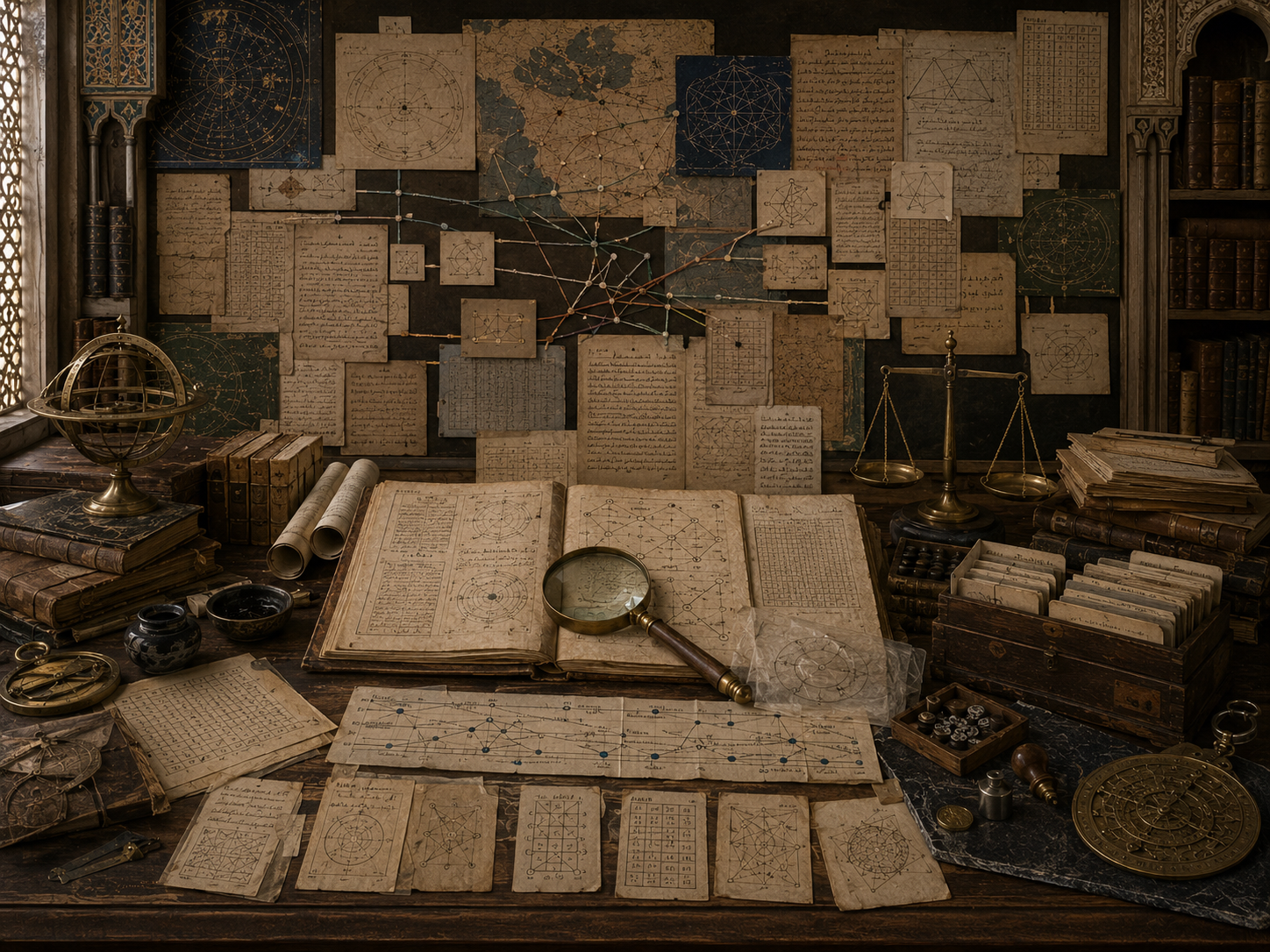
This article introduces origin stories, algorithm historiography, al-Khwārizmī, algorism, algebra, etymology, word history, concept history, procedure history, transmission, translation, reception, Indian numerals, Greek geometry, Arabic algebra, Latin algorism, Euclidean procedure, Babylonian calculation, mechanical procedure, symbolic logic, computing history, historiographic caution, single-origin myths, great-man narratives, civilizational erasure, anachronism, and responsible historical interpretation. It argues that better origin stories do not remove drama from history; they make history more accurate, more generous, and more useful.
Why Origin Stories Matter
Origin stories matter because they shape what readers remember. A careful origin story can open the door to a field. It can explain why a term exists, why a method mattered, how a tradition traveled, and why modern concepts are layered. A careless origin story can do the opposite. It can turn history into a slogan.
Algorithms are often explained through origin stories because the word has a striking etymology. It is connected to al-Khwārizmī through Latin mathematical transmission. That connection deserves attention. But the history of algorithms is not identical with the history of the word. Procedures existed before the word. The word changed meaning over time. Modern algorithmic theory emerged through later developments in logic, computability, programming, and computer science.
| Origin-story layer | Good question | Risk if confused |
|---|---|---|
| Word origin | Where did the term come from? | Mistaking etymology for invention. |
| Concept origin | When did people formalize the idea? | Assuming one definition existed from the start. |
| Practice origin | Where were procedures used? | Ignoring older or parallel traditions. |
| Institutional origin | When did methods become teachable and durable? | Forgetting schools, texts, scribes, and users. |
| Modern origin | When did the contemporary technical meaning develop? | Projecting computer science backward. |
| Public origin story | What story helps readers understand responsibly? | Replacing complexity with myth. |
Origin stories matter because they teach readers where to place credit, meaning, and complexity.
The Power and Danger of Beginnings
Beginnings are attractive. A beginning gives a story shape. It tells readers where to start. It makes a large field feel manageable. But historical beginnings are rarely simple. They are often retrospective labels placed on long developments.
The danger is that a beginning can become a border. Anything before it is treated as prehistory. Anything outside it is treated as secondary. Anything that does not fit the story disappears. In the history of algorithms, this can erase procedures from Babylonian mathematics, Greek geometry, Indian combinatorics and numeration, Arabic algebra, Islamic-world astronomy, Latin algorism, medieval mechanics, early modern symbolic algebra, and modern logic.
| Type of beginning | Usefulness | Danger |
|---|---|---|
| Etymological beginning | Explains the word. | Can become a false invention claim. |
| Biographical beginning | Humanizes history. | Can overburden one figure. |
| Civilizational beginning | Shows cultural setting. | Can create civilizational competition. |
| Technical beginning | Identifies formal definition. | Can erase informal practice. |
| Institutional beginning | Explains teaching and transmission. | Can ignore earlier manuscript or oral traditions. |
| Modern beginning | Clarifies current usage. | Can project present categories backward. |
The question is not whether origin stories should be used. The question is whether they are used with care.
Word History Is Not Concept History
The word “algorithm” has a history. So does the concept of an algorithm. So do the practices of calculation, procedure, rule-governed problem solving, proof, and mechanical sequence. These histories overlap, but they are not identical.
A word may arrive after the practice it names. A concept may become formal long after people use examples of it. A technical meaning may broaden or narrow over centuries. A public story may attach a modern idea to an earlier name. Careful history asks which layer is being discussed.
| History type | Example question | Careful phrasing |
|---|---|---|
| Word history | How did “algorithm” develop from algorism? | The term has a traceable linguistic lineage. |
| Concept history | When did people define algorithm as a general procedure? | The general concept developed through later formalization. |
| Practice history | Where did step-by-step procedures appear? | Procedural reasoning appears in many traditions. |
| Disciplinary history | How did algorithms become part of computer science? | Modern theory depends on logic, computability, and machines. |
| Reception history | How did a method spread? | Transmission depends on teaching, institutions, and trust. |
| Public history | What story should be told to general readers? | Use a memorable story without erasing complexity. |
A careful origin story says exactly what kind of origin it is describing.
Al-Khwārizmī Without Myth
Al-Khwārizmī deserves serious attention. His works on calculation and algebra were historically important. His name became connected to algorism and, eventually, algorithm. His algebraic treatise helped organize equation solving into a systematic discipline. His role in the transmission of Hindu-Arabic numerals and Arabic mathematical methods into Latin traditions is central to the history of computational reasoning.
But honoring al-Khwārizmī does not require exaggeration. He did not invent every algorithm. He did not create all procedural reasoning. He did not write modern symbolic algebra or computer programs. His importance is more precise and more interesting: he helped systematize, teach, and transmit powerful forms of calculation and problem solving that became historically durable.
| Careless claim | Problem | Careful alternative |
|---|---|---|
| Al-Khwārizmī invented algorithms. | Too broad; procedures existed before and after him. | His name is central to the word history of algorithm and to algorism. |
| He invented algebra from nothing. | Erases earlier and parallel traditions. | He decisively systematized algebraic problem solving in Arabic mathematical culture. |
| He was the first computer scientist. | Anachronistic. | His work belongs to the premodern history of procedural reasoning. |
| His work directly created modern AI. | Collapses many historical layers. | His legacy is one deep strand in the long history of computation. |
| He merely preserved earlier knowledge. | Understates synthesis and systematization. | He transmitted, organized, adapted, and formalized methods. |
| His story belongs only to one modern identity category. | Flattens medieval intellectual geography. | Study him within Abbasid, Persianate, Arabic, Islamic-world, and transregional contexts. |
Al-Khwārizmī does not need mythic inflation. His real historical role is already profound.
Algorism, Algebra, and Etymology
Etymology is useful when it is handled carefully. “Algorism” historically referred to arithmetic with Hindu-Arabic numerals and is connected to Latinized forms of al-Khwārizmī’s name. “Algebra” is connected to al-jabr, one of the operations named in al-Khwārizmī’s algebraic work. These word histories help reveal transmission routes.
But etymology is not enough. A word can preserve a memory while hiding the full process. Algorism involved numerals, place value, zero, arithmetic procedures, teaching, merchant use, manuscripts, and resistance. Algebra involved unknowns, cases, transformations, demonstrations, translations, and later symbolic developments. Etymology is a doorway, not the whole house.
| Term | What etymology reveals | What etymology cannot explain alone |
|---|---|---|
| Algorithm | Connection to al-Khwārizmī through algorism. | Modern general theory of procedures and computation. |
| Algorism | Latin reception of arithmetic methods. | Social adoption of numerals and calculation practice. |
| Algebra | Connection to al-jabr. | Full development of algebraic concepts and notation. |
| Variable | Modern formal language. | Earlier unknowns, things, roots, and verbal algebra. |
| Computation | Calculation and counting roots. | Modern machines, logic, and automated procedure. |
| AI | Contemporary technical term. | Deep histories of reasoning, representation, automation, and judgment. |
Etymology can begin the story, but it cannot carry the whole explanation.
Procedures Before the Word Algorithm
Procedural reasoning is older than the word algorithm. Ancient and medieval mathematical cultures used step-by-step methods for calculation, measurement, equation solving, calendar reckoning, astronomical prediction, geometry, inheritance, trade, and construction. Some were verbal. Some were tabular. Some were diagrammatic. Some were embodied in instruments or devices.
This does not mean every old procedure is an algorithm in the modern computer-science sense. It means that the history of algorithmic reasoning has many ancestors. The modern term can be used retrospectively if the limits are clear. A procedure can be algorithm-like without being a modern algorithm as formally defined in computability theory.
| Historical procedure | Algorithm-like feature | Caution |
|---|---|---|
| Euclidean greatest common divisor procedure | Repeated rule for reducing numbers. | Later named “Euclidean algorithm.” |
| Babylonian calculation methods | Worked procedures for numerical problems. | Do not force modern algebra categories too quickly. |
| Indian numeral and combinatorial traditions | Systematic calculation and representation. | Study in their own intellectual settings. |
| Arabic algebra | Case-based rule-governed problem solving. | Verbal algebra is not modern symbolic algebra. |
| Astronomical tables | Lookup and computation procedures. | Tables are data structures but not digital databases. |
| Mechanical automata | Sequenced material action. | Automata are not modern robots or computers. |
A careful history recognizes procedural ancestors without collapsing them into modern definitions.
Multiple Traditions of Procedure
Algorithms have many historical roots because procedure is a broad human achievement. Administrative systems need procedures. Religious calendars need procedures. Merchants need procedures. Astronomers need procedures. Surveyors need procedures. Musicians, cryptanalysts, engineers, jurists, teachers, and scribes all use repeatable methods.
This means the history of algorithms should be plural. It should include mathematical procedures, but also textual, institutional, mechanical, and practical procedures. It should ask how procedures become formal, portable, teachable, and trustworthy.
| Tradition | Procedural contribution | Why it belongs |
|---|---|---|
| Babylonian calculation | Rule-like numerical procedures. | Shows early procedural mathematics. |
| Greek geometry | Proof, construction, and stepwise demonstration. | Shows procedure tied to proof. |
| Indian mathematics | Numerals, place value, combinatorics, calculation. | Shows representation and efficient procedure. |
| Islamic-world mathematics | Algebra, algorism, astronomy, tables, mechanics. | Shows systematization and transmission. |
| Latin reception | Teaching, commerce, universities, notation adoption. | Shows institutionalization. |
| Modern logic and computing | Formal computability and executable machines. | Shows modern technical definition. |
A plural history makes the algorithm stronger, not weaker.
Translation, Reception, and Institutional Memory
Origin stories often focus on invention, but transmission is equally important. A procedure that is not transmitted may vanish. A method that is translated poorly may become unusable. A notation that is not taught may remain obscure. A table that is copied inaccurately may fail. A concept that is not institutionalized may not survive.
Translation, reception, and institutional memory explain how methods become durable. They also distribute credit. Translators, scribes, teachers, commentators, merchants, instrument makers, patrons, and students are not background noise. They are part of how computational knowledge survives.
| Historical actor or system | Role | Origin-story correction |
|---|---|---|
| Translator | Moves procedure across language. | Origin is not only invention. |
| Scribe | Copies and preserves method. | Survival depends on replication. |
| Commentator | Explains and corrects. | Understanding requires interpretation. |
| Teacher | Makes method usable. | Adoption depends on pedagogy. |
| Merchant or practitioner | Tests usefulness. | Practice validates method. |
| Institution | Stabilizes and legitimizes. | Durability depends on memory systems. |
A method’s origin is incomplete without its transmission history.
Anachronism and Modern Computing
Anachronism occurs when modern categories are projected backward without care. It is tempting to say that medieval scholars were doing computer science, that automata were robots, that tables were databases, or that algebraic rules were code. These analogies can be useful pedagogically, but only if they are explicitly marked as analogies.
The problem is not comparison. The problem is collapse. A medieval table can be compared to a data structure, but it is not a digital database. A mechanical automaton can be compared to sequenced control, but it is not a modern robot. A verbal algebraic rule can be compared to an algorithm, but it is not a program in a programming language.
| Modern analogy | What it helps explain | What must be preserved |
|---|---|---|
| Procedure as algorithm | Stepwise method. | Historical form and context. |
| Table as data structure | Organized lookup values. | Manuscript, instrument, and use context. |
| Automaton as control system | Sequenced action. | Material mechanics and spectacle. |
| Algebra as symbolic manipulation | Transformation of unknowns. | Verbal, geometric, and case-based structure. |
| Translation as porting | Moving procedure across environments. | Language, commentary, and institution. |
| Origin story as metadata | Context for method. | Uncertainty, plurality, and evidence. |
Analogy is useful when it clarifies difference instead of erasing it.
Great-Man Narratives and Network Histories
Great-man narratives are memorable. They attach a field to a person. They help readers remember al-Khwārizmī, Euclid, Fibonacci, Lovelace, Turing, Church, Shannon, von Neumann, Hopper, and others. But such narratives can turn networks into biographies.
Network histories do not deny individual brilliance. They situate it. They ask who taught, translated, copied, criticized, funded, used, transmitted, and institutionalized the work. They ask which prior traditions made the work possible and which later communities changed its meaning.
| Great-man question | Network-history question | Why it matters |
|---|---|---|
| Who invented it? | Who made it possible, usable, and durable? | Expands credit accurately. |
| Which genius changed history? | Which institutions and traditions shaped the work? | Prevents isolation. |
| What was the breakthrough? | What prior problems and methods did it reorganize? | Shows continuity. |
| When did it begin? | Which layers began at different times? | Prevents false singular origins. |
| Who gets remembered? | Who gets erased by the story? | Improves historical ethics. |
| How did it influence us? | How was influence mediated and transformed? | Tracks transmission. |
Great people matter, but they do not replace the history of systems.
Civilizational Erasure and Token Inclusion
Origin stories can erase civilizations by pretending that modern ideas emerged only from Europe or only from modern computing. But they can also make a different mistake: token inclusion. Token inclusion names a non-European figure briefly, often as a trivia fact, without explaining the intellectual tradition, institutional setting, technical content, or transmission pathway.
A careful history avoids both. It does not erase Islamic-world, Indian, Greek, Chinese, Babylonian, Persian, Syriac, Hebrew, Latin, African, or other contributions. It also does not reduce them to decorative references. The goal is not symbolic inclusion. The goal is accurate intellectual architecture.
| Bad pattern | What it does | Better pattern |
|---|---|---|
| Erasure | Leaves major traditions out. | Map the actual knowledge network. |
| Tokenism | Mentions a figure without context. | Explain method, institution, and transmission. |
| Civilizational competition | Turns history into ownership dispute. | Study exchange, adaptation, and synthesis. |
| Modern superiority story | Treats earlier methods as primitive. | Evaluate historical methods in their own forms. |
| Romantic inversion | Overcorrects by exaggerating one tradition. | Use evidence and careful scope. |
| Flat multiculturalism | Lists names without explaining relationships. | Trace specific procedures and pathways. |
Responsible origin stories require both inclusion and structure.
Historiography as Method
Historiography is the study of how history is written. It asks what counts as evidence, which categories are used, what is foregrounded, what is omitted, and how present concerns shape interpretations of the past. In the history of algorithms, historiography is not optional. It is part of the subject.
The term algorithm is modern in its broad technical sense, but many older procedures can be studied as ancestors of algorithmic reasoning. That requires methodological care. Historiography helps distinguish literal usage, retrospective classification, analogy, influence, transmission, and formal definition.
| Historiographic category | Question | Use in algorithm history |
|---|---|---|
| Primary source | What does the text actually say? | Prevents invented claims. |
| Translation history | How did the wording change? | Tracks concept movement. |
| Reception history | How was the method used later? | Shows adoption and transformation. |
| Conceptual history | How did the idea develop? | Distinguishes practice from definition. |
| Comparative history | Which traditions share related methods? | Prevents single-origin claims. |
| Presentist caution | Are modern categories being projected backward? | Controls anachronism. |
Historiography is a method for keeping origin stories honest.
What a Careful Origin Story Does
A careful origin story does not avoid beginnings. It multiplies them responsibly. It can say that the word algorithm has a lineage through al-Khwārizmī and algorism. It can say that systematic procedures existed earlier in many mathematical traditions. It can say that modern computer-science algorithms depend on later developments in logic, computability, programming, and machines. These claims do not contradict each other if their scope is clear.
A careful origin story also explains uncertainty. It does not pretend that every line of transmission is direct or fully known. It uses evidence, dates, manuscripts, terminology, and institutional context. It marks where the story is strong and where it is interpretive.
| Careful origin-story practice | What it improves | Example |
|---|---|---|
| Define the layer | Prevents category confusion. | Word origin vs procedure origin. |
| Name evidence | Grounds the claim. | Manuscript, translation, treatise, commentary. |
| Use precise verbs | Avoids exaggeration. | Systematized, transmitted, popularized, formalized. |
| Include networks | Expands credit accurately. | Translators, teachers, scribes, practitioners. |
| Mark analogies | Controls anachronism. | Algorithm-like, not modern program. |
| Preserve uncertainty | Builds trust. | Known, likely, debated, unclear. |
A careful origin story makes history more powerful because it makes it more truthful.
Origin Stories in the Age of AI
Origin stories matter even more in the age of AI because algorithms now shape public life. Search, recommendation, credit, hiring, policing, health care, education, logistics, climate modeling, finance, and governance all depend on computational systems. Public stories about algorithms influence how people understand authority, responsibility, and trust.
If algorithms are presented as inevitable products of modern technology, their social and institutional histories disappear. If they are presented as ancient wisdom directly leading to AI, the differences between calculation, procedure, automation, statistical learning, and machine agency disappear. Better origin stories help the public see that algorithms are historical, human-made, institutionally embedded, and accountable.
| AI-era origin-story risk | Consequence | Careful correction |
|---|---|---|
| Algorithms as timeless inevitability | Hides design choices. | Show human decisions and institutions. |
| Ancient-to-AI straight line | Erases discontinuities. | Distinguish procedure, machine, statistics, and agency. |
| Genius-founder myth | Hides collective labor. | Show networks and infrastructures. |
| Technological destiny | Weakens accountability. | Emphasize governance and judgment. |
| Pure abstraction story | Ignores material systems. | Include institutions, data, devices, and users. |
| Marketing history | Turns heritage into brand. | Separate scholarship from promotional myth. |
AI makes algorithm history more urgent, not less.
Examples of Better Algorithm Origin Stories
The examples below show how origin stories can be sharpened without losing narrative force.
Instead of “Al-Khwārizmī invented algorithms”
Say that his name is central to the word history of algorithm and his works helped transmit powerful calculation and algebraic procedures.
Instead of “algorithms began with computers”
Say that modern computer-science algorithms formalized and mechanized much older traditions of procedure.
Instead of “Europe rediscovered lost knowledge”
Say that Latin Europe received, translated, adapted, taught, and institutionalized Arabic and Arabic-mediated knowledge.
Instead of “Islamic scholars merely preserved Greek knowledge”
Say that they translated, corrected, synthesized, criticized, extended, and created mathematical and scientific traditions.
Instead of “old procedures were primitive algorithms”
Say that many historical procedures are algorithm-like ancestors but must be studied in their own forms.
Instead of “the word explains the concept”
Say that word history, concept history, practice history, and institutional history overlap but differ.
Instead of “one tradition owns algorithms”
Say that algorithmic reasoning emerged through many traditions of procedure, representation, proof, and transmission.
Instead of “AI is the endpoint of ancient algorithms”
Say that AI is one modern branch of a longer history of calculation, reasoning, automation, statistics, data, and governance.
Better origin stories do not weaken the history. They make it usable without making it false.
Mathematics, Computation, and Modeling
A careful origin story can be modeled as a layered structure:
OriginStory = WordHistory + ConceptHistory + PracticeHistory + TransmissionHistory + ModernFormalization
\]
Interpretation: A good origin story separates linguistic, conceptual, procedural, institutional, and modern technical layers.
A careless origin story often collapses layers:
Name \neq Invention \neq FormalDefinition \neq ModernUse
\]
Interpretation: The fact that a word comes from a name does not prove that the named person invented every modern meaning of the concept.
A network model is more accurate:
Procedure \rightarrow Translation \rightarrow Teaching \rightarrow Practice \rightarrow Institution \rightarrow Memory
\]
Interpretation: Computational methods become historically durable when they move through social and institutional systems.
Historiographic care can be summarized as:
Care = Evidence + Scope + Context + Caution + Credit
\]
Interpretation: Responsible origin stories ground claims, limit scope, preserve context, avoid anachronism, and distribute credit accurately.
These formulas use modern notation to clarify historiographic structure. They are interpretive models, not mathematical laws.
Python Workflow: Origin Story Caution Map
The Python workflow below creates a dependency-light interpretive map of algorithm origin-story risks. It scores themes by evidence grounding, scope clarity, anachronism control, network awareness, etymology caution, transmission depth, credit distribution, public usefulness, historical significance, and modern resonance, then writes reproducible CSV and JSON outputs.
# why_origin_stories_of_algorithms_need_care_map.py
# Dependency-light workflow for mapping historiographic risk in algorithm origin stories.

from __future__ import annotations

from dataclasses import asdict, dataclass
from pathlib import Path
from statistics import mean
import csv
import json
from datetime import datetime, timezone

ARTICLE_ROOT = Path(__file__).resolve().parents[1]
TABLES = ARTICLE_ROOT / "outputs" / "tables"
JSON_DIR = ARTICLE_ROOT / "outputs" / "json"


@dataclass(frozen=True)
class OriginStoryConfig:
    article: str = "why_origin_stories_of_algorithms_need_care"
    core_threshold: float = 0.80
    high_caution_threshold: float = 0.86


def timestamp_utc() -> str:
    return datetime.now(timezone.utc).isoformat()


def write_csv(path: Path, rows: list[dict[str, object]]) -> None:
    path.parent.mkdir(parents=True, exist_ok=True)
    if not rows:
        path.write_text("", encoding="utf-8")
        return
    fieldnames = sorted({key for row in rows for key in row.keys()})
    with path.open("w", newline="", encoding="utf-8") as handle:
        writer = csv.DictWriter(handle, fieldnames=fieldnames, extrasaction="ignore")
        writer.writeheader()
        writer.writerows(rows)


def write_json(path: Path, payload: object) -> None:
    path.parent.mkdir(parents=True, exist_ok=True)
    path.write_text(json.dumps(payload, indent=2, sort_keys=True), encoding="utf-8")


def origin_story_themes() -> list[dict[str, object]]:
    return [
        {"theme_id": "word_history_not_concept_history", "evidence_grounding": 0.96, "scope_clarity": 0.98, "anachronism_control": 0.96, "network_awareness": 0.88, "etymology_caution": 0.98, "transmission_depth": 0.90, "credit_distribution": 0.90, "public_usefulness": 0.96, "historical_significance": 0.98, "modern_resonance": 0.98},
        {"theme_id": "al_khwarizmi_without_myth", "evidence_grounding": 0.98, "scope_clarity": 0.96, "anachronism_control": 0.96, "network_awareness": 0.92, "etymology_caution": 0.96, "transmission_depth": 0.94, "credit_distribution": 0.94, "public_usefulness": 0.98, "historical_significance": 0.98, "modern_resonance": 0.96},
        {"theme_id": "procedures_before_algorithm_word", "evidence_grounding": 0.94, "scope_clarity": 0.96, "anachronism_control": 0.98, "network_awareness": 0.96, "etymology_caution": 0.92, "transmission_depth": 0.92, "credit_distribution": 0.96, "public_usefulness": 0.94, "historical_significance": 0.96, "modern_resonance": 0.96},
        {"theme_id": "translation_reception_institutional_memory", "evidence_grounding": 0.94, "scope_clarity": 0.92, "anachronism_control": 0.90, "network_awareness": 0.98, "etymology_caution": 0.88, "transmission_depth": 0.98, "credit_distribution": 0.98, "public_usefulness": 0.94, "historical_significance": 0.96, "modern_resonance": 0.96},
        {"theme_id": "great_man_vs_network_history", "evidence_grounding": 0.92, "scope_clarity": 0.94, "anachronism_control": 0.92, "network_awareness": 0.98, "etymology_caution": 0.90, "transmission_depth": 0.94, "credit_distribution": 0.98, "public_usefulness": 0.96, "historical_significance": 0.94, "modern_resonance": 0.98},
        {"theme_id": "civilizational_erasure_token_inclusion", "evidence_grounding": 0.92, "scope_clarity": 0.94, "anachronism_control": 0.92, "network_awareness": 0.96, "etymology_caution": 0.88, "transmission_depth": 0.94, "credit_distribution": 0.98, "public_usefulness": 0.94, "historical_significance": 0.96, "modern_resonance": 0.98},
        {"theme_id": "ai_age_origin_story_caution", "evidence_grounding": 0.88, "scope_clarity": 0.96, "anachronism_control": 0.98, "network_awareness": 0.94, "etymology_caution": 0.90, "transmission_depth": 0.88, "credit_distribution": 0.92, "public_usefulness": 0.98, "historical_significance": 0.94, "modern_resonance": 0.98},
    ]


def score_theme(row: dict[str, object], config: OriginStoryConfig) -> dict[str, object]:
    origin_care_score = mean([
        float(row["evidence_grounding"]),
        float(row["scope_clarity"]),
        float(row["anachronism_control"]),
        float(row["network_awareness"]),
        float(row["etymology_caution"]),
        float(row["transmission_depth"]),
        float(row["credit_distribution"]),
        float(row["public_usefulness"]),
        float(row["historical_significance"]),
        float(row["modern_resonance"]),
    ])

    if origin_care_score >= config.core_threshold and float(row["anachronism_control"]) >= config.high_caution_threshold:
        interpretive_status = "core_origin_story_care_thread"
    elif origin_care_score >= config.core_threshold:
        interpretive_status = "major_origin_story_care_thread"
    else:
        interpretive_status = "supporting_origin_story_care_thread"

    return {
        "theme_id": row["theme_id"],
        "evidence_grounding": round(float(row["evidence_grounding"]), 6),
        "scope_clarity": round(float(row["scope_clarity"]), 6),
        "anachronism_control": round(float(row["anachronism_control"]), 6),
        "network_awareness": round(float(row["network_awareness"]), 6),
        "etymology_caution": round(float(row["etymology_caution"]), 6),
        "transmission_depth": round(float(row["transmission_depth"]), 6),
        "credit_distribution": round(float(row["credit_distribution"]), 6),
        "public_usefulness": round(float(row["public_usefulness"]), 6),
        "historical_significance": round(float(row["historical_significance"]), 6),
        "modern_resonance": round(float(row["modern_resonance"]), 6),
        "origin_care_score": round(origin_care_score, 6),
        "interpretive_status": interpretive_status,
    }


def interpretation_cautions() -> list[dict[str, str]]:
    return [
        {"caution": "do_not_confuse_word_origin_with_invention", "meaning": "The word algorithm has an etymological history, but the concept and practices are broader."},
        {"caution": "do_not_turn_al_khwarizmi_into_a_myth", "meaning": "Honor his role without claiming he invented every algorithm or modern computer science."},
        {"caution": "do_not_project_modern_computing_backward", "meaning": "Historical procedures can be algorithm-like without being programs or modern formal algorithms."},
        {"caution": "do_not_erase_transmission_networks", "meaning": "Translators, scribes, teachers, readers, and institutions make methods durable."},
        {"caution": "do_not_replace_erasure_with_tokenism", "meaning": "Inclusion requires context, method, transmission, and evidence, not just name-dropping."},
    ]


def main() -> None:
    config = OriginStoryConfig()
    themes = origin_story_themes()
    scored = [score_theme(row, config) for row in themes]
    cautions = interpretation_cautions()

    summary = {
        "article": config.article,
        "timestamp_utc": timestamp_utc(),
        "themes_reviewed": len(scored),
        "core_threads": sum(1 for row in scored if row["interpretive_status"] == "core_origin_story_care_thread"),
        "major_threads": sum(1 for row in scored if row["interpretive_status"] == "major_origin_story_care_thread"),
        "supporting_threads": sum(1 for row in scored if row["interpretive_status"] == "supporting_origin_story_care_thread"),
        "mean_origin_care_score": round(mean(float(row["origin_care_score"]) for row in scored), 6),
        "cautions": len(cautions),
        "interpretation": "Algorithm origin stories need care because word histories, concept histories, procedure histories, transmission histories, and modern formalization do not all begin at the same point.",
    }

    write_csv(TABLES / "origin_story_themes.csv", themes)
    write_csv(TABLES / "origin_story_care_map.csv", scored)
    write_csv(TABLES / "interpretation_cautions.csv", cautions)
    write_csv(TABLES / "origin_story_summary.csv", [summary])

    write_json(JSON_DIR / "origin_story_config.json", asdict(config))
    write_json(JSON_DIR / "origin_story_care_map.json", scored)
    write_json(JSON_DIR / "interpretation_cautions.json", cautions)
    write_json(JSON_DIR / "origin_story_summary.json", summary)

    print("Algorithm origin story caution map complete.")
    print(TABLES / "origin_story_summary.csv")


if __name__ == "__main__":
    main()
This workflow turns historiographic care into a reproducible interpretive artifact: evidence, scope, anachronism, networks, etymology, transmission, credit, public usefulness, historical significance, and modern resonance are documented together.
R Workflow: Historiography Diagnostics
The R workflow reads the generated CSV outputs, summarizes origin-story themes, visualizes historiographic dimensions, and writes an additional diagnostic table.
# why_origin_stories_of_algorithms_need_care_summary.R
args <- commandArgs(trailingOnly = FALSE)
file_arg <- grep("^--file=", args, value = TRUE)

if (length(file_arg) > 0) {
  script_path <- normalizePath(sub("^--file=", "", file_arg[1]), mustWork = TRUE)
  article_root <- normalizePath(file.path(dirname(script_path), ".."), mustWork = TRUE)
} else {
  article_root <- getwd()
}

setwd(article_root)

tables_dir <- file.path(article_root, "outputs", "tables")
figures_dir <- file.path(article_root, "outputs", "figures")
dir.create(tables_dir, recursive = TRUE, showWarnings = FALSE)
dir.create(figures_dir, recursive = TRUE, showWarnings = FALSE)

map_path <- file.path(tables_dir, "origin_story_care_map.csv")
summary_path <- file.path(tables_dir, "origin_story_summary.csv")

if (!file.exists(map_path)) {
  stop(paste("Missing", map_path, "Run the Python workflow first."))
}

origin_map <- read.csv(map_path, stringsAsFactors = FALSE)
summary <- read.csv(summary_path, stringsAsFactors = FALSE)

png(file.path(figures_dir, "origin_story_care_dimensions.png"), width = 1200, height = 850)
score_matrix <- t(as.matrix(origin_map[, c("evidence_grounding", "scope_clarity", "anachronism_control", "network_awareness", "etymology_caution", "transmission_depth", "credit_distribution", "public_usefulness", "historical_significance", "modern_resonance")]))
barplot(score_matrix,
        beside = TRUE,
        names.arg = origin_map$theme_id,
        las = 2,
        ylim = c(0, 1),
        ylab = "Interpretive Score",
        main = "Why Origin Stories of Algorithms Need Care: Historiography Dimensions")
legend("bottomright",
       legend = rownames(score_matrix),
       cex = 0.68,
       bty = "n")
grid()
dev.off()

png(file.path(figures_dir, "origin_care_score_by_theme.png"), width = 1000, height = 750)
barplot(origin_map$origin_care_score,
        names.arg = origin_map$theme_id,
        las = 2,
        ylab = "Origin-Care Score",
        main = "Algorithm Origin-Story Care Score by Theme")
grid()
dev.off()

r_summary <- data.frame(
  themes_reviewed = summary$themes_reviewed[1],
  core_threads = summary$core_threads[1],
  major_threads = summary$major_threads[1],
  supporting_threads = summary$supporting_threads[1],
  mean_origin_care_score = summary$mean_origin_care_score[1],
  cautions = summary$cautions[1],
  diagnostic_note = "Algorithm origin stories need care because word histories, concept histories, procedure histories, transmission histories, and modern formalization do not all begin at the same point."
)

write.csv(r_summary, file.path(tables_dir, "r_origin_story_diagnostic_summary.csv"), row.names = FALSE)
print(r_summary)
The R layer makes the interpretive structure visible: evidence, scope, anachronism, network awareness, etymology, transmission, credit, public usefulness, historical significance, and modern resonance can be examined as related but distinct dimensions.
GitHub Repository
The companion repository contains reproducible workflows, synthetic interpretive data, outputs, calculators, documentation, and multilingual examples for this article.
Complete Code Repository
Companion article folder with Python, R, Julia, SQL, Haskell, C, C++, Fortran, Rust, Go, Java, TypeScript, Prolog, Racket, notebooks, documentation, synthetic teaching data, generated outputs, schemas, calculators, and Canvas-ready workflow artifacts for algorithm origin stories, historiography, al-Khwārizmī, algorism, algebra, etymology, procedural traditions, translation, reception, anachronism, great-man narratives, network history, civilizational erasure, token inclusion, and responsible algorithmic reasoning.
A Practical Method for Evaluating Algorithm Origin Stories
A careful origin-story evaluation asks what kind of beginning is being claimed and whether the evidence supports it.
| Step | Historical action | Output |
|---|---|---|
| 1 | Identify the claim: word origin, concept origin, practice origin, institution, or modern definition. | Scope definition. |
| 2 | Ask what evidence supports the claim: text, manuscript, translation, usage, commentary, or institution. | Evidence map. |
| 3 | Check whether the claim overstates invention, priority, direct influence, or continuity. | Exaggeration audit. |
| 4 | Identify earlier, parallel, and later traditions that complicate the story. | Network map. |
| 5 | Separate etymology from conceptual and procedural development. | Layer separation. |
| 6 | Mark modern analogies as analogies rather than literal identities. | Anachronism control. |
| 7 | Include transmission actors: translators, scribes, teachers, users, institutions, and tools. | Credit distribution. |
| 8 | Rewrite the story using precise verbs: preserved, translated, systematized, popularized, formalized, mechanized. | Responsible narrative. |
This method makes origin stories useful without making them misleading.
Common Pitfalls
The first pitfall is confusing word origin with invention. The second is projecting modern computer science backward. The third is replacing erasure with tokenism. The fourth is turning network history into a single heroic biography.
| Pitfall | Why it matters | Better practice |
|---|---|---|
| Etymology equals invention | It turns word history into technical origin. | Separate word, concept, practice, and formalization. |
| Great-man simplification | It hides networks and institutions. | Honor individuals within systems. |
| Modern category projection | It misreads historical practice. | Use analogy carefully. |
| Single-civilization ownership | It turns exchange into competition. | Map transmission, adaptation, and synthesis. |
| Token inclusion | It names figures without explaining their work. | Include methods, contexts, and pathways. |
| Marketing history | It uses the past to sell the present. | Prioritize evidence over branding. |
The strongest origin stories are precise enough to survive scrutiny.
Why Careful Origins Belong in Algorithmic Reasoning
Origin stories of algorithms need care because algorithms sit at the intersection of language, mathematics, procedure, institution, technology, and power. A careless story can exaggerate, erase, mythologize, or mislead. A careful story can do something better: it can show how procedural reasoning became formal, transmissible, teachable, mechanical, programmable, and governable across centuries.
Al-Khwārizmī belongs in that story, but not as a slogan. Algorism belongs, but not as the whole history. Ancient and medieval procedures belong, but not as modern computer science in disguise. Modern algorithms belong, but not as if they appeared without deep antecedents.
The lesson for modern systems is direct. If we want responsible algorithmic reasoning, we also need responsible algorithmic history. The way we tell the origin story shapes the way we assign credit, understand authority, judge claims, and govern the systems built in the name of computation. AI belongs in the toolkit, not in control.
Related Articles
- The Unknown, the Variable, and Islamic Mathematical Philosophy
- History of Algorithms
- Al-Khwārizmī, Algorism, and the Procedural Imagination
- From Baghdad to Latin Europe: Algorism, Algebra, and Reception
- Translation Movements and Computational Knowledge Transfer
Further Reading
- Knuth, D.E. (1972) ‘Ancient Babylonian Algorithms’. Communications of the ACM, 15(7), pp. 671–677.
- Chabert, J.-L. (ed.) (1999) A History of Algorithms: From the Pebble to the Microchip. Berlin: Springer.
- OED (2026) ‘Algorithm, n.’. Oxford English Dictionary.
- Online Etymology Dictionary (n.d.) ‘Algorithm’.
- MacTutor History of Mathematics (n.d.) ‘Al-Khwarizmi’. University of St Andrews.
- Zarepour, M.S. (2022) ‘Arabic and Islamic Philosophy of Mathematics’. Stanford Encyclopedia of Philosophy.
- Rashed, R. (1994) The Development of Arabic Mathematics: Between Arithmetic and Algebra. Dordrecht: Kluwer.
- Burnett, C. (2009) Arabic into Latin in the Middle Ages: The Translators and Their Intellectual and Social Context. Farnham: Ashgate.
References
- Burnett, C. (2009) Arabic into Latin in the Middle Ages: The Translators and Their Intellectual and Social Context. Farnham: Ashgate.
- Chabert, J.-L. (ed.) (1999) A History of Algorithms: From the Pebble to the Microchip. Berlin: Springer.
- Knuth, D.E. (1972) ‘Ancient Babylonian Algorithms’. Communications of the ACM, 15(7), pp. 671–677.
- MacTutor History of Mathematics (n.d.) ‘Al-Khwarizmi’. University of St Andrews. Available at: https://mathshistory.st-andrews.ac.uk/Biographies/Al-Khwarizmi/.
- OED (2026) ‘Algorithm, n.’ Oxford English Dictionary. Available at: https://www.oed.com/dictionary/algorithm_n.
- Online Etymology Dictionary (n.d.) ‘Algorithm’. Available at: https://www.etymonline.com/word/algorithm.
- Rashed, R. (1994) The Development of Arabic Mathematics: Between Arithmetic and Algebra. Dordrecht: Kluwer.
- Zarepour, M.S. (2022) ‘Arabic and Islamic Philosophy of Mathematics’. Stanford Encyclopedia of Philosophy. Available at: https://plato.stanford.edu/entries/arabic-islamic-phil-math/.