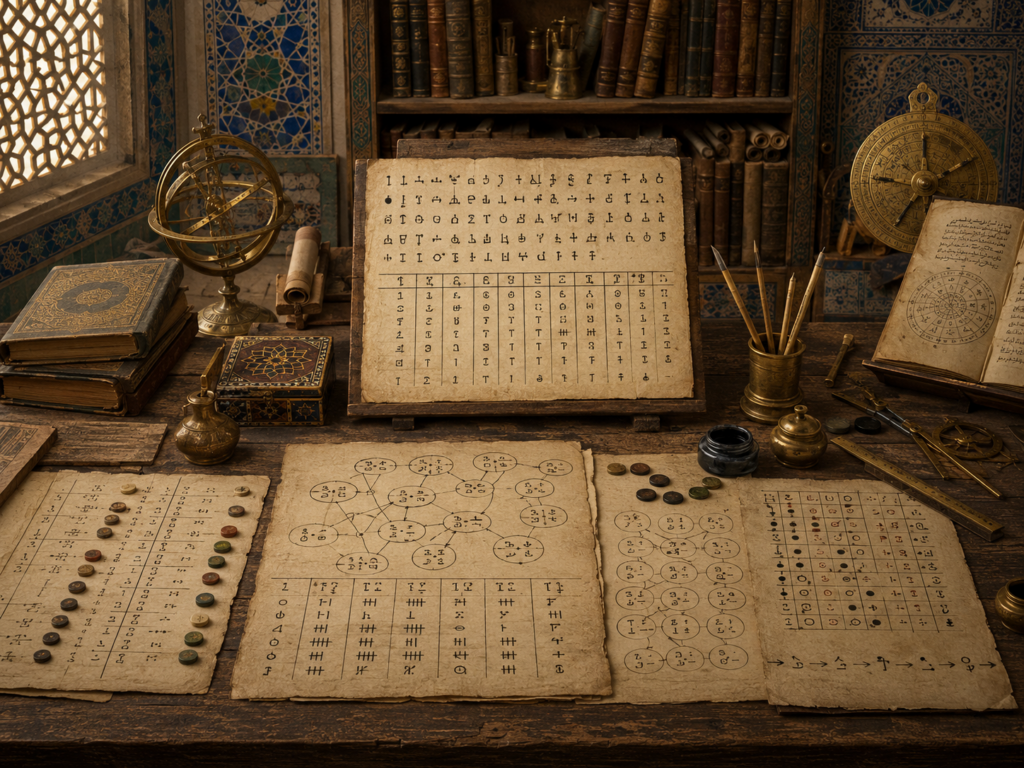
The Unknown, the Variable, and Islamic Mathematical Philosophy: Algebra, Abstraction, and Algorithmic Reasoning
The Unknown, the Variable, and Islamic Mathematical Philosophy examines how algebraic traditions turned missing quantities into disciplined objects of reasoning through names, cases, procedures, demonstrations, translations, and verification. This article introduces the unknown, variable thinking, Islamic mathematical philosophy, Arabic algebra, shayʾ, root, square, number, al-jabr, al-muqābalah, case classification, geometric demonstration, verbal procedure, abstraction, proof, Latin res, Italian cosa, symbolic transition, and the gradual movement toward modern variable notation. It explains why the unknown should not be collapsed into the modern variable or dismissed because early algebra lacked familiar symbols, since verbal and geometric methods could still be rigorous. By connecting the unknown with algorithmic reasoning, the article frames algebra as a method for operating on what is not yet known, transforming uncertainty into structured inference across practical calculation, philosophy, translation, pedagogy, and mathematical imagination within enduring mathematical knowledge traditions.