
Last Updated June 2, 2026
Futures thinking is the disciplined practice of exploring multiple possible futures in order to improve present-day judgment, strategy, and decision-making under conditions of uncertainty. It does not attempt to predict one definitive outcome. Instead, it examines how social, technological, economic, environmental, political, cultural, and institutional forces may interact across time to produce different plausible trajectories. The purpose of futures thinking is not prophecy. It is preparation: helping institutions, communities, researchers, and decision-makers think more clearly about change before change fully arrives.
At its core, futures thinking begins from a simple premise: the future is not singular. It is open, contingent, contested, and shaped by both structural forces and human choices. Because of this, responsible long-range planning cannot rely only on trend extrapolation, short-term forecasting, or managerial confidence. It must also account for discontinuity, surprise, systemic interaction, threshold effects, weak signals, social imagination, and the possibility that current assumptions may break down.
Futures thinking therefore provides a structured way to widen the field of possibility before events narrow it by force. It helps people ask not only what is likely to happen, but what could happen, what should be avoided, what should be made possible, what must be prepared for, and what present-day choices already assume about the future.
Main Library
Publications
Article Map
Futures Thinking
Related Topic
Systems Modeling
Related Topic
Resilience Thinking
Related Topic
Sustainable Development
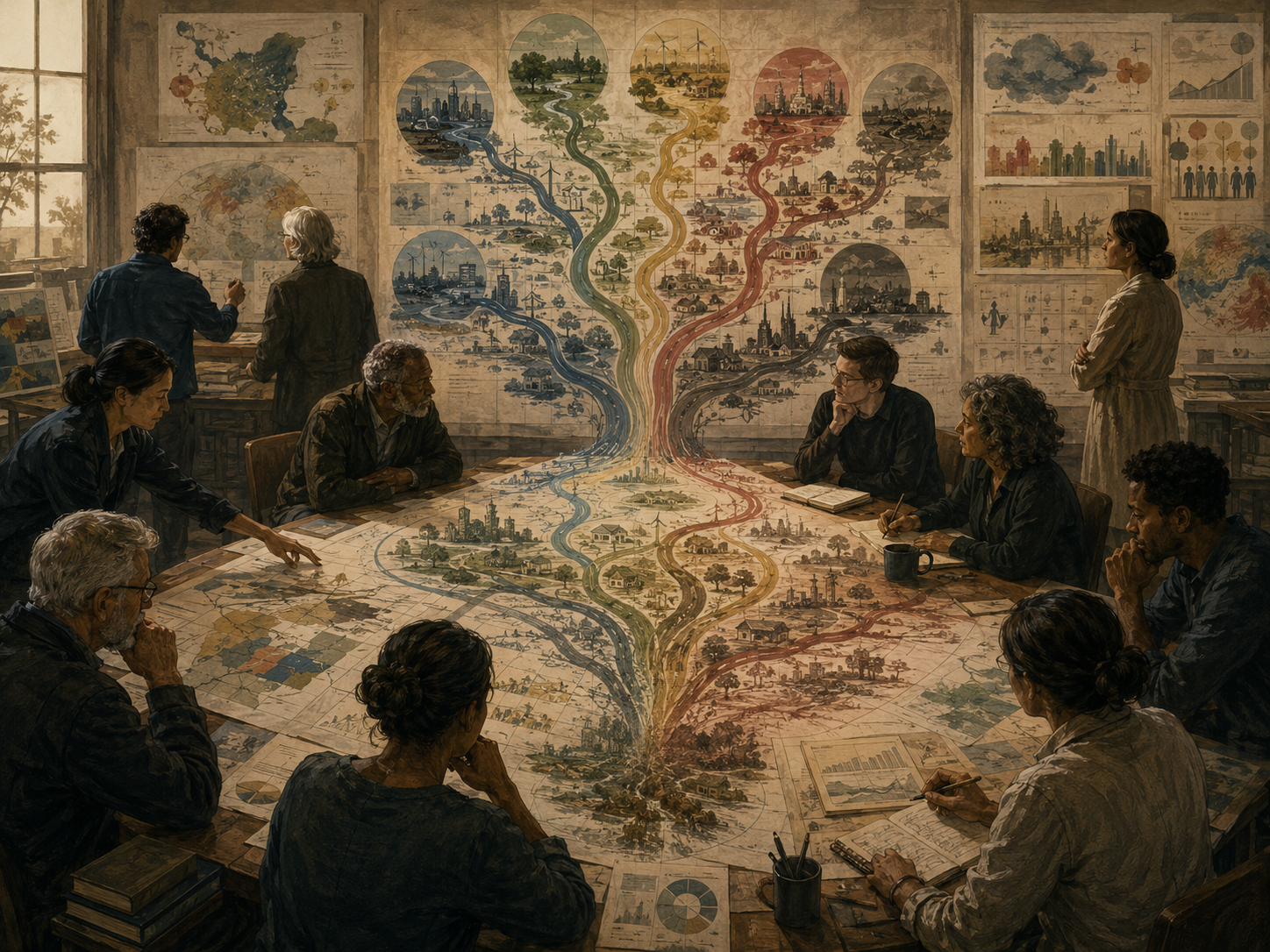
Futures thinking is most useful when the stakes are high, the time horizon is long, the evidence is incomplete, and the system being studied is too complex to reduce to a single projection. Climate change, artificial intelligence, public health, migration, infrastructure, energy transition, governance, education, institutional trust, and technological risk all require more than ordinary forecasting. They require disciplined plural imagination joined to rigorous analysis.
Why Futures Thinking Matters
Futures thinking matters because many of the most consequential decisions made today have effects that unfold over years, decades, or generations. Climate policy, infrastructure design, technological governance, education systems, labor markets, demographic planning, public health capacity, food systems, water security, and institutional reform all involve long-term conditions that cannot be understood through short-term analysis alone. A decision that appears efficient under current assumptions may become fragile under altered technological, ecological, social, or geopolitical conditions.
In this sense, futures thinking is not a luxury for long-range planners. It is a practical response to uncertainty. Institutions constantly make bets about the future, even when they do not call them bets. A transportation agency assumes something about future mobility. A university assumes something about future labor markets and knowledge needs. A hospital system assumes something about future disease burdens. A city assumes something about climate exposure, population growth, and infrastructure capacity. A business assumes something about customers, regulation, supply chains, energy systems, and technological disruption.
The problem is not that institutions make assumptions. They must. The problem is that many assumptions remain invisible until they fail. Futures thinking helps surface those assumptions while there is still time to revise them.
Its practical value lies in widening the field of possibility before events narrow it by force.
For individuals, futures thinking strengthens judgment by making uncertainty less paralyzing. For communities, it supports collective imagination and public preparation. For institutions, it improves strategy by testing present choices against multiple plausible futures rather than one favored projection. For societies, it opens ethical questions about which futures are being built, which futures are being neglected, and whose futures are being sacrificed.
Futures Thinking Is Not Prediction
One of the most important things to understand about futures thinking is that it is not the same as prediction. Prediction assumes that the future can be forecast with enough precision to guide present decisions directly. Futures thinking takes a different view. It recognizes that while some developments can be estimated probabilistically, many of the forces shaping long-term change are nonlinear, politically contested, culturally mediated, technologically unstable, and structurally uncertain.
Forecasting can be useful when the system is relatively stable, the time horizon is short, and past data remain a reasonable guide to near-term change. Futures thinking becomes especially important when those conditions weaken. It is designed for situations in which there is no single reliable trendline, where different forces may interact in surprising ways, and where strategic judgment requires more than estimating the most likely outcome.
For that reason, futures thinking works with categories such as possible futures, plausible futures, probable futures, and preferable futures. These distinctions help clarify that not every imaginable future is equally credible, but neither is the future reducible to one expected path. The value of futures thinking lies in making this wider landscape explicit so that present choices are informed by a broader strategic horizon rather than trapped inside one anticipated continuation.
| Future Type | Core Question | Strategic Use |
|---|---|---|
| Possible futures | What could happen in principle? | Expands imagination and prevents premature closure. |
| Plausible futures | What could happen given known drivers, uncertainties, and constraints? | Supports scenario development and institutional preparedness. |
| Probable futures | What appears most likely under current evidence and assumptions? | Supports forecasting, planning, and near-term resource allocation. |
| Preferable futures | What future should be pursued ethically, socially, or politically? | Supports visioning, backcasting, public deliberation, and transformation. |
| Robust futures | What choices remain useful across several plausible conditions? | Supports resilience, strategic flexibility, and risk-informed decision-making. |
Futures thinking does not replace knowledge with speculation. It replaces false certainty with disciplined plurality.
What Futures Thinking Actually Does
Futures thinking helps decision-makers identify change, question assumptions, imagine alternatives, and prepare for uncertainty. It does this by asking structured questions that would often be ignored in conventional planning:
- What trends are shaping the environment over the long term?
- What uncertainties could significantly alter current trajectories?
- What disruptive events or weak signals might indicate deeper change?
- Which current assumptions about markets, institutions, technologies, ecosystems, or societies may no longer be valid?
- What strategies remain viable across multiple possible futures?
- Which groups are most exposed if a preferred future fails to arrive?
- What future is being implicitly designed by today’s infrastructure, policy, investment, and institutional choices?
- What forms of knowledge are being excluded from official future-making?
These questions move planning beyond static forecasting. They create a more adaptive mode of strategic reasoning, one better suited to complexity, emergence, uncertainty, institutional stress, and structural change. Futures thinking does not remove uncertainty. It makes uncertainty more legible. It does not guarantee correct decisions. It improves the quality of judgment under imperfect knowledge.
In practice, futures thinking does four major kinds of work. First, it scans the environment for change. Second, it interprets signals, drivers, uncertainties, and assumptions. Third, it constructs plausible scenarios or pathways. Fourth, it uses those futures to test present-day strategies, policies, investments, or ethical commitments.
| Function | Purpose | Example Question |
|---|---|---|
| Scanning | Detect early signs of change across systems. | What weak signals suggest that current assumptions may be shifting? |
| Interpretation | Understand drivers, uncertainties, patterns, and tensions. | Which forces are structural, and which remain contingent? |
| Imagination | Develop multiple plausible futures rather than one expected path. | What futures become plausible if key uncertainties unfold differently? |
| Stress testing | Evaluate strategy across alternative conditions. | Which plans remain useful if the world changes faster, slower, or differently than expected? |
| Backcasting | Work backward from a desired future to identify present actions. | What must be true ten years from now, and what must begin today? |
Futures thinking is therefore not passive observation. It is active preparation. Its aim is not to admire uncertainty from a distance, but to help people and institutions act more intelligently within it.
Core Ideas Behind Futures Thinking
Although the field includes many schools, methods, and institutional traditions, several ideas recur throughout serious futures work. These ideas are not slogans. They are working principles that change how strategy, policy, and public imagination are practiced.
1. The Future Is Multiple
The future is not one prewritten outcome waiting to be discovered. It consists of multiple possible trajectories shaped by different interactions among drivers of change, institutional choices, ecological pressures, technological systems, social movements, cultural meanings, and political decisions. Futures thinking begins by refusing to collapse this plurality into a single expected continuation.
2. The Future Shapes the Present
People act not only on present conditions, but on expectations, fears, hopes, models, scenarios, myths, targets, and images of what lies ahead. Financial markets, elections, education systems, climate policy, technology investment, and public trust are all shaped by imagined futures. Futures thinking studies how those anticipatory images guide present behavior.
3. Uncertainty Is Structuring, Not Accidental
Uncertainty is not simply a temporary lack of information. In many complex systems it is an enduring condition produced by interdependence, nonlinear causality, political conflict, institutional opacity, ecological feedback, and technological change. Futures thinking treats uncertainty as a condition to reason with, not merely as a data gap waiting to be filled.
4. Anticipation Can Be Improved
Although the future cannot be known perfectly, anticipatory capacity can be strengthened. Institutions can become better at scanning change, detecting weak signals, exploring scenarios, challenging assumptions, listening to affected communities, and preparing for alternatives. Futures thinking is therefore a discipline of improved anticipation rather than a promise of certainty.
5. Futures Are Contested
Different groups imagine different futures because they occupy different positions within systems of power, risk, privilege, and vulnerability. A future that looks efficient to one institution may look extractive, dangerous, or exclusionary to another community. Futures thinking must therefore ask whose future is being imagined, who benefits, who bears risk, and who has authority to define what counts as desirable.
6. Futures Are Shaped by Both Choice and Structure
Futures thinking avoids two opposite errors: treating the future as fully determined by structural forces, or treating it as infinitely open to willpower. Long-term outcomes are shaped by constraints, path dependence, institutions, material systems, ecological limits, and political choices. Serious futures work examines the relationship between agency and constraint.
| Core Idea | Strategic Implication | Risk If Ignored |
|---|---|---|
| The future is multiple. | Use scenarios, alternatives, and robustness tests. | Planning collapses into one fragile forecast. |
| The future shapes the present. | Study expectations, narratives, and institutional assumptions. | Organizations act on hidden images of the future without recognizing them. |
| Uncertainty is structuring. | Design for adaptation, monitoring, and revision. | Complexity is mistaken for temporary ignorance. |
| Anticipation can be improved. | Build foresight capacity, scanning systems, and learning routines. | Institutions remain reactive until disruption arrives. |
| Futures are contested. | Include public, marginalized, Indigenous, local, and affected-community perspectives. | Foresight becomes elite imagination disguised as neutrality. |
| Choice and structure interact. | Identify both constraints and leverage points. | Planning becomes either fatalistic or naïvely voluntarist. |
These ideas make futures thinking less a prediction exercise than a discipline of anticipatory judgment.
Major Methods Used in Futures Thinking
Futures thinking is not one technique. It is a family of approaches used to explore long-term change. Different methods serve different purposes. Some help detect change early. Some help structure uncertainty. Some help explore possible futures. Some help identify pathways toward desirable outcomes. Some help evaluate whether a strategy is robust across several plausible conditions.
Scenario Planning
Scenario planning constructs alternative future narratives to test strategy under uncertainty. Instead of assuming one expected path, it asks how different combinations of social, technological, economic, environmental, political, and institutional forces could produce distinct future contexts. Scenarios are useful because they make assumptions visible, expose strategic fragility, and help institutions prepare for conditions that may differ sharply from the present.
Trend Analysis
Trend analysis examines long-term patterns across social, economic, political, technological, cultural, and environmental systems. It helps distinguish directional change from short-term noise. In futures thinking, trend analysis is not used simply to project the present forward. It is used to understand momentum, structural pressure, and the conditions under which existing trends may accelerate, slow, reverse, or interact with other forces.
Horizon Scanning
Horizon scanning identifies emerging issues, developments, disruptions, and early indicators of possible change. It looks beyond dominant headlines and established datasets to detect shifts that may not yet be widely recognized. Strong horizon scanning is systematic, cross-domain, and revisited over time. It helps institutions avoid being surprised by developments that were visible at the margins before they became central.
Weak Signals Analysis
Weak signals analysis detects small, marginal, ambiguous, or early developments that may later become significant drivers of change. A weak signal is not proof of a future trend. It is a clue that something may be changing beneath the surface. Futures thinking uses weak signals to challenge settled assumptions, expand strategic imagination, and identify developments that conventional planning may overlook.
Backcasting
Backcasting starts with a desired future outcome and works backward to identify the actions, milestones, capacities, and institutional changes needed to achieve it. It is especially useful for sustainability, climate transition, public health, infrastructure, and long-term policy goals. Rather than asking what is likely if current trends continue, backcasting asks what must happen if a preferred future is to become possible.
Delphi Methods
Delphi methods use structured expert consultation to explore possible long-range developments, areas of agreement, and areas of uncertainty. Experts respond across multiple rounds, often with anonymized feedback between rounds, allowing judgments to be refined without ordinary group-pressure dynamics. In futures thinking, Delphi methods are useful when evidence is incomplete but informed judgment is still necessary.
Cross-Impact Analysis
Cross-impact analysis examines how drivers and uncertainties may interact rather than treating them independently. This matters because futures rarely emerge from isolated variables. Climate risk, technological change, migration, public trust, supply chains, and governance capacity may reinforce or constrain one another. Cross-impact analysis helps reveal cascading effects, hidden dependencies, and combinations of change that may alter strategic conditions.
Causal Layered Analysis
Causal layered analysis examines futures at several levels, including visible events, systemic causes, worldviews, and underlying myths or metaphors. It is useful because many futures debates remain trapped at the surface level of trends and headlines. By moving through deeper layers of meaning and structure, causal layered analysis helps reveal how assumptions, narratives, values, and cultural frames shape what futures appear plausible or desirable.
Three Horizons Thinking
Three horizons thinking distinguishes between dominant current systems, transitional innovations, and longer-term transformative possibilities. The first horizon represents the existing system and its declining fitness under changing conditions. The second horizon contains experiments, conflicts, and bridge practices. The third horizon represents emerging patterns that may define a different future. This method is especially useful for understanding transition, transformation, and institutional change.
Wind-Tunneling
Wind-tunneling tests policies, strategies, plans, or investments against multiple scenarios to identify vulnerabilities and robust options. A strategy that works only in one favorable future may be brittle. A strategy that performs acceptably across several plausible futures may be more resilient. Wind-tunneling helps decision-makers move from scenario imagination to practical strategic evaluation.
| Method | Best Used For | Typical Output |
|---|---|---|
| Scenario planning | Exploring plausible future contexts | Scenario set, narratives, implications matrix |
| Trend analysis | Understanding directional patterns | Trend report, driver analysis, evidence summary |
| Horizon scanning | Detecting early signs of change | Signal inventory, emerging-issue map, scanning brief |
| Weak signals analysis | Identifying marginal or early indicators of possible change | Weak-signal register, interpretation notes, monitoring prompts |
| Backcasting | Planning from a desired future | Pathway map, milestones, intervention sequence |
| Delphi methods | Structuring expert judgment | Consensus ranges, uncertainty map, expert interpretation |
| Cross-impact analysis | Examining interactions among drivers and uncertainties | Cross-impact matrix, dependency map, cascade-risk notes |
| Causal layered analysis | Examining events, systems, worldviews, and underlying narratives | Layered diagnosis, worldview map, reframing prompts |
| Three horizons thinking | Understanding transition from current systems to future possibilities | Horizon map, transition analysis, innovation pathways |
| Wind-tunneling | Testing strategy under alternative futures | Robustness score, vulnerability matrix, adaptive option set |
The key point is that futures thinking is not brainstorming without discipline. It is structured imagination supported by evidence, methods, comparison, uncertainty analysis, and public reasoning.
Futures Thinking vs Foresight vs Forecasting
Futures thinking, foresight, and forecasting are related, but they are not identical. Confusing them can weaken strategy.
Forecasting usually refers to projecting likely developments based on existing data and patterns. It is often quantitative and works best when systems are relatively stable, historical data remain relevant, and the time horizon is limited. Forecasting asks, “What is most likely to happen?”
Foresight generally refers to the structured use of futures methods to support present decisions. Strategic foresight is especially associated with governments, public institutions, international organizations, universities, and businesses seeking to improve long-term planning, preparedness, and resilience. Foresight asks, “How should we prepare for plausible change?”
Futures thinking is the broadest of the three. It includes the wider mindset as well as the practical methods used to explore alternative futures, challenge assumptions, detect emerging change, and build anticipatory capacity. Futures thinking asks, “How do our images, assumptions, systems, and choices shape what becomes possible?”
| Practice | Primary Question | Strength | Limitation |
|---|---|---|---|
| Forecasting | What is likely to happen? | Useful for near-term projections and measurable trends. | Can become fragile when systems shift or assumptions break. |
| Foresight | What should we prepare for? | Supports institutional strategy, planning, and preparedness. | Can become procedural if detached from power, ethics, and lived experience. |
| Futures thinking | How do multiple futures reshape present judgment? | Broadens imagination, strategy, assumptions, and anticipatory capacity. | Requires discipline to avoid vague speculation or aesthetic futurism. |
Put simply: forecasting projects likely outcomes, foresight organizes structured anticipatory practice, and futures thinking names the wider field and orientation that make both possible.
Futures Thinking and Complex Systems
Futures thinking is especially important in complex systems because complex systems rarely change in linear or isolated ways. Economic change is shaped by technological innovation, policy, culture, labor markets, finance, and geopolitics. Environmental change is shaped by climate dynamics, institutional response, markets, land use, infrastructure, and ecological feedback. Political change is shaped by demography, legitimacy, communication systems, inequality, crisis events, and institutional memory.
In such settings, long-term outcomes emerge from interaction rather than from one dominant variable. A drought is not only a weather event. It can become a food-price shock, a migration pressure, a public-health stressor, a governance crisis, an infrastructure test, and a geopolitical risk. A technology is not only a tool. It can alter labor, surveillance, knowledge production, institutional trust, educational systems, and social imagination. A housing shortage is not only a market imbalance. It can affect public health, family formation, climate exposure, transportation, labor mobility, and political legitimacy.
This is why futures thinking belongs naturally alongside Systems Modeling and Resilience Thinking. All three reject simplistic equilibrium assumptions and focus instead on interdependence, feedback loops, uncertainty, adaptation, and structural change over time. Futures thinking extends that analysis by asking how such systems may evolve across multiple possible pathways.
Where complexity limits prediction, futures thinking expands interpretive readiness.
| Complex System Feature | Why It Matters for Futures Thinking | Foresight Response |
|---|---|---|
| Feedback loops | Small changes can reinforce or dampen future dynamics. | Map reinforcing and balancing feedback relationships. |
| Thresholds | Systems may shift abruptly after slow accumulated stress. | Monitor early warning signals and slow variables. |
| Path dependence | Past choices shape future options and constraints. | Identify lock-in, sunk costs, and institutional inertia. |
| Emergence | System behavior may not be predictable from individual parts. | Use scenarios, simulation, and adaptive monitoring. |
| Interdependence | Change in one domain can cascade into others. | Use cross-impact analysis and systems mapping. |
| Contestation | Different actors define desirable futures differently. | Use participatory foresight and ethical deliberation. |
Assumptions and Mental Models
One of the deepest contributions of futures thinking is that it helps make assumptions visible. Every institution carries implicit beliefs about how the future will unfold: that growth will continue, that governance systems will remain stable, that technologies will diffuse in familiar ways, that populations will behave predictably, that infrastructure will remain adequate, that markets will remain functional, that public trust will recover, or that current constraints will persist.
Many of these assumptions are never fully articulated until disruption reveals them. Futures thinking surfaces those assumptions before failure occurs. It asks not only what might happen, but what present-day beliefs are already shaping decisions.
Assumption work is especially important because institutions often confuse inherited expectations with objective analysis. A school district may assume that digital learning will expand in one direction. A city may assume that commuting patterns will normalize. A hospital may assume that staffing shortages are temporary. A public agency may assume that climate extremes will remain within historical ranges. A company may assume that its supply chain risk is manageable because past disruptions were survivable.
Futures thinking does not automatically prove those assumptions wrong. Instead, it asks whether they have been tested against alternative futures.
| Assumption Type | Example | Futures Thinking Question |
|---|---|---|
| Continuity assumption | Current trends will continue. | What breaks if the trend accelerates, reverses, or becomes unstable? |
| Institutional assumption | Existing rules and agencies will remain legitimate. | What if trust, capacity, or compliance erodes? |
| Technological assumption | Technology will diffuse predictably and beneficially. | Who controls deployment, who benefits, and what harms may scale? |
| Ecological assumption | Environmental conditions will remain within historical ranges. | What if climate, water, biodiversity, or land systems cross thresholds? |
| Social assumption | People will respond rationally to incentives or information. | How might fear, identity, inequality, trauma, or distrust alter behavior? |
| Ethical assumption | The preferred future is broadly shared. | Whose preferences are treated as universal, and whose futures are excluded? |
In that sense, futures thinking is as much about epistemic discipline as it is about long-range imagination.
Strategic Foresight in Institutions
Governments use futures thinking to examine long-term risks, emerging technologies, demographic shifts, environmental pressures, and strategic uncertainty. Businesses use it to test strategy against market disruption, regulatory change, technological transformation, supply chain instability, and changing social expectations. Universities, multilateral institutions, civil society organizations, and research centers use futures thinking to explore the long-range implications of structural change across society.
The practical value lies in helping organizations prepare for multiple possible futures rather than overcommitting to one expected scenario. This does not guarantee correctness. It improves readiness, flexibility, and judgment.
In institutional settings, futures thinking can serve several roles:
- Strategic readiness: preparing institutions to operate under several plausible future conditions.
- Policy design: testing whether policies remain useful under changing social, ecological, technological, or economic conditions.
- Risk governance: identifying low-probability but high-impact disruptions before they become acute crises.
- Innovation governance: exploring how emerging technologies may reshape labor, rights, markets, public services, or social trust.
- Public deliberation: helping communities imagine and debate alternative futures rather than inherit decisions made elsewhere.
- Institutional learning: creating routines for monitoring signals, revising assumptions, and updating strategy.
Futures thinking is strongest when it becomes part of institutional learning rather than a one-time workshop. A scenario exercise may produce useful insights, but long-term readiness depends on whether those insights change decision routines, budgeting, monitoring, governance, and public accountability.
Futures Thinking and Sustainability
Futures thinking is especially important in sustainability because sustainability challenges are inherently long-term and uncertainty-rich. Climate change, biodiversity loss, resource constraints, urban growth, food systems, energy transitions, public health, migration, and institutional adaptation all require thinking across decades rather than quarters. They also involve ethical questions about what kinds of futures are desirable, just, and viable.
This makes futures thinking closely related to Sustainable Development. Sustainability asks what should be sustained, for whom, under what conditions, and across what time horizon. Futures thinking helps explore the pathways through which those conditions may emerge, degrade, or be transformed.
It also prevents sustainability from becoming a narrow technical exercise. A carbon model, infrastructure plan, or climate adaptation strategy is not only about efficiency. It is also about whose lives are protected, whose neighborhoods are exposed, whose knowledge counts, whose risks are discounted, and which future generations inherit the consequences of present decisions.
Futures thinking gives long-horizon problems a structured language of anticipation rather than leaving them trapped inside short-term decision cycles.
| Sustainability Challenge | Futures Thinking Contribution | Strategic Question |
|---|---|---|
| Climate adaptation | Explores multiple exposure, vulnerability, and response pathways. | What strategies remain viable under several warming and governance futures? |
| Energy transition | Tests infrastructure, demand, equity, and technology assumptions. | What pathways reduce emissions without producing new forms of exclusion? |
| Food and water systems | Maps cascading risks across climate, land, labor, markets, and governance. | Where are the hidden dependencies that could fail under stress? |
| Urban resilience | Connects housing, transportation, heat, inequality, and public services. | Which neighborhoods are being designed into future vulnerability? |
| Biodiversity | Examines ecological thresholds, restoration futures, and land-use conflict. | What futures become impossible if ecological loss continues? |
| Intergenerational justice | Links present choices to long-term moral responsibility. | What obligations do present institutions owe to people not yet born? |
Anticipatory Governance and Public Responsibility
Futures thinking becomes especially important when it is connected to governance. Anticipatory governance refers to the capacity of institutions to detect emerging change, deliberate about possible consequences, involve affected publics, revise assumptions, and adapt decisions before harms become irreversible. It is not merely about being innovative. It is about governing responsibly under uncertainty.
This matters because many modern risks are difficult to address after the fact. Climate thresholds, infrastructure lock-in, technological surveillance, democratic erosion, biodiversity loss, public-health fragility, and financial instability can all accumulate gradually before producing visible crisis. By the time the harm becomes obvious, options may be narrower, costs may be higher, and vulnerable communities may already have absorbed disproportionate damage.
Anticipatory governance therefore asks institutions to take weak signals seriously without treating every possibility as equally likely. It requires judgment, humility, evidence, participation, and revision. It also requires a willingness to examine power. Futures are not only discovered; they are governed, funded, designed, narrated, regulated, resisted, and contested.
Responsible futures thinking should therefore include more than expert scenario workshops. It should include public participation, local knowledge, Indigenous knowledge where relevant and respectfully engaged, youth perspectives, marginalized communities, frontline workers, domain experts, systems modelers, historians, ethicists, and those most likely to bear the consequences of institutional failure.
The democratic question is not only “What future is coming?” It is also “Who gets to imagine, shape, and prepare for the future?”
Common Misunderstandings About Futures Thinking
Several misunderstandings often weaken the field in practice.
- It is not prediction dressed up with new language. Futures thinking is not about naming the one future that will happen. It is about improving judgment across plausible alternatives.
- It is not science fiction. Creative imagination may help widen possibilities, but futures thinking remains a structured analytical practice.
- It is not only for governments or large organizations. Communities, educators, researchers, entrepreneurs, public agencies, civil society groups, and institutions of many kinds can use futures methods.
- It is not about being right about the future. It is about making better decisions in the present.
- It is not neutral imagination. Futures work always involves values, assumptions, beneficiaries, risks, and exclusions.
- It is not a substitute for evidence. Good futures thinking uses evidence, models, trends, history, domain expertise, and participatory knowledge. It does not replace analysis with speculation.
A particularly dangerous misunderstanding is the belief that futures thinking is valuable only when a scenario “comes true.” That is not the right standard. A scenario may be valuable because it reveals hidden assumptions, identifies brittle strategies, exposes ethical blind spots, or strengthens preparedness for conditions that never fully arrive. Futures thinking often succeeds not by predicting disruption, but by making institutions less brittle when disruption occurs.
Limits and Misuse of Futures Thinking
Futures thinking is powerful, but it can be misused. Poor futures work may become vague speculation, elite storytelling, corporate theater, technological hype, or a polished exercise that changes no decisions. It may overemphasize novelty while ignoring historical continuity. It may treat marginalized communities as “stakeholders” without giving them real authority. It may use scenarios to legitimize decisions already made. It may confuse imagination with strategy.
There are several common failure modes:
- Scenario theater: producing impressive future narratives that do not alter strategy, budgets, governance, or accountability.
- Techno-futurist bias: treating technological change as the dominant driver while neglecting social, ecological, legal, cultural, and political dynamics.
- Elite capture: allowing powerful institutions to define desirable futures while affected communities remain peripheral.
- Presentism: projecting current values, institutions, and assumptions into the future without critical examination.
- False balance: treating all imagined futures as equally plausible regardless of evidence.
- Paralysis by possibility: generating too many futures without translating insight into action.
- Overconfidence: turning scenario outputs into a new form of certainty.
Good futures thinking requires discipline against these failures. It should be evidence-informed, transparent about assumptions, serious about uncertainty, open to revision, ethically grounded, and connected to real decision points.
The purpose is not to make the future feel imaginative. The purpose is to make present decisions more responsible.
A Practical Futures Thinking Workflow
Futures thinking can be practiced in many ways, but a useful workflow usually moves from framing to scanning, interpretation, scenario development, strategy testing, and learning. The workflow below is deliberately general enough to apply across policy, sustainability, education, business, public health, infrastructure, technology governance, and community planning.
| Stage | Purpose | Key Questions | Outputs |
|---|---|---|---|
| 1. Frame the focal issue | Define the decision, system, time horizon, and stakeholders. | What decision or system is being explored? Who is affected? | Focal question, scope, time horizon, stakeholder map |
| 2. Scan for change | Identify signals, trends, drivers, disruptions, and emerging issues. | What is changing, where, and why might it matter? | Signal inventory, trend map, evidence brief |
| 3. Identify critical uncertainties | Distinguish known trends from uncertain but high-impact variables. | Which uncertainties could most alter the future context? | Uncertainty matrix, driver map |
| 4. Build scenarios | Combine drivers and uncertainties into plausible future contexts. | What distinct futures could plausibly emerge? | Scenario narratives, scenario matrix, implications summary |
| 5. Stress-test strategy | Evaluate plans, policies, investments, or assumptions across scenarios. | What works across futures? What fails? What is fragile? | Robustness assessment, risk matrix, adaptation options |
| 6. Backcast from preferred futures | Identify steps needed to move toward desirable outcomes. | What must happen now to make a preferred future possible? | Milestones, pathway map, near-term actions |
| 7. Monitor and revise | Create learning routines as new signals appear. | What indicators show which future conditions may be emerging? | Monitoring dashboard, signal review, assumption updates |
This workflow is not a rigid formula. It is a disciplined cycle. Futures thinking should return repeatedly to assumptions, evidence, signals, and strategic choices as conditions change.
Mathematical Lens: Plural Futures, Uncertainty, and Strategic Readiness
A simple way to represent forecasting logic is as a projected continuation of present conditions:
X_{t+1} = X_t + \Delta_t
\]
Interpretation: \(X_t\) is the current state and \(\Delta_t\) is expected change under assumed continuity. This is useful when the system is stable enough for near-term projection, but it can become fragile when future conditions depart from historical patterns.
Futures thinking expands beyond this by treating the future as a set of alternative pathways:
\Pi = \{F_1, F_2, \dots, F_n\}
\]
Interpretation: \(\Pi\) is the set of plausible futures and each \(F_i\) reflects a different interaction of drivers, uncertainties, assumptions, constraints, and strategic conditions.
Strategic readiness can then be represented conceptually as a robustness problem:
R_k = \min_{i \in \Pi} V_{ki}
\]
Interpretation: \(R_k\) is the robustness of strategy \(k\) across the futures set, and \(V_{ki}\) is the value or performance of strategy \(k\) in future \(F_i\). This captures one of the deepest insights of futures thinking: the aim is often not optimization for one assumed future, but usefulness across several plausible conditions.
A more complete framework can include probability, uncertainty, ethical value, and regret. For example, if each future \(F_i\) is assigned a subjective probability \(p_i\), expected value can be written as:
E[V_k] = \sum_{i=1}^{n} p_i V_{ki}
\]
Interpretation: Expected value is useful when probabilities are meaningful, but futures thinking is often used precisely when probabilities are uncertain, contested, or unstable.
Under deep uncertainty, a regret-based framing may be more useful:
G_{ki} = \max_{j}(V_{ji}) – V_{ki}
\]
Interpretation: \(G_{ki}\) is the regret of choosing strategy \(k\) in future \(F_i\), compared with the best-performing strategy in that same future. Robust strategies often aim to reduce severe regret across plausible futures rather than maximize performance in only one.
These equations are not meant to turn futures thinking into a purely quantitative field. They clarify the logic of plural futures: strategy should be evaluated not only by how well it performs under an expected future, but by how it behaves under uncertainty, stress, surprise, and changing assumptions.
Computational Modeling for Futures Thinking
Computational modeling can support futures thinking when it is used carefully. Models can simulate strategic readiness, scenario robustness, signal detection, assumption sensitivity, and uncertainty conditions. They can help decision-makers compare strategies, test vulnerabilities, and identify which assumptions matter most.
However, computational models should not be mistaken for the future itself. A model is a structured argument. It contains assumptions, boundaries, variables, weights, exclusions, and simplifications. Futures thinking benefits from computational tools when those tools make assumptions explicit, support comparison, and encourage revision. It is weakened when models conceal uncertainty behind polished outputs.
Useful computational futures workflows often include:
- Scenario matrices: organizing plausible futures across drivers and uncertainties.
- Robustness scoring: evaluating how strategies perform across multiple conditions.
- Signal tracking: monitoring weak signals and emerging indicators over time.
- Assumption registers: documenting the beliefs that support current strategy.
- Sensitivity analysis: testing which variables most influence outcomes.
- Readiness dashboards: summarizing institutional preparedness across scenarios.
- Regret analysis: comparing the consequences of strategic choices under different futures.
The companion repository for this article is designed around those ideas. It includes Python, R, Julia, SQL, Rust, Go, C++, Fortran, and C examples for strategic readiness, scenario robustness, signal tracking, uncertainty modeling, and futures diagnostics.
Advanced R Workflow: Comparing Futures Thinking Profiles Across Strategic Orientations
The R workflow below compares stylized strategic orientations across uncertainty tolerance, assumption visibility, flexibility, scenario breadth, signal awareness, and long-horizon readiness. It is designed as an evergreen illustration of how futures thinking differs from narrower planning styles.
# ------------------------------------------------------------
# R Workflow: Comparing Futures Thinking Profiles
# Article: Futures Thinking, Strategic Foresight, and Uncertainty
#
# Purpose:
#   Build stylized profiles across strategic orientations using
#   uncertainty tolerance, assumption visibility, flexibility,
#   scenario breadth, signal awareness, and long-horizon readiness.
#
# Optional dependency:
#   install.packages(c("tidyverse"))
# ------------------------------------------------------------

library(tidyverse)

orientations <- tibble(
  orientation = c(
    "Short-Term Forecast Orientation",
    "Mixed Planning Orientation",
    "Futures Thinking Orientation"
  ),
  uncertainty_tolerance = c(0.28, 0.58, 0.86),
  assumption_visibility = c(0.22, 0.54, 0.82),
  flexibility = c(0.31, 0.66, 0.84),
  scenario_breadth = c(0.18, 0.57, 0.88),
  signal_awareness = c(0.24, 0.61, 0.85),
  long_horizon_readiness = c(0.26, 0.63, 0.87)
)

weights <- tibble(
  dimension = c(
    "uncertainty_tolerance",
    "assumption_visibility",
    "flexibility",
    "scenario_breadth",
    "signal_awareness",
    "long_horizon_readiness"
  ),
  weight = c(0.18, 0.16, 0.18, 0.18, 0.14, 0.16)
)

orientations_long <- orientations %>%
  pivot_longer(
    cols = -orientation,
    names_to = "dimension",
    values_to = "value"
  ) %>%
  left_join(weights, by = "dimension") %>%
  mutate(weighted_value = value * weight)

profile_scores <- orientations_long %>%
  group_by(orientation) %>%
  summarise(
    futures_profile_score = sum(weighted_value),
    lowest_dimension = min(value),
    highest_dimension = max(value),
    .groups = "drop"
  ) %>%
  arrange(desc(futures_profile_score))

print(profile_scores)

dimension_summary <- orientations_long %>%
  group_by(orientation, dimension) %>%
  summarise(value = mean(value), .groups = "drop")

ggplot(dimension_summary, aes(x = dimension, y = value, fill = orientation)) +
  geom_col(position = "dodge") +
  labs(
    title = "Stylized Futures Thinking Dimensions",
    subtitle = "Comparison of strategic orientations across anticipatory capacities",
    x = "Dimension",
    y = "Value",
    fill = "Orientation"
  ) +
  theme_minimal(base_size = 12) +
  coord_flip()

ggplot(profile_scores, aes(x = reorder(orientation, futures_profile_score), y = futures_profile_score)) +
  geom_col() +
  coord_flip() +
  labs(
    title = "Stylized Futures Thinking Profile Score",
    subtitle = "Weighted profile across uncertainty, assumptions, flexibility, scenarios, signals, and readiness",
    x = "Strategic orientation",
    y = "Profile score"
  ) +
  theme_minimal(base_size = 12)

write_csv(profile_scores, "outputs/futures_thinking_profile_scores.csv")
write_csv(orientations_long, "outputs/futures_thinking_dimensions_long.csv")
This workflow is not intended to measure an actual organization without further data. Its purpose is conceptual: it shows how futures thinking can be translated into dimensions that support comparison, reflection, and institutional self-assessment.
Advanced Python Workflow: Simulating Strategic Readiness Across Multiple Future Conditions
The Python workflow below simulates stylized strategic performance under several future conditions to illustrate why futures-oriented planning often sacrifices some short-term precision in exchange for wider resilience.
# ------------------------------------------------------------
# Python Workflow: Simulating Strategic Readiness Across Futures
# Article: Futures Thinking, Strategic Foresight, and Uncertainty
#
# Purpose:
#   Compare stylized planning orientations across multiple
#   future environments under uncertainty.
#
# Optional dependencies:
#   pip install pandas numpy matplotlib
# ------------------------------------------------------------

from pathlib import Path

import numpy as np
import pandas as pd
import matplotlib.pyplot as plt

OUTPUT_DIR = Path("outputs")
OUTPUT_DIR.mkdir(exist_ok=True)

futures = [
    "Stable Continuity",
    "Technology Disruption",
    "Climate Stress",
    "Institutional Fragmentation",
    "Resource Constraint",
    "Public Trust Crisis"
]

orientations = {
    "Short-Term Forecast Orientation": [0.84, 0.39, 0.34, 0.36, 0.41, 0.33],
    "Mixed Planning Orientation": [0.76, 0.63, 0.59, 0.57, 0.61, 0.55],
    "Futures Thinking Orientation": [0.72, 0.78, 0.74, 0.73, 0.76, 0.71]
}

rows = []

for orientation, values in orientations.items():
    for future, value in zip(futures, values):
        rows.append({
            "orientation": orientation,
            "future": future,
            "performance": value
        })

df = pd.DataFrame(rows)

summary = (
    df.groupby("orientation")["performance"]
    .agg(
        mean_performance="mean",
        worst_case="min",
        best_case="max",
        volatility="std"
    )
    .reset_index()
)

summary["robustness_score"] = (
    0.50 * summary["worst_case"] +
    0.35 * summary["mean_performance"] -
    0.15 * summary["volatility"].fillna(0)
)

summary = summary.sort_values("robustness_score", ascending=False)

print("\nScenario performance:")
print(df)

print("\nStrategic readiness summary:")
print(summary)

plt.figure(figsize=(11, 6))
for orientation in df["orientation"].unique():
    subset = df[df["orientation"] == orientation]
    plt.plot(
        subset["future"],
        subset["performance"],
        marker="o",
        label=orientation
    )

plt.xticks(rotation=25, ha="right")
plt.ylabel("Performance")
plt.title("Strategic Readiness Across Multiple Futures")
plt.legend()
plt.tight_layout()
plt.savefig(OUTPUT_DIR / "strategic_readiness_across_futures.png", dpi=150)
plt.close()

plt.figure(figsize=(9, 5))
plt.barh(summary["orientation"], summary["robustness_score"])
plt.xlabel("Robustness score")
plt.title("Robustness-Oriented Strategy Comparison")
plt.tight_layout()
plt.savefig(OUTPUT_DIR / "robustness_strategy_comparison.png", dpi=150)
plt.close()

summary.to_csv(OUTPUT_DIR / "futures_thinking_summary.csv", index=False)
df.to_csv(OUTPUT_DIR / "futures_thinking_performance.csv", index=False)
This model illustrates a central foresight insight: a strategy may perform very well under stable continuity while failing under disruption. A futures thinking orientation may not always maximize performance in the easiest future, but it can improve robustness across a wider futures set.
GitHub Repository
The companion repository for this article contains computational examples for strategic readiness, scenario robustness, signal tracking, uncertainty modeling, and futures diagnostics. It is organized as a reusable article-specific directory within the broader Futures Thinking code repository.
Complete Code Repository
The companion code for this article is located in articles/futures-thinking-strategic-foresight-uncertainty/ and includes Python, R, Julia, SQL, Rust, Go, C++, Fortran, C, documentation, synthetic datasets, outputs, and notebook placeholders for applied futures thinking workflows.
| Directory | Purpose |
|---|---|
python/ |
Strategic readiness, scenario robustness, signal tracking, and uncertainty examples. |
r/ |
Foresight profiles, orientation comparison, scenario matrices, and readiness summaries. |
julia/ |
Dynamic scenario and uncertainty examples. |
sql/ |
Drivers, signals, uncertainties, scenarios, assumptions, and strategy-evaluation schemas. |
rust/ |
Command-line futures diagnostics scaffold. |
go/ |
Signal and scenario utility scaffold. |
cpp/ |
Efficient scenario-performance examples. |
fortran/ |
Dynamic readiness examples. |
c/ |
Low-level scenario scoring utilities. |
docs/ |
Article notes, modeling principles, assumptions, and reproducibility guidance. |
data/ |
Synthetic datasets for futures thinking examples. |
outputs/ |
Generated tables, summaries, diagnostics, and figures. |
notebooks/ |
Notebook placeholders for exploratory workflows. |
Why This Matters
Futures thinking provides a disciplined way to engage uncertainty without collapsing it into one forecast or one preferred story. It helps institutions broaden their strategic horizon, recognize assumptions sooner, and design choices that remain useful across multiple possible futures.
For strategy, futures thinking matters because it changes the question from “What do we think will happen?” to “What must we be ready for?” That shift is profound. It moves strategy away from dependence on one forecast and toward robustness across multiple possibilities. It encourages institutions to widen their planning horizon, detect change earlier, and design responses that remain useful when the world departs from expectation.
For public life, futures thinking matters because the future is not distributed equally. Some communities are protected from risk while others are treated as sacrifice zones. Some institutions have the power to define official futures while others are forced to adapt to choices made without them. Responsible futures thinking must therefore be analytical and ethical at the same time. It must examine uncertainty, but also power, responsibility, exclusion, and justice.
In a world shaped by technological acceleration, ecological instability, institutional strain, inequality, demographic change, and geopolitical volatility, anticipatory capacity is no longer optional. Futures thinking is becoming a basic requirement for serious long-range judgment.
Futures thinking is not about seeing the future clearly enough to predict it. It is about seeing uncertainty clearly enough to act more intelligently in the present.
Related Articles
- Futures Thinking
- Foresight vs Forecasting
- Scenario Planning
- Strategic Foresight Methods
- Systems Modeling
- Resilience Thinking
- Sustainable Development
Further Reading
- Bell, W. (1997) Foundations of Futures Studies: Human Science for a New Era. Volume 1: History, Purposes, and Knowledge. New Brunswick, NJ: Transaction Publishers.
- Inayatullah, S. (2008) ‘Six pillars: futures thinking for transforming’, Foresight, 10(1), pp. 4–21. Available at: Emerald.
- Miller, R. (2018) Transforming the Future: Anticipation in the 21st Century. Paris: UNESCO Publishing. Available at: UNESCO.
- Schwartz, P. (1991) The Art of the Long View. New York: Currency Doubleday.
- Slaughter, R.A. (2004) Futures Beyond Dystopia: Creating Social Foresight. London: Routledge.
- Voros, J. (2003) ‘A generic foresight process framework’, Foresight, 5(3), pp. 10–21. Available at: Emerald.
References
- Bell, W. (1997) Foundations of Futures Studies: Human Science for a New Era. Volume 1: History, Purposes, and Knowledge. New Brunswick, NJ: Transaction Publishers.
- Inayatullah, S. (2008) ‘Six pillars: futures thinking for transforming’, Foresight, 10(1), pp. 4–21. Available at: Emerald.
- Miller, R. (2018) Transforming the Future: Anticipation in the 21st Century. Paris: UNESCO Publishing. Available at: UNESCO.
- Organisation for Economic Co-operation and Development (OECD) (no date) Strategic Foresight. Available at: OECD.
- Organisation for Economic Co-operation and Development Observatory of Public Sector Innovation (OECD OPSI) (no date) Futures & Foresight. Available at: OECD OPSI.
- Schwartz, P. (1991) The Art of the Long View. New York: Currency Doubleday.
- Slaughter, R.A. (2004) Futures Beyond Dystopia: Creating Social Foresight. London: Routledge.
- United Nations Educational, Scientific and Cultural Organization (UNESCO) (no date) Futures Literacy & Foresight. Available at: UNESCO.
- UK Government Office for Science (2025) A Brief Guide to Futures Thinking and Foresight. London: Government Office for Science. Available at: UK Government.
- UK Government Office for Science (no date) Futures, Foresight and Emerging Technologies. Available at: UK Government.
- Voros, J. (2003) ‘A generic foresight process framework’, Foresight, 5(3), pp. 10–21. Available at: Emerald.