Warren McCulloch, Walter Pitts, and Neural Logic: Threshold Neurons, Cybernetics, and AI History
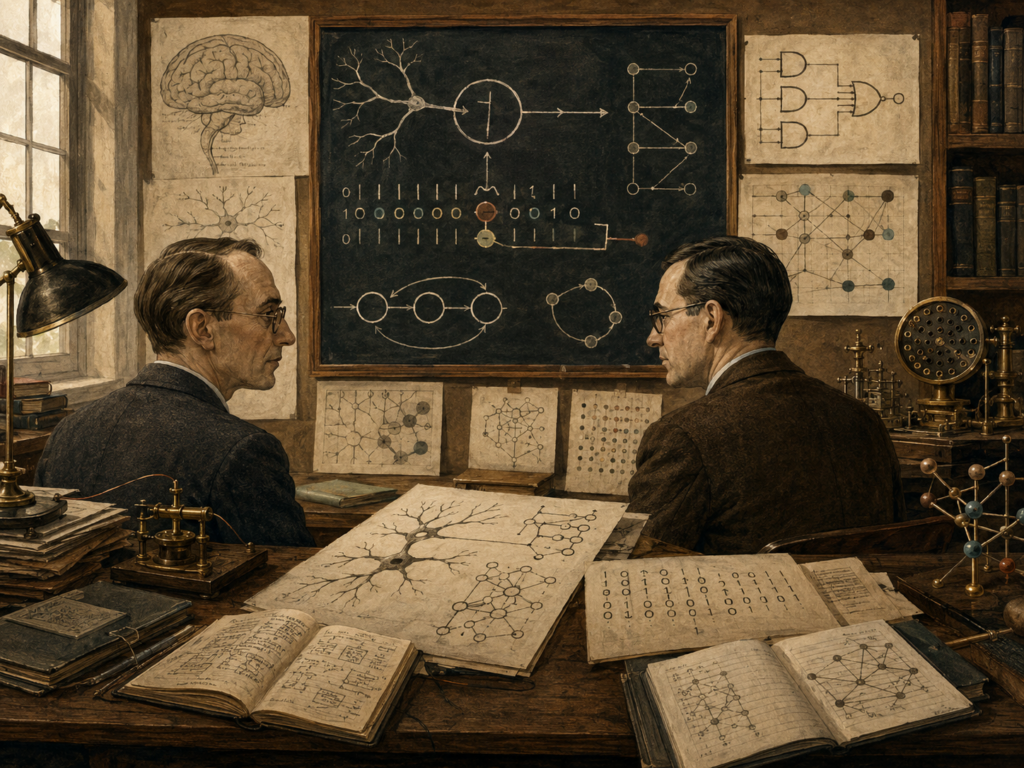
Warren McCulloch, Walter Pitts, and Neural Logic examines how simplified neural models helped connect nervous activity, symbolic logic, cybernetics, automata theory, and artificial intelligence. This article introduces Warren McCulloch, Walter Pitts, neural logic, the McCulloch-Pitts neuron, threshold logic, Boolean networks, mathematical biophysics, nervous activity, propositional calculus, cybernetics, feedback, automata, finite-state machines, connectionism, artificial neural networks, cognitive science, neuroscience, symbolic AI, hybrid AI, representation, abstraction, biological plausibility, model limits, AI history, and responsible computational reasoning. It explains why McCulloch and Pitts should not be treated as direct inventors of modern deep learning, but as foundational figures who made networks of simple threshold units formally thinkable. By connecting logic, neurons, machines, and abstraction, the article frames neural logic as a crucial bridge between early computation, cybernetic systems, neural-network history, and responsible AI interpretation across scientific, institutional, and philosophical accounts of computation.