
Last Updated June 23, 2026
Donald Knuth and the Art of Computer Programming examines the transformation of algorithms into a disciplined literary, mathematical, and computational art. Knuth’s importance is not only that he wrote one of the most influential book projects in computer science. It is that he gave algorithmic thinking a style: careful definitions, rigorous analysis, worked examples, historical scholarship, exercises, precise notation, program fragments, and respect for both mathematical beauty and practical performance.
If Dijkstra made programming a discipline of correctness, Knuth made algorithmic analysis a discipline of exposition. He showed that computer programs and algorithms could be studied with the same seriousness given to mathematics, engineering, typography, music, and literature. The title The Art of Computer Programming was not ornamental. It announced that programming required craft, taste, structure, proof, measurement, notation, and judgment.
Knuth’s legacy spans The Art of Computer Programming, the analysis of algorithms, asymptotic notation, sorting and searching, combinatorial algorithms, random numbers, MIX/MMIX, TeX, METAFONT, digital typography, literate programming, WEB, CWEB, mathematical writing, error correction, and a lifelong commitment to making technical knowledge precise and readable. For computational reasoning, Knuth matters because he treated algorithms as objects that deserve explanation: not black boxes, not code snippets, but carefully analyzed procedures embedded in a culture of clarity.
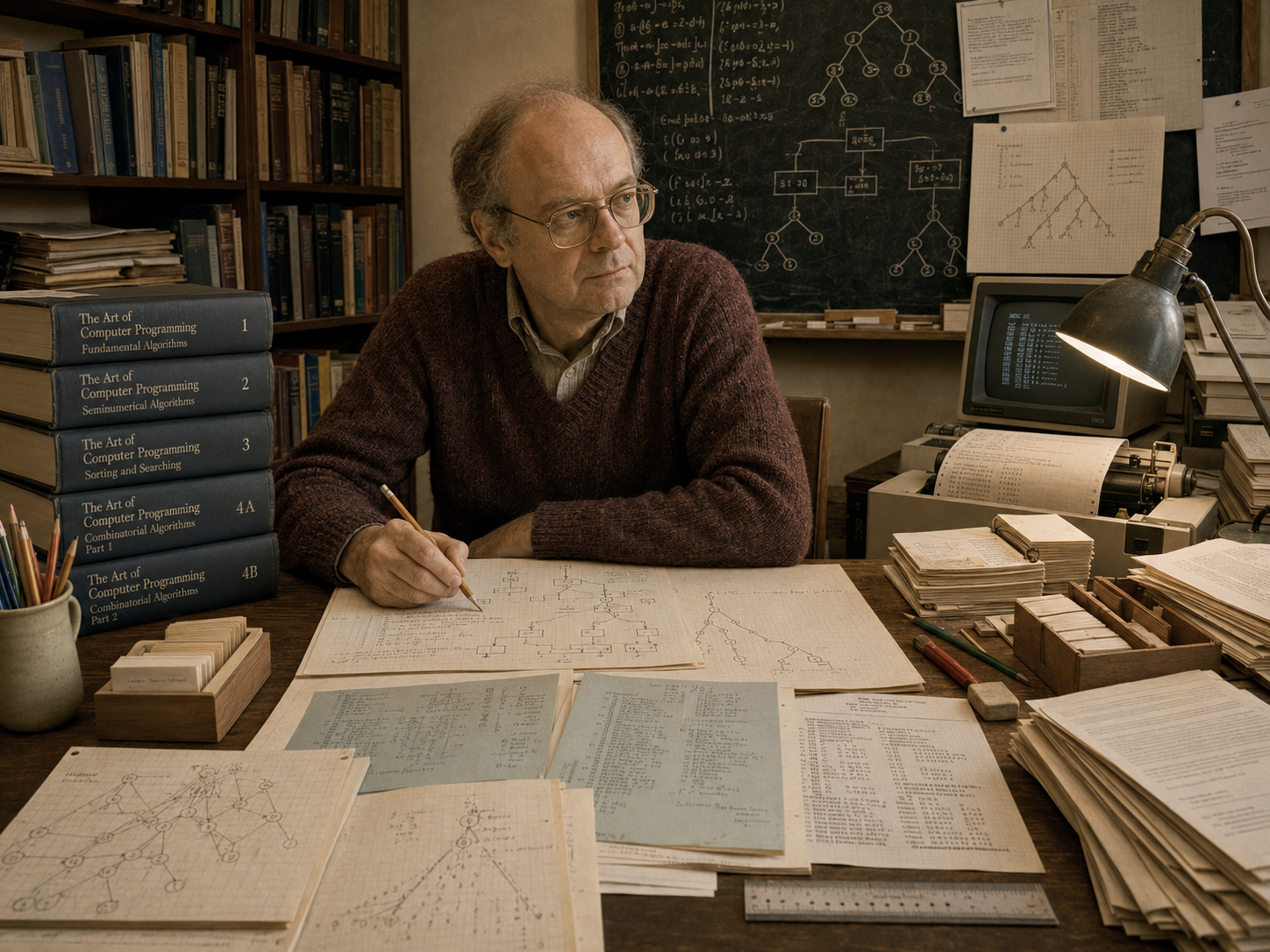
This article introduces Donald Knuth, The Art of Computer Programming, algorithmic analysis, asymptotic notation, sorting, searching, combinatorial algorithms, random numbers, MIX, MMIX, mathematical exposition, exercises, program correctness, empirical analysis, TeX, METAFONT, digital typography, literate programming, WEB, CWEB, documentation, error correction, algorithmic culture, computational craftsmanship, software readability, AI code-generation caution, and responsible computational reasoning. It argues that Knuth matters because he made algorithms into a literature of disciplined procedure: precise enough for machines, rigorous enough for mathematics, and readable enough for humans.
Why Knuth Matters
Knuth matters because he made the analysis of algorithms a central language of computer science. Algorithms had existed long before modern computers, but Knuth helped systematize how they could be described, classified, compared, measured, proved, and taught in a modern computational discipline.
His work insists that algorithms are not merely executable recipes. They are objects of study. A serious account of an algorithm should explain what problem it solves, what assumptions it requires, how it represents data, how it performs, how it fails, how it compares to alternatives, where it came from, and why its structure is elegant or instructive.
| Dimension | Knuth’s relevance | Computational meaning |
|---|---|---|
| Algorithmic analysis | Procedures should be measured and compared. | Complexity and performance reasoning. |
| Exposition | Algorithms should be explained with precision. | Readable technical culture. |
| Historical scholarship | Algorithms have intellectual lineages. | Computational memory. |
| Exercises | Understanding requires active work. | Pedagogical depth. |
| Typography | Technical writing requires visual clarity. | Knowledge presentation. |
| Literate programming | Programs should address human readers. | Executable documentation. |
Knuth matters because he made algorithms both analyzable and readable.
The Art in Computer Programming
The word “art” in Knuth’s work is important. It does not mean that programming is vague, decorative, or purely subjective. It means that programming involves judgment, taste, elegance, craft, and expressive clarity alongside formal rigor.
An algorithm can be correct but clumsy. It can be efficient but unreadable. It can be clever but fragile. It can be beautiful because its structure reveals the problem clearly. Knuth’s art is the union of mathematical discipline and computational craft.
| Artistic dimension | Technical counterpart | Why it matters |
|---|---|---|
| Elegance | Simplicity of structure. | Supports understanding. |
| Craft | Careful implementation. | Prevents hidden defects. |
| Style | Readable notation and exposition. | Supports teaching and maintenance. |
| Judgment | Choice among alternatives. | Context matters. |
| Beauty | Conceptual economy. | Reveals deep structure. |
| Rigor | Proof and analysis. | Disciplines taste. |
For Knuth, computer programming is art because it requires disciplined excellence, not because it escapes formal analysis.
TAOCP as Computational Canon
The Art of Computer Programming became a canon-forming project because it did more than collect algorithms. It established a way of writing about them. Knuth’s volumes mix definitions, mathematical analysis, historical notes, program-like presentations, exercises, answers, and fine-grained distinctions.
A canon is not merely a list of important works. It is a shared reference system. TAOCP helped define what counted as deep knowledge of algorithms: not just use, but analysis; not just code, but explanation; not just implementation, but proof and comparison.
| TAOCP feature | Function | Computational value |
|---|---|---|
| Definitions | Establish precise terms. | Shared language. |
| Algorithms | Present procedures. | Executable reasoning. |
| Analysis | Measure cost and behavior. | Performance understanding. |
| Exercises | Develop skill. | Active mastery. |
| Historical notes | Trace intellectual lineage. | Context and memory. |
| Errata culture | Correct and refine over time. | Durable scholarship. |
TAOCP is not only a set of books. It is a model for how algorithmic knowledge can be curated.
Algorithmic Analysis
Algorithmic analysis asks how a procedure behaves as inputs vary. It studies time, space, comparisons, assignments, memory access, probability, average cases, worst cases, and structural assumptions. Knuth helped make this kind of analysis central to computer science.
This matters because algorithms do not merely work or fail. They scale differently. They have hidden costs. They depend on data distributions. They interact with machine models. They can be excellent in one setting and poor in another. Analysis gives programmers a disciplined way to reason before implementation becomes expensive.
| Analysis dimension | Question | Why it matters |
|---|---|---|
| Time | How many steps are required? | Runtime scalability. |
| Space | How much memory is used? | Resource constraints. |
| Worst case | How bad can performance get? | Reliability under stress. |
| Average case | What happens under typical assumptions? | Expected behavior. |
| Distribution | What inputs are likely? | Model realism. |
| Machine model | What operations are counted? | Meaning of cost. |
Algorithmic analysis disciplines intuition with measurement and proof.
Asymptotic Thinking
Asymptotic thinking studies how algorithmic cost grows as input size increases. It abstracts away constant factors and machine details to compare growth patterns. Knuth did not invent asymptotic notation, but his work helped popularize rigorous forms of algorithm analysis in computer science.
This way of thinking is powerful because small examples can mislead. An algorithm that looks fast on ten items may become impossible on ten million. Another algorithm may have overhead on small inputs but scale better. Asymptotic analysis helps separate temporary convenience from structural growth.
| Growth pattern | Typical notation | Interpretive meaning |
|---|---|---|
| Constant | O(1) | Cost does not grow with input size. |
| Logarithmic | O(log n) | Cost grows slowly. |
| Linear | O(n) | Cost grows proportionally. |
| Linearithmic | O(n log n) | Common in efficient sorting. |
| Quadratic | O(n²) | Pairwise growth can become expensive. |
| Exponential | O(2ⁿ) | Cost can become infeasible rapidly. |
Asymptotic thinking teaches programmers to reason about growth, not merely observed speed.
Sorting, Searching, and Data Structures
Sorting and searching are central in TAOCP because they are fundamental to computation. They reveal how data organization and procedure interact. A search algorithm depends on whether data are sorted, indexed, hashed, linked, arrayed, tree-structured, or distributed. A sorting algorithm depends on comparisons, exchanges, memory layout, stability, and expected input.
Knuth’s treatment of these topics helped define a tradition in which algorithms are not isolated tricks. They are connected to data structures, cost models, proof techniques, and use cases.
| Topic | Core issue | Knuthian question |
|---|---|---|
| Sorting | Put records into order. | How many comparisons and moves? |
| Searching | Find a target item. | What structure makes search efficient? |
| Hashing | Map keys to locations. | How are collisions handled? |
| Trees | Represent hierarchical decisions. | How is balance maintained? |
| Lists | Represent sequential links. | What operations are cheap? |
| Tables | Organize records and access. | What access pattern dominates? |
Knuth’s algorithms are always entangled with representation.
Random Numbers and Seminumerical Algorithms
Knuth’s work on seminumerical algorithms emphasizes that computation often depends on arithmetic, randomness, approximation, and numerical care. Random-number generation is especially important because a sequence can look random while hiding bias, periodicity, or statistical weakness.
This is a broader lesson about computational reasoning. A result is not reliable merely because it is produced by a machine. The procedure, assumptions, representation, and tests matter. Randomness must be analyzed. Arithmetic must be understood. Numerical methods require judgment.
| Seminumerical issue | Question | Computational risk |
|---|---|---|
| Random-number generation | Does the generator behave statistically well? | Hidden pattern. |
| Arithmetic representation | How are numbers stored? | Rounding and overflow. |
| Approximation | How accurate is the result? | Accumulated error. |
| Distribution | What values are produced? | Biased simulation. |
| Period | When does a sequence repeat? | Predictability. |
| Testing | What evidence supports reliability? | False confidence. |
Knuth’s seminumerical work reminds us that computation is exact only when its representations and assumptions justify exactness.
MIX, MMIX, and Machine Models
Knuth used fictional machine models, first MIX and later MMIX, to present algorithms with enough concreteness to discuss implementation while avoiding dependence on one commercial machine. This was a powerful pedagogical choice. A machine model gives algorithms an execution setting, instruction vocabulary, memory structure, and cost context.
A machine model is not the same as a real hardware platform. It is a teaching and analysis device. It lets the reader understand how abstract algorithms meet executable operations.
| Machine-model role | Purpose | Reasoning benefit |
|---|---|---|
| Instruction set | Define operations. | Concrete execution. |
| Registers | Model fast storage. | State tracking. |
| Memory | Represent stored data. | Cost awareness. |
| Program fragments | Show implementation. | Algorithm-to-code bridge. |
| Neutral platform | Avoid vendor dependence. | Pedagogical stability. |
| Cost model | Count operations. | Analysis discipline. |
MIX and MMIX show that algorithms need both abstraction and executable imagination.
Exercises and the Pedagogy of Difficulty
TAOCP’s exercises are famous because they are not decorative. They are part of the argument. They turn reading into active mathematical and computational work. Some exercises reinforce definitions. Others extend results. Some require substantial creativity.
This pedagogy matters because algorithms cannot be mastered passively. Reading an algorithm is not the same as understanding it. Understanding requires tracing, proving, modifying, comparing, implementing, and sometimes struggling.
| Exercise type | Learning function | Computational skill |
|---|---|---|
| Routine calculation | Practice notation. | Fluency. |
| Proof exercise | Justify a claim. | Correctness reasoning. |
| Implementation task | Translate idea into code. | Programming discipline. |
| Counterexample | Test assumptions. | Boundary awareness. |
| Optimization challenge | Improve procedure. | Algorithmic creativity. |
| Historical note | Connect ideas across time. | Intellectual context. |
Knuth’s exercises teach that algorithmic understanding is earned through work.
Precision, History, and Style
Knuth’s writing is distinctive because it combines precision with historical depth and stylistic care. He often traces ideas backward, gives credit across generations, and attends to notation and presentation. This makes his work unusually durable.
The lesson is not only scholarly courtesy. Historical memory improves technical reasoning. It shows why an idea appeared, what problem it addressed, what alternatives existed, and what assumptions shaped it. Style matters because difficult ideas need forms that can carry them.
| Expository value | Technical role | Why it matters |
|---|---|---|
| Precision | Reduce ambiguity. | Supports proof. |
| Notation | Compress structure. | Supports analysis. |
| History | Trace development. | Supports context. |
| Examples | Make abstraction concrete. | Supports learning. |
| Style | Shape reader attention. | Supports comprehension. |
| Errata | Correct over time. | Supports trust. |
Knuth’s style shows that technical exposition is part of technical work.
TeX, METAFONT, and Digital Typography
Knuth created TeX after dissatisfaction with the typesetting of his books. This episode is not a side story. It reveals his standards: the presentation of mathematics and algorithms matters. If notation is poorly set, understanding suffers. If technical documents are visually unstable, knowledge becomes harder to preserve.
TeX and METAFONT show how deeply Knuth connected computation, typography, precision, and craft. The tools were not merely utilities. They were computational systems for making formal knowledge visually reliable.
| Typography problem | Computational response | Knowledge value |
|---|---|---|
| Mathematical notation | TeX typesetting. | Readable formulas. |
| Font design | METAFONT. | Programmable letterforms. |
| Document stability | Precise layout rules. | Durable scholarship. |
| Technical publishing | Automated composition. | Scalable clarity. |
| Reproducibility | Source-based documents. | Repeatable output. |
| Aesthetic quality | Algorithmic typography. | Readable beauty. |
TeX and METAFONT show that the art of computer programming includes the art of presenting computation clearly.
Literate Programming
Knuth’s literate programming argues that programs should be written for human understanding as well as machine execution. Instead of ordering code primarily according to compiler convenience, the programmer organizes explanation according to the logic of human comprehension.
This is one of Knuth’s most important contributions to responsible computational culture. Code is not only executed. It is read, maintained, audited, taught, inherited, and trusted. Literate programming treats source code as a communicative artifact.
| Literate-programming feature | Purpose | Human value |
|---|---|---|
| Exposition | Explain program logic. | Comprehension. |
| Code fragments | Provide executable detail. | Precision. |
| Human order | Organize by explanation. | Readable development. |
| Tangling | Generate compilable code. | Machine execution. |
| Weaving | Generate readable document. | Technical literature. |
| Indexes | Trace identifiers and structure. | Maintainability. |
Literate programming makes code a document of reasoning, not only a sequence of instructions.
WEB, CWEB, and Readable Programs
WEB and CWEB embodied Knuth’s literate-programming philosophy. They connect documentation and source code so that a program can be processed into both an executable form and a readable document. This dual output captures a deep idea: software should serve both machines and readers.
WEB and CWEB also show that readability is not an afterthought. It can be designed into the programming environment. The system itself can encourage programmers to explain their reasoning.
| WEB/CWEB concept | Function | Computational significance |
|---|---|---|
| Module | Named section of explanation and code. | Readable decomposition. |
| Weave | Produce typeset documentation. | Human-facing program. |
| Tangle | Produce compilable source. | Machine-facing program. |
| Index | Track identifiers. | Maintenance support. |
| Cross-reference | Connect definitions and uses. | Navigation. |
| Expository order | Organize by understanding. | Pedagogical structure. |
WEB and CWEB make Knuth’s principle concrete: programs should be written for humans and machines together.
Analysis Plus Craft
Knuth’s work resists a false separation between theory and practice. He cared about formal analysis, but also about implementation details. He cared about mathematical proof, but also about typography. He cared about abstract algorithms, but also about machine models and empirical behavior.
This combination is especially important today. Computational systems fail when theory and practice are separated too sharply. A theoretically elegant method can fail in implementation. A practical hack can fail under scale. A model can score well while being unreadable, unmaintainable, or poorly governed.
| Dimension | Theory alone risks | Practice alone risks |
|---|---|---|
| Algorithm design | Ignoring implementation cost. | Ignoring proof and scaling. |
| Performance | Abstracting away too much. | Overfitting to one machine. |
| Documentation | Formalism without guidance. | Notes without precision. |
| Software | Correct idea poorly expressed. | Working code poorly understood. |
| Teaching | Proof without examples. | Examples without generality. |
| Governance | Principles without systems. | Deployment without justification. |
Knuth’s standard is theory and practice disciplined by exposition.
Knuth and Software Engineering
Knuth’s relationship to software engineering is distinctive. He did not reduce programming to process management. He emphasized deep understanding, careful design, literate explanation, and algorithmic mastery. Yet many of his values are central to good software engineering: correctness, maintainability, documentation, testing, performance analysis, readability, and respect for users.
His work challenges software culture to treat code as durable technical literature. If a program will be read, maintained, ported, audited, or taught, then its explanation matters. Software engineering without explanation becomes operational opacity.
| Software engineering concern | Knuthian response | Practice implication |
|---|---|---|
| Maintainability | Write for human readers. | Literate documentation. |
| Performance | Analyze algorithms carefully. | Complexity plus measurement. |
| Correctness | Use proof and tests. | Reasoned implementation. |
| Knowledge transfer | Teach through exposition. | Examples and exercises. |
| Durability | Preserve source and explanation. | Long-term code culture. |
| Quality | Care about details. | Craft standards. |
Knuth’s software engineering lesson is that code should be worthy of careful reading.
AI Code Generation and Knuth’s Standard
AI code generation makes Knuth’s standard more important, not less. A model can produce plausible code quickly, but plausible code is not the same as analyzed, explained, tested, and maintainable code. Knuth’s work asks a higher question: can the algorithm be understood well enough to trust?
Generated code should be reviewed through a Knuthian lens. What algorithm is being used? What data structures are assumed? What is the running time? What are the edge cases? What is the explanation? What tests support it? What documentation would help a future reader maintain it?
| AI coding issue | Knuthian review question | Responsible practice |
|---|---|---|
| Plausible algorithm | What procedure is actually implemented? | Trace and explain. |
| Hidden complexity | How does it scale? | Analyze cost. |
| Unclear data structure | What representation is assumed? | Document invariants. |
| Weak tests | What cases are missing? | Add systematic tests. |
| Poor documentation | Can future humans understand it? | Write explanation. |
| Automation overconfidence | Who remains responsible? | Human review. |
Knuth’s legacy warns that faster code production is not the same as better computational reasoning.
Examples of Knuth’s Algorithmic Legacy
The examples below show how Knuth reshaped computational reasoning.
Algorithmic analysis
Algorithms are compared through rigorous study of cost, assumptions, and growth.
Asymptotic reasoning
Growth rates help distinguish temporary speed from structural scalability.
Sorting and searching
Basic operations become deep studies in data representation and efficiency.
MIX and MMIX
Machine models bridge abstract algorithms and executable procedure.
Exercises
Algorithmic mastery requires active proof, calculation, implementation, and comparison.
TeX and METAFONT
Typography becomes a computational craft for preserving technical clarity.
Literate programming
Programs become documents for human understanding as well as machine execution.
AI code review
Generated code should be analyzed, documented, tested, and explained before trust.
These examples show why Knuth belongs at the center of computational reasoning: he made algorithms part of a culture of proof, style, history, and human-readable explanation.
Mathematics, Computation, and Modeling
A simple algorithm-analysis statement can be modeled as:
T(n) = O(f(n))
\]
Interpretation: The running time grows no faster than a constant multiple of f(n) after some input size.
A sorting lower-bound intuition can be modeled as:
\log_2(n!) = \Omega(n \log n)
\]
Interpretation: Comparison sorting requires enough decisions to distinguish among n! possible orderings.
A literate-programming transformation can be modeled as:
LiterateSource \rightarrow \{ReadableDocument,\ ExecutableSource\}
\]
Interpretation: A literate program is processed into both human-readable explanation and machine-readable code.
A Knuthian trust model can be written as:
Trust = Explanation + Analysis + Tests + History + Correction
\]
Interpretation: Durable computational knowledge depends on readable explanation, rigorous analysis, empirical checks, historical context, and ongoing correction.
A review model for generated code can be written as:
GeneratedCode \not\Rightarrow UnderstoodCode
\]
Interpretation: Code production alone does not establish algorithmic understanding, correctness, maintainability, or trust.
These formulas are simplified teaching models. They clarify Knuth’s contribution without replacing algorithm analysis, combinatorics, programming-language theory, literate-programming practice, or software verification.
Python Workflow: Algorithmic Art and Analysis Map
The Python workflow below creates a dependency-light interpretive map of Knuth’s algorithmic legacy. It scores themes by algorithm-analysis centrality, exposition quality, mathematical rigor, historical depth, implementation relevance, typography relevance, literate-programming relevance, pedagogy, maintainability, and governance caution, then writes reproducible CSV and JSON outputs.
# donald_knuth_art_of_computer_programming_map.py
# Dependency-light workflow for mapping Knuth's algorithmic art and analysis.

from __future__ import annotations

from dataclasses import asdict, dataclass
from pathlib import Path
from statistics import mean
import csv
import json
from datetime import datetime, timezone

ARTICLE_ROOT = Path(__file__).resolve().parents[1]
TABLES = ARTICLE_ROOT / "outputs" / "tables"
JSON_DIR = ARTICLE_ROOT / "outputs" / "json"


@dataclass(frozen=True)
class KnuthConfig:
    article: str = "donald_knuth_and_the_art_of_computer_programming"
    core_threshold: float = 0.80
    high_analysis_threshold: float = 0.86


def timestamp_utc() -> str:
    return datetime.now(timezone.utc).isoformat()


def write_csv(path: Path, rows: list[dict[str, object]]) -> None:
    path.parent.mkdir(parents=True, exist_ok=True)
    if not rows:
        path.write_text("", encoding="utf-8")
        return
    fieldnames = sorted({key for row in rows for key in row.keys()})
    with path.open("w", newline="", encoding="utf-8") as handle:
        writer = csv.DictWriter(handle, fieldnames=fieldnames, extrasaction="ignore")
        writer.writeheader()
        writer.writerows(rows)


def write_json(path: Path, payload: object) -> None:
    path.parent.mkdir(parents=True, exist_ok=True)
    path.write_text(json.dumps(payload, indent=2, sort_keys=True), encoding="utf-8")


def knuth_themes() -> list[dict[str, object]]:
    return [
        {"theme_id": "art_of_computer_programming", "algorithm_analysis": 0.98, "exposition": 0.98, "mathematical_rigor": 0.98, "historical_depth": 0.94, "implementation_relevance": 0.94, "typography_relevance": 0.88, "literate_programming": 0.90, "pedagogy": 0.98, "maintainability": 0.92, "governance_caution": 0.90},
        {"theme_id": "analysis_of_algorithms", "algorithm_analysis": 0.98, "exposition": 0.92, "mathematical_rigor": 0.98, "historical_depth": 0.88, "implementation_relevance": 0.94, "typography_relevance": 0.78, "literate_programming": 0.82, "pedagogy": 0.94, "maintainability": 0.88, "governance_caution": 0.90},
        {"theme_id": "asymptotic_thinking", "algorithm_analysis": 0.96, "exposition": 0.90, "mathematical_rigor": 0.96, "historical_depth": 0.84, "implementation_relevance": 0.92, "typography_relevance": 0.76, "literate_programming": 0.80, "pedagogy": 0.92, "maintainability": 0.86, "governance_caution": 0.88},
        {"theme_id": "sorting_searching_data_structures", "algorithm_analysis": 0.96, "exposition": 0.94, "mathematical_rigor": 0.94, "historical_depth": 0.92, "implementation_relevance": 0.98, "typography_relevance": 0.80, "literate_programming": 0.82, "pedagogy": 0.96, "maintainability": 0.90, "governance_caution": 0.88},
        {"theme_id": "mix_mmix_machine_models", "algorithm_analysis": 0.92, "exposition": 0.90, "mathematical_rigor": 0.90, "historical_depth": 0.90, "implementation_relevance": 0.98, "typography_relevance": 0.82, "literate_programming": 0.84, "pedagogy": 0.94, "maintainability": 0.88, "governance_caution": 0.86},
        {"theme_id": "tex_metafont_typography", "algorithm_analysis": 0.82, "exposition": 0.98, "mathematical_rigor": 0.92, "historical_depth": 0.92, "implementation_relevance": 0.92, "typography_relevance": 0.98, "literate_programming": 0.90, "pedagogy": 0.92, "maintainability": 0.94, "governance_caution": 0.88},
        {"theme_id": "literate_programming_web_cweb", "algorithm_analysis": 0.88, "exposition": 0.98, "mathematical_rigor": 0.90, "historical_depth": 0.90, "implementation_relevance": 0.96, "typography_relevance": 0.94, "literate_programming": 0.98, "pedagogy": 0.96, "maintainability": 0.98, "governance_caution": 0.94},
        {"theme_id": "ai_code_generation_review", "algorithm_analysis": 0.90, "exposition": 0.96, "mathematical_rigor": 0.94, "historical_depth": 0.84, "implementation_relevance": 0.96, "typography_relevance": 0.82, "literate_programming": 0.94, "pedagogy": 0.92, "maintainability": 0.98, "governance_caution": 0.98},
    ]


def score_theme(row: dict[str, object], config: KnuthConfig) -> dict[str, object]:
    art_score = mean([
        float(row["algorithm_analysis"]),
        float(row["exposition"]),
        float(row["mathematical_rigor"]),
        float(row["historical_depth"]),
        float(row["implementation_relevance"]),
        float(row["typography_relevance"]),
        float(row["literate_programming"]),
        float(row["pedagogy"]),
        float(row["maintainability"]),
        float(row["governance_caution"]),
    ])

    if art_score >= config.core_threshold and float(row["algorithm_analysis"]) >= config.high_analysis_threshold:
        interpretive_status = "core_knuth_algorithmic_art_thread"
    elif art_score >= config.core_threshold:
        interpretive_status = "major_knuth_algorithmic_art_thread"
    else:
        interpretive_status = "supporting_knuth_algorithmic_art_thread"

    return {
        "theme_id": row["theme_id"],
        "algorithm_analysis": round(float(row["algorithm_analysis"]), 6),
        "exposition": round(float(row["exposition"]), 6),
        "mathematical_rigor": round(float(row["mathematical_rigor"]), 6),
        "historical_depth": round(float(row["historical_depth"]), 6),
        "implementation_relevance": round(float(row["implementation_relevance"]), 6),
        "typography_relevance": round(float(row["typography_relevance"]), 6),
        "literate_programming": round(float(row["literate_programming"]), 6),
        "pedagogy": round(float(row["pedagogy"]), 6),
        "maintainability": round(float(row["maintainability"]), 6),
        "governance_caution": round(float(row["governance_caution"]), 6),
        "art_score": round(art_score, 6),
        "interpretive_status": interpretive_status,
    }


def interpretation_cautions() -> list[dict[str, str]]:
    return [
        {"caution": "do_not_treat_art_as_anti_rigor", "meaning": "Knuth's art combines beauty, style, mathematical proof, implementation detail, and analysis."},
        {"caution": "do_not_reduce_knuth_to_taocp_only", "meaning": "TAOCP is central, but TeX, METAFONT, literate programming, and digital typography are also part of the legacy."},
        {"caution": "do_not_confuse_code_generation_with_understanding", "meaning": "Generated code still needs explanation, analysis, tests, and review."},
        {"caution": "do_not_ignore_machine_models", "meaning": "Algorithm analysis depends on assumptions about operations and representation."},
        {"caution": "do_not_skip_exposition", "meaning": "Readable explanation is part of computational responsibility."},
    ]


def main() -> None:
    config = KnuthConfig()
    themes = knuth_themes()
    scored = [score_theme(row, config) for row in themes]
    cautions = interpretation_cautions()

    summary = {
        "article": config.article,
        "timestamp_utc": timestamp_utc(),
        "themes_reviewed": len(scored),
        "core_threads": sum(1 for row in scored if row["interpretive_status"] == "core_knuth_algorithmic_art_thread"),
        "major_threads": sum(1 for row in scored if row["interpretive_status"] == "major_knuth_algorithmic_art_thread"),
        "supporting_threads": sum(1 for row in scored if row["interpretive_status"] == "supporting_knuth_algorithmic_art_thread"),
        "mean_art_score": round(mean(float(row["art_score"]) for row in scored), 6),
        "cautions": len(cautions),
        "interpretation": "Knuth should be studied as a theorist of algorithmic analysis, rigorous exposition, literate programming, typography, and computational craft.",
    }

    write_csv(TABLES / "knuth_themes.csv", themes)
    write_csv(TABLES / "knuth_algorithmic_art_map.csv", scored)
    write_csv(TABLES / "interpretation_cautions.csv", cautions)
    write_csv(TABLES / "knuth_algorithmic_art_summary.csv", [summary])

    write_json(JSON_DIR / "knuth_config.json", asdict(config))
    write_json(JSON_DIR / "knuth_algorithmic_art_map.json", scored)
    write_json(JSON_DIR / "interpretation_cautions.json", cautions)
    write_json(JSON_DIR / "knuth_algorithmic_art_summary.json", summary)

    print("Knuth algorithmic art map complete.")
    print(TABLES / "knuth_algorithmic_art_summary.csv")


if __name__ == "__main__":
    main()
This workflow turns Knuth’s algorithmic legacy into a reproducible interpretive artifact: algorithm analysis, exposition, mathematical rigor, historical depth, implementation relevance, typography, literate programming, pedagogy, maintainability, and governance caution are documented together.
R Workflow: Knuthian Analysis Diagnostics
The R workflow reads the generated CSV outputs, summarizes Knuth themes, visualizes dimensions, and writes an additional diagnostic table.
# donald_knuth_art_of_computer_programming_summary.R
args <- commandArgs(trailingOnly = FALSE)
file_arg <- grep("^--file=", args, value = TRUE)

if (length(file_arg) > 0) {
  script_path <- normalizePath(sub("^--file=", "", file_arg[1]), mustWork = TRUE)
  article_root <- normalizePath(file.path(dirname(script_path), ".."), mustWork = TRUE)
} else {
  article_root <- getwd()
}

setwd(article_root)

tables_dir <- file.path(article_root, "outputs", "tables")
figures_dir <- file.path(article_root, "outputs", "figures")
dir.create(tables_dir, recursive = TRUE, showWarnings = FALSE)
dir.create(figures_dir, recursive = TRUE, showWarnings = FALSE)

map_path <- file.path(tables_dir, "knuth_algorithmic_art_map.csv")
summary_path <- file.path(tables_dir, "knuth_algorithmic_art_summary.csv")

if (!file.exists(map_path)) {
  stop(paste("Missing", map_path, "Run the Python workflow first."))
}

knuth_map <- read.csv(map_path, stringsAsFactors = FALSE)
summary <- read.csv(summary_path, stringsAsFactors = FALSE)

png(file.path(figures_dir, "knuth_algorithmic_art_dimensions.png"), width = 1200, height = 850)
score_matrix <- t(as.matrix(knuth_map[, c("algorithm_analysis", "exposition", "mathematical_rigor", "historical_depth", "implementation_relevance", "typography_relevance", "literate_programming", "pedagogy", "maintainability", "governance_caution")]))
barplot(score_matrix,
        beside = TRUE,
        names.arg = knuth_map$theme_id,
        las = 2,
        ylim = c(0, 1),
        ylab = "Interpretive Score",
        main = "Donald Knuth and the Art of Computer Programming")
legend("bottomright",
       legend = rownames(score_matrix),
       cex = 0.68,
       bty = "n")
grid()
dev.off()

png(file.path(figures_dir, "knuth_art_score_by_theme.png"), width = 1000, height = 750)
barplot(knuth_map$art_score,
        names.arg = knuth_map$theme_id,
        las = 2,
        ylab = "Algorithmic Art Score",
        main = "Knuth Algorithmic Art Score by Theme")
grid()
dev.off()

r_summary <- data.frame(
  themes_reviewed = summary$themes_reviewed[1],
  core_threads = summary$core_threads[1],
  major_threads = summary$major_threads[1],
  supporting_threads = summary$supporting_threads[1],
  mean_art_score = summary$mean_art_score[1],
  cautions = summary$cautions[1],
  diagnostic_note = "Knuth should be studied as a theorist of algorithmic analysis, rigorous exposition, literate programming, typography, and computational craft."
)

write.csv(r_summary, file.path(tables_dir, "r_knuth_algorithmic_art_diagnostic_summary.csv"), row.names = FALSE)
print(r_summary)
The R layer makes the interpretive structure visible: algorithm analysis, exposition, mathematical rigor, historical depth, implementation relevance, typography, literate programming, pedagogy, maintainability, and governance caution can be compared across themes.
GitHub Repository
The companion repository contains reproducible workflows, synthetic interpretive data, outputs, calculators, documentation, and multilingual examples for this article.
Complete Code Repository
Companion article folder with Python, R, Julia, SQL, Haskell, C, C++, Fortran, Rust, Go, Java, TypeScript, Prolog, Racket, notebooks, documentation, synthetic teaching data, generated outputs, schemas, calculators, and Canvas-ready workflow artifacts for Donald Knuth, The Art of Computer Programming, algorithmic analysis, asymptotic notation, sorting, searching, random numbers, MIX, MMIX, TeX, METAFONT, literate programming, WEB, CWEB, mathematical exposition, exercises, error correction, software readability, AI code-generation review, and responsible algorithmic explanation.
A Practical Method for Studying Knuth
A careful study of Knuth asks how algorithms are explained, analyzed, implemented, taught, and preserved.
| Step | Historical action | Output |
|---|---|---|
| 1 | Begin with TAOCP as a model of algorithmic exposition. | Expository frame. |
| 2 | Identify the problem, procedure, data representation, and assumptions. | Algorithm profile. |
| 3 | Analyze time, space, average case, worst case, and growth. | Cost model. |
| 4 | Study sorting, searching, random numbers, and data structures as foundational cases. | Algorithmic repertoire. |
| 5 | Use MIX/MMIX to understand machine-model assumptions. | Execution model. |
| 6 | Study TeX and METAFONT as computational typography. | Technical-presentation map. |
| 7 | Study literate programming as executable explanation. | Human-readable software model. |
| 8 | Apply Knuthian review to AI-generated code. | Responsible explanation checklist. |
This method keeps Knuth’s legacy focused on algorithms as artifacts of analysis, style, proof, and explanation.
Common Pitfalls
The first pitfall is treating “art” as anti-rigor. The second is reducing Knuth to TAOCP alone. The third is confusing code generation with understanding. The fourth is ignoring machine models. The fifth is skipping exposition.
| Pitfall | Why it matters | Better practice |
|---|---|---|
| Art means taste only. | Misses Knuth’s mathematical rigor. | Connect style to proof and analysis. |
| TAOCP as book trivia. | Misses its method of explanation. | Study definitions, exercises, notes, and analysis. |
| Efficiency only. | Ignores clarity and maintainability. | Analyze and explain. |
| Machine model ignored. | Cost claims become vague. | State operations and assumptions. |
| Literate programming as comments. | Misses its structural method. | Organize code by human reasoning. |
| AI-generated code trusted immediately. | Generated code may be unclear or wrong. | Review algorithms, tests, explanation, and scaling. |
Knuth is most useful when algorithms are treated as literature, mathematics, and executable procedure together.
Why Knuth Still Matters
Donald Knuth still matters because algorithmic culture needs standards of explanation. Modern computing produces enormous amounts of code, models, pipelines, metrics, simulations, dashboards, and generated artifacts. But production is not understanding. Knuth’s work reminds us that procedures deserve analysis, notation, history, examples, exercises, proof, implementation detail, and beautiful presentation.
His legacy is also a warning against shallow automation. A system that writes code quickly is not necessarily doing the art of computer programming. The art requires knowing what the code means, how it behaves, why it works, how it scales, where it came from, and how future readers can maintain it.
For computational reasoning, Knuth adds a distinctive standard. Church gives functions. Turing gives machines. Von Neumann gives architecture. Shannon gives information. Wiener gives feedback. Hopper gives programming language as human mediation. Dijkstra gives disciplined proof-oriented programming. Knuth gives the art of algorithmic exposition and analysis. AI belongs in the toolkit, not in control.
Related Articles
- Edsger Dijkstra and the Discipline of Structured Programming
- John Backus, FORTRAN, and the Rise of High-Level Scientific Programming
- Algorithmic Analysis and Computational Complexity
- Sorting, Searching, and Indexing Algorithms
- From Pseudocode to Programs
Further Reading
- Knuth, D.E. (1968–) The Art of Computer Programming. Reading, MA: Addison-Wesley.
- ACM (n.d.) ‘Donald E. Knuth: A.M. Turing Award Laureate’.
- Stanford University (n.d.) ‘Donald Knuth’.
- Stanford University (n.d.) ‘Don Knuth’s Home Page’.
- Knuth, D.E. (1984) ‘Literate Programming’.
- Knuth, D.E. (1992) Literate Programming. Stanford: CSLI Publications.
- Knuth, D.E. and Levy, S. (n.d.) ‘CWEB’.
- Knuth, D.E. (1974) ‘Computer Programming as an Art’. Communications of the ACM, 17(12), pp. 667–673.
References
- ACM (n.d.) ‘Donald E. Knuth: A.M. Turing Award Laureate’. Available at: https://amturing.acm.org/award_winners/knuth_1013846.cfm.
- Knuth, D.E. (1968–) The Art of Computer Programming. Reading, MA: Addison-Wesley. Available at: https://www-cs-faculty.stanford.edu/~knuth/taocp.html.
- Knuth, D.E. (1974) ‘Computer Programming as an Art’. Communications of the ACM, 17(12), pp. 667–673. Available at: https://dl.acm.org/doi/pdf/10.1145/361604.361612.
- Knuth, D.E. (1984) ‘Literate Programming’. Available at: https://www-cs-faculty.stanford.edu/~knuth/lp.html.
- Knuth, D.E. (1992) Literate Programming. Stanford: CSLI Publications. Available at: https://web.stanford.edu/group/cslipublications/cslipublications/site/0937073806.shtml.
- Knuth, D.E. and Levy, S. (n.d.) ‘CWEB’. Available at: https://www-cs-faculty.stanford.edu/~knuth/cweb.html.
- Stanford University (n.d.) ‘Donald Knuth’. Available at: https://profiles.stanford.edu/donald-knuth.
- Stanford University (n.d.) ‘Don Knuth’s Home Page’. Available at: https://www-cs-faculty.stanford.edu/~knuth/.